Mathematics 9709/11 — May/June 2024
Cambridge AS Level · Pure Mathematics 1 · worked solutions for every part, with the mark scheme
Topics Coordinate Geometry · Quadratics · Functions · Series · Differentiation · Trigonometry · +2 more
Approach
Factor out the leading coefficient , then complete the square for the quadratic part in .
Working
Factor out :
Complete the square for :
Therefore
So and .
Answer
with and .
3(y - 2)^2 - 27 (a = -2, b = -27)
Walkthrough
We need to rewrite in the form . First factor out the from all terms so that the quadratic inside the bracket has leading coefficient : . Then complete the square on : this is . Substituting back gives . Therefore and .
Key Takeaways
Completing the square expresses a quadratic in the form . When the coefficient of is not , factor it out first, complete the square inside the bracket, and then multiply the constant term by the factored coefficient.
Common Mistakes
- Forgetting to multiply the constant term by when completing the square.
- Sign error: , not .
- Writing instead of because the requested form is .
Things to Be Careful About
Always verify your answer by expanding to confirm it equals . Note that can be negative even though the form uses .
Approach
Use the completed-square form from part a with , set the expression equal to zero, solve for , then take square roots and discard any non-real solution.
Working
From part a, with :
Set the expression equal to :
Taking square roots:
So
Since for real , the equation has no real solution. Therefore
Answer
x = ±√5
Walkthrough
We use the result of part a, replacing by . This gives . Setting this equal to gives . Taking square roots gives , so or . Since cannot be negative for real , we discard . Hence , so .
Key Takeaways
- A quartic that is quadratic in can be solved using the completed-square form.
- When a squared variable equals a negative number, there are no real solutions.
- Always take both positive and negative square roots when solving .
Common Mistakes
- Forgetting to take the negative root, giving only .
- Including from ; the mark scheme says to ignore , , and .
- Using a calculator without showing any working, which scores no marks.
- Not using the completed-square form from part a, although factorising is also an accepted method.
Things to Be Careful About
- When , there is no real , so the answer is only .
- The answer must be exact, so write , not a decimal approximation.
- Ensure both positive and negative square roots are included.
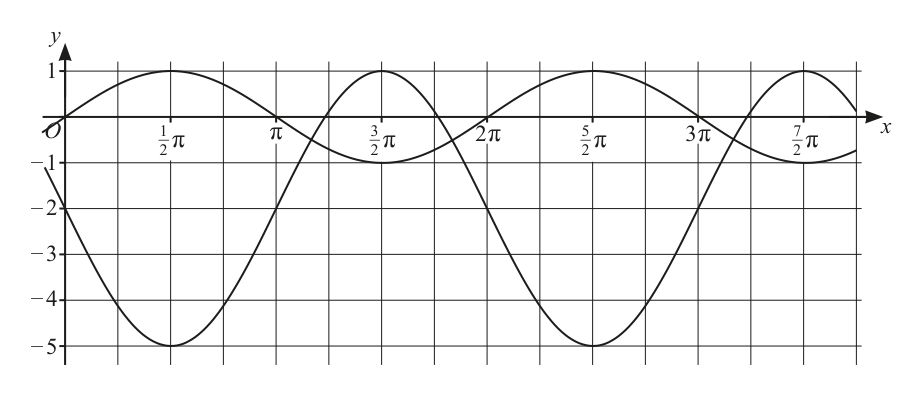
The diagram shows two curves. One curve has equation and the other curve has equation .
In order to transform the curve to the curve , the curve is first reflected in the -axis.
Describe fully a sequence of two further transformations which are required.
Approach
Read the amplitude and midline of from the graph. After the given reflection , determine a stretch and a translation that produce the correct range and position for .
Working
From the graph, has:
- Maximum value: at
- Minimum value: at
- Midline:
- Amplitude:
Starting from , after reflection in the -axis:
This has range .
Method 1: Stretch by factor 3 in the -direction:
Range becomes . Then translate by :
Range becomes , which matches . ✓
Method 2: Translate by :
Range becomes . Then stretch by factor 3 in the -direction:
Range becomes , which matches . ✓
Answer
Stretch by factor 3 in the -direction and translate by (in either order).
Stretch by factor 3 in the y-direction and translate by (0, -2)
Walkthrough
The graph shows (amplitude 1, range ) and (amplitude 3, range ). We are told the first transformation is a reflection in the -axis, giving .
Step 1: Read features of . The maximum of is and the minimum is . The midline (average of max and min) is . The amplitude is half the total height: .
Step 2: Determine the stretch. After reflection, has amplitude 1. Since has amplitude 3, we need a stretch by factor 3 in the -direction, giving with range .
Step 3: Determine the translation. The range of is , but has range . The midline of is , while the midline of is . So we translate down by 2 units: .
Alternative order: We could translate first by to get , then stretch by 3 in the -direction to get .
Key Takeaways
- The amplitude of a transformed sine curve is the vertical stretch factor.
- The midline of the curve gives the vertical translation after accounting for the stretch.
- A stretch in the -direction followed by a translation is not the same as a translation followed by a stretch; the translation amount depends on the order.
- When a translation is applied before a stretch, the translation vector must be scaled by the stretch factor in the final expression.
Common Mistakes
- Forgetting that the translation vector must be adjusted if the stretch is applied after it (the mark scheme accepts either order, but the translation amounts differ: after stretch, or before stretch).
- Describing only one transformation when two are required.
- Stating "shift down by 2" without specifying it as a translation vector or being precise about the direction.
- Confusing the amplitude of with the translation amount.
Things to Be Careful About
- The question says the curve is first reflected in the -axis, so you must start from , not .
- The order of stretch and translation matters: if you stretch first then translate, the translation is ; if you translate first then stretch, the translation is .
- Both sequences are acceptable, but you must describe two further transformations (the reflection is already given).
- Be precise with terminology: use "stretch" with a scale factor and direction, or "translation" with a vector.
Approach
Apply the three transformations in sequence to to obtain .
Working
Transformation 1: Reflect in the -axis:
Transformation 2: Stretch by factor 3 in the -direction:
Transformation 3: Translate by (subtract 2 from ):
Therefore:
Answer
f(x) = -3 sin x - 2
Walkthrough
We build by applying the transformations in order to the original curve .
Step 1: Reflection in the -axis. This negates the -values: becomes .
Step 2: Stretch by factor 3 in the -direction. Multiply all -values by 3: becomes .
Step 3: Translation by . This shifts the curve down by 2 units, which means subtracting 2 from the expression: becomes .
The final expression is .
Key Takeaways
- Each transformation can be written as an algebraic operation on the function expression.
- Reflection in the -axis: negate the function.
- Stretch by factor in the -direction: multiply the function by .
- Translation by : add to the function (so means subtract 2).
- Applying transformations in order and tracking the effect on the expression gives the final function directly.
Common Mistakes
- Forgetting the reflection and writing instead of .
- Applying the stretch to the constant term: writing instead of . The stretch only multiplies the function values, not the translation.
- Adding extra terms not present in the transformation sequence.
Things to Be Careful About
- The mark scheme awards no marks if extra terms are seen in the expression.
- The order of transformations matters for the expression: reflection first, then stretch, then translation gives . If you use the alternative order (translate then stretch), you must use the adjusted translation to get the same result.
- Ensure the final expression matches the graph: at , ✓; at , ✓.
The coefficient of in the expansion of is 160.
Approach
Use the binomial theorem to write the general term of , extract the term containing , set its coefficient equal to 160, and solve for .
Working
The general term of is:
For the term, set :
The coefficient of is . Given that this equals 160:
Therefore:
Answer
a = 2/3
Walkthrough
The binomial theorem states that . To find the coefficient of , we need the term where . This gives . Since the problem states this coefficient is 160, we set up the equation . Dividing both sides by 540 gives . Taking the cube root of both sides gives .
Key Takeaways
The key skill here is extracting a specific term from a binomial expansion. The general term allows us to find any term by choosing the appropriate value of . The coefficient includes the binomial coefficient, the power of the constant term (3), and the power of .
Common Mistakes
- Forgetting to include the factor — the coefficient is not just .
- Making arithmetic errors when simplifying .
- Forgetting to take the cube root when solving for .
Things to Be Careful About
- The coefficient of is the full product , not just the part involving .
- When solving , remember that could theoretically be negative, but since is positive, must be positive (the real cube root). Here is positive, so .
Approach
When expanding , the coefficient receives contributions from the term of multiplied by the constant 1, and from the term of multiplied by . Find the coefficient using , then combine the two contributions.
Working
First, find the coefficient of in . Using the general term with :
With :
Now combine the two contributions to the coefficient in :
Answer
-920
Walkthrough
When expanding the product , each term in the result comes from multiplying one term of by one term of . The term can arise in two ways: the term of multiplied by the constant 1, or the term of multiplied by .
We already know the coefficient of is 160 (given in the problem). Now we need the coefficient. Using the general term with : .
The coefficient of the product is therefore .
Key Takeaways
When multiplying two polynomials, the coefficient of in the product is the sum of all products of coefficients where . This is a fundamental concept that applies to polynomial multiplication in general.
Common Mistakes
- Only considering one contribution to the term (e.g., only the part).
- Forgetting the negative sign in when computing the second contribution.
- Using the wrong coefficient for the term of .
Things to Be Careful About
- The coefficient of must be computed using the value of found in part (a).
- The sign of the second contribution is negative because of the factor.
- The answer is , not .
The equation of a curve is , where . The following points lie on the curve. Non-exact values have been given correct to 5 decimal places.
, , , , ,
Approach
Evaluate in . Since lies on the curve, its -coordinate equals . Round the result to 5 decimal places.
Working
For :
So
Evaluating:
Rounded to 5 decimal places:
Answer
k = 4.00063
Walkthrough
Because lies on the curve , the value of is found by substituting into . First compute : . Then compute : . Therefore . A calculator gives , which rounds to at 5 decimal places.
Key Takeaways
This part checks substitution into a function and rounding to a given number of decimal places. It also creates a nearby point , which will be used to form a chord and approximate the derivative at .
Common Mistakes
- Forgetting to subtract the final from the whole expression.
- Rounding to the wrong number of decimal places; the question asks for 5.
- Substituting the wrong value of , such as using another point's coordinate.
- Misreading the expression as instead of .
Things to Be Careful About
- The is outside the product, so it is subtracted after the product is evaluated.
- Keep the full calculator value until the final step, then round to 5 decimal places.
- The mark scheme accepts as the correct answer.
The table shows the gradients of the chords , , and .
| Chord | |||||
|---|---|---|---|---|---|
| Gradient of chord | 6.2501 | 6.2511 | 6.2608 | 7.2288 |
Find the gradient of the chord . Give your answer correct to 4 decimal places.
Approach
The gradient of the chord is the change in divided by the change in between and .
Working
This is already correct to 4 decimal places.
Answer
6.3566
Walkthrough
The gradient of a chord is the same as the gradient of the straight line through its endpoints. For chord , the endpoints are and . The change in is , and the change in is . Dividing gives , which is already correct to 4 decimal places.
Key Takeaways
A chord gradient is the finite difference quotient . It gives the average rate of change of the function over an interval, and it approximates the tangent gradient when the interval is small.
Common Mistakes
- Using the coordinates in the wrong order, e.g. , which gives the wrong sign.
- Dividing the -difference by the -difference instead of the other way round.
- Rounding to the wrong number of decimal places.
- Using the wrong point, such as instead of .
Things to Be Careful About
- The chord is , so the -interval is .
- The answer is , not or .
- The mark scheme accepts as the correct answer.
Approach
The gradient of the chord from to a point with -coordinate is
As tends to , this quotient tends to . Read the trend in the table to deduce the limit.
Working
The table gives:
| Chord | Gradient | |
|---|---|---|
As decreases, the chord gradients approach . Hence the gradient of the tangent at is .
Answer
f'(2) = 6.25
Walkthrough
The gradient of a chord joining to a nearby point is
As approaches , this quotient tends to the derivative . The table lists chord gradients for decreasing values of : for , for , for , for , and for . These values are getting closer and closer to , so the limit is .
Key Takeaways
This is the definition of the derivative as the limit of chord gradients. It shows that can be estimated numerically without applying differentiation rules, by letting the chord shrink towards the tangent point.
Common Mistakes
- Choosing one of the table values, such as , instead of the limit .
- Treating the closest chord gradient as exactly equal to the derivative.
- Trying to differentiate symbolically when the question asks to deduce the value from the table.
- Reading the table in the wrong order.
Things to Be Careful About
- The table gives approximations, not the exact derivative, so the answer is the limit they approach.
- The correct value is , not or .
- The mark scheme accepts as the correct answer.
Approach
Use the identity to rewrite the numerator in terms of , factorise, and then cancel the common factor.
Working
Start with the left-hand side:
Replace by :
Factorise the numerator:
Cancel the common factor :
Answer
-cos x
Walkthrough
We want to show that the left-hand side equals . The numerator contains both and , so we use the Pythagorean identity to rewrite as . Substituting this into the numerator gives , which simplifies to . Next, factor out from the numerator to get . Since the denominator is , the common factor cancels, leaving . This proves the identity.
Key Takeaways
- The identity is the key tool for converting between and .
- You must factorise before cancelling; cancellation is only valid for common factors, not individual terms.
- This type of proof is a standard manipulation of trigonometric expressions.
Common Mistakes
- Forgetting to replace with , leaving the numerator in a form that cannot be simplified.
- Making a sign error when factorising as .
- Trying to cancel terms before factorising.
Things to Be Careful About
- Cancelling is only valid when , i.e. when in the given range. The identity is understood on the domain where the fraction is defined.
- Keep the negative sign throughout; a lost sign is a common error.
Approach
Use the identity from part (a). Since , the left-hand side becomes . Then solve for .
Working
From part (a),
Therefore,
The equation becomes
Multiply both sides by :
For , in the second and third quadrants:
Answer
x = 120° or x = 240°
Walkthrough
We start with the equation and use the identity from part (a). The denominator is , so the fraction is exactly half of the left-hand side from part (a). Since that left-hand side simplifies to , the whole fraction simplifies to . Setting this equal to gives , so . The cosine is negative in the second and third quadrants. Since , the reference angle is . Therefore the solutions in to are and .
Key Takeaways
- A result from an earlier part can be substituted directly into a new equation.
- To solve , find the principal angle and then use the quadrants to determine all solutions in the required interval.
- Exact trigonometric values, such as , are important for solving without a calculator.
Common Mistakes
- Forgetting the factor of when rewriting the denominator .
- Giving only one solution, such as , instead of both solutions in the interval.
- Including extra solutions outside the given interval or values where is not .
- Giving answers in radians when the question asks for degrees. The mark scheme allows special credit only if both radian answers and are given.
Things to Be Careful About
- The mark scheme gives follow-through for the candidate's answer, but if extra solutions are included in the range, the final answer mark is lost.
- When using a calculator, returns the principal value ; you must also include in the interval.
- Always check that the final answers satisfy the original equation.
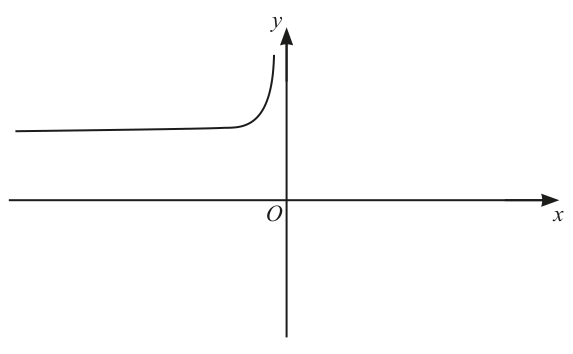
The function is defined by for . The diagram shows the graph of .
Approach
The graph of is the reflection of the graph of in the line . Reflect the curve, swap the asymptotes, and mark the mirror line.
Working
The original curve for has:
- Domain and range
- Horizontal asymptote as
- Vertical asymptote (the -axis) as
- Lies in the second quadrant
Reflecting in swaps the roles of and , so the inverse curve has:
- Domain and range
- Vertical asymptote
- Horizontal asymptote (the -axis)
- Lies in the fourth quadrant
Draw the line through the origin as a dashed line, then sketch the inverse curve in the fourth quadrant: starting just below the -axis for large and plunging down to as .
Answer
The graph of is the reflection of in the line , lying in the fourth quadrant with vertical asymptote and horizontal asymptote .
Sketch of y = f⁻¹(x) in the fourth quadrant: reflection of f in the line y = x, with vertical asymptote x = 4 and horizontal asymptote y = 0.
Walkthrough
The graph of the inverse of any one-to-one function is obtained by reflecting the original graph in the line . The point on the graph of corresponds to the point on the graph of , and these two points are reflections of each other in .
The original is defined only for , so its graph lies entirely in the second quadrant. As , , so from above, giving a horizontal asymptote . As , , so , giving a vertical asymptote at the -axis ().
When we reflect in , the two asymptotes swap roles. The horizontal asymptote of becomes the vertical asymptote of . The vertical asymptote of becomes the horizontal asymptote of (i.e., the -axis). The branch in the second quadrant reflects into the fourth quadrant, and the line should be drawn through the origin to make the mirror visible.
Key Takeaways
- The graph of is the reflection of the graph of in the line .
- Reflection in swaps horizontal and vertical asymptotes.
- The domain of becomes the range of , and vice versa.
Common Mistakes
- Placing the inverse in the wrong quadrant (e.g., still in the second quadrant or in the first).
- Confusing the asymptotes — giving a horizontal asymptote for instead of the vertical asymptote .
- Forgetting to draw the mirror line .
Things to Be Careful About
- The horizontal asymptote of becomes the vertical asymptote of .
- The vertical asymptote of becomes the horizontal asymptote of .
- The shape must be a true mirror image of the original across — the perpendicular distance from any point to the line is preserved.
Approach
Write , swap and , then solve for . When the square root appears, use the fact that the range of equals the domain of (which is ) to choose the correct sign.
Working
Start with
Swap and :
Subtract from both sides:
Multiply both sides by :
Divide by :
Take the square root:
The range of is the domain of , namely . So we must take the negative root:
Answer
f⁻¹(x) = -√(2/(x-4))
Walkthrough
The standard procedure to find the inverse of a one-to-one function is to swap the variables and solve for the new dependent variable.
Step 1. Write .
Step 2. Swap and . This is the key conceptual step: the equation now says 'the value of at is ', which is exactly what the inverse means.
Step 3. Isolate . Subtract : . Cross-multiply: . Divide by : .
Step 4. Take the square root: .
Step 5. Choose the correct sign. The original is defined only for , so the range of (the possible -values the inverse can output) must be . The expression is non-negative, so to get a negative result we must take the negative root.
The domain of is (the range of ), and the range is (the domain of ).
Key Takeaways
- The procedure for finding the inverse: write , swap and , solve for .
- When a square root is involved, use the domain/range of the original function to select the correct sign.
- The domain of becomes the range of , and vice versa.
Common Mistakes
- Omitting the sign selection step and giving or the positive root.
- Forgetting that the formula implicitly requires .
- Algebra errors when isolating (e.g., writing instead of ).
Things to Be Careful About
- The range of is (since ), so the domain of is .
- The range of is (the domain of ), so the negative root is required.
- The constant in the original formula is the horizontal asymptote of , and it becomes the vertical asymptote of .
Approach
Substitute into the formula and solve the resulting equation, then apply the domain restriction .
Working
Set :
Subtract from both sides:
Multiply both sides by :
Divide both sides by :
Take the square root:
Since the domain of is , the only valid solution is .
Answer
x = -2
Walkthrough
We need the value(s) of for which . Substituting the formula:
Subtract from both sides to isolate the term containing :
Multiply both sides by to clear the denominator:
Divide by to get alone:
The square root gives . The original function is defined only for , so is rejected. The unique solution is .
Key Takeaways
- Solving means finding the input that produces the given output.
- Always apply the domain restriction at the end when the function is defined on a restricted domain.
Common Mistakes
- Stating both and as solutions, ignoring the domain restriction .
- Algebraic slips when rearranging.
Things to Be Careful About
- The domain must be checked at the end.
- A negative answer is the only valid one here, even though gives two real roots.
- This is a small algebraic manipulation, but the conceptual point is that is one-to-one on its domain, so the equation has at most one solution.
Approach
Compare the values can produce with the values can produce. If those value sets do not overlap, the equation cannot hold.
Working
For , the term for every in the domain, so
i.e. is always strictly greater than (and so always positive).
For , the square root is non-negative and the leading minus sign makes strictly negative (for every ):
Since and , the two functions can never take the same value. Hence the equation has no solution.
Answer
is always (positive) while is always (negative), so the equation has no solution.
f(x) is always > 4 (positive) while f⁻¹(x) is always < 0 (negative), so f⁻¹(x) = f(x) has no solution.
Walkthrough
The equation asks for an where the inverse and the function itself produce the same value. To see why no such exists, look at the value sets (ranges) of the two functions.
Range of . For every :
The term is strictly positive, so . The entire graph of sits strictly above the line — it never reaches the -axis or any negative -value.
Range of . From part (b):
The square root is positive for , and the leading minus sign makes strictly negative. The whole graph of lies below the -axis.
Since the two graphs lie in entirely different vertical regions (one strictly above , the other strictly below ), the curves never meet. So has no solution.
Key Takeaways
- The range of and the range of are linked: the range of is the domain of , and vice versa.
- If two functions have disjoint ranges, the equation has no solution.
- Sign-of-function arguments are a quick way to rule out solutions.
Common Mistakes
- Stating only that 'the curves don't intersect' without giving a reason based on signs or ranges.
- Confusing domain and range — saying is defined only for does not on its own explain why the equation has no solution; the values it outputs, not the values it accepts, are what matter.
Things to Be Careful About
- strictly, not , because strictly.
- strictly, because strictly.
- The argument is purely about the outputs (ranges) of the two functions, not about where they are defined (domains).
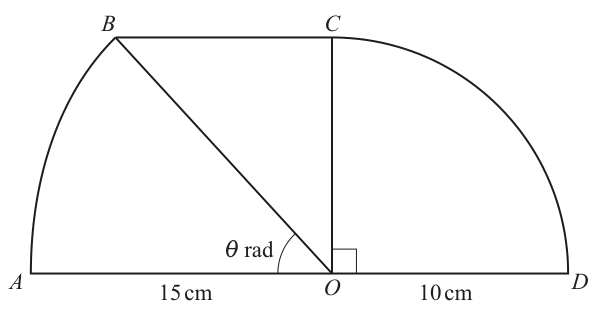
In the diagram, and are two parallel straight lines. Arc is part of a circle with centre and radius . Angle radians. Arc is part of a circle with centre and radius . Angle radians.
Approach
From the diagram, is parallel to and , meaning is perpendicular to . Since is horizontal and is at a height of above (the radius of the inner arc), point is also at a vertical height of above the line . We can form a right-angled triangle with hypotenuse and opposite side to find .
Working
Let be the foot of the perpendicular from to . Then and .
In right-angled triangle :
Solving for :
Rounding to 4 decimal places:
Answer
0.7297
Walkthrough
First, we observe the geometric relationships in the diagram. The line is horizontal, and is parallel to it. The angle is a right angle, and is a radius of the inner circle with length . This means is located directly above . Because is parallel to , point must also be at a vertical height of above the line .
Next, we consider the right-angled triangle formed by dropping a perpendicular from to . Let's call the intersection point . The hypotenuse of this triangle is , which is a radius of the outer circle, so . The side opposite to angle (which is ) is .
Using the sine ratio in right-angled triangles:
To find , we apply the inverse sine function:
Rounding to 4 decimal places gives .
Key Takeaways
- Parallel lines and perpendicular radii can be used to determine vertical heights in composite geometric shapes.
- The sine ratio relates the opposite side and hypotenuse in a right-angled triangle, and inverse sine recovers the angle.
Common Mistakes
- Forgetting to convert the result from degrees to radians if using a calculator set to degree mode.
- Using the wrong trigonometric ratio (e.g., cosine instead of sine) by misidentifying the sides relative to angle .
Things to Be Careful About
- The mark scheme accepts working in degrees as long as it is converted to radians at the end.
- Ensure the final answer is given to exactly 4 decimal places as requested.
Find the perimeter and the area of the shape . Give your answers correct to 3 significant figures.
Approach
The perimeter of shape is the sum of the lengths of its four boundary components: arc , line segment , arc , and line segment . The area can be found by decomposing the shape into a right-angled triangle , a sector , and a quarter-circle sector .
Working
Perimeter:
-
Find the length of :
Since is at height and , the horizontal distance from to the vertical line through is:Since is directly above , .
-
Find the length of arc :
-
Find the length of arc :
-
Find the length of :
-
Total perimeter:
Correct to 3 significant figures: .
Area:
-
Area of triangle :
The base is and the height is . -
Area of sector :
-
Area of sector :
This is a quarter-circle with radius . -
Total area:
Correct to 3 significant figures: .
Answer
Perimeter =
Area =
Perimeter = 62.8 cm, Area = 217 cm^2
Walkthrough
Perimeter Calculation:
The perimeter is the total length of the boundary of shape . We break it down into four parts:
-
Line segment : Point is directly above (since and radius ). Point is on the outer circle (radius ) and at the same height as (). Using Pythagoras' theorem on the right triangle formed by , , and the projection of onto , the horizontal distance from to is . Since is directly above , .
-
Arc : Using the arc length formula with and , we get .
-
Arc : This is a quarter-circle with radius , so its length is .
-
Line segment : This is the straight line along the bottom, composed of and , giving .
Summing these gives the perimeter: , which rounds to .
Area Calculation:
The shape can be decomposed into three non-overlapping regions meeting at :
-
Triangle : A right-angled triangle with base and height . Area .
-
Sector : A circular sector with radius and angle . Area .
-
Sector : A quarter-circle with radius . Area .
Summing these gives the total area: , which rounds to .
Key Takeaways
- Composite shapes can often be decomposed into simpler geometric figures (triangles, sectors, rectangles) for area calculation.
- Arc length and sector area formulas are and respectively, where must be in radians.
- Pythagoras' theorem is useful for finding horizontal or vertical distances when a point lies on a circle and its height is known.
Common Mistakes
- Forgetting to include all boundary segments when calculating the perimeter (e.g., omitting or using the wrong arc length).
- Using degrees instead of radians in the arc length and sector area formulas.
- Incorrectly decomposing the area, such as trying to use a trapezoid formula which doesn't apply to curved boundaries.
Things to Be Careful About
- Always ensure angles are in radians when using and .
- Carry out intermediate calculations with full calculator precision and only round the final answer to the required significant figures to avoid rounding errors.
- The mark scheme allows for AWRT (Any Correct Rounding Technique), meaning intermediate rounding is acceptable as long as the final answer is correct to 3 significant figures.
The first three terms of an arithmetic progression are , and , where is a constant.
Find the value of the tenth term of the progression.
Approach
For an arithmetic progression, consecutive terms differ by the same amount, so the middle term is the average of the first and third terms. This gives an equation for . Once is known, the common difference and then the tenth term can be found.
Working
Using the constant-difference property:
Expand and simplify:
The common difference is the second term minus the first:
The tenth term of an arithmetic progression is :
Answer
-49
Walkthrough
An arithmetic progression has a common difference , so . Equivalently, the middle term is the average of the first and third terms, giving . Solve this linear equation: expand to , then , so . Substitute into and subtract to get the common difference . Finally use with : .
Key Takeaways
An arithmetic progression is characterised by a constant common difference. The nth term is . To find an unknown parameter, use the constant-difference property to form an equation, solve it, and then substitute back.
Common Mistakes
- Setting up the equation incorrectly, for example forgetting that the middle term must be doubled.
- Losing the negative sign when expanding or .
- Substituting directly into the nth term formula instead of first finding the common difference .
- Using instead of for the tenth term.
Things to Be Careful About
- The common difference can be negative; here it is , so the terms decrease.
- Keep all working in exact fractions; do not round or .
- The mark scheme requires the method for finding and to be shown, so present the equation and substitution clearly.
The first three terms of a geometric progression are , and , where is a positive constant.
Find the sum to infinity of the progression.
Approach
In a geometric progression, the square of the middle term equals the product of the first and third terms. Use this to form a quadratic in , solve it, choose the positive value, then find the common ratio. Finally, apply the sum to infinity formula, checking that the common ratio satisfies .
Working
For a geometric progression:
Expand and simplify:
Factorise:
So or . Since is positive, .
The common ratio is:
Since , the sum to infinity exists:
Answer
125/2
Walkthrough
In a geometric progression, consecutive terms have the same ratio, so . Cross-multiplying gives . Expand to and rearrange to . Factorising gives , so or . Since is positive, only is valid. The common ratio is . Because , the sum to infinity is . If you solve directly for instead, the negative ratio is rejected because it corresponds to a negative value of .
Key Takeaways
A geometric progression has a constant ratio, so the middle term squared equals the product of the outer terms. The sum to infinity exists only when , and is given by . Quadratic equations often arise when finding the parameters of a progression.
Common Mistakes
- Forgetting to cross-multiply correctly and writing incorrectly.
- Expanding as instead of .
- Choosing the negative root without checking the condition that is positive.
- Applying the sum to infinity formula without checking .
- Giving an unsupported answer for the quadratic; show the factorisation or quadratic formula.
Things to Be Careful About
- is given as positive, so reject .
- The common ratio must be between and for a finite sum to infinity.
- Keep the final answer as an exact fraction , not a rounded decimal.
- The mark scheme ignores the extra negative ratio if solving directly for , but the positive value must be justified.
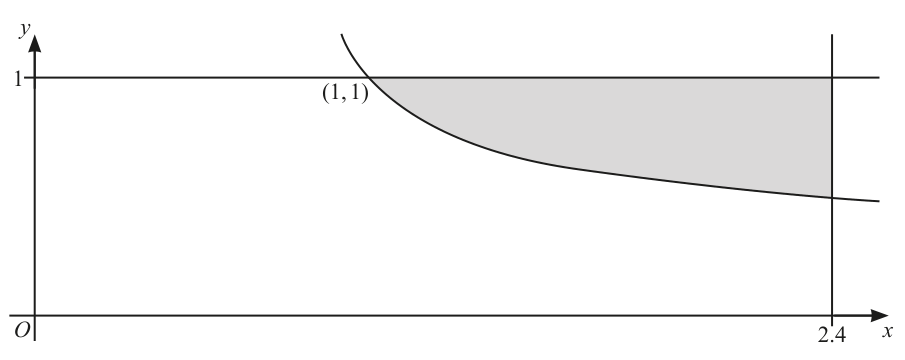
The diagram shows part of the curve with equation and the lines and . The curve intersects the line at the point .
Find the exact volume of the solid generated when the shaded region is rotated through about the -axis.
Approach
The shaded region is bounded above by , below by , and on the right by . The left boundary is the intersection point . When this region is rotated about the -axis, the resulting solid can be viewed as a cylinder of radius and height , with the volume generated by rotating the area under the curve removed. We calculate the volume of the cylinder and subtract the volume under the curve.
Working
The volume of the cylinder generated by rotating the rectangle bounded by , , , and about the -axis is:
The volume under the curve from to when rotated about the -axis is:
To integrate , we use the substitution , so or :
Evaluating the definite integral with the limits to :
At : , so .
At : , so .
The volume of the solid generated is the cylinder volume minus the volume under the curve:
Answer
4pi/5
Walkthrough
The problem asks for the volume of a solid of revolution. The shaded region is bounded by on top, the curve on the bottom, and the vertical line on the right. The left boundary is where the curve meets , which is at .
When rotated about the -axis, the outer boundary is the line and the inner boundary is the curve. Instead of using the washer method directly, it is simpler to think of the solid as a full cylinder (radius , height ) with the volume under the curve removed.
First, we calculate the volume of the cylinder:
Next, we find the volume under the curve by integrating from to :
Using the substitution , the integral becomes . Evaluating this from to gives . Multiplying by gives .
Finally, subtracting the volume under the curve from the cylinder volume gives .
Key Takeaways
- When a region between a curve and a horizontal line is rotated about the -axis, the solid can often be viewed as a cylinder minus the volume under the curve.
- Integration of requires the reverse chain rule (or substitution), giving .
- Always check the limits of integration and evaluate the antiderivative at both bounds carefully.
Common Mistakes
- Forgetting to square the -expression when setting up the volume integral ( instead of ).
- Incorrectly applying the chain rule in reverse for the integration, forgetting to divide by the coefficient of (which is ).
- Subtracting the wrong way around or miscalculating the cylinder height (, not ).
Things to Be Careful About
- The limits of integration are and . Ensure and are computed correctly.
- The cube root of is , and the cube root of is . Do not confuse these with square roots.
- The mark scheme awards a method mark for using instead of only if it is used to find the volume of the cylinder directly; using for the curve volume will not earn further marks.
The equation of a circle is . The line with equation passes through the point and is a tangent to the circle.
Find the two possible values of and, for each value of , find the coordinates of the point at which the tangent touches the circle.
Approach
The line passes through the point , so its equation is . Substitute this into the circle equation to obtain a quadratic in . For the line to be tangent, this quadratic must have exactly one solution, so its discriminant must be zero. Solve for , then substitute each value back to find the -coordinate of the tangent point and use the line equation to find the corresponding -coordinate.
Working
The line through with gradient is
Substitute into the circle equation:
Expand and collect all terms on one side:
For tangency, set the discriminant equal to zero:
Simplify:
Divide by :
Factorise:
So
For , the quadratic in becomes:
Hence . Then
So one tangent point is .
For , the quadratic in becomes:
Divide by :
Hence . Then
So the other tangent point is .
Answer
The two possible values of are and . The corresponding tangent points are and .
m = 1 or m = -7; tangent points (6, -3) and (-6/5, -3/5)
Walkthrough
The line passes through , so in we must have , giving .
A tangent line touches the circle at exactly one point. Therefore, when we substitute the line into the circle equation, the resulting quadratic in must have exactly one repeated root. This happens precisely when its discriminant is zero.
Substituting into gives
Expanding and collecting terms:
Apply the discriminant condition with , and :
This simplifies to , which factorises as , so or .
For each value of , substitute back into the quadratic in . The quadratic should be a perfect square; its repeated root is the -coordinate of the tangent point. Then use to find the corresponding -coordinate.
For , and . For , and .
Key Takeaways
- A line is tangent to a circle when it intersects it at exactly one point, so the substitution gives a quadratic with a double root.
- The discriminant condition is the algebraic way to enforce tangency.
- After finding the gradient , the tangent point is found by solving the quadratic's repeated root and then using the line equation.
- This question connects coordinate geometry of circles with algebraic manipulation of quadratics.
Common Mistakes
- Forgetting that the line passes through , so .
- Not collecting all terms on one side of the equation before using the discriminant.
- Sign errors when expanding or when subtracting .
- Stopping after finding without finding the tangent point coordinates.
- Using the quadratic formula instead of the discriminant to enforce tangency; the mark scheme specifically requires the discriminant.
Things to Be Careful About
- The discriminant must be set equal to zero for tangency.
- Keep symbolic until the discriminant step; do not substitute a numeric value too early.
- The coefficient of is , not .
- For , the quadratic simplifies to , giving .
- Check that the tangent points satisfy the original circle equation.
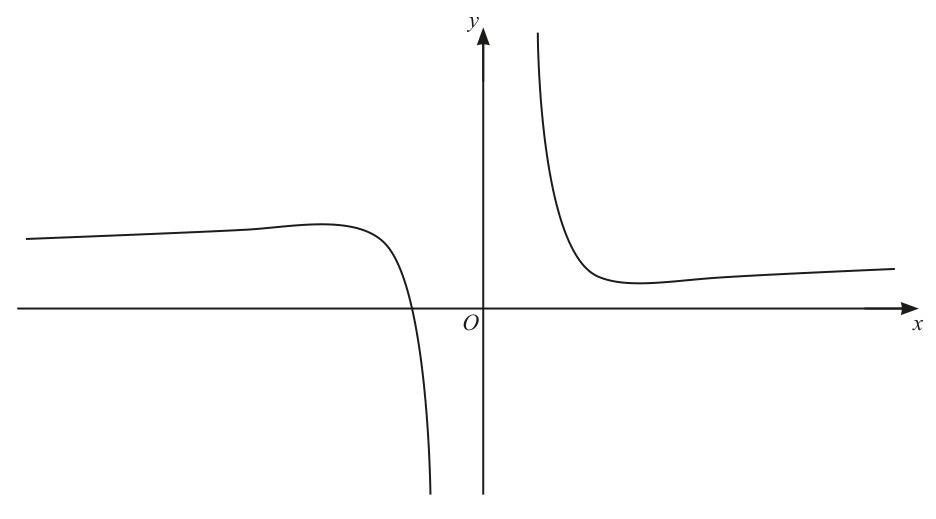
A function is defined by for . The graph of is shown in the diagram.
Approach
To find where is decreasing, we need . We differentiate , set the derivative equal to zero to find stationary points, then determine the intervals where the derivative is negative, remembering that .
Working
Differentiate :
Set to find stationary points:
Multiply through by (valid since ):
For to be decreasing, we require :
Combine over a common denominator:
Since for all , the sign of the fraction depends only on the numerator:
Since , the function is decreasing for:
Answer
-2 < x < 0 or 0 < x < 2
Walkthrough
Step 1: Differentiate the function.
We rewrite as and apply the power rule term by term. The derivative of is , and the derivative of is . The constant differentiates to .
Step 2: Find stationary points.
We set . Multiplying through by (which is positive and non-zero) clears the denominators, giving . This is a simple quadratic in , yielding , so .
Step 3: Determine where the function is decreasing.
We need , which means . Since always (for ), the inequality reduces to , giving , i.e., . We must exclude because the function is undefined there.
Step 4: Write the final answer.
The function is decreasing on and , or equivalently and .
Key Takeaways
- To find where a function is decreasing, set .
- When solving with rational expressions, consider the sign of each factor separately.
- Always check the domain of the original function and exclude points where it is undefined.
Common Mistakes
- Forgetting to exclude from the final answer, giving without the domain restriction.
- Making sign errors when multiplying through by or when simplifying the fraction.
- Only finding stationary points and not checking the sign of to determine decreasing intervals.
- Writing including the endpoints where ; the question asks where is decreasing, which is where .
Things to Be Careful About
- The function is undefined at , so this point must be excluded from any interval.
- is always positive for , so multiplying or dividing by it does not change the inequality direction.
- The mark scheme awards B1FT marks for the final interval, but only if the correct expression was used earlier.
A triangle is bounded by the -axis, the normal to the curve at the point where and the tangent to the curve at the point where .
Find the area of the triangle. Give your answer correct to 3 significant figures.
Approach
The triangle is bounded by three lines: the -axis (), the normal to the curve at , and the tangent to the curve at . We find the equations of these two lines, then determine the three vertices of the triangle by finding where they intersect. Finally, we compute the area using the base along the -axis and the horizontal distance to the third vertex.
Working
Step 1: Find the point and gradient on the curve at .
Point:
Step 2: Equation of the normal at .
The normal gradient is the negative reciprocal of the tangent gradient:
Equation of the normal through :
Step 3: Find the point and gradient on the curve at .
Point:
Step 4: Equation of the tangent at .
Equation of the tangent through :
Step 5: Find the vertices of the triangle.
The triangle is bounded by:
- The -axis:
- The normal:
- The tangent:
Vertex A: Intersection of the normal and the -axis ():
Point A:
Vertex B: Intersection of the tangent and the -axis ():
Point B:
Vertex C: Intersection of the normal and the tangent:
Multiply through by :
Substitute back to find :
Point C:
Step 6: Calculate the area of the triangle.
The base lies along the -axis from to :
The height is the horizontal distance from the -axis to vertex C:
Correct to 3 significant figures:
Answer
6.51
Walkthrough
Step 1: Evaluate the function and its derivative at .
Substitute into to get , giving the point . Substitute into to get the tangent gradient .
Step 2: Find the equation of the normal at .
The normal is perpendicular to the tangent, so its gradient is . Using point-slope form , we get .
Step 3: Evaluate the function and its derivative at .
Substitute into to get , giving the point . The derivative at is also (since depends on and , which are the same for and ).
Step 4: Find the equation of the tangent at .
Using point-slope form with gradient : , giving .
Step 5: Find the three vertices of the triangle.
The triangle is bounded by the -axis (), the normal, and the tangent. The three vertices are:
- Where the normal meets the -axis:
- Where the tangent meets the -axis:
- Where the normal meets the tangent: solve to get ,
Step 6: Compute the area.
Use the -axis segment as the base (length ) and the horizontal distance from the -axis to the third vertex as the height (). Area .
Key Takeaways
- The gradient of the normal is the negative reciprocal of the tangent gradient: .
- When a triangle is bounded by a coordinate axis and two lines, use the axis as the base and the perpendicular distance to the third vertex as the height.
- Always verify that the intersection point lies on both lines by substituting back.
Common Mistakes
- Using the wrong sign for the normal gradient (forgetting the negative in ).
- Making algebra errors when solving ; multiplying through by first avoids fraction errors.
- Computing the area using integration instead of the simple triangle formula, and then making substitution errors.
- Forgetting that the base is along the -axis, so the height is measured horizontally (the -coordinate of the third vertex), not vertically.
- Rounding too early; keep exact fractions until the final step.
Things to Be Careful About
- The mark scheme allows integration if set up correctly, but the triangle area formula is simpler and less error-prone.
- Give the final answer to 3 significant figures as stated: (not or ).
- The base length is , not written without combining fractions — both are correct but combining avoids errors.
- The -intercepts of the normal and tangent are and respectively; these are the -coordinates of two vertices, not the base length itself.