Mathematics 9709/42 — February/March 2024
Cambridge AS Level · Mechanics · worked solutions for every part, with the mark scheme
Topics Kinematics of Motion in a Straight Line · Forces and Equilibrium · Energy, Work and Power · Newton's Laws of Motion · Momentum
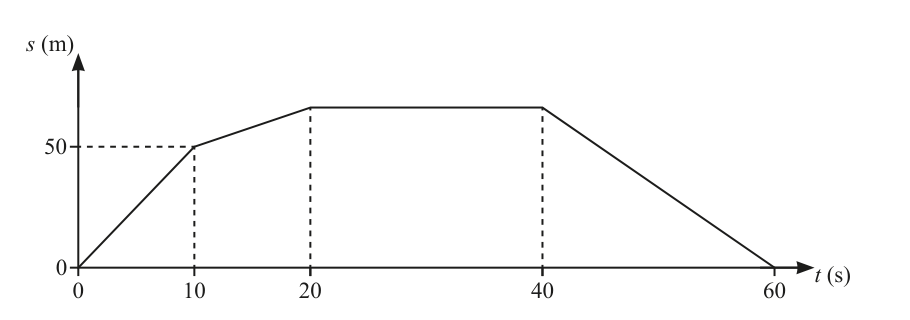
The displacement of a particle at time after leaving a fixed point is . The diagram shows a displacement-time graph which models the motion of the particle. The graph consists of 4 straight line segments. The particle travels in the first , then travels at for a period of . The particle then comes to rest for a period of , before returning to its starting point when .
Approach
The velocity during any straight-line segment of a displacement-time graph is the gradient of that segment. First, determine the total displacement at s by adding the distances covered in the first two segments. Then, calculate the velocity during the last 20 s using the change in displacement over this time interval.
Working
In the first 10 s, the particle travels 50 m.
For the next 10 s (from to ), the particle travels at .
From to , the particle is at rest, so .
During the last 20 s (from to ), the particle returns to the starting point, so .
Answer
-3.5 m s^-1
Walkthrough
The velocity of a particle at any point on a displacement-time graph is given by the gradient of the graph at that point. Since the graph consists of straight line segments, the velocity is constant during each segment.
First, we find the displacement at s. The particle travels 50 m in the first 10 s, so . For the next 10 s (from to ), it travels at a constant velocity of , covering a distance of m. Thus, m.
From to , the particle is at rest, meaning its displacement does not change. So m.
Finally, during the last 20 s (from to ), the particle returns to its starting point , so . The velocity is the change in displacement divided by the change in time:
Key Takeaways
- The gradient of a displacement-time graph gives the velocity.
- Total displacement is the sum of displacements in each segment.
- Returning to the starting point means the final displacement is zero.
Common Mistakes
- Forgetting that the particle is at rest between and , and incorrectly calculating the displacement at .
- Calculating the magnitude of velocity but forgetting the negative sign to indicate direction towards .
Things to Be Careful About
- Ensure the velocity is negative, as the particle is returning to the starting point (displacement is decreasing).
- The mark scheme allows stating the magnitude and direction separately (e.g., ", directed towards "), but the signed value is the standard mathematical answer.
Approach
The velocity during each straight-line segment of the displacement-time graph is constant and equal to the gradient of that segment. Calculate the velocity for each of the four time intervals and then sketch the velocity-time graph as a stepped diagram with horizontal line segments at these constant velocities.
Working
Interval :
Interval :
Given velocity is .
Interval :
Particle is at rest, so .
Interval :
From part (a), .
Answer
A velocity-time graph consisting of four horizontal segments: for ; for ; for ; and for .
Stepped graph with v=5 (0-10s), v=2 (10-20s), v=0 (20-40s), v=-3.5 (40-60s)
Walkthrough
To sketch the velocity-time graph, we determine the constant velocity during each of the four time intervals from the displacement-time graph.
- : The displacement changes from 0 to 50 m. Velocity .
- : The problem states the particle travels at .
- : The particle is at rest, so velocity is .
- : From part (a), the velocity is .
Since the velocity is constant in each interval, the velocity-time graph consists of horizontal line segments at these values. The graph is a stepped diagram. Vertical lines connecting the segments are not drawn (or are ignored) because the velocity changes instantaneously in this model.
Key Takeaways
- A displacement-time graph with straight line segments corresponds to a velocity-time graph with horizontal line segments.
- The gradient of the s-t graph gives the v value for each interval.
- Sketches should show horizontal segments without vertical connecting lines.
Common Mistakes
- Drawing vertical lines to connect the horizontal segments in the velocity-time graph.
- Incorrectly calculating the velocity for the first interval (e.g., using 70 instead of 50).
- Forgetting to label the axes or the key values on the axes.
Things to Be Careful About
- The graph is a sketch, but all key values ( and ) must be clearly indicated.
- The mark scheme accepts or if the line is halfway between them, but is exact.
A particle is projected vertically upwards from horizontal ground. The speed of the particle seconds after it is projected is and it is travelling downwards.
Approach
Take upwards as positive. At s the particle is moving downwards, so its velocity is . Use the constant acceleration formula with to form an equation in only, then solve.
Working
Using , , and :
Answer
The speed of projection is .
15 m/s
Walkthrough
We need the initial speed. Choose upwards as positive. At s the particle is moving downwards, so its velocity is , not . Using with gives , so . The speed is the magnitude of velocity, so it is .
Alternatively, since the speed decreases by each second, the particle was at its greatest height s before s, so the time to the greatest height is s. Then , giving again.
The mark scheme requires an equation in only for M1, and the final speed must be positive for A1.
Key Takeaways
- A velocity sign convention must be chosen and used consistently.
- The suvat equation connects initial speed, final velocity and time.
- Speed is the magnitude of velocity, so it is always non-negative.
Common Mistakes
- Using because the word "speed" is used, ignoring that the particle is travelling downwards.
- Quoting without showing the suvat equation; the method mark requires an equation in only.
- Mixing up the sign of ; with upwards positive, .
Things to Be Careful About
- Use the value of specified in the question; the mark scheme here uses .
- Include units in the final answer.
- If the question asks for speed, the answer must be positive.
Find the distance travelled by the particle between the two times at which its speed is .
Approach
The two times at which the speed is occur symmetrically: once on the way up and once on the way down at the same height. The distance travelled between them is twice the distance from that height up to the maximum height. Use with and to find that one-way distance.
Working
From the point where the speed is to the maximum height, , and :
This is the distance from the height where the speed is up to the maximum height. The particle travels this distance once upwards and once downwards between the two times, so
Answer
The distance travelled is .
10 m
Walkthrough
The particle passes the speed twice: once moving upwards and once moving downwards. These two instants are symmetric about the maximum height, so they occur at the same height. The distance travelled between them is the distance from that height up to the maximum plus the same distance back down, so it is twice the one-way distance.
To find the one-way distance, use from the point where the speed is to the maximum height, where :
So the total distance is .
Alternative using the initial speed from part (a), : the maximum height is m and the height where the speed is is m, so the one-way difference is m and the total distance is m. An energy method also works: gives m, and doubling gives m.
The mark scheme's M1 is for a complete method, and A1FT follows through from their value of if used.
Key Takeaways
- Projectile motion under gravity is symmetric: the upward and downward journeys between the same height take equal distances.
- "Distance travelled" is a scalar and can be larger than the displacement; here the displacement between the two instants is zero, but the distance is m.
- The suvat equation is useful when time is not needed.
Common Mistakes
- Stopping after finding the one-way distance m instead of doubling it.
- Thinking the distance is zero because the particle returns to the same height.
- Using at the maximum height; at the maximum height the speed is .
- Forgetting to use the initial speed from part (a) if solving via heights.
Things to Be Careful About
- The two times are at the same height, but the distance travelled between them includes both the upward and downward parts.
- Use the value of specified in the question; here the mark scheme uses .
- If using an energy method, include both kinetic and potential energy terms and check that the equation is dimensionally correct.
- Include units in the final answer.
A crate of mass is being pulled up a line of greatest slope of a rough plane at a constant speed of by a rope attached to a winch. The plane is inclined at an angle of to the horizontal and the rope is parallel to the plane. The winch is working at a constant rate of .
Find the coefficient of friction between the crate and the plane.
Approach
The crate moves at constant speed, so its acceleration is zero and the resultant force along the plane is zero. First use the winch power to find the driving force from . Then resolve perpendicular to the plane to find the normal reaction . Resolve parallel to the plane to relate the driving force, the weight component down the slope and the friction. Finally use to find .
Working
The winch works at and the speed is , so
Resolving perpendicular to the plane, the normal reaction balances the component of weight perpendicular to the plane:
Taking ,
Resolving parallel to the plane, with motion up the slope, the forces are the driving force up the slope, and the weight component and friction down the slope. Since the speed is constant,
Thus
Using the friction model :
Answer
μ = √3/9 ≈ 0.192
Walkthrough
The crate is moving at constant speed up the plane. Constant speed means acceleration is zero, so by Newton's second law the resultant force along the plane is zero. We are given the power of the winch, not the driving force directly. The relationship lets us find the driving force: N.
Next, we need the normal reaction between the crate and the plane. The plane is rough, so there is also a friction force acting down the slope, opposing the motion. To find , resolve perpendicular to the plane. The only forces with components perpendicular to the plane are the weight and the normal reaction. The weight component perpendicular to the plane is , so . With , N.
Now resolve parallel to the plane. Up the slope we have the driving force N. Down the slope we have the component of weight N and the friction . Because the crate is not accelerating, these balance: , so N.
Finally, the friction model for a rough surface in limiting equilibrium is . Here the crate is being pulled at constant speed, so friction is at its limiting value. Substitute and : , so .
Key Takeaways
- Power and force are linked by when the force acts in the direction of motion.
- Constant speed means zero acceleration, so the resultant force is zero (equilibrium along the direction of motion).
- On an inclined plane, the weight has components parallel to the plane and perpendicular to the plane.
- Friction opposes motion and is given by , where is the normal reaction, not the weight.
Common Mistakes
- Forgetting to convert kW to W before using .
- Using instead of .
- Swapping and when resolving weight components.
- Forgetting that friction acts down the slope when the crate is pulled up.
- Setting the driving force equal to the weight component only, omitting friction.
- Using instead of .
- Not using the constant-speed condition to justify setting the resultant force to zero.
Things to Be Careful About
- The driving force from the winch is only because the rope is parallel to the plane and the crate moves in the direction of the rope.
- Use the value of specified in the question; here the mark scheme uses .
- The normal reaction is a component of the weight, not the full weight.
- Keep the exact surd form if an exact answer is required; the decimal is acceptable to 3 significant figures.
- The friction force is N, not the coefficient itself; the coefficient is dimensionless.
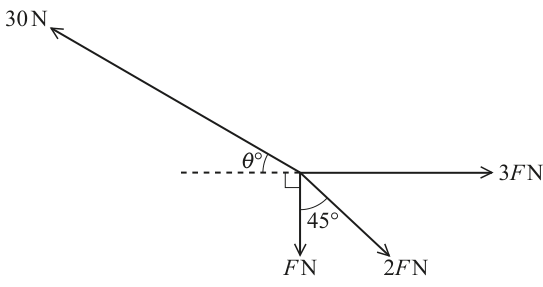
Four coplanar forces act at a point. The magnitudes of the forces are , , and . The directions of the forces are as shown in the diagram.
Given that the forces are in equilibrium, find the value of and the value of .
Approach
Resolve the forces horizontally and vertically. Since the system is in equilibrium, the resultant force in both directions is zero. This gives two equations that can be solved simultaneously for and .
Working
Let the horizontal direction to the right be positive and the vertical direction upwards be positive.
Resolving horizontally:
The forces with horizontal components are , , and .
The force acts at an angle above the negative horizontal axis, so its horizontal component is .
The force acts horizontally to the right, so its component is .
The force acts at to the vertical, so its horizontal component is .
Setting the sum of horizontal forces to zero:
Resolving vertically:
The forces with vertical components are , , and .
The force acts upwards, so its vertical component is .
The force acts vertically downwards, so its component is .
The force acts downwards, so its vertical component is .
Setting the sum of vertical forces to zero:
Finding :
Divide equation (2) by equation (1):
Substitute :
Rounding to 3 significant figures:
Finding :
Square equations (1) and (2) and add them together. Using the identity :
Expand the terms in the bracket:
So:
Rounding to 3 significant figures:
Answer
F = 5.96, θ = 28.7°
Walkthrough
First, we set up a coordinate system with the positive x-axis to the right and the positive y-axis upwards. We then resolve each of the four forces into their horizontal and vertical components. Since the forces are in equilibrium, the sum of all horizontal components must be zero, and the sum of all vertical components must be zero. This gives us two equations with two unknowns, and . To find , we divide the vertical equation by the horizontal equation, which cancels out and leaves us with . To find , we square both equations and add them together, using the Pythagorean identity to eliminate . Finally, we calculate the numerical values and round to 3 significant figures.
Key Takeaways
- When a particle is in equilibrium under multiple forces, resolving those forces horizontally and vertically yields two independent equations.
- Simultaneous equations involving trigonometric functions of an angle and a magnitude can be solved by taking their ratio to find the angle, and squaring and adding them to find the magnitude.
- Resolving at to the vertical means the horizontal component uses and the vertical component uses .
Common Mistakes
- Getting the signs wrong when resolving forces (e.g., forgetting that the force has a negative horizontal component).
- Mixing up sine and cosine when resolving the force; since it is to the vertical, its horizontal component is and its vertical component is .
- Forgetting to square both sides when adding the equations to eliminate .
Things to Be Careful About
- Always check the direction of each force component against your chosen positive axes.
- Ensure final answers are given to an appropriate number of significant figures (3 s.f. is standard unless specified otherwise).
- The angle is measured from the negative horizontal axis, so its horizontal component is and vertical is .
A particle moves in a straight line starting from a point . The velocity of the particle after leaving is given by
You may assume that the velocity of the particle is positive for , is zero at and is negative for .
Approach
Since the velocity is positive on , the distance travelled equals the displacement, so integrate with respect to from to .
Working
Integrate :
Evaluate from to :
Answer
The distance travelled between and is
21/64 m (0.328125 m)
Walkthrough
We are told that the velocity is positive for , so on the interval the particle moves in one direction only and never reverses. For motion in one direction, distance travelled equals displacement. Displacement is obtained by integrating velocity with respect to time.
Integrate each term: becomes , becomes , and the constant becomes . This gives .
To find the distance between and , substitute these limits. At every term is zero, so only the upper limit contributes. Substituting gives .
Key Takeaways
This question tests the fundamental link between velocity and displacement through integration. It also reminds us that distance and displacement are the same only when the direction of motion does not change. Practise increasing each power of by one and dividing by the new power when integrating polynomials.
Common Mistakes
- Using instead of integrating: the mark scheme explicitly gives no method mark for this.
- Forgetting to increase the power of every term, or failing to divide by the new power.
- Including the constant of integration in the definite integral incorrectly, or omitting the lower limit.
- Using limits beyond in part (a), which would include regions where the velocity has changed sign.
Things to Be Careful About
- The lower limit is ; at this point the displacement expression is zero.
- The units are metres, so state the final answer as metres.
- The answer may be left as an exact fraction or a decimal.
Find the positive value of at which the acceleration is zero. Hence find the total distance travelled between and this instant.
Approach
Differentiate to find the acceleration , set , and take the positive solution. Since the velocity is negative between and , distance travelled on that interval is the magnitude of the change in displacement. Add this to the distance from part (a).
Working
Differentiate the velocity:
Set :
so or . The positive value is
The displacement function is
At :
At :
Thus the change in displacement from to is
Since the velocity is negative on this interval, the distance travelled is the magnitude:
Total distance from to is the distance up to plus this:
Answer
The positive time when the acceleration is zero is
and the total distance travelled up to this instant is
t = 3; total distance travelled = 573/32 m (17 29/32 m)
Walkthrough
Acceleration is the derivative of velocity with respect to time. Differentiating gives . Factorising gives , so the acceleration is zero at and . Since the question asks for the positive value, the answer is .
To find the total distance travelled up to , we must split the motion at , where the velocity changes sign. From to , the distance is the displacement from part (a). From to , the velocity is negative, so the displacement decreases. The distance travelled is the magnitude of the change in displacement: .
Compute . Then
So the second distance is . The total distance is therefore
Equivalently, this is the same as .
Key Takeaways
This question combines two key ideas: acceleration is the derivative of velocity, and total distance must be calculated segment by segment when the velocity changes sign. For a velocity function, the area under the - curve for distance must be treated as positive even when ; in calculations this means taking magnitudes of displacement changes on intervals where the particle reverses.
Common Mistakes
- Writing instead of differentiating: this earns no method mark.
- Forgetting to reject when selecting the positive time of zero acceleration.
- Using net displacement from to instead of total distance. The net displacement is negative, but the distance travelled is positive.
- Failing to split at , where the velocity changes sign.
- Adding without taking its magnitude, which gives a negative contribution.
Things to Be Careful About
- The derivative factorises as , giving two roots; only is positive.
- The displacement integral must come from integration of ; the mark scheme requires an expression for from integration before accepting the distance calculation.
- The mark scheme allows follow-through from the part (a) value, but the total must be a positive distance.
- Exact fractions are preferred; decimals such as or are accepted.
A car of mass is towing a trailer of mass up a straight road inclined at an angle to the horizontal, where . The car and trailer are connected by a tow-bar which is light and rigid and is parallel to the road. There is a resistance force of acting on the car and a resistance force of acting on the trailer. The driving force of the car's engine is .
Approach
Treat the car and trailer as a single connected system to find the acceleration. Resolve the weights along the slope; the component pulling each vehicle back is . Then apply Newton's second law to the trailer to find the tension in the tow-bar. Use and , as required by the mark scheme.
Working
Let be the acceleration and the tension. Total mass is .
For the whole system, with motion up the slope taken as positive:
This gives:
For the trailer alone:
With :
(Check with the car equation: , so .)
Answer
Acceleration ; tension .
Acceleration = 0.5 m/s^2, tension = 400 N
Walkthrough
First, identify the forces acting up and down the slope. The engine supplies up the slope; resistances on car and trailer and the components of both weights act down the slope. Choose up the slope as positive, so downward forces are subtracted. Combining the two vehicles into one system removes the internal tension from the equation, so we can solve for the acceleration immediately.
The weight component of each vehicle down the slope is . With and , the car contributes and the trailer contributes . Substituting all known forces into Newton's second law for the system gives , hence .
Then isolate the trailer. The forces on the trailer along the slope are the tension up the slope and the resistance plus weight-component down the slope. So . Substituting gives . The car equation gives the same value, confirming the calculation.
Key Takeaways
This question tests Newton's second law for a connected system on an inclined plane. The tow-bar is internal to the whole system, so its tension does not appear when considering car and trailer together. To find an internal force, isolate one body and apply Newton's second law to it. Weight on a slope has component parallel to the slope.
Common Mistakes
- Forgetting to include the weight component of the trailer in the system equation.
- Omitting one of the resistance forces.
- Using the car equation alone to find tension with the wrong acceleration.
- Sign errors when subtracting forces that act down the slope.
Things to Be Careful About
Use the specified and substitute ; do not use for components parallel to the slope. The mark scheme allows small angular approximations, but requires correctly resolved components. The tension is internal, so it must not appear in a whole-system equation.
It is given instead that the total work done against in moving a distance of up the road is . The speed of the car at the start of the is .
Use an energy method to find the speed of the car at the end of the .
Approach
Use the work-energy principle for the car and trailer as one system. The final kinetic energy equals the initial kinetic energy plus the work done by the engine, minus the work done against all resistances and minus the gain in gravitational potential energy as the system moves up the slope. The work done against is given directly.
Working
Let be the final speed. Total mass is and .
Work done by the driving force:
Work against the resistance on the car:
Work against over the is .
Gravitational PE gained by car and trailer:
Initial kinetic energy:
Final kinetic energy:
Work-energy equation:
Answer
The speed at the end of the is .
21.2 m/s
Walkthrough
Work-energy is the efficient method here because the total work done against is already known. Compute every energy transfer over the 50 m: engine input, work against resistances, gravitational PE gained, and change in kinetic energy. The final kinetic energy is isolated and gives the final speed.
The system moves up a slope with , so the vertical rise is . The gain in gravitational PE is therefore . Initial KE is , final KE is . Work by engine is ; work against car resistance is ; work against is . Energy balance: final KE equals initial KE plus engine work minus resistances minus PE gain. This gives , so .
Key Takeaways
Work-energy can be applied to a whole connected system. The change in gravitational PE is total weight times vertical rise. Work against a resistance is force times distance moved along the direction of the force. All work and energy terms must have correct signs: inputs add energy, outputs remove energy.
Common Mistakes
- Wrong sign on PE gain or resistance work, which changes the final speed.
- Using the distance along the road as the vertical rise when calculating PE.
- Forgetting to include the trailer's mass in total mass.
- Trying to find acceleration with constant-acceleration formulae first; the mark scheme gives at most 2 marks for that method here because the work-energy approach is expected.
Things to Be Careful About
The total mass is , not just . The PE term uses , the vertical component of the displacement. The work against is given as , so the system method does not need to find separately. Give the final speed to 3 significant figures: .
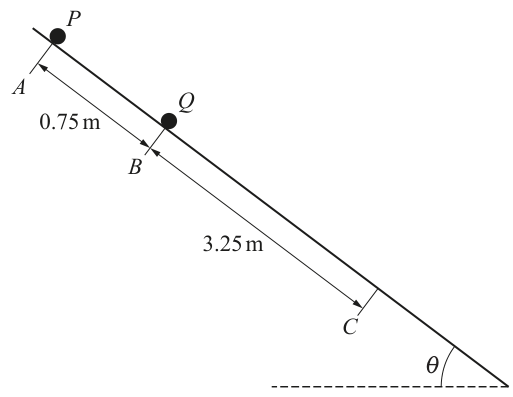
The diagram shows two particles and which lie on a line of greatest slope of a plane . Particles and are each of mass . The plane is inclined at an angle to the horizontal, where . The length of is and the length of is . The section of the plane is smooth and the section is rough. The coefficient of friction between each particle and the section is . Particle is released from rest at . At the same instant, particle is released from rest at .
Approach
Particle slides down the smooth section . The only force along the plane is the component of weight . Use Newton's second law to find the acceleration, then apply the constant acceleration formulae to verify the speed at and the time taken.
Working
The component of weight acting down the plane is . Since is smooth, there is no friction.
By Newton's second law along the plane:
Particle starts from rest, so , and travels m to reach .
Using :
Using :
Both results are verified.
Answer
Particle reaches at s with speed m s.
t = 0.5 s, v = 3 m s^{-1}
Walkthrough
First, we identify the forces acting on particle as it slides down the smooth section . Since the plane is smooth, the only force along the surface is the component of the particle's weight parallel to the plane, which is . The perpendicular component is balanced by the normal reaction.
Applying Newton's second law along the direction of motion gives . The mass cancels, leaving m s. This is the constant acceleration down the plane.
With (released from rest), m s, and m, we use to find the speed at : , so m s. Then we use to find the time: , giving s. Both required values are verified.
Key Takeaways
- On a smooth inclined plane, the acceleration is regardless of mass.
- The suvat equations can be used flexibly: finds speed from distance, and finds time from speed.
Common Mistakes
- Forgetting to cancel the mass when applying Newton's second law on an incline.
- Using instead of for the component along the plane.
- Not showing the method clearly — the mark scheme requires seeing the Newton's second law attempt and the suvat substitution.
Things to Be Careful About
- The value m s is used (implied by ).
- Ensure signs are consistent: acceleration is positive down the plane, and all quantities are measured in the same direction.
Find the time that it takes from the instant the two particles are released until they collide.
Approach
Both particles accelerate down the rough section with the same acceleration (mass cancels). Particle enters at s with speed m s. Particle enters at s from rest. Find the common acceleration, then write displacement equations for both particles measured from , and set them equal to find the collision time.
Working
Acceleration on rough section :
The forces on either particle along the plane are down the plane and friction up the plane.
Since , we have .
By Newton's second law:
Displacement of from :
Let be the time elapsed after reaches (so corresponds to s after release). Particle has m s and m s:
Displacement of from :
When reaches , has been moving on for s. Let be the total time from release. Then has been on for seconds with and :
At collision, . Since :
Expanding:
Answer
The particles collide s after they are released.
1 s
Walkthrough
First, we determine the acceleration of particles on the rough section . The component of weight down the plane is . The frictional force up the plane is . The net force down the plane is , giving acceleration m s.
Particle starts from at the instant of release (). By the time reaches (at s), has already been accelerating for s and has moved a distance of m down the plane, with speed m s.
We measure both displacements from . Let be the total time from release. Particle 's displacement from after time is . Particle 's displacement from is measured from the moment it enters at s, so it has been on for seconds with initial speed m s: .
Setting and solving gives s. The collision occurs 1 second after release.
Key Takeaways
- Both particles have the same acceleration on the rough section since mass cancels in Newton's second law.
- When tracking two moving objects, choose a common reference point and express both displacements in terms of a single time variable.
- The time offset between the two particles entering the rough section must be carefully accounted for.
Common Mistakes
- Using different accelerations for and on — they are the same since mass cancels.
- Forgetting that has an initial speed of m s when entering , treating it as starting from rest.
- Setting up the displacement equations with inconsistent time variables.
Things to Be Careful About
- Ensure the same acceleration m s is used in both displacement expressions.
- The collision point must be between and : at s, m, which is less than m, so the collision does occur on .
- The mark scheme accepts alternative methods including relative velocity: at s after enters , has speed m s and is m ahead, so s, giving total time s.
The two particles coalesce when they collide. The coefficient of friction between the combined particle and the plane is still .
Find the time that it takes from the instant the particles collide until the combined particle reaches .
Approach
At the collision instant ( s), find the speeds of and using suvat. Apply conservation of linear momentum to find the speed of the combined particle immediately after coalescence. Then determine the remaining distance to and use suvat to find the time to reach .
Working
Speeds at collision ( s):
For : it has been on for s with m s and m s:
For : it has been on for s with and m s:
Conservation of momentum at coalescence:
Both particles move down the plane (same direction), so:
Position of collision:
Distance from at collision (using 's motion):
Remaining distance to :
Motion of combined particle from collision to :
The combined particle has mass . The acceleration on the rough plane is the same as before (mass cancels):
Using with , , :
Multiply by :
Using the quadratic formula:
Answer
The time from collision until the combined particle reaches is s.
0.25 s
Walkthrough
At the moment of collision ( s), we first determine the individual speeds. Particle has been accelerating at m s for s on starting at m s, giving m s. Particle has been accelerating from rest for s, giving m s.
Since the particles coalesce, we apply conservation of linear momentum along the plane. Both move in the same direction (down the plane), so , yielding m s.
The collision occurs at a distance of m from (calculated from 's displacement: m). Since m, the remaining distance to is m.
The combined particle of mass continues on the rough plane. The acceleration is unchanged at m s because mass cancels in Newton's second law. Using with , , , we solve the quadratic to get s (rejecting the negative root).
Key Takeaways
- Conservation of momentum applies during coalescence: the combined mass is the sum, and both particles share the same final velocity.
- The acceleration on the rough incline is independent of mass, so it remains m s after coalescence.
- Always check that the collision point lies within the rough section before proceeding.
Common Mistakes
- Forgetting that both particles move in the same direction at collision, so momenta add (not subtract).
- Using in the momentum equation and then withholding the final mark — the mass must cancel properly.
- Using the wrong distance: the remaining distance is m, not m or m.
- Using or instead of the correct m s for the rough section.
Things to Be Careful About
- The quadratic equation has two roots; only the positive root s is physically meaningful.
- The acceleration of the combined particle is the same as for individual particles because mass cancels: m s.
- Ensure the collision happens before : at s, the distance from is m m, so this is valid.