Mathematics 9709/22 — February/March 2024
Cambridge AS Level · Pure Mathematics 2 · worked solutions for every part, with the mark scheme
Topics Algebra · Trigonometry · Integration · Differentiation · Logarithmic and Exponential Functions · Numerical Solution of Equations
Use logarithms to solve the equation . Give your answer correct to 3 significant figures.
Approach
Take natural logarithms of both sides so the unknown can be brought down from the exponents using the power law. Then expand, collect the -terms, and solve the resulting linear equation.
Working
Take of both sides:
Apply the power law:
Expand both sides:
Collect the -terms on one side:
Factor out :
Solve for :
Evaluate:
Therefore, correct to 3 significant figures:
x = 6.78
Walkthrough
This is an exponential equation because the variable appears in the exponents. To solve it, take logarithms of both sides. Any base works, but natural logarithms are standard. The key step is the power law: , which lets us move the exponents down in front of the logarithms. Applying this gives a linear equation in . Then expand the brackets, bring all terms involving to one side, factor out , and divide. Finally, round to 3 significant figures.
The mark scheme requires applying logarithms and the power law at least once, then solving the linear equation. Showing the logarithmic equation before evaluating is important for method marks.
Key Takeaways
- Exponential equations with different bases can be solved by taking logarithms.
- The power law of logarithms converts an exponent into a multiplier.
- After taking logarithms, the equation becomes linear in .
- Rounding should be done at the end to avoid rounding errors.
Common Mistakes
- Forgetting to apply the power law to both exponents.
- Expanding incorrectly: must be expanded to , not times only one term.
- Sign errors when moving terms across the equation.
- Rounding prematurely, which can change the final answer.
- Using different logarithm bases inconsistently.
Things to Be Careful About
- The final answer must be correct to 3 significant figures; has three significant figures.
- Any consistent logarithm base gives the same answer; do not mix bases in one calculation.
- The denominator is positive, so there is no sign issue in division. However, check signs carefully when rearranging.
- If the mark scheme asks for method, show the logarithmic equation before evaluating.
Sketch the graph of , stating the coordinates of the points where the graph meets the axes.
Approach
Find the vertex by setting the expression inside the modulus to zero, then find the y-intercept by substituting . Sketch the V-shaped graph using these points.
Working
Find the x-intercept (vertex):
So the vertex is at .
Find the y-intercept by setting :
So the y-intercept is at .
The graph is V-shaped with the vertex on the positive x-axis at , and the left arm passing through .
Answer
Vertex: , y-intercept:
Vertex: (7/3, 0), y-intercept: (0, 7)
Walkthrough
First, we identify the vertex of the modulus graph . The vertex occurs where the expression inside the modulus is zero, giving , so . This is the x-intercept.
Next, we find the y-intercept by substituting into the equation: . This gives the point .
The graph of is V-shaped. The right arm () has gradient 3, and the left arm () has gradient -3. We sketch this V-shape with the vertex at and the left arm passing through .
Key Takeaways
- The graph of is V-shaped with its vertex on the x-axis at .
- The y-intercept is found by evaluating .
- The two arms have gradients and .
Common Mistakes
- Forgetting to take the absolute value when finding the y-intercept (getting instead of ).
- Incorrectly placing the vertex on the y-axis instead of the x-axis.
Things to Be Careful About
- Ensure the sketch clearly shows the V-shape and the correct intercepts. The mark scheme awards marks for the shape and the coordinates.
Hence find the set of values of the constant for which the equation has exactly two real roots.
Approach
The equation represents the intersection of the graph from part (a) and the straight line . The line passes through the fixed point on the x-axis. We need to find the values of for which there are exactly two intersections.
Working
The line has gradient and passes through the fixed point .
The graph consists of two linear parts:
- Right arm (): , with gradient .
- Left arm (): , with gradient .
The point lies on the positive x-axis, to the right of the vertex . Since the V-shape is always non-negative (), and the line is negative for when , there can be no intersections for if . Thus, cannot give two roots.
If , the line is , which intersects the V-shape only at the vertex , giving one root.
For exactly two roots, we need . The line will then have a positive y-value for , allowing it to intersect both arms of the V-shape.
The left arm has gradient . For the line to intersect the left arm, its gradient must be greater than (i.e., less steep than the left arm). If , the line is parallel to or steeper than the left arm and will not intersect it (or will intersect only at the vertex, giving fewer than two roots).
Therefore, for exactly two real roots, the gradient must satisfy:
Answer
-3 < k < 0
Walkthrough
The equation can be interpreted graphically as finding the intersection points of and .
The graph is the V-shaped graph from part (a), with vertex at , left arm gradient , and right arm gradient .
The equation represents a straight line with gradient passing through the fixed point . Since is on the x-axis to the right of the vertex, we analyse how the line intersects the V-shape.
For the line to intersect the V-shape in exactly two points, it must cross both arms. Since the V-shape is above or on the x-axis, and the line passes through on the x-axis, the line must go upwards to the left (negative gradient) to intersect the left arm. Thus .
The left arm has gradient . If the line's gradient is less than or equal to (i.e., ), the line is parallel to or steeper than the left arm, meaning it will not intersect the left arm (or will only touch at the vertex). For the line to intersect the left arm, it must be less steep than the left arm, so .
If , the line is the x-axis, intersecting only at the vertex (one root). If , the line goes downwards to the left, where the V-shape is positive, so no intersection occurs for . Thus .
Combining these conditions, we get .
Key Takeaways
- Interpreting equations as intersections of graphs is a powerful technique for solving modulus equations.
- Fixed points on lines (like here) help visualise the family of lines.
- Comparing gradients determines the number of intersections.
Common Mistakes
- Forgetting that the line must have a negative gradient to intersect both arms.
- Including or in the answer, which give fewer than two roots.
Things to Be Careful About
- Use strict inequalities () not inclusive inequalities (), as the boundary cases give exactly one root.
- Ensure the reasoning clearly explains why must be between and .
The polynomial is defined by
where is a constant. It is given that is a factor of .
Approach
Since is a factor of , the factor theorem gives . Substitute into and solve for . Then divide the cubic by to obtain a quadratic factor, and factorise that quadratic completely.
Working
Substitute :
Simplify:
Combine the constant terms:
So:
Now divide by :
Factorise the quadratic:
Therefore:
Answer
a = 31; p(x) = (2x - 1)(3x + 2)(x + 5)
Walkthrough
We are told that is a factor of . By the factor theorem, if is a factor then the corresponding root is and . Substituting into the cubic gives an equation involving only . Simplify the fractions and solve to find . Then replace in and divide by the known factor . The quotient is a quadratic, which we factorise into two linear factors. This gives the complete factorisation.
Key Takeaways
- The factor theorem states that if is a factor of a polynomial , then .
- Polynomial division by a linear factor reduces a cubic to a quadratic.
- A cubic with three linear factors can be written as the product of three binomials.
Common Mistakes
- Forgetting to set ; substituting without equating to zero gives no equation for .
- Arithmetic errors when combining fractions such as , and .
- Sign errors during polynomial division, especially when subtracting.
- Stopping after finding the quadratic factor instead of factorising it completely.
Things to Be Careful About
- The factor is , so the root is , not or .
- When dividing, keep the divisor as and check the quotient by multiplying back.
- Include the constant term correctly in the division.
Approach
Use the factorised form of from part (a). Set and solve for . Since , only roots with can be valid for real . Solve the resulting equation for in the given range.
Working
From part (a):
So gives:
Hence:
Since and , we need . Therefore only is possible.
For :
Answer
theta = -11.5 degrees
Walkthrough
Use the factorised form of from part (a). Replacing with means each factor can be zero, giving three possible values for : , , and . However, , and since is always between and , the reciprocal must have magnitude at least . Therefore and are impossible. Only remains. Solving in the range gives .
Key Takeaways
- The range of is .
- When solving , check which roots are attainable by .
- Inverse sine returns the principal value in , which matches the given range.
Common Mistakes
- Trying to solve or from invalid roots.
- Forgetting that , so writing without converting.
- Giving only the positive angle or missing the negative sign.
Things to Be Careful About
- The range excludes the endpoints, but our answer lies inside the interval.
- Ensure the calculator is in degrees when evaluating .
- Use the correct root from part (a); only is valid because .
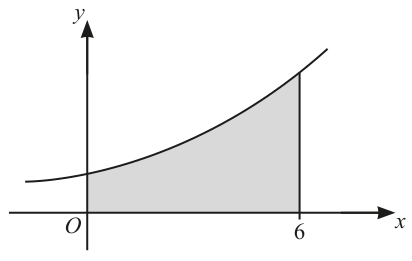
The diagram shows the curve with equation . The shaded region is bounded by the curve and the straight lines , and .
Use the trapezium rule with three intervals to find an approximation to the area of the shaded region. Give your answer correct to 3 significant figures.
Approach
Divide the interval into three equal sub-intervals, so each has width . Evaluate at the four values , then apply the trapezium rule.
Working
With and intervals, the -values are , , , .
The corresponding -values are:
Apply the trapezium rule:
Rounded to 3 significant figures, the approximation is .
Answer
15.7
Walkthrough
The trapezium rule approximates the area under a curve by replacing small sections of the curve with straight-line segments (trapeziums). With 3 intervals across , each interval has width . The -values are therefore .
At each of these -values we substitute into . Notice that , so , giving . At , we get , so . At , , and at , . These exact forms are useful for the B1 mark; the mark scheme also accepts decimal equivalents.
The trapezium rule formula is , with the end values unweighted and the interior values doubled. Since , the factor is , which simplifies the calculation considerably — we just sum the four values with the interior ones doubled.
Substituting the decimal approximations gives , which rounds to to 3 significant figures.
Key Takeaways
- The trapezium rule approximates the area under a curve using straight-line segments.
- For intervals across , the width is and the formula is .
- The end ordinates are unweighted, but every interior ordinate is doubled.
- Always keep more digits during calculation and round only at the end to the required precision.
Common Mistakes
- Forgetting to double the interior -values (an easy slip when happens to equal ).
- Using the wrong number of intervals — with 3 intervals you need 4 -values, not 3.
- Computing incorrectly: the exponent is , not written as .
Things to Be Careful About
- Make sure to read the exact form of each -value correctly, since , , and .
- 3 significant figures means 3 meaningful digits, so , not .
- Keep the unrounded sum until the very last step to avoid premature rounding error.
The shaded region is rotated completely about the -axis.
Find the exact volume of the solid produced.
Approach
When the region under a curve is rotated about the -axis, the volume of the solid of revolution is given by
Since , we integrate this from to and multiply by .
Working
Set up the volume integral:
Integrate term by term. The constant integrates to , and for we use with , giving :
Evaluate at the upper limit :
Evaluate at the lower limit :
Subtract:
Answer
4π + 2πe³
Walkthrough
The standard formula for the volume of the solid obtained by rotating the region under a curve from to about the -axis is . Each thin vertical strip of width becomes a disc of radius and area , and these discs are stacked to form the solid.
Squaring the given function simplifies the integral significantly: . This avoids the awkward that would otherwise appear under the integral sign.
We integrate two terms. The first, , is straightforward. The second uses the standard result . Here , so the integral of is . This gives the antiderivative .
We now evaluate between the limits. At : . At : . The difference is , and multiplying by the outside gives .
Key Takeaways
- The volume formula is essential for solids of revolution about the -axis.
- Squaring the integrand before integrating can dramatically simplify the calculation.
- For , divide by the coefficient in the exponent.
Common Mistakes
- Forgetting the factor in the volume formula.
- Integrating as just instead of .
- Sign errors when subtracting the lower limit: remember it is .
- Forgetting to multiply by at the end if it was omitted during integration — though the mark scheme accepts introduced at the end.
Things to Be Careful About
- The exact answer must be left in terms of and ; do not approximate.
- Check the integration constant: the lower limit gives , not .
- Equivalently, the answer can be written as — the mark scheme allows exact equivalents.
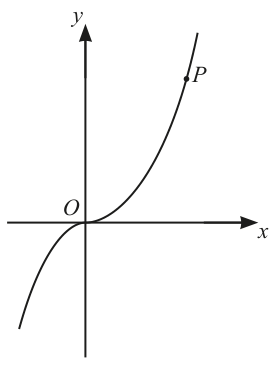
The diagram shows part of the curve with equation . At the point , the gradient of the curve is 6.
Approach
Differentiate using the quotient rule, set the derivative equal to 6 (the gradient at ), and rearrange the resulting equation to obtain .
Working
By the quotient rule, with and (so and ):
Expand and simplify the numerator:
At the gradient is 6, so:
Multiply both sides by :
Expand the right-hand side:
The terms cancel on each side:
Divide by 2:
Take the cube root of both sides:
Answer
x = ∛(12x + 12)
Walkthrough
We are given the curve and told that at point the gradient is 6. We need to show that the -coordinate of satisfies .
Step 1: Differentiate using the quotient rule. With and , we have and , so:
Expanding the numerator gives , so:
Step 2: Equate to the given gradient. Setting the derivative equal to 6:
Step 3: Rearrange. Multiplying both sides by and expanding the right-hand side gives:
The terms cancel on each side, leaving . Dividing by 2 gives:
Step 4: Take the cube root. The cube root is the inverse of cubing, so:
This is the required equation.
Key Takeaways
- The quotient rule is the key tool for differentiating a quotient of two functions.
- Setting the derivative equal to a known gradient and rearranging algebraically is the standard way to find a specific point on a curve.
- The cube root is the inverse of cubing, used here to rewrite the equation in a form suitable for iteration.
Common Mistakes
- Forgetting the minus sign in the quotient rule: it is , not .
- Errors expanding as .
- Failing to cancel the terms on both sides after expanding.
- Trying to divide by at some point, which would be invalid (the root is not ).
Things to Be Careful About
- The quotient rule must be applied correctly, with the minus sign between and .
- All intermediate algebraic steps must be shown, since the question asks to "show that" the equation holds.
Approach
Define , a continuous function whose zero is the -coordinate of . Evaluate at and . If the values have opposite signs, a root lies in the interval.
Working
At :
Estimating the cube root. Since and , lies just above , so :
At :
Estimating the cube root. Since and , :
Since and , the continuous function changes sign between and . By the intermediate value theorem, the root of (the -coordinate of ) lies in the interval .
Answer
The -coordinate of lies between 3.8 and 4.0.
The x-coordinate of P lies between 3.8 and 4.0
Walkthrough
We use the sign-change (intermediate value) method to locate the root.
Step 1: Define a continuous function whose root we seek. From part (a), the -coordinate of satisfies . Rearranging gives , so define:
The function is continuous because it is built from continuous operations (addition, multiplication, cube root).
Step 2: Evaluate at . Compute . To estimate, find values whose cubes bracket : and . So lies just above , approximately . Thus:
Step 3: Evaluate at . Compute . Bracketing: and , so . Thus:
Step 4: Apply the intermediate value theorem. Since is continuous and changes sign on the interval , there is a root in the open interval .
Key Takeaways
- The sign-change method relies on the intermediate value theorem: a continuous function that changes sign over an interval must have a root there.
- The choice is natural because the original equation is .
- Estimating cube roots can be done by bracketing: find with and interpolate.
Common Mistakes
- Computing only without subtracting to obtain a signed value.
- Computing the cube root inaccurately, leading to wrong sign.
- Failing to invoke the sign-change argument (or intermediate value theorem) to justify the conclusion.
- Using the equivalent function without showing the sign change at both endpoints.
Things to Be Careful About
- The mark scheme accepts approximate values for and (e.g., and ), but the sign change must be clear.
- The conclusion follows from continuity of , which is automatic here.
- is positive for both and , so the real cube root is well-defined.
Use an iterative formula, based on the equation in part (a), to find the -coordinate of correct to 3 significant figures. Show the result of each iteration to 5 significant figures.
Approach
Use the equation from part (a) to construct the iterative formula . Starting from , iterate until the values stabilize to 3 significant figures.
Working
Take . Then:
From onwards, each value rounds to to 3 significant figures, so the iteration has converged. The -coordinate of is to 3 significant figures.
Answer
x = 3.88
Walkthrough
We use the equation from part (a) to construct an iterative formula.
Step 1: Construct the iterative formula. Set and define:
Step 2: Choose a starting value. From part (b), the root lies between 3.8 and 4.0. Start with (any value in the interval works).
Step 3: Iterate. Each step substitutes the previous iterate into the formula. The values are computed to 5 significant figures:
Step 4: Round to 3 significant figures. The sequence converges to , which rounds to to 3 significant figures. From onwards, each iterate rounds to at 3 sig fig, justifying the answer.
Key Takeaways
- The iterative formula allows numerical solution of equations that cannot be solved algebraically.
- Each iteration should be computed to 5 significant figures (or more) to ensure accuracy of the rounded final answer.
- Iteration should continue until successive values agree to the required precision.
Common Mistakes
- Rounding intermediate iterates too aggressively (e.g., to 3 sig fig), which can slow convergence or cause the sequence to stabilise at a wrong value.
- Stopping the iteration too early, before values have stabilised.
- Not displaying iterations to 5 significant figures, as required by the mark scheme.
- Choosing a starting value outside the interval from part (b).
Things to Be Careful About
- The number of iterations needed depends on the function and required precision; here, six iterations are sufficient.
- The iteration converges because near the root, where and .
- The final answer is correct to 3 significant figures; the converged value is approximately .
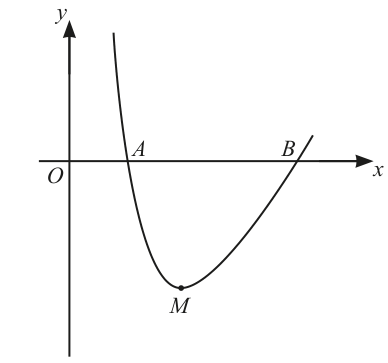
The diagram shows the curve with parametric equations
for . The curve crosses the -axis at the points and and has a minimum point .
Approach
Use the product rule to find , find by the chain rule, then form .
Working
Differentiate :
Differentiate using the product rule, with each factor having derivative :
Form by dividing by :
Answer
dy/dx = (4 ln t - 2) / sqrt(t)
Walkthrough
The curve is given parametrically, so to find we need both and and then take the quotient .
For , rewriting as and using the standard power rule gives .
For , both factors are functions of that depend on , whose derivative is . The product rule states . Applying it here gives , which simplifies to .
Finally, dividing gives . Since , we obtain , as required.
Key Takeaways
- Parametric differentiation uses .
- The product rule is needed when is given as a product of two functions of .
- The derivative of is , regardless of what it is multiplied or composed with.
Common Mistakes
- Forgetting to divide rather than multiply when forming from parametric derivatives.
- Differentiating only one of the two factors in and forgetting the other half of the product rule.
- Errors simplifying — remember this equals .
Things to Be Careful About
- The expression in the denominator of is undefined for , but the question restricts so this is fine.
- Watch the sign carefully when combining the two product-rule terms: , not .
Approach
Find at by setting , then substitute that into the formula for from part (a).
Working
At the points where the curve meets the -axis, :
From Fig. 6.1, is the point with the larger -coordinate. Since is increasing in , corresponds to the larger :
Substitute into :
Answer
10e^(-3/2)
Walkthrough
To find the gradient at a specific point on a parametric curve, we first need the parameter value at that point. The points and are where the curve crosses the -axis, so at both. Setting the product and applying the zero-product property gives or , hence or .
We have to decide which value corresponds to . Looking at the figure, is the rightmost of the two intercepts, so it has the larger . Since is increasing in , corresponds to the larger , namely .
Plugging into : the numerator becomes , and the denominator is . So the gradient is .
Key Takeaways
- -axis crossings on a parametric curve are found by solving .
- When a curve has multiple solutions, the figure (or the wording) tells you which one to use.
- Always substitute the parameter value into the formula for to get the gradient at a specific point.
Common Mistakes
- Picking the wrong root () and using that at . The figure shows is the right-hand intercept.
- Writing the answer as without simplifying to — both are usually accepted as exact equivalents.
- Forgetting that rather than or written ambiguously.
Things to Be Careful About
- , which is less than , so both roots lie in the domain .
- The problem asks for the exact gradient, so a decimal answer would lose marks.
Approach
At the minimum , . Solve for , then substitute into the parametric equations to obtain the coordinates.
Working
Set :
Since for , the numerator must vanish:
-coordinate:
-coordinate:
Answer
M = (1 + e^(1/4), -25/4)
Walkthrough
A stationary point on a curve occurs where the gradient is zero. Using the result from part (a), we set . Because for , we may multiply both sides by and deduce , giving and so .
To find the coordinates of , we substitute into both parametric equations. For the -coordinate, . For the -coordinate, we use the given product form with : .
The negative -value confirms that lies below the -axis, consistent with Fig. 6.1.
Key Takeaways
- Stationary points on a parametric curve are found by setting and solving for the parameter.
- The condition lets us multiply through without changing the equation.
- Once is found, the coordinates follow from the original parametric equations.
Common Mistakes
- Forgetting that the stationary condition applies to , not or separately.
- Setting the denominator to zero instead of the numerator.
- Using correctly — a common slip is to write again, which is wrong.
Things to Be Careful About
- We should verify this is a minimum and not a maximum. The figure shows a clear U-shape with one turning point, so the only stationary point is indeed a minimum.
- Keep the answer exact: rather than a decimal, and rather than .
Approach
Use the double-angle formula for , and rewrite and in terms of and . Then use the double-angle formula for and the Pythagorean identity to simplify.
Working
Use and :
Simplify:
Hence the identity is proved.
Answer
sin 2θ(a cotθ + b tanθ) ≡ a + b + (a - b) cos 2θ
Walkthrough
We need to prove an identity, so we start with the left-hand side and transform it until it matches the right-hand side. The first key step is to replace by . We also write and . This turns the product into . The next step is to express and using the double-angle formula for cosine: and . Substituting these gives , which simplifies to . This is exactly the right-hand side, so the identity is proved.
Key Takeaways
This question tests the double-angle formulae and the ability to rewrite trigonometric expressions in terms of and . It also tests algebraic simplification of expressions involving . The important skill is recognising when to use and its rearranged forms.
Common Mistakes
- Forgetting the factor 2 when replacing with .
- Mixing up the signs in and .
- Not showing enough detail; since the answer is given in the question, the mark scheme requires all necessary working.
Things to Be Careful About
- Keep the constants and separate; do not combine them incorrectly.
- The final expression must have , not .
- Although we divide by and when rewriting and , the identity is proved algebraically for the general expression; no special cases are needed in this proof.
Approach
Use the identity from part (a) with and to simplify the integrand, then integrate term by term and apply the limits.
Working
With , :
Therefore
Integrate:
Evaluate at the limits:
Answer
2π/3 + √3/2 - 1/2
Walkthrough
Part (a) gives a general identity. For part (b), substitute and into that identity. The integrand becomes . We then integrate term by term: the integral of the constant is , and the integral of is , because differentiating gives . We evaluate the definite integral at the upper limit and the lower limit . At , ; at , . Subtracting gives .
Key Takeaways
This question shows how a proven identity can simplify an integral dramatically. It also tests integration of and evaluation of definite integrals with exact trigonometric values.
Common Mistakes
- Forgetting that , not .
- Incorrectly substituting the limits: , not .
- Arithmetic errors when subtracting the two limit values, especially with fractions involving .
Things to Be Careful About
- Use the identity from part (a) exactly; with , , the coefficient of is .
- The limits are and ; convert carefully when evaluating .
- The answer must be exact; do not give a decimal approximation.
Approach
Compare the given expression with the identity from part (a), using , , . Then solve the resulting cosine equation within the interval .
Working
Using part (a) with , and :
Set this equal to 11:
Let . Since , we have . In this interval,
The next solutions differ by and lie outside this interval, so these are the only two solutions. Therefore
Numerically, , so
To 3 significant figures,
Answer
α ≈ 2.97 or α ≈ -2.97
Walkthrough
This part uses the identity from part (a) in reverse. Compare the expression with the identity: we have . This matches with , , . Therefore the left-hand side equals . Setting this equal to 11 gives , so , or . Let . The condition becomes . The equation has two solutions in this interval: . Multiplying by gives . No other solutions lie in the interval because the next solutions are obtained by adding multiples of , which fall outside .
Key Takeaways
This question combines a proven trigonometric identity with solving a trigonometric equation over a restricted interval. It tests the ability to match parameters and to use the inverse cosine function correctly, including both positive and negative solutions.
Common Mistakes
- Forgetting to multiply by after solving for .
- Only giving the positive solution and missing the negative solution.
- Not checking the interval; because is even, both solutions are valid, but other periodic solutions must be excluded.
- Sign error when rearranging ; it gives , not .
Things to Be Careful About
- The identity gives . With , , the coefficient is , so the expression is .
- The interval for is , so lies in . Both lie inside this interval.
- The final answers are approximate; the mark scheme accepts (or greater accuracy).