Mathematics 9709/12 — February/March 2024
Cambridge AS Level · Pure Mathematics 1 · worked solutions for every part, with the mark scheme
Topics Integration · Trigonometry · Functions · Differentiation · Series · Quadratics · +2 more
Find the exact value of
Approach
Evaluate the improper integral by first rewriting as , finding its antiderivative, and then treating the infinite upper limit as a limit.
Working
Treat the upper limit as a limit:
Answer
2/3
Walkthrough
This is an improper integral because the upper limit is infinite. We cannot substitute directly, so we first find the antiderivative of . Since , we use the power rule to integrate: the antiderivative is . Next we evaluate the integral from to , where tends to infinity. Substituting the upper limit gives , and substituting the lower limit gives . The value of the integral is the upper-limit value minus the lower-limit value: . As , tends to , leaving .
Key Takeaways
This question tests the ability to integrate for negative powers and to recognise improper integrals by taking the infinite limit. It also reinforces the useful fact that as , which makes the upper-limit contribution vanish.
Common Mistakes
- Writing the antiderivative of as or instead of .
- Substituting directly without taking a limit.
- Sign errors when subtracting the lower limit: the correct result is , not .
- Omitting the limit step; the mark scheme requires a clear indication that the upper limit gives .
Things to Be Careful About
Write an improper integral with an infinite upper bound as a limit before evaluating. In the mark scheme, the integration earns B1, the correct limit/substitution earns M1, and the final value earns A1. Always show the antiderivative, the substitution, and the limit so that all marks are earned.
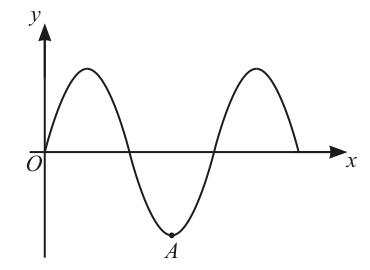
The diagram shows part of the curve with equation , where is a positive constant and is measured in radians. The curve has a minimum point .
Approach
The curve is with . The minimum value of the sine function is , so we find the smallest positive where .
Working
The minimum of is , occurring at (and ).
Set :
At :
Answer
(3π, -k)
Walkthrough
The curve is with . Since is positive, the minimum value of occurs when is at its minimum, which is . The sine function first reaches at an angle of . Setting gives . Substituting back gives . So the minimum point has coordinates .
Key Takeaways
- The sine function has minimum value at .
- For with , the minimum -value is .
Common Mistakes
- Confusing the angle where sine is minimum with where it is zero.
- Forgetting that means the minimum of corresponds to the minimum of .
Things to Be Careful About
- Ensure is in radians.
- The first minimum after the origin is at , not (which gives the maximum).
A sequence of transformations is applied to the curve in the following order.
Translation of 2 units in the negative -direction
Reflection in the -axis
Find the equation of the new curve and determine the coordinates of the point on the new curve corresponding to .
Approach
Apply the two transformations in the given order to the equation . Then track the point through the same transformations to find its image.
Working
Step 1: Translation of 2 units in the negative -direction.
Subtract 2 from :
Step 2: Reflection in the -axis.
Replace with :
Multiply through by :
Coordinates of the image of :
Point is .
After translation of 2 units in the negative -direction:
After reflection in the -axis (negate the -coordinate):
Verification: Substitute into the new equation:
This confirms the point is .
Answer
Equation:
Coordinates:
y = 2 - k sin(1/2 x); (3π, 2 + k)
Walkthrough
We apply the transformations in the given order to the original equation .
First, translate 2 units in the negative -direction. This means subtracting 2 from the -value, giving .
Second, reflect in the -axis. This means replacing with , giving , which simplifies to .
For the point corresponding to : is at . After translating 2 units down, it moves to . After reflecting in the -axis, the -coordinate is negated, giving . We can verify this by substituting into the new equation: .
Key Takeaways
- A translation of units in the negative -direction gives .
- A reflection in the -axis replaces with .
- When applying multiple transformations, apply them in the given order.
- Points transform the same way as the equation: translate coordinates, then reflect.
Common Mistakes
- Applying the reflection before the translation (order matters).
- Forgetting to negate the entire right-hand side during reflection.
- Confusing reflection in the -axis with reflection in the -axis.
Things to Be Careful About
- The order of transformations is specified and must be followed exactly.
- Reflection in the -axis affects the -coordinate, not the -coordinate.
- Verify the final point by substituting into the new equation.
A curve is such that . It is given that the points and lie on the curve.
Find the value of .
Approach
Integrate to obtain the general equation of the curve, introduce the constant of integration , then use the known point to find . Finally substitute to evaluate .
Working
Using :
Simplify the coefficient:
Substitute and :
So the constant of integration is
Therefore the curve is
At , since the point is :
Answer
a = 58
Walkthrough
The derivative gives the gradient of the curve at every point. To recover as a function of , integrate with respect to . The integrand has the linear form . When integrating something of the form , increase the power by and divide by the new power, and also divide by because of the chain rule. Here and , so
Because integration is only defined up to an additive constant, include . Use the known point : substitute and to form an equation in . Since , this gives , so . Finally, evaluate at : and , so
Key Takeaways
This question tests the basic reverse-power rule for integration, in particular when the integrand contains a linear expression such as . It also tests the use of a point on the curve to determine the arbitrary constant of integration, and the correct evaluation of fractional powers. The key idea is that integration gives a family of curves, and a given point selects the particular curve.
Common Mistakes
A common mistake is to integrate without dividing by , giving an incorrect coefficient. Another is to forget the constant before substituting the point, which makes it impossible to find the right curve. Students may also evaluate fractional powers incorrectly: and , not or . Finally, careless arithmetic when subtracting can produce instead of .
Things to Be Careful About
Always divide by the coefficient of inside the bracket when using . Introduce before using the given point, even though the mark scheme allows it to be omitted immediately after integration. Use exact fractions rather than decimals for . When substituting the second point, use the -coordinate , not the -coordinate, because the point is written as .
Approach
Start from the left-hand side, expand the square, simplify the numerator using , and then rewrite the result as .
Working
Using :
Cancel the common factor (valid wherever the expression is defined):
Since :
Answer
2 tan θ
Walkthrough
Begin with the left-hand side of the identity. Expanding gives . Subtract and use to replace the sum of the two squared terms by . The numerator becomes . Dividing by gives , and using completes the proof.
Key Takeaways
This question tests manipulation of trigonometric expressions: expanding brackets, applying the Pythagorean identity, and using the definition of . It also shows that proving an identity means starting from one side and transforming it until it matches the other side.
Common Mistakes
A common error is forgetting that the in the numerator came from , so students may wrongly simplify to zero before expanding. Another common mistake is cancelling a single from one term but not from both terms of the numerator.
Things to Be Careful About
The expression is not defined when , so cancellation by is valid only on the domain where . For this identity, the equivalence holds whenever both sides are defined. Show every step so that the mark scheme's method marks are clearly earned.
Approach
Use the identity from part (a) to replace the left-hand side by . Rearrange the resulting equation, factorise, solve for , and then find the corresponding angles in .
Working
From part (a),
So the equation becomes
Bring all terms to one side:
Factorise:
Hence either
or
so
Now solve for in the interval :
and
The tangent function is one-to-one on , so these are the only solutions.
Answer
θ = 0°, θ ≈ 32.3°, θ ≈ -32.3°
Walkthrough
Use the identity proved in part (a) to replace the left-hand side of the equation with . Rearranging gives . Factor out : this is crucial because the factor gives the solution , which would be lost if we divided by first.
The remaining factor gives , so . Since the interval is , inverse tangent gives exactly one angle for each real tangent value: and . Together with , these are all three solutions.
Key Takeaways
This question shows how a proved identity can be used to simplify a more complicated equation. It also reinforces that factorisation is safer than cancellation, and that the range of inverse tangent helps find all solutions in an interval such as .
Common Mistakes
The most common mistake is cancelling from and losing the solution . Another common mistake is giving only and forgetting the negative angle, or adding multiples, which would put the solutions outside the given interval.
Things to Be Careful About
Because the interval is , do not add periodic solutions. The tangent function has period , but the given interval contains only one representative for each value of . The final answer must include and both , with no extra angles. Show all factoring steps to earn the method mark.
A curve has the equation .
Find the equation of the normal to the curve at the point , giving your answer in the form , where , and are integers.
Approach
Differentiate using the chain rule, evaluate the gradient at , take the negative reciprocal to find the gradient of the normal, then form the equation of the normal through and rearrange it into .
Working
Write as a power of :
Differentiate with respect to :
At the point , substitute :
So the gradient of the tangent is . The gradient of the normal is the negative reciprocal of this:
Using the point and the normal gradient , the equation of the normal is:
Multiply through by :
Rearrange into the form :
Answer
3x - 8y + 2 = 0
Walkthrough
We need the equation of the normal to the curve at the point . A normal is perpendicular to the tangent, so we first need the gradient of the tangent at that point.
The curve is . To differentiate it, write it as . Using the chain rule, the derivative is . The factor comes from differentiating the inside function .
Substituting gives the gradient of the tangent at that point:
.
Since the normal is perpendicular to the tangent, its gradient is the negative reciprocal of , which is .
Now use the point-slope form of a straight line with the point and gradient :
Multiplying by gives , and rearranging gives .
Key Takeaways
- To differentiate a quotient of the form , rewrite it as and use the chain rule.
- The gradient of the tangent at a point is found by substituting the -coordinate into the derivative.
- The gradient of the normal is the negative reciprocal of the gradient of the tangent.
- A straight line can be written in the form and then rearranged into .
Common Mistakes
- Forgetting the chain rule factor when differentiating .
- Forgetting the negative sign in the derivative, which would give the wrong gradient.
- Taking the reciprocal instead of the negative reciprocal when finding the normal gradient.
- Substituting only but not using the point when forming the equation of the normal.
- Leaving the final answer in a form other than with integer coefficients.
Things to Be Careful About
- The derivative must be simplified correctly: should be reduced to , though the mark scheme also allows .
- The mark scheme requires an attempt at differentiation before awarding the normal-gradient mark, so the derivative must be shown.
- The final answer can be written as a multiple of , but the question asks for integers, so is the cleanest form.
It is given that the coefficient of in the expansion of
is 432.
Find the value of the constant .
Approach
Expand only as far as the and terms, since these are the only terms that can produce an term after multiplication by . Then multiply by , collect the coefficient of , equate it to , and solve for .
Working
The relevant terms of are
and
The term in is obtained by multiplying:
- the term by :
- the term by :
So the coefficient of is
Equate this coefficient to :
Answer
a = 3
Walkthrough
We need the coefficient of in the product . The first factor is a binomial raised to the fourth power, so we can use the binomial expansion. However, we do not need the whole expansion: after multiplying by , only certain terms can contribute to .
First, identify the and terms from . The term is , which simplifies to . The term is , which simplifies to . These are the only terms that matter because, when multiplied by , the term can combine with to give , and the term can combine with to give .
Next, perform those two multiplications. Multiplying by gives . Multiplying by gives . Adding these gives the total coefficient .
Finally, set , divide by to get , and take the real cube root to obtain . Since the cube root is unique for real numbers, there is no second solution.
Key Takeaways
This question tests the binomial expansion of for a positive integer , and the ability to select only the terms needed for a particular power in a product. It also reinforces that when multiplying two expansions, the coefficient of a given power comes from combining several contributing products, and that a cubic equation such as has a unique real solution.
Common Mistakes
- Expanding the whole of unnecessarily, increasing the chance of arithmetic errors.
- Forgetting to multiply the term by , and only using the term multiplied by .
- Sign errors when multiplying by : the product must be , not .
- Incorrect binomial coefficients, e.g. writing instead of , or instead of .
- Equating the coefficient of in itself to , instead of the coefficient in the full product.
Things to Be Careful About
The coefficient of in the final product is not simply one term; it is the sum of two contributions. Be careful with the sign of when multiplying by . Also, the final equation is , not ; taking the cube root gives the single real value . The mark scheme requires the answer only, with no other real solutions.
The straight line meets the curve at a single point .
Approach
Substitute the line equation into the curve equation to obtain a quadratic in . Then use the fact that the line meets the curve at a single point, so the quadratic has exactly one solution and its discriminant is zero. Solve this discriminant condition to find .
Working
Substitute into :
Expand and simplify:
For a unique intersection, the discriminant of this quadratic must be zero:
Here , , , so:
Answer
k = 30
Walkthrough
We are given a line and a curve. To find where they meet, substitute the line equation into the curve equation. This removes one variable and gives a quadratic equation in . The phrase “meets at a single point” tells us that the line is tangent to the curve, so the quadratic has exactly one repeated root. A quadratic has a repeated root exactly when its discriminant is zero. Therefore, after writing the equation as , we identify , , and set . This simplifies to , which gives .
Key Takeaways
- A “single point” intersection between a line and a curve corresponds to a zero discriminant.
- Substitution is the standard method for solving a pair of equations where one is linear and one is quadratic.
- The discriminant condition can be used to find an unknown constant in the curve equation.
Common Mistakes
- Forgetting to set the discriminant equal to zero; some students set it greater than or less than zero.
- Expanding incorrectly.
- Moving to the wrong side and using instead of .
- Not simplifying the discriminant fully before solving for .
Things to Be Careful About
- The coefficient of is , not , after substitution.
- The discriminant must be computed using the coefficients of the quadratic in the form .
- The mark scheme requires explicit substitution and the discriminant equation; an unsupported answer is not sufficient.
Approach
Use the value of found in part (a) in the quadratic equation obtained by substitution. Solve the resulting quadratic to find the -coordinate of the single meeting point, then use the line equation to find the -coordinate.
Working
With , the equation becomes:
Divide by :
So . Substitute into :
Answer
P = (-3, 2)
Walkthrough
We already found in part (a). Substitute this value back into the quadratic obtained from the line and curve:
This simplifies to . Dividing by 5 gives , which is . Therefore the only solution is . Using the line equation , we get . Hence the point is .
Key Takeaways
- Once the constant is known, the same substitution equation gives the intersection point.
- A repeated root corresponds to the single tangent point.
- Always use the line equation to find the other coordinate.
Common Mistakes
- Using an incorrect value of from part (a).
- Forgetting to divide the quadratic by 5 before factorising.
- Stopping after finding and not finding .
- The mark scheme awards only SC B1 for coordinates without an attempt to solve the quadratic, so working must be shown.
Things to Be Careful About
- The root is repeated, so is the only -coordinate.
- Substitute into the line to find .
- Check the point satisfies the curve: .
An arithmetic progression is such that its first term is 6 and its tenth term is 19.5.
Find the sum of the first 100 terms of this arithmetic progression.
Approach
Use the formula for the th term of an arithmetic progression to find the common difference , then substitute , and into the formula for the sum of the first terms.
Working
The th term of an arithmetic progression is
Given and :
Solve for :
The sum of the first terms is
For :
Answer
8025
Walkthrough
Start with the th term formula for an arithmetic progression, . Substitute the known first term and the tenth term with . This gives , because there are 9 common differences between the first and tenth terms. Solving gives .
Then use the sum formula . Substitute , and . The bracket becomes , and multiplying by gives .
Key Takeaways
This question tests the two fundamental arithmetic progression formulae: the th term and the sum of the first terms. It also requires careful substitution and arithmetic with decimals.
Common Mistakes
- Using instead of in the sum formula, since there are only 99 differences between 100 terms.
- Forgetting to multiply by after finding the bracket.
- Substituting the tenth term directly as instead of .
Things to Be Careful About
Make sure the common difference is found correctly before using the sum formula. The mark scheme requires the substitution into the sum formula to use the candidate's value of , so keep the working clear. Also check decimal arithmetic carefully: and .
A geometric progression is such that and the common ratio is .
The sum to infinity of this geometric progression is denoted by . The sum to infinity of the even-numbered terms (i.e. ) is denoted by .
Find the values of and .
Approach
Use the sum to infinity formula for the full geometric progression. For the even-numbered terms, identify their first term and common ratio, then apply the same formula.
Working
For the full geometric progression, and . Since , the sum to infinity exists:
The even-numbered terms are . Their first term is
and their common ratio is the square of the original common ratio:
Therefore,
Answer
S = 48, S_E = 16
Walkthrough
The sum to infinity of a geometric progression is , valid only when . Here and , so .
For the even-numbered terms , the first term is . To find the common ratio, notice that moving from one even term to the next means multiplying by twice, so the new common ratio is . Then .
Key Takeaways
This question shows how a subsequence of a geometric progression can itself be a geometric progression. It also reinforces the sum to infinity formula and the convergence condition .
Common Mistakes
- Using the original common ratio for the even-numbered terms instead of .
- Taking the first term of the even-numbered terms as instead of .
- Applying the sum to infinity formula without checking that the common ratio has magnitude less than 1.
Things to Be Careful About
The mark scheme awards a method mark for attempting the sum to infinity with at least one of the first term and common ratio correct, but only if . Both and satisfy this. Keep the first term and common ratio for the even-numbered subsequence clearly identified before substituting.
The functions and are defined for all real values of by
where is a constant.
Approach
The composite means apply after . Since the range of is given as , the minimum value of must be . The expression is a square, so its least value is ; this gives the minimum of .
Working
Given:
Form :
Simplify:
Since , the minimum value of is . The range is , so:
Solve:
Answer
k = 8
Walkthrough
First, interpret as : replace every in with . This gives , which simplifies to .
The key observation is that is a perfect square, so it can never be negative. Its smallest possible value is , occurring when , i.e. . Therefore the smallest value of is .
The statement "the range of is " tells us that is exactly the minimum value. So set and solve: , giving .
Key Takeaways
- Composite functions are evaluated from the inside out: .
- A squared expression has minimum value .
- The lower bound of a range is the minimum value of the function.
Common Mistakes
- Using instead of ; the order matters.
- Treating the range condition as and concluding ; since is the minimum, equality is required.
- Algebraic errors when expanding .
Things to Be Careful About
- The mark scheme requires equality , not an inequality, to find the exact value of .
- Ensure the coefficient multiplies both the square and .
Approach
Use found in part (a). Form the composite by applying after , then use the fact that a squared term is always non-negative to identify the minimum value and hence the range.
Working
Given and , form :
Simplify inside the square:
So:
Since , the minimum value of is . Therefore:
Answer
fg(x) >= 8
Walkthrough
With , substitute into : .
Now form . Since , replace in by :
Simplify inside the bracket:
Thus .
The square is always at least , so is always at least . Since can take every real value as varies, the square can actually be , so the range is .
Key Takeaways
- Composition order matters: .
- The range of a quadratic in completed-square form is determined by its minimum value.
- A square term has minimum and can attain every non-negative value.
Common Mistakes
- Forgetting to add the constant after squaring.
- Writing instead of including the .
- Using instead of ; the minimum is actually attained.
Things to Be Careful About
- Use the value of from part (a), even if it was obtained via an inequality.
- The answer must be , not , because the square can equal .
The function is defined for all real values of and is such that .
Find an expression for and hence, or otherwise, find an expression for .
Approach
Find the inverse of the linear function . Then apply to both sides of to isolate .
Working
Let . Solve for :
So:
Given:
Apply to both sides:
Simplify:
Answer
g^-1(x) = (x+1)/5, h(x) = 7x + 4
Walkthrough
To find , write and solve for in terms of :
Interchanging the variable names gives .
Now . Applying to both sides undoes on the left:
Substitute into the inverse:
Key Takeaways
- The inverse of a linear function is found by solving for .
- If is known, applying isolates .
- Composition and inverse are inverse operations: .
Common Mistakes
- Writing instead of .
- Applying incorrectly, e.g. substituting rather than .
- Forgetting to state before using it.
Things to Be Careful About
- The inverse must be clearly indicated; the mark scheme awards a mark for .
- When simplifying, combine and before dividing by .
- The final expression must be identified as .
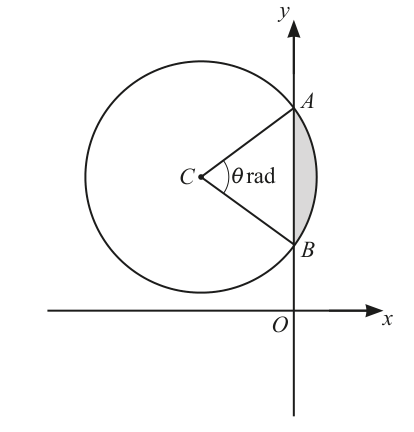
The diagram shows the circle with centre and radius units. The circle intersects the -axis at the points and . The size of angle is radians.
Approach
Find the gradient of the radius connecting the centre to the point . The tangent is perpendicular to this radius, so its gradient is the negative reciprocal. Use the point-slope form to find the equation of the tangent line.
Working
The centre of the circle is and the point on the circle is . The gradient of the radius is:
Since the tangent is perpendicular to the radius at the point of contact, the gradient of the tangent satisfies :
Using the point-slope form with the point and gradient :
Expanding and rearranging:
Answer
y = 1/2 x + 12
Walkthrough
First, we identify the coordinates of the centre of the circle and the point of tangency . We calculate the gradient of the radius using the standard gradient formula , which gives . A key geometric property is that the tangent to a circle is always perpendicular to the radius at the point of contact. Therefore, we find the gradient of the tangent by taking the negative reciprocal of , which is . Finally, we use the point-slope form of a straight line equation with the known point and the new gradient to derive the full equation .
Key Takeaways
- The gradient of a line through two points and is .
- Perpendicular lines have gradients and such that .
- The point-slope form is useful for forming line equations when a point and gradient are known.
Common Mistakes
- Forgetting the negative reciprocal rule and using the same gradient for the tangent.
- Sign errors when calculating the gradient of the radius, especially with negative coordinates like and .
- Algebraic errors when expanding and rearranging the point-slope equation.
Things to Be Careful About
- Ensure the gradient calculation uses the correct order of subtraction in the numerator and denominator.
- The final equation can be written in any valid form (e.g., , ), but the mark scheme accepts .
Approach
Use the standard form of the equation of a circle with the given centre and radius . Expand the brackets and rearrange all terms to one side to obtain the required general form .
Working
The centre is and the radius is . Substituting into the standard form:
Expand the squared binomials:
Combine like terms:
Subtract 20 from both sides to set the equation to zero:
Answer
x^2 + y^2 + 8x - 10y + 21 = 0
Walkthrough
The standard equation of a circle with centre and radius is . Substituting , , and gives . To convert this to the general form , we expand to and to . Adding these and the constant on the right side gives . Subtracting from both sides yields the final general form .
Key Takeaways
- The standard form of a circle equation is .
- Converting to general form requires careful expansion of binomial squares and collecting all terms on one side.
Common Mistakes
- Sign errors when expanding or .
- Forgetting to subtract the radius squared from the constant terms when rearranging to equal zero.
Things to Be Careful About
- Ensure the radius is squared correctly: , not .
- The required form is , so all terms must be on the left side and the right side must be exactly .
Approach
To find the angle subtended by the chord at the centre, first determine the coordinates of and by finding where the circle intersects the -axis (set ). Then, use either the right-angled triangle formed by the centre, the midpoint of , and one of the points, or the cosine rule in , to find .
Working
Step 1: Find the coordinates of and
The circle intersects the -axis where . Substitute into the equation from part (b):
Factorise the quadratic:
So or . The points are and . The length of the chord is .
Step 2: Find using the cosine rule
In , the sides are , , and . Apply the cosine rule:
Take the inverse cosine to find :
Rounding to 4 significant figures:
(Alternative method using right-angled triangle: Let be the midpoint of , so . The distance from to is . In right-angled , . Thus .)
Answer
0.9273
Walkthrough
First, we find where the circle crosses the -axis by substituting into the circle's equation. This gives the quadratic , which factorises to , yielding points and . The chord length is therefore . To find the angle at the centre, we use the cosine rule in with sides , , and . This gives , and taking yields radians. Alternatively, dropping a perpendicular from to bisects the angle, giving , which leads to the same result.
Key Takeaways
- Setting in the circle equation finds the -intercepts.
- The cosine rule is a reliable method for finding angles in triangles when all three side lengths are known.
- Inverse trigonometric functions must be used in radian mode to match the question's requirement.
Common Mistakes
- Forgetting to square the radius when using the cosine rule (, not ).
- Using degree mode on the calculator instead of radian mode, giving .
- Only finding and forgetting to multiply by if using the right-angled triangle method.
Things to Be Careful About
- The question asks for correct to 4 significant figures, so is correct (not or ).
- Ensure the calculator is in radian mode, as the angle is specified in radians in the diagram.
Approach
The shaded segment is bounded by the chord and the arc . Its perimeter is the sum of the arc length and the chord length. Its area is the area of the sector minus the area of the triangle . Use the formulas for arc length and for segment area.
Working
Perimeter of the segment
The arc length is given by :
The chord length is (from part c).
The perimeter is:
Rounding to 3 significant figures:
Area of the segment
The area of the sector is:
The area of the triangle is:
Since , we have :
The area of the segment is:
Rounding to 3 significant figures:
Answer
Perimeter , Area
Perimeter = 8.15, Area = 1.27
Walkthrough
The perimeter of the shaded segment consists of the curved arc and the straight chord . We calculate the arc length using . Adding the chord length gives a perimeter of . For the area, we use the formula for the area of a circular segment: . Substituting , , and (derived from ), we get .
Key Takeaways
- The perimeter of a circular segment is the arc length plus the chord length.
- The area of a circular segment can be found by subtracting the triangle area from the sector area: .
- Exact trigonometric values (like when ) can simplify calculations and reduce rounding errors.
Common Mistakes
- Using instead of in the arc length formula.
- Forgetting to add the chord length when calculating the perimeter of the segment.
- Using the wrong area formula, such as calculating only the sector area or only the triangle area.
- Rounding too early in the calculation, which can propagate errors into the final area.
Things to Be Careful About
- The mark scheme allows missing or incorrect units for perimeter and area, but it is best practice to include them (e.g., units).
- Use the unrounded value of (or the exact value from ) in intermediate steps to maintain accuracy.
- Ensure is calculated correctly; since is in the first quadrant, is positive.
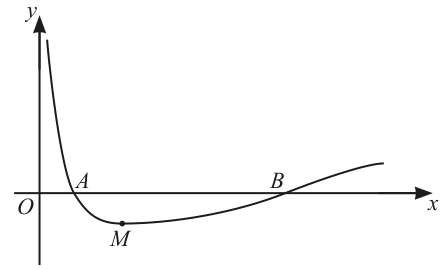
The diagram shows the curve with equation for . The curve crosses the -axis at points and and has a minimum point .
Approach
To find the minimum point , we differentiate with respect to , set , and solve for . Then we substitute this -value back into the original equation to find the -coordinate.
Working
Differentiate :
Set to find stationary points:
Factor out (noting ):
Since , , so:
Cube both sides to find :
Substitute into the original equation to find . Note that and :
The coordinates of are .
Answer
(64/27, -1/8)
Walkthrough
First, we differentiate the function using the power rule. Remember that the derivative of is . This gives . To find the stationary point, we set the derivative to zero. Factoring out the term with the most negative index, , leaves us with . Solving this gives , and cubing both sides yields . Finally, we substitute back into the original equation. Using the fact that makes the arithmetic much simpler: . Thus, the minimum point is at .
Key Takeaways
- Differentiating expressions with negative fractional indices requires careful application of the power rule.
- Factoring out the term with the most negative index is a reliable way to solve equations involving negative indices.
- Substituting back using the simpler form avoids messy arithmetic with large fractions.
Common Mistakes
- Forgetting to subtract 1 from the index when differentiating (e.g., writing instead of ).
- Incorrectly factoring out negative indices, leading to sign errors.
- Making arithmetic errors when substituting back into the original equation.
Things to Be Careful About
- The domain is , so we must ignore any solution that might appear if we multiply through by positive powers of .
- Ensure you cube both sides correctly: , not or similar.
- The question asks for exact coordinates, so leave fractions as they are; do not convert to decimals unless specified.
Approach
The region is bounded by the curve and the line segment on the x-axis. First, find the x-coordinates of and by setting . Recognize the equation as a quadratic in to solve for . Then, integrate the function between these limits. Since the curve is below the x-axis between and , the definite integral will be negative; take the absolute value to find the area.
Working
Find the x-intercepts and :
Set :
Let . The equation becomes:
Factorize:
So or .
Substitute back :
The curve crosses the x-axis at and . From the diagram, is and is .
Integrate to find the area:
The area is given by . First, find the indefinite integral:
Evaluate from to :
At :
At :
Definite integral:
Since the area is below the x-axis, the area is the absolute value:
Answer
0.5
Walkthrough
To find the area bounded by the curve and the line segment , we first need the x-coordinates of and , which are the x-intercepts. Setting gives . By substituting , this becomes a standard quadratic , which factors to . Solving gives and , meaning and . So the limits of integration are 1 and 8.
Next, we integrate the function . Using the power rule for integration, , we get . Evaluating this at the upper limit gives . Evaluating at the lower limit gives . The definite integral is . Since the region is below the x-axis (as seen in the diagram and confirmed by the negative value), the area is the absolute value, .
Key Takeaways
- Equations with fractional indices can often be solved by substituting a variable to form a quadratic equation.
- When finding the area between a curve and the x-axis, always check if the curve is above or below the axis. If it is below, the definite integral will be negative, and you must take the absolute value.
- Integration with negative indices follows the same power rule as positive indices, but be careful with the signs and fractions in the denominator.
Common Mistakes
- Forgetting to take the absolute value of the definite integral when the region is below the x-axis, resulting in a negative area.
- Making errors when integrating negative fractional indices, such as adding 1 to the index incorrectly (e.g., , not ).
- Incorrectly solving the quadratic in , leading to wrong limits of integration.
Things to Be Careful About
- The limits of integration must be in the correct order: lower limit 1, upper limit 8. Reversing them will give the wrong sign.
- Ensure you use 'your' limits from your working in the evaluation step, as marked in the scheme.
- The question asks for the area, which is always positive. A negative answer indicates the region is below the axis, but the final answer must be positive.