Mathematics 9709/41 — October/November 2022
Cambridge AS Level · Mechanics · worked solutions for every part, with the mark scheme
Topics Forces and Equilibrium · Energy, Work and Power · Newton's Laws of Motion · Kinematics of Motion in a Straight Line · Momentum
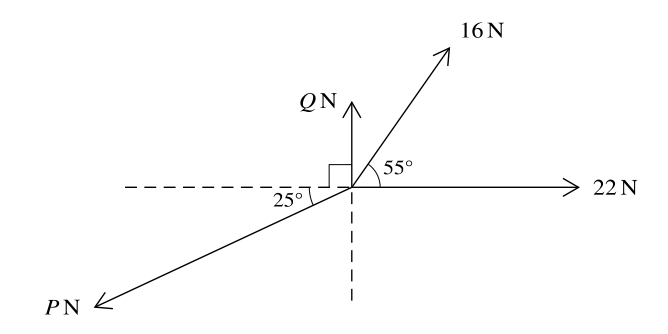
Coplanar forces of magnitudes , , and act at a point in the directions shown in the diagram. The forces are in equilibrium.
Find the values of and .
Approach
Since the four coplanar forces are in equilibrium, the vector sum of all forces is zero. This means the sum of horizontal components is zero and the sum of vertical components is zero. We resolve each force into horizontal and vertical components using the angles given in the diagram, then solve the resulting two equations for and .
Working
Resolving horizontally (taking right as positive):
The forces with horizontal components are:
- acting to the right:
- at to the positive -axis:
- at below the negative -axis:
- is vertical, so no horizontal component.
Setting the sum equal to zero:
Resolving vertically (taking upwards as positive):
The forces with vertical components are:
- acting upwards:
- at to the positive -axis:
- at below the negative -axis:
- is horizontal, so no vertical component.
Setting the sum equal to zero:
Solving for from the horizontal equation:
Rounding to 3 significant figures: .
Solving for from the vertical equation:
Rounding to 3 significant figures: .
Answer
P = 34.4, Q = 1.43
Walkthrough
The problem states that four coplanar forces act at a point and are in equilibrium. Equilibrium means the net force is zero, so we can split this into two independent conditions: the sum of horizontal components is zero, and the sum of vertical components is zero.
Step 1: Identify the direction and components of each force.
From the diagram:
- acts vertically upwards along the positive -axis. Its horizontal component is and its vertical component is .
- acts horizontally to the right along the positive -axis. Its horizontal component is and its vertical component is .
- acts in the first quadrant at above the positive -axis. Its horizontal component is and its vertical component is .
- acts in the third quadrant at below the negative -axis. This means it points left and down. Its horizontal component is (negative because it points left) and its vertical component is (negative because it points down).
Step 2: Resolve horizontally.
Sum of horizontal components :
Rearranging gives:
This is one equation with one unknown (), so we can solve for directly.
Step 3: Resolve vertically.
Sum of vertical components :
Rearranging gives:
Now that we know , we can substitute to find .
Step 4: Calculate .
So .
Step 5: Calculate .
So .
Key Takeaways
- When a system of coplanar forces is in equilibrium, both the horizontal and vertical components must independently sum to zero.
- Resolving forces into perpendicular components is the standard method for solving equilibrium problems with forces at angles.
- Always carefully determine the sign (positive or negative) of each component based on the direction the force points relative to the chosen positive axes.
- When a force makes an angle with a horizontal or vertical reference line, use for the component along that reference line and for the perpendicular component.
Common Mistakes
- Sign errors in components: Forgetting that acts in the third quadrant means both its horizontal and vertical components are negative. A common error is writing or instead of and .
- Mixing up sin and cos: Using where should be used (or vice versa) when resolving forces at an angle. Remember: the component along the reference line (the one the angle is measured from) uses , and the perpendicular component uses .
- Forgetting a term: The mark scheme requires 3 terms in the resolution equations. Students sometimes omit one of the forces, especially in the horizontal equation (which is zero) or in the vertical equation (which is also zero).
- Rounding too early: Carrying only 2 or 3 decimal places in intermediate steps can lead to an incorrect final answer for . Keep at least 4-5 significant figures during calculation.
Things to Be Careful About
- Direction of : The diagram shows making with the negative -axis (dashed line) in the third quadrant. This means points left and down, so both components are negative. Do not confuse this with an angle measured from the positive -axis.
- Sign conventions: Choose a consistent sign convention (e.g., right and up positive) and apply it uniformly to all forces. The mark scheme allows sign errors in the initial resolution attempt (M1), but the final equations must be correct (A1).
- Precision of final answers: The mark scheme gives and to 3 significant figures. Using more precise intermediate values (, ) ensures the final answers are correct to the required precision.
- Equilibrium condition: Remember that equilibrium requires the vector sum to be zero, not just the magnitudes. This is why we must resolve into components rather than simply adding magnitudes.
The rest of this paper
5 more questions- Q2Momentum · Energy, Work and Power5M
- Q3Forces and Equilibrium · Energy, Work and Power · Newton's Laws of Motion9M
- Q4Newton's Laws of Motion · Forces and Equilibrium · Kinematics of Motion in a Straight Line9M
- Q5Kinematics of Motion in a Straight Line10M
- Q6Forces and Equilibrium · Energy, Work and Power12M