Mathematics 9709/21 — May/June 2022
Cambridge AS Level · Pure Mathematics 2 · worked solutions for every part, with the mark scheme
Topics Logarithmic and Exponential Functions · Trigonometry · Integration · Differentiation · Algebra · Numerical Solution of Equations
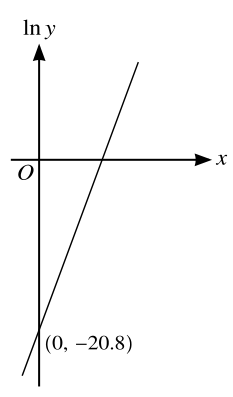
The variables and satisfy the equation , where is an integer. As shown in the diagram, the graph of against is a straight line passing through the point , where the second coordinate is given correct to 3 significant figures.
Show that the gradient of the straight line is .
Approach
Take the natural logarithm of both sides of the given equation to linearise it into the form . Then identify the gradient .
Working
Given .
Take of both sides:
Using the law of logarithms :
Expand the right side:
This is a linear equation in the form , where the gradient .
Using the logarithm law :
Thus, the gradient of the straight line is .
Answer
The gradient is .
The gradient is .
Walkthrough
We start with the exponential equation . To analyse the graph of against , we take the natural logarithm of both sides. This allows us to bring the exponent down using the power rule for logarithms, , giving . Expanding this gives , which is in the standard linear form where and . The gradient is the coefficient of , which is . We can rewrite this using the logarithm law to get , proving the required result.
Key Takeaways
Taking the logarithm of both sides of an exponential equation is a standard technique to linearise it. The power rule for logarithms is essential for moving the exponent to the front. Comparing the result to allows direct extraction of the gradient and y-intercept.
Common Mistakes
- Failing to use brackets when expanding , leading to incorrect terms like instead of .
- Not using the logarithm law to simplify to as required by the question.
Things to Be Careful About
- Ensure proper use of brackets when applying logarithm laws to expressions with multiple terms in the exponent.
- The question asks to show the gradient is , so the final step must explicitly show .
Determine the value of .
Approach
Use the y-intercept of the straight line from part (a) to find . The line passes through , so when , .
Working
From part (a), the equation of the line is:
The y-intercept occurs when , giving:
We are given that the line passes through , so substitute and :
Solve for :
Calculate the value:
Since is an integer, .
Answer
a = 15
Walkthrough
From part (a), we established the linear equation . The y-intercept is the value of when . Setting gives . The problem states the graph passes through , meaning the y-intercept is . Equating the two expressions for the y-intercept gives . Solving this for yields . Since the question specifies that is an integer, we round to the nearest integer to get .
Key Takeaways
Once an equation is linearised, substituting known coordinates allows you to solve for unknown parameters. Always check the question for constraints on the parameter, such as being an integer, which helps in rounding or selecting the correct value.
Common Mistakes
- Forgetting that the point is on the vs graph, and mistakenly using instead of .
- Not rounding to the nearest integer when the question specifies is an integer, leading to a non-integer answer like .
Things to Be Careful About
- The coordinate given is on a graph of against , so the second coordinate is the value of , not itself.
- The question states is an integer, so the final answer must be an exact integer. Condone but require an integer form.
The rest of this paper
6 more questions- Q2Trigonometry6M
- Q3Trigonometry · Integration7M
- Q4Differentiation7M
- Q5Algebra · Logarithmic and Exponential Functions · Numerical Solution of Equations9M
- Q6Differentiation · Logarithmic and Exponential Functions8M
- Q7Algebra · Integration · Logarithmic and Exponential Functions9M