Mathematics 9709/45 — October/November 2025
Cambridge A-Level · Mechanics · worked solutions for every part, with the mark scheme
Topics Forces and Equilibrium · Kinematics of Motion in a Straight Line · Energy, Work and Power · Newton's Laws of Motion · Momentum
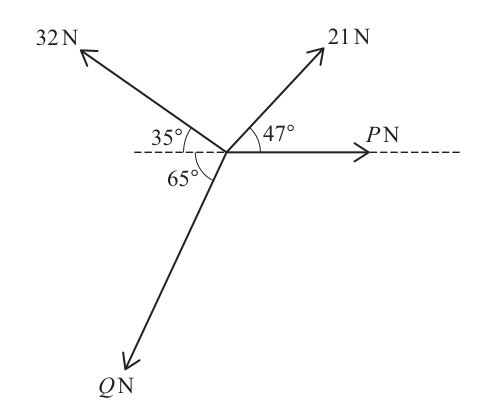
Coplanar forces of magnitudes , , and act at a point in the directions shown in the diagram. The forces are in equilibrium.
Find the value of and the value of .
Approach
Resolve the forces into horizontal and vertical components. Since the system is in equilibrium, the sum of horizontal components is zero and the sum of vertical components is zero. This gives two simultaneous equations in and .
Working
Resolve horizontally (taking right as positive):
Resolve vertically (taking upward as positive):
From equation (2), solve for :
Substitute into equation (1) to find :
Rounding to three significant figures:
Answer
P = 27.6, Q = 37.2
Walkthrough
First, we establish a coordinate system. Taking the positive horizontal axis to the right and the positive vertical axis upwards, we resolve each force into its horizontal and vertical components using sine and cosine of the given angles.
For the horizontal direction, the forces and act to the right (positive), while and act to the left (negative). Setting the sum of horizontal components to zero gives equation (1).
For the vertical direction, the forces and act upwards (positive), while acts downwards (negative). Setting the sum of vertical components to zero gives equation (2).
Equation (2) contains only one unknown, , so we can solve it directly. We calculate the numerical values of the sine terms, sum them, and divide by to find .
Once is known, we substitute its value into equation (1) and rearrange to solve for . We calculate the cosine terms, substitute , and find the final value for .
Key Takeaways
- Any system of coplanar forces in equilibrium can be analysed by resolving forces along two perpendicular axes.
- The sum of components along each axis must independently equal zero.
- Equations with only one unknown should be solved first to simplify the system.
Common Mistakes
- Mixing up sine and cosine when resolving forces (e.g., using for the horizontal component of a force given at an angle to the horizontal).
- Sign errors when setting up the equations (e.g., adding a leftward force instead of subtracting it).
- Rounding intermediate values too early, which leads to incorrect final answers.
Things to Be Careful About
- Always carry at least 4-5 decimal places in intermediate calculations to avoid rounding errors.
- Ensure the angles are correctly matched to their respective sine or cosine components based on whether they are measured from the horizontal or vertical axis.
- The mark scheme allows sign errors and inconsistent sin/cos mixes as long as they are consistent throughout the working, but final answers must be correct for the equations set up.
An athlete runs along a straight horizontal road. The athlete starts from rest and accelerates at reaching a speed of . The athlete maintains this speed of for before decelerating at back to rest. The athlete covers a total distance of in .
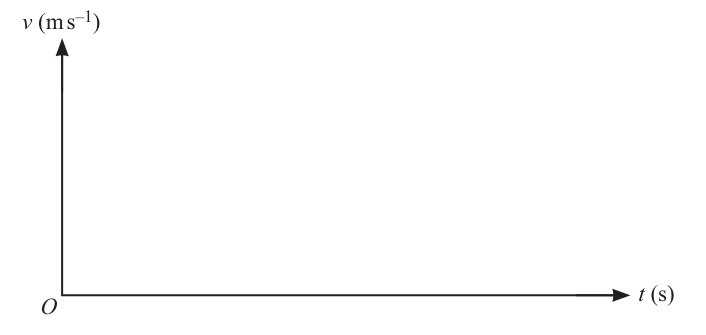
Approach
The motion consists of three phases: constant acceleration from rest, constant velocity, and constant deceleration to rest. The velocity-time graph will be a trapezium starting and finishing on the time axis.
Working
- Phase 1 (Acceleration): Accelerates from to at . Time taken . The graph is a straight line from to .
- Phase 2 (Constant velocity): Maintains speed for seconds. The graph is a horizontal line from to .
- Phase 3 (Deceleration): Decelerates from to at . Time taken . The graph is a straight line from to .
- Total time: , so the graph ends at .
The velocity-time graph is a trapezium with vertices at , , , and . The horizontal axis is and the vertical axis is . The values and are labelled on the axes.
Answer
A trapezium on - axes with vertices at , , , and . The points on the -axis and on the -axis are labelled.
Trapezium with vertices (0,0), (2V, V), (246-5V, V), and (246, 0)
Walkthrough
The athlete's motion has three distinct phases. First, they accelerate from rest at a constant rate, which produces a straight line with a positive gradient on a velocity-time graph. Second, they run at a constant speed, producing a horizontal line. Third, they decelerate at a constant rate to rest, producing a straight line with a negative gradient. Connecting these three phases gives a trapezium shape that starts and ends on the time axis (velocity = 0).
Key Takeaways
A velocity-time graph for constant acceleration, constant velocity, and constant deceleration forms a trapezium. The area under this graph represents the total distance travelled, and the gradients of the sloping lines represent the acceleration and deceleration.
Common Mistakes
- Drawing a triangle instead of a trapezium (forgetting the constant velocity phase).
- Failing to label the key values and on the axes.
- Drawing the sloping lines with incorrect relative gradients (the deceleration gradient should be less steep than the acceleration gradient since ).
Things to Be Careful About
The question only asks for a sketch, so exact scale is not required. However, the shape must be a trapezium, and the labels and must be present. Ignore gradients for marking purposes, but ensure the deceleration line is less steep than the acceleration line to reflect the given values.
Approach
Use the kinematic equation to find the time spent accelerating and decelerating in terms of . Then use the total time to find in terms of . Finally, use the area under the velocity-time graph (which is a trapezium) to set up an equation equal to the total distance of , and simplify to get the required quadratic.
Working
Time for each phase:
Time accelerating ():
Time decelerating ():
Find in terms of :
Total time is :
Equation for total distance:
The total distance is the area under the velocity-time graph. The graph is a trapezium with parallel sides of length and , and height :
Substitute :
Multiply both sides by 2:
Expand:
Rearrange into standard quadratic form:
Answer
7V^2 - 492V + 2700 = 0
Walkthrough
First, we find the time spent in each phase using . For acceleration, , so . For deceleration, , so . The total time is the sum of the three phases: , which gives .
Next, we use the fact that the total distance is the area under the velocity-time graph. The graph is a trapezium with parallel sides (the total time) and (the time at constant speed), and height (the maximum speed). The area formula gives . Substituting yields . Multiplying by 2 and expanding gives , which rearranges to .
Key Takeaways
The area under a velocity-time graph equals the displacement. For constant acceleration phases, you can use to find times, and the trapezium area formula to find total distance efficiently.
Common Mistakes
- Forgetting to include the constant velocity phase when calculating total time or distance.
- Using the wrong formula for the area of a trapezium (e.g., using only the rectangle area and forgetting the triangles).
- Algebraic errors when expanding and rearranging the equation into standard quadratic form.
Things to Be Careful About
Ensure all terms are present when setting up the equation. If you substitute back into the trapezium area equation and get , you have not formed a valid equation for . You must use an independent equation (like total time) to eliminate before substituting into the distance equation.
Approach
Solve the quadratic equation using the quadratic formula. Then use physical constraints (e.g., or total time for acceleration and deceleration must be less than ) to reject the larger root.
Working
Solve :
This gives two possible values for :
Justification for rejecting :
If , the time spent at constant speed would be:
Since time cannot be negative, is not physically feasible. Alternatively, the time to decelerate alone would be , which exceeds the total time of .
Thus, the only valid solution is .
Answer
V = 6
Walkthrough
First, apply the quadratic formula to . The discriminant is . The square root of is . This gives , yielding or .
Next, we must check which value is physically meaningful. We know . If , then , which is impossible since time cannot be negative. Therefore, we reject and accept .
Key Takeaways
When solving physics problems that lead to quadratic equations, always check the solutions against physical constraints (e.g., time > 0, speed < reasonable human limit). Extraneous mathematical solutions often arise and must be discarded.
Common Mistakes
- Stating both values of without rejecting the invalid one.
- Failing to show the calculation that proves the rejected root is invalid (e.g., just saying "it's too fast" without calculating ).
- Arithmetic errors when evaluating the quadratic formula or the discriminant.
Things to Be Careful About
The question asks for a justification. You must explicitly show why the larger root is rejected, for example by calculating and showing it is negative, or by showing the deceleration time exceeds the total time. Simply stating without reference to the other root may not earn full marks.
A car of mass is moving on a straight road.
When the car is moving at a constant speed of on a horizontal section of the road, the engine of the car is working at .
When the car is moving at a constant speed of up a section of the road inclined at to the horizontal, the engine of the car is also working at .
On both sections of the road there is a constant force of magnitude resisting the motion of the car.
Approach
Let be the driving force on the horizontal section and that on the inclined section. Since the car moves at constant speed, its acceleration is zero. Use to express the driving forces, then apply Newton's second law parallel to the road on each section.
Working
On the horizontal section, the driving force is
and, since the acceleration is zero,
On the inclined section, let , so . The component of the weight down the slope is . The driving force is
Applying Newton's second law parallel to the slope at constant speed,
Using , we have . Taking , the weight component is , so
Hence
Then
Answer
R = 1800 N, P = 36000 W
Walkthrough
The important observation is that constant speed means zero acceleration, so the resultant force on the car is zero. On each road section, resolve parallel to the road. Use to write the engine's driving force as ; this gives on the flat road and on the slope. On the flat road the only horizontal forces are the driving force and the resistance, so . On the slope, the weight has a component down the slope, which must be included as an extra resisting term. This gives the equation . The two equations are then solved simultaneously. Replacing by uses and makes the algebra straightforward.
Key Takeaways
- A constant speed implies , so the resultant force along the direction of motion is zero.
- The relation connects engine power to the driving force at a given speed.
- On an incline, the component of the weight parallel to the plane is .
- Two equations in two unknowns can be solved by substitution.
Common Mistakes
- Giving only the final values without showing the equations. The mark scheme awards marks for the equations, so unsupported answers score no marks.
- Using instead of for the component of weight down the slope.
- Forgetting the resistance on the slope, or using two different resistance forces in the two equations.
- Rounding to and then using ; this can prevent the final answers from being correct to 3 significant figures.
Things to Be Careful About
- Choose a positive direction (up the slope for the inclined section) and be consistent with signs.
- The force from the engine is not ; it is in newtons.
- Include the term exactly, with , not an approximated angle.
- With , the weight component is , leading to and .
Find the acceleration of the car when it is moving at up the inclined section of the road with the engine working at .
Approach
The engine now works at , which is . At speed , use to find the driving force. Then apply Newton's second law parallel to the incline, using from part (a) and the weight component .
Working
The driving force is
Take the direction up the slope as positive. Newton's second law gives
Substitute , and :
Therefore
Answer
a = 0.25 m s^-2
Walkthrough
Part (b) uses the same ideas but now there is acceleration. First convert the power to watts: . The driving force is obtained from : . Resolve parallel to the slope, taking up the slope as positive. The driving force acts up the slope, while the resistance and the component act down the slope. Newton's second law gives . Substitute from part (a) and the weight component , then solve to obtain , so .
Key Takeaways
- Convert kW to W before using .
- The driving force from the engine is , not the power itself.
- On an incline, Newton's second law must include the component of weight parallel to the plane.
- A previous part may supply a needed value, such as , for later calculations.
Common Mistakes
- Forgetting to convert to .
- Omitting either the resistance or the weight component when writing the Newton's second law equation.
- Using the value of from part (a) instead of the new power .
- Using on the wrong side or with a sign error; since motion is up the slope, use .
Things to Be Careful About
- Use the from part (a) consistently; it is the same resistance force on both sections.
- The weight component is with , so it is when .
- If an approximate angle such as is used, the answer may be , which the mark scheme condones; using would not be correct to 3 significant figures.
A particle moves in a straight line. At time after leaving a point on the line, the acceleration of is given by , where is a positive constant. At time , the velocity of is .
Approach
Integrate the acceleration to obtain the velocity, use the initial condition to fix the constant, then require the quadratic for to have no real roots by setting its discriminant negative.
Working
Acceleration is
Integrating with respect to :
At , , so :
For never to be at instantaneous rest, must have no real solutions. The quadratic is
Its discriminant is
For no real roots:
Answer
k > 4.5
Walkthrough
We are told that the acceleration is a function of time, so the velocity is found by integrating with respect to . The initial condition at determines the constant of integration.
The phrase 'never at instantaneous rest' means that the velocity is never zero. Since the velocity is a quadratic function of , the equation must have no real solutions. A quadratic has no real roots exactly when its discriminant is negative. Setting gives the required inequality.
Key Takeaways
This question combines calculus with the algebraic condition for a quadratic to have no real roots. It shows that 'instantaneous rest' corresponds to , and that a quadratic velocity function stays away from zero only when its discriminant is negative.
Common Mistakes
- Using instead of integrating .
- Forgetting the constant of integration and not using at .
- Using instead of ; a zero discriminant would give one instant of rest.
- Making an algebraic error when simplifying .
Things to Be Careful About
The inequality is strict: , not . The coefficient of is , so the discriminant is . Since is given as positive, the result is consistent with the domain of the problem.
Approach
Substitute into the velocity expression, find the times in the interval when , split the interval at that time, integrate to get displacement on each sub-interval, and add the magnitudes.
Working
With :
Set :
Multiply by 4:
Solve:
So
Only lies in , so the particle changes direction at . Integrate :
At the limits:
Distance from to :
Distance from to :
Total distance:
Answer
2 m
Walkthrough
From part (a), the velocity is . With , this becomes . To find where the particle changes direction, solve . The roots are and ; only is inside .
Because the velocity changes sign at , the displacement from to is not the total distance. We integrate separately on to and to , take absolute values, and add them.
Key Takeaways
Total distance is the sum of the magnitudes of displacements over intervals where the direction of motion does not change. To find where direction changes, solve and check which roots lie in the given interval.
Common Mistakes
- Integrating from to directly and giving the net displacement .
- Forgetting to solve before integrating.
- Including as a split point even though it is outside the interval.
- Sign errors when evaluating the definite integrals.
Things to Be Careful About
Use absolute values for each segment. The total distance is positive. The roots of are and ; only matters here. Keep the units as metres.
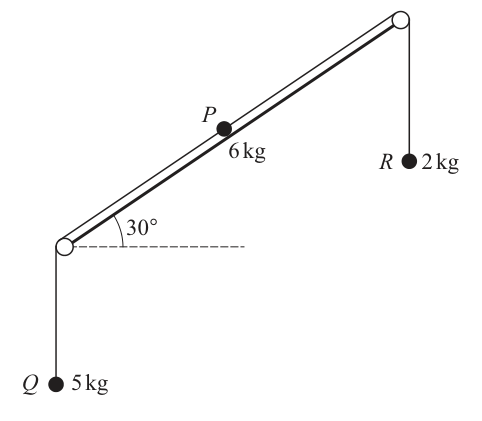
The diagram shows a particle of mass on a rough plane inclined at an angle of to the horizontal. Two light inextensible strings are attached to . The strings pass over small smooth pulleys, which are fixed at the ends of the plane. The non-vertical parts of the string are parallel to a line of greatest slope of the plane. Particles and , of masses and respectively, hang vertically at the ends of the strings.
Both strings are taut, and the system is released from rest.
It is given that the tension in the string attached to is twice the tension in the string attached to .
Find, in terms of , the tension in each of the strings and the magnitude of the acceleration of the particles.
Approach
Let be the tension in the string connecting to (bottom pulley), and be the tension in the string connecting to (top pulley). We are given .
Since (5 kg) is heavier than (2 kg), will accelerate downward, will accelerate upward, and will accelerate down the plane toward the bottom pulley. All three particles share the same magnitude of acceleration .
Working
Apply Newton's second law to (taking downward as positive):
Apply Newton's second law to (taking upward as positive):
Substitute into the first equation:
From the second equation, express in terms of :
Substitute this into the modified first equation:
Now find :
And :
Answer
a = g/9, T_PQ = 40g/9, T_PR = 20g/9
Walkthrough
Step 1: Identify the direction of motion.
Particle (5 kg) is heavier than particle (2 kg), so when the system is released, accelerates downward, accelerates upward, and accelerates down the inclined plane toward the bottom pulley. All three particles have the same acceleration magnitude because the strings are inextensible.
Step 2: Set up Newton's second law for each hanging particle.
For , taking downward as positive: the weight acts downward and tension acts upward, so .
For , taking upward as positive: the tension acts upward and weight acts downward, so .
Step 3: Use the given tension relationship.
We are told . Substitute this into the equation for to get .
Step 4: Solve the simultaneous equations.
From the equation for , express . Substitute into the modified equation for : , which simplifies to , giving .
Step 5: Find the tensions.
Substitute back to get and .
Key Takeaways
- When connected particles share an inextensible string, they all have the same acceleration magnitude.
- Newton's second law can be applied to each particle independently, choosing the direction of motion as positive for each.
- A given relationship between tensions (here ) provides the extra equation needed to solve the system.
Common Mistakes
- Using the same tension symbol for both strings — the problem explicitly states the tensions are different.
- Getting the signs wrong in Newton's second law equations (e.g., writing for when accelerates downward).
- Not substituting the tension relationship correctly, leading to an equation with two unknowns.
Things to Be Careful About
- The acceleration must be the same for all three particles due to the inextensible strings.
- Tensions must be expressed in terms of as the final answer, not as a numerical value (unless is substituted throughout).
- The direction of acceleration for each particle must be consistent with the chosen positive direction in the equation.
Approach
Particle (mass 6 kg) is on a rough plane inclined at . The forces acting on are:
- Weight acting vertically downward
- Normal reaction perpendicular to the plane
- Friction opposing motion (acting up the plane since accelerates down)
- Tension pulling down the plane (toward )
- Tension pulling up the plane (toward )
Working
Resolve perpendicular to the plane:
Apply Newton's second law along the plane (downward positive):
Substitute known values (, , ):
Use the friction model :
Answer
μ = 41√3/81 ≈ 0.877
Walkthrough
Step 1: Resolve forces perpendicular to the plane.
The component of 's weight perpendicular to the plane is . Since there is no acceleration perpendicular to the plane, the normal reaction balances this: .
Step 2: Apply Newton's second law along the plane.
Taking the direction of motion (down the plane) as positive, the forces along the plane are:
- Component of weight down the plane:
- Tension pulling down the plane:
- Tension pulling up the plane:
- Friction opposing motion (up the plane)
The equation is: .
Step 3: Solve for friction .
Simplifying gives .
Step 4: Apply .
Substitute and to find .
Key Takeaways
- On an inclined plane, resolve weight into components parallel () and perpendicular () to the plane.
- Friction opposes the direction of motion (or impending motion) and is given by at limiting equilibrium.
- The normal reaction on an inclined plane is , not .
Common Mistakes
- Forgetting to include both tensions in the equation for .
- Using instead of .
- Getting the direction of friction wrong — it must oppose the actual motion of .
- Not substituting the values from part (a) correctly.
Things to Be Careful About
- The friction force acts up the plane because accelerates down the plane.
- The coefficient of friction is dimensionless — check that cancels out in the final calculation.
- Rationalise the denominator: .
It is given that when the system is released from rest, is at the midpoint of the plane. In the subsequent motion, does not reach the pulley at the top of the plane, and takes to reach the pulley at the bottom of the plane.
Find the total length of the plane.
Approach
Particle starts at the midpoint of the plane and accelerates down the plane with constant acceleration . It takes s to reach the bottom pulley. We need to find the distance from the midpoint to the bottom, then double it to get the total length.
Working
Use the suvat equation with , , and :
Using m/s²:
The total length of the plane is twice this distance (since started at the midpoint):
Answer
2.5 m
Walkthrough
Step 1: Identify the known quantities.
Particle starts from rest () at the midpoint of the plane. It accelerates down the plane with m/s² (using m/s²). The time taken to reach the bottom pulley is s.
Step 2: Calculate the distance from midpoint to bottom.
Using : m.
Step 3: Find the total length.
Since started at the midpoint, the total length is m.
Key Takeaways
- The suvat equation is the most direct tool when initial velocity, acceleration, and time are known.
- Always check what the question is asking — here it asks for the total length, not just the distance travelled.
Common Mistakes
- Forgetting that starts at the midpoint, so the total length is twice the distance travelled.
- Using or when the mark scheme expects (though the mark scheme does condone other values).
- Using first and then , which is valid but more work.
Things to Be Careful About
- The acceleration from part (a) is in terms of . The mark scheme accepts , , or , but the final answer of 2.5 m follows from .
- Ensure units are consistent: acceleration in m/s², time in s, distance in m.
Two particles and of masses and respectively, where and are constants, are free to move in a straight line on a smooth horizontal plane. Particle is projected towards with speed and at the same instant is projected towards with speed .
The particles collide. After the collision the speed of is and both particles move in the same direction as ’s original motion.
It is given that of the total kinetic energy is lost in the collision. Find, in terms of , the speed of after the collision.
Approach
Use conservation of linear momentum to relate the unknown speed to , then write the kinetic energy before and after the collision. Since 35% of the kinetic energy is lost, 65% remains, so set . Solve the resulting quadratic and reject the root that is physically impossible.
Working
Take the positive direction to be A's original motion. Particle is initially moving towards , so its initial velocity is . After the collision both particles move in A's original direction, so A's velocity is and B's speed is .
Conservation of linear momentum:
Simplify:
Kinetic energy before the collision:
Kinetic energy after the collision:
Since 35% is lost, 65% remains:
Substitute :
Divide by and multiply by 2:
So
Solve:
Thus or . Since , we must have , so reject .
Therefore
Answer
v_B = 2.5u
Walkthrough
Start by choosing a positive direction. Since is projected towards with speed and towards with speed , if A's original direction is taken as positive then B's initial velocity is . After the collision both particles move in A's original direction, so A's velocity is and B's unknown speed is positive.
Apply conservation of linear momentum: the total momentum before equals the total momentum after. This gives , which simplifies to . This relation is essential because it removes one unknown and links to .
Next write the kinetic energy before the collision: . After the collision, .
The statement that 35% of the kinetic energy is lost means 65% remains, so the correct equation is , not . Substituting into this equation gives an equation in only.
Divide by and multiply by 2 to obtain , then rearrange to . Solving this quadratic gives or . The value must be rejected because it would give , which contradicts the fact that both particles move in A's original direction. Hence and .
Key Takeaways
- In a direct collision, linear momentum is conserved, but kinetic energy is not necessarily conserved.
- A direction convention must be chosen and used consistently; velocities, not speeds, appear in the momentum equation.
- A fractional energy loss means the retained fraction is , so a 35% loss leaves 65% of the original kinetic energy.
- Physical constraints, such as the direction of motion after impact, can be used to reject an otherwise valid algebraic root.
Common Mistakes
- Taking B's initial momentum as positive instead of negative, because B is moving towards A.
- Writing instead of .
- Leaving both and in the energy equation instead of substituting .
- Accepting without checking that it gives , which is impossible here.
- Including with the masses in the momentum equation; the mark scheme penalises this.
Things to Be Careful About
- Use B's initial velocity as , not , in the momentum equation.
- The speed after the collision must be positive, so ; this is the reason is rejected.
- When cancelling, remember that and are non-zero constants, so dividing by is valid.
- The energy-loss equation must be set up the correct way round: 65% of the kinetic energy before equals the kinetic energy after.
- If the mark scheme is followed strictly, showing the quadratic and the rejection of the invalid root is necessary for full marks.