Mathematics 9709/43 — October/November 2025
Cambridge A-Level · Mechanics · worked solutions for every part, with the mark scheme
Topics Kinematics of Motion in a Straight Line · Energy, Work and Power · Newton's Laws of Motion · Forces and Equilibrium · Momentum
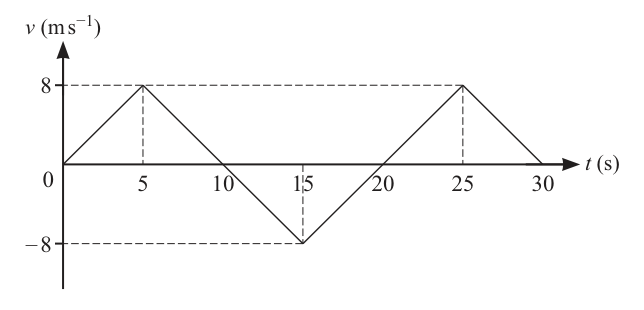
The diagram shows the velocity-time graph for the motion of an athlete. The athlete runs in a straight line from point to point , runs back to point and finishes at point . The graph consists of four straight line segments.
Approach
The acceleration of the athlete at any time is given by the gradient of the velocity-time graph at that time. Since s lies on the straight line segment from to , we calculate the gradient of this segment. Deceleration is the magnitude of negative acceleration.
Working
The segment containing connects and .
Since the acceleration is negative, the athlete is decelerating. The deceleration is the magnitude of this value:
Answer
1.6 ms^{-2}
Walkthrough
The problem asks for the deceleration at s. On a velocity-time graph, the acceleration at any point is equal to the gradient of the graph at that point. We first identify which line segment contains s. Looking at the graph, the segment from to covers this time. The velocity at is ms and at is ms. We calculate the gradient using the formula . This gives ms. Acceleration is ms, which means the velocity is decreasing at a rate of ms. Deceleration is defined as the positive magnitude of a negative acceleration, so the deceleration is ms.
Key Takeaways
- The gradient of a velocity-time graph represents acceleration.
- Deceleration is the magnitude of negative acceleration (or the rate at which speed is decreasing in the direction of motion, but here simply the positive value of negative acceleration).
- Identifying the correct time interval and corresponding coordinates on the graph is crucial.
Common Mistakes
- Forgetting that deceleration is a positive quantity and writing ms (though the mark scheme condones this, it is technically the acceleration, not deceleration).
- Using the wrong coordinates, for example using and instead of the segment containing .
Things to Be Careful About
- Ensure you read the coordinates correctly from the graph. The segment from to has endpoints and .
- Deceleration is the magnitude of negative acceleration. If acceleration is , deceleration is (when ).
Approach
The total distance travelled is the sum of the absolute areas between the velocity-time graph and the time axis. The graph consists of triangles above and below the axis. We calculate the area of each triangle and sum their absolute values.
Working
The graph can be divided into three main sections based on where it crosses the time axis:
- From to : A triangle with base s and height ms.
- From to : A triangle with base s and height ms (below the axis).
- From to : A triangle with base s and height ms.
Alternatively, we can see six smaller triangles, each with base s and height ms.
Using the smaller triangles:
Total distance is the sum of the areas of all six triangles:
Or using the larger triangles:
Answer
120 m
Walkthrough
The problem asks for the total distance travelled by the athlete. On a velocity-time graph, the area under the curve represents displacement. However, total distance is the sum of the absolute values of the areas between the graph and the time axis, because distance is a scalar quantity and does not account for direction.
The graph crosses the time axis at s and s. This creates three main triangular regions:
- Region 1: to . The velocity is positive. The shape is a triangle with base and height . Area = m.
- Region 2: to . The velocity is negative. The shape is a triangle with base and height (taking the absolute value of velocity). Area = m.
- Region 3: to . The velocity is positive. The shape is a triangle with base and height . Area = m.
Total distance = m.
Alternatively, you can notice there are six identical smaller triangles, each with base s and height ms. Area of one = m. Total distance = m.
Key Takeaways
- The area under a velocity-time graph gives displacement.
- Total distance is the sum of the absolute areas between the graph and the time axis.
- Areas below the time axis must be treated as positive when calculating total distance.
Common Mistakes
- Calculating displacement instead of distance by taking the area below the axis as negative (which would give m).
- Misreading the coordinates of the vertices of the triangles on the graph.
Things to Be Careful About
- Ensure you are calculating total distance, not displacement. The question states the athlete runs from A to B, back to A, and finishes at B, confirming the total path length is required.
- The graph consists of straight lines, so the areas are simple triangles. Use .
The engine of a motorcycle can generate a maximum power of . The mass of the motorcycle and its rider is . The total resistance to the motion of the motorcycle and its rider is , where is the motorcyclist’s speed and is a constant.
The motorcyclist travels along a straight horizontal road under maximum engine power. When the motorcyclist’s speed is , his acceleration is .
Approach
Use the maximum power to find the driving force at with . Then apply Newton's second law along the horizontal road, where the resultant force is the driving force minus the resistance .
Working
At , the resistance is . Newton's second law gives:
Answer
c = 80
Walkthrough
First convert the maximum power to watts: . The equation relates power, driving force and speed, so at the driving force is .
Next write the resultant force horizontally. The driving force acts forwards and the resistance , evaluated at , acts backwards. Newton's second law therefore gives:
Solving this linear equation gives .
Key Takeaways
The power-speed relation gives the driving force produced by an engine at a given speed. The resistance here is speed-dependent, so it is , not a constant force. Newton's second law is applied by taking the resultant of all forces in the direction of motion.
Common Mistakes
- Forgetting to convert to .
- Using directly as the driving force instead of .
- Assuming the acceleration is zero in part (a). The mark scheme awards only the first mark if the equation is set up with .
- Omitting one of the three terms in Newton's second law, such as the resistance.
Things to Be Careful About
The speed at which the resistance is evaluated must be inside . Be careful with the signs: the driving force and resistance act in opposite directions, so the resultant is their difference. The final answer is exact, , and is clearly stated.
The motorcyclist now travels up a straight hill under maximum engine power. The hill makes an angle of with the horizontal.
Find the steady speed at which the motorcyclist travels up the hill.
Approach
At steady speed up the hill, acceleration is zero. The maximum power still gives driving force . The forces opposing motion are the resistance and the component of the weight down the slope . Set their sum equal to the driving force, form a quadratic in , and take the positive root.
Working
With , the weight component down the slope is
Steady speed means , so
Multiply by :
Apply the quadratic formula:
The positive solution is
The negative root is rejected.
Answer
32.7 m s^-1
Walkthrough
The motorcyclist travels up the hill at steady speed, so the acceleration is zero. The driving force produced by the engine is still , because the power is maximum and power is .
The resistance is now , using the value of found in part (a). The weight also has a component down the slope. Since the hill makes an angle with the horizontal, and , this component is:
Because the speed is steady, the resultant force along the slope is zero. Taking the direction up the hill as positive:
Multiply by and rearrange to obtain the quadratic:
Solving this quadratic gives one positive root and one negative root. Speed cannot be negative, so the negative root is rejected. The positive root is approximately .
Key Takeaways
Steady speed means zero acceleration, so the resultant force is zero. The driving force from an engine at maximum power is and therefore varies with speed. On an incline, the weight contributes a component along the slope, and it must be included in the force balance.
Common Mistakes
- Mixing up and when resolving the weight component. Here the component along the slope is .
- Forgetting the resistance term , or the weight component, or using the wrong sign for one of them.
- Not multiplying through by after forming , leading to a non-quadratic equation.
- Stating the negative root without rejecting it. The mark scheme accepts only the positive speed, .
- Using a value of other than ; part (b) must use .
Things to Be Careful About
The mark scheme allows the exact form or the decimal . If you write the negative root, it must be explicitly rejected. Remember that means ; do not convert the angle unnecessarily. Finally, ensure all powers are in watts and all forces are in newtons.
A block of mass is pulled along a rough horizontal road by a constant force of magnitude acting at an angle of above the horizontal. The block moves in a straight line passing through two points and on the road, where . The coefficient of friction between the block and the road is .
Approach
Resolve forces vertically to find the normal reaction , then use the friction model to find the friction force, and finally multiply by the distance to obtain the work done against friction.
Working
Since the block moves horizontally, there is no vertical acceleration, so the vertical forces balance:
The friction force is:
Work done against friction over distance :
Answer
1210 J (3 s.f.) or 1215 J (4 s.f.)
Walkthrough
The block is pulled along a rough horizontal road by a force of 25 N acting at 36° above the horizontal. This force has a horizontal component that pulls the block forward, and a vertical component that lifts the block slightly. Because the block moves horizontally, it has no vertical acceleration, so the vertical forces must balance: the upward normal reaction plus the upward vertical component equals the downward weight .
Using , we get , so:
Note that is less than the weight (40 N) because the vertical component of the pulling force supports part of the block's weight.
The friction force is given by . This friction opposes the motion.
Work done against friction is the friction force multiplied by the distance travelled:
This rounds to 1210 J to 3 significant figures, or 1215 J to 4 significant figures.
Key Takeaways
- When a force acts at an angle, resolve it into components: the vertical component affects the normal reaction, and the horizontal component does the useful work of pulling.
- The normal reaction is not always equal to the weight; it is reduced when a force has an upward vertical component.
- Work done against friction = friction force distance, where friction force .
Common Mistakes
- Using directly (ignoring the vertical component of the pulling force) — this scores no marks.
- Adding or subtracting the work done by the pulling force when only the work against friction is asked.
- Mixing up and when resolving the 25 N force.
Things to Be Careful About
- Use (standard for this syllabus).
- The vertical component of the pulling force is (opposite to the angle) and the horizontal component is (adjacent to the angle).
- The work done against friction is a positive quantity.
The speed of the block at is .
Use an energy method to find the speed of the block at .
Approach
Use the work-energy principle: the change in kinetic energy of the block equals the work done by the pulling force minus the work done against friction.
Working
Change in kinetic energy:
Work done by the pulling force:
Work done against friction (from part (a)):
Work-energy equation:
Answer
25.6 m/s
Walkthrough
The work-energy principle states that the net work done on an object equals its change in kinetic energy. Here, the net work is the work done by the pulling force minus the work done against friction.
The kinetic energy at is . The kinetic energy at is . So the change in kinetic energy is .
The work done by the pulling force is its horizontal component times the distance:
The work done against friction was found in part (a) to be .
Setting up the work-energy equation:
Solving:
Key Takeaways
- The work-energy principle links work done and kinetic energy change.
- The work done by the pulling force uses only its horizontal component ( distance).
- The work done against friction is subtracted because it removes energy from the block.
Common Mistakes
- Using instead of for the work done by the pulling force.
- Forgetting to subtract the work done against friction.
- Using the wrong sign convention (e.g., adding instead of subtracting the friction work).
Things to Be Careful About
- The work done against friction from part (a) must be used consistently.
- The kinetic energy change must be written with the correct sign: final minus initial.
- The final answer should be rounded to 3 significant figures: .
A particle moves in a straight line. At time after passing through a point on the line, the displacement of from is , where .
Find the value of when has its minimum velocity, and find also the speed of at this instant.
Approach
Differentiate the displacement to obtain the velocity , then differentiate again to obtain the acceleration . Since the velocity is minimised when its derivative is zero, set to find the required time. Substitute this time into and , and take the magnitude of the velocity to give the speed.
Working
The displacement is
Differentiate to obtain the velocity:
Differentiate again to obtain the acceleration:
At minimum velocity, , so
Substitute into :
Substitute into :
The speed is the magnitude of the velocity, so the speed is .
Answer
s = -40.7 m, speed = 5.07 m/s
Walkthrough
We are given the displacement of a particle as a function of time and asked for the value of when the velocity is a minimum, plus the speed at that instant.
The velocity is the rate of change of displacement, so we differentiate with respect to :
The velocity is a quadratic in . To find its minimum we need the derivative of with respect to , which is the acceleration:
Setting this derivative to zero locates the stationary point of ; since is a quadratic with a positive coefficient of , this point is a minimum. Solving gives .
With we substitute back: into to get the displacement
and into to get the velocity . The speed is the magnitude of the velocity, so we drop the negative sign and report . The negative velocity simply means the particle is moving in the negative direction, while the speed is a scalar, so it is always non-negative.
Key Takeaways
This question tests the kinematic link between displacement, velocity and acceleration through differentiation, and the important idea that the maximum or minimum of a function is found by setting its derivative to zero. It also reinforces the distinction between velocity (a vector, which can be negative) and speed (the magnitude of velocity, always non-negative).
Common Mistakes
- Forgetting to differentiate a second time and instead solving to find the minimum velocity. The minimum of the velocity occurs where , not where .
- Treating as if it were the acceleration; this is not valid here because acceleration is the derivative of velocity, not velocity divided by time.
- Removing the negative sign from the velocity and saying the velocity is ; the velocity is and only the speed is .
- Reporting instead of ; the displacement is negative and must be kept negative.
Things to Be Careful About
- The mark scheme is strict: the negative displacement must be preserved, and the speed must be stated as the positive value . Saying the speed is either is not acceptable.
- The time must come from setting the correct two-term linear expression for equal to zero; it must follow from the correct three-term quadratic for .
- The final marks in this part require the method marks to have already been earned, so keep all intermediate steps clearly shown.
Approach
The direction of motion changes when the velocity becomes zero. Set the quadratic expression for equal to zero, solve for the positive value of , and substitute this time into the expression for acceleration.
Working
With the velocity from part (a),
set :
Multiply through by 100:
Divide by 3:
Factorise:
So or . Since time must be positive, .
The acceleration is , so
Answer
a = 0.78 m s^-2
Walkthrough
The direction of motion of a particle changes exactly when the velocity passes through zero. So to find this instant we set the velocity equal to zero:
This is a quadratic equation. To make the arithmetic cleaner, multiply by 100 and divide by 3:
Factorising gives
so or . The value corresponds to a time before the particle passes through , and since time is taken as positive after passing , we reject it and use .
Now substitute into the acceleration expression :
The acceleration at the instant the direction of motion changes is therefore .
Key Takeaways
This part tests the kinematic fact that a change of direction occurs when the velocity is zero, and then requires solving a quadratic and substituting into the derivative of the velocity. It emphasises that the acceleration at such an instant need not be zero — here the particle is momentarily at rest but still accelerating.
Common Mistakes
- Setting the acceleration equal to zero instead of the velocity. The direction of motion changes when , not when .
- Including the negative root without rejecting it. Time must be positive here, so is invalid.
- Forgetting that this part relies on the correct three-term quadratic for from part (a); using a truncated form of the velocity will lose the method mark.
- Substituting into the velocity instead of the acceleration when finding the required value.
Things to Be Careful About
- The mark scheme awards the method mark in this part only if it is dependent on the correct velocity expression; the value must be stated in this part even if it was previously found.
- The final answer must be positive: only is accepted. If the negative value is obtained, it must be explicitly rejected.
- Make sure every step is shown, since the method is implied by a correct answer but is otherwise only recoverable from visible working.
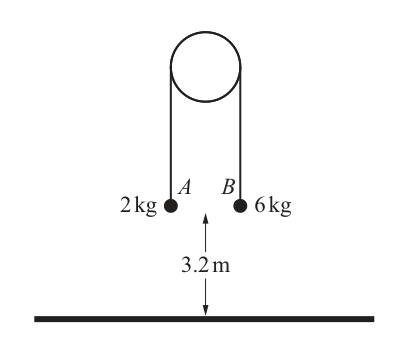
Particles and , of masses and respectively, are attached to the ends of a light inextensible string. The string passes over a smooth fixed pulley and the particles hang vertically below the pulley. Both particles are initially held at rest at a height of above horizontal ground (see diagram). Particle is projected vertically downwards with a speed of .
Approach
Identify the forces acting on each particle. Since is heavier than , the system will accelerate such that moves downwards and moves upwards. Apply Newton's second law to each particle separately, using a consistent direction for acceleration, and solve the resulting simultaneous equations.
Working
Let be the magnitude of the acceleration of the system, with accelerating downwards and accelerating upwards. Let be the tension in the string.
For particle (mass ), moving upwards:
For particle (mass ), moving downwards:
Adding the two equations eliminates :
Taking :
Substitute into the equation for to find :
Answer
The tension in the string is and the magnitude of the acceleration is .
Tension = 30 N, Acceleration = 5 m s^-2
Walkthrough
First, we determine the direction of motion. Since particle () is heavier than particle (), will accelerate downwards and will accelerate upwards. We define the positive direction for each particle as its direction of acceleration.
For , the upward forces are tension and downward weight . Newton's second law gives .
For , the downward forces are weight and upward tension . Newton's second law gives .
Adding these two equations eliminates and allows us to solve for : , so .
Substituting back into the first equation gives .
Key Takeaways
In a connected particles system with a smooth pulley, the tension is the same throughout the string and the magnitude of acceleration is the same for both particles. Always define a consistent positive direction for each particle relative to its expected motion.
Common Mistakes
- Assuming the heavier particle moves upwards.
- Using the wrong sign for acceleration in the equations of motion.
- Forgetting that is typically taken as in these problems unless specified otherwise.
Things to Be Careful About
Ensure that the tension is positive in the equation where it acts in the positive direction, and negative (or on the opposite side) where it acts in the negative direction. The acceleration must be taken as a positive magnitude.
In the subsequent motion, does not hit the ground and neither particle reaches the pulley. When hits the ground, it does not rebound.
Find the time that is in motion.
Approach
Particle is projected vertically downwards with speed . Since the string is inextensible, particle initially moves vertically upwards with speed . Particle accelerates downwards at (from part a). We use the suvat equation to find the time when has a displacement of (taking upwards as positive).
Working
Let upwards be the positive direction for particle .
Initial velocity:
Acceleration:
Displacement when hits the ground:
Using :
Multiply by 10 to clear decimals:
Rearrange into standard quadratic form:
Use the quadratic formula :
Since time must be positive, we take the positive root:
Rounding to 2 significant figures:
Answer
The time that is in motion is .
1.4 s
Walkthrough
Particle is projected downwards at , so particle is initially projected upwards at . The acceleration of is downwards (from part a).
We set upwards as positive. Thus , , and (since ends up below its starting point).
Substituting into gives . Rearranging gives .
Solving this quadratic yields .
Key Takeaways
When connected particles move, their initial velocities are equal in magnitude but opposite in direction. Careful sign conventions are essential in suvat equations.
Common Mistakes
- Taking the initial velocity of as downwards instead of upwards.
- Using instead of the calculated acceleration .
- Discarding the positive root of the quadratic equation.
Things to Be Careful About
Ensure the displacement is negative if the particle ends up below its starting position and upwards is defined as positive. The time must be positive.
Approach
The motion of occurs in three distinct phases:
- moves downwards from its initial position until it first comes to instantaneous rest.
- moves upwards while is still falling, until hits the ground.
- continues moving upwards in free fall (string becomes slack) until it reaches its highest point.
We calculate the distance covered in each phase and sum them to find the total distance between the lowest and highest points.
Working
Phase 1: A moves downwards to first rest
Initial velocity of : (downwards)
Acceleration of : (upwards, so if downwards is positive)
Final velocity:
Using :
So reaches its lowest point below its initial position.
Phase 2: A moves upwards until B hits the ground
When hits the ground, it has travelled downwards. Thus has travelled upwards from its initial position.
Velocity of at this point (taking upwards as positive):
At this moment, is at a height of above the ground.
Phase 3: A moves upwards in free fall
Once hits the ground, the string becomes slack. is in free fall with initial velocity upwards and acceleration .
Distance travels upwards from to rest:
Total distance between lowest and highest points
Lowest point: below initial position.
Highest point: above initial position.
Total distance:
Rounding to 3 significant figures:
Answer
The distance between the lowest and highest points that reaches is .
5.02 m
Walkthrough
We break the motion of into three phases based on the forces acting on it.
In Phase 1, is projected downwards at but accelerates upwards at . Using , we find it travels downwards before momentarily stopping. This is the lowest point.
In Phase 2, accelerates upwards at for a distance of (the distance falls). Using , we find its speed when hits the ground is . At this point, is above the ground.
In Phase 3, hits the ground and the string goes slack. is now in free fall, moving upwards at with acceleration . It travels a further upwards before stopping. This is the highest point.
The total distance between the lowest and highest points is the sum of the downward distance (), the distance from initial to -hit (), and the upward free-fall distance (), giving .
Key Takeaways
Connected particle problems often involve multiple phases of motion with different accelerations. Carefully track the position and velocity at each transition point.
Common Mistakes
- Forgetting that continues to move upwards after hits the ground.
- Using in Phase 3 instead of (free fall).
- Miscalculating the height of when hits the ground (it is , not ).
Things to Be Careful About
The string only provides tension while it is taut. Once hits the ground, is in free fall with acceleration . Ensure you use the correct acceleration for each phase.
Particle of mass and particle of mass are free to move on a smooth horizontal plane. and are moving directly towards each other with speeds and respectively. and collide and the direction of motion of each particle is reversed by the collision. Immediately after the collision the speed of is .
Find, in terms of and , an expression for the velocity of after the collision and hence show that .
Approach
Choose P's initial direction as positive. Write the total momentum before and after the collision using conservation of linear momentum. Solve for Q's velocity . Since Q's direction is reversed, , which gives the inequality for .
Working
Take P's initial direction as positive.
Before the collision:
- P: mass , velocity
- Q: mass , velocity
After the collision:
- P: velocity (reversed)
- Q: velocity (unknown, reversed so )
Conservation of momentum:
Since Q's direction is reversed, :
Divide by (positive):
Answer
v = (2mu)/3 - 3u, and m > 4.5
Walkthrough
We start by choosing a positive direction. It is convenient to take P's initial direction of motion as positive. Since Q is moving directly towards P, Q's velocity is negative: .
Before the collision, the total momentum is the sum of each particle's momentum: for P and for Q.
After the collision, both particles reverse direction. P now moves with velocity . Q's new velocity is unknown, call it . Because Q's direction is reversed, must be positive.
Conservation of momentum says the total momentum before equals the total momentum after. This gives an equation we solve for :
Rearranging gives .
Since Q's direction was reversed, must be positive. Setting and dividing by gives , so .
Key Takeaways
- Conservation of linear momentum applies to direct collisions on a smooth horizontal plane.
- Choosing and consistently applying a sign convention is essential — velocities in opposite directions get opposite signs.
- The phrase "direction of motion is reversed" translates directly into a sign condition on the velocity.
Common Mistakes
- Giving Q's initial velocity as instead of — this is a sign error. The mark scheme allows this sign error for the method mark (M1) but not for the accuracy marks.
- Forgetting to include the factor of 2 (Q's mass) in the momentum terms.
- Using trial and improvement with particular values of instead of solving the inequality — the mark scheme awards no accuracy mark for this unless the boundary is also shown.
- Not explicitly stating before forming the inequality.
Things to Be Careful About
- The mark scheme requires the inequality to be derived correctly: . Simply stating without showing may lose the final mark.
- If is introduced with either mass, the method mark is allowed but no accuracy marks follow.
- The final accuracy mark depends on the previous accuracy mark (it is a "correct working only" mark).
subsequently hits a vertical wall which is perpendicular to the direction of motion of . The speed of after the impact with the wall is a quarter of its speed before the impact with the wall. There are no further collisions between and .
Given that is an integer, determine the largest possible value of .
Approach
Use the velocity of Q from part (a). After the wall impact, Q's speed is a quarter of its speed before, and Q's direction reverses. P is moving away with speed . For no further collision, Q must not catch P, so Q's speed after the wall must be less than or equal to P's speed. Solve the inequality and combine with and the integer condition.
Working
From part (a), Q's speed before the wall is:
After the wall impact, Q's speed is a quarter of this:
Q now moves back towards P. P is moving away with speed . For no further collision, Q must not catch P:
Combined with from part (a):
Since is an integer, or . The largest possible value is:
Answer
m = 6
Walkthrough
From part (a), Q's velocity after the collision with P is , and we know so this is positive. Q moves in the positive direction towards the wall.
When Q hits the wall, its speed becomes a quarter of its speed before the impact:
The wall reverses Q's direction, so Q now moves back towards P. Meanwhile P is moving away with speed .
For there to be no further collision, Q must not catch up to P. Since both move in the same direction after Q's bounce, Q (which is behind P) must have speed no greater than P's speed:
Substituting and solving:
Combining with gives . Since is an integer, the possible values are 5 and 6, so the largest is 6.
Key Takeaways
- After an impact with a fixed wall, a particle's direction reverses; only its speed changes (here, to a quarter).
- "No further collision" means the chasing particle must not have a greater speed than the particle ahead — this is a speed comparison, not a distance calculation.
- Combining the inequality from part (a) with the new inequality and the integer condition gives the final answer.
Common Mistakes
- Forgetting that Q's direction reverses at the wall, so Q moves back towards P.
- Setting the inequality the wrong way round (e.g. ), which would imply a collision.
- Solving an equation () instead of an inequality — the mark scheme withholds the method mark for this.
- Forgetting to combine with from part (a).
Things to Be Careful About
- The mark scheme follows through Q's velocity from part (a); any form with is acceptable for the first mark.
- The inequality must be derived from an inequality, not an equation, for the method marks.
- Since is an integer and , the only candidates are and ; the largest is 6.
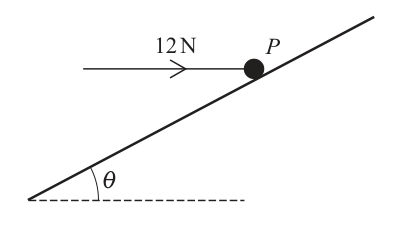
A particle of mass lies on a rough plane inclined at an acute angle to the horizontal. A horizontal force of magnitude acts on as shown in the diagram. The line of action of this horizontal force lies in a vertical plane which contains the line of greatest slope of the plane that passes through . The coefficient of friction between and the plane is .
is in equilibrium and on the point of sliding down the plane.
Approach
Resolve all forces acting on the particle into components perpendicular and parallel to the inclined plane. Since is in equilibrium and on the point of sliding down, the frictional force acts up the plane and is at its limiting value . Use to match the required form.
Working
The forces acting on are:
- Weight acting vertically downwards.
- Horizontal force acting horizontally towards the plane.
- Normal reaction acting perpendicular to the plane, away from it.
- Friction acting parallel to the plane, up the slope (since is about to slide down).
Resolve perpendicular to the plane:
The component of weight into the plane is . The component of the horizontal force into the plane is . For equilibrium:
Substituting :
Resolve parallel to the plane:
The component of weight down the plane is . The component of the horizontal force up the plane is . Friction acts up the plane. For equilibrium:
Apply limiting friction condition:
Substitute the expressions for and :
Solve for :
Divide the numerator and denominator by :
This is the required result.
Answer
μ = (5tanθ - 1) / (5 + tanθ)
Walkthrough
First, identify all forces acting on the particle. There is the weight acting vertically down, the horizontal push , the normal reaction perpendicular to the surface, and friction parallel to the surface. Since the particle is on the point of sliding down, friction must act up the plane to oppose the motion.
Next, resolve forces perpendicular to the plane. The weight has a component pressing into the plane. The horizontal force has a component also pressing into the plane. The normal reaction balances these, giving .
Then, resolve forces parallel to the plane. The weight has a component pulling down the slope. The horizontal force has a component pushing up the slope. Friction also acts up the slope. Equilibrium gives , so .
Finally, use the limiting friction equation . Substitute the expressions for and , and use (standard for this problem type to match the coefficients). Divide top and bottom by to convert sines and cosines into tangents, yielding the required expression.
Key Takeaways
- When resolving on an inclined plane, always resolve forces into components parallel and perpendicular to the slope.
- A horizontal force has components (parallel) and (perpendicular) when the slope is at angle to the horizontal.
- The direction of friction is always opposite to the direction of impending motion.
Common Mistakes
- Forgetting to include the component of the horizontal force in the perpendicular resolution (the term).
- Getting the direction of friction wrong (acting down the slope instead of up).
- Using instead of , which prevents matching the required form exactly.
Things to Be Careful About
- Ensure all force components are dimensionally consistent and correctly signposted (into/out of plane, up/down slope).
- When dividing by , ensure (valid since is acute).
- The mark scheme requires evidence of the intermediate step (dividing by or using ) to award the final mark; simply jumping to the answer may not earn full credit.
Approach
The coefficient of friction must be positive (). Use the expression derived in part (a) to set up an inequality for .
Working
From part (a):
Since and is an acute angle (), we have , which means the denominator .
For the fraction to be positive, the numerator must be positive:
Taking the inverse tangent:
Since is an acute angle:
Answer
11.3° < θ < 90°
Walkthrough
The coefficient of friction is a physical property that must be strictly positive (). We use the formula from part (a): .
Since is acute, is positive, so the denominator is always positive. Therefore, for to be positive, the numerator must be positive.
Solve to get . Calculate . Combine this with the condition that is acute () to get the final range.
Key Takeaways
- The coefficient of friction must be positive. This is a crucial physical constraint often used to find ranges of angles or parameters.
- When solving rational inequalities, check the sign of the denominator first to simplify the condition to just the numerator.
Common Mistakes
- Forgetting that (the upper bound from the question stating is acute).
- Including as a constraint (not necessarily true; can be greater than 1).
- Using instead of for the inequality (if , the plane is smooth and friction cannot act to prevent sliding, but the problem states there is friction and it's on the point of sliding, implying ).
Things to Be Careful About
- Must be strict inequality: , not .
- The upper bound must be ; any other upper bound (like ) will lose the mark.