Mathematics 9709/32 — October/November 2025
Cambridge A-Level · Pure Mathematics 3 · worked solutions for every part, with the mark scheme
Topics Algebra · Integration · Differentiation · Trigonometry · Logarithmic and Exponential Functions · Complex Numbers · +3 more
Approach
The graph of is a V-shaped graph with its vertex on the x-axis where the expression inside the modulus is zero.
Working
The vertex occurs where , so . The vertex is at .
The y-intercept is found by setting :
The y-intercept is .
For , , which is a straight line with gradient 1.
For , , which is a straight line with gradient -1.
The graph is symmetrical about the line and consists of two solid line segments above the x-axis.
Answer
The graph is a V-shape with vertex at and y-intercept at .
V-shaped graph with vertex at (-3a, 0) and y-intercept at (0, 3a)
Walkthrough
First, identify the vertex of the modulus function . The vertex occurs where the expression inside the modulus equals zero, which is , giving . Since the modulus function is always non-negative, the vertex is at on the x-axis.
Next, find the y-intercept by substituting : (since is positive). This gives the point .
The graph consists of two straight line segments meeting at the vertex. For , the expression inside is positive, so (gradient 1). For , the expression is negative, so (gradient -1). The graph is entirely above or on the x-axis, forming a V-shape.
Key Takeaways
- The graph of is a V-shape with its vertex on the x-axis at .
- The y-intercept is found by evaluating the modulus at .
- The two arms of the V have gradients of and .
Common Mistakes
- Drawing the graph below the x-axis (modulus is always ).
- Failing to mark the vertex at and the y-intercept at .
- Drawing curved lines instead of straight line segments.
Things to Be Careful About
- Ensure the graph is symmetrical about the vertical line .
- Use solid lines for the graph; ignore any dotted lines below the axis.
- The constant is positive, so is on the negative x-axis and is on the positive y-axis.
Approach
To solve , we find the critical value where the two expressions are equal, then use the graph from part (a) or algebraic reasoning to determine the region where the inequality holds. We must be careful to reject any extraneous solutions.
Working
Method 1: Using the graph
From part (a), the graph of is a V-shape with vertex at and y-intercept at .
We want to find where this graph lies above the line .
The critical value occurs where the two expressions are equal:
At this value, .
Since , the line has a negative gradient and intersects the right arm of the V-shape at .
We test a value in the region , for example :
LHS:
RHS:
Since , , so satisfies the inequality.
Thus, the solution is .
Method 2: Algebraic (squaring both sides)
Note that squaring is only directly valid when both sides are non-negative, but we can solve to find critical values:
This gives or .
However, is an extraneous solution introduced by squaring. We must check the regions:
- For , the inequality holds.
- For , the inequality does not hold.
The clear conclusion is .
Answer
x > -2/3 a
Walkthrough
To solve the inequality , we first find the critical value where the two sides are equal. Setting gives , so .
This critical value divides the number line into two regions: and . We test a value in each region to see where the inequality holds.
Testing (which is since ):
LHS:
RHS:
Since , the inequality is satisfied for .
Testing (which is ):
LHS:
RHS:
Since , the inequality is not satisfied.
Thus, the solution is .
If using the squaring method, gives or . The value is extraneous because squaring can introduce false solutions when one side is negative. The correct solution must be stated as with a clear implication that is rejected.
Key Takeaways
- To solve modulus inequalities, find the critical value where the expressions are equal.
- Test regions to determine where the inequality holds.
- Be careful with algebraic methods like squaring, which can introduce extraneous solutions.
Common Mistakes
- Forgetting to reject extraneous solutions when squaring both sides.
- Using instead of in the final answer (the original inequality is strict).
- Failing to test regions to confirm the solution.
Things to Be Careful About
- The constant is positive, so is negative.
- Ensure the final answer uses strict inequality as in the original question.
- If using the squaring method, explicitly reject and justify why.
Solve the equation . Give your answer correct to 3 significant figures.
Approach
Take natural logarithms of both sides to convert the exponential equation into a linear equation in . Then solve the linear equation and collect the result.
Working
Take natural logarithms of both sides:
Use and :
Expand the brackets:
Collect the -terms on one side:
Factor out and combine using logarithm laws:
Since , divide:
Evaluate:
Answer
x = 2.46
Walkthrough
Since the variable is in the exponents, we cannot solve the equation with ordinary algebra. Taking logarithms of both sides is the standard technique because it turns powers into multipliers.
Both sides of the equation are positive, so taking natural logarithms is valid. Apply two laws:
- for the products and .
- for the powers and .
This gives a linear equation in :
Next, expand the brackets so that all terms involving are explicit. Then move all -terms to one side and all constant terms to the other, as in a normal linear equation. Factor out and divide by its coefficient.
The coefficient simplifies to , and the constant side simplifies to . Therefore
Finally, evaluate this quotient with a calculator and round to 3 significant figures, obtaining .
Key Takeaways
- When the unknown appears in an exponent, taking logarithms is the standard strategy.
- The laws and convert an exponential equation into a linear equation.
- Careful collection of terms is required before solving. The final answer must be rounded to the requested degree of accuracy.
Common Mistakes
- Incorrectly combining as . This is invalid because the bases are different; the mark scheme explicitly says it is not allowed.
- Forgetting to apply the power law to both and .
- Making sign errors when moving terms across the equation.
- Leaving the answer as an unsimplified logarithm expression when the question asks for a value to 3 significant figures.
Things to Be Careful About
- Both sides of the equation are positive, so taking natural logarithms is valid.
- When simplifying, note that .
- The final answer must be , not an unrounded value such as .
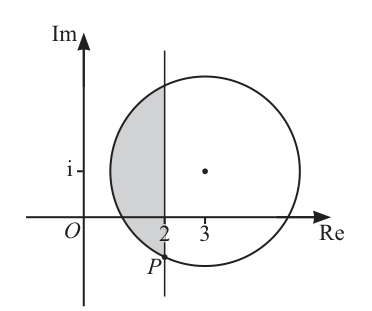
The shaded region in the Argand diagram, bounded by a line and a circle, represents the complex numbers satisfying
The point shown on the diagram is one of the points of intersection of the line and the circle.
Find the complex number represented by the point . Give your answer in the form , where and are real and exact.
Approach
P is the lower intersection of the line with the circle . Substitute into the circle equation, solve for , and take the smaller root.
Working
The circle corresponds to the equation
Set (since ):
The two intersection points have (upper) and (lower). From the diagram, is the lower intersection, so .
Answer
2 + i(1 − √3)
Walkthrough
The shaded region is bounded by the vertical line and the circle (centre , radius ). The point is the lower intersection of this line and the circle, so it lies on both loci.
The circle equation is the expanded form of . The line is just , so we substitute into the circle equation. This gives , i.e. , so . The two intersection points are (upper) and (lower). From the diagram, is the lower intersection, so and .
Key Takeaways
- The locus in the Argand diagram is a circle of centre and radius .
- The line is the vertical line .
- Intersections of a vertical line with a circle are found by substituting into the circle equation.
Common Mistakes
- Choosing the upper intersection instead of the lower one.
- Forgetting to write the final answer in the form (e.g. giving the coordinates instead).
Things to Be Careful About
- Make sure the answer is written as a single complex number, not as a coordinate pair.
- Both intersection points satisfy the equation; read the diagram carefully to pick the correct one.
Approach
The maximum in the shaded region occurs at the point on the circle where a ray from the origin is tangent to it. The required angle is the angle from the positive real axis to this tangent, which equals the angle from the positive real axis to the line (where is the centre) plus the half-angle between and the tangent (computed from the right triangle with hypotenuse and opposite side equal to the radius).
Working
The centre of the circle is , with modulus
Angle from the positive real axis to the line :
Half-angle of the tangent at the origin (right triangle with hypotenuse and side opposite the angle at equal to the radius ):
The maximum in the shaded region is the sum of these two angles (the upper tangent gives the larger argument):
Evaluating numerically:
(Sanity check: the top of the line inside the circle is at , with rad, which is less than rad, so the maximum is indeed on the circle, not on the line.)
Answer
1.01 radians (≈ 57.7°)
Walkthrough
The shaded region is the part of the disc with . The argument of is the angle that the line from the origin to makes with the positive real axis. As we rotate counterclockwise from the positive real axis, the ray first hits a boundary point; the largest such angle is the argument of the upper tangent line from to the circle.
The tangent point is the foot of the perpendicular from the centre to the tangent line. The triangle formed by , the tangent point and is right-angled at the tangent point, with hypotenuse and the side opposite the angle at being the radius . If is the angle at in this triangle, , giving .
The line itself makes angle with the positive real axis. The upper tangent is rotated further anticlockwise from , so the maximum argument in the shaded region is
This evaluates to about rad, or about .
Check: the top of the line segment on inside the circle is at , whose argument is rad, which is smaller, so the maximum is on the circle.
Key Takeaways
- For a closed region, the maximum is attained on its boundary.
- For a circle not containing the origin, the largest on the circle corresponds to the upper tangent from the origin.
- The geometry of a tangent from an external point can be exploited using a right triangle whose hypotenuse is the distance from the origin to the centre and one leg is the radius.
- The maximum over the whole shaded region is the larger of the two candidate maxima (on the circle vs. on the line ); here the circle wins.
Common Mistakes
- Forgetting to include the angle that accounts for the offset of the centre from the real axis; using only underestimates the maximum.
- Using the lower tangent (giving a negative or smaller angle).
- Confusing with .
- Failing to verify that the tangent point lies inside the shaded region (it does, with ).
- Quoting the answer in degrees without the radian value (or vice versa).
Things to Be Careful About
- The maximum is taken over the shaded region, not the entire circle; the boundary line must be considered, although here the circle gives a larger angle.
- is typically taken in , so we look at the upper (positive) half of the figure.
- The numerical value is rad; the mark scheme accepts rad or (AWRT).
Find the exact value of .
Approach
Use integration by parts with and . Then split the resulting rational integrand and evaluate the definite integral.
Working
Let
Then
Integration by parts gives
Now split the fraction:
Therefore
Hence an antiderivative is
Evaluate from to :
At :
At :
Therefore
Answer
π/4 - 1/2
Walkthrough
We need to integrate a product . Since is not a simple derivative, integration by parts is the natural method. Choose so that its derivative simplifies the remaining integral, and choose because its integral is easy. This gives
The new integral is not immediately standard, but we can rewrite the fraction:
This splits it into a polynomial term and the standard derivative of . Integrating gives . Substituting back gives the antiderivative. Finally, evaluate at the limits and , using and . The lower limit contributes zero, so the exact value is .
Key Takeaways
This question tests integration by parts, recognising the derivative of inverse tangent, rewriting a rational function, and evaluating definite integrals. A student should understand how to choose and so the new integral is simpler, and how to split into .
Common Mistakes
- Choosing and leads to a harder integral, since integrating is possible but less direct.
- Forgetting the factor after integration by parts.
- Incorrectly simplifying ; it is not or , but .
- Using degrees instead of radians when evaluating ; the mark scheme requires radians.
- Forgetting to subtract the lower-limit value, or substituting incorrectly.
Things to Be Careful About
- The integration by parts formula has a minus sign; it is condoned in the mark scheme but must be handled correctly.
- The lower limit at : and , so it contributes , but evidence of substitution at least once is needed.
- Use exact values: , not a decimal.
- The final answer must be exact; decimals are not accepted.
Approach
Use the product rule to differentiate , then factor out and apply the factor theorem.
Working
Let and . Then
By the product rule,
Factor out the common factor :
This has the form , where .
Answer
Since , is a factor of .
(x - a) is a factor of f'(x)
Walkthrough
We need to show that the derivative contains as a factor. Since is written as the product of two functions, the product rule is the natural tool. Let and . The derivative of is , because the derivative of the inside is . The derivative of is just . Applying the product rule gives two terms. Both terms contain one copy of , so factor it out. The remaining bracket is a new polynomial , so . By the factor theorem, this means is a factor of .
Key Takeaways
- The product rule applies whenever a function is a product of two different functions.
- A common factor can be taken out of a derivative just as from any algebraic expression.
- The factor theorem says: if a polynomial can be written as , then is a factor.
Common Mistakes
- Applying the product rule as instead of .
- Forgetting the term in the second product.
- Writing the derivative without factorising and therefore not giving a clear conclusion.
Things to Be Careful About
- The derivative of is , not , because the derivative of the inside is .
- To score the final mark, make the factorisation explicit, or state that and invoke the factor theorem.
Approach
Because is a factor, is a repeated root of . Hence and, from part (a), . Use these two conditions to form equations in and and solve them.
Working
Let . Since is a root,
So
Now differentiate :
Since is a repeated root, :
Hence
Substitute into :
Answer
p = -30, q = 72
Walkthrough
A repeated factor means that is a root with multiplicity two. Therefore the value of the polynomial is zero at , and so is its derivative. This is exactly part (a) applied with .
First impose :
After evaluating the powers, this becomes
so
Next differentiate the polynomial:
Since is a repeated root, set :
This simplifies to , so .
Finally, substitute into :
so .
Key Takeaways
- A repeated factor gives two conditions: and .
- Unknown coefficients in a polynomial can be found by using root conditions to form equations.
- The derivative of a cubic is a quadratic, and evaluating it gives a separate linear equation in the coefficients.
Common Mistakes
- Using only , which leaves one equation with two unknowns and so and cannot be found.
- Forgetting the derivative condition for a repeated root.
- Making sign errors when substituting or when moving terms across the equation.
- Differentiating incorrectly, for example writing the derivative of as instead of .
Things to Be Careful About
- The condition is only valid because the factor is repeated; a single factor would not give a derivative condition.
- Evaluate powers correctly: , , , not .
- The final answers are and ; check by substituting back into the cubic or by expanding if desired.
By sketching a suitable pair of graphs, show that the equation has exactly one root in the interval .
Approach
To show that the equation has exactly one root in , we sketch the graphs of and on the same axes and identify their points of intersection.
Working
Consider the two functions:
For on :
- As , (vertical asymptote at ).
- when , so .
- As , (vertical asymptote at ).
- The curve is continuous and strictly decreasing from to .
For on :
- At , .
- Maximum value occurs when , i.e., . The maximum is .
- At , .
- The curve is a sine wave shifted downwards by 1 unit.
By sketching both curves:
- starts at , decreases through , and goes to .
- starts at , increases to a maximum at , and decreases back to .
The curves intersect exactly once in the interval (marked with a red dot in the diagram). For , while , but drops to much faster than reaches , and they do not cross again before . Thus, there is exactly one point of intersection in .
Answer
The graphs intersect at exactly one point in the interval , confirming exactly one root.
The curves y = cot(2x) and y = 2sin(2x) - 1 intersect at exactly one point in 0 < x < π/2.
Walkthrough
We are asked to show that the equation has exactly one root in . The most direct method is to treat each side of the equation as a separate function and sketch them on the same set of axes. The roots of the equation correspond to the x-coordinates of the intersection points of the two graphs.
First, we analyze . The cotangent function has vertical asymptotes where . For , this occurs when , so . In the interval , the asymptotes are at the boundaries and . The function crosses the x-axis when , which gives . Since is decreasing between its asymptotes, falls from to .
Next, we analyze . This is a sine wave with period , amplitude 2, and a vertical shift of . At , . It reaches its maximum of when , i.e., at . At , . The curve rises from to a peak at and then falls back to .
By drawing these two curves, we see that starts high above (since and at ). At , and , so . By continuity, they must cross at least once in . Since is strictly decreasing and is strictly increasing in this sub-interval, there is exactly one crossing. For , and decreasing to , while is decreasing but bounded below by , so they do not cross again. Thus, there is exactly one root.
Key Takeaways
- Sketching two functions on the same axes is a powerful graphical method to locate roots of equations.
- Understanding the key features of trigonometric graphs (asymptotes, intercepts, maxima, minima) is essential for accurate sketching.
- The number of intersections between two graphs directly corresponds to the number of roots of the equation formed by equating them.
Common Mistakes
- Sketching with the wrong period or missing the vertical asymptotes at and .
- Forgetting to shift the sine curve down by 1 unit, which would place the maximum at instead of .
- Not justifying why there is only one intersection (e.g., by noting the monotonic behavior in the relevant sub-interval).
Things to Be Careful About
- Ensure all angles are in radians, as the interval is given in terms of .
- The sketch must be clear enough to show that no second intersection occurs in the interval. Marking the intersection point explicitly helps.
- Scales do not need to be perfectly accurate, but key points (asymptotes, x-intercept at , maximum at ) must be correctly positioned.
Approach
To show that the root lies in , we define a function and evaluate it at the endpoints and . If and have opposite signs, then by the Intermediate Value Theorem, there is a root in the interval.
Working
Let . We calculate and using radians.
For :
For :
Since and , there is a sign change in the interval . Because is continuous on this interval, there must be at least one root in .
Answer
and , so the root lies in .
f(0.4) ≈ 0.537 > 0 and f(0.6) ≈ -0.475 < 0, so there is a sign change and a root in 0.4 < x < 0.6.
Walkthrough
We need to prove that the root of lies between and . The standard method for this is to rearrange the equation into the form and check the signs of at the endpoints of the interval.
Rearranging gives . We must ensure our calculator is in radian mode, as the interval is given in radians.
At , we compute . Then and . Substituting these into gives , which is positive.
At , we compute . Then and . Substituting gives , which is negative.
Since is continuous on and changes sign from positive to negative, the Intermediate Value Theorem guarantees that there is at least one root in this interval. The question asks to "show by calculation", so presenting these values with a clear statement of the sign change is sufficient.
Key Takeaways
- The sign-change method is a reliable way to locate roots within a given interval.
- Always ensure the calculator is in the correct mode (radians for trigonometric equations involving ).
- Values should be given to at least 2 significant figures to justify the sign change.
Common Mistakes
- Using degrees instead of radians when evaluating trigonometric functions. This will give completely wrong values and no sign change.
- Making arithmetic errors when calculating (remembering that , not ).
- Not explicitly stating that a sign change implies a root (though often implied, it is good practice to mention continuity).
Things to Be Careful About
- The mark scheme awards M0 if working in degrees. Always use radians.
- Values should be accurate to at least 2 significant figures. Using more decimal places is fine and helps avoid rounding errors.
- Ensure the function is defined and continuous on the entire interval . Since has asymptotes at and , it is continuous on .
Use the iterative formula to calculate the root correct to 2 decimal places. Give the result of each iteration to 4 decimal places.
Approach
We are given the iterative formula:
We start with an initial value in the interval (e.g., ) and iterate until the result is correct to 2 decimal places. Each iteration must be given to 4 decimal places.
Working
Let .
Iteration 1:
Iteration 2:
Iteration 3:
Iteration 4:
Iteration 5:
Iteration 6:
Continuing this process, the values oscillate and converge:
To confirm the root is to 2 decimal places, we can check for a sign change in around and :
Since and , the root lies in , which means it is to 2 decimal places.
Answer
The root correct to 2 decimal places is .
0.49
Walkthrough
We are given an iterative formula to find the root of the equation. The formula is:
We choose an initial guess , which is within the interval established in part (b). We then substitute this into the right-hand side to find , and repeat the process.
Iteration 1:
. . . . .
Iteration 2:
. . . . .
Iteration 3:
. . . . .
The values oscillate: . This oscillation indicates that the iterative formula is converging to a root, but slowly. We continue iterating until the values agree to 2 decimal places.
After several iterations, the values settle around . To rigorously justify that the root is to 2 decimal places, we can check the sign of at and . If and , then the root must lie in , which means it rounds to .
Calculating:
Since there is a sign change in , the root is indeed to 2 decimal places.
Key Takeaways
- Iterative formulas can be used to find roots of equations to a specified degree of accuracy.
- The sequence of values may oscillate around the root before converging; this is normal and does not mean the formula is incorrect.
- To confirm the final answer to a given number of decimal places, it is best to check for a sign change in the function at the boundaries of the rounding interval (e.g., ).
Common Mistakes
- Using degrees instead of radians. This will cause the iteration to diverge or give completely wrong values.
- Rounding intermediate values too early. Always keep at least 4 decimal places during iterations to avoid accumulation of rounding errors.
- Stopping the iteration too early. The values must agree to 2 decimal places, and even then, a sign change check is the most robust way to confirm the answer.
- Not showing enough iterations. The mark scheme requires at least a second iteration to be completed, and sufficient iterations to justify the final answer.
Things to Be Careful About
- The iterative formula may oscillate. Do not assume it is converging monotonically.
- Always use radians in calculator mode.
- When checking for the final answer, use the original function rather than relying solely on the iterative values, as the iteration itself may not have fully converged to the exact root.
- The mark scheme accepts various starting values (e.g., ) and will condone missing iterations in the middle as long as the start and end are correct.
The equation of a curve is .
Approach
Differentiate the given equation implicitly with respect to , using the product rule for the term . Then collect the terms involving and rearrange to obtain the required expression.
Working
Differentiate each term:
For , use the product rule:
Also:
So differentiating the whole equation gives:
Collect the terms:
Factor from the numerator and denominator and cancel the common factor:
as required.
Answer
dy/dx = (x^2 + 2xy)/(2y^2 - x^2)
Walkthrough
We are given an equation that defines implicitly as a function of . To find , differentiate every term with respect to .
For , since is a function of , the derivative is .
For , use the product rule: differentiate to get , and keep ; then keep and differentiate to get . This gives .
The derivative of is , and the derivative of the constant is . Putting these together gives an equation involving . Collect the terms on one side, then factor from the numerator and denominator and cancel it. This is exactly the required expression.
Key Takeaways
This question tests implicit differentiation, the product rule, and algebraic rearrangement. When a variable is defined implicitly in terms of , every -term must be differentiated with an extra factor . The product rule is needed when a term contains both and .
Common Mistakes
- Forgetting to multiply by when differentiating .
- Applying the product rule incorrectly to .
- Losing the minus sign in front of .
- Failing to collect the terms before solving.
- Cancelling incorrectly; factor first, then cancel the common factor .
Things to Be Careful About
The derivative of is , not . The right-hand side is a constant, so its derivative is . When simplifying, write the numerator and denominator with a common factor before cancelling. The mark scheme requires clear working showing how was obtained.
Hence find the coordinates of the points on the curve at which the normal is parallel to the -axis.
Approach
For the normal to be parallel to the -axis, the tangent must be horizontal, so . Since the derivative is a fraction, set its numerator equal to zero. This gives two possible relationships between and . Substitute each into the curve equation to find the coordinates.
Working
The normal is parallel to the -axis when the tangent is horizontal, so:
Using the derivative from part (a):
So the numerator must be zero:
Factorise:
Hence:
Case 1: . Substitute into the curve:
So one point is .
Case 2: . Substitute into the curve:
Simplify:
Then:
So the other point is .
Answer
(0, 2) and (4, -2)
Walkthrough
A normal line perpendicular to the curve is parallel to the -axis exactly when it is vertical. That happens when the tangent is horizontal, i.e. when . Since the derivative is a fraction, a fraction is zero only when its numerator is zero (provided the denominator is not also zero). Set and factorise to get or .
Each of these gives a possible family of points on the curve. Substitute each relation into the original curve equation to find the actual points.
For , the curve becomes , so , giving .
For , substitute carefully: and . The curve becomes , which simplifies to , so and , giving .
Both points have nonzero denominator in the derivative, so the condition is valid.
Key Takeaways
This question connects the geometry of tangents and normals to the value of the derivative. A vertical normal corresponds to a horizontal tangent, so . Solving an implicit derivative condition often leads to two cases that must each be substituted back into the original equation.
Common Mistakes
- Setting the denominator equal to zero instead of the numerator.
- Forgetting the case after factorising.
- Making sign errors when substituting , especially with .
- Stopping after finding and not finding .
Things to Be Careful About
The normal is parallel to the -axis, so the tangent is horizontal: , not infinite. Use the numerator of the derivative. When substituting , remember . The mark scheme accepts coordinates stated separately, but both coordinates of each point are needed.
Approach
Start with and use the double angle formula for sine, then express in terms of and .
Working
This proves the identity.
Answer
sin 4x = 4 sin x(2 cos^3 x - cos x)
Walkthrough
We start with the left-hand side, . The double angle formula for sine says . Taking gives . Next, expand as , and expand as . Substituting gives . Finally, multiply the into the bracket to obtain , which is exactly the right-hand side. Since every step is reversible and valid for all , the identity is proved.
Key Takeaways
This question tests the double angle formulae for sine and cosine. It also shows how to rewrite a trigonometric expression entirely in terms of and by expanding compound angles. Recognising which double angle form of to use is an important skill.
Common Mistakes
- Using directly, which is false.
- Using the wrong form of , such as .
- Losing the factor when expanding or .
- Stopping at without distributing the .
Things to Be Careful About
Because the statement is an identity, the working must be valid for all , not just particular values. Ensure the final expression has the factor distributed correctly: . The mark scheme requires full working to earn the final A1; an unsupported statement of the identity is not enough.
Approach
Use the identity from part (a) to rewrite the integrand as a sum of terms of the form , integrate each by the reverse chain rule, then evaluate between the limits.
Working
Using ,
Therefore
Since ,
So an antiderivative is
Evaluate at the limits:
Hence
Answer
(sqrt(2) + 12)/35
Walkthrough
Part (b) says 'Hence', so we must use the identity from part (a). Substitute into the integrand:
This splits the integral into two simpler integrals. For each, notice that the derivative of is , so is almost the derivative of . Hence
Applying this with and gives the antiderivative . Then evaluate at and . At , , so and . At , both powers are . Subtracting from and simplifying gives .
Key Takeaways
This question combines a trigonometric identity with integration by recognition (reverse chain rule). It shows how an identity can transform an apparently difficult integrand into terms of the form , which integrate immediately. Exact trigonometric values at special angles are then used to obtain an exact final answer.
Common Mistakes
- Forgetting to use the identity from part (a) and trying to integrate the original expression directly.
- Incorrectly multiplying: , then forgetting the factor from the identity.
- Sign errors: the derivative of is , so the antiderivative must have a negative sign.
- Evaluating the upper limit incorrectly, especially the powers of .
- Forgetting to subtract .
Things to Be Careful About
The mark scheme first awards a B1 for writing the integral as , so show this line clearly. The antiderivative must be stated before substituting limits. When simplifying, , and the final exact value is . Use radians throughout.
Let , where is a positive constant.
Approach
Since the numerator and denominator have the same degree, the decomposition must include a constant term:
Find , and by multiplying both sides by and comparing coefficients.
Working
Comparing the coefficient of gives .
Comparing the coefficient of and the constant term respectively gives
With , these become
From , . Substitute into :
Hence . Therefore
f(x) = 1 + 2a/(x + 2a) - 3a/(x + 3a)
Walkthrough
The first thing to notice is that the numerator and denominator are both quadratic, so the fraction is not proper. If we try to write it as only two partial fractions, we cannot match the leading term. We therefore include a constant term:
Multiplying both sides by the denominator converts this into a polynomial identity. Comparing the coefficient of immediately gives , because is multiplied by , whose leading term is .
Next, comparing the coefficient of gives , and comparing the constant terms gives . Substituting turns these into the two linear equations
Solving this simple system gives and . The positive parameter is carried through the algebra and appears naturally in the coefficients.
Key Takeaways
This question tests the decomposition of an improper rational function. When the degrees of the numerator and denominator are equal, the partial fractions must begin with a non-constant term, here the constant . It also reinforces comparing coefficients as a systematic way of finding unknown constants, and solving a small linear system.
Common Mistakes
- Omitting the constant term and trying to write the expression as only two fractions. The mark scheme only awards full credit if the form includes the constant term.
- Substituting a numerical value such as to make the algebra easier. The question requires an answer in terms of , and the mark scheme restricts credit if is replaced by a number.
- Making sign errors when expanding , especially in the constant term .
Things to Be Careful About
The positive constant must be treated as a single unknown throughout. It is also important to expand correctly:
When solving and , keep the signs in the simultaneous equations consistent; a single sign error will give incorrect coefficients.
Approach
Use the partial-fraction form from part (a):
Integrate term by term from to . The reciprocal terms integrate to logarithms of the form .
Working
Since , both and are positive on , so we can write the antiderivative as
At the upper limit :
At the lower limit :
Therefore
Now use logarithm laws:
So and , both rational.
Answer
a(2 + ln(9/8))
Walkthrough
The function is already split into partial fractions from part (a). To integrate it, recall that
when the argument is positive. Since the interval is and , and are positive throughout, so no absolute-value complications arise.
The antiderivative is therefore
Substitute the upper limit and the lower limit . A common mistake is to subtract the lower antiderivative incorrectly. In the log terms, the factors inside the arguments cancel:
The -term contributes
Combine everything:
Finally,
so the final answer is .
Key Takeaways
This question requires:
- using the result of a partial-fraction decomposition in integration,
- integrating as ,
- carefully substituting definite limits,
- combining logarithms using laws, especially and .
Common Mistakes
- Forgetting the constant term when integrating, i.e. missing the in the antiderivative.
- Incorrectly substituting into ; be careful not to write or anything similar. At , we have , not .
- Subtracting the lower antiderivative with the wrong signs. The final difference is , so the term contributes .
- Losing the factor when combining the logarithmic parts. The expression is , not .
Things to Be Careful About
The mark scheme requires a completed partial-fraction form; if part (a) is wrong, the final answer may not be accepted even if the integration is correct.
Because is given as positive, no division by zero or negative argument to a logarithm occurs in the integration interval. Also remember that the final result must be stated in the requested form with rational and ; here and .
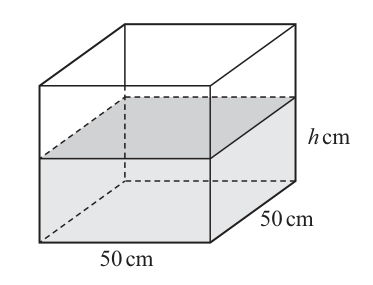
The diagram shows a tank for holding water. The tank is in the shape of a cube of side . At time seconds, the depth of water in the tank is . Water is poured into the tank at a rate of . Water pours out of the tank through a hole in the bottom at a rate proportional to .
When , the depth of the water is increasing at a rate of .
Approach
Relate the volume of water to the depth . Differentiate with respect to using the chain rule to find in terms of . Use the given condition to find the constant of proportionality , then substitute back to obtain the required differential equation.
Working
The volume of water in the tank is:
The rate of change of volume is the rate in minus the rate out:
Using the chain rule, . Equating the two expressions:
When , . Substitute these values to find :
Substitute into the expression for :
Answer
dh/dt = (500 - h^2) / 250
Walkthrough
First, we express the volume of water in terms of the depth . Since the tank has a square base of , the volume is . The rate at which the volume changes, , is the rate at which water enters () minus the rate at which it leaves (). This gives .
Next, we use the chain rule to connect to . Since , we have . Equating the two expressions for gives .
To find the constant , we use the given condition that when , . Substituting these values yields , which simplifies to . Finally, substituting and dividing numerator and denominator by gives the required result .
Key Takeaways
- Relating physical quantities like volume and depth to set up differential equations.
- Using the chain rule to change the variable of differentiation from volume to depth.
- Determining unknown constants in a differential equation using provided initial or conditional data.
Common Mistakes
- Forgetting to multiply the base area () when finding .
- Failing to show the method for finding ; simply stating without working will not earn the mark.
- Not simplifying the final fraction correctly to match the required form.
Things to Be Careful About
- Ensure the final statement is complete and clearly shows to secure the final mark.
- Pay attention to units; all given values are in cm and seconds, so no unit conversion is needed, but consistency must be maintained.
Given that when , find the time taken for the depth of the water in the tank to reach .
Approach
Separate the variables and in the differential equation from part (a). Integrate both sides, using the standard integral form for . Apply the initial condition when to find the constant of integration, then substitute to find the time .
Working
Separate variables:
Integrate the right-hand side:
For the left-hand side, use the standard integral with :
Equating the integrals and adding the constant of integration :
Use the initial condition :
The particular solution is:
Find the time when :
Rationalise the argument of the logarithm:
Answer
16.1 s
Walkthrough
We begin by separating the variables in the differential equation to get . Integrating the right side gives . For the left side, we recognize the standard integral form where .
Applying this formula gives . Equating the two integrated sides and using the initial condition when shows that the constant of integration because .
To find the time when , we substitute into the equation and solve for . This involves simplifying the logarithmic argument, which can be done by rationalising the denominator: . Multiplying by gives the final numerical value seconds.
Key Takeaways
- Separation of variables is a powerful technique for solving first-order differential equations.
- Recognising standard integral forms, particularly , is essential for solving these equations.
- Applying initial conditions correctly determines the particular solution from the general solution.
Common Mistakes
- Forgetting the absolute value signs inside the logarithm (though they can be omitted if the argument is known to be positive).
- Incorrectly applying the standard integral formula, especially the coefficient .
- Algebraic errors when rationalising the fraction inside the logarithm.
Things to Be Careful About
- Ensure you use the correct form of the standard integral; do not confuse it with which gives an arctan result.
- When calculating the final numerical answer, keep at least 3 significant figures during intermediate steps to avoid rounding errors.
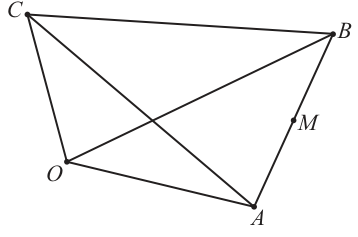
Relative to the origin , the position vectors of the points , and are
The midpoint of is , as shown in the diagram.
Approach
Find the position vector of the midpoint using the average of and . Then subtract from and to obtain and .
Working
The position vector of , the midpoint of , is:
Substitute the given vectors:
Now find :
Now find :
Answer
MB = -i + 5j + 2k, MC = -5i - 3j + 4k
Walkthrough
First, we locate the midpoint of the segment . The position vector of a midpoint is the average of the position vectors of the endpoints, so we compute . Adding the components of and gives , and halving this yields .
Next, to find the displacement vector from to , we subtract the position vector of the start point from the end point: . Subtracting component by component gives . Similarly, gives .
Key Takeaways
- The position vector of a midpoint is the arithmetic mean of the position vectors of the endpoints.
- A displacement vector from to is found by .
Common Mistakes
- Forgetting to divide by 2 when finding the midpoint.
- Subtracting in the wrong order (e.g., computing instead of ).
- Dropping a component (like ) when vectors have different numbers of non-zero components.
Things to Be Careful About
- Ensure all three components () are accounted for, even if one is zero in the original vectors.
- The mark scheme accepts column vector notation as an equivalent answer.
Approach
Use the scalar product formula to find . Calculate the scalar product and the magnitudes of and , then divide and simplify the surds.
Working
Compute the scalar product :
Compute the magnitudes:
Apply the cosine formula:
Simplify :
So:
Rationalise the denominator:
Answer
-sqrt(15)/75
Walkthrough
To find the cosine of the angle between two vectors, we use the identity . First, we calculate the scalar (dot) product of and by multiplying corresponding components and summing: .
Next, we find the magnitudes of each vector by taking the square root of the sum of the squares of their components: and .
Dividing the scalar product by the product of the magnitudes gives . Simplifying to and reducing the fraction yields . Finally, rationalising the denominator by multiplying top and bottom by gives the exact answer .
Key Takeaways
- The scalar product provides a direct way to find the angle between two vectors.
- Simplifying surds step-by-step prevents arithmetic errors in the final answer.
Common Mistakes
- Sign errors in the scalar product (e.g., computed as instead of ).
- Forgetting to rationalise the denominator when an exact value is required.
- Not stating explicitly before giving the final value.
Things to Be Careful About
- Ensure the angle is correctly identified as (the angle at between and ).
- The mark scheme allows equivalent exact forms such as , but the rationalised form is preferred.
Approach
Since is the midpoint of , the median divides into two triangles of equal area. Thus, the area of is twice the area of . Use the sine formula for the area of a triangle: . Find using .
Working
Since is the midpoint of , .
First, find using the identity :
Simplify :
So:
Since is an angle in a triangle, :
Now calculate the area of :
Combine the square roots:
Simplify :
Finally, the area of is:
Answer
2sqrt(374)
Walkthrough
The key geometric insight is that a median of a triangle divides it into two smaller triangles of equal area. Since is the median to side , the area of is exactly twice the area of .
To find the area of , we use the formula , where and are the lengths of two sides and is the included angle. We already know , , and we found in part (b).
Using , we compute , so .
Substituting into the area formula: .
Doubling this gives the area of as .
Key Takeaways
- A median divides a triangle into two equal-area sub-triangles.
- The sine area formula is highly efficient when two sides and the included angle are known.
- Combining square roots before simplifying often leads to cleaner arithmetic.
Common Mistakes
- Forgetting to double the area of to get the area of .
- Sign errors when computing (e.g., forgetting the square on the cosine).
- Incorrectly simplifying ; noting that is a helpful check.
Things to Be Careful About
- Always take the positive root for when is an angle in a triangle, since angles in a triangle are between and .
- The mark scheme explicitly warns against changing the sign of the cosine from part (b); if done, the final answer must also be adjusted accordingly, but this is not recommended.