Mathematics 9709/31 — October/November 2025
Cambridge A-Level · Pure Mathematics 3 · worked solutions for every part, with the mark scheme
Topics Trigonometry · Integration · Differentiation · Complex Numbers · Logarithmic and Exponential Functions · Differential Equations · +3 more
Find the exact value of . Give your answer in the form , where and are integers.
Approach
Use integration by parts with and , then evaluate the antiderivative between the limits 1 and 2, combining the logarithms at the end.
Working
Let and . Then:
Using integration by parts:
Simplify the integrand:
Evaluate the definite integral from 1 to 2:
Simplify:
Combine the logarithms:
Answer
So and .
-1 + ln 12
Walkthrough
We need to find the exact value of . Since is not a standard integrand we recognise directly, we use integration by parts:
We choose (to be differentiated) and (to be integrated). Differentiating using the chain rule gives , and integrating 1 gives . Substituting into the formula:
We then evaluate this antiderivative at the limits. At the value is ; at the value is . Subtracting the lower from the upper:
Finally we combine the logarithms. Since , we have . So the final answer is , matching the required form with and .
Key Takeaways
This question tests the ability to apply integration by parts to a logarithmic function, to differentiate correctly using the chain rule, and to combine logarithms using the laws of logarithms. It also tests careful substitution of limits into a definite integral.
Common Mistakes
- Forgetting that (the 3 cancels), and instead writing .
- Incorrectly substituting the limits, e.g. mixing up which limit is subtracted from which.
- Failing to combine into , leaving the answer in an uncombined form that does not match the required structure.
Things to Be Careful About
- The final answer must be in the form with integers and , so the logarithm must be fully combined.
- The mark scheme requires working to be shown; an unsupported answer gains no marks.
- When substituting limits, be careful with the signs: the lower-limit contribution is subtracted.
Approach
Express the constant 2 as a logarithm in base 4, apply the power law to move the coefficient inside the logarithm, combine the logarithms using the quotient law, then equate arguments and expand to obtain a quadratic equation.
Working
Start with the equation:
Since , rewrite the equation:
Apply the power law :
So:
Combine using the quotient law :
Since the logarithms are equal, their arguments are equal:
Multiply through by 16:
Expand and rearrange:
This is the required quadratic equation.
Answer
The equation can be written as:
(or equivalently ).
9x^2 - 38x - 15 = 0 (or equivalently 16(2x+1) = (3x-1)^2)
Walkthrough
We start with the equation . The goal is to eliminate the logarithms and obtain a quadratic equation in .
First, we express the constant 2 as a logarithm in base 4. Since , we can write . This earns the B1 mark — stating or implying that .
Next, we apply the power law of logarithms to the term . The power law says , so . This earns the M1 mark.
Now the equation becomes . We combine the two logarithms on the right using the quotient law: . So .
Since both sides are logarithms with the same base 4, their arguments must be equal: . Multiplying by 16 gives . Expanding and rearranging gives , which is the required quadratic. This earns the A1 mark.
Key Takeaways
- A constant can be written as a logarithm in any base: .
- The power law moves a coefficient inside the logarithm.
- The quotient law combines two logarithms.
- If , then (provided the base is the same).
- The final equation must be free of logarithms to be a "quadratic equation in ".
Common Mistakes
- Forgetting to express the constant 2 as a logarithm — students sometimes try to equate arguments directly, which fails because the right-hand side is not a single logarithm.
- Incorrectly applying the power law, e.g. writing instead of .
- Sign errors when combining logarithms with the quotient law (adding instead of subtracting).
- Errors in expanding — forgetting the middle term .
Things to Be Careful About
- The mark scheme requires showing the step (or equivalent) for the B1 mark.
- The M1 mark requires using the power law (or product/quotient law) correctly.
- The A1 mark requires a correct equation free of logs, in any form — e.g. or .
- All logarithms in the original equation must have positive arguments; this becomes relevant in part (b).
Approach
Solve the quadratic obtained in part (a) using the quadratic formula, then reject any root that makes the argument of a logarithm negative.
Working
From part (a):
Apply the quadratic formula with , , :
Since , we have :
The two roots are:
and
The original equation contains and , which require and , i.e. . The root is negative, so it is rejected.
Therefore:
Answer
x = (19 + 4√31)/9 ≈ 4.59
Walkthrough
From part (a) we have the quadratic . We solve it using the quadratic formula with , , .
This gives . The two roots are approximately 4.59 and -0.363.
Now we must check the roots against the domain of the original equation. The original equation contains and , which require and . The stricter condition is , i.e. . The root is negative, so it is rejected. Only is valid.
The M1 mark is for solving the 3-term quadratic; the A1 mark is for the correct answer "4.59 only" — the word "only" signals that the negative root must be rejected.
Key Takeaways
- The quadratic formula solves any 3-term quadratic.
- Solutions of a transformed equation must be checked against the domain of the original equation.
- Logarithms are only defined for positive arguments, so any root making or undefined must be rejected.
Common Mistakes
- Forgetting to reject the negative root — the mark scheme explicitly requires "4.59 only".
- Arithmetic errors in the quadratic formula, especially with the discriminant .
- Not simplifying to (though this is not required for the marks, it gives the exact answer).
Things to Be Careful About
- The mark scheme accepts AWRT 4.59 (anything within reasonable tolerance of 4.59).
- The exact answer is .
- The domain condition is , since is stricter than .
- Do not round to 4.6 unless the question allows it; AWRT 4.59 is the accepted value.
Approach
Expand using the compound angle formula, simplify to , then write this in the form by comparing coefficients.
Working
Using ,
Since , the given expression becomes
Now write . Comparing with gives
Hence
and
So
Answer
R = 5, alpha = 36.9°; expression = 5 cos(x - 36.9°)
Walkthrough
Start with the given expression. The angle is a compound angle, so expand using the addition formula. Substitute and multiply by . This gives . Adding the extra gives , which is exactly the form.
To rewrite this as , expand the target form using the cosine subtraction formula and equate the coefficients of and . This gives and . Square and add these equations to eliminate and find . Dividing the second equation by the first gives , then taking inverse tangent in degrees gives .
Be careful not to write and without the factors; because , the correct statements are and .
Key Takeaways
- An expression of the form can be rewritten as a single sinusoidal expression .
- The compound angle formula lets us simplify angles such as .
- Comparing coefficients is a powerful technique for matching two equivalent trigonometric forms.
- For , we have and .
Common Mistakes
- Expanding incorrectly, especially swapping the sine and cosine terms.
- Forgetting to add the remaining after multiplying the expansion by .
- Writing and instead of including the factors; the mark scheme gives M0A0 for this.
- Mixing up the coefficients: the coefficient of is and the coefficient of is .
- Working in radians when the question is in degrees.
Things to Be Careful About
- Keep all angles in degrees throughout.
- must be positive, so take the positive square root.
- The required answer has , which satisfies.
- Show the intermediate step to earn the M1 mark.
Approach
Use the result from part (a) to rewrite the left-hand side as . Then solve by finding the principal angle and the two families of solutions.
Working
From part (a),
The equation is therefore
so
Let . The principal value is
Thus the general solutions are
where is an integer.
Case 1:
For , gives ; gives , which is not included.
Case 2:
For , gives ; gives , which is outside the interval.
Answer
θ = 60.0° and θ = 84.6°
Walkthrough
The word "Hence" tells us to use the result of part (a). Replace the left-hand side by . Then set this equal to . Dividing by isolates the cosine: .
Let . The principal angle whose cosine is is , because cosine is negative in the second quadrant. For a cosine equation, the general solution is . This accounts for both the second-quadrant angle and its reflection in the x-axis, and for all full rotations.
Solve the two cases for :
- gives . Within , only is valid; is excluded by the strict inequality.
- gives . Within the interval, gives ; gives , which is outside.
So the two solutions are and .
Key Takeaways
- A single sinusoidal form such as turns a more complicated equation into a standard equation.
- The general solution of is .
- After solving for , remember to convert to the required variable, here , by dividing by the coefficient.
- Always test each integer to see whether the resulting value lies in the required interval.
Common Mistakes
- Forgetting the sign in the general solution and losing one of the two families.
- Not adding , so missing repeated solutions for larger .
- Solving for but forgetting to divide by to get .
- Including , even though the interval is and therefore excludes the endpoint.
- Stopping after finding only one solution.
- If part (a) gives a different , keep using that value consistently; the mark scheme allows follow-through marks.
Things to Be Careful About
- All angles are in degrees; set the calculator to degree mode.
- The inequality is strict, so neither nor is allowed.
- Acceptable answers are AWRT and AWRT .
- Answers outside the given interval should be ignored, not counted as extra solutions.
- Show the step clearly, as this earns the B1 mark.
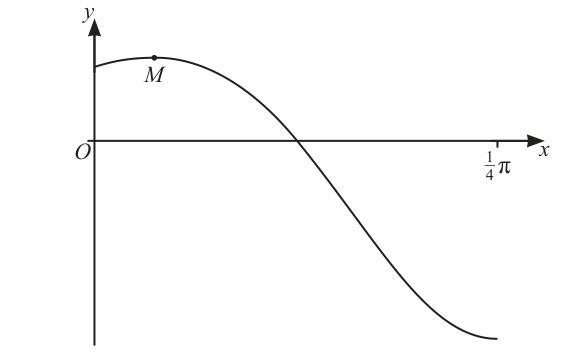
The diagram shows the graph of for , and its maximum point .
Find the -coordinate of .
Approach
Differentiate using the product rule and chain rule, set at the maximum point , and solve the resulting equation by expressing everything in terms of using double-angle identities.
Working
Differentiate using the product rule:
Compute each derivative using the chain rule:
Substitute back:
At the maximum point , . Since , divide through:
Use the double-angle identity :
Factor out :
So either or .
For with , we get , so . At this point, , giving , which is not a maximum.
Now solve . Use :
Let :
Apply the quadratic formula:
The two solutions are:
Since , reject .
So .
For , we have , so:
Rounding to 3 decimal places:
Answer
x = 0.113
Walkthrough
Step 1: Differentiate using the product rule. The function is a product of two functions: and . The product rule gives . This earns the first mark (M1) for correctly applying the product rule.
Step 2: Apply the chain rule to each part. For , the outer function is and the inner function is , giving . For , the outer function is and the inner function is , giving . Substituting these back yields the full derivative , which earns the second mark (A1).
Step 3: Set the derivative to zero and simplify. At a maximum point, . Since is always positive and never zero, we can divide it out, leaving . This earns the third mark (M1) for equating the derivative to zero and obtaining an equation in one trig function.
Step 4: Use double-angle identities to reduce to a single trig function. Substitute to get . Factor out to get . The factor gives , but checking this in the original function shows it is not a maximum (it gives ). For the other factor, substitute to get , which rearranges to . This earns the fourth mark (A1).
Step 5: Solve the quadratic in . Let , giving . The quadratic formula gives . Since must lie in , only is valid. Then , so , which rounds to . This earns the final mark (A1).
Key Takeaways
- The product rule combined with the chain rule is essential for differentiating functions involving products of exponentials and trigonometric functions.
- Setting and factoring out common terms (especially which is never zero) simplifies the equation significantly.
- Double-angle identities ( and ) are powerful tools for reducing equations involving multiple angles to a single trig function.
- Always check whether solutions from factored equations actually correspond to maxima or minima by evaluating the original function.
Common Mistakes
- Forgetting the chain rule when differentiating , leading to an incorrect derivative such as instead of .
- Not dividing out when setting the derivative to zero, making the equation appear more complicated than it is.
- Failing to check the extraneous solution from , which does not correspond to the maximum point .
- Making sign errors when applying the double-angle identity for , particularly confusing with .
- Rejecting the valid root or incorrectly keeping which is outside the range of .
Things to Be Careful About
- The interval means , so and there is only one solution to in this range. Always check the domain when solving trigonometric equations.
- The mark scheme condones a sign error in the derivative and allows arithmetical errors, but requires showing the method clearly.
- The answer is given to 3 decimal places; more accuracy (e.g., ) is also acceptable.
- When factoring , remember to check both factors in the original context — gives a point on the curve, but it is not the maximum .
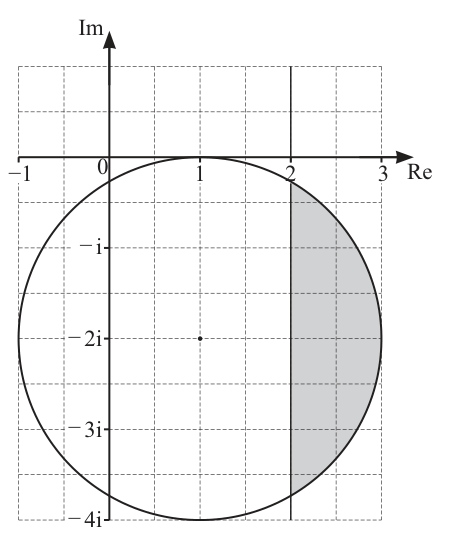
The shaded region on the Argand diagram shows points representing complex numbers defined by two inequalities. The shaded region is bounded by a circle and a line parallel to the imaginary axis. The boundaries of the region are included in the shaded region.
Approach
The shaded region is bounded by a vertical line and a circle. We translate these geometric boundaries into inequalities involving .
Working
The vertical line is at . Since the shaded region is to the right of this line (including the boundary), the first inequality is:
The circle is centred at with radius 2. The region inside the circle (including the boundary) is described by the modulus inequality :
Simplifying the expression inside the modulus:
Answer
Re(z) >= 2 and |z - 1 + 2i| <= 2
Walkthrough
First, observe the vertical boundary of the shaded region. It is a straight line parallel to the imaginary axis passing through . The shaded area lies to the right of this line, which directly translates to the inequality .
Next, observe the circular boundary. The diagram shows a circle centred at the point , which corresponds to the complex number . The radius of the circle is 2 units. The shaded region lies inside this circle. The set of points whose distance from a fixed point is less than or equal to a constant is given by the modulus inequality . Substituting and , we get , which simplifies to .
Key Takeaways
- A vertical line on the Argand diagram corresponds to . The half-plane to the right is .
- A circle with centre and radius on the Argand diagram corresponds to the locus . The interior (including boundary) is .
Common Mistakes
- Forgetting to include the equality sign when the boundary is included in the shaded region. The question states "The boundaries of the region are included", so and must be used, not and .
- Writing the centre incorrectly, e.g., using instead of , which leads to .
Things to Be Careful About
- Ensure the modulus inequality is written in the form where is complex and is real. The expression is correct because .
- The argument of is typically defined in or . Part (a) does not require argument, but part (b) will.
Approach
The least value of occurs at the point in the shaded region that makes the most negative angle with the positive real axis. This point lies on the boundary of the region, specifically where the vertical line intersects the lower part of the circle.
Working
The boundaries are given by and . Let . The circle equation is:
Substitute into the circle equation to find the intersection points:
The two intersection points are and . Since , the -coordinates are approximately and .
The point is in the fourth quadrant and has the most negative -value for . For points in the region and inside the circle, the argument is minimized when is as negative as possible and is as small as possible. The point satisfies this.
Calculate the argument of :
In radians:
Alternatively, using the positive angle measure:
The least value is or rad.
Answer
-61.8 degrees or -1.08 rad
Walkthrough
To find the least value of , we need to identify the point in the shaded region that has the smallest angle measured from the positive real axis. Since the region is in the fourth quadrant (mostly), the least argument will be the most negative angle.
The boundary of the region consists of the line and the circle . The extreme points for the argument will lie on these boundaries. We find the intersection of the line and the circle by substituting into the circle equation:
.
The intersection points are and . The point is lower down, meaning it has a more negative -coordinate. For a fixed , a more negative gives a more negative argument. We also check if any other point in the region could give a smaller argument. The circle extends to at , giving , which is greater than . Thus, the minimum argument occurs at .
Calculating the argument: . Using a calculator, or rad.
Key Takeaways
- The extreme values of in a bounded region often occur at boundary points, particularly intersections of boundaries.
- When finding the least argument, consider the quadrant and whether you want the most negative value (principal value) or the smallest positive value.
Common Mistakes
- Finding the wrong intersection point (e.g., using instead of ).
- Forgetting that can be negative and giving as the answer when is the least value (though both may be accepted depending on the convention, the question asks for the least value, which is ).
- Rounding errors in the final answer.
Things to Be Careful About
- Ensure the argument is calculated using the correct quadrant. The point is in the fourth quadrant, so the argument is negative (or between and ).
- The mark scheme accepts , , rad, or rad. Be consistent with the required format.
Solve the quadratic equation . Give your answers in the form , where and are real.
Approach
This is a quadratic equation with complex coefficients, so use the quadratic formula
with , , . Simplify the discriminant using , then write each root in the form by multiplying numerator and denominator by the conjugate of the denominator.
Working
First compute the discriminant:
so . Therefore
For the first root:
For the second root:
Answer
w = -3/5 + 4/5 i or w = -1 + 0i
Walkthrough
We are asked to solve a quadratic equation, but now the coefficients are complex numbers. The quadratic formula still applies: for ,
Here , and . First calculate the discriminant. The product is a difference of squares: it equals . Hence . Since , the two roots are .
Now we need each answer in the form . The denominators are complex, so multiply numerator and denominator by the conjugate . This makes the denominator real: . For the first numerator, , so the first root is . For the second numerator, , so the second root is , which can be written as .
An alternative approach is to multiply the whole equation by first. This gives , which can then be solved by factorising or the quadratic formula. Both methods lead to the same two roots.
Key Takeaways
- The quadratic formula can be used with complex coefficients as well as real coefficients.
- Use whenever simplifying products of complex numbers.
- To write a quotient of complex numbers in Cartesian form, multiply numerator and denominator by the conjugate of the denominator.
- A real answer such as is also a complex number, written as .
Common Mistakes
- Forgetting that when multiplying conjugates, giving wrong real parts.
- Dropping the sign when taking the square root of the discriminant.
- Leaving the answer as a quotient of complex numbers instead of simplifying to .
- Sign errors when expanding .
- Not showing evidence of multiplying by the conjugate; the mark scheme requires some evidence of this step.
Things to Be Careful About
- The discriminant is negative, so the square root introduces .
- The coefficient is complex, so , not .
- When rationalising, multiply both numerator and denominator by the same conjugate.
- Give the final answers in the required form ; write as if needed.
The parametric equations of a curve are
Obtain a simplified expression for in terms of .
Approach
Since and are given parametrically in terms of , differentiate each expression with respect to , then use
Working
Differentiate with respect to . The derivative of is , and by the chain rule the derivative of is :
Differentiate using the quotient rule:
Now use the parametric differentiation formula:
Simplify the denominator first:
Therefore
Answer
dy/dx = 1 / [2(2t + 1)(2t - 1)(t + 1)]
Walkthrough
We are given and separately in terms of a parameter , so to find we differentiate both and with respect to , then use the parametric formula .
For , the derivative of is . For the logarithmic term, the chain rule says that the derivative of is , because the derivative of the inner function is . This gives .
For , use the quotient rule:
Here and , so and . Substituting gives , which simplifies to .
The final step is to divide by . Write as a single fraction and factor the numerator:
Then dividing gives the simplified result.
Key Takeaways
This question tests the standard parametric differentiation technique: differentiate each parametric equation with respect to the parameter and divide the two derivatives. It also requires the chain rule for differentiating and the quotient rule for differentiating a rational function of . Finally, it tests algebraic fluency in rewriting a compound fraction as a single simplified fraction.
Common Mistakes
A common error is to forget the factor when differentiating , writing the derivative as instead of . Another common error is applying the quotient rule incorrectly, especially getting the order of numerator terms wrong. Students also sometimes divide by instead of the other way round. Finally, marks can be lost by not simplifying the compound fraction fully; the answer should be written as a single fraction with numerator .
Things to Be Careful About
The expression is only defined for , so . Within this domain, . Also note that when or , but is outside the domain; at the tangent is vertical and the formula for is not valid. In the final answer, ensure the denominator is left fully factorised and that the numerator is exactly .
The variables and satisfy the differential equation
where is a constant. It is given that when and that when .
Solve the differential equation and find the exact value of when .
Approach
Separate the variables so that all terms in are on one side and all terms in are on the other. Integrate both sides, using and . Then use the two given pairs of values to determine the constants and , and finally substitute .
Working
Separate variables:
Integrate both sides:
Use when :
Use when :
Thus the particular solution is
When , , so
Answer
y = -1/2 ln(2e - 1)
Walkthrough
We start with the differential equation . The first step is to separate the variables: put all terms with and all terms with . Dividing by gives
Now integrate each side. The left side is . On the right, the numerator is a constant multiple of the derivative of (since the derivative is ), so . Including the constant of integration gives
Use when . Since , this gives , so .
Now use when . Substituting gives
Multiply by 2 and rearrange: , so and .
Finally substitute . Since and , the logarithm term becomes
Thus
Multiplying by gives , so .
Key Takeaways
This question tests separation of variables for a first-order differential equation, integration of an exponential and of the form , and the use of two initial conditions to determine two constants. It also requires exact manipulation with logarithms, especially simplifying .
Common Mistakes
- Forgetting the constant of integration after integrating both sides. The mark scheme requires the constant to be included before using the initial conditions.
- Sign error when integrating : the integral is , not .
- Missing the factor on the exponential term or on the logarithm term.
- Using only one of the two given conditions; both are needed, one to find and one to find .
- Algebra error in the final substitution: remember , so the logarithm term simplifies before solving for .
- The mark scheme notes that when separating variables, missing integral signs or missing , is condoned, but not both missing.
Things to Be Careful About
- The constant of integration may be written on either side; if written on the right, it must be carried through correctly.
- When substituting , the term becomes , not . This is a common sign mistake.
- Since for all real , there is no domain restriction from the logarithm in this problem.
- Keep the answer exact: do not replace or by a decimal approximation.
- Check that , so the logarithm is defined.
By sketching a suitable pair of graphs, show that the equation
has only one root in the interval .
Approach
To show that has only one root in , we sketch the graphs of and on the same axes and observe their intersection.
Working
Consider the function .
- At , .
- As , , so .
- As , , so .
- At , .
- There is a vertical asymptote at .
Consider the function .
- At , .
- The function is strictly decreasing and negative for all .
- At , .
- At , .
In the interval :
- and , so there is no intersection.
In the interval :
- increases from to .
- decreases from to .
- Since goes from (below ) to (above ), and both functions are continuous in this interval, they must intersect exactly once.
Thus, the equation has only one root in .
Answer
The graphs intersect exactly once in the interval , proving there is only one root.
The graphs intersect exactly once in the interval (pi/4, pi/2).
Walkthrough
First, we analyze the behavior of in the interval . The function has a vertical asymptote at because . For , is positive, so . For , is negative, so . Specifically, as approaches from the right, , and at , .
Next, we consider . This is always negative and strictly decreasing. At , . At , .
Comparing the two graphs:
- In , while , so no intersection is possible.
- In , rises from to , while falls from to . Since one starts below the other and ends above it, they must cross exactly once.
Key Takeaways
- Sketching requires identifying asymptotes at and key points like and .
- Graphical methods can prove the existence and uniqueness of roots by analyzing the monotonic behavior and bounds of the functions involved.
Common Mistakes
- Forgetting the vertical asymptote at when sketching .
- Assuming the graphs intersect in without checking the signs of the functions.
- Not justifying why there is only one intersection (e.g., by noting the monotonic nature of both curves in the relevant interval).
Things to Be Careful About
- Ensure the sketch clearly shows the asymptote and the correct branches of .
- The mark scheme also accepts sketching and , which is obtained by rearranging to . If using this alternative, note that goes from to and goes from to in the interval .
Approach
Let . We evaluate at and to show a sign change, indicating a root lies between these values.
Working
Calculate :
Calculate :
Since and , there is a sign change. As is continuous in this interval, the root lies between and .
Answer
The root lies between and .
The root lies between 0.9 and 1.
Walkthrough
We define a function whose root corresponds to the solution of . To show the root is between 0.9 and 1, we calculate and .
At : , so . Adding gives .
At : , so . Adding gives .
Because is negative and is positive, and the function is continuous between these points, the Intermediate Value Theorem guarantees a root exists in the interval .
Key Takeaways
- To locate a root between two values, evaluate a rearranged function at both endpoints.
- A sign change in confirms the presence of a root in the interval.
Common Mistakes
- Using degrees instead of radians when calculating trigonometric values.
- Forgetting to add the term or making sign errors when evaluating .
Things to Be Careful About
- Ensure your calculator is in radian mode.
- The mark scheme also accepts evaluating the original expressions and separately and comparing them (e.g., and ).
Show that if a sequence of values given by the iterative formula
converges, then it converges to the root of the equation in part (a).
Approach
If the sequence converges, let the limit be . Then as , and . Substitute into the iterative formula and show it is equivalent to the original equation.
Working
Given the iterative formula:
If the sequence converges to a root , we set :
Rearrange to isolate the inverse cosine:
Take the cosine of both sides:
Multiply both sides by :
Divide by :
Recognize that :
Rearrange to obtain the original equation:
Thus, if the sequence converges, it converges to the root of .
Answer
The iterative formula converges to the root of .
The iterative formula converges to the root of sec 2x = -e^x.
Walkthrough
When an iterative sequence converges, the limit satisfies . We substitute into the given formula and rearrange to show it is equivalent to the original equation .
Multiplying by 2 gives . Taking the cosine of both sides yields . Multiplying by gives , which rearranges to , or . This proves the fixed point of the iteration is the root of the original equation.
Key Takeaways
- The limit of a convergent iterative sequence is a fixed point of the iteration function.
- Rearranging the fixed-point equation can verify it matches the original equation whose root is being found.
Common Mistakes
- Forgetting to state that at convergence.
- Making algebraic errors when rearranging back to .
Things to Be Careful About
- The question only asks to show that IF it converges, it converges to the root. You do not need to prove convergence itself.
- Ensure all algebraic steps are reversible or clearly stated.
Use the iterative formula given in part (c) to calculate correct to 3 decimal places. Give the result of each iteration to 5 decimal places.
Approach
Use the iterative formula starting with an initial value (or another value in the interval). Calculate successive values to 5 decimal places until the result is stable to 3 decimal places.
Working
Let .
Iteration 1:
Iteration 2:
Iteration 3:
Iteration 4:
Iteration 5:
The values are stabilizing. To 3 decimal places:
Thus, the root is correct to 3 decimal places.
Answer
0.978
Walkthrough
We start with an initial guess (which is in the interval identified in part (b)). We apply the formula repeatedly, keeping 5 decimal places for accuracy.
Since and both round to to 3 decimal places, the root is .
Key Takeaways
- Iterative methods require sufficient iterations to ensure the result has stabilized to the required precision.
- Always keep extra decimal places during intermediate steps to avoid rounding errors.
Common Mistakes
- Rounding too early (e.g., to 3 decimal places) at each iteration, which can cause the sequence to oscillate or converge to the wrong value.
- Using the wrong mode (degrees instead of radians) on the calculator.
- Stopping the iteration too early before the value has stabilized.
Things to Be Careful About
- The mark scheme requires showing sufficient iterations to 5 d.p. to justify the 3 d.p. answer. Showing a sign change in is also acceptable.
- Different starting values (e.g., or ) will produce different intermediate sequences but should converge to the same final answer.
Let .
Approach
The numerator and denominator have the same degree, so first perform polynomial long division to obtain a constant plus a proper fraction. Then express the proper fraction in the form and solve for the constants.
Working
Step 1 — Long division.
Dividing by :
Hence
Step 2 — Set up the identity.
Step 3 — Find by substituting .
Step 4 — Compare coefficients to find and .
Expanding the right side:
Coefficient of : .
Coefficient of : .
Check the constant: ✓
So , , , .
Answer
f(x) = 1 - 4/(3+x) + (x-3)/(2+x^2)
Walkthrough
The denominator has degree 3, the same as the numerator . Whenever the numerator and denominator have equal degree, we must do polynomial long division first to get a constant plus a proper fraction. Dividing gives the quotient and remainder , so
The proper fraction has degree of numerator (2) less than degree of denominator (3), so it can be split into partial fractions. Because is an irreducible quadratic, the second term must be linear in in its numerator: . The first term is the standard form for a distinct linear factor.
Clearing denominators gives the identity . Setting is the easiest way to find , because the factor vanishes, leaving , i.e. .
With known, we expand the right side and compare coefficients of , and the constant with the left side:
- :
- :
- constant: — this is a useful check.
Key Takeaways
- Always check degrees before attempting partial fractions: equal-degree case requires long division first.
- When the denominator contains an irreducible quadratic, the corresponding partial fraction must have a linear numerator , not just a constant.
- Substituting the root of a linear factor into the cleared identity is the fastest way to isolate one constant.
- After finding constants, the constant-term check is a free way to confirm the work.
Common Mistakes
- Trying to apply the partial fraction form directly without first doing long division (the term is needed because the fractions are not proper).
- Writing the second term as instead of when the quadratic is irreducible.
- Forgetting to expand the right side correctly and dropping a term when comparing coefficients.
Things to Be Careful About
- The constant is not "free" — it is determined by the long division, and is in this problem.
- Sign errors when applying the substitution (remember to substitute into the polynomial factors, not just leave the as ).
- The form has four unknowns — make sure all four are obtained.
Hence obtain the expansion of in ascending powers of , up to and including the term in .
Approach
Rewrite each partial-fraction term so that its denominator is a constant times with a multiple of or , then use the binomial expansion up to the term. Finally multiply out the linear numerator in the second term and collect coefficients.
Working
Step 1 — Expand .
Factor the out of the denominator:
Using the binomial expansion, up to the term:
Therefore
Step 2 — Expand .
Factor the out of the denominator:
Using the binomial expansion, up to the term:
Multiplying out:
Keeping terms up to :
Step 3 — Combine the three pieces.
Constant term:
Coefficient of :
Coefficient of :
Answer
f(x) = -11/6 + (17/18)x + (65/108)x^2
Walkthrough
The idea is to write each denominator in the form where is small when is small, then use the binomial series .
For the term , factor out to get . The expansion up to uses :
Multiplying by gives .
For the term , factor out to get . Here , so the expansion up to is just (the term is already an term, and there is no contribution). The key step is to multiply out the linear numerator by this expansion. The product
gives from the first part and from the second; we only keep terms up to . After dividing by , we get
Finally, the function , so the constant adds to , giving . The coefficient is (note both terms contribute with a positive sign because of the leading minus in front of the term). The coefficient is .
A quick sanity check: setting in the original gives , matching the constant in the expansion. ✓
Key Takeaways
- Always rewrite a denominator as with before applying the binomial expansion; never try to expand directly without factoring.
- For , there is no linear term in at all (only and ) — this is what makes the contribution come from the multiplication by .
- When collecting terms, pay attention to signs: the partial fraction decomposition has a minus in front of , so each of its contributions is subtracted.
- A quick numerical check using confirms the constant term.
Common Mistakes
- Forgetting the leading (i.e. ignoring the constant from part (a)) and writing when combining.
- Treating as having an term — it does not, because has no linear part.
- Dropping the contribution from the part of the linear numerator when multiplying by the expansion. In this problem , which contributes an term: .
- Errors collecting the coefficient — there are two contributions: from the first term and from the second.
Things to Be Careful About
- The validity of the expansion requires and , but for the algebraic manipulation this is not an issue — we are simply truncating a formal series.
- Fractions should be combined over a common denominator; using a common denominator of for the coefficient avoids arithmetic slips.
- The expansion of up to is ; with this is . The signs alternate, and this is easy to slip on.
With respect to the origin , the points and have position vectors given by
The line passes through the points and .
Approach
The direction vector of the line is the displacement from one point to the other. Then write the equation in the form .
Working
The direction vector from to is
Using as the direction vector and point , a vector equation for is
Answer
r = (1, 5, 3) + λ(1, 1, 2)
Walkthrough
The vector equation of a line needs two pieces of information: a point on the line (given by its position vector) and a direction vector. Here we have two points on the line, and , so the direction vector is simply the displacement from one to the other: or . Either works — using just reverses the sign of the parameter. We choose and use 's position vector as the base point, giving .
Key Takeaways
- A line in 3D is written as , where is a position vector of a point on the line and is a direction vector.
- The direction vector is any scalar multiple of the displacement between two points on the line.
- The parameter (or ) can be any real number.
Common Mistakes
- Using a position vector as the direction vector (e.g., writing instead of adding it to a base point).
- Forgetting the base point, writing only .
- Sign errors when computing .
Things to Be Careful About
- Any scalar multiple of the direction vector is acceptable; the mark scheme accepts either or .
- The answer must be written in the form — the mark scheme explicitly requires this.
Find the position vector of the point of intersection of and the line passing through the points and .
Approach
Parametrise the line through and with a parameter , equate corresponding components of the two lines, solve for the parameters, then substitute back to find the intersection point.
Working
Line :
Direction of line :
Line through and :
Equate components:
Check third component:
So . The intersection point is on with :
Answer
(-3, 1, -5)
Walkthrough
To find where two lines intersect, we write both in parametric form and equate their components. The line through and has direction , giving . Equating the first two components of this with line gives two equations in and . Solving gives and . We must verify the third component is consistent (it is), otherwise the lines would be skew. Substituting into (or into the line) gives the intersection point .
Key Takeaways
- Two lines in 3D intersect only if a consistent solution exists for all three component equations.
- If two equations give a solution but the third does not match, the lines are skew.
- The intersection point can be found by substituting the parameter back into either line.
Common Mistakes
- Only equating two components and not checking the third — this can give a false intersection for skew lines.
- Sign errors when writing the components of the line (e.g., writing instead of ).
- Confusing the parameters and when substituting back.
Things to Be Careful About
- The mark scheme notes that if the direction of is taken as , then ; if the direction of is , then . The final point is the same regardless.
- The answer can be given as coordinates or as a position vector.
Approach
Let be a general point on . Form the vector . For the foot of the perpendicular, is perpendicular to the direction of , so their scalar product is zero. Solve for and substitute.
Working
A general point on :
Vector from to :
Perpendicular condition with direction :
So . The foot of the perpendicular is
Answer
(-1, 3, -1)
Walkthrough
The foot of the perpendicular from to is the point on such that is perpendicular to . We write a general point on as . Then . Perpendicularity means the scalar product of with the direction vector of , , is zero. Computing the scalar product gives , so . Substituting back gives the foot of the perpendicular .
Key Takeaways
- The foot of the perpendicular is found by imposing the condition that the connecting vector is perpendicular to the line.
- Perpendicularity in 3D is expressed through the scalar (dot) product being zero.
- The scalar product of and is .
Common Mistakes
- Using instead of — the sign flips but the scalar product being zero is unaffected, so either works, but be consistent.
- Forgetting to subtract 's coordinates correctly (e.g., writing instead of ).
- Arithmetic errors in expanding the scalar product.
Things to Be Careful About
- The mark scheme accepts alternative forms of , e.g. .
- The answer can be given as coordinates or as a position vector.