Mathematics 9709/43 — May/June 2025
Cambridge A-Level · Mechanics · worked solutions for every part, with the mark scheme
Topics Energy, Work and Power · Newton's Laws of Motion · Kinematics of Motion in a Straight Line · Momentum · Forces and Equilibrium
Two particles and , of masses and respectively, are at rest on a smooth horizontal plane. is projected directly towards with speed . At the same instant, is projected directly towards with speed . After and collide, moves with speed and moves with speed .
Approach
Take the direction in which is initially projected as positive. Since both particles move on a smooth horizontal plane, momentum is conserved in the collision. The final speeds are known, but the directions after the collision are not, so test the possible sign choices for the final velocities and keep those giving a positive value of .
Working
Let positive be the direction of 's initial motion. Then initial velocities are:
Conservation of linear momentum gives:
After the collision, and . Test the sign choices that give positive .
Case 1: , .
Case 2: , .
The other two sign choices give and , which are not possible because is a speed.
Answer
u = 14 or u = 10
Walkthrough
This part uses conservation of momentum in a direct collision. The particles are on a smooth horizontal plane, so there is no external horizontal force and total momentum is conserved.
First choose a positive direction. It is convenient to take the direction in which is initially projected as positive. Since is projected directly towards , 's initial velocity is in the opposite direction, so it is .
Write the conservation equation:
The left-hand side simplifies to . On the right-hand side, the final velocities are not known exactly because we are told speeds, not directions. Try the sign choices that can give positive .
If both final velocities are in the positive direction, and , giving . If rebounds but continues in the positive direction, and , giving . The remaining combinations give negative , which cannot be a speed.
Thus the two possible values are and .
Key Takeaways
- Momentum is a vector, so directions must be included in the conservation equation.
- Speeds are magnitudes; the actual velocities after collision may be positive or negative.
- In a direct collision on a smooth horizontal plane, total momentum is conserved.
- Reject solutions that give a negative speed.
Common Mistakes
- Forgetting that 's initial velocity is , not .
- Assuming both final velocities have the same sign.
- Accepting negative values of .
- Using only one of the two valid sign combinations and missing one value of .
- The mark scheme requires a correct momentum equation with the correct number of terms; sign errors in the final velocities may be condoned only if the method is otherwise clear.
Things to Be Careful About
- Be consistent with the sign convention throughout.
- The masses are and ; include both masses on both sides.
- The final speeds are and , but their signs are unknown.
- Only positive values of are physically possible because is a speed.
Approach
The loss of kinetic energy is the initial total kinetic energy minus the final total kinetic energy. Since the final kinetic energy is the same for both possible values of , the largest loss occurs with the larger value of found in part (a).
Working
For a value of , the initial kinetic energy is
The final kinetic energy is independent of :
Using the larger value :
For comparison, gives , so the largest loss is .
Answer
183.6 J
Walkthrough
Kinetic energy is a scalar, so direction does not matter; only the speeds matter. The total kinetic energy before the collision is
This simplifies to . The final kinetic energy is
Because the final kinetic energy is fixed, the loss is larger when the initial kinetic energy is larger. Since initial kinetic energy is proportional to , use the larger value from part (a). Then
Using would give only , so the largest possible loss is .
Key Takeaways
- Kinetic energy is and depends on speed squared.
- Loss of kinetic energy is initial kinetic energy minus final kinetic energy.
- When the final state is fixed, larger initial speed gives larger initial kinetic energy and therefore larger loss.
Common Mistakes
- Using the smaller value of from part (a).
- Forgetting to square the speeds when calculating kinetic energy.
- Omitting the final kinetic energy and giving only the initial kinetic energy as the loss.
- Using the mass of one particle only.
- The mark scheme awards M1 for the correct difference expression and A1 for the final value; if only one value of was found in part (a), the method mark is not awarded.
Things to Be Careful About
- The final answer should be in joules.
- The loss is positive; if your expression gives a negative value, take the absolute value or reorder the subtraction.
- The largest loss corresponds to the larger value of , not the smaller one.
- Units: masses in kg and speeds in give energy in joules.
A van of mass is towing a trailer of mass along a straight horizontal road. The van and trailer are connected by a light rigid tow-bar which is parallel to the road. There are resistance forces of on the van and on the trailer. The driving force produced by the van's engine is . The tension in the tow-bar is , and the acceleration of the van is .
Find the value of and the value of .
Approach
Treat the van and trailer as separate objects. Choose the direction of motion as positive and apply Newton's second law, , to each body.
Working
For the trailer, the tension pulls it forward and the resistance acts backward:
For the van, the driving force acts forward, while the resistance and the tension both act backward:
Substitute :
Answer
T = 260 N, X = 440 N
Walkthrough
The van and trailer move together, so both have the same acceleration . Choose the direction of motion as positive.
Start with the trailer. The only horizontal forces on the trailer are the tension in the tow-bar, pulling it forward, and the resistance , opposing motion. Newton's second law gives:
The right-hand side is the trailer's mass times its acceleration. This gives:
so .
Now consider the van. The driving force acts forward. The resistance acts backward. The tension in the tow-bar also acts backward on the van, by Newton's third law, because the tow-bar pulls the trailer forward and therefore pulls the van backward. Thus:
Substitute :
As a check, applying Newton's second law to the whole system gives:
so , hence , which agrees.
Key Takeaways
This question tests setting up Newton's second law for each body in a connected system. The key steps are: identify all forces on each body, choose a positive direction, write for each body, and solve the equations. The tension in a light tow-bar has the same magnitude at both ends but acts in opposite directions on the two bodies. Resistances always oppose motion.
Common Mistakes
- Forgetting that the tension pulls backward on the van as well as forward on the trailer.
- Writing with the wrong sign for .
- Using the trailer's mass in the van equation, or the van's mass in the trailer equation.
- Adding the masses incorrectly when checking with the system equation.
- Omitting the resistance on the trailer in the system equation.
Things to Be Careful About
- The acceleration is the same for both bodies because the tow-bar is rigid and light.
- All forces are horizontal, so only horizontal components are needed.
- The mark scheme requires dimensionally correct equations with the correct number of terms; an unsupported final answer may not receive full marks.
- Keep units consistent: masses in kg, forces in N, acceleration in .
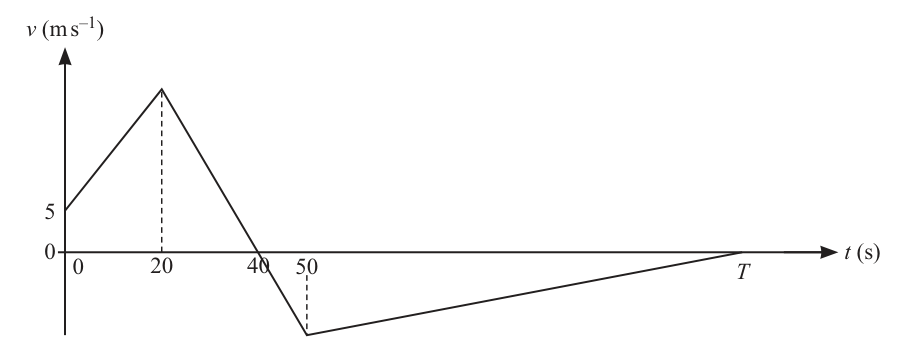
The diagram shows a velocity-time graph which models the motion of a particle. The graph consists of 3 straight line segments. The velocity of the particle at time after passing a fixed point is . The particle leaves with a velocity of and accelerates at for . The particle then decelerates for the next . At , the velocity of the particle is zero. After , the particle starts to travel back to , coming to rest at at time .
Approach
Find the velocity at key times ( and ) using the given acceleration and graph features. Calculate the displacement up to by finding the area under the graph. Use the condition that the particle returns to (total displacement = 0) to set up an equation for using the area of the negative velocity region.
Working
Step 1: Find velocity at
The particle starts at and accelerates at for .
Step 2: Find velocity at
From to , the velocity decreases from to over . The acceleration (gradient) during this phase is:
The graph continues with this gradient to :
Step 3: Calculate displacement at
The displacement is the area under the velocity-time graph from to .
Step 4: Use the return condition to find
The particle returns to at time , so the total displacement is . The negative displacement from to must cancel the positive displacement of .
The region from to is a triangle with base and height (at ):
Set total displacement to zero:
Answer
T = 130
Walkthrough
First, determine the velocity at the peak of the graph () using the initial velocity and acceleration. The particle starts at and accelerates at , reaching at .
Next, analyze the deceleration phase. From to , the velocity drops from to , giving a gradient (acceleration) of . This gradient continues until , where the velocity becomes .
Calculate the total positive displacement up to by finding the area under the graph. This is a trapezium from to and a triangle from to , totaling .
Since the particle returns to the starting point at time , the total displacement must be zero. The area below the time axis from to represents negative displacement. This forms a triangle with base and height . Setting the sum of areas to zero allows solving for .
Key Takeaways
- The area under a velocity-time graph represents displacement.
- Areas below the time axis represent negative displacement (motion in the opposite direction).
- Returning to the starting point means the total signed area under the graph is zero.
Common Mistakes
- Forgetting that displacement is the signed area; using only positive areas.
- Calculating the area of the negative region incorrectly (e.g., using the wrong base or height).
- Not recognizing that the gradient from to continues to .
Things to Be Careful About
- Ensure the velocity at is correctly calculated as (speed is , but velocity is negative for the area calculation).
- The base of the negative triangle is , not , if using the full triangle from to .
- The final answer must be a positive time value greater than .
Approach
Acceleration is the gradient of the velocity-time graph. Identify the velocity at the start () and end () of the interval and calculate the gradient.
Working
From part (a), we know:
- At ,
- At ,
The acceleration is the change in velocity divided by the time taken:
Answer
0.125 ms^-2
Walkthrough
Acceleration is defined as the rate of change of velocity, which corresponds to the gradient of the velocity-time graph. For the interval from to , the graph is a straight line, so the acceleration is constant.
Using the values from part (a):
- Initial velocity at is .
- Final velocity at is .
Calculate the gradient: . The positive value indicates the particle is accelerating in the positive direction (slowing down its negative velocity).
Key Takeaways
- Acceleration is the gradient of a velocity-time graph.
- A positive gradient on a graph where velocity is negative indicates the object is decelerating (slowing down) in the negative direction.
Common Mistakes
- Using speed instead of velocity (getting instead of positive).
- Calculating the time interval incorrectly (e.g., using is correct, but sometimes students use ).
Things to Be Careful About
- Pay attention to signs: velocity is , not . The change in velocity is .
- The question asks for acceleration, which is a vector; the sign matters.
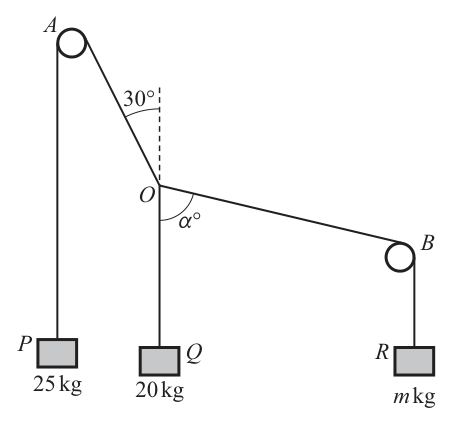
Three blocks , and , of masses , and respectively, are held in equilibrium by three light inextensible strings , and . The strings and both pass over small fixed smooth pulleys and respectively, with and hanging vertically below the pulleys. The block hangs vertically below the point . The angle between and the vertical is and the angle (see diagram).
Find the value of and the value of .
Approach
Identify the tensions in the three strings from the weights of the hanging masses P, Q, and R. Apply the equilibrium condition at the junction point O by resolving the forces horizontally and vertically. This produces two equations in the two unknowns and , which can be solved simultaneously.
Working
The tensions in the strings are equal to the weights of the hanging masses (since the pulleys are smooth):
At point O, the three forces , , and are in equilibrium. Resolve forces horizontally (taking left as positive):
Substitute the tensions:
Resolve forces vertically (taking upwards as positive):
Substitute the tensions and rearrange:
Divide equation (1) by equation (2) to eliminate and :
Calculate the value:
Rounding to 3 significant figures:
To find , square and add equations (1) and (2) after removing :
Rounding to 3 significant figures:
Answer
α = 82.5, m = 12.6
Walkthrough
First, we recognize that the tension in each string is simply the weight of the mass it supports, because the pulleys are smooth and the system is in equilibrium. Thus, , , and . At the junction point O, three forces meet: pulling up and to the left at 30° to the vertical, pulling straight down, and pulling down and to the right at an angle to the vertical.
To apply the equilibrium condition, we resolve these forces into horizontal and vertical components. Horizontally, the leftward pull of must balance the rightward pull of , giving . Vertically, the upward pull of must balance the downward pulls of both and the vertical component of , giving .
Substituting the known tensions into these equations yields two equations with two unknowns ( and ). By isolating in the vertical equation and dividing the horizontal equation by it, we eliminate and , leaving a single equation for . Solving this gives .
Finally, to find , we use the Pythagorean identity by squaring and adding the two original equations (with factored out), which directly gives . Taking the square root yields .
Key Takeaways
- In equilibrium problems with smooth pulleys, the tension in a string supporting a hanging mass is equal to the weight of that mass ().
- When multiple forces act at a point in equilibrium, resolving them in two perpendicular directions (horizontal and vertical) produces a system of independent equations.
- Simultaneous equations involving and can be solved by dividing to find , and by squaring and adding to find using the identity .
Common Mistakes
- Forgetting to include in the tension expressions or dropping it during calculation, which leads to incorrect final values.
- Resolving incorrectly: mixing up sine and cosine components, or getting the directions of the vertical components wrong (e.g., thinking has an upward vertical component when it actually pulls downwards).
- Attempting to find and separately without eliminating one first, leading to complex algebraic manipulations.
Things to Be Careful About
- Always check the signs of the components based on the direction of the forces. Here, pulls upwards and leftwards, while and pull downwards and rightwards (horizontally).
- Ensure the angle is measured correctly from the vertical, as shown in the diagram, so its horizontal component uses and vertical uses .
- Round final answers to 3 significant figures as is standard in Cambridge A-Level Mechanics, unless otherwise specified.
A van of mass travelling at speed experiences a resistance force of . The constant power of the van's engine is .
The steady speed that the van could maintain when moving along a straight horizontal road is .
Show that , and find the acceleration of the van when its speed is on this straight horizontal road.
Approach
At constant power, the driving force at speed is . On level ground at steady speed the acceleration is zero, so the driving force equals the resistance. This determines . Then use Newton's second law at the other speed.
Working
At steady speed , the driving force is
The resistance is . Since the van is in equilibrium along the road,
At speed ,
and the resistance is
Newton's second law gives
Answer
k = 0.5; acceleration = 0.875 m s^-2
Walkthrough
At steady speed the acceleration is zero, so the resultant force along the horizontal road is zero. The engine provides a driving force . The power equation lets you find at the steady speed, and this must equal the resistance ; substituting gives . Then at , repeat to find the new driving force, calculate the resistance, and use to get the acceleration.
Key Takeaways
This question tests the constant-power relation , the dependence of resistance on speed squared, and the use of Newton's second law. To find acceleration you must use the instantaneous driving force at that speed, not a fixed value.
Common Mistakes
- Using the driving force found at again at ; this gives the wrong acceleration.
- Forgetting to convert into .
- Confusing the resistance with the driving force or omitting one of the three terms in Newton's second law.
- Not showing an equation linking to the steady state; the question says "show that", so a clear equation is required.
Things to Be Careful About
Keep all quantities in SI units: power in watts, speed in , force in newtons. At steady speed on a horizontal road, the acceleration is zero so the net force is zero. The resistance is , so it increases with the square of the speed.
The van begins to ascend a hill inclined at an angle to the horizontal. The van travels along a line of greatest slope of the hill. The speed of the van at the start of the hill is , and its acceleration is . Later, on the same hill, the speed of the van is , and its acceleration is . The power of the van's engine remains at , and the resistance force remains at .
Find the value of and the value of .
Approach
Resolve along the line of greatest slope. The driving force at speed is , the resistance is , and the component of weight down the slope is . Write Newton's second law for both speeds and solve the two equations simultaneously.
Working
Using , the component of weight down the slope is
At speed with acceleration :
At speed with acceleration :
Subtract equation (1) from equation (2):
Substitute into equation (2):
Answer
a = 0.129 m s^-2 (31/240); theta = 3.0 degrees
Walkthrough
At each instant on the hill the engine still supplies constant power, so the driving force is not fixed; it is . The van's weight has a component down the slope, opposing the motion. Therefore Newton's second law up the slope is
Write this equation with the two given pairs and . Both equations contain the same unknown , so subtracting them eliminates and gives . Substitute back to find , then take the inverse sine to get in degrees.
Key Takeaways
This is a constant-power motion problem with variable driving force. It combines , the quadratic resistance law, the weight component on an incline, and simultaneous equations from Newton's second law. The key idea is that the same unknowns appear in both equations, so subtracting them eliminates the angle.
Common Mistakes
- Using a fixed driving force value instead of at each speed.
- Putting the weight component on the wrong side or using instead of .
- Swapping the accelerations: corresponds to , and to .
- Forgetting that the van travels up the slope, so the weight component and resistance oppose the driving force.
- Using when the mark scheme uses ; the line shows the intended value.
Things to Be Careful About
Use SI units throughout: . The acceleration is instantaneous, so every speed needs its own driving force . When subtracting the equations, check the sign of every term. Give in degrees and retain sufficient accuracy; and match the mark scheme.
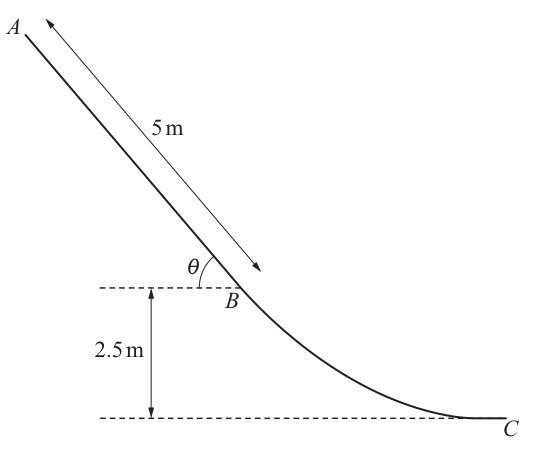
The diagram shows the vertical cross-section of a rough waterslide. The section is a straight line of length inclined at an angle of to the horizontal, where . The point is above the level of . A man of mass , modelled as a particle, slides down the waterslide, starting from rest at . The coefficient of friction between the man and the straight section of the waterslide is .
Approach
Resolve the forces acting on the man perpendicular and parallel to the slope . Use Newton's second law to find the acceleration down the slope, then apply the suvat equation to find the speed at .
Working
Since , we have .
Resolve perpendicular to the slope. The normal reaction force balances the component of weight perpendicular to the slope:
Taking :
The friction force opposes motion down the slope:
Resolve parallel to the slope (downwards positive). The component of weight down the slope is :
The man starts from rest at , so . The distance . Using :
Answer
8.60 m s⁻¹
Walkthrough
Step 1: Find
We are given . Using the Pythagorean identity , we get . This is needed to resolve the weight into components perpendicular and parallel to the slope.
Step 2: Resolve forces perpendicular to the slope
There is no acceleration perpendicular to the slope, so the normal reaction balances the perpendicular component of weight. The weight acts vertically downwards, and its component perpendicular to the slope is . Thus .
Step 3: Calculate the friction force
Friction is . This acts up the slope, opposing the motion.
Step 4: Resolve forces parallel to the slope and apply Newton's second law
The component of weight down the slope is . The net force down the slope is . By Newton's second law, , so .
Step 5: Use suvat to find velocity at B
The man starts from rest () and travels with constant acceleration . Using , we get , so .
An alternative energy method: the loss in gravitational PE is . The work done against friction is . By the work-energy principle, , giving and .
Key Takeaways
- On an inclined plane, resolve weight into components: parallel to the slope (downwards) and perpendicular to the slope.
- The normal reaction equals the perpendicular component of weight when there is no acceleration perpendicular to the surface.
- Friction is and acts opposite to the direction of motion (or intended motion).
- Newton's second law can be applied along any direction; for constant acceleration problems on a straight line, suvat equations are the natural follow-up.
- The work-energy principle provides an alternative approach that can avoid finding acceleration explicitly.
Common Mistakes
- Using instead of for the normal reaction, or vice versa. Remember: perpendicular to the slope uses and parallel uses .
- Forgetting that friction is and not . The normal reaction on an inclined plane is , not .
- Using the wrong suvat equation or forgetting that .
- In the energy method, forgetting to multiply the friction force by the distance when computing work done against friction.
Things to Be Careful About
- The mark scheme accepts (as evidenced by the expected answer ). Using gives , which would not match the expected answer.
- The answer must be given to at least 3 significant figures: , not .
- The acceleration is constant because all forces (weight, normal reaction, friction) are constant on the straight section .
- In the energy method, the distance in the work-done-against-friction term must be (the length of ), not the vertical height.
It is given that there is no change in the speed of the man when passing through and that his speed at is .
Find the work done against the resistance force as the man moves from to .
Approach
Apply the work-energy principle between points and . The change in kinetic energy equals the work done by gravity minus the work done against resistance. Use the speed found in part (a) for the speed at .
Working
From part (a), the speed at is , so .
The speed at is .
Change in kinetic energy from to :
Change in gravitational potential energy from to :
Point is above , so the man descends . The loss in PE is:
Work-energy principle:
The work done by gravity (loss in PE) minus the work done against resistance equals the gain in KE:
Answer
120 J
Walkthrough
Step 1: Identify the speeds at B and C
From part (a), the speed at is , so . The speed at is given as . The question states there is no change in speed when passing through , so we use directly.
Step 2: Calculate the change in kinetic energy from B to C
. The KE increases by .
Step 3: Calculate the change in gravitational potential energy from B to C
Point is above . The man descends , so the loss in PE is .
Step 4: Apply the work-energy principle
The work-energy principle states that the net work done on the man equals his change in KE. The forces doing work are gravity (positive, since he descends) and the resistance force (negative, since it opposes motion). Let be the work done against resistance (a positive quantity). Then:
Key Takeaways
- The work-energy principle can be applied between any two points, not just from the start.
- When using the work-energy principle, be clear about what represents: work done by the resistance force is negative, while work done against resistance is positive.
- The change in PE depends only on the vertical height difference, not the path taken.
- Always use the correct speed at each point; do not include the PE change from to when only considering the motion from to .
Common Mistakes
- Including the PE change from to instead of just from to . The question asks for work done from to , so only the height difference matters.
- Getting the sign wrong: writing instead of , which gives vs . The work done against resistance must be positive.
- Using (rounded) instead of (exact), which gives instead of . The mark scheme allows from using from part (a), but the exact answer is .
- Forgetting that the man descends from to , so PE is lost (positive work done by gravity).
Things to Be Careful About
- The mark scheme explicitly states that using the change in PE from to gives M0 (no method mark). Only the height difference from to should be used.
- The answer must be positive: work done against resistance is , not .
- Use (exact value from part a) rather than the rounded to get the exact answer . The mark scheme allows if is used from part (a).
- The work-energy equation must be dimensionally correct: all terms must be in joules (or equivalently, ).
A particle moves in a straight line. The displacement of from at time after leaving is , where for .
Approach
Differentiate the displacement function to obtain the velocity, then substitute .
Working
The velocity is the derivative of displacement with respect to time:
At :
Answer
3 m s^-1
Walkthrough
The displacement of the particle is given as a function of time. Velocity is the rate of change of displacement, so we differentiate with respect to . This gives . To find the velocity at the instant , substitute into the derivative. The result is metres per second.
Key Takeaways
This question tests the fundamental kinematic link between displacement and velocity: . It also reinforces differentiating a polynomial term-by-term.
Common Mistakes
- Substituting into the displacement formula instead of the velocity formula.
- Forgetting to differentiate the term correctly; its derivative is .
- Arithmetic slips such as being misread.
Things to Be Careful About
The units are metres per second because displacement is in metres and time is in seconds. The derivative must be taken before substitution. The mark scheme allows an un-simplified derivative, but the final value must be .
For , the acceleration of at time after leaving is , where . There is no change in the velocity of at . The velocity of at is .
Approach
For , integrate the acceleration to obtain the velocity. Use the fact that the velocity does not change at to determine the constant of integration, then set the velocity equal to and solve for .
Working
From part (a), the velocity at is .
For , the acceleration is
Integrate with respect to :
Since there is no change in velocity at , when :
Now
So
Hence
At , :
Answer
T = 16
Walkthrough
For , acceleration is given as a function of time, so velocity is obtained by integration: . The integration of gives . The constant is unknown, but the velocity is continuous at : the velocity just before equals the velocity just after . From part (a), that common velocity is . Substituting and gives . Then set the resulting expression equal to and solve , so . Raising both sides to the power gives .
Key Takeaways
- Acceleration is the derivative of velocity, so velocity is the integral of acceleration.
- A continuity condition at a switch time provides the initial condition needed to find the constant of integration.
- Fractional powers can be solved by raising both sides to the reciprocal power.
Common Mistakes
- Using instead of integrating; this is not valid when acceleration is not constant.
- Forgetting the constant of integration, or not using the continuity condition to find it.
- Writing the integrated form as rather than ; the acceleration is a function of , not of time since .
- Arithmetic errors with or .
Things to Be Careful About
The mark scheme requires an attempt at integrating to a form . The constant must be found using the velocity at from part (a). The final equation must be set equal to . Also remember ; the solution satisfies this.
Approach
The velocity is positive on both intervals, so distance travelled equals displacement. First use the given displacement formula to find the distance in the first 4 seconds. Then integrate the velocity found in part (b)(i) to obtain the displacement from to , and add the two distances.
Working
For , the displacement is
At :
So the distance travelled in the first 4 seconds is .
For , from part (b)(i),
Integrate to find displacement:
Let . The displacement from to is
Compute:
So the displacement from to is
Total distance:
Answer
103.36 m
Walkthrough
Since the velocity is positive for both parts of the motion, the particle never reverses direction, so distance travelled is the same as displacement. For the first 4 seconds, substitute into the given displacement formula to get . For , integrate the velocity to get . To find the displacement between and , use the definite integral , where is the antiderivative with . This gives . Finally add the first 4 seconds' distance: .
Key Takeaways
- Integrating velocity gives displacement; a definite integral between two times gives the change in displacement over that interval.
- When motion is in one direction only, distance equals displacement.
- For piecewise motion, split the problem at the change in the motion rule and add the contributions.
Common Mistakes
- Forgetting to add the travelled in the first 4 seconds.
- Using the wrong limits, for example evaluating with the second-interval formula, which would use an incorrect constant.
- Arithmetic errors with and .
- If a constant of integration is included, using an incorrect value; to make displacement continuous at , the constant must be .
Things to Be Careful About
The mark scheme requires the first 4 seconds distance to be found separately. The integration of the velocity from part (b)(i) must be of the form . When using limits, they must be and . The final answer should be (or ); do not stop at , which is only the distance from to .