Mathematics 9709/42 — May/June 2025
Cambridge A-Level · Mechanics · worked solutions for every part, with the mark scheme
Topics Kinematics of Motion in a Straight Line · Energy, Work and Power · Forces and Equilibrium · Momentum · Newton's Laws of Motion
A crate is being pushed in a straight line along a horizontal surface by a force of magnitude inclined at above the horizontal. The crate moves a distance of in seconds with constant speed.
Approach
Since the motion is at constant speed, the speed is the total distance divided by the total time.
Working
Answer
The constant speed is .
1.5 m s^-1
Walkthrough
The problem tells us the crate moves in seconds with constant speed. Constant speed means the speed does not change, so the speed over the whole journey is simply the total distance divided by the total time. Therefore
There is no need to use the force or angle in this part; they only become relevant when calculating work and power.
Key Takeaways
- Speed is a scalar quantity: distance divided by time.
- Constant speed lets us use the average speed formula without worrying about acceleration.
- Units are important: metres per second, .
Common Mistakes
- Trying to include the force in the speed calculation; speed depends only on distance and time here.
- Writing the answer without units, or giving as if it were just a number when the units are required.
Things to Be Careful About
This part only needs distance and time. Keep the answer exact: , not or . Since the motion is in a straight line, distance and displacement have the same magnitude, but the question asks for speed.
Approach
Only the component of the force in the direction of motion does work. The force is above the horizontal and the crate moves horizontally, so the horizontal component is . Multiply this by the displacement.
Working
Since ,
So, to 3 significant figures,
Answer
The work done is .
282 J
Walkthrough
The force is inclined at above the horizontal, but the crate moves horizontally. Work done by a constant force is , where is the angle between the force and the displacement. Since the displacement is horizontal, the relevant component of the force is . Multiplying this by the displacement gives
Computing this gives J, which is to 3 significant figures.
Key Takeaways
- Only the component of force in the direction of motion does work.
- The formula already accounts for that component.
- Units of work are joules: .
Common Mistakes
- Using : this is the vertical component and does not give the correct final answer for work done along the horizontal.
- Multiplying directly and ignoring the angle; this would overestimate the work.
- Rounding too early; keep for the next part.
Things to Be Careful About
The mark scheme requires the component multiplied by displacement to score the method mark, and the final answer must be (allow ). Ensure the calculator is in degree mode, not radians, because the angle is .
Approach
Power is the rate at which work is done: . Use the work from part (b) and divide by the time. Equivalently, , where and .
Working
Using J and s:
So, to 3 significant figures,
Answer
The power is .
35.2 W
Walkthrough
Power is the rate of doing work, so divide the work from part (b) by the time taken. With and :
Therefore the power is to 3 significant figures. Alternatively, using with the horizontal component of force and the constant speed:
Both methods give the same answer.
Key Takeaways
- Power equals work done per unit time.
- Power can also be calculated as force component in the motion direction times speed.
- Units of power are watts: .
Common Mistakes
- Using , ignoring the angle; the mark scheme awards B0 for this.
- Forgetting to divide by 8 when using .
- Giving the answer as instead of ; the question asks for watts.
- If following through from the rounded , a value of is allowed by the mark scheme, but it is better to keep unrounded values when possible.
Things to Be Careful About
Use the work value from part (b). If using , use from part (a) and the horizontal component, not the full force. Keep the units as watts and give 3 significant figures.
Two particles and , of masses and respectively, are free to move in a straight line on a smooth horizontal plane. is projected towards with speed . At the same instant, is projected away from with speed . When collides with , the particles coalesce.
Find the kinetic energy lost during the collision.
Approach
The particles coalesce, so this is a perfectly inelastic collision. Use conservation of linear momentum to find the common speed after impact. Then calculate the total kinetic energy before and after the collision and subtract to find the energy lost.
Working
Let the common direction of motion be positive. Before the collision:
Total kinetic energy before:
Total kinetic energy after:
Kinetic energy lost:
Answer
0.3 J
Walkthrough
This is a collision in which the two particles stick together, so it is a perfectly inelastic collision. On a smooth horizontal plane there are no external horizontal forces, so the total momentum of the two particles is conserved during the collision.
First choose a positive direction. Since is projected towards and is projected away from , both particles move in the same direction before impact. Therefore the total momentum before the collision is .
After coalescing, the combined mass is and moves with common speed . Conservation of momentum gives , so .
Next calculate the kinetic energy before the collision. Each particle contributes , so the total before is .
After the collision the combined particle has kinetic energy .
The kinetic energy lost is the difference .
Key Takeaways
- In a collision where particles coalesce, momentum is conserved but kinetic energy is not.
- The total momentum before and after must be written using the same positive direction.
- Kinetic energy is always ; it is a scalar, so all terms are added.
- The energy lost is found by subtracting the final total kinetic energy from the initial total kinetic energy.
Common Mistakes
- Using instead of in the momentum equation. The mark scheme allows at most M1A0M1A0 for this error.
- Forgetting to include the kinetic energy of both particles before the collision.
- Using the wrong mass after collision, such as or , instead of .
- Incorrectly subtracting in the wrong order; the mark scheme allows but the physical answer should be stated as a positive loss.
Things to Be Careful About
- Choose a positive direction and be consistent. Both velocities are in the same direction before impact, so both momentum terms have the same sign.
- The mark scheme allows sign errors in the momentum equation for the method mark, but the final answer must be consistent.
- Ensure all terms are dimensionally correct: mass in kg, speed in , energy in joules.
- The phrase 'kinetic energy lost' means the initial kinetic energy minus the final kinetic energy.
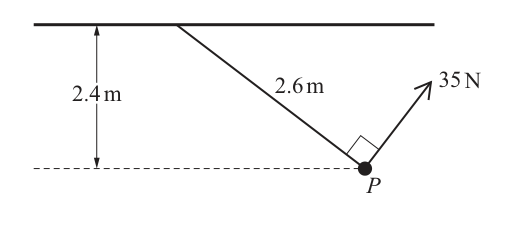
A particle of mass is attached to one end of a light inextensible string of length . The other end of the string is attached to a fixed point on a horizontal ceiling, and the string is taut. The particle is held in equilibrium by a force of magnitude , acting in a vertical plane which is perpendicular to the ceiling and contains the string. The force acts in a direction perpendicular to the string (see diagram). The tension in the string is and the vertical distance of from the ceiling is .
Find, in either order, the value of and the value of .
Approach
Identify the three forces acting on particle : its weight acting vertically downwards, the tension in the string acting along the string towards the ceiling, and the applied force of acting perpendicular to the string. Use the given lengths to find the trigonometric ratios of the angle between the string and the vertical. Resolve forces horizontally and vertically to form two equations, then solve for and .
Working
Let be the angle between the string and the vertical. From the diagram:
The horizontal distance from to the point directly below the ceiling attachment point is:
So:
The three forces at are:
- Weight: vertically downwards
- Tension: along the string, directed up and to the left at angle to the vertical
- Applied force: perpendicular to the string, directed up and to the right
Since the force is perpendicular to the string and the string makes angle with the vertical, the force makes angle with the horizontal and angle with the vertical.
Resolving horizontally (taking right as positive):
Substituting the trig ratios:
Resolving vertically (taking upwards as positive):
Substituting:
Using :
Answer
m = 9.1, T = 84
Walkthrough
Step 1: Extract geometry from the diagram.
The particle is suspended from a ceiling by a string of length , and the vertical distance from the ceiling to is . Let be the angle between the string and the vertical. Using right-triangle trigonometry, . The horizontal distance is , so . These clean fractions will make the algebra much simpler.
Step 2: Identify all forces.
There are three forces acting on :
- Weight acting straight down.
- Tension acting along the string from toward the ceiling attachment point (up and to the left).
- The applied force acting perpendicular to the string, up and to the right.
Step 3: Resolve horizontally.
Taking right as positive, the horizontal component of the force is (since the force makes angle with the horizontal, being perpendicular to a line at angle to the vertical). The horizontal component of is to the left. Setting the sum to zero:
Substituting and :
The denominators cancel, giving , so .
Step 4: Resolve vertically.
Taking upwards as positive, the vertical component of is (upwards), the vertical component of the force is (upwards), and the weight is (downwards). Setting the sum to zero:
Substituting and the trig ratios:
So , and with , .
Key Takeaways
- When a particle is in equilibrium under three or more forces, resolving horizontally and vertically gives two independent equations that can be solved simultaneously.
- If a force is perpendicular to a line at angle to the vertical, it makes angle with the horizontal — this swaps sin and cos for that force's components.
- Using exact fractions (like and ) instead of decimal approximations keeps the arithmetic clean and avoids rounding errors.
- Always verify the geometry: the string length, vertical drop, and horizontal offset must satisfy the Pythagorean theorem.
Common Mistakes
- Using the wrong angle: resolving with as the angle to the horizontal instead of the vertical, which swaps sin and cos and gives incorrect equations.
- Forgetting that the force is perpendicular to the string, not to the vertical or horizontal — its components are horizontally and vertically, not the other way around.
- Using decimal approximations like too early, which can lead to rounding errors that affect the final answer.
- Not using when converting from to , giving an incorrect mass.
Things to Be Careful About
- The mark scheme allows and if intermediate rounding is used, but the exact answers are and . Using exact fractions avoids this issue.
- The mark scheme also accepts Lami's theorem as an alternative method, where . This gives the same results but requires correctly identifying the angles between the force directions.
- Ensure the direction of the force is correctly interpreted: it acts perpendicular to the string and upwards, so its horizontal component is to the right and its vertical component is upwards.
- The question asks for and in either order, so either or is acceptable.
A car is travelling along a straight horizontal road. The car passes through a point , on the road travelling at a speed of , and then accelerates uniformly at for seconds. The car then moves at constant speed for seconds, where . The car then decelerates uniformly at and after a further seconds passes through a point on the road.
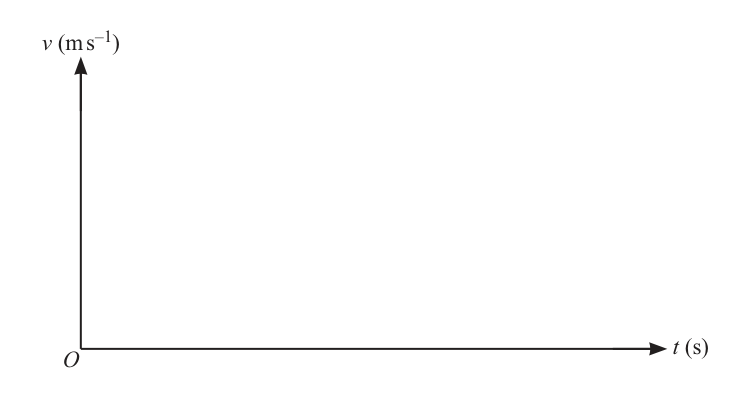
On the given axes, sketch a velocity-time graph for the motion of the car between points and .
Approach
The motion has three phases: uniform acceleration, constant speed, and uniform deceleration. Each phase corresponds to a line segment on the velocity-time graph. Calculate the key velocities and times, then sketch the three segments with correct labels.
Working
Phase 1: Acceleration (t = 0 to t = 30)
Initial speed ms, acceleration ms, time s.
Speed at :
Phase 2: Constant speed (t = 30 to t = 30 + 3T)
Speed remains constant at ms.
Phase 3: Deceleration (t = 30 + 3T to t = 30 + 4T)
Deceleration ms, duration s.
Speed at point ():
Since , we have , so . The speed at is positive.
Answer
The velocity-time graph consists of three line segments:
- From to with positive gradient
- From to horizontal
- From to with negative gradient
Three-line graph: (0, 15) to (30, 27), then horizontal to (30+3T, 27), then down to (30+4T, 27-0.2T)
Walkthrough
The question describes three distinct phases of motion. On a velocity-time graph, each phase is represented by a line segment whose gradient equals the acceleration.
Phase 1 (t = 0 to 30 s): The car accelerates uniformly at ms from ms. Using , the speed at is ms. This gives a straight line from to with gradient .
Phase 2 (t = 30 to 30 + 3T): The car moves at constant speed, so velocity does not change. This is a horizontal line at from to .
Phase 3 (t = 30 + 3T to 30 + 4T): The car decelerates at ms for seconds. The speed at is . Since , this speed is positive (greater than ms), so the graph does not reach the -axis.
Key Takeaways
- A velocity-time graph has three distinct segments for three-phase motion.
- The gradient of each segment equals the acceleration during that phase.
- Constant speed appears as a horizontal line.
- Key points must be labelled with correct values or expressions.
Common Mistakes
- Forgetting to label the key time values , , and on the horizontal axis.
- Drawing the third segment reaching the -axis, implying the car stops at , which contradicts the problem.
- Using incorrect initial velocity or acceleration values for the segments.
Things to Be Careful About
- The third line segment must stop before the -axis since the speed at is positive.
- All three time labels (, , ) must be correctly placed on the horizontal axis.
- The vertical axis must show at and at .
Approach
The distance from to equals the area under the velocity-time graph from to . This area is the sum of three parts: a trapezium (acceleration phase), a rectangle (constant speed phase), and a trapezium (deceleration phase). Set this total area equal to and solve for .
Working
Speed after 30 seconds:
Speed at :
Area under the graph (distance from to ):
The area is split into three regions:
Region 1 (trapezium, to ):
Region 2 (rectangle, to ):
Region 3 (trapezium, to ):
Total distance:
Rearranging:
Multiply by :
Using the quadratic formula:
Since , we reject .
Answer
T = 20
Walkthrough
The total distance from to is given as m. On a velocity-time graph, the area under the curve equals the displacement. Since the motion is in one direction along a straight road, the area equals the distance.
Step 1: Find the speed after the acceleration phase.
Using with , , :
ms.
Step 2: Find the speed at .
During the deceleration phase, , , :
.
Step 3: Calculate the area under the graph.
The graph has three regions:
- A trapezium from to with parallel sides and , and width . Area .
- A rectangle from to with height and width . Area .
- A trapezium from to with parallel sides and , and width . Area .
Step 4: Form and solve the equation.
Total area .
Rearranging gives , or .
Applying the quadratic formula: .
This gives or . Since the problem states , we reject and accept .
Key Takeaways
- The area under a velocity-time graph gives the displacement (or distance, if motion is in one direction).
- For multi-phase motion, split the area into simple geometric shapes.
- Quadratic equations from kinematics often have two roots; always check against given constraints.
Common Mistakes
- Forgetting that the area of a trapezium is and using the wrong formula.
- Not checking the constraint and accepting both roots.
- Sign errors when rearranging the equation to standard quadratic form.
Things to Be Careful About
- The constraint must be used to reject .
- Ensure all areas are in metres and times in seconds for consistency.
- The equation must be correctly rearranged before applying the quadratic formula.
The car continues its journey from , decelerating uniformly at until it comes to rest at a point on the road.
Find the total distance from to .
Approach
First, find the speed at point using the value of from part (b). Then use for the motion from to (where the car comes to rest) to find the distance from to . Add this to the distance from to .
Working
Speed at :
Distance from to :
For the motion from to : , , , find .
Using :
Total distance from to :
Answer
3279 m
Walkthrough
Step 1: Find the speed at .
From part (b), . The speed at is:
ms.
Step 2: Find the distance from to .
From to , the car decelerates at ms until it comes to rest. So , , . We need .
Using :
m.
Step 3: Find the total distance from to .
Distance from to is given as m. Distance from to is m.
Total distance m.
Key Takeaways
- The speed at the end of one phase becomes the initial speed for the next phase.
- The equation is useful when time is not given or required.
- Total distance is the sum of distances for each phase of the journey.
Common Mistakes
- Using the wrong speed for the initial velocity in the to calculation.
- Forgetting to add the distance from to to get the total distance from to .
- Sign errors with the deceleration (should be negative in ).
Things to Be Careful About
- Use the correct speed at ( ms), not the speed after the first acceleration phase ( ms).
- The deceleration is ms, so in the formula.
- The final answer may be accepted as m (rounded), but m is exact.
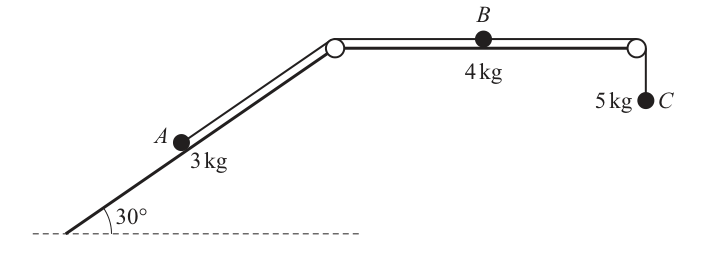
One end of a light inextensible string is attached to a particle of mass . The other end of the string is attached to a particle of mass . Particle is in contact with a rough plane inclined at to the horizontal, and particle is in contact with a smooth horizontal plane. A second light inextensible string is attached to . The other end of this second string is attached to a particle of mass which hangs vertically.
Both strings are taut and pass over small smooth pulleys that are fixed at the ends of the horizontal plane. The part of the string from to the pulley is parallel to a line of greatest slope of the inclined plane, and , and are in the same vertical plane (see diagram).
The system is released from rest. In the subsequent motion, moves vertically downwards with acceleration , and neither nor reach a pulley.
Approach
Apply Newton's second law to particles C and B separately. Since the strings are inextensible and taut, all particles share the same acceleration magnitude of . Particle C accelerates downwards, while particles A and B accelerate in their respective directions of motion.
Working
For particle C (mass ), moving vertically downwards with acceleration :
For particle B (mass ), moving horizontally with acceleration . The horizontal plane is smooth, so there is no friction acting on B:
Answer
T_BC = 40 N, T_AB = 32 N
Walkthrough
Step 1: Analyse particle C.
Particle C has mass and accelerates vertically downwards at . Taking the downward direction as positive, the forces acting on C are its weight downwards and the tension upwards. Applying Newton's second law ():
Using , this gives , so .
Step 2: Analyse particle B.
Particle B has mass and accelerates horizontally at towards the second pulley. The horizontal plane is smooth, so there is no friction. The forces in the horizontal direction are pulling B to the right and pulling B to the left. Applying Newton's second law:
Substituting : , giving .
Key Takeaways
- When particles are connected by inextensible strings, they all share the same acceleration magnitude.
- Newton's second law can be applied to each particle independently, using the correct direction of acceleration for each.
- Smooth surfaces contribute no frictional force, simplifying the equations of motion.
Common Mistakes
- Using the wrong mass in Newton's second law for a given particle.
- Getting the sign wrong in the equation of motion (e.g., writing instead of ). The mark scheme allows sign errors as long as the correct mass is used.
- Forgetting that the horizontal plane is smooth, and incorrectly adding a friction term for particle B.
Things to Be Careful About
- Ensure consistent use of throughout the question.
- The tension is the same on both sides of the smooth pulley at the end of the horizontal plane.
- Particle B is on a smooth horizontal plane, so no friction acts on it — only the two tensions and the vertical weight/normal reaction (which are irrelevant for horizontal motion).
Approach
Apply Newton's second law to particle A, resolving forces into components parallel and perpendicular to the inclined plane. Use the perpendicular equation to find the normal reaction , then use the parallel equation to find the friction force . Finally, apply to find the coefficient of friction.
Working
Particle A (mass ) moves up the inclined plane with acceleration . The forces acting on A are:
- Tension up the plane
- Weight acting vertically downwards
- Normal reaction perpendicular to the plane
- Friction acting down the plane (opposing the motion)
Resolving perpendicular to the plane:
Resolving parallel to the plane (up the plane is positive):
Applying the friction model :
Answer
μ = 11√3/45 ≈ 0.423
Walkthrough
Step 1: Identify forces on particle A.
Particle A is on a rough inclined plane at to the horizontal. The forces are: tension pulling up the plane, weight acting vertically down, normal reaction perpendicular to the plane, and friction acting down the plane (since A is moving up).
Step 2: Resolve perpendicular to the plane.
There is no acceleration perpendicular to the plane, so the forces balance:
Step 3: Resolve parallel to the plane.
Taking up the plane as positive, and using :
Substituting known values:
Step 4: Apply .
Key Takeaways
- On an inclined plane, always resolve forces parallel and perpendicular to the plane.
- The component of weight perpendicular to the plane is , and parallel to the plane is .
- Friction opposes the direction of motion (or intended motion) and is given by at limiting equilibrium.
Common Mistakes
- Mixing up and when resolving the weight component. Remember: perpendicular to the plane uses , parallel uses .
- Forgetting that friction acts down the plane when the particle moves up the plane.
- Not using the correct value of from part (a).
- Arithmetic errors when computing or .
Things to Be Careful About
- The friction force is found to be , which is less than the maximum possible friction . The question states the system is in motion, so we use (the particle is on the rough plane and moving, so limiting friction applies).
- Always rationalise the denominator in the final answer: .
- The mark scheme accepts to 3 significant figures.
When the system has been in motion for , the string attached to breaks.
Find the total distance that travels up the plane from the instant that the system is released from rest to the instant that comes to instantaneous rest.
Approach
The motion of A occurs in two phases:
- Phase 1: The system is in motion for with constant acceleration . Use suvat equations to find the distance travelled and the speed at .
- Phase 2: After the string breaks, A continues up the plane but decelerates due to friction and the component of weight. Apply Newton's second law to find the new acceleration, then use suvat equations to find the additional distance until A comes to rest.
The total distance is the sum of the distances from both phases.
Working
Phase 1: System in motion ( to )
Initial velocity , acceleration , time .
Distance travelled:
Speed at :
Phase 2: After the string breaks
The tension is removed. Particle A continues moving up the plane but now decelerates. The forces acting on A parallel to the plane are:
- Friction down the plane
- Component of weight down the plane
Taking up the plane as positive, apply Newton's second law:
Now use with , , and :
Total distance:
Answer
36/13 m ≈ 2.77 m
Walkthrough
Phase 1: System in motion (0 to 1.5 s)
Particle A starts from rest () and accelerates at up the plane. Using the suvat equation :
The speed at is found using :
Phase 2: After the string breaks
When the string attached to A breaks, the tension disappears. Particle A is still moving up the plane at , but now the only forces parallel to the plane are friction (, down the plane) and the component of weight (, down the plane). Both act to decelerate A.
Applying Newton's second law (up the plane positive):
Now use with (A comes to instantaneous rest):
Total distance:
Key Takeaways
- When a system's configuration changes (e.g., a string breaks), the motion must be split into phases with different accelerations.
- The speed at the end of one phase becomes the initial speed for the next phase.
- After the string breaks, friction and the weight component both act to decelerate the particle up the plane.
- Always check that the acceleration is negative (deceleration) when the particle is slowing down.
Common Mistakes
- Forgetting to add the distances from both phases — only finding and stopping.
- Using the wrong acceleration in Phase 2. The acceleration is NOT ; it must be recalculated using Newton's second law with the new forces.
- Sign errors in the equation of motion for Phase 2. Both friction and the weight component act down the plane, so both are negative when up the plane is positive.
- Arithmetic errors when adding . Converting to a common denominator helps: .
- Using instead of (the mark scheme uses ).
Things to Be Careful About
- The friction force remains the same in Phase 2 because the normal reaction hasn't changed, and is the same. The coefficient of friction doesn't change when the string breaks.
- Particle A comes to instantaneous rest, so in Phase 2. Do not assume it then slides back down — the question only asks for the distance up the plane until rest.
- The acceleration in Phase 2 is , which is a large deceleration. This is because both friction and the weight component oppose the motion.
- The mark scheme accepts the answer as or or to 3 significant figures.
A particle moves in a straight line and passes through the point at time . The velocity of at time seconds is given by
Approach
Differentiate with respect to to locate stationary points, then choose the value of in that gives the greatest velocity.
Working
Differentiate using the chain rule:
Set :
Square both sides:
Solve:
So or .
Since , the relevant stationary point is .
At this time,
Checking endpoints: and , both less than . Hence this is the maximum.
Answer
3.5 m/s
Walkthrough
We are given for . To find the maximum velocity, we need the point where the derivative changes from positive to negative: a stationary point. Differentiating with the chain rule gives . Setting this to zero isolates the square root, and squaring both sides removes it to produce a quadratic. Solving gives and . Only lies in the interval. Substituting back gives . Checking the endpoint velocities shows this is larger than and , so it is the maximum.
Key Takeaways
- The maximum or minimum of a velocity function is found by differentiating and solving .
- The chain rule is needed when differentiating expressions of the form .
- After solving an equation with a square root, reject roots that are outside the given domain or that do not satisfy the original equation.
Common Mistakes
- Using instead of differentiating is not accepted.
- Forgetting the factor from differentiating under the chain rule, giving instead of .
- Squaring incorrectly or failing to produce the three-term quadratic .
- Not rejecting because it is outside .
Things to Be Careful About
- When an equation has been squared, check that any candidate root satisfies the original equation and lies in the given interval.
- The mark scheme requires the simplified maximum value as the final answer.
- If verifying , you must show that it makes the derivative zero, not just guess it from a graph or table.
It is given that in the interval the velocity of is always positive.
Find the distance of from at the instant when is moving at this maximum velocity.
Approach
Because on the interval, the distance from equals the displacement . Integrate and evaluate the definite integral between and .
Working
Integrating:
At :
At :
Therefore the distance from is
79/20 m (3.95 m)
Walkthrough
The particle starts at at . Since is always positive on , the distance travelled is the same as the displacement from . The displacement is the definite integral of velocity. We integrate using the reverse of the chain rule: the power increases by and we divide by the new power and by the derivative of , giving denominator . At , . At , . The distance is the difference
Key Takeaways
- The definite integral of velocity from to gives displacement; if velocity is positive, distance equals displacement.
- The reverse chain rule is used to integrate composite functions such as .
- Definite integration uses , so the arbitrary constant cancels.
Common Mistakes
- Using is invalid because the velocity is not constant.
- Forgetting to use from part (a); using an arbitrary time.
- Making arithmetic errors when computing or .
- Forgetting to subtract , or incorrectly handling the constant of integration.
Things to Be Careful About
- The mark scheme accepts or only if the full integration method is shown.
- If using an indefinite integral, remember the constant of integration; it cancels when evaluating . For reference, the constant would be if is imposed.
- Since , there is no need to consider absolute values or changes of direction.
A particle of mass is projected with a speed of up a line of greatest slope of a rough plane inclined at to the horizontal. is projected from a point on the plane and comes to instantaneous rest at a point on the plane. then slides back down the plane. The coefficient of friction between and the plane is .
Using an energy method throughout, find the speed of at the instant it returns to .
Approach
Use the work-energy principle. Between and the particle's initial kinetic energy is converted into gravitational potential energy and work done against friction. On the return journey the gravitational energy is converted back into kinetic energy, while friction again removes energy. Treating the round trip lets us compare the final kinetic energy with the initial kinetic energy directly.
Working
Let be the distance and take .
Resolving perpendicular to the plane, the normal reaction is
The friction force, which opposes motion in either direction, has magnitude
With ,
The initial kinetic energy at is
For the motion , the gain in gravitational potential energy is
and the work done against friction is
The work-energy principle for gives
Thus
so
The work done against friction on the way up is therefore
For the round trip , the particle starts and finishes at the same height, so the net gravitational potential energy change is zero. The only net loss of energy is the total work done against friction, which is on the way up and the same on the way down. If the required speed is , then
So
and therefore
Answer
The speed of at the instant it returns to is
6.20 m s^-1
Walkthrough
Start by naming the unknown distance as . The energy method needs every form of energy involved. At , the particle has only kinetic energy . As it moves up the plane to , it rises through a vertical height ; this appears as gravitational potential energy . At the same time, friction does work against the motion, removing energy from the particle. The frictional force is found from . The normal reaction is perpendicular to the plane, and since there is no acceleration perpendicular to the plane, . Substituting the coefficient of friction gives .
The work-energy equation for the upward half is therefore: initial kinetic energy equals gravitational potential energy gained plus work done against friction. This gives one equation in only, so can be found. Once is known, the work done against friction on the upward journey is also known.
For the return journey, the particle starts from rest at , slides down to , and regains kinetic energy as it loses gravitational potential energy. Because and the end of the whole journey are at the same height, a neat way to finish is to look at the complete round trip. The particle starts and finishes at the same height, so the net change in gravitational potential energy is zero. The only net energy loss is the work done against friction on both halves, which is twice the work on one half. Therefore the final kinetic energy is the initial kinetic energy minus the total friction work. Solving gives the required speed; only the positive square root is meaningful.
Key Takeaways
The work-energy principle states that the total work done by non-gravitational forces equals the change in mechanical energy. Here friction, a non-gravitational force, removes mechanical energy. The gravitational potential energy of a particle on an inclined plane is , where is the vertical rise, not the distance along the plane. The normal reaction on an inclined plane is , and the frictional force is . Because friction always opposes motion, it does work on both the upward and the downward halves of the journey. For a round trip returning to the same height, gravitational potential energy cancels, leaving only the total work against friction as the energy loss.
Common Mistakes
A common error is to use Newton's second law instead of an energy method; the question explicitly requires an energy method throughout, so a Newton's-law solution loses the main method marks. Mixing up sine and cosine is another frequent mistake: the vertical height uses , while the normal reaction and friction use . Some candidates forget that friction acts on the way down as well as on the way up, so the total friction work over the whole trip is doubled. Sign errors in the energy equation are also common: on the way up, both the gain in gravitational potential energy and the work against friction are positive terms on the right-hand side.
Things to Be Careful About
Use , as is standard in this syllabus. Every term in the energy equation must be dimensionally correct; in particular, the weight term must include the component for the vertical rise. The final answer must be positive, and the exact value is , which rounds to . Writing an unsupported final value may lose the final accuracy mark, so all working should be shown. If a special case using Newton's second law is considered, it can only recover limited special-case marks and is not the intended full solution.