Mathematics 9709/35 — May/June 2025
Cambridge A-Level · Pure Mathematics 3 · worked solutions for every part, with the mark scheme
Topics Differentiation · Trigonometry · Complex Numbers · Logarithmic and Exponential Functions · Integration · Numerical Solution of Equations · +3 more
Solve the equation . Give your answer correct to 3 significant figures.
Approach
Take natural logarithms of both sides so that the powers can be brought down using the power law of logarithms. Then use the product law on the right-hand side and rearrange the resulting linear equation for .
Working
Take natural logarithms of both sides:
Apply the power law on the left and the product law on the right:
Expand both sides:
Collect the -terms on one side:
Divide by the coefficient of :
Evaluate using , , :
Answer
x = 1.15 (3 s.f.)
Walkthrough
The equation has the unknown in the exponents, so the first step is to take logarithms of both sides. Any consistent base works, but natural logarithms are standard.
Taking of both sides gives:
On the left, the power law lets us bring the exponent down: . On the right, the product law splits the logarithm of a product into a sum: , and then the power law gives .
This converts the exponential equation into a linear equation in :
Expand the brackets:
Then collect the terms containing on one side and the constants on the other. The coefficient of is , so dividing gives the exact expression for .
Finally, substitute the approximate values of the logarithms and round to 3 significant figures, obtaining .
Key Takeaways
This question tests the ability to solve an exponential equation by taking logarithms. The key skills are:
- Applying the power law to bring exponents down.
- Applying the product law when the right-hand side contains a product.
- Rearranging a linear equation carefully after applying the log laws.
- Rounding a final numerical answer to the required number of significant figures.
Common Mistakes
- Forgetting to take the logarithm of both sides, or taking logs of only one side.
- Omitting brackets when applying the power law, e.g. writing instead of .
- Incorrectly applying the product law, e.g. writing as instead of .
- Using different logarithm bases on different sides of the equation.
- Giving the answer without showing the logarithmic equation; the mark scheme requires working to be shown.
Things to Be Careful About
- Use a consistent logarithm base throughout. Natural logarithms are usually simplest.
- Keep brackets around expressions such as and until they are expanded.
- When collecting terms, be careful with signs: the coefficient of is negative here.
- The final answer must be given to 3 significant figures. If no working is shown, no marks are awarded.
Solve the equation for .
Approach
Use the Pythagorean identity to rewrite the equation as a quadratic in . Solve the quadratic, then use the periodicity of to find every solution in the interval .
Working
Starting from
Substitute :
Simplify:
Multiply by :
Factorise:
Hence
For , we have , so
In the interval :
For , we have , so
Numerically, , so in the interval:
Answer
(radians, approximate values correct to 3 significant figures).
θ = π/4, -3π/4, -1.33, 1.82 (radians)
Walkthrough
The equation contains two different trigonometric functions: and . To solve it, we first express everything in terms of one function. The identity is exactly the link needed.
Substituting gives , which simplifies to . Multiplying by gives . This is a quadratic in , and it factorises as . Therefore or .
For , since , the principal solution is . Because has period , the other solution in is .
For , we have . The calculator gives ; adding gives approximately . Both of these lie in the interval .
Thus the four solutions are , , , and .
Key Takeaways
This question tests the ability to reduce a trigonometric equation to a single trigonometric function using a Pythagorean identity, then solve a quadratic equation and use the periodic nature of trigonometric functions to find all required solutions in a given interval.
Common Mistakes
- Using the wrong Pythagorean identity, such as confusing with .
- Making a sign error when rearranging the quadratic, especially when multiplying by .
- Only giving the principal value of and forgetting to add to obtain the second solution.
- Forgetting that the interval includes negative angles, so missing or .
- Giving answers outside the interval; the mark scheme ignores solutions outside .
Things to Be Careful About
- means , not .
- The period of is , so solutions repeat every radians.
- The interval is in radians, so all answers must be in radians.
- Exact values such as and are preferred, but decimal equivalents such as and are also accepted.
The complex numbers and are given by
Approach
Write both and in exponential form , then divide by dividing moduli and subtracting arguments. Verify the resulting argument lies in the principal range .
Working
Given , we can write:
And is already in exponential form:
Dividing:
Since , the argument is in the required range.
Answer
So and .
s/t = (5/6)e^(-2.75i)
Walkthrough
The number is written in polar form with and . By Euler's formula, this is equivalent to .
The number is given directly as , so it has modulus 6 and argument 3.
To divide two complex numbers in exponential form, we divide their moduli and subtract their arguments:
Applying this:
The final step is to verify the argument lies in the principal range . Since and , the argument is valid as is — no adjustment is needed.
Key Takeaways
- Converting between and forms of a complex number.
- Division in polar form: divide moduli and subtract arguments.
- Always check the argument is in the principal range .
Common Mistakes
- Failing to evaluate and leaving the answer as — the mark scheme requires the subtraction to be evaluated.
- Writing the argument as — the argument is a real angle, not a complex number; this scores B0.
- Rounding the modulus to 0.83 — the mark scheme requires or 0.833 (0.83 scores B0).
Things to Be Careful About
- The principal range is . If the computed argument falls outside this range, add or subtract to bring it into range. Here is already in range.
- The modulus must be positive; here .
- Angles are in radians throughout this question.
In an Argand diagram with origin , the points and represent the complex numbers and respectively.
By considering the line segments and , or otherwise, state the two geometric effects of dividing a complex number by .
Approach
Interpret division by as two separate geometric transformations: a scaling of the distance from the origin (modulus) and a rotation (argument change).
Working
Given and .
Dividing a complex number by is equivalent to multiplying by .
Modulus effect: The modulus is divided by 6:
So the distance from the origin is multiplied by . This is an enlargement with scale factor .
Argument effect: The argument is reduced by 3:
So the point is rotated clockwise by 3 radians (equivalently a rotation of radians, or an anticlockwise rotation of radians).
Answer
The two geometric effects of dividing by are:
- An enlargement with scale factor .
- A clockwise rotation of 3 radians.
Enlargement with scale factor 1/6 and clockwise rotation of 3 radians
Walkthrough
Dividing a complex number by is equivalent to multiplying by its reciprocal, . Geometrically, multiplying a complex number by scales its distance from the origin by and rotates it by angle .
Here, the modulus factor is : the original point (representing ) has modulus 5, and after division the point (representing ) has modulus . So the distance from is multiplied by — an enlargement with scale factor .
The argument change is radians: and . A negative change in argument means a clockwise rotation. So the point is rotated clockwise by 3 radians (equivalently anticlockwise by radians).
Both transformations have centre (the origin).
Key Takeaways
- Dividing by scales by and rotates by .
- Geometric interpretation of complex number operations on the Argand diagram.
- The modulus and argument of a complex number correspond to distance from origin and angle from the positive real axis.
Common Mistakes
- Using words like 'reduction', 'shrink' or 'compression' instead of 'enlargement' — the mark scheme explicitly disallows these.
- Stating only one of the two effects — both the enlargement and the rotation are required for the marks.
- Stating an incorrect centre of transformation (e.g. a point other than the origin).
Things to Be Careful About
- The scale factor is , not 6 — dividing by 6 makes the modulus smaller.
- The rotation is clockwise by 3 radians because the argument decreases by 3.
- The rotation can also be described as anticlockwise by radians (since ).
- Both effects must be stated to gain the marks. Stating the centre of transformation is not required, but if stated it must be the origin — an incorrect centre scores B0.
Find the exact coordinates of the stationary point of the curve with equation , for .
Approach
Use the product rule to differentiate , set the derivative to zero, solve for , then substitute back to find .
Working
Let and . By the product rule:
Therefore:
At a stationary point, :
Since , divide by :
Exponentiate both sides:
Since :
Now find :
Answer
The stationary point is .
x = e^{-1/3}, y = -4/e
Walkthrough
We need to find the point where the curve's gradient is zero. The function is a product of two functions of : and . This is exactly the situation where the product rule applies.
The product rule states that if , then . Here we set and .
First differentiate each factor. The derivative of is . For , we use the chain rule: the derivative of the logarithm of a function is , giving .
Substituting into the product rule gives .
At a stationary point the gradient is zero, so we set this equal to zero. Since , we can divide through by (which is never zero for ), giving . Rearranging gives .
To eliminate the logarithm, exponentiate both sides: . Taking the fourth root, and remembering so we take only the positive root, gives .
Finally, substitute back into the original equation to find : .
Key Takeaways
This question tests the product rule for differentiation, the chain rule when differentiating the logarithm of a composite function, solving equations involving logarithms by exponentiating, and careful algebraic simplification. It also reinforces the importance of domain restrictions () when taking roots.
Common Mistakes
The mark scheme highlights several specific errors:
- Answers with no working score no marks — all steps must be shown.
- scores A0 — the fourth root must be simplified to .
- scores A0 — the negative root is not valid because the domain is .
- scores A0 — the -coordinate must be simplified to .
- A sign error in the product rule (e.g. using instead of ) leads to , which is incorrect.
Things to Be Careful About
- The domain means only the positive fourth root is taken.
- The derivative of is , not — remember the chain rule.
- When dividing by , this is valid because guarantees .
- Ensure the final -value is fully simplified to .
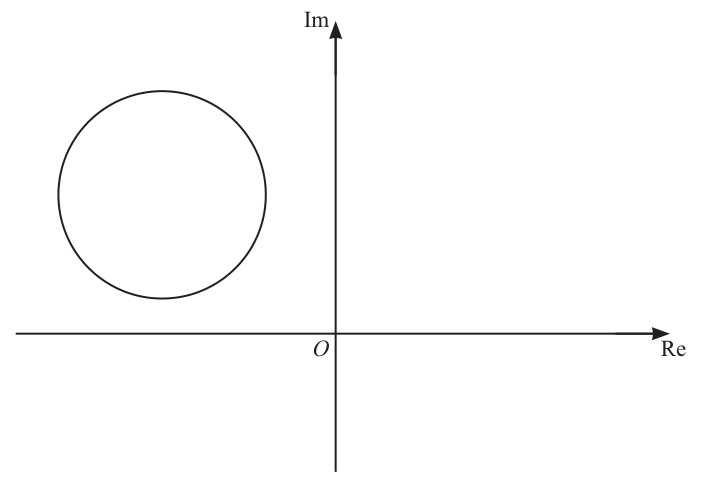
The diagram shows the locus of points representing the complex numbers, , satisfying .
Approach
The locus is a circle in the Argand diagram with centre and radius . The quantity is the distance from the origin to a point on this circle. The maximum and minimum values of occur at the points on the circle that lie on the line from the origin through the centre, on opposite sides of the centre.
Working
The centre of the circle is , which corresponds to the point in the Argand diagram.
The distance from the origin to the centre is found using Pythagoras:
The maximum value of is the distance to the point on the far side of the centre from the origin:
The minimum value of is the distance to the point on the near side of the centre to the origin:
Answer
Minimum
Maximum
Minimum: sqrt(41) - 3 (≈ 3.40); Maximum: sqrt(41) + 3 (≈ 9.40)
Walkthrough
The equation tells us that the distance from to the complex number is exactly . In the Argand diagram, this is a circle centred at the point , i.e. the Cartesian point in the second quadrant, with radius .
The modulus is just the distance from the origin to a point on this circle. To find the maximum and minimum of this distance, we look for the points on the circle that are farthest from and closest to the origin. These two points lie on the straight line from through the centre , on opposite sides of .
We first compute the distance using the Pythagorean theorem with the horizontal leg of length and the vertical leg of length :
The closest point on the circle to lies on the line between and , at distance from . The farthest point lies on the opposite side of from , at distance from .
Key Takeaways
- The equation always represents a circle in the Argand diagram with centre and radius .
- is the distance from the origin to a point on the locus.
- For a circle, the maximum and minimum distances from any external point occur along the line through that external point and the centre.
Common Mistakes
- Swapping the max and min values.
- Forgetting to subtract the radius for the minimum (using just ).
- Confusing the centre: writing it as or instead of .
Things to Be Careful About
- The sign of each component in the centre matters. has centre , not .
- The numerical answers are and , as the mark scheme requires AWRT 3.4 and 9.4.
- The mark scheme warns that if the max and min are swapped, the student can still earn M1 but only one of the A1 marks (max 2/3).
Approach
The minimum value of on the locus is the argument of the point on the circle where a tangent from the origin touches the circle on the lower side (the side closer to the real axis). This argument is found by combining the angle from the positive real axis to the line from the origin to the centre, with the angle between this line and the tangent line.
Working
The centre of the circle is , at the point in the second quadrant.
The distance from the origin to the centre is:
Step 1: Angle from the positive real axis to the line .
Since is in the second quadrant, the angle from the positive real axis (measured counter-clockwise) to is obtuse. Dropping a perpendicular from to the real axis gives a right triangle with horizontal leg and vertical leg , so the acute angle at the origin is . The full angle is therefore:
Step 2: Angle between and the tangent line (where is the tangent point on the lower side).
In the right triangle , the angle at is (the radius is perpendicular to the tangent at the point of contact). The hypotenuse is , and the side opposite to the angle at is the radius . Therefore:
Step 3: Subtract to find the minimum argument.
The minimum argument of is the angle from the positive real axis to the lower tangent line , which is the angle to minus the half-angle :
Numerical evaluation:
Answer
1.98 rad (≈ 113.4°)
Walkthrough
The minimum argument of any on the circular locus occurs at the point where a tangent from the origin touches the circle on the lower side (the side closer to the real axis). This is because as you move along the circle starting from this tangent point in either direction, the argument increases.
To find this minimum argument, we use the right triangle formed by the origin , the centre , and the tangent point . The line is a radius of length , and it is perpendicular to the tangent line at the point of tangency, so the triangle has a right angle at .
The angle from the positive real axis to :
Since is at in the second quadrant, the line from the origin to makes an obtuse angle with the positive real axis. If we drop a perpendicular from to the real axis, we get a right triangle with horizontal leg and vertical leg . The acute angle at the origin in this triangle is . The full angle from the positive real axis to is therefore .
The half-angle at the origin between and :
In the right triangle , the hypotenuse is and the side opposite to the angle at is . So this angle is .
Combining the angles:
The minimum argument of is the angle from the positive real axis to the tangent line , which is the angle to minus the half-angle:
Numerically this is approximately radians or .
Key Takeaways
- For a circular locus, the minimum (and maximum) argument of corresponds to the points where a tangent from the origin touches the circle.
- The geometry of the tangent gives a right triangle with the origin, the centre, and the tangent point as vertices; the radius is perpendicular to the tangent at the contact point.
- The minimum argument is the angle to the centre minus the half-angle at the origin; the maximum argument would be the angle to the centre plus the half-angle.
Common Mistakes
- Forgetting to use when computing the angle to a point in the second quadrant (giving the acute angle instead of the obtuse one).
- Using the radius as the hypotenuse of the right triangle (it is the opposite side, not the hypotenuse).
- Confusing the lower and upper tangent points — the upper one gives the maximum argument, not the minimum.
- Adding the half-angle instead of subtracting it.
- Using the wrong inverse trig function: would be wrong; the mark scheme accepts or equivalent.
Things to Be Careful About
- The centre is in the second quadrant, so the angle from the positive real axis is obtuse: , not just .
- The half-angle at the origin is , computed from the right triangle where the hypotenuse is and the opposite side is the radius .
- The mark scheme warns that scores B1FT M0 A0, because it omits the for the second-quadrant centre.
- The mark scheme also notes that if a student instead computes the maximum argument ( rad or ), they would score only B1FT (1/3) as a special case.
The parametric equations of a curve are
for .
Approach
Differentiate and with respect to the parameter , then use
and simplify to a multiple of .
Working
Rewrite :
Differentiate with respect to using the chain rule:
Differentiate with respect to :
Then
Simplify:
Answer
so .
dy/dx = (1/2)cosec 3t, so A = 1/2
Walkthrough
We are given a curve in parametric form, so and are both functions of . To find , we first differentiate both and with respect to , then divide by .
For , rewrite it as . The chain rule gives
For , the derivative is
Then
This matches the required form, with .
Key Takeaways
This question combines parametric differentiation with the chain rule and trigonometric identities. The key idea is that for parametric curves, is obtained by dividing the two derivatives with respect to the parameter. It also shows how reciprocal trigonometric functions such as and simplify naturally.
Common Mistakes
- Differentiating without using the chain rule, or forgetting the factor from the derivative of .
- Getting the sign wrong when differentiating .
- Dividing the wrong way round, e.g. using .
- Stopping before simplifying to .
- Not writing the final answer in the requested form.
Things to Be Careful About
The derivative is undefined where or , since the parametric representation has vertical or horizontal tangents there. Within the given interval, those points must be excluded. The final expression must be exact and in the form requested by the question.
Find an equation of the normal to the curve at the point where . Give your answer in the form , where the constants and are exact.
Approach
Evaluate the coordinates at , find the tangent gradient from part (a), take its negative reciprocal to get the normal gradient, then form the equation of the normal.
Working
At , we have .
From part (a), the tangent gradient is
The normal gradient is the negative reciprocal:
Using the point :
Answer
y = -sqrt(2)x + 5
Walkthrough
First find the point on the curve. When , . Therefore
Next, use part (a) to find the gradient of the tangent at this point:
The normal is perpendicular to the tangent, so its gradient is the negative reciprocal:
Using the point-slope form of a line through :
Expanding gives , so
Key Takeaways
This part uses the derivative to find the gradient of a normal, which requires taking the negative reciprocal. It also reinforces exact trigonometric values at and the point-slope formula for a straight line.
Common Mistakes
- Using the gradient of the tangent instead of the normal.
- Forgetting the negative sign when taking the reciprocal.
- Using decimal approximations instead of exact values; the question requires exact constants.
- Expanding incorrectly, especially the constant term.
Things to Be Careful About
The final answer must be in the form with exact and . Here and . The mark scheme also accepts , since .
The equation of a curve is .
Approach
Differentiate using the chain rule, then set the derivative equal to and solve for .
Working
Using the derivative of , which is , and the chain rule:
Set the gradient equal to :
Multiply both sides:
Hence:
Answer
x = ±√15/4
Walkthrough
The curve is . To find where the gradient is , we first differentiate. The derivative of is , so with we get . Then set this equal to and solve:
This gives , so and . Both values are valid because the derivative formula is defined for all real .
Key Takeaways
This question tests differentiating an inverse trigonometric function with a linear composite, and solving a simple equation. The chain rule is essential when differentiating .
Common Mistakes
- Forgetting the chain rule and writing instead of .
- Losing the negative solution when taking square roots.
- Not simplifying to .
Things to Be Careful About
The derivative of has in the denominator, not . When solving , remember both positive and negative roots. The mark scheme accepts exact equivalents such as .
Approach
Use integration by parts with and . Then integrate the remaining term using the form , and evaluate between and .
Working
Let
Use integration by parts, , with and :
So
Now integrate . Since the derivative of is , we have
Therefore
Evaluate at :
At , both terms are , so the value is
Answer
π/16 - (1/8)ln 2
Walkthrough
We need to integrate from to . Since is not a standard direct integral, integration by parts is appropriate: choose and . Then and . This gives
The remaining integral is of the form because the derivative of is , so
Substituting the limits, at we get , and at the expression is .
Key Takeaways
This question combines integration by parts with recognising a logarithmic integral of the form . It also requires careful substitution of exact limits involving .
Common Mistakes
- Choosing the wrong and , making the integral harder.
- Forgetting the coefficient when integrating ; the correct antiderivative is , not .
- Forgetting to subtract the lower-limit value, although here it is zero.
- Writing as instead of .
Things to Be Careful About
At , , so . Also . The mark scheme allows equivalent forms such as or , so any exact equivalent is acceptable. Since , the lower limit contributes nothing, but it must still be stated for full method marks.
By sketching a suitable pair of graphs, show that the equation has exactly one root in the interval .
Approach
Sketch and on the same axes for . Identify the number of intersection points to show there is exactly one root.
Working
Graph of :
Recall that . Key features for :
- At : , so the graph passes through .
- As : , so . There is a vertical asymptote at .
- As : , so .
- At : , so the graph passes through .
The graph has two branches: one from rising to as , and another from (as ) rising to at .
Graph of :
This is a straight line with gradient and -intercept .
- At : , so the line passes through .
- At : .
The line decreases steadily from to approximately .
Intersection:
The first branch of (where ) lies entirely above the line (which is at most in this region), so there is no intersection here.
The second branch of (where ) rises from to , while the line decreases from approximately at to at . Since the secant curve goes from to and the line goes from about to , they must cross exactly once in the interval .
We can verify this by noting:
- At : .
- At : .
By the Intermediate Value Theorem, there is at least one intersection. Since is strictly increasing on and is strictly decreasing, there is exactly one point of intersection.
Answer
The equation has exactly one root in , located between and .
Exactly one root exists in the interval, as the graphs intersect at a single point between x = π/4 and x = π/2.
Walkthrough
First, we sketch on the interval . The function has a vertical asymptote where , which occurs at , i.e., . This divides the interval into two branches:
- Branch 1 (): is positive and decreasing from 1 to 0, so increases from 1 to .
- Branch 2 (): is negative, going from to , so goes from to .
Next, we sketch , which is a straight line with negative gradient passing through .
On Branch 1, while the line is at most , so no intersection is possible. On Branch 2, the secant curve rises from to while the line falls from about to . Since one is increasing and the other decreasing, and they cross in sign relative to each other, there is exactly one intersection point.
Key Takeaways
- The secant function has vertical asymptotes at and alternates between branches where it is and .
- To show an equation has exactly one root graphically, sketch both sides and argue that the curves intersect exactly once, using monotonicity to rule out multiple intersections.
Common Mistakes
- Forgetting the vertical asymptote at and drawing a continuous curve.
- Not showing the correct values at key points: and .
- Simply stating "only one root" without justification from the sketch (the mark scheme requires a dot at the intersection or a dotted line to the x-axis).
- Sketching regions outside (these should be ignored).
Things to Be Careful About
- The interval is , not . Only sketch within this range.
- The asymptote at must be clearly indicated; the curve does not cross it.
- Justification requires more than just stating there is one intersection — show why by comparing values at the endpoints of the branch or by noting monotonicity.
Approach
Define . Calculate and . If there is a sign change between these values, then by the Intermediate Value Theorem, the root lies between 0.8 and 1.2.
Working
Calculate :
So .
Calculate :
So .
Since and , there is a sign change in the interval . Since is continuous on this interval (the asymptote at is less than 0.8), by the Intermediate Value Theorem, there is at least one root in . From part (a), there is exactly one root in the entire interval , so this root must lie between 0.8 and 1.2.
Answer
The root lies between 0.8 and 1.2, as and .
f(0.8) = -32.14 < 0 and f(1.2) = 1.544 > 0, so the root lies between 0.8 and 1.2.
Walkthrough
We want to show the root of lies between 0.8 and 1.2. Rearrange this as .
We evaluate at the endpoints and . Remember that all trigonometric calculations must be in radians.
At : rad. , so . Then .
At : rad. , so . Then .
Since changes sign between and , and is continuous on this interval (the asymptote at is outside this interval), there must be a root between 0.8 and 1.2.
Key Takeaways
- The sign-change method (bisection principle) requires evaluating a continuous function at two points and checking for a sign change.
- Always ensure your calculator is in radian mode when working with trigonometric functions in calculus/numerical methods.
- The function must be continuous on the interval; check that no asymptotes lie within it.
Common Mistakes
- Working in degrees instead of radians — this gives completely wrong values and earns no marks.
- Not showing both evaluations clearly; the mark scheme requires seeing both and explicitly.
- Forgetting to check continuity: if there were an asymptote between the two points, a sign change would not guarantee a root.
- Rounding too early: answers must be correct to at least 2 significant figures for the A1 mark.
Things to Be Careful About
- The asymptote at is just below 0.8, so the interval does not contain the asymptote and is continuous there.
- Use at least 2 significant figures in the final values for the A1 mark.
- The mark scheme also accepts alternative approaches: comparing and directly at both endpoints, or using the rearranged form .
Show that, if a sequence of real values given by the iterative formula
converges, then it converges to the root of the equation in part (a).
Approach
If the sequence converges, let the limit be . Then as , both and . Substitute into the iterative formula and rearrange to show that satisfies .
Working
Assume the sequence converges to a limit . Then:
Substitute into the iterative formula:
Multiply both sides by 2:
Take cosine of both sides:
Take the reciprocal of both sides:
Simplify the right-hand side:
Therefore:
This shows that is a root of the equation . Since part (a) establishes that there is exactly one root in the interval , the sequence must converge to this unique root.
Answer
If the sequence converges to , then satisfies , so it converges to the root of the equation.
Substituting x_n = x_{n+1} = L into the iterative formula and rearranging gives sec 2L = -2L - 1/2, proving convergence to the root.
Walkthrough
The key idea is that if a sequence defined by converges, then in the limit, and both approach the same value . This is called a fixed point of the function .
So we set in the formula:
Now we need to manipulate this to recover the original equation .
Step 1: Multiply by 2 to isolate the inverse cosine:
Step 2: Apply cosine to both sides. Since for :
Step 3: Take reciprocals:
Step 4: Recognize and simplify the right side:
This is exactly the original equation with in place of . Therefore, the limit must be a root of the original equation.
Key Takeaways
- If an iterative sequence converges to , then is a fixed point: .
- To show convergence to a specific root, substitute the fixed-point condition and rearrange to recover the original equation.
- The rearrangement must be algebraically correct at every step — slips lose the accuracy mark.
Common Mistakes
- Forgetting to take cosine of both sides after isolating .
- Making algebraic errors when taking reciprocals or simplifying .
- Not showing enough working — the mark scheme requires full correct working with no slips for the A1 mark.
- Using inconsistent variables (mixing and without justification).
Things to Be Careful About
- The rearrangement must be done carefully: , not .
- The mark scheme accepts either direction of rearrangement: from the iterative formula to the original equation, or vice versa.
- Ensure all steps are reversible and valid (e.g., the reciprocal step requires , which is satisfied since the root is not at an asymptote).
Use this iterative formula to calculate this root correct to 3 decimal places. Give the result of each iteration to 5 decimal places.
Approach
Choose an initial value between 0.8 and 1.2 (from part b). Apply the iterative formula repeatedly, giving each result to 5 decimal places. Continue until the answer is stable to 3 decimal places.
Working
Choose (a value between 0.8 and 1.2).
Iteration 1:
Iteration 2:
Iteration 3:
Iteration 4:
Iteration 5:
Iteration 6:
Since and , the sequence has converged to 5 decimal places. To 3 decimal places:
We can verify this is correct to 3 d.p. because and agree to 5 d.p., and both round to to 3 d.p.
Answer
x = 0.992
Walkthrough
We use the iterative formula with an initial value (chosen between 0.8 and 1.2 from part b).
Each iteration requires:
- Compute .
- Compute .
- Find of this value (in radians).
- Divide by 2 to get .
We continue until two consecutive values agree to 5 decimal places, which guarantees the answer is correct to 3 decimal places.
The iterations give:
Since to 5 d.p., the sequence has converged. Rounding to 3 d.p. gives .
Key Takeaways
- Always choose an initial value within the interval where the root is known to lie.
- Carry at least 5 decimal places during iterations to justify the answer to 3 d.p.
- Continue until two consecutive values agree to the required accuracy (or more).
- Always work in radians for inverse trigonometric functions in this context.
Common Mistakes
- Starting with a value outside — the mark scheme gives M0 if is not in this range.
- Working in degrees instead of radians — this gives completely wrong iterations and earns no marks.
- Stopping too early — need to show enough iterations to justify the answer. The mark scheme requires either convergence to 5 d.p. or a sign change in .
- Writing instead of simply stating — the mark scheme awards A0 for the latter phrasing.
- Rounding intermediate results too aggressively — always keep at least 5 d.p. during iterations.
Things to Be Careful About
- The iterative formula must be entered correctly into the calculator: .
- Ensure the calculator is in radian mode throughout.
- The mark scheme provides iteration sequences for several starting values (0.8, 0.9, 1.0, 1.1, 1.2). All should converge to the same value .
- To justify 3 d.p., you can either show convergence to 5 d.p. (as done above) or show that and have opposite signs.
Approach
Since the numerator and denominator have the same degree, first divide to express the fraction as a constant plus a proper partial fraction. Then decompose the remainder into and solve for and .
Working
Let
Divide the numerator by the denominator:
Subtract:
so and
Now set
Multiply through by the denominator:
Compare coefficients:
From the first equation, . Substitute:
Then .
Thus
Answer
4 + 6/(3x - 2) - 5/(x + 6)
Walkthrough
The numerator has degree 2 and the denominator has degree 2, so the fraction is improper. Before using the usual partial fraction method, we extract the whole-number part by division. Dividing gives quotient and remainder , so the fraction becomes .
Next, because the denominator has two distinct linear factors, write the proper part as . Multiplying through by the denominator gives . Comparing coefficients of and the constant term produces two linear equations. Solving them gives and . Thus the original expression is .
Key Takeaways
This question tests partial fractions for an improper rational function. The key idea is that when the numerator degree is not smaller than the denominator degree, divide first. It also tests solving a small system of linear equations by comparing coefficients.
Common Mistakes
- Forgetting the constant term when numerator and denominator have the same degree.
- Using the form without the leading ; this loses the mark for the correct form.
- Making sign errors when substituting into the constant equation.
- Confusing the remainder when dividing.
Things to Be Careful About
The denominator factors are distinct linear factors, so the partial fraction numerators are constants, not linear expressions. When comparing coefficients, check both the coefficient and the constant term. The mark scheme allows the alternative method of dividing first and then decomposing the remainder; either route should give the same final answer.
Hence obtain the expansion of in ascending powers of , up to and including the term in .
Approach
Use the partial fraction result from part (a). Rewrite each denominator as a constant times , then apply the binomial expansion for negative powers up to and collect like terms.
Working
From part (a),
Expand the first partial fraction:
Using with :
Expand the second partial fraction:
Add the constant and collect terms.
Constant term:
Coefficient of :
Coefficient of :
Therefore
Answer
1/6 - 157/36 x - 1463/216 x^2
Walkthrough
We use the partial fraction result from part (a). Each term must be expanded separately. For , factor out of the denominator to get . For , factor out to get . Then apply the binomial expansion for negative index: . We only need terms up to , so we stop after the term. After expanding both terms and adding the constant , collect the constant, and coefficients to obtain the final expansion.
Key Takeaways
This question tests the binomial expansion for rational and negative powers, which produces an infinite series. It also shows how partial fractions can break a complicated rational function into simpler pieces that are easy to expand. The expansion is valid only when is small enough for both geometric-type series to converge.
Common Mistakes
- Forgetting to multiply the binomial expansion by the constant factor in front, such as or .
- Using the wrong sign in ; the signs alternate.
- Stopping at the term instead of including .
- Making arithmetic errors when adding fractions with denominators and .
Things to Be Careful About
The expansion of is , so the term is negative and the term is positive before multiplying by the outer constant. Combine the constant terms carefully: . The mark scheme allows follow-through on and from part (a), but the final simplified coefficients must be correct. Since requires and requires , the combined expansion is valid for .
With respect to the origin , the points , and have position vectors given by
Approach
Form the displacement vectors and , equate their squared magnitudes to avoid square roots, and solve the resulting equation for .
Working
Equate the squared magnitudes:
Setting :
Using the difference of squares :
Answer
b = -1/3
Walkthrough
We are told that the lengths of and are equal. To make use of this, we first need the two displacement vectors themselves, which we obtain by subtracting position vectors. The position vector gives the coordinates of , and similarly for and .
For , we subtract component-wise: the -component is , the -component is , the -component is . For , the -component is , the -component is , the -component is .
Because both magnitudes are non-negative, the equation is equivalent to . This removes the square roots and gives a polynomial equation in . Expanding the squares and simplifying leads to a linear equation once the quadratic terms cancel, which happens because the squared terms and both contain . Using the difference of squares makes the simplification quick: the factor contains the only remaining . Solving gives .
Key Takeaways
- Displacement vectors are obtained by subtracting position vectors component-wise.
- The equation is equivalent to , avoiding square roots.
- When the squared expressions both contain , those terms cancel and the resulting equation is linear.
Common Mistakes
- Forgetting to square both sides, leaving an equation with two square roots.
- Sign errors when forming (should be , not the other way round).
- Errors when squaring terms like — remember the cross term is .
Things to Be Careful About
- The squared magnitude drops the square root but introduces no extraneous solutions because both sides are non-negative.
- Always check that the difference of squares factorisation is applied correctly to avoid sign errors.
Approach
In a rhombus with vertices labelled , , , in order, the opposite sides are equal as vectors: . Therefore .
Working
Substituting :
Then:
Answer
OD = -5/3 i + 6j - 11k
Walkthrough
In any quadrilateral (vertices taken in order), the side goes from to , while goes from to . When the figure is a rhombus, opposite sides are parallel and equal in length, and as vectors they are equal: .
To reach from the origin, we travel first from to (giving ) and then from to (giving ). So .
We already formed in part (a). With , the -component becomes . Adding component-wise to gives the position vector of .
Key Takeaways
- A rhombus has opposite sides equal both in length and direction (as vectors).
- Adding and produces the position vector of .
- The order in which vertices are named in a rhombus determines the direction of each side.
Common Mistakes
- Using instead of to find — this would not give a rhombus.
- Substituting (forgetting the result of part (a)) and so losing the answer.
- Reversing the direction of when adding, which would give the wrong vertex.
Things to Be Careful About
- The rhombus property used is , not . The order of vertices in the name matters.
- Per the mark scheme, the answer must be given in , , notation (or as a column vector with bare numbers), not as a column of -, -, -unit vectors.
Approach
Use the scalar product formula , solve for the cosine, and then take the inverse cosine.
Working
Scalar product:
Magnitudes:
So . Therefore:
Finally:
Answer
60.2° (or 1.05 rad)
Walkthrough
The angle at vertex in triangle is formed by the two sides and . To find it, we use the scalar product identity , where is the angle between the two vectors. Rearranging gives as a ratio.
We first build by subtracting the position vectors: . With , each component simplifies: the -component becomes , the -component is , and the -component is . The vector was already found in part (b).
The scalar product is computed term by term, multiplying corresponding components and adding. We then compute and separately, which conveniently come out equal (both equal to ) — this confirms the rhombus property used in part (b).
The product of the magnitudes is , and the scalar product is , so the ratio is . Taking the inverse cosine gives an angle of about or radians.
Key Takeaways
- The scalar product gives directly when both magnitudes are known.
- A clean simplification occurs when both sides of a triangle have equal length — their squared magnitudes are equal, so the product of the magnitudes is just the squared magnitude.
- Either degrees or radians are accepted; the mark scheme accepts or .
Common Mistakes
- Using and (or some other pair) instead of and ; the angle at must be formed by the two vectors emerging from .
- Forgetting to take the square root after squaring magnitudes.
- Using degrees versus radians inconsistently in the final answer.
Things to Be Careful About
- The scalar product formula requires the two vectors to share a common initial point — here that is , so and both start from .
- Be careful with negative components when computing the scalar product, as they can produce a negative term that partially cancels with positive terms.
The variables and satisfy the differential equation
It is given that when .
Solve the differential equation, and find the value of when .
Approach
Separate the variables so that all -terms are on one side and all -terms are on the other, then integrate both sides. Use the initial condition when to find the constant, and finally substitute .
Working
Separate the variables:
Integrate both sides. Left-hand side:
Right-hand side:
So the general solution is
Use , :
Therefore
At :
Answer
y = -0.331
Walkthrough
This is a separable differential equation, so the first step is to rearrange it so that every term involving is on one side with , and every term involving is on the other side with .
Starting from
we divide both sides by and by :
Now integrate both sides. The left side is a standard exponential integral:
The right side is split into two standard forms:
The first term integrates to , because the numerator is (apart from a constant) the derivative of the denominator. The second term integrates to , using the standard form .
After integrating, we have a constant . The initial condition when lets us evaluate :
Substituting this back gives the particular solution. Finally, put and evaluate the right-hand side numerically to obtain .
Key Takeaways
This question combines separation of variables with three standard integrals: , , and . It also tests the use of an initial condition to find the arbitrary constant and the evaluation of a particular solution.
Common Mistakes
- Forgetting to divide by correctly, so the left side is written as instead of .
- Missing the factor when integrating .
- Missing the factor inside the and the factor outside it when integrating .
- Forgetting to use the initial condition, or using it before combining the two sides correctly.
- Giving an unsupported numerical answer for ; the mark scheme requires the constant to be evaluated from the initial condition.
Things to Be Careful About
- The right-hand side can be written as . Do not omit the constant of integration before applying the initial condition.
- When , and , so the constant is not simply .
- The final answer is negative; check the sign of the term when evaluating at .
- The mark scheme allows equivalent forms, but the constant must be consistent with the integrated form used.