Mathematics 9709/33 — May/June 2025
Cambridge A-Level · Pure Mathematics 3 · worked solutions for every part, with the mark scheme
Topics Algebra · Integration · Complex Numbers · Differentiation · Trigonometry · Logarithmic and Exponential Functions · +3 more
Approach
The graph of is a V-shaped curve. To sketch it, we find the vertex (where the expression inside the modulus is zero) and the y-intercept.
Working
Find the vertex by setting the inside of the modulus to zero:
When , . So the vertex is at .
Find the y-intercept by setting :
Since is a positive constant, . So the y-intercept is at .
The graph consists of two straight lines meeting at the vertex , extending upwards into the first and second quadrants.
Answer
The sketch is as shown in Fig. 1, with vertex at and y-intercept at .
Sketch with vertex at (2a/3, 0) and y-intercept at (0, 2a)
Walkthrough
The function is a modulus function, which always produces a V-shaped graph. The vertex of the V occurs where the expression inside the modulus equals zero. Setting gives , and the corresponding y-value is 0, so the vertex is . Since the coefficient of inside the modulus is positive (3), the right branch has a slope of 3 and the left branch has a slope of -3. The y-intercept is found by substituting , giving because . Plotting these two points and drawing straight lines through them into the upper quadrants completes the sketch.
Key Takeaways
- The graph of is V-shaped with its vertex on the x-axis at .
- The y-intercept is .
- The branches are straight lines with slopes and .
Common Mistakes
- Forgetting that is positive and writing the y-intercept as instead of .
- Drawing curved branches instead of straight lines.
- Placing the vertex on the y-axis instead of the x-axis.
Things to Be Careful About
- Ensure the graph is symmetrical about the vertical line .
- Both branches must extend into the first and second quadrants (i.e., everywhere).
- The question asks to ignore if seen; do not draw it in part (a).
Approach
The inequality asks where the graph of lies below the line . We find the intersection points by solving , which gives two cases depending on the sign of .
Working
Case 1: (i.e., )
This value satisfies since for .
Case 2: (i.e., )
This value satisfies since for .
The two graphs intersect at and . Since is a V-shaped graph opening upwards and is a line with positive slope, the modulus graph lies below the line between the two intersection points.
Answer
-3a/4 < x < 7a/2
Walkthrough
The inequality is satisfied where the V-shaped graph from part (a) is below the straight line . To find where they cross, we set . Because of the modulus, we split this into two linear equations.
In the first case, the expression inside the modulus is positive, so . Setting this equal to gives , which simplifies to and . We check that this is in the valid region , which it is.
In the second case, the expression inside the modulus is negative, so . Setting this equal to gives , which simplifies to and . We check that this is in the valid region , which it is.
The line intersects the V-shape at these two x-values. Because the V-shape opens upwards and the line has a positive slope, the line is above the V-shape between the two intersection points. Thus, the inequality holds for .
Key Takeaways
- Solving requires considering both and .
- Always check that the solutions fall within the assumed sign region for each case.
- Graphical interpretation helps confirm the solution interval for inequalities.
Common Mistakes
- Forgetting to check that the solutions satisfy the assumed conditions for each case.
- Writing the inequality with instead of .
- Not verifying which region satisfies the inequality (though for this standard V-shape vs line, it is always between the intersections).
Things to Be Careful About
- Ensure is used when simplifying and when checking validity of solutions.
- The final answer must be written as a compound inequality or as two separate inequalities and .
- An alternative method is to square both sides: , which gives . Factoring or using the quadratic formula yields the same critical values and .
Solve the equation .
Approach
Use the laws of logarithms to combine the left-hand side into a single logarithm, then exponentiate both sides to obtain an equation free of logarithms. Solve the resulting quadratic and reject any solution that is not in the domain of the original logarithms.
Working
Apply the power law to the first term:
Combine the two logarithms using the quotient law:
The equation becomes:
Since is a one-to-one function, equate the arguments:
Multiply both sides by :
Expand both sides:
Rearrange into a quadratic equation:
Factorise:
So:
The original equation contains , so we require . Therefore is not valid.
Answer
x = 3/2
Walkthrough
We start with an equation that has logarithms on both sides. The overall strategy is to rewrite the left-hand side as a single logarithm using the laws of logarithms, then use the fact that logarithms are one-to-one to drop the logarithms and solve the resulting algebraic equation.
First, the coefficient in front of is moved inside as a power: . This is the power law for logarithms.
Next, we have a difference of two logarithms with the same base. The quotient law says , so the left-hand side becomes .
Now both sides are single logarithms with the same base. Because the natural logarithm function is one-to-one, equal logarithms must have equal arguments. This gives the logarithmic-free equation .
Multiplying through by and expanding produces a quadratic equation. Rearranging gives , which factorises as . Hence the candidate solutions are and .
Finally, we must check the domain. The original equation contains , which requires , i.e. . It also contains and , but these are automatically positive for . Since is negative, it is not in the domain and must be rejected. The only valid solution is .
Key Takeaways
- The laws of logarithms allow sums and differences of logarithms to be combined into a single logarithm.
- If two logarithms with the same base are equal, their arguments are equal.
- After removing logarithms, the resulting algebraic equation may have extra roots; always check the domain of the original logarithmic expressions.
- A quadratic equation can have two solutions, but not every algebraic solution is valid in a logarithmic equation.
Common Mistakes
- Forgetting to apply the power law before combining the two logarithms on the left.
- Using the quotient law incorrectly, e.g. writing instead of a quotient.
- Dropping logarithms without ensuring both sides are single logarithms with the same base.
- Failing to reject ; the mark scheme requires the final answer to be only, with clear rejection of the negative value if it is mentioned.
- Forgetting to state the domain condition before rejecting the extraneous root.
Things to Be Careful About
- The domain: requires . Also and ; these are satisfied for but should be considered if the candidate solutions differ.
- When multiplying by , it is positive for , so no sign change is introduced; however, the equation is valid for candidate roots as long as the argument is not zero.
- The mark scheme awards the final mark only for the valid solution ; if you write both roots, you must clearly reject the negative one.
- Be careful with expansion: , not .
- The coefficient must be applied as a power, not simply dropped.
Find the exact value of
Approach
Use the double-angle identity for cosine squared to rewrite as , then integrate term by term and evaluate between the given limits.
Working
Start with the double-angle identity:
With , this gives:
So the integrand becomes:
Integrate term by term:
Now evaluate from to .
At :
since .
At :
since .
Therefore:
Answer
3/20 + 3π/40
Walkthrough
This integral contains , which is not one of the basic integrals. The standard technique is to replace using the double-angle identity:
Here , so . This rewrites the integrand as , which can be integrated directly.
Then integrate term by term: the integral of the constant is , and the integral of is because dividing by the coefficient of in the argument gives .
Finally evaluate the antiderivative at the upper limit and lower limit , subtract, and simplify. The sine term at the lower limit is zero because , and at the upper limit it is because .
Key Takeaways
- Recognising or in an integral should trigger the double-angle identities.
- After using the identity, integration is straightforward.
- Always evaluate definite integrals by substituting upper and lower limits into the antiderivative and subtracting.
Common Mistakes
- Forgetting to multiply the double-angle identity by the coefficient 3.
- Incorrectly integrating as without dividing by 10.
- Evaluating at the limits incorrectly, especially and .
- Mixing up the order of subtraction when applying limits.
Things to Be Careful About
- The identity must be applied before integrating; the mark scheme awards the first method mark for using the correct double-angle formula.
- The antiderivative must be exact: .
- The final answer must be simplified exactly; is the expected exact value.
- Make sure to use radians, not degrees, when evaluating trigonometric functions.
Approach
Multiply the two complex numbers in polar form, then take the conjugate by replacing with in the exponent. Separately form the product of the individual conjugates and show that the two results are identical.
Working
Taking the conjugate of this product,
Now form the product of the conjugates of and :
Since both expressions equal , we conclude that
Answer
(z1 z2)* = z1* z2*
Walkthrough
We begin with the product of the two complex numbers in polar form. Since and , multiplying them gives .
The conjugate of a complex number in exponential form is obtained by changing the sign of the angle, because and its conjugate is . Therefore the conjugate of the product is .
Next, we compute the product of the individual conjugates. The conjugate of is and the conjugate of is . Their product is , which is exactly the same expression. This proves the required identity.
Key Takeaways
This question tests the polar form of complex numbers, multiplication of complex numbers in polar form, and the effect of conjugation on the argument. The key idea is that conjugation changes to , so becomes .
Common Mistakes
A common mistake is to stop after writing the conjugate of the product without showing that it equals the product of the conjugates. The mark scheme requires a clear conclusion. Another mistake is to forget that and are real moduli, so they are unaffected by conjugation.
Things to Be Careful About
Remember that the conjugate of is , not . Also, when adding the arguments, the conjugate changes the sign of the whole sum, giving . Finally, ensure the final line explicitly states that .
is a root of the equation , where and are real.
State the other root and hence find the values of and .
Approach
Since the quadratic has real coefficients, non-real roots must occur in conjugate pairs. Therefore the other root is the conjugate of the given root. Then use the sum and product of the roots to recover and .
Working
The given root is
so the other root is its conjugate:
For the quadratic , the sum of the roots is and the product of the roots is . Compute the sum:
Therefore , so
The product is
so
Answer
Other root: ; , .
Other root = 3e^(-pi i/4); b = -3 sqrt(2), c = 9
Walkthrough
The equation has real coefficients and . For such an equation, if a non-real complex number is a root, then its conjugate must also be a root. Since is given as a root, the other root is .
Now recall the relationship between the roots and coefficients of a quadratic. If the roots are and , then and . Here the two roots are conjugates, so their sum is twice the real part. Using , the sum is . Since this equals , we get .
The product of a complex number and its conjugate is the square of its modulus, so . Hence .
Key Takeaways
This question combines the conjugate-root theorem for polynomials with real coefficients and the sum/product relationships for quadratic roots. It also reinforces that , which is often quicker than multiplying exponential forms.
Common Mistakes
A common mistake is to forget that the other root is the conjugate, not another unrelated root. Another is to use the sum of the roots as instead of . Also, if expanding , students sometimes make sign errors when simplifying the cross term.
Things to Be Careful About
Remember that the coefficient of in is , so the sum of the roots is . The product of the roots is . The conjugate root may be written as or equivalently . Finally, the product is a quick way to find .
The equation of a curve is .
Approach
Differentiate the equation implicitly with respect to . Use the product rule for and for , then collect the terms containing and solve for it.
Working
Differentiating the whole equation gives
Collect the terms:
Therefore
Multiply numerator and denominator by :
Answer
dy/dx = (y^2 - y e^x)/(x e^x + 2y)
Walkthrough
The equation defines implicitly as a function of , so we differentiate both sides with respect to .
For , the product rule gives
For , the product rule gives
The derivative of the right-hand side, , is . Equating the sum of the two derivatives to gives the equation with terms. We then collect these terms on one side and factor out :
Dividing gives the derivative in terms of and . Finally, multiplying numerator and denominator by removes the negative exponent and produces the required form.
Key Takeaways
This question tests implicit differentiation, the product rule, and careful algebraic rearrangement. It also shows how to handle a product in which one factor is a function of and the other is a function of .
Common Mistakes
- Forgetting to multiply by when differentiating .
- Using the wrong sign for the derivative of ; it is , not .
- Differentiating as just and omitting the term.
- Not collecting the terms before solving, or losing a term when rearranging.
- Stopping before multiplying by , so the answer does not match the given form.
Things to Be Careful About
Because is a function of , every term containing must be differentiated using the chain rule. The mark scheme requires the derivative of and the derivative of to be stated correctly, then the equation set to zero and solved. Since this is a show that question, enough intermediate working must be shown to justify the final expression.
Approach
Substitute into the curve equation to find the corresponding -values. Then substitute and each value of into the derivative expression to obtain the tangent gradients.
Working
When :
So
Substitute into the derivative:
For :
For :
Answer
The gradients of the tangents when are and .
1/2 and -3/2
Walkthrough
At , the curve equation becomes
so or . These are the two points on the curve with : and .
Now substitute into the derivative formula from part (a):
For , this gives
For , it gives
These are the gradients of the two tangents at .
Key Takeaways
This part uses the result of implicit differentiation and applies it at specific points. It also reinforces that a vertical line may meet an implicit curve in more than one point, so each point must be considered separately.
Common Mistakes
- Substituting into the derivative before finding the corresponding -values.
- Forgetting that .
- Making a sign error for : , not .
- Dividing by without noting that is not zero; here , so the division is valid.
Things to Be Careful About
The mark scheme awards one mark for each gradient. Both points must be found, and the derivative must be evaluated at both. Since the denominator is , the simplification is valid only because .
Find the complex numbers for which is real and . Give your answers in the form , where and are real.
Approach
Let and write the given fraction in terms of and . The condition that the fraction is real means its imaginary part is zero; the second condition gives .
Working
Multiply numerator and denominator by the conjugate of the denominator, :
The numerator becomes
For the fraction to be real, the imaginary part of the numerator must be zero:
Expanding,
Now use the modulus condition:
Since , substitute into the modulus equation:
So or . With :
- if , then , giving ;
- if , then , giving .
Answer
z = -3 - i or z = -1 - 3i
Walkthrough
We need to find all complex numbers satisfying two conditions. First, write , so and .
The fraction is not in a simple form because the denominator is complex. To decide whether it is real, multiply numerator and denominator by the conjugate of the denominator, . This keeps the fraction unchanged but makes the denominator real, so the real/imaginary status of the whole fraction is determined by the numerator. We expand the numerator and collect real and imaginary parts. For the fraction to be real, the imaginary part must be zero. This gives , which simplifies to . This is the line on which the fraction is real.
Next, use the modulus condition . Since , we have . Substitute from the realness condition. This gives a quadratic in : , or . Factorising gives or , and the corresponding -values are and . Hence the two complex numbers are and .
Key Takeaways
- To test whether a quotient of complex numbers is real, multiply by the conjugate of the denominator and set the imaginary part of the numerator equal to zero.
- The modulus condition translates to , not .
- A real condition plus a modulus condition often produces a system that reduces to a quadratic, leading to two solutions.
Common Mistakes
- Forgetting to multiply by the conjugate of the denominator and instead trying to set the whole denominator real.
- Expanding the numerator incorrectly, especially the sign in .
- Writing as instead of .
- Giving only one solution. The quadratic gives two values of , and both must be converted to the form .
- The mark scheme notes that both pairs of and correct but not written in the form only earns partial credit (SC A1 A0).
Things to Be Careful About
- The denominator must not be zero; here that would require , which does not satisfy , so no solution is lost.
- When substituting , it is easy to make a sign error: .
- The mark scheme requires a clear method: an unsupported answer is not awarded full credit.
- Both solutions are required for the final A1 marks; one correct solution earns only one of the two final A1 marks.
Let , where is a positive constant.
Approach
Write in the standard partial-fraction form for two distinct linear factors, then determine the constants by clearing denominators and comparing coefficients.
Working
Let
Multiplying by :
Comparing coefficients of and the constant terms:
Since , divide the second equation by :
From , . Substitute:
Then .
Answer
f(x) = 3/(3a+2x) - 1/(2a-x)
Walkthrough
The denominator has two distinct linear factors, so can be written as . To find and , multiply through by the common denominator. This removes the fractions and gives an identity that holds for all . Comparing coefficients of and the constant terms gives two linear equations. Since is positive, the constant equation can be divided by safely. Solving the two equations gives and then .
Key Takeaways
This part tests the standard method of partial fractions for two distinct linear factors: set up the correct form, clear denominators, and compare coefficients. The constants can also be found by substituting suitable values of , but coefficient comparison is reliable here.
Common Mistakes
A common error is to forget the factor in the constant term when comparing coefficients. Another is a sign error when collecting the coefficient of , especially from the term in .
Things to Be Careful About
The identity must be true for all , so comparing coefficients is valid. Because is positive, dividing by does not change the inequality or sign. Keep the partial fractions in the exact form requested, with constants and clearly identified.
Hence obtain the expansion of in ascending powers of , up to and including the term in .
Approach
Use the partial fractions from part (a). Rewrite each fraction as a constant multiple of or , expand each using the binomial series up to the term in , then add the two expansions.
Working
From part (a),
For the first term:
For the second term:
Adding the two expansions:
Answer
1/(2a) - 11x/(12a^2) + 23x^2/(72a^3)
Walkthrough
After part (a), is a sum of two fractions. Each fraction can be written in the form or , so the binomial expansion applies. For the first fraction, factor out of ; for the second, factor out of . Expand each bracket up to using and . Then multiply by the outside constants and add the two series, collecting constant, and terms separately.
Key Takeaways
The key skill is converting a linear denominator into the form before expanding. This is a direct application of the binomial theorem for negative indices. The final answer must be simplified by combining coefficients over common denominators.
Common Mistakes
A frequent error is expanding only one of the two fractions, or stopping after the term. Another is forgetting to multiply the binomial expansion by the constant factor pulled out of the denominator, such as or . Sign errors in the second expansion are also common because the denominator is .
Things to Be Careful About
The mark scheme allows follow-through on the values of and from part (a), but the final simplified coefficients must be correct. Keep terms only up to ; higher powers can be ignored. Combine fractions carefully: , , and .
Approach
The binomial expansion of is valid only when for the negative indices used here. Apply this condition to each factor in part (b) and take the intersection of the two intervals.
Working
For the first factor, , so
For the second factor, , so
The stricter condition is .
Answer
|x| < 3a/2
Walkthrough
The binomial series for converges only when when is negative or fractional. In part (b), the two expansions used and . Both must satisfy for the combined expansion to be valid. This gives and . Since for , the more restrictive condition is the validity set.
Key Takeaways
Validity of a binomial expansion is not optional: for negative or fractional , the series is valid only for . When a function is expanded as a sum of two binomial series, both series must converge, so the validity interval is the intersection of the individual intervals.
Common Mistakes
A common mistake is to use only one of the two conditions, usually the first, without checking that the second is less restrictive. Another is to write instead of because the second factor was forgotten or the comparison was not made.
Things to Be Careful About
Remember that is positive, so . The condition can also be written as . The answer must be a set of values of , not just a single bound.
Approach
Express the left-hand side in terms of and , combine into a single fraction, factorise the numerator using the difference of two squares, then apply the double angle formulae to obtain the right-hand side.
Working
Starting with the left-hand side:
Combine into a single fraction over the common denominator :
Factorise the numerator as a difference of two squares:
Use and the double angle formula :
Since , squaring gives , so :
Finally, write this as a product of and :
Therefore:
Answer
cot^2 θ - tan^2 θ ≡ 4cot 2θ csc 2θ
Walkthrough
We need to prove that equals . The strategy is to express everything in terms of and , since these are the fundamental functions from which all others are defined.
Step 1 — Express in terms of sine and cosine. Write and . This gives the difference of two fractions.
Step 2 — Combine into one fraction. Over the common denominator , the difference becomes .
Step 3 — Factorise the numerator. The numerator is a difference of two squares: . This factorisation is the key step that exposes the double angle structure.
Step 4 — Apply identities. Use (Pythagorean identity) and (double angle formula for cosine).
Step 5 — Relate the denominator to . Since , squaring gives . Therefore .
Step 6 — Simplify. Substitute to get , then split as .
This proves the identity.
Key Takeaways
- The fundamental strategy for proving trigonometric identities: express everything in terms of and .
- The difference of two squares factorisation is a powerful tool in trigonometry proofs.
- The double angle formulae convert expressions in to expressions in .
- The relationship and its square are essential.
- Recognising and completes the proof.
Common Mistakes
- Forgetting to square the double angle relation: , not .
- Making sign errors when combining the fractions.
- Not recognising the difference of two squares pattern in .
- Confusing (reciprocal of ) with (reciprocal of ).
- The mark scheme requires showing all intermediate steps — a correct final answer without working earns no marks.
Things to Be Careful About
- The identity must be applied correctly — the factor of 4 comes from squaring the factor of 2.
- The final step requires recognising both and .
- Each step in the proof must be justified; the mark scheme awards method marks for each stage (expressing in / , combining, factorising, applying double angle formulae).
Approach
Substitute the identity from part (a) into the equation, express everything in terms of and , solve for , then find all values of in the given range.
Working
Using the identity from part (a) with :
Express in terms of and :
Cross-multiply:
Divide by (note in the given range, since would make undefined):
So:
Since , we have .
For :
For :
In the range , the tangent is negative in the second quadrant:
Both values lie in the range .
Answer
x = 20.9° or x = 69.1°
Walkthrough
We use the identity proved in part (a) to simplify the equation.
Step 1 — Substitute the identity. Replace with , giving:
Step 2 — Express in terms of sine and cosine. Write , , and .
Step 3 — Cross-multiply. becomes .
Step 4 — Solve for . Divide by (valid since would make undefined in the original equation): , so .
Step 5 — Take square roots. . The is crucial — we must consider both signs.
Step 6 — Find solutions in range. Since , the angle ranges over .
- For : the principal value is , giving .
- For : tangent is negative in the second quadrant, so , giving .
Both solutions lie in the required range.
Key Takeaways
- A proved identity can be directly substituted to simplify an equation.
- Solving requires considering both and .
- When the argument is rather than , the range of the angle doubles: becomes .
- The general solution of in a given range must account for the periodicity and sign of the tangent function.
Common Mistakes
- Forgetting the sign when taking square roots of .
- Only finding the first-quadrant solution and missing the second-quadrant one.
- Forgetting that the range of is double the range of — this could lead to including extra solutions or missing valid ones.
- Dividing by without checking it is not zero. Here it is safe because (i.e. ) would make undefined in the original equation.
- The mark scheme requires showing the substitution of the identity — an unsupported answer earns no marks.
Things to Be Careful About
- The domain translates to for the angle in the equation.
- In the second quadrant, is negative, giving the second solution .
- Both solutions should be verified to satisfy the original equation.
- The mark scheme awards marks for: using the identity (M1), obtaining (A1), finding one solution (DM1), and finding the second solution with no extras in range (A1).
With respect to the origin , the points , and have position vectors given by
The line passes through and .
Approach
The line passes through and , so a direction vector for is . A vector equation of a line is , where is a point on the line and is a direction vector.
Working
The direction vector is:
Using as the known point:
Answer
r = i + 3j - 2k + lambda(i - 4j + 5k)
Walkthrough
We need the equation of the line through and . A vector equation of a line has the form , where is the position vector of a point on the line and is a direction vector. Choose . The direction vector is . Subtract the components: the -component is , the -component is , and the -component is . Therefore . Substituting gives . As varies, this traces every point on the line.
Key Takeaways
The vector equation of a line requires one point on the line and one direction vector. The direction vector can be any scalar multiple of , including its negative, so there are many equivalent correct answers.
Common Mistakes
- Writing instead of ; the mark scheme requires a vector equation with or component/column vector form.
- Using the wrong direction vector, such as instead of , without adjusting the parameter; this is still acceptable if the parameter sign is handled consistently.
- Arithmetic errors when subtracting components, especially with negative -components.
Things to Be Careful About
- The direction vector may be scaled by any non-zero constant; both and are valid.
- Use either or as the known point; the resulting equations are equivalent.
Approach
Let be a general point on with parameter . Then . Since is perpendicular to , . Solve for and substitute back.
Working
A general point on is:
Hence:
Since is perpendicular to , its scalar product with the direction vector is zero:
Simplify:
So:
Substitute :
Answer
OP = (4/3)i + (5/3)j - (1/3)k
Walkthrough
Start with a general point on : . The vector from to is . Subtract component by component: . Because is the foot of the perpendicular from , is perpendicular to , so where . Expand the scalar product: . This simplifies to , so . Substitute this value back into to get .
Key Takeaways
The perpendicularity condition between a line and a segment is expressed by setting the scalar product of the segment vector and the line's direction vector equal to zero. Parameterising the line first lets us write the unknown foot as a single variable vector.
Common Mistakes
- Using instead of in the scalar product; the mark scheme specifically requires .
- Forgetting to set the scalar product equal to zero.
- Sign errors when expanding .
- Not substituting the found back into .
Things to Be Careful About
- The direction vector may be a scalar multiple of ; if a different direction vector is used, the value of changes but the final point is the same.
- If the line is written using with parameter , the corresponding value is .
- Keep fractions exact; do not round.
Approach
Since is the foot of the perpendicular from to , is the midpoint of when is the reflection of in . Therefore .
Working
From part (b):
Then:
Answer
OD = (5/3)i + (4/3)j - (2/3)k
Walkthrough
When is the reflection of in the line , the foot is the midpoint of . Therefore , or equivalently . From part (b), . Then . Adding gives .
Key Takeaways
Reflection in a line uses the perpendicular foot as the midpoint of the original point and its image. This gives a simple vector addition formula: image = original + 2 times the perpendicular vector.
Common Mistakes
- Using instead of .
- Using or another sign-reversed vector.
- A single component slip may still earn the method mark, but the final answer must be fully correct for the accuracy mark.
Things to Be Careful About
- means , not .
- Check component arithmetic: the -component of is , so the reflected -component is .
- The formula is equivalent and often quicker.
The variables and satisfy the differential equation
It is given that when .
Approach
Separate the variables so all -terms sit with and all -terms with . Simplify the -integral using the double angle formula , then evaluate the -integral by parts. Finally substitute the given initial condition to determine the constant of integration.
Working
Separate the variables:
Apply :
Hence:
Left-hand side:
Right-hand side — integrate by parts with , :
Therefore:
Use when :
Answer
sin 2y = -(1/3)x cos 3x + (1/9) sin 3x + 11/18
Walkthrough
This is a first-order separable differential equation. The first step is to rearrange it so that every -term is paired with and every -term with . Dividing both sides by and multiplying by achieves this, giving .
Before integrating the left-hand side, notice that is not immediately integrable. The double angle formula rewrites the numerator so that cancels, leaving , which integrates directly to .
The right-hand side, , is a product of a polynomial and a trigonometric function, so integration by parts is the appropriate tool. Choosing and gives and . Applying yields , and completes the integration.
Equating the two sides gives . The final step is to use the initial condition at to find . Substituting these values, , , and . This gives , so .
Key Takeaways
- Separable differential equations are solved by collecting all -terms with and all -terms with before integrating.
- Double angle formulas often simplify ratios of trigonometric functions into directly integrable forms.
- Integration by parts is the standard method for products of a polynomial and a trigonometric function.
- Initial conditions determine the constant of integration, producing the particular solution.
Common Mistakes
- Forgetting to simplify with the double angle formula before integrating.
- Sign errors in integration by parts, particularly the negative sign from .
- Omitting the constant of integration.
- Substituting the initial condition into the wrong side of the equation or miscomputing , , or .
Things to Be Careful About
- The double angle formula — the factor of 2 must not be lost.
- When integrating by parts, the factor from multiplies the existing , giving .
- and — these exact values are needed for the constant calculation.
- The final answer must be a relation between and with the constant evaluated.
Approach
Substitute into the solution from part (a) to obtain a trigonometric equation in . Solve over the range , which follows from .
Working
With :
Since , we have . The two solutions in this range are:
and
Answer
y ≈ 0.329 or y ≈ 1.24
Walkthrough
Part (b) uses the solution from part (a). Setting makes the terms and both vanish (the first because of the factor , the second because ), leaving .
The range translates to . Within this range, the equation (with ) has two solutions: and . Here , so . The two values of are therefore approximately and . Dividing by 2 gives and , both within .
Key Takeaways
- Substituting into a particular solution lets you solve for a specific variable value.
- The equation has two solutions in : and .
- Always divide by the coefficient of (here 2) after solving for .
Common Mistakes
- Finding only one of the two solutions.
- Giving answers in degrees — the mark scheme explicitly disallows this.
- Forgetting to halve the solutions of to obtain .
Things to Be Careful About
- The range means , so both solutions of must lie in this interval.
- Use radians throughout.
- The values and are approximate (AWRT — allow within reason).
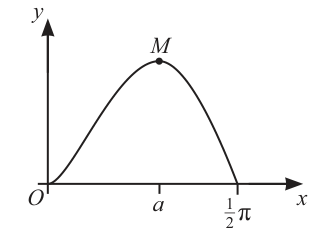
The diagram shows the curve for . The curve has a maximum point at , where .
Approach
Use the product rule to differentiate . Since is a maximum point, set at and rearrange the resulting equation to obtain .
Working
Given:
Differentiate using the product rule:
At the maximum point , and :
Multiply the entire equation by to eliminate the surd in the denominator:
Rearrange to isolate :
Divide both sides by :
Answer
Shown that .
Shown
Walkthrough
First, we differentiate the given function using the product rule. The derivative of is and the derivative of is . Setting the derivative equal to zero at the maximum point gives an equation involving and . By multiplying through by , we clear the fraction and surd, leaving a simple trigonometric equation. Dividing by converts the sine and cosine into tangent, yielding the required result .
Key Takeaways
- The product rule is essential for differentiating products of functions.
- At a maximum or minimum point, the first derivative is zero.
- Basic trigonometric identities like are useful for rearranging equations.
Common Mistakes
- Forgetting the chain rule when differentiating (must multiply by 2).
- Failing to multiply the entire equation by , leaving a fraction that is harder to rearrange.
- Algebraic errors when isolating .
Things to Be Careful About
- Ensure all trigonometric functions are in radians when using a calculator in later parts.
- The mark scheme awards a method mark for obtaining the form , so show the unsimplified derivative first.
Approach
Rearrange into the form . Evaluate at and . If there is a sign change, then by the intermediate value theorem, a root exists in the interval .
Working
Let . We need to show and .
Calculate (in radians):
Since , .
Calculate (in radians):
Since , .
Since and , there is a sign change in the interval . Therefore, .
Answer
Shown that .
Shown
Walkthrough
We start with the equation and define a function . To show that the root lies between 0.9 and 0.95, we evaluate at these two endpoints. It is crucial to use radians on the calculator. At , , which is negative. At , , which is positive. Because the function changes sign between these two values and is continuous in this interval, there must be a root between them.
Key Takeaways
- Locating roots by sign change is a fundamental numerical method.
- Always ensure your calculator is in the correct mode (radians for calculus and trigonometry involving ).
- The function must be continuous in the interval for the sign change to guarantee a root.
Common Mistakes
- Using degrees instead of radians, which will give completely wrong values.
- Failing to state the values of and clearly.
- Not explicitly mentioning the sign change.
Things to Be Careful About
- The mark scheme allows a smaller interval provided it contains the root, but using the given bounds is safest.
- Show at least 3 decimal places in your calculated values to justify the sign.
Show that if a sequence of values given by the iterative formula
converges, then it converges to .
Approach
Assume the sequence converges to a limit . Then as , both and approach . Substitute into the iterative formula and rearrange to show it satisfies the equation , which is satisfied by .
Working
Assume the sequence converges to a limit . Then:
Multiply both sides by 2:
Rearrange to isolate the inverse tangent:
Take the tangent of both sides:
Use the compound angle identity :
This is exactly the equation satisfied by (from part (a)). Therefore, if the sequence converges, it converges to .
Answer
Shown that the sequence converges to .
Shown
Walkthrough
When an iterative formula converges, the limit satisfies . We substitute for the limit in the given formula and perform algebraic manipulations to recover the original equation . The key step is taking the tangent of both sides of and using the identity to simplify to .
Key Takeaways
- If an iterative sequence converges, the limit is a fixed point of the iteration function.
- Inverse trigonometric functions can be removed by applying the corresponding trigonometric function to both sides.
- Compound angle identities are useful for simplifying expressions involving .
Common Mistakes
- Forgetting to use the correct identity for .
- Algebraic errors when rearranging the iterative formula.
- Not explicitly stating that the limit satisfies the original equation from part (a).
Things to Be Careful About
- The question says "if a sequence ... converges", so you do not need to prove convergence, only that the limit must be .
- Work in radians throughout.
Use the iterative formula in part (c) to calculate correct to 4 decimal places. Give the result of each iteration to 6 decimal places.
Approach
Choose an initial value in the interval , for example . Apply the iterative formula repeatedly, calculating each result to 6 decimal places. Continue until the value is constant to 4 decimal places, and verify by checking for a sign change in the interval .
Working
Let .
Iteration 1:
Iteration 2:
Iteration 3:
Iteration 4:
Iteration 5:
Iteration 6:
The values are stabilising around . To justify to 4 decimal places, we check for a sign change in between and :
Since there is a sign change in , correct to 4 decimal places.
Answer
0.9183
Walkthrough
We start with an initial guess and repeatedly apply the iterative formula. Each new value is calculated using the previous value, and we keep 6 decimal places to avoid rounding errors accumulating. The sequence oscillates and converges towards the root. To confirm that to 4 decimal places, we don't just rely on the iterations stabilising; we check for a sign change in the original equation across the interval . Since and , the root must lie in this interval, confirming the answer to 4 d.p.
Key Takeaways
- Iterative formulas can be used to find roots of equations to any desired accuracy.
- Always carry extra decimal places during intermediate calculations to prevent rounding errors.
- Justification of the final answer to a given number of decimal places requires checking for a sign change in the appropriate interval.
Common Mistakes
- Working in degrees instead of radians, which will give completely wrong iterations.
- Rounding intermediate results to too few decimal places, causing the final answer to be incorrect.
- Failing to justify the final answer to 4 d.p. by checking the interval or showing sufficient iterations.
Things to Be Careful About
- The mark scheme requires showing sufficient iterations to at least 6 d.p. to justify the answer. Show at least 4-5 iterations.
- The final answer must be . If you get a different value, check your calculator mode and rounding.