Mathematics 9709/32 — May/June 2025
Cambridge A-Level · Pure Mathematics 3 · worked solutions for every part, with the mark scheme
Topics Algebra · Trigonometry · Complex Numbers · Integration · Logarithmic and Exponential Functions · Numerical Solution of Equations · +3 more
Solve the equation
Give your answer correct to 3 decimal places.
Approach
Multiply both sides by to clear the fraction, rearrange into a quadratic in , solve the quadratic, take natural logs, and reject the negative root because .
Working
Starting from
multiply by :
Rearrange:
Multiply by :
or
Let :
Using the quadratic formula:
Since , reject . Therefore
and
Evaluating:
Answer
x = 1.426
Walkthrough
We need to solve an equation where the unknown appears in exponents, both as and . The first step is to clear the denominator by multiplying both sides by . This is valid as long as , and we will check at the end that our answer does not make the denominator zero.
After multiplying out, we bring all terms to one side. The term is awkward, so we multiply the whole equation by . This converts into and into , giving a quadratic in .
To make the quadratic easier to handle, we substitute . The quadratic in is solved with the quadratic formula. One of the two solutions is negative. Since is always positive, that solution cannot be valid and must be rejected.
For the remaining positive value of , we take natural logarithms on both sides to recover , because . Finally we evaluate the logarithm and round to 3 decimal places.
Key Takeaways
- Exponential equations with and can be turned into quadratics by substituting after multiplying through by .
- The domain restriction is essential: any root of the quadratic that is negative must be rejected.
- Taking natural logarithms is the correct inverse operation to solve .
- A full method must be shown; an unsupported decimal answer would receive no marks.
Common Mistakes
- Forgetting to multiply the right-hand side by the denominator when clearing the fraction.
- Mis-handling : multiplying by turns it into , not into .
- Keeping the negative quadratic root and taking its logarithm, which is undefined.
- Giving an unsupported answer: the mark scheme awards 0/5 for an answer with no working.
- Rounding incorrectly to 3 decimal places (the required answer is 1.426, not 1.425 or 1.43).
Things to Be Careful About
- The denominator must not be zero. Our final answer gives , so the denominator is not zero.
- The quadratic formula must be applied correctly: , , .
- The negative root is approximately , so it must be rejected because . If seen, it must be explicitly rejected.
- The answer must be given correct to 3 decimal places; the mark scheme requires exactly 1.426.
Expand in ascending powers of , up to and including the term in , simplifying the coefficients.
Approach
Use the binomial expansion for with and , keeping terms up to . Then multiply the resulting three-term expansion by and collect terms up to .
Working
Simplify term by term:
Now multiply by :
Collect terms up to :
Answer
6 + 17x + 42x^2
Walkthrough
We need the expansion of up to the term in . The binomial theorem for works for any rational as long as , so we first expand using and . The first term is . The second term is . The third term is . We then multiply this three-term expansion by , keeping only terms up to . The term coming from is ignored. Collecting gives .
Key Takeaways
This question tests the binomial expansion for a negative fractional index. The key skill is to substitute carefully into the standard formula and then multiply by another polynomial while ignoring terms beyond the required power. It also reinforces the importance of simplifying coefficients completely.
Common Mistakes
A common mistake is to use instead of , which gives the wrong sign in the second term. Another common mistake is to forget the factor of , leading to an incorrect coefficient. Some students also multiply incorrectly by and include the term, which should be ignored because only terms up to are required.
Things to Be Careful About
The coefficient of in the binomial expansion must be simplified from to . When multiplying by , remember that the multiplies every term of the expansion, so it contributes and before ignoring higher powers.
Approach
The binomial expansion is valid only when . Here , so the expansion is valid when .
Working
Answer
-1/2 < x < 1/2
Walkthrough
For a binomial expansion of with a negative or fractional , the series is valid only when . In this question , so we need . Since , this becomes , or . Written as an interval, this is . The inequality must be strict because the binomial series does not converge at the endpoints.
Key Takeaways
The validity condition for a binomial expansion with a non-positive or fractional index is always , where is the term being raised to the power. This question shows how to translate that condition into an inequality in when is a multiple of .
Common Mistakes
A common mistake is to write without the modulus, which is incomplete. Another common mistake is to include equality, writing , which is incorrect because the expansion is not valid at the endpoints.
Things to Be Careful About
The condition must be strict: , not . Also remember that , so dividing by gives the correct bound on .
On an Argand diagram shade the region whose points represent complex numbers which satisfy both the inequalities and .
Approach
Interpret each inequality geometrically on the Argand diagram. The first inequality defines a circular region, and the second defines an angular sector. The solution is the intersection of these two regions.
Working
1. Analyze the first inequality:
This represents the set of points whose distance from is less than or equal to 2. On the Argand diagram, corresponds to the point . Thus, this is a closed disk (a circle and its interior) with centre and radius 2.
2. Analyze the second inequality:
This can be rewritten as . The argument is measured from the point , which corresponds to . The angles and are measured anticlockwise from the positive real axis. This defines a sector (a wedge-shaped region) bounded by two half-lines emanating from :
- One half-line at an angle of to the positive real axis (slope 1, passing through and ).
- The other half-line at an angle of to the positive real axis (slope -1, passing through and ).
3. Find the intersection and shade:
The required region is the intersection of the closed disk and the angular sector. This is the portion of the disk that lies between the two half-lines.
Answer
The shaded region is the intersection of the closed disk and the sector .
The region inside the circle and between the rays from at angles and .
Walkthrough
First, we translate the complex inequalities into geometric conditions on the Argand diagram.
The inequality is a standard modulus inequality. It states that the distance between the point and the point (which is on the Argand diagram) is at most 2. This describes a solid circle (disk) with centre and radius 2.
Next, we look at . The expression represents the vector from the point (which is ) to the point . The argument of this vector is the angle it makes with the positive real axis. Requiring this angle to be between and restricts to a wedge-shaped region (sector) originating at . The boundary rays are:
- : a half-line from at 45° to the horizontal. Since the slope is , this line passes through and .
- : a half-line from at 135° to the horizontal. Since the slope is , this line passes through and .
Finally, we shade the region that satisfies both conditions simultaneously. This is the part of the circular disk that lies between the two half-lines.
Key Takeaways
- represents a closed disk of radius centred at the point on the Argand diagram.
- represents a sector (angular region) with its vertex at , bounded by half-lines at angles and .
- Finding the solution to simultaneous complex inequalities involves graphing each locus and identifying their intersection.
Common Mistakes
- Forgetting that includes the interior of the circle (the inequality is , not ).
- Drawing full lines instead of half-lines for the argument inequalities. The argument is only defined relative to the starting point , so the boundaries must be rays emanating from , not infinite lines.
- Measuring the argument angles from the origin instead of from the point .
- Shading the wrong region (e.g., outside the circle or outside the sector).
Things to Be Careful About
- Ensure the half-lines are correctly drawn from and not from the origin. The angles and are measured from the positive real axis direction starting at .
- The circle centre is , not . Remember that corresponds to the imaginary axis.
- The shading must be the intersection of both regions. Dependent marks in the scheme mean that incorrect previous drawings will lead to incorrect shading.
Solve the equation for .
Approach
Use and the double-angle formula to rewrite the equation as a quadratic in . Solve the quadratic, then take arctangent values in the interval .
Working
Let . Then
Substitute into the equation:
Simplify the left-hand side:
Therefore
Factorise:
So
Since :
For , the only solutions are
Answer
x = 45° or x ≈ Ϳ26.6°
Walkthrough
The equation mixes with . To make it solvable, express both in terms of . Let . Then and, from the double-angle formula for tangent, . Substituting turns the trigonometric equation into an algebraic equation in .
After substitution, combine the two fractions on the left. This gives a single fraction . Setting this equal to 3 and multiplying by produces the quadratic . Factorising gives or .
Now return to : solve and . Within , these give and . Because tangent has period , adding to either answer would leave the interval, so there are no further solutions.
Key Takeaways
- Cotangent is the reciprocal of tangent: .
- The double-angle formula for cotangent is ; it follows from .
- Rewriting a trigonometric equation in terms of one function often reduces it to a polynomial equation.
- Always check the required interval after solving a trigonometric equation.
Common Mistakes
- Using an incorrect double-angle formula for , such as treating it as .
- Forgetting that is undefined when , so and are not solutions; no solutions are lost by multiplying by .
- Stopping after finding without converting back to angles in the given interval.
Things to Be Careful About
- The interval is . Since tangent has period , each value of gives exactly one angle in this interval here; the other possible angles are outside the interval and should be ignored, as the mark scheme says.
- Use AWRT for the approximate answer; the exact form is .
- When simplifying, ensure the algebraic manipulation preserves equality; multiplying by is valid because for valid inputs.
The square roots of can be expressed in the Cartesian form , where and are real and exact.
By first forming a quartic equation in or , find the square roots of in exact Cartesian form.
Approach
Let the square root be . Square it and equate real and imaginary parts with and respectively. This gives two equations in and . Eliminate one variable to obtain a quartic in the other, solve it, then recover the other variable using .
Working
Let . Then
Equating real and imaginary parts:
From :
Since , write . Substitute into :
Multiply by :
so
Let . Then
Thus or . Since is real, , so and
Now use .
If :
If :
Therefore the square roots are
that is,
Answer
±(2 - √5 i)
Walkthrough
We need to find complex numbers whose square is . The most direct method is to expand and compare real and imaginary parts. This produces two equations linking and . Because the two equations involve both and , we can eliminate one variable by substituting into the first equation. This is why the question asks for a quartic in or : after substitution and multiplying by , the equation becomes quartic. We solve it by treating as a single unknown , giving a quadratic. We discard because is real, so cannot be negative. Finally, we use to find the matching for each , giving two square roots.
Key Takeaways
- Squaring and equating real and imaginary parts is the standard way to find square roots of a complex number in Cartesian form.
- The equations and must be solved simultaneously, not separately.
- A quartic in or can often be reduced to a quadratic by substituting or .
- The sign of determines the signs of and together; both combinations must be checked.
Common Mistakes
- Forgetting to equate both real and imaginary parts.
- Using only and not using to connect and .
- Incorrectly substituting , for example writing instead of . The mark scheme explicitly disallows incorrect algebra such as .
- Keeping as a real possibility. Since is real, .
- Giving and separately instead of stating the square roots . The mark scheme requires the square roots, not coordinates.
- Writing instead of ; exact form should be simplified.
Things to Be Careful About
- The quartic may be written as or ; either is acceptable. If you use the -quartic, you must still recover using .
- When solving , the factorisation is , so or . Only is valid for real .
- Check that both final values satisfy the original equation. For , ; for , . No additional roots exist.
- If no working is shown, the mark scheme awards 0 marks. Show the expansion, the two equations, the elimination, and the final square roots.
By sketching a suitable pair of graphs, show that the equation
has only one root in the interval .
Approach
To show that the equation has only one root in , we sketch the two functions and on the same axes within this interval and observe their point of intersection.
Working
For the interval , we note that , so . This is a straight line with a y-intercept at and an x-intercept at .
For the sine function :
- At , .
- At , .
- The graph is a smooth curve increasing from to .
The V-shaped modulus graph (specifically the left arm ) and the increasing sine curve intersect at exactly one point in the interval . This single intersection confirms that the equation has only one root in this interval.
Answer
The graphs intersect at a single point in , proving there is only one root.
The graphs y = |x - 2| and y = 2sin(x/2) intersect at exactly one point in the interval 0 < x < pi.
Walkthrough
We are asked to show that the equation has exactly one root in . We do this by treating each side of the equation as a separate function and sketching them on the same set of axes.
First, consider . In the interval (which is approximately ), the value is less than for part of the interval and greater than for the rest. However, for , , which is a straight line with a y-intercept of and an x-intercept of . For , , which is a line rising from . The overall graph is V-shaped with its vertex at .
Next, consider . At , . At , . The graph is a smooth, increasing curve from to .
By drawing both graphs, we see that the descending line crosses the ascending sine curve exactly once before , and the ascending line does not meet the sine curve again before . Thus, there is only one intersection point, meaning only one root.
Key Takeaways
- Sketching graphs is a powerful way to visualize and confirm the number of roots of an equation in a given interval.
- Understanding the behavior of modulus functions and trigonometric functions in specific intervals is essential for accurate sketching.
Common Mistakes
- Sketching the full modulus graph without restricting to the given interval .
- Forgetting that when , and incorrectly drawing the left arm as descending from the origin.
- Using degrees instead of radians for the trigonometric calculations or sketching.
Things to Be Careful About
- Ensure the sketch is restricted to as instructed.
- The vertex of the modulus graph at should be correctly positioned relative to .
- The maximum value of the sine graph in this interval is at , which matches the y-intercept of the modulus graph, but they do not intersect there.
Approach
To show the root lies between and , we define a function and evaluate it at and . If and have opposite signs, a root must lie between them by the Intermediate Value Theorem.
Working
Let . Since and are both less than , we have for these values.
Evaluate at :
Using a calculator (in radians):
Evaluate at :
Using a calculator:
Since and , there is a sign change in the interval . Because is continuous, there must be at least one root in this interval.
Answer
and , so the root lies between and .
f(1) > 0 and f(1.5) < 0, so the root lies between 1 and 1.5.
Walkthrough
We want to prove that the root of is between and . We rearrange this into a single function and look for a sign change between and .
First, we calculate . Since , . The sine term is . Calculating this gives , which is positive.
Next, we calculate . Since , . The sine term is . Calculating this gives , which is negative.
Because the function changes from positive to negative between and , and the function is continuous (composed of continuous modulus and sine functions), the Intermediate Value Theorem guarantees that at some point in this interval. Thus, the root lies between and .
Key Takeaways
- The sign change method (Intermediate Value Theorem) is a reliable way to locate roots within a specific interval.
- Always ensure your calculator is in the correct mode (radians, not degrees) when evaluating trigonometric functions in calculus and numerical methods.
Common Mistakes
- Forgetting to take the absolute value correctly (e.g., calculating as instead of ).
- Using degrees instead of radians for the sine function, which gives incorrect values (e.g., ).
- Failing to state the conclusion clearly, such as not mentioning the sign change or continuity.
Things to Be Careful About
- The function must be continuous in the interval for the sign change argument to be valid. Here, both and are continuous everywhere, so their difference is continuous.
- Ensure all intermediate values are calculated to sufficient decimal places to clearly determine the sign.
Use the iterative formula with an initial value of 1.03 to calculate the root correct to 2 decimal places. Give the result of each iteration to 4 decimal places.
Approach
We use the given iterative formula with . We calculate successive values of to decimal places until the values converge to decimal places.
Working
Given :
Iteration 1:
Iteration 2:
Iteration 3:
Iteration 4:
Iteration 5:
Iteration 6:
Iteration 7:
Iteration 8:
The values are oscillating and converging. Let us continue to confirm convergence to d.p.:
Iteration 9:
Iteration 10:
The values and both round to to decimal places. The root is therefore to d.p.
Answer
The root correct to 2 decimal places is .
1.02
Walkthrough
We are given the iterative formula and an initial value . We substitute into the formula to find , repeating this process until the answer stabilizes to the required accuracy (2 decimal places).
Starting with :
We see the values are oscillating around the true root. We continue calculating:
Since and both round to to 2 decimal places, we can be confident that the root to 2 d.p. is . To be absolutely rigorous, one could also show that the root lies in the interval by evaluating the original function at these bounds, but showing sufficient iterations that converge to is typically accepted.
Key Takeaways
- Iterative formulas can be used to find roots of equations to a specified accuracy.
- The process often involves oscillation before convergence; you must continue until the required number of decimal places is stable.
- Always use the unrounded value from the previous iteration when calculating the next one to avoid accumulated rounding errors.
Common Mistakes
- Rounding intermediate values too early (e.g., using instead of in the next iteration).
- Using degrees instead of radians in the calculator, which will give completely wrong iteration values.
- Stopping the iterations too early before the answer has clearly converged to 2 d.p.
Things to Be Careful About
- The question asks for the result of each iteration to 4 d.p., so you must show these values in your working.
- Ensure you are using the correct iterative formula exactly as given: .
- To justify the final answer to 2 d.p., you should either show that two consecutive iterations round to the same value to 2 d.p., or show a sign change in the interval .
Approach
Expand using the compound angle formula, then match coefficients of and with to find and .
Working
Expand using the identity :
Comparing with :
Square and add to find :
Find by dividing:
Since and , lies in the first quadrant, which satisfies .
Answer
α = 0.2838
Walkthrough
We want to rewrite as a single cosine. The compound-angle identity gives
Matching the coefficient gives , and matching the coefficient gives . Squaring and adding eliminates because , leaving , so .
Dividing the two equations gives . Both and are positive, so is in the first quadrant — automatically satisfying the constraint . Evaluating on a calculator: , which rounds to to four decimal places.
Key Takeaways
- The form requires the identity , with the term multiplying and the term multiplying .
- is found from where and are the coefficients of and respectively.
- is found from .
- The quadrant of is determined by the signs of and (equivalently, the signs of the original coefficients).
Common Mistakes
- Confusing with : in the cosine form, the term must have a plus sign (no negative), i.e. .
- Swapping the ratio: should be (coefficient of ) / (coefficient of ) = , not .
- Forgetting to check the quadrant: here both coefficients are positive so is in the first quadrant, but if the coefficient were negative, would lie in the second quadrant and would have to be added.
Things to Be Careful About
- The mark scheme requires to be stated (B1) before any decimal approximation is used; if a decimal is written first, the B1 is not awarded. Always state exactly.
- The mark scheme does not allow credit if and are written without the factor : those raw values would give but no identification, so the M mark is not earned. The cleanest way is to write and explicitly.
- Round to 4 decimal places: .
Approach
Substitute the form from part (a), then solve using the inverse cosine, taking both the principal and supplementary angles into account.
Working
Using the result of part (a) with :
Divide by :
Apply to both sides. The principal value is
The general solutions for are . For the relevant range is , so only the principal-angle solutions are needed:
And:
Both values lie in , so both are valid solutions.
Answer
x = 0.250 or x = 1.45
Walkthrough
From part (a) we have with . The equation we are solving uses , so we substitute to get
Dividing both sides by gives . This is a standard cosine equation: we need every angle whose cosine equals . The principal value is , and because cosine is even, the other solution in one period is . Writing , we have
The full general solution would be , but our interval restricts , so ranges over — only the cases produce solutions in this window.
For : , so .
For : , so .
Both fall inside , so the solution set is or (to 3 significant figures).
Key Takeaways
- Once is in form, the equation reduces to a single cosine equation in .
- (with ) has two solutions per period, — the symmetry of cosine is the reason for two answers here.
- Always convert back to the original variable and check whether each candidate lies in the requested interval.
Common Mistakes
- Forgetting the second solution. Cosine is even, so gives both and , not just one of them.
- Reporting an answer outside the interval. The mark scheme explicitly says "ignore answers outside the given interval", so a stray solution like should be excluded; only solutions in count.
- Rounding too early and propagating the rounding through every subsequent step. The mark scheme accepts to 4 d.p. (CAO for the mark), but for the final values it accepts AWRT (anything within rounding tolerance), so a slight rounding error in doesn't usually cost marks provided the method is correct.
- Confusing degrees and radians. The problem uses radians throughout (the interval is in terms of ); make sure the calculator is in radian mode.
Things to Be Careful About
- The B1FT in the mark scheme can be awarded for even if it isn't numerically evaluated, provided (which it is, since ). Writing the expression is enough to earn this mark.
- The M1 requires a complete correct method leading to a value of — for example, the equation must be visible (or implied by calculator working), and a candidate -value must be obtained. Insufficient working scores M0 even with the right final number.
- The final A1 marks require both (or ) and in the interval, and no other in-interval solutions.
The variables and satisfy the differential equation
and when .
Solve the differential equation and obtain an expression for in terms of .
Approach
Separate the variables so that all terms involving are on one side and all terms involving are on the other, then integrate both sides.
Working
Separating variables gives
Integrating both sides,
Use the initial condition when :
Therefore
So the particular solution is
Multiplying by 4 and combining the logarithms,
Exponentiating both sides gives
Answer
x = (12 sin^2(2θ) - 3)/4
Walkthrough
The differential equation is separable because we can collect all terms with and all terms with . Dividing by gives
On the left, the derivative of is , so the integral is . On the right, the derivative of is , so the integral is .
We then use the initial condition when . Since , we get
so
Substituting this back and combining logarithms gives
and exponentiating both sides gives the final expression for .
Key Takeaways
This question tests the full process of solving a first-order separable differential equation: separating variables, integrating using the pattern, applying an initial condition, and using laws of logarithms to rearrange for the dependent variable. It also shows that the constant of integration can be written as a logarithm, which makes the final exponentiation cleaner.
Common Mistakes
- Forgetting the factors and that come from the chain rule when integrating and .
- Using the wrong value for ; it is , not or .
- Not applying the initial condition, or applying it before the constant is introduced.
- Making sign errors when simplifying .
- Failing to combine the logarithms correctly before exponentiating.
Things to Be Careful About
The mark scheme accepts equivalent intermediate forms, such as , so do not worry if your constant appears as a logarithm in a different but equivalent way. When exponentiating, remember that , and that . Ensure the final answer is expressed in terms of only, with no remaining constant .
With respect to the origin , the points , and have position vectors given by
Approach
Use the position vectors of and to find a direction vector , then write the line as .
Working
The direction vector from to is
Using as a point on the line, a vector equation is
Answer
r = (1, -4, 2) + lambda(-3, 5, 1)
Walkthrough
The line through and needs a point on the line and a direction vector. We already know the position vector of , so we can use as the fixed point. To move from to , subtract from ; this gives the direction vector . A vector equation is then , where is a real parameter. As varies, every point on the line is obtained.
Key Takeaways
A line in 3D can be written as , where is a position vector of a point on the line and is a direction vector. The direction vector between two points is found by subtracting their position vectors.
Common Mistakes
- Writing instead of ; the mark scheme requires .
- Using the wrong order when subtracting: , not the reverse. (Using the reverse still gives a valid line with a different parameter sign, but the displayed direction vector would be the negative.)
- Forgetting to include a parameter such as .
Things to Be Careful About
- Any point on the line can be used as the fixed point, and any non-zero scalar multiple of the direction vector is acceptable.
- The answer should be a vector equation, not just a direction vector.
Approach
The angle is the angle between the vectors and . Use the scalar product formula
Working
From part (a), . Also,
Scalar product:
Magnitudes:
Therefore
Answer
cos BAC = sqrt(35/59)
Walkthrough
The angle is at , so it is the angle between the vectors and . We already have from part (a). We find by subtracting from . Then the scalar product formula gives . Compute the dot product by multiplying corresponding components and adding. Compute each modulus by taking the square root of the sum of squares of components. Finally divide and simplify: since , the fraction becomes .
Key Takeaways
The scalar product of two vectors is . To find an angle at a point, use the two vectors that start at that point. The modulus of a vector is the square root of the sum of the squares of its components.
Common Mistakes
- Using and together; both vectors must start at (or both must be reversed).
- Forgetting to divide by the product of the moduli.
- Leaving the answer as without simplifying, or writing only without stating ; the mark scheme requires the statement of .
- Not showing the scalar product calculation when the mark scheme requires method.
Things to Be Careful About
- The scalar product here is positive, so is positive and the angle is acute.
- Exact simplification: ; equivalent forms such as are also accepted.
- The answer must come from using a scalar product, as requested.
Approach
Use the formula for the area of a triangle in terms of two side lengths and the included angle:
Since is known from part (b), find using .
Working
From parts (a) and (b):
Then
So, since is an angle of a triangle,
The area is
Answer
Area = sqrt(210)
Walkthrough
The area of a triangle formed by two sides from is . We know the two lengths and from part (b). To get , use . Since , , and the sine is positive for an angle of a triangle. Substitute into the area formula: .
Key Takeaways
The area formula can be applied using vectors from a common vertex. The identity lets us convert a known cosine into the required sine. Surds can be simplified by combining square roots and dividing by inside the root.
Common Mistakes
- Forgetting the factor .
- Taking as negative; for an angle in a triangle it must be positive.
- Not using the angle at ; because the question says "Hence", the area must be found using and the previous result.
- Giving an answer from without showing the method of evaluation; the mark scheme requires evidence of the calculation.
- Not simplifying to an exact form such as or .
Things to Be Careful About
- The two method marks (area formula and sine conversion) are independent, but both must be present for full method marks.
- , not with any ambiguity about sign.
- Equivalent exact forms such as are accepted, but unsupported numerical answers are not.
Approach
We need to divide by . Since both are quadratics, the quotient will be a constant and the remainder a constant. Write and compare coefficients.
Working
Let the quotient be and the remainder be :
Comparing coefficients of : , so .
Comparing constant terms: , so .
Answer
Quotient , remainder .
Quotient = 1/4, remainder = -1/4
Walkthrough
We are dividing by . Since both are quadratics, the quotient must be a constant and the remainder a constant (any remainder must have degree less than the divisor, so degree less than 2). We write the division identity and compare coefficients. Expanding gives . Matching the coefficient gives , so . Matching constants gives , so .
Key Takeaways
This tests polynomial division where the divisor is a quadratic. The key idea is that when the degrees of dividend and divisor are equal, the quotient is a constant. Comparing coefficients is often faster than long division.
Common Mistakes
- Forgetting that the remainder must have degree less than the divisor.
- Sign errors when comparing constant terms.
- The mark scheme says: "Allow B1B1 if implied by correct division and no further working, but do not ISW." So if the division is correct but the remainder is stated incorrectly, do not ignore subsequent working — the remainder mark is lost.
Things to Be Careful About
- The divisor is written as , i.e. . The quotient is , not .
- The remainder is negative: . It's easy to drop the sign.
Approach
Use integration by parts with and . Then use the quotient and remainder from part (a) to split the resulting rational integrand, integrate, and evaluate the definite integral at the limits.
Working
Let , . Then and .
Now split the integrand using the result from part (a): , so
Therefore
So the antiderivative is
Evaluate at the limits:
At : , so
At : .
Hence
Answer
π/16 - 1/8
Walkthrough
We need . The integrand is a product of a polynomial () and an inverse trig function (), which signals integration by parts. Choose so that differentiating gives , and so that . This transforms the integral into .
The remaining integral is handled by using the division result from part (a): . So the integrand becomes . Integrating gives because .
Combining, the antiderivative is . Substituting the upper limit gives , so the value is . The lower limit gives 0.
Key Takeaways
- Integration by parts is the right tool when the integrand is a product of a polynomial and an inverse trig function.
- The derivative of is , which produces the rational integrand.
- Splitting a rational function using the quotient and remainder from a division (part (a)) converts it into a constant plus a term of the form , which integrates to an arctan.
Common Mistakes
- Choosing the wrong and (e.g. , ) makes the problem harder.
- Forgetting the factor of 2 in .
- Incorrectly splitting — the mark scheme FT's the quotient and remainder from part (a).
- Forgetting to subtract the lower-limit contribution (mark scheme DM1 requires evidence of considering the lower limit, e.g. sight of 0).
Things to Be Careful About
- The mark scheme says "do not ISW" for part (a) — if the quotient is correct but the remainder is wrong, subsequent working in part (b) that uses the wrong remainder will not be credited.
- When substituting limits, the mark scheme requires evidence that the lower limit 0 has been considered for each term.
- The final answer must be exact: .
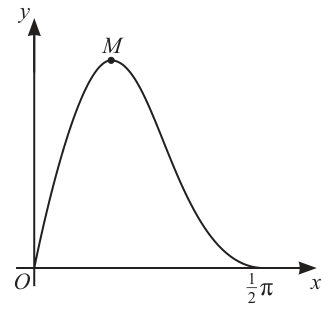
The diagram shows the graph of for and its maximum point .
Approach
Differentiate using the product rule. Factor the resulting derivative, simplify using the compound angle identity, and solve the equation for in the interval .
Working
Let and , so .
Apply the product rule:
Factor out (which is non-zero in the interior of the interval):
Apply the compound angle identity with , :
Set :
So either or .
- (the right-hand endpoint, not an interior maximum).
- (the only solution in ).
Hence the maximum occurs at .
Answer
x = π/6
Walkthrough
We are asked to find the -coordinate of the maximum point on the curve for . Since the maximum is an interior point of the domain, we differentiate and set the derivative equal to zero.
Step 1 — Identify the two factors. Write as a product of and so the product rule can be applied. The first factor is a sine of a multiple of , the second is a cosine squared (a composite function).
Step 2 — Differentiate each factor.
- For , the chain rule gives .
- For , the chain rule gives , which is the same as by the double angle identity.
Step 3 — Apply the product rule. The product rule states . Substituting and simplifying with and writing gives the derivative in the form .
Step 4 — Factor and simplify using trig identities. Factor out of both terms. The remaining bracket is , which is exactly the expansion of by the compound angle identity. The derivative simplifies to .
Step 5 — Solve the equation. With , either factor can be zero. gives (the endpoint, not a maximum in the interior). has solutions , and the only one in is , i.e. .
Key Takeaways
- The product rule is essential whenever a function is a product of two or more simpler functions.
- The chain rule is required to differentiate (a composite of cosine and squaring).
- The double angle and compound angle identities are powerful tools for condensing a derivative into a factorable form.
- A maximum in the interior of a closed interval corresponds to there, not to one of the endpoints.
Common Mistakes
- Forgetting the chain rule on and writing the derivative of as instead of .
- Dropping the chain rule on and writing the derivative as instead of .
- Failing to use the compound angle identity, leaving the derivative as an unfactorable expression and not being able to solve it.
- Including (where ) as the location of the maximum, when in fact it is the right-hand endpoint where the curve returns to the -axis.
Things to Be Careful About
- Dividing by to factor is only valid when ; the case must be checked separately. Here it gives the endpoint , which is not the maximum.
- When solving the general solution is for integer ; only the solution with is required.
- The mark scheme accepts any of , , , or as the equation in a single trig function; the cleanest derivation uses .
By using the substitution , find the area of the region bounded by the curve, the -axis between and , and the line .
Approach
Express the integrand using the double angle identity , then apply the substitution as instructed. Convert both the integrand and the limits of integration, evaluate the resulting polynomial integral, and simplify.
Working
The required area is:
Use the double angle identity :
Substitute , so , i.e. .
Change the limits:
Substitute into the integral:
Since :
Answer
15/8
Walkthrough
We need the area enclosed by the curve , the -axis, the line , and the line . Since the curve lies above the -axis on , this area is just the definite integral of the curve between these limits.
Step 1 — Use the double angle identity. , so the integrand becomes . This is necessary because the substitution requires the integrand to involve (and a single to match the differential ).
Step 2 — Apply the substitution. Let , then , so . The integrand becomes , giving the constant factor in front.
Step 3 — Convert the limits. When , . When , . Note that , so the integral goes from a larger to a smaller value of . The minus sign in front of the integral flips the limits back, giving the integral from to — alternatively, one may keep the limits as written and carefully apply the minus sign when evaluating.
Step 4 — Evaluate. The antiderivative of is , so the value is .
Key Takeaways
- The double angle identity is often the key step that prepares a trig integrand for a (or ) substitution.
- Always convert the limits of integration when using a definite integral with a substitution — this avoids the need to convert the antiderivative back to .
- A minus sign appears whenever the substitution has a negative derivative (here ); this sign flips the order of the limits.
Common Mistakes
- Forgetting the factor of 2 from the double angle identity, leaving the integrand as and being unable to make progress.
- Failing to convert the limits and instead substituting into the antiderivative while keeping the -limits — this mixes up the variable of integration.
- Losing the minus sign from and getting a negative final answer.
- Miscalculating as or instead of .
Things to Be Careful About
- The integrand is non-negative on , so the geometric area equals the definite integral with no absolute value needed.
- The mark scheme accepts either keeping the original limits with the minus sign explicit, or swapping the limits so the minus sign is absorbed. Both are correct.
- The final answer is exactly, which is approximately .