Mathematics 9709/31 — May/June 2025
Cambridge A-Level · Pure Mathematics 3 · worked solutions for every part, with the mark scheme
Topics Algebra · Complex Numbers · Differentiation · Integration · Logarithmic and Exponential Functions · Trigonometry · +3 more
Approach
Identify the vertex of the graph by setting the expression inside the modulus to zero. Then find the y-intercept by substituting . Sketch the V-shaped graph passing through these points.
Working
Find the vertex where :
The vertex is at .
Find the y-intercept by substituting :
The y-intercept is at .
The graph of is a V-shaped curve with its vertex on the x-axis at , symmetric about the line , and passing through .
Answer
The graph is a V-shape with vertex at and y-intercept at .
V-shaped graph with vertex at (3/2, 0) and y-intercept at (0, 3)
Walkthrough
To sketch the graph of a modulus function , we first find the vertex by setting the inner expression to zero. Here, gives , so the vertex is at . Next, we find the y-intercept by evaluating the function at , which gives . Since the modulus function outputs non-negative values, the graph is V-shaped, opening upwards, with the two linear branches meeting at the vertex. The graph is symmetric about the vertical line .
Key Takeaways
- The graph of is always V-shaped with its vertex on the x-axis at .
- The y-intercept is found by substituting and taking the absolute value.
- The graph consists of two straight lines with slopes and .
Common Mistakes
- Forgetting to mark the vertex and y-intercept clearly on the axes.
- Drawing a curve instead of straight lines for the branches.
- Placing the vertex at the wrong position on the x-axis.
Things to Be Careful About
- Ensure the graph exists for negative values as well, extending to the second quadrant.
- The branches must be straight lines, not curved.
- The vertex must touch the x-axis, not the y-axis.
Approach
To solve , consider the definition of the modulus function. Split into two cases based on the sign of . Solve the resulting linear inequality in each case and check for consistency with the case condition.
Working
Case 1: , which means
In this case, . The inequality becomes:
This contradicts the condition . Thus, there is no solution in this case.
Case 2: , which means
In this case, . The inequality becomes:
This is consistent with the condition since .
Combining both cases, the final solution is .
Answer
x < 4/5
Walkthrough
The inequality involves a modulus expression. To solve it, we remove the modulus by considering the two possible cases for the expression inside: and .
In the first case (), the modulus is simply . Solving gives , which has no overlap with , so no solution here.
In the second case (), the modulus is . Solving gives , or . Since is less than , this entire range satisfies the case condition.
Thus, the final solution is .
Key Takeaways
- Solving modulus inequalities requires splitting into cases based on the sign of the inner expression.
- Always check that the solution from each case is consistent with the condition defining that case.
- The final answer is the union of all valid solutions from each case.
Common Mistakes
- Forgetting to check the consistency of the solution with the case condition.
- Incorrectly removing the modulus sign (e.g., writing for all ).
- Missing the second case entirely and only finding part of the solution.
Things to Be Careful About
- Ensure the boundary values (like ) are correctly assigned to the appropriate case.
- Verify that the final inequality direction is correct after combining terms.
- The mark scheme also accepts an alternative method using , but students must be careful to interpret the resulting quadratic inequality correctly and may need to reject extraneous roots.
It is given that .
Find in terms of .
Approach
Apply the laws of logarithms to combine the terms into a single logarithm, then exponentiate both sides to remove the logarithm and solve for .
Working
Start with
Use the power law and write :
Combine the logarithms:
Since is one-to-one, equate the arguments:
Rearrange:
Square both sides:
Solve for :
Equivalently,
Answer
q = (p^2(p-1)/e^3)^2 - 1
Walkthrough
The equation contains three logarithmic terms plus a constant. To solve for , we first express every term as a single logarithm. The power law lets us move coefficients inside: and . Also rewrite the constant as , because and are inverse functions. Then combine the three logarithms into one using the product and quotient laws: addition becomes multiplication and subtraction becomes division. This gives a single equation of the form . Because the logarithm function is one-to-one, we can drop the logs and equate . Then rearrange to isolate , square both sides to remove the square root, and solve for .
Key Takeaways
- The laws of logarithms allow coefficients to be moved inside as powers: .
- A constant can be written as a logarithm using the inverse relationship .
- When both sides of an equation are single logarithms with the same base, the arguments can be equated.
- Solving for a variable inside a square root requires squaring both sides, then rearranging carefully.
Common Mistakes
- Forgetting to rewrite the constant as before combining.
- Incorrectly combining logs, e.g. treating as . Logs combine by multiplication and division, not addition and subtraction.
- After obtaining , forgetting to square both sides, or squaring only part of the left-hand side.
- Dropping the when solving for .
- Not stating or using the domain assumptions , , ; these are needed for the original logarithms to be defined.
Things to Be Careful About
- The mark scheme awards M1 for using a logarithm of a root or a power; show and explicitly.
- A1 is given for the log-free equation . Ensure this is written before squaring.
- The final answer can be written in either equivalent form; the mark scheme allows OE (or equivalent) and ISW (ignore subsequent working).
- Squaring is valid here because both sides are positive under the domain assumptions, so no extraneous solutions are introduced.
Find the complex numbers for which
is real and . Give your answers in the form , where and are real.
Approach
Write with . Multiply the quotient by the conjugate of the denominator so that the denominator becomes real. The quotient is real exactly when the imaginary part of the resulting numerator is zero. This gives a linear equation in and . Then use to obtain a second equation and solve simultaneously.
Working
Let . Then
Multiply numerator and denominator by :
The numerator becomes
Since the denominator is real, the quotient is real only if the imaginary part of the numerator is zero:
Expanding,
The modulus condition gives
From (1), . Substitute into (2):
Hence or . Since , the corresponding values are or .
Answer
z = 4 - i or z = 1 - 4i
Walkthrough
We are told that the quotient is real. A complex number is real when its imaginary part is zero, but the denominator here is complex, so we cannot immediately read off the imaginary part. The standard technique is to multiply the numerator and denominator by the conjugate of the denominator, . This makes the denominator , a real number, while the numerator becomes a new complex number whose imaginary part determines whether the quotient is real.
After expanding the numerator, we set its imaginary part equal to zero. This gives . Next, the condition means . Substituting into this equation gives a quadratic in . Factorising it gives or , and then or respectively. These give the two required complex numbers.
Key Takeaways
- To test whether a quotient of complex numbers is real, multiply by the conjugate of the denominator.
- After rationalising, the denominator is real, so the real/imaginary status of the quotient is determined by the numerator.
- The modulus of is , so is equivalent to .
- A linear equation and a quadratic equation in and can be solved by substitution.
Common Mistakes
- Multiplying only the numerator by the conjugate and not the denominator. Both must be multiplied so the value of the quotient is unchanged.
- Trying to equate imaginary parts before rationalising the denominator.
- Sign errors when expanding ; the terms cancel, leaving .
- Forgetting that gives , not .
- Discarding one of the two solutions when solving the quadratic.
Things to Be Careful About
- The denominator must not be zero; this would require and , which is not among the solutions.
- Keep and real throughout; only the imaginary unit carries the imaginary part.
- The mark scheme expects the conjugate multiplication and the step equating the imaginary part to zero to be shown clearly.
- Both answers satisfy the original conditions, so include both and .
The parametric equations of a curve are
Find the equation of the tangent to the curve at the point . Give your answer in the form , where and are exact.
Approach
At the given point, determine the parameter value from (or ). Differentiate and with respect to using the chain rule, then use
to find the gradient. Substitute to get the gradient at the point, and use the point-gradient form of a straight line.
Working
At :
(so is a suitable value).
Differentiate with respect to :
Therefore:
At :
Equation of tangent through :
Answer
y = (6/e)x - 3
Walkthrough
The curve is given parametrically, so the gradient at a point is not directly available. We first locate the parameter value that corresponds to . Since , setting gives , hence . This is the key value needed for the gradient.
Next, differentiate both parametric equations with respect to . For , the chain rule gives because the derivative of is . For , use the chain rule again: the derivative of is , so .
The gradient of the curve is . Dividing gives , and the factor cancels, leaving . Substituting gives gradient .
Finally, use the straight-line equation through with gradient : . Expanding gives .
Key Takeaways
This question tests parametric differentiation, the chain rule for composite functions, and forming the equation of a tangent. It also shows that when a point is given in terms of and , you must first find the corresponding parameter value before differentiating.
Common Mistakes
- Forgetting to find (or ) before substituting into .
- Differentiating incorrectly: the derivative of is , not just .
- Cancelling incorrectly when forming ; the factors cancel, but the exponential in the denominator remains as .
- Substituting into but not simplifying to .
- Making an algebraic slip when expanding : the constant term is , not .
Things to Be Careful About
- The answer must be exact, so leave the gradient as rather than a decimal.
- The parameter value could be ; all such values give , so the gradient is the same.
- The gradient formula is only valid when ; here and .
- The final line must be in the form with exact and .
The polynomial is denoted by , where , and are constants and .
When is divided by the remainder is . When is divided by the remainder is .
Find the values of and .
Approach
Since the remainder when a polynomial is divided by a linear factor is , we evaluate at the roots of the two divisors and set the results equal to the given remainders. This gives two linear equations in and , which we solve simultaneously.
Working
For the divisor , the root is , so:
Substitute into :
Equate to :
Since , divide by :
For the divisor , the root is , so:
Substitute :
Equate to :
Divide by and simplify:
Multiply by 9:
Now solve the simultaneous equations:
From the first equation, . Substitute into the second:
Then:
Answer
p = 5, q = -4
Walkthrough
The remainder theorem says that if a polynomial is divided by a linear expression , the remainder is . For the first divisor , we can write it as , so the root is . Therefore the remainder is , and the question tells us this equals . We substitute into every term of , collect the terms, and equate the coefficient to . Since , we may divide by to get a linear equation in and .
For the second divisor , the root is found by setting , giving . So the remainder is , and this equals . Substituting and simplifying gives another linear equation. We then solve the two equations simultaneously, for example by substituting into the second equation, to find and .
Key Takeaways
The remainder theorem lets us avoid long division: to find the remainder when dividing by a linear factor, evaluate the polynomial at the root of that factor. To find the root of , solve . This question also shows how two remainder conditions can be turned into a system of linear equations and solved for unknown coefficients.
Common Mistakes
- Using instead of for the divisor .
- Using instead of for the divisor .
- Forgetting to evaluate every term of the polynomial, especially the term.
- Making sign errors with powers of negative numbers, such as .
- Forgetting that , so it is valid to divide by .
- Not simplifying the equations before solving, which can lead to arithmetic slips.
Things to Be Careful About
- The root of is negative: .
- When substituting , remember and .
- The mark scheme requires the terms to be evaluated; an unsupported final answer may not be awarded full marks.
- For , the cube gives , so .
- The simplified equations are and ; check these before solving.
It is given that , and .
Approach
To multiply complex numbers in exponential form, multiply their moduli and add their arguments. Then ensure the resulting argument is within the specified principal range .
Working
Given:
For :
Modulus:
Argument:
Since , the result is:
For :
Modulus:
Argument:
Since , the result is:
Answer
ωz₁ = 6e^(3πi/4) and ωz₂ = 3e^(2πi/3)
Walkthrough
The problem asks for the product of complex numbers given in exponential form. The rule for multiplying complex numbers in exponential form and is to multiply the moduli () and add the arguments ().
For , we multiply the moduli and to get , and add the arguments and to get . Since is already within the required range , no adjustment is needed.
For , we multiply the moduli and to get , and add the arguments and . Finding a common denominator gives . This is also within the required range.
Key Takeaways
- When multiplying complex numbers in exponential form, multiply the moduli and add the arguments.
- Always check that the final argument lies within the principal range specified by the question, typically .
Common Mistakes
- Forgetting to add the arguments and instead multiplying them.
- Forgetting to multiply the moduli and instead adding them.
- Failing to simplify the argument to the required range (e.g., leaving it as instead of if it exceeded ).
Things to Be Careful About
- Ensure the argument is strictly within . If the sum of arguments exceeds , subtract to bring it back into range. If it is less than , add . In this case, both sums naturally fall within the range.
On a sketch of an Argand diagram with origin , show the points and representing the complex numbers and respectively.
Approach
To plot points on an Argand diagram, use the modulus as the distance from the origin and the argument as the angle measured anticlockwise from the positive real axis. Use the values calculated in part (a) for points C and D.
Working
Point A represents :
- Modulus:
- Argument: ()
Point B represents :
- Modulus:
- Argument: ()
Point C represents :
- Modulus:
- Argument: ()
Point D represents :
- Modulus:
- Argument: ()
Answer
Points A, B, C, and D are plotted on the Argand diagram with the specified moduli and arguments as shown in the diagram above.
Points plotted at A(3, π/4), B(1.5, π/6), C(6, 3π/4), D(3, 2π/3)
Walkthrough
An Argand diagram is a graphical representation of complex numbers where the horizontal axis represents the real part and the vertical axis represents the imaginary part. A complex number is plotted at a distance from the origin, at an angle measured anticlockwise from the positive real axis.
- Point A (): Distance 3 from origin, angle 45°. This places it in the first quadrant.
- Point B (): Distance 1.5 from origin, angle 30°. This also places it in the first quadrant, closer to the origin and lower than A.
- Point C (): Distance 6 from origin, angle 135°. This places it in the second quadrant, exactly twice as far from the origin as A, and rotated 90° anticlockwise from A.
- Point D (): Distance 3 from origin, angle 120°. This places it in the second quadrant, exactly twice as far from the origin as B, and rotated 90° anticlockwise from B.
The diagram should clearly show these relative positions, with lines from the origin to each point indicating their moduli and angles.
Key Takeaways
- The modulus of a complex number in exponential form gives its distance from the origin on the Argand diagram.
- The argument gives the angle of the line joining the origin to the point, measured anticlockwise from the positive real axis.
- Multiplying by a complex number with modulus and argument scales the distance from the origin by and rotates the point by .
Common Mistakes
- Plotting the modulus on the x-axis and the argument on the y-axis instead of using polar coordinates.
- Measuring the argument clockwise instead of anticlockwise.
- Failing to scale the points correctly relative to each other (e.g., C should be twice as far from the origin as A).
Things to Be Careful About
- Ensure the angles are measured correctly in radians or degrees and placed in the correct quadrant.
- The question asks for a sketch, so exact precision is not required, but the relative positions, angles, and distances must be clearly correct to demonstrate the geometric transformation.
Approach
When a complex number is multiplied by another complex number , the geometric effect on the Argand diagram is an enlargement (scaling) by a factor of and a rotation by an angle anticlockwise about the origin.
Working
Given :
- The modulus of is .
- The argument of is radians ().
Therefore, multiplying any complex number by results in:
- A rotation of radians () anticlockwise about the origin.
- An enlargement (scale factor) of 2.
Answer
Multiplying by causes a rotation of radians anticlockwise and an enlargement with scale factor 2.
Rotation of π/2 radians anticlockwise and enlargement with scale factor 2
Walkthrough
The geometric interpretation of multiplying a complex number by another complex number is well-established. The modulus of acts as a scale factor for the distance of the point from the origin, while the argument of acts as the angle of rotation anticlockwise about the origin.
For :
- The modulus is , which means every point is scaled to be twice as far from the origin. This is an enlargement with scale factor 2.
- The argument is radians, which is . This means every point is rotated anticlockwise about the origin.
We can verify this with the points from part (b):
- Point A () is at modulus 3, angle . After multiplying by , point C () is at modulus , angle . This matches the rotation and enlargement.
- Point B () is at modulus 1.5, angle . After multiplying by , point D () is at modulus , angle . This also matches.
Key Takeaways
- Multiplying by a complex number geometrically transforms a point by rotating it by anticlockwise and scaling its distance from the origin by .
- The modulus of the multiplier is the scale factor of the enlargement.
- The argument of the multiplier is the angle of rotation.
Common Mistakes
- Stating the rotation as clockwise instead of anticlockwise (or giving the wrong equivalent angle like clockwise without justification).
- Forgetting to mention the enlargement/scale factor and only stating the rotation.
- Specifying a centre of rotation or enlargement other than the origin (the question does not require this, and stating an incorrect centre loses marks).
Things to Be Careful About
- The rotation can be stated as radians anticlockwise or radians clockwise; both are acceptable.
- Do not need to state the centre of rotation or enlargement (it is the origin), but if you do state one, it must be correct (the origin), otherwise you may lose marks.
Express in the form , where and . State the exact value of and give the value of correct to 3 decimal places.
Approach
Expand the compound angle using the addition formula, then match the resulting coefficients with those of to find and .
Working
Expand the compound angle:
Substitute into the expression:
Now write the target form:
Match coefficients:
Square and add:
So .
Divide the two equations:
Therefore:
Answer
R = √21, α ≈ 0.333 radians
Walkthrough
We start by expanding the compound angle. The addition formula for sine says . Here and , so we get . Since and , this becomes .
We then multiply by 5 and subtract : .
The target form is . Using the subtraction formula, . We match the coefficients: the coefficient of is , and the coefficient of is , so .
To find R, we use the Pythagorean identity: . So .
To find , we divide: . Then radians.
Key Takeaways
- The R-form (or ) is a standard way to simplify .
- R is found by Pythagoras: .
- is found by the tangent ratio: (with appropriate sign care).
- The compound angle formula is essential for the expansion.
Common Mistakes
- Incorrect expansion of — forgetting the term.
- Sign errors when matching: the minus in means is positive while the coefficient is negative.
- Confusing which coefficient is and which is .
- Giving in degrees instead of radians.
Things to Be Careful About
- The mark scheme gives follow-through for R based on the student's expansion — so even if the expansion is slightly wrong, R can still be awarded if correctly computed from their coefficients.
- The exact value should be shown before the decimal.
- must be stated to 3 decimal places: 0.333.
Approach
Use the R-form result from part (a) to rewrite the equation, then solve for in the interval .
Working
From part (a), with :
So the equation becomes:
Since , we have , so:
i.e. approximately .
Let . Then .
The principal value is:
The second solution in the range is:
Both lie in , and adding would take them out of range, so these are the only two solutions.
Now :
Both are in .
Answer
θ ≈ 0.47 or θ ≈ 1.43
Walkthrough
The word "hence" tells us to use the result from part (a). We replace the left-hand side of the equation with the R-form: .
Divide both sides by : (since ).
Now we need to solve where . The interval for is , so , and therefore . With , this is approximately .
The principal value is . The sine function is positive in the first and second quadrants, so the second solution is . Both are within the interval. Adding would give values above 5.950, so there are no more solutions.
Finally, :
- , so .
- , so .
Both are in , so the answers are and .
Key Takeaways
- The R-form is not just for rewriting — it's a powerful tool for solving equations of the form .
- When solving , always find all solutions in the relevant interval, not just the principal value.
- The interval for the argument must be derived from the interval for the original variable.
Common Mistakes
- Only finding the principal value and missing the second solution.
- Forgetting to add before dividing by 2.
- Using degrees instead of radians.
- Not checking that both solutions lie in .
- Rounding prematurely, leading to answers that are off by 0.01.
Things to Be Careful About
- The B1FT mark requires showing — this step must be visible.
- Answers must be correct to 2 decimal places: 0.47 and 1.43.
- The mark scheme notes "no others in the interval" — you must verify that adding doesn't produce additional solutions in range.
With respect to the origin , the points and have position vectors and respectively. The line passes through the points and .
Approach
The direction vector of is the displacement from to : . A vector equation is then .
Working
Using as the base point:
Answer
r = (2i + 4k) + λ(3i + j + 2k)
Walkthrough
We need a vector equation for the line through and . A line is determined by one point on it and a direction vector. The direction vector is the displacement from to , found by subtracting the position vector of from that of :
Then we use the position vector of as the base point and add a scalar multiple of the direction vector. As varies, this traces every point on the line.
Key Takeaways
- The direction vector of a line through two points is the difference of their position vectors.
- A vector equation has the form .
- Any scalar multiple of a direction vector is also a valid direction vector.
Common Mistakes
- Forgetting to write ; the equation must be presented as a vector equation.
- Using the position vector of the other point as the direction vector instead of the displacement.
- Mixing up the order of subtraction; while this reverses the direction, it is still acceptable because can be any real number.
Things to Be Careful About
- The vector is the direction from to ; using as the base point with the same direction is also correct.
- The parameter is often written as or ; any letter is acceptable.
Approach
Write both lines in component form. Equate two pairs of components to solve for and . Then substitute into the third component; if the two values differ, the lines do not intersect.
Working
For using :
For :
Equate the - and -components:
From the first, . Substituting into the second:
Check the -components:
Since , no point satisfies all three components simultaneously.
Answer
The - and -components give , , but the -components give . Therefore the lines do not intersect.
lambda = -1/5, mu = -3/5; z-components 18/5 != 16/5, so no intersection.
Walkthrough
To test whether two lines intersect, write both in component form. If the lines intersect, there must be values of and that make all three coordinates equal. Start by equating two pairs of components. Here equating - and -components gives two equations in and . Solve them simultaneously. Then substitute the solutions into the third component. If the resulting -values are different, no common point exists, so the lines do not intersect.
Key Takeaways
- Intersection of two lines requires a single pair of parameters satisfying all three component equations.
- Solving two equations and checking the third is an efficient method.
- Unequal third components prove the lines are skew (non-intersecting) in 3D.
Common Mistakes
- Equating only two components and concluding intersection without checking the third.
- Algebraic errors when solving simultaneous equations.
- Using different parameter names for the two lines and confusing them.
Things to Be Careful About
- The mark scheme requires showing the check of the third component explicitly.
- Use the same line parameter consistently; e.g. for and for .
- A common pair of solutions is , ; then the -components are and .
Approach
Use the scalar product formula to find the angle between the direction vectors. Since the cosine is positive, the angle obtained is acute.
Working
Direction vectors:
Scalar product:
Magnitudes:
Therefore:
Answer
The acute angle between the directions is (or radians) AWRT.
38.2° (0.667 radians)
Walkthrough
The angle between two lines is the angle between their direction vectors. Use the scalar product formula . Compute the dot product of the two direction vectors, then divide by the product of their magnitudes and take inverse cosine. Since the dot product is positive, the angle is acute; if it were negative, we would take the acute supplement.
Key Takeaways
- The scalar product links vectors to angles.
- The cosine formula gives the angle between vectors directly.
- The direction vectors for and are and .
Common Mistakes
- Forgetting to divide by the product of the magnitudes.
- Using the position vectors instead of direction vectors.
- Giving the answer in degrees when radians are expected, or vice versa; both are acceptable here but should be stated.
Things to Be Careful About
- The scalar product is 11 and each magnitude is , so .
- The acute angle is or radians AWRT.
- If the dot product had been negative, the formula would give an obtuse angle; the acute angle would then be minus that value.
The constant is such that .
Approach
Integrate by parts, evaluate from to , set the result equal to , then rearrange to isolate and exponentiate.
Working
Let , . Then and .
Evaluate from to :
Set equal to :
Multiply by :
Therefore
where .
Answer
a = exp((1/6)(5/a^2 + 3))
Walkthrough
We need to integrate a product . The factor becomes simple when differentiated, and is easy to integrate, so integration by parts is the natural choice. Set and ; then and . The formula gives . The key simplification is , so the remaining integral is . When substituting the limits, remember , so the lower limit contributes , and subtracting it gives . Setting the result equal to and clearing fractions gives . Dividing by isolates , and exponentiating both sides gives the required form.
Key Takeaways
This question tests integration by parts with a logarithmic factor, simplifying the resulting integral, evaluating a definite integral with limits, and rearranging an equation into exponential form.
Common Mistakes
A common mistake is to forget to simplify before integrating, or to make a sign error when subtracting the lower limit. Another is to stop at without rearranging to the required exponential form. The mark scheme requires the integration to be completed before the limits are used.
Things to Be Careful About
At , , so the lower limit is not zero overall: it contributes . Use exact fractions when rearranging, and remember that means .
Approach
Use the equation from part (a) in the form where . Evaluate and and use a sign change.
Working
From part (a),
Let . Then
Since is continuous on and , the equation has a root in the interval .
Answer
2 < a < 2.1
Walkthrough
Part (a) gave . Define ; then we need a root of . Evaluate at the two endpoints. At , , which is below 5. At , , which is above 5. Since is continuous on the interval, the sign change from below 5 to above 5 means there is some between 2 and 2.1 with .
Key Takeaways
This part uses the intermediate value theorem idea: a continuous function changing from below a target to above a target must cross it. It also shows the value of rewriting the integral equation as a function equation before evaluating.
Common Mistakes
A common mistake is to use a calculator to evaluate the original integral, which the mark scheme does not allow. Another is to evaluate the wrong expression, such as without multiplying by 2, or to forget to state that the sign change justifies the conclusion.
Things to Be Careful About
Use , not the original integrand. Include approximate values to show the comparison with 5. Mention continuity so the sign-change argument is valid.
Use an iterative formula based on the equation in part (a) to determine correct to 2 decimal places. Give the result of each iteration to 4 decimal places.
Approach
Use the iterative formula starting from , recording each iterate to 4 decimal places.
Working
Using :
The iterates settle at to 4 decimal places, so to 2 decimal places .
Answer
a = 2.02
Walkthrough
Use the equation from part (a) as an iteration formula: . Starting from , each application produces a new approximation. The values to 4 decimal places are . They oscillate with decreasing amplitude around about . Since every iterate from onwards rounds to when rounded to 2 decimal places, the required answer is .
Key Takeaways
This part tests iterative methods: substituting a current approximation into a rearranged equation to get a better one, recording sufficient precision, and recognising when the sequence has converged to the required accuracy.
Common Mistakes
A common mistake is to stop after only one or two iterations, which may not be enough to justify the final rounding. Another is to give iterations to insufficient precision, or to round the final answer to 4 decimal places instead of 2. The mark scheme requires showing enough iterations to justify .
Things to Be Careful About
Keep at least 4 decimal places in each iterate. Use the correct iterative formula with in the denominator. Check that the final value rounds correctly to 2 decimal places.
Approach
Use polynomial long division. Divide the leading term of the dividend by the leading term of the divisor to build the quotient, then subtract the product from the dividend and repeat until the remaining degree is less than the divisor's degree.
Working
Divide the leading term:
Multiply the divisor by :
Subtract from the dividend:
Divide the new leading term:
Multiply the divisor by :
Subtract:
The remainder has degree less than the divisor , so the division stops.
Check:
Answer
Quotient: ; remainder: .
Quotient x + 5; remainder x
Walkthrough
We are dividing the cubic by the quadratic . The quotient will be linear and the remainder will have degree less than 2.
Start by comparing leading terms: . This is the first term of the quotient. Multiply the divisor by to get , and subtract it from the dividend. The terms cancel, leaving .
Now repeat: . Multiply the divisor by to get , and subtract. The terms cancel, leaving . Since the degree of is 1, which is less than the degree 2 of the divisor, this is the remainder.
Thus the quotient is and the remainder is .
Key Takeaways
Polynomial division is the same process as long division with numbers. The quotient is built term by term from the leading terms, and the process stops when the remainder has smaller degree than the divisor.
Common Mistakes
- Forgetting to subtract the whole product, not just the leading term.
- Sign errors when subtracting, especially with negative terms like .
- Continuing the division after the remainder has degree less than the divisor.
- Giving only the quotient without the remainder, or mixing the two up.
Things to Be Careful About
Align terms of the same degree carefully. The divisor has no term, so when multiplying by or , keep the terms in their correct columns. An unsupported answer may not receive full credit; show the division steps.
The variables and satisfy the differential equation
It is given that when .
Solve the differential equation to obtain an expression for in terms of .
Approach
Separate the variables so that all terms are on one side and all terms are on the other. Use the result from part (a) to rewrite the rational expression in as a polynomial plus a remainder term, then integrate both sides. Finally, use the initial condition , to determine the constant of integration.
Working
Starting from
multiply both sides by and by :
Integrate both sides:
From part (a), the integrand can be written as
Therefore
Integrating term by term:
Use , :
Hence . Therefore
Divide by 3:
Answer
y^2 = (1/6)x^2 + (5/3)x + (1/6)ln(x^2 - 3)
Walkthrough
This is a separable differential equation. We want all 's with on one side and all 's with on the other. Multiplying by and gives .
The right-hand side is a rational function. From part (a), the numerator divided by gives with remainder , so the integrand becomes . This is much easier to integrate.
Integrate the left side: . On the right, , , and because the derivative of is , so the numerator is half of the derivative of the denominator.
Then use the initial condition , . Substituting gives . Since , this gives . Finally divide by 3 to solve for .
Key Takeaways
- Separable differential equations are solved by separating variables and integrating both sides.
- Polynomial division can simplify the integrand of a rational function before integration.
- An integral of the form gives .
- Initial conditions determine the particular constant of integration.
Common Mistakes
- Forgetting to integrate the left side correctly: , not .
- Omitting the constant of integration before using the initial condition.
- Missing the factor in .
- Forgetting to divide by 3 at the end when solving for .
- Not using the result from part (a) to simplify the integrand.
Things to Be Careful About
- The logarithm requires ; the initial point satisfies this.
- Since , the constant becomes 0 here, but do not assume that in general.
- In the mark scheme, the term follows from the linear quotient and the term follows from the remainder term .
- Show the separation step explicitly to earn the method mark.
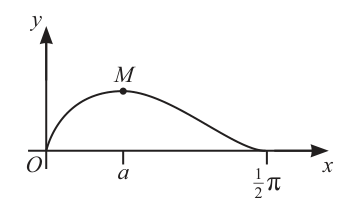
The diagram shows the curve for . The curve has a maximum point at , where .
Approach
Differentiate using the product rule, treating as a composite function. Set the derivative to zero, clear the square root, and use the compound angle identity to reduce the equation to a single trig function before solving within the given domain.
Working
Using the product rule:
Differentiate using the chain rule:
Combining:
At the maximum on , the derivative is zero:
Multiply through by to clear the radical:
Rearranging:
Apply the compound angle identity with and :
In the given range , we have . The only interior zero of in this range is at , so:
Answer
a = π/6
Walkthrough
We want to find where the curve has its maximum on the interval . The standard method is to differentiate and set the derivative to zero, then check that the resulting point is indeed a maximum.
The function is a product of two factors, and , so the product rule is the natural tool. The first factor differentiates directly to . The second factor is a composite: a square root wrapped around the trig function . The chain rule tells us to differentiate the outer function (square root) and then multiply by the derivative of the inner function (). The factor of from the chain rule cancels with the from differentiating the square root, leaving the clean expression .
Setting the derivative to zero gives a single equation containing a square root. Multiplying through by removes the radical and produces a much simpler expression: . This is precisely the form of the compound angle identity , and recognising this is the key step that converts the equation into .
In the domain , the variable lies in . The cosine is zero at within this range, giving . The other zero of cosine in this range, , corresponds to , which is an endpoint where the curve meets the -axis, not the location of the maximum.
Key Takeaways
- The product rule is required whenever a function is expressed as a product of two or more factors.
- The chain rule lets us differentiate composite functions like by working from the outside in.
- Recognising trigonometric identities (here, the compound angle identity) is often the key step that makes the equation tractable.
- Always restrict solutions to the stated domain.
Common Mistakes
- Differentiating only one factor of the product and forgetting the other term.
- Mistakes in the chain rule, such as forgetting the factor of from differentiating .
- Not multiplying through by , leaving an awkward expression that is hard to simplify further.
- Failing to recognise the compound angle identity and being unable to proceed.
- Solving without considering the domain restrictions on .
Things to Be Careful About
- The domain is , so only one value of in the relevant range gives a valid solution.
- must hold on the interval for to be real; this is satisfied in the given range.
- The final answer must be exact and given in radians.
The region enclosed between the -axis and the curve is rotated through radians about the -axis.
Find the exact volume of the solid generated.
Approach
Use the volume of revolution formula between and . Simplify the integrand with the double angle identity , then evaluate by the substitution .
Working
The volume of revolution about the -axis is:
Apply the double angle identity :
Let , so .
Update the limits:
- When : .
- When : .
Substitute:
Integrate:
Answer
V = π/2
Walkthrough
For a region between a curve and the -axis, rotated through about the -axis, the volume of the resulting solid is between the relevant -limits. The curve meets the -axis at and at (where ), so the limits are and .
Squaring gives , so the integral becomes . This looks awkward to integrate directly, but the double angle identity transforms it into , which is a perfect candidate for the substitution .
With and , the integrand becomes . The new limits come from evaluating at the original limits: and . So the integral becomes .
The two minus signs (one from the swapped limits, one from ) cancel, leaving a clean positive integral. Evaluating and multiplying by gives .
Key Takeaways
- The volume of revolution about the -axis is between the curve's -intercepts.
- The double angle identity can turn a difficult integral into a simple substitution.
- When using -substitution on a definite integral, update the limits to the new variable rather than converting back.
- A sign from a negative differential (like ) often cancels with reversed limits.
Common Mistakes
- Forgetting the leading factor of in the volume formula; the mark scheme explicitly allows the first four marks but withholds the final A mark if the is missing throughout.
- Not applying the double angle identity and being unable to integrate directly.
- Forgetting to change the limits of integration when substituting.
- Sign errors when handling the negative differential .
- Miscounting the limits: , not .
Things to Be Careful About
- The factor of is essential — the mark scheme warns that omitting it throughout forfeits the final accuracy mark.
- When the substitution reverses the limits, the negative from and the negative from swapping the limits cancel each other, but students should handle each sign explicitly rather than relying on memory.
- The final answer must be exact, in terms of .