Mathematics 9709/43 — October/November 2024
Cambridge A-Level · Mechanics · worked solutions for every part, with the mark scheme
Topics Energy, Work and Power · Forces and Equilibrium · Newton's Laws of Motion · Kinematics of Motion in a Straight Line · Momentum
An athlete has mass . The athlete runs along a horizontal road against a constant resistance force of magnitude . The total work done by the athlete in increasing his speed from to while running a distance of metres is .
Find the value of .
Approach
Use the work-energy principle. The work done by the athlete is used to increase the kinetic energy and to overcome the constant resistance.
Working
Initial kinetic energy:
Final kinetic energy:
Increase in kinetic energy:
Work done against resistance:
Work-energy equation:
Solve for :
Answer
m = 62
Walkthrough
We are given the total work done by the athlete, which is 1541 J. This work is not all used to speed up: part of it is used to overcome the constant resistance of 24 N over 50 m. So the work-energy equation must include both the increase in kinetic energy and the work done against resistance.
First find the kinetic energy before and after. The kinetic energy formula is . Before the speed increase, , so . After the speed increase, , so . The increase is therefore .
Next, the work done against the constant resistance is force times distance: J.
Now apply the work-energy principle:
So
Subtract 1200 from both sides:
Divide by 5.5:
The athlete's mass is 62 kg.
An alternative method using constant acceleration would give the same result: from , , and then the driving force is , so the work done is , which again gives .
Key Takeaways
- Work done by a force can be split into useful energy change and energy lost to resistance.
- Kinetic energy depends on , so the change in KE is , not .
- Work done against a constant resistance is .
- The work-energy equation is a powerful way to relate forces, distances and speeds without needing time.
Common Mistakes
- Using for the change in kinetic energy. This is incorrect because kinetic energy is proportional to the square of speed, not to the square of the speed change.
- Forgetting to include the 1200 J of work done against resistance, or subtracting it instead of adding it.
- Writing the resistance work with an incorrect mass term, such as .
- Not showing a dimensionally correct work-energy equation; the marks require all four relevant terms.
- Giving an unsupported final answer; the final value should follow from a clearly formed equation.
Things to Be Careful About
- Keep units consistent: mass in kg, speed in m/s, distance in m, work in J.
- The total work done by the athlete is the input energy, so it equals the sum of the useful KE gain and the work against resistance.
- The resistance force acts opposite to motion, so its work is positive in the energy-loss term when we write total work input = useful gain + loss.
- If using the constant-acceleration alternative, make sure the acceleration is obtained from and that the driving force is .
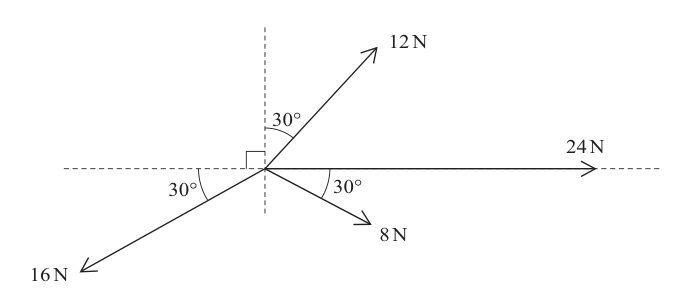
Coplanar forces of magnitudes , , and act at a point in the directions shown in the diagram.
Find the magnitude and direction of the single additional force acting at the same point which will produce equilibrium.
Approach
Set up a coordinate system with the positive -axis to the right and the positive -axis upward, matching the diagram. Resolve each of the four given forces into horizontal and vertical components. For equilibrium, the additional force must be equal in magnitude and opposite in direction to the resultant of the four forces.
Working
Resolving the four forces:
Force 1: at to the positive -axis (first quadrant)
Force 2: along the positive -axis
Force 3: at below the positive -axis (fourth quadrant)
Force 4: at below the negative -axis (third quadrant)
Summing the components:
Total horizontal component:
Total vertical component:
Equilibrium condition:
Let the additional force be . For equilibrium:
Magnitude of :
Direction of :
Since and , the force lies in the second quadrant (above the negative -axis). The angle above the negative -axis is:
Answer
The additional force has magnitude and acts at above the negative -axis (i.e., measured anticlockwise from the positive -axis).
23.1 N at 3.99° above the negative x-axis
Walkthrough
Step 1: Set up a coordinate system.
We choose the positive -axis pointing right and the positive -axis pointing up, matching the dashed axes in the diagram. This gives us a consistent way to assign signs to each component.
Step 2: Resolve each force into components.
Each force is broken into horizontal () and vertical () parts using sine and cosine of the given angle. The key is to use the correct trigonometric ratio for each direction and to assign the correct sign based on which quadrant the force points into.
- The force is from the vertical, so its horizontal component is (positive, pointing right) and its vertical component is (positive, pointing up).
- The force is purely horizontal, so it contributes to and to .
- The force is below the positive -axis, so its horizontal component is (positive) and its vertical component is (negative, pointing down).
- The force is below the negative -axis, so both components are negative: horizontal is and vertical is .
Step 3: Sum the components.
Add all horizontal components together to get the net horizontal force, and do the same for the vertical components. This gives the resultant of the four given forces.
Step 4: Apply the equilibrium condition.
For the system to be in equilibrium, the vector sum of all forces must be zero. The additional force must therefore be equal in magnitude and opposite in direction to the resultant of the four given forces. This means we negate both components of the resultant.
Step 5: Calculate the magnitude.
Use Pythagoras' theorem: . Substitute the numerical values and compute.
Step 6: Determine the direction.
Use to find the acute angle the force makes with the horizontal. Then use the signs of and to place the force in the correct quadrant. Since and , the force is in the second quadrant, so the angle is measured above the negative -axis.
Key Takeaways
- Resolving forces into perpendicular components is the standard method for handling multiple coplanar forces.
- For equilibrium, the equilibrant force is the negative of the resultant: .
- The signs of the components determine the quadrant and must be used carefully when finding the direction angle.
- Using gives the acute angle; the quadrant is determined separately from the component signs.
Common Mistakes
- Using sine and cosine in the wrong places for a force given at an angle to the vertical. If the angle is to the vertical, the horizontal component uses sine and the vertical uses cosine.
- Forgetting the signs of components. Forces in the third and fourth quadrants have negative components that must be included correctly.
- Writing instead of to find the angle. The mark scheme explicitly warns that gives but scores M0A0 because it is the wrong method.
- Not specifying the direction clearly. Simply stating without indicating the reference axis or quadrant loses the final mark.
Things to Be Careful About
- The mark scheme allows a consistent sin/cos mix (e.g., swapping which force uses sin and which uses cos for a given angle) as long as it is applied consistently, but does not accept "forces to the left = forces to the right" without subsequent correction.
- When using or to find , the magnitude must be given to several significant figures; otherwise, the angle will be wrong.
- The angle must not be rounded to alone; the mark scheme allows but not simply .
- Direction can be expressed in multiple equivalent ways: "above the negative -axis", "north of west", from the positive -axis, or a bearing of . Any clear, unambiguous description is acceptable.
A car of mass travels up a slope inclined at an angle of to the horizontal. There is a constant resistance of magnitude acting on the car.
It is given that the car travels at a constant speed of .
Find the power of the engine of the car.
Approach
Since the car moves at constant speed, its acceleration is zero, so the resultant force along the slope is zero. Resolve the weight into a component down the slope, add the resistance, and equate the driving force to the total opposing force. Then use .
Working
Take . The slope is inclined at angle where .
Weight component down the slope:
At constant speed, , so:
Power:
Answer
48640 W
Walkthrough
Start by listing the forces acting on the car along the slope: the engine's driving force acts up the slope, the resistance of acts down the slope, and the component of the car's weight down the slope is . The normal reaction acts perpendicular to the slope and does not affect motion along the slope.
The slope angle is given by , so the weight component is
Because the car travels at constant speed, its acceleration is zero. By Newton's first law, the resultant force along the slope must be zero, so the driving force must balance the resistance plus the weight component:
Finally, power is the rate at which the driving force does work, so
Key Takeaways
This part combines two ideas: equilibrium when acceleration is zero, and the power formula . It also shows the importance of resolving the weight into a component along an inclined plane.
Common Mistakes
- Forgetting the weight component and using only the resistance.
- Using instead of using ; the angle is defined by its sine, so the component is .
- Omitting when calculating the weight component.
- Leaving the answer in watts when the mark scheme also allows kilowatts, but without stating units if using kW.
Things to Be Careful About
Use , as is standard in this syllabus. The expression gives the angle, but you do not need to find the angle itself; you only need . Keep the calculation exact where possible; if you round the power too early, part (b) may be affected.
Find the acceleration of the car when its speed is and the engine is working at of the power found in (a).
Approach
The engine now works at 95% of the power found in part (a). Use to find the new driving force at , then apply Newton's second law along the slope to find the acceleration.
Working
Engine power:
Driving force at :
Newton's second law up the slope:
Simplify the left-hand side:
Therefore:
Answer
0.253 m/s^2
Walkthrough
The engine now supplies only 95% of the power from part (a), so the new power is
At a speed of , the driving force is found from :
Now the car is accelerating, so the forces are not balanced. Apply Newton's second law along the slope, taking the direction up the slope as positive:
Substitute the values:
The left-hand side simplifies to , so
Key Takeaways
This part shows how power, driving force and acceleration are linked. Once the driving force is known from , Newton's second law gives the acceleration. It also reinforces that on an incline the weight component always acts down the slope.
Common Mistakes
- Using the full power from part (a) instead of 95% of it.
- Forgetting the weight component or the resistance when applying Newton's second law.
- Using the wrong speed: the driving force must be calculated at , not at .
- Rounding the power to and then using it in part (b) without following through correctly; the mark scheme allows this only if the subsequent acceleration is consistent.
Things to Be Careful About
The mark scheme allows follow-through from part (a), so use your part (a) power unless told otherwise. Make sure the equation is dimensionally correct: every term must be a force in newtons. The final answer is ; an answer of is not accepted because it is rounded too much. Keep the exact fraction if you want an exact answer.
Two particles, and , of masses and respectively, lie on a smooth horizontal plane. Initially, is at rest and is moving towards with speed . After and collide, moves with speed .
Find the greater of the two possible total losses of kinetic energy due to the collision.
Approach
Use conservation of linear momentum in the direction of 's initial motion. Since the speed of after the collision is , may either continue in the same direction or rebound, so the two possible velocities of are and . For each case, use conservation of momentum to find 's velocity, then calculate the kinetic energy before and after the collision and find the loss. Finally choose the greater loss.
Working
Take the positive direction to be 's initial direction of motion.
Total momentum before the collision:
Case 1: continues in the same direction,
Case 2: rebounds,
So the two possible outcomes are and .
The initial kinetic energy is
For :
For :
The greater of the two possible losses is
Answer
63 J
Walkthrough
The plane is smooth, so no external horizontal force acts during the collision. We can therefore use conservation of linear momentum. However, momentum is a vector, so the direction of after impact matters. We only know 's speed after the collision is . If we choose the positive direction to be the direction in which was originally moving, then the possible velocities of are and .
Start with the total momentum before the collision. is at rest, so the initial momentum is entirely due to :
For the first possibility, continues forwards with . Substituting into momentum conservation gives ; for the second possibility, rebounds with , giving .
Next, kinetic energy. Initially only is moving:
After the collision, both particles may be moving, so add their kinetic energies. Use the squares of their speeds. For the outcome the final KE is , so the loss is . For the outcome the final KE is , so the loss is . The greater loss is therefore .
Key Takeaways
- Momentum is conserved during a collision as long as no external horizontal force acts.
- Momentum is a vector: use signed velocities, not merely speeds, in the momentum equation.
- Kinetic energy is a scalar and uses speed squared, so the direction does not affect the energy formula, but the possible speed values differ.
- When a problem says a particle's speed after collision, the direction may be unknown; consider both directions.
Common Mistakes
- Using for 's velocity and never considering . If both outcomes are found, the mark scheme requires both speeds to be correct and the greater loss to be identified.
- Writing the momentum equation with speeds instead of signed velocities, especially in the rebound case.
- Forgetting that is initially at rest, so its initial momentum is zero.
- Computing the kinetic energy loss as only one particle's change instead of subtracting the total final kinetic energy from the total initial kinetic energy.
- Giving the smaller loss, , as the answer instead of .
Things to Be Careful About
- Clearly state a positive direction before applying momentum conservation.
- In the rebound case, ; omitting the minus sign gives instead of and misses the other possible outcome.
- Kinetic energy after the collision must include both particles: .
- All speeds are in , masses in , so energy is in joules ().
- The marking scheme allows a solution that finds only one possible loss, but if both possible losses are found, both must be correct and the greater loss must be selected.

A particle of mass is going to be pulled across a rough horizontal plane by a light inextensible string. The string is at an angle of above the plane and has tension (see diagram). The coefficient of friction between the particle and the plane is .
Approach
The particle is on the point of moving, so it is in limiting equilibrium. We resolve forces vertically and horizontally, then apply the condition where .
Working
Identify the forces acting on the particle:
- Weight: acting vertically downwards
- Normal reaction: acting vertically upwards
- Tension: acting at above the horizontal
- Friction: acting horizontally opposite to the direction of motion
Resolve vertically (upwards positive):
Resolve horizontally (in the direction of impending motion):
Apply the limiting friction condition :
Answer
T = 53.8 N
Walkthrough
The particle is on the point of moving, which means it is in limiting equilibrium. At this point, the friction force is at its maximum value and equals .
Step 1: Identify all forces. The particle experiences four forces: its weight acting downward, the normal reaction from the plane acting upward, the tension in the string at above the horizontal, and the friction force acting horizontally opposing the impending motion. The diagram shows the tension pulling at above the horizontal plane.
Step 2: Resolve vertically. Taking upward as positive, the upward forces are and the vertical component of tension . The downward force is the weight (using ). Since there is no vertical acceleration:
This gives . Note that the vertical component of tension reduces the normal reaction because it lifts the particle slightly off the plane.
Step 3: Resolve horizontally. The horizontal component of tension is , and this is balanced by friction since the particle is in equilibrium:
Step 4: Apply the limiting friction condition. At the point of moving, . Substituting the expressions from Steps 2 and 3:
Step 5: Solve for . Expand and collect terms:
Key Takeaways
- When a particle is on the point of moving, friction is at its maximum: .
- Resolving forces in two perpendicular directions gives two equations that can be solved simultaneously.
- A tension at an angle to the horizontal has both a horizontal component (driving motion) and a vertical component (reducing the normal reaction and hence friction).
Common Mistakes
- Forgetting that the vertical component of tension reduces the normal reaction: writing instead of .
- Using when the mark scheme expects (common in Cambridge papers).
- Resolving incorrectly by mixing up and for the angle.
- Not showing enough working to eliminate or before stating the final answer.
Things to Be Careful About
- The particle is on the point of moving, not moving yet. This means acceleration is zero and (limiting friction), not .
- Always use unless otherwise stated in Cambridge A-Level questions.
- The normal reaction is not simply when there is a vertical component of an applied force. Here, .
- Ensure the final answer is given to an appropriate number of significant figures (3 sf here gives ).
Approach
The particle is now accelerating at . We apply Newton's second law horizontally, while still resolving vertically to find . The friction is still at its limiting value since the particle is moving.
Working
Resolve vertically (same as part (a)):
Apply Newton's second law horizontally:
The resultant horizontal force equals mass times acceleration:
Substitute and :
Answer
T = 55.9 N
Walkthrough
In part (b), the particle is no longer in equilibrium — it is accelerating at . This means we must use Newton's second law () rather than the equilibrium condition.
Step 1: Resolve vertically. The vertical situation is unchanged from part (a). There is still no vertical acceleration, so:
Step 2: Apply Newton's second law horizontally. The horizontal forces are the driving component (forward) and friction (backward). The resultant equals :
Step 3: Substitute the friction expression. Since the particle is moving, friction is at its limiting value . Substituting :
Step 4: Form and solve the equation. Substitute into the N2L equation:
Key Takeaways
- When a particle is accelerating, use instead of equilibrium equations.
- The vertical resolution (finding ) is often the same as in the equilibrium case, even when horizontal motion is accelerating.
- The friction force is still when the particle is moving (kinetic friction at limiting value).
- The tension must be larger than in part (a) because it must both overcome friction and provide the net force for acceleration.
Common Mistakes
- Using the equilibrium condition instead of .
- Using the value of from part (a) in part (b) — each part must be solved independently.
- Forgetting that the vertical component of tension still reduces the normal reaction.
- Sign errors when subtracting friction from the driving force.
Things to Be Careful About
- The particle is accelerating, so . This is the key difference from part (a).
- Do not use from part (a); the tension is different because the particle is now accelerating.
- The friction is still because the particle is moving across the rough surface.
- The answer is larger than in part (a) (), which makes physical sense: more tension is needed to accelerate the particle.
A particle moves in a straight line. It starts from rest, at time , and accelerates at for , reaching a speed of . The particle then travels at for , and finally slows down, with constant deceleration, stopping after a further .
Approach
The acceleration is given as a function of time. Integrate with respect to to find the velocity function, using the initial condition that the particle starts from rest. Then substitute to find .
Working
Given , integrate to find :
Since the particle starts from rest at , when , so . Thus, .
At , the velocity is :
Answer
4.8
Walkthrough
We are given the acceleration . Velocity is the integral of acceleration with respect to time. Integrating gives . Since the particle starts from rest at , the constant of integration is zero. To find the speed reached at , we simply substitute into the velocity equation, giving .
Key Takeaways
Velocity is the integral of acceleration. Initial conditions determine the constant of integration.
Common Mistakes
Using with instead of integrating the time-dependent acceleration. Forgetting that acceleration is , not a constant .
Things to Be Careful About
Ensure that is actually substituted into the expression, not just stated. The mark scheme explicitly forbids using with .
Approach
The motion consists of three distinct phases. We sketch the velocity-time graph by identifying the shape and key coordinates for each phase.
Working
Phase 1 ():
The velocity is . This is a quadratic curve starting at and ending at , with increasing gradient.
Phase 2 ():
The particle travels at constant speed . This is a horizontal line from to .
Phase 3 ():
The particle decelerates uniformly to rest. This is a straight line from to .
Answer
A velocity-time graph with a quadratic curve from to , a horizontal line from to , and a straight line from to .
Graph with quadratic from (0,0) to (4, 4.8), horizontal line to (15, 4.8), straight line to (20, 0)
Walkthrough
The motion is divided into three time intervals. From to , velocity is , which is a parabola opening upwards starting at the origin. From to , velocity is constant at , giving a horizontal line. From to , the particle stops with constant deceleration, giving a straight line with negative slope from to .
Key Takeaways
A velocity-time graph visually represents motion phases. Quadratic velocity gives a curved graph; constant velocity gives a horizontal line; constant acceleration gives a straight line.
Common Mistakes
Drawing the first phase as a straight line instead of a curve. Forgetting to label the key coordinates , , and .
Things to Be Careful About
The graph does not need to be to scale, but the shape must be correct. The first section must be a curve with increasing gradient (convex), not a straight line.
Approach
For , the particle undergoes constant deceleration. Find the acceleration using the gradient of the velocity-time graph, then use to find the velocity expression.
Working
The velocity changes from at to at .
The acceleration is:
Using where at :
Answer
v = 19.2 - 0.96t
Walkthrough
In the third phase (), the velocity-time graph is a straight line, meaning acceleration is constant. We calculate this acceleration as the gradient of the line: . Then we use the equation . Since the phase starts at with , we write . Expanding this gives .
Key Takeaways
The gradient of a velocity-time graph gives acceleration. The suvat equation can be applied from any starting time by using .
Common Mistakes
Using directly without adjusting for the start time . Forgetting the negative sign for deceleration.
Things to Be Careful About
The expression is valid only for . If you use , remember that must be the time elapsed since , so use .
Approach
The total distance is the area under the velocity-time graph. We calculate the area for each of the three phases separately and sum them.
Working
Phase 1 ():
Distance is the integral of velocity:
Phase 2 ():
Distance is the area of a rectangle:
Phase 3 ():
Distance is the area of a triangle:
Total distance:
Answer
71.2
Walkthrough
Distance travelled is the area under the velocity-time graph. We split this into three parts corresponding to the three phases of motion. For the first phase, we integrate the velocity function from to , giving evaluated from 0 to 4, which is m. For the second phase, the graph is a rectangle with height and width , giving m. For the third phase, the graph is a triangle with base and height , giving m. Adding these gives m.
Key Takeaways
Distance is the area under a velocity-time graph. For curved sections, integration is required. For straight-line sections, geometric area formulas (rectangle, triangle, trapezium) can be used.
Common Mistakes
Using for the first phase instead of integrating. Forgetting to add the distances from all three phases. Miscalculating the width of the rectangle or triangle.
Things to Be Careful About
Ensure limits of integration are correct. The mark scheme notes that using for the first phase scores 0 marks. You can also calculate the total area using a trapezium for the last two phases: , then add to get .
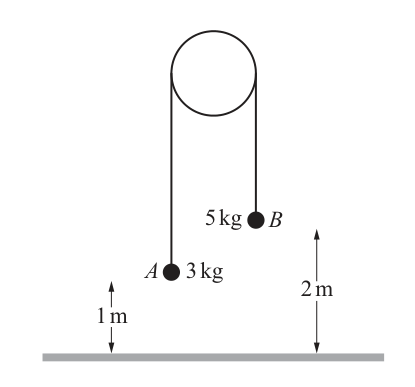
Two particles, and , of masses and respectively, are connected by a light inextensible string that passes over a fixed smooth pulley. The particles are held with the string taut and its straight parts vertical. Particle is above a horizontal plane, and particle is above the plane (see diagram). The particles are released from rest. In the subsequent motion, does not reach the pulley, and after reaches the plane it remains in contact with the plane.
Approach
Since particle B (5 kg) is heavier than particle A (3 kg), B accelerates downward and A accelerates upward with the same magnitude of acceleration . Apply Newton's second law to each particle to find and the tension . Then use suvat equations to find the time for B to travel 2 m from rest.
Working
Newton's second law for each particle:
For A (moving upward, mass 3 kg):
For B (moving downward, mass 5 kg):
Finding acceleration:
Adding the two equations to eliminate :
Finding tension:
Substituting into the equation for A:
Finding time for B to reach the plane:
Particle B starts from rest (), travels m with acceleration m/s². Using :
Answer
Tension N, time s
T = 37.5 N, t = 2√10/5 ≈ 1.26 s
Walkthrough
Step 1: Determine the direction of motion.
Particle B has mass 5 kg and particle A has mass 3 kg. Since B is heavier, when released from rest, B will accelerate downward and A will accelerate upward. The string is inextensible, so both particles have the same magnitude of acceleration .
Step 2: Apply Newton's second law to each particle.
For particle A moving upward, the forces are tension upward and weight downward. Taking upward as positive:
For particle B moving downward, the forces are weight downward and tension upward. Taking downward as positive:
Step 3: Solve for acceleration.
Adding the two equations eliminates :
Step 4: Solve for tension.
Substituting into :
Step 5: Find the time for B to reach the plane.
B starts from rest and must travel 2 m. Using with , , :
Key Takeaways
- For connected particles over a smooth pulley, apply Newton's second law to each particle separately, choosing the positive direction as the direction of motion for each.
- The tension is the same throughout a light inextensible string over a smooth pulley.
- Once acceleration is found, suvat equations can be used to find time, velocity, or displacement.
Common Mistakes
- Taking the wrong sign for acceleration in the equations of motion (must be consistent: positive direction is the direction of motion for each particle).
- Forgetting that the string is inextensible, so both particles have the same magnitude of acceleration.
- Using the wrong displacement for B (it is 2 m, not 1 m).
- Not showing enough working to earn method marks — the mark scheme requires seeing the equations and the attempt to solve for and .
Things to Be Careful About
- Use m/s² as is standard in Cambridge A-Level unless otherwise stated.
- The mark scheme allows an alternative energy method: using to find , then to find . Both methods are acceptable.
- If a candidate finds without simplifying, they only get the final A mark if they attempt to evaluate it; alone scores A0.
Approach
When B reaches the plane, A has risen 2 m (to height 3 m) and the string becomes slack. After this, A moves upward under gravity alone with . Find the velocity of A when the string goes slack using suvat, then use suvat again to find the two times when A is at height 3.25 m. The time at least 3.25 m is the difference between these times.
Working
Velocity of A when the string goes slack:
A has risen m from rest with m/s². Using :
At this moment, A is at height m above the plane.
Motion of A after the string goes slack:
A continues upward under gravity alone with m/s². We need A to be at least 3.25 m above the plane, i.e., rise m above its current height of 3 m.
Using with , , :
Solving the quadratic:
Using the quadratic formula:
The two solutions are:
Time at least 3.25 m above the plane:
Answer
Time = s s
√5/5 ≈ 0.447 s
Walkthrough
Step 1: Understand what happens when B reaches the plane.
When B hits the plane, it stops. Since the string is inextensible, the string goes slack — there is no longer any tension. Particle A, which was rising, continues upward but now only under the influence of gravity (no tension pulling it up).
At the moment B hits the plane, A has risen 2 m (same distance B fell), so A is at height m above the plane.
Step 2: Find the velocity of A when the string goes slack.
During the first phase of motion, A accelerated at m/s² from rest over m. Using :
Step 3: Set up the equation for A's motion after the string goes slack.
After the string goes slack, A moves under gravity alone: m/s² (upward is positive). We want to find when A is at height 3.25 m, i.e., when it has risen m from its current height of 3 m.
Using :
Rearranging:
Step 4: Solve the quadratic.
s (A reaches 3.25 m on the way up)
s (A reaches 3.25 m on the way down)
Step 5: Find the time interval.
Key Takeaways
- When a connected particle system has one particle hit a surface, the string may go slack and the other particle continues under gravity alone.
- Always identify the change in physical situation and adjust the equations of motion accordingly.
- A quadratic from suvat gives two times: one on the way up and one on the way down. The time at or above a height is the difference.
Common Mistakes
- Forgetting that the string goes slack when B hits the plane and continuing to use m/s² throughout.
- Using the wrong displacement: A needs to rise only 0.25 m above 3 m, not 3.25 m from the ground.
- Making sign errors with m/s².
- Not solving the quadratic correctly or not finding both roots.
Things to Be Careful About
- The mark scheme provides alternative methods: finding the maximum height (3.5 m) and computing the time from 0.25 m below the top, or using energy methods. All are acceptable.
- When using energy: PE gain = KE loss gives , yielding at height 3.25 m, then gives , doubled for the round trip.
- Do not allow sign errors in energy equations.
- The final answer can also be written as or s.