Mathematics 9709/42 — October/November 2024
Cambridge A-Level · Mechanics · worked solutions for every part, with the mark scheme
Topics Kinematics of Motion in a Straight Line · Energy, Work and Power · Newton's Laws of Motion · Forces and Equilibrium · Momentum
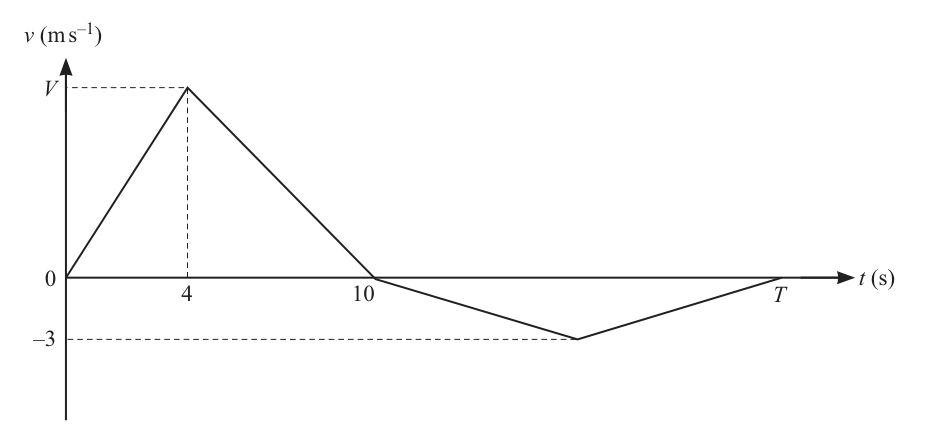
The velocity of a particle moving in a straight line at time seconds after leaving a fixed point is . The diagram shows a velocity-time graph which models the motion of the particle from to . The graph consists of four straight line segments. The particle accelerates from rest to a speed of over a period of , and then decelerates at to instantaneous rest over a period of . The particle then travels back towards , reaching a maximum speed of before coming to rest at time .
Approach
The particle decelerates from speed to rest over a period of 6 seconds (from to ) with a deceleration of . We can use the constant acceleration formula or the fact that acceleration is the gradient of the velocity-time graph.
Working
The time interval for deceleration is seconds.
Initial velocity , final velocity , acceleration .
Using :
Alternatively, using the gradient of the line from to :
Answer
10
Walkthrough
The problem gives a velocity-time graph with a deceleration phase from to . During this phase, the particle goes from speed to in 6 seconds, with a known deceleration of . We apply the constant acceleration formula , where , , , and . Solving this simple linear equation gives . Alternatively, the gradient of the velocity-time graph represents acceleration, so , which also yields .
Key Takeaways
- The gradient of a velocity-time graph gives the acceleration.
- The suvat equations can be applied to any phase of motion with constant acceleration.
Common Mistakes
- Forgetting that deceleration means negative acceleration, leading to and giving .
- Using the wrong time interval, e.g., using instead of .
Things to Be Careful About
- Ensure the time elapsed is calculated correctly as s, not s.
- The sign of acceleration must be negative since it is deceleration.
Given that the total distance travelled by the particle from to is , find the value of .
Approach
The total distance travelled is the total area under the velocity-time graph (treating all areas as positive, since distance is the integral of speed ). We calculate the area for the first 10 seconds, then add the area for the remaining time from to , and set the sum equal to 68 m.
Working
Distance in the first 10 seconds:
The graph forms a triangle with base 10 and height .
Distance from to :
The graph forms a triangle below the -axis with base and height .
Total distance:
Answer
22
Walkthrough
The total distance travelled is the total area under the velocity-time graph, treating all areas as positive because distance is the integral of speed (the magnitude of velocity). The graph from to is a triangle above the axis with base 10 and height , giving an area of m. From to , the graph is a triangle below the axis with base and height 3 (since the maximum speed in this direction is ). The area of this triangle is . Adding these two areas and setting the sum to 68 m gives the equation . Solving this linear equation yields .
Key Takeaways
- Distance is the total area under a velocity-time graph, regardless of whether the velocity is positive or negative.
- Areas below the time axis contribute positively to distance but negatively to displacement.
Common Mistakes
- Treating the area below the -axis as negative and subtracting it from the first area, which would calculate displacement instead of distance.
- Assuming the triangle from to is isosceles without justification, which may not match the given maximum speed of .
- Assuming the particle returns to , which would mean displacement is zero, leading to an incorrect equation.
Things to Be Careful About
- Always use the magnitude of velocity (speed) when calculating distance from a velocity-time graph.
- Ensure the base of the second triangle is correctly identified as rather than .
A block of mass is held at rest at the top of a plane inclined at to the horizontal. The block is projected with speed down a line of greatest slope of the plane. There is a resistance force acting on the block. As the block moves down the plane from its point of projection, the work done against this resistance force is .
Find the speed of the block when it has moved down the plane.
Approach
Use the work-energy principle. The block loses gravitational potential energy as it moves down the plane, gains kinetic energy, and the resistance removes of mechanical energy. Equate the increase in kinetic energy to the loss in gravitational potential energy minus the work done against the resistance. Take .
Working
Vertical drop after moving down the plane is
Loss in gravitational potential energy:
Initial kinetic energy:
Let the final speed be . Final kinetic energy:
Work-energy equation:
Solve for :
Since speed is positive,
Answer
6.32 m s^-1 (or sqrt(40) m s^-1)
Walkthrough
The block moves along the plane, but gravitational potential energy depends on the vertical height lost. Moving down a plane inclined at gives a vertical drop
The potential energy lost by the block is its weight times this vertical drop, so
At the start the kinetic energy is
At the end, with unknown speed , it is
The work-energy principle states that the increase in kinetic energy equals the net work done on the block. Gravity does work equal to the loss in potential energy, , while the resistance does of work. Therefore
This gives , so and, because speed is positive,
Key Takeaways
- The work-energy principle connects changes in kinetic energy to work done by forces and changes in gravitational potential energy.
- Gravitational potential energy depends only on vertical displacement, not distance along an incline.
- When work is done against a resistance, that energy is removed from the mechanical energy of the system.
- The final speed is found from an energy balance, avoiding the need to know the actual resistance force.
Common Mistakes
- Using the whole distance as the vertical height instead of .
- Writing the change in kinetic energy as ; the correct change is .
- Adding the of work done against resistance instead of subtracting it.
- Omitting one of the four energy terms in the equation.
- Using the initial speed as or giving the final answer as a negative speed.
Things to Be Careful About
- Adopt one consistent sign convention. Here the block descends, so potential energy is lost and contributes positively to the kinetic energy gain.
- Use as is standard in this syllabus.
- The mark scheme requires the potential energy term to include the component of displacement vertically, so must use the vertical drop.
- The answer may be given as , , or ; it should not be left as .
A cyclist is riding along a straight horizontal road. The total mass of the cyclist and his bicycle is . The power exerted by the cyclist is . At an instant when the cyclist's speed is , his acceleration is .
Approach
Use to find the driving force from the power and speed, then apply Newton's second law along the road to relate driving force, resistance and acceleration.
Working
The driving (pedalling) force is
Taking the direction of motion as positive, the resultant force is , where is the resistance. Newton's second law gives:
So
Answer
41 N
Walkthrough
Start by finding the driving force. Since power is the rate of doing work and, for a constant force moving in the direction of motion, , the driving force is .
Next, apply Newton's second law. The cyclist is accelerating at , so the resultant force on the cyclist must be . The driving force pushes forward and the resistance acts backward, so . Solving gives .
Key Takeaways
This part combines the power relation with Newton's second law. It shows that when an object accelerates, the resultant force is not zero; the driving force must overcome the resistance and still provide the acceleration.
Common Mistakes
- Using instead of .
- Forgetting the acceleration term and writing .
- Using the mass as the force directly, e.g. writing instead of .
- Sign errors: putting both forces on the same side without a consistent positive direction.
Things to Be Careful About
Choose a positive direction (forward) and keep it consistent. The resistance opposes motion, so it must be subtracted from the driving force. The mark scheme allows sign errors in the equation, but the final resistance must be positive. Also, the driving force found from must be used, not the power value itself.
The cyclist comes to the bottom of a hill inclined at to the horizontal.
Given that the power and resistance to motion are unchanged, find the steady speed which the cyclist could maintain when riding up the hill.
Approach
At steady speed up the hill the acceleration is zero, so the resultant force along the slope is zero. Express the driving force as , add the resistance and the component of weight down the slope, then solve for .
Working
Using , the component of the weight down the slope is
The driving force up the slope is
For steady speed, the resultant force along the slope is zero:
So
Answer
3.45 m s^-1
Walkthrough
At steady speed up the hill, acceleration is zero, so the resultant force along the slope is zero. The power is unchanged, so the driving force up the slope is .
Down the slope there are two forces: the constant resistance and the component of the weight acting down the slope, . Using , this component is .
For steady speed, the driving force must balance the total force down the slope:
Therefore
Key Takeaways
Steady speed means zero acceleration, hence zero resultant force. On an incline, only the component of weight parallel to the slope matters, . The power relation links the driving force to the speed.
Common Mistakes
- Using the full weight instead of its component .
- Using instead of .
- Forgetting to include the resistance .
- Setting acceleration equal to something other than zero; steady speed means .
- Using instead of ; the mark scheme expects .
Things to Be Careful About
The mark scheme requires a component of weight, not the mass. It allows a sin/cos mix in the equation but the correct component is . Use the value of from part (a). Keep the final answer to 3 significant figures: .
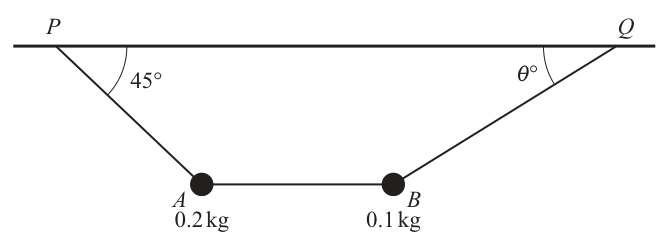
The diagram shows two particles, and , of masses and respectively. The particles are suspended below a horizontal ceiling by two strings, and , attached to fixed points and on the ceiling. The particles are connected by a horizontal string, . Angle and . Each string is light and inextensible. The particles are in equilibrium.
Approach
Focus on particle and apply the equilibrium condition. Resolve the forces acting on horizontally and vertically to eliminate the unknown tension and solve for .
Working
The forces acting on particle are:
- Its weight acting vertically downwards.
- The tension in the horizontal string acting to the right.
- The tension in the string acting at above the horizontal to the left.
Resolving vertically at :
Resolving horizontally at :
Divide the vertical equation by the horizontal equation to eliminate :
Using and :
Answer
2 N
Walkthrough
First, isolate particle and identify all forces acting on it. There are three forces: the weight pulling straight down, the tension pulling horizontally to the right along string , and the tension pulling up and to the left along string at an angle of to the ceiling.
Because the particle is in equilibrium, the net force in both the horizontal and vertical directions must be zero. We resolve the forces vertically to get an equation involving and the weight, and horizontally to get an equation involving and . By dividing the vertical equation by the horizontal equation, the unknown cancels out, leaving a direct relationship between and the known weight. Substituting and gives .
Key Takeaways
- When a particle is in equilibrium, the sum of forces in any direction is zero. Resolving horizontally and vertically is the standard approach.
- Dividing two resolved equations is a powerful technique to eliminate an unknown tension or normal reaction.
- Always check which direction each force acts before writing the equations; signs matter.
Common Mistakes
- Using the wrong trigonometric ratio (e.g., using for the horizontal component instead of ). Remember that the angle is with the horizontal ceiling, so the horizontal component of uses and the vertical uses .
- Forgetting that is used in this syllabus unless otherwise stated, leading to instead of .
- Assuming ; the tensions in different strings are generally not equal.
Things to Be Careful About
- The angle is given between the string and the horizontal ceiling . This means it is also the angle between and the horizontal, making the horizontal component and the vertical component.
- The mark scheme accepts condoning directly from , but showing the resolution steps is safer to earn method marks.
Approach
Focus on particle and apply the equilibrium condition. Resolve the forces acting on horizontally and vertically to find and .
Working
The forces acting on particle are:
- Its weight acting vertically downwards.
- The tension in the horizontal string acting to the left.
- The tension in the string acting at angle above the horizontal to the right.
Resolving vertically at :
Resolving horizontally at :
Using , the vertical equation becomes:
Divide the vertical equation by the horizontal equation to eliminate :
To find , square both resolved equations and add them:
Answer
θ = 26.6°, T_BQ = √5 N (or 2.24 N)
Walkthrough
Isolate particle and identify the three forces acting on it: its weight downwards, the known tension pulling to the left, and the unknown tension pulling up and to the right at angle to the horizontal.
Apply the equilibrium condition by resolving vertically and horizontally. Vertically, the upward component of must balance the weight: . Horizontally, the rightward component of must balance : .
Dividing the vertical equation by the horizontal gives , from which . To find , square both equations and add them, using the identity , yielding , so .
Key Takeaways
- When two unknowns remain after resolving forces, divide the equations to find an angle, or square and add them to find the resultant magnitude.
- The tension in the connecting string is the same on both sides; it pulls particle to the left with .
- Pythagorean theorem applies directly to the resolved components of a single tension force.
Common Mistakes
- Assuming ; the tensions are different because the angles and weights are different.
- Using the wrong angle for the components of . The angle is with the horizontal, so the horizontal component is and the vertical is .
- Forgetting to use , which gives instead of .
- Not providing both values for and as required by the question.
Things to Be Careful About
- The mark scheme allows alternative methods such as resolving parallel and perpendicular to , using a triangle of forces, or applying Lami's theorem. All must yield the same final values.
- When using Lami's theorem at , the angles between the forces are (between weight and ), (between and ), and (between and weight).
- Always carry forward the correct value of from part (a); using an incorrect value will cascade errors.
Two particles, and , of masses and respectively, are held at rest in the same vertical line. The heights of and above horizontal ground are and respectively. is projected vertically upwards with speed . At the same instant, is released from rest.
Approach
Take upward as positive. Write the displacement of each particle from its own starting height using . At the collision the particles are at the same height, so equate their heights. Then use to find the velocities just before impact.
Working
Let upward be positive and take .
For , starting height , , :
For , starting height , , :
At collision the heights are equal:
Velocities just before collision:
Speeds are the magnitudes of these velocities:
Answer
Speed of = ; speed of = .
Speed of P = 3 m s^-1; speed of Q = 5 m s^-1
Walkthrough
We need the speeds just before the particles collide. The most reliable way is to write down where each particle is at time and find the time when those positions are the same.
Choose upward as positive. starts above the ground with initial velocity , so its displacement from its starting point is . starts above the ground and is dropped from rest, so its displacement from its starting point is (negative because it moves downward).
At the collision, the height of above the ground, , equals the height of above the ground, . Substituting gives . The quadratic terms cancel, leaving , so .
Now use for each particle. For , . For , . The negative signs mean both are moving downward. Speeds are positive magnitudes, so the speeds are and .
Key Takeaways
- Use to describe position when acceleration is constant.
- At a collision, the particles are at the same position, so equate their heights.
- Velocity is a vector: a negative answer means downward. Speed is the magnitude and is always positive.
Common Mistakes
- Using the wrong sign for : if upward is positive, is in the acceleration.
- Forgetting the initial heights when equating positions, e.g. writing instead of .
- Giving and as speeds instead of taking magnitudes.
- Using for ; is projected upwards with .
Things to Be Careful About
- The collision time is found from positions, not from velocities.
- The quadratic terms in cancel because both particles have the same acceleration .
- If the mark scheme asks for speeds, final answers must be positive.
It is given that immediately after the collision the downward speed of is .
Find the speed of at the instant that it reaches the ground.
Approach
Use conservation of linear momentum during the collision to find the velocity of immediately after impact. Then find the height of at the collision from part (a), and use to find its speed when it reaches the ground.
Working
Take downward as positive for the collision.
Before impact:
- : mass , speed downward, momentum .
- : mass , speed downward, momentum .
After impact, has downward speed , so its momentum is . Let have downward velocity after impact.
Conservation of momentum:
Height of at the collision:
So is above the ground.
Now falls with initial downward speed and acceleration downward:
Answer
Speed of when it reaches the ground = .
5.39 m s^-1 (exact sqrt(465)/4)
Walkthrough
First use momentum conservation. Choose downward as positive. Before the collision both particles are moving downward, so their momenta are and . After the collision still moves downward at , so its momentum is . Let 's downward velocity after the collision be . Conservation of momentum gives , so and downward.
Next find where is when the collision happens. From part (a), at , . Since started above the ground, it is now above the ground.
Finally, travels downward to the ground with initial speed and acceleration downward. Using :
So .
Key Takeaways
- Momentum is conserved in a direct collision between two particles, provided no external impulse acts during the collision.
- Momentum is a vector; choose a positive direction and apply it consistently.
- After a collision, a particle may continue with a new velocity; use suvat equations from the new position and new velocity.
Common Mistakes
- Using or in the momentum equation instead of the speeds just before impact from part (a).
- Forgetting 's momentum after the collision.
- Using the wrong height for at the collision, e.g. or instead of .
- Taking 's velocity after the collision as upward when conservation of momentum gives it downward.
- Using in the final suvat calculation; already has speed downward after the collision.
Things to Be Careful About
- The height at collision can be found from either particle; both give .
- In the final fall, downward is positive, so and .
- The exact answer is ; the mark scheme accepts AWRT .
A particle, , travels in a straight line, starting from a point with velocity . The acceleration of at time after leaving is , where
Approach
Integrate the acceleration for to obtain the velocity, then use the initial condition when to find the constant of integration. Finally substitute .
Working
For ,
Use when :
So
At :
Answer
5 m s^-1
Walkthrough
The acceleration is the rate of change of velocity, so to go from acceleration to velocity we integrate with respect to time. Integrating gives because increasing the power by 1 gives and multiplying by the reciprocal of the new power, , cancels the . The constant is found from the fact that the particle starts at with velocity when . Substituting then gives the required velocity.
Key Takeaways
- Integration of acceleration produces velocity.
- The initial condition fixes the arbitrary constant.
- Evaluating at a specific time completes the problem.
Common Mistakes
- Forgetting the constant of integration.
- Using instead of integrating; the mark scheme awards no method mark for this.
- Incorrectly integrating : the new power is and the coefficient becomes .
Things to Be Careful About
- The initial condition is at , not at .
- Keep the expression for for the correct interval; this part only uses .
Given that there is no change in the velocity of when , find an expression for the velocity of for .
Approach
Integrate the acceleration expression valid for . Use the fact that the velocity is continuous at : the value from part (a), , must also be obtained by the new expression when . This determines the new constant.
Working
For ,
Since there is no change in velocity at , when :
So
Therefore, for ,
Answer
v = t^(3/2) - 6 t^(1/2) + 10
Walkthrough
For the acceleration changes, so we integrate the new expression. The antiderivative of is , and the antiderivative of is . Because the velocity does not change at , the new expression must give when . Substituting and gives , so .
Key Takeaways
- A piecewise acceleration needs a separate velocity expression for each interval.
- Continuity of velocity at the boundary determines the new constant of integration.
Common Mistakes
- Using a velocity other than at .
- Forgetting the constant of integration.
- Wrong antiderivative of : it becomes , so becomes .
Things to Be Careful About
- The phrase no change in velocity means the two velocity expressions agree at .
- Use the exact value from part (a), not a rounded or invented value.
Given that the velocity of is positive for , find the total distance travelled between and .
Approach
Since the velocity is positive for , the particle never reverses direction, so the total distance is the total displacement. Integrate the velocity expression piecewise: use on and on . Add the two displacements.
Working
For :
For :
At :
At :
So
Total distance:
Answer
20 m
Walkthrough
The particle moves in a straight line and its velocity is stated to be positive up to , so it never turns back. Therefore distance travelled equals displacement. We integrate each velocity expression over its interval. The first displacement uses limits and ; the second uses limits and . Finally add the two positive displacements.
Key Takeaways
- When velocity keeps one sign, distance equals displacement.
- Piecewise-defined velocity requires integrating each piece separately.
- Definite integrals with correct limits give displacements for each interval.
Common Mistakes
- Using instead of integrating; the mark scheme awards no method mark for this.
- Not increasing powers or not changing coefficients when integrating.
- Using incorrect limits, such as to for the whole motion without splitting at .
- Forgetting to add the two displacements.
- If a displacement expression has an incorrect constant of integration, the final answer is not awarded even if m is seen.
Things to Be Careful About
- Use only on .
- Use only on .
- Evaluate at and at , then subtract.
- The two displacements are and , giving total m.
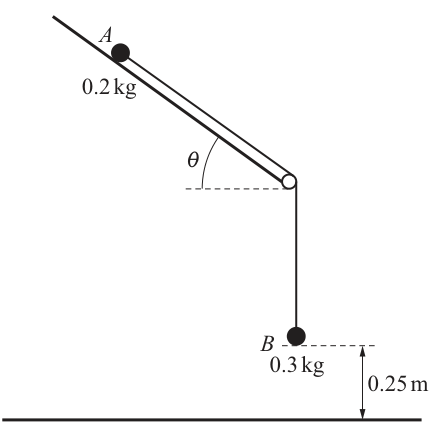
Two particles, and , of masses and respectively, are attached to the ends of a light inextensible string. The string passes over a small fixed smooth pulley which is attached to the bottom of a rough plane inclined at an angle to the horizontal where . Particle lies on the plane, and particle hangs vertically below the pulley, above horizontal ground. The string between and the pulley is parallel to a line of greatest slope of the plane (see diagram). The coefficient of friction between and the plane is . Particle is released from rest.
Approach
Resolve the forces acting on particle perpendicular and parallel to the inclined plane to find the normal reaction and the limiting friction . Then apply Newton's second law to both particles to form a system of equations in the tension and acceleration . Solve these simultaneously.
Working
For particle , resolve perpendicular to the plane:
Given , we have . Using :
The limiting friction is:
Apply Newton's second law to particle (moving downwards):
Apply Newton's second law to particle (moving down the plane):
Add equations (1) and (2):
Substitute into equation (1) to find :
Answer
Tension = 1.56 N, acceleration = 4.8 m s^-2
Walkthrough
First, we resolve the forces on particle perpendicular to the inclined plane to find the normal reaction force . Since , we know . Using , we calculate . Next, we use the coefficient of friction to find the limiting friction .
Then, we apply Newton's second law () to both particles. For particle , which moves vertically downwards, the net force is its weight minus the tension: . For particle , which moves down the plane, the net force is the tension plus the component of its weight down the plane, minus the friction opposing the motion: . Substituting the known values gives two simultaneous equations in and . Adding these equations eliminates , allowing us to solve for . Substituting this back into the equation for gives the tension .
Key Takeaways
- Resolving forces perpendicular to an inclined plane is essential for finding the normal reaction and friction.
- Connected particles over a smooth pulley share the same magnitude of acceleration and tension.
- Newton's second law must be applied separately to each particle, taking care with the direction of the net force for each.
Common Mistakes
- Forgetting to include the component of weight down the plane for particle in the equation of motion.
- Using the wrong value for or mixing up and .
- Sign errors when setting up the equations of motion (e.g., adding friction instead of subtracting it).
Things to Be Careful About
- Ensure is used as implied by the mark scheme values.
- Friction always opposes the direction of motion; since moves down the plane, friction acts up the plane.
- The tension is the same throughout the string because the pulley is smooth and the string is light and inextensible.
When reaches the ground, it comes to rest.
Find the total distance that travels down the plane from when it is released until it comes to rest. You may assume that does not reach the pulley.
Approach
The motion of particle occurs in two stages. In the first stage, both particles accelerate together until hits the ground. Use to find the velocity of at this point. In the second stage, the string becomes slack, so tension is zero. Calculate the new acceleration of using Newton's second law, then use again to find the additional distance travels before coming to rest.
Working
Stage 1: Both particles move together
Particle falls a distance with initial velocity and acceleration . Find the velocity when hits the ground:
Stage 2: Particle decelerates after the string goes slack
When hits the ground, the string becomes slack, so the tension . Particle continues to move down the plane but is now decelerating due to friction and the component of weight acting up the plane (relative to its motion).
Apply Newton's second law to (taking down the plane as positive):
Now use to find the additional distance traveled by before coming to rest ():
Total distance
The total distance travels down the plane is the sum of the distances in both stages:
Answer
0.65 m
Walkthrough
The problem involves two distinct phases of motion. In the first phase, particles and are connected and accelerate together. Particle falls , so we use the constant acceleration formula with , , and to find . This is the square of the velocity of particle at the moment hits the ground.
In the second phase, is at rest, so the string goes slack and the tension drops to zero. Particle is still moving down the plane, but now the only forces acting along the plane are the component of its weight () pulling it down and the friction () opposing the motion. The net force is , giving a deceleration of . We use again, with final velocity , initial , and , to find the additional distance .
Adding the two distances gives the total distance traveled by : .
Key Takeaways
- When a connected system is broken (e.g., a string goes slack), the motion must be analyzed in separate stages.
- The velocity at the end of the first stage becomes the initial velocity for the second stage.
- Always re-evaluate the forces and acceleration for each stage, as the tension may change or disappear.
Common Mistakes
- Assuming the acceleration remains after hits the ground.
- Forgetting to add the distance traveled during the first stage to the distance traveled during the second stage.
- Sign errors when calculating the new acceleration (e.g., getting instead of ).
Things to Be Careful About
- Ensure you use the correct initial velocity for the second stage; it is the velocity reached at the end of the first stage.
- The acceleration in the second stage is negative (deceleration) because friction is greater than the component of weight down the plane.
- The question asks for the total distance, not just the distance after the string goes slack.