Mathematics 9709/41 — October/November 2024
Cambridge A-Level · Mechanics · worked solutions for every part, with the mark scheme
Topics Kinematics of Motion in a Straight Line · Newton's Laws of Motion · Energy, Work and Power · Forces and Equilibrium · Momentum
Two particles, of masses and , are connected by a light inextensible string that passes over a fixed smooth pulley. The particles hang vertically. The system is released from rest.
Find the magnitude of the acceleration of the particles and find the tension in the string.
Approach
The string is light and inextensible and the pulley is smooth, so the tension has the same magnitude throughout and both particles have the same acceleration . Choose the positive direction for the particle upwards and for the particle downwards. Apply Newton's second law to each particle, then eliminate by adding the equations.
Working
For the particle, resultant force upwards:
For the particle, resultant force downwards:
Add the equations to eliminate :
Using :
Substitute into :
Answer
a = 2 m s^-2, T = 14.4 N
Walkthrough
Start by identifying the forces on each particle. Each particle has its weight acting vertically downwards and the tension in the string acting vertically upwards. Since the string is light and inextensible and the pulley is smooth, the tension has the same magnitude throughout and the two particles have the same acceleration . The heavier particle moves downwards, so the lighter particle moves upwards.
For the particle, taking upwards as positive, the resultant force is . Newton's second law gives:
For the particle, taking downwards as positive, the resultant force is , so:
Adding the equations cancels and gives:
With , this gives . Substituting back into the first equation gives .
Key Takeaways
This question tests the standard method for connected particles over a smooth pulley: use a light inextensible string to justify equal tension, use the same acceleration for both particles, apply Newton's second law separately to each particle, and eliminate the tension by adding the equations. It also uses the relation weight .
Common Mistakes
- Getting a sign wrong in one of the two equations. The mark scheme allows sign errors in the first method mark, but the final equations must be correct for the accuracy mark.
- Taking different positive directions without being consistent, which can make the accelerations appear to have opposite signs.
- Forgetting the weight term and writing only .
- Assuming because the particles are hanging; this is only true at equilibrium, not when the system is accelerating.
- Finding but not substituting back to find .
Things to Be Careful About
- Use as expected by the mark scheme. If you use , you will get and , which would not match the expected answers.
- Give the correct units: acceleration in and tension in newtons.
- Show the two Newton's second law equations clearly; the mark scheme requires them for the method and accuracy marks.
- The heavier particle moves down and the lighter particle moves up, so both accelerations have the same magnitude but opposite directions in the physical sense.
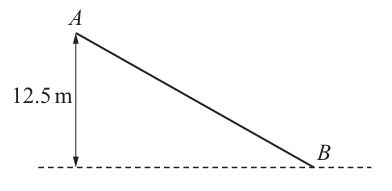
A particle of mass , starting from rest at , slides down an inclined plane . The point is metres vertically below the level of , as shown in the diagram.
Given that the plane is smooth, use an energy method to find the speed of the particle at .
Approach
Use the principle of conservation of mechanical energy. Since the plane is smooth (no friction), the gravitational potential energy lost by the particle as it descends equals the kinetic energy gained.
Working
The particle starts from rest at A, so the initial kinetic energy is zero. The vertical drop from A to B is m.
Gravitational potential energy lost:
Kinetic energy at B:
By conservation of energy (PE lost = KE gained):
Divide both sides by :
Answer
v = 15.8 m s⁻¹
Walkthrough
The particle starts from rest at A and slides down a smooth inclined plane to B. Since the plane is smooth, there is no friction, so mechanical energy is conserved. The particle loses gravitational potential energy as it descends m vertically, and this energy is entirely converted into kinetic energy.
Step 1: Calculate the gravitational potential energy lost. Using , where kg, m s (the standard value used in this syllabus), and m, we get J.
Step 2: Express the kinetic energy at B in terms of the unknown speed . .
Step 3: Equate PE lost to KE gained (conservation of energy) and solve for . This gives , so m s.
Key Takeaways
- Conservation of mechanical energy applies when there is no friction or other non-conservative forces.
- The vertical height, not the distance along the incline, determines the change in gravitational potential energy.
- Starting from rest means initial kinetic energy is zero.
Common Mistakes
- Using the distance along the incline ( m) instead of the vertical height ( m) when calculating potential energy.
- Forgetting that the particle starts from rest, so initial KE is zero.
- Not showing the energy equation explicitly; the mark scheme requires the PE and KE expressions to be shown.
Things to Be Careful About
- Use m s as is standard in this syllabus unless otherwise stated.
- The answer is exact; is the 3-significant-figure decimal approximation.
- The mark scheme awards B0 for correct answer with no working, so all steps must be shown.
It is given instead that the plane is rough and the particle reaches with a speed of . The plane is long and the constant frictional force has magnitude .
Find the value of .
Approach
Use the work-energy principle. The gravitational potential energy lost equals the kinetic energy gained plus the work done against friction. The frictional force acts over the full length of the plane ( m).
Working
Gravitational potential energy lost (same as part (a)):
Kinetic energy at B (speed is now m s):
Work done against friction (frictional force acts over distance m along the plane):
By the work-energy principle (PE lost = KE gained + work done against friction):
Answer
F = 27.9 N
Walkthrough
The plane is now rough, so friction does negative work on the particle. The energy equation becomes: gravitational potential energy lost = kinetic energy gained + work done against friction.
Step 1: Calculate the gravitational potential energy lost. This is the same as in part (a): J.
Step 2: Calculate the kinetic energy at B with the new speed m s: J.
Step 3: Express the work done against friction. The frictional force acts along the plane over the full length of m, so .
Step 4: Set up the energy equation: , then solve for to get N.
An alternative approach uses Newton's second law: first find the acceleration using to get m s, then apply where , giving , which also yields N.
Key Takeaways
- When friction is present, mechanical energy is not conserved; the work done against friction must be accounted for.
- The work done by friction is , where is the distance along the surface over which the friction acts.
- The work-energy principle provides a direct route without needing to find acceleration or the angle of the incline.
Common Mistakes
- Using the vertical height ( m) instead of the distance along the plane ( m) when calculating work done by friction.
- Forgetting that the particle starts from rest, so initial KE is zero.
- Not showing the complete energy equation with all three terms; the mark scheme requires the attempt at a three-term equation.
Things to Be Careful About
- Use m s as is standard in this syllabus.
- The frictional force acts along the plane, so the distance used in is the length of the plane ( m), not the vertical drop.
- The mark scheme allows sign errors in the energy equation but requires the equation to be dimensionally correct with three terms.
- The final answer N is exact to 3 significant figures.
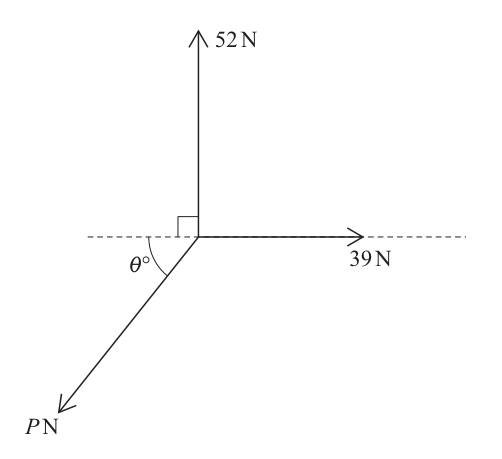
Coplanar forces of magnitudes , and act at a point in the directions shown in the diagram. The system is in equilibrium.
Find the values of and .
Approach
Since the system is in equilibrium, the vector sum of all forces must be zero. Resolve the forces horizontally and vertically to obtain two equations in and .
Working
Resolve horizontally (taking right as positive):
Resolve vertically (taking upwards as positive):
Square both equations and add, using :
Divide the vertical equation by the horizontal equation:
Answer
P = 65, θ = 53.1°
Walkthrough
The problem states that three coplanar forces act at a point and the system is in equilibrium. Equilibrium means the net force is zero, so the sum of forces in any direction must be zero. We choose to resolve along the horizontal and vertical axes since the given forces (52 N upwards and 39 N rightwards) are already aligned with these axes.
Step 1: Resolve horizontally. The 39 N force acts to the right (positive direction). The force acts downwards and to the left, making an angle with the negative horizontal axis. Its horizontal component is acting to the left (negative direction). Setting the sum of horizontal forces to zero:
Step 2: Resolve vertically. The 52 N force acts upwards (positive direction). The force has a vertical component acting downwards (negative direction). Setting the sum of vertical forces to zero:
Step 3: Find . Square both equations and add them. The identity eliminates :
Step 4: Find . Divide the vertical equation by the horizontal equation to eliminate :
Key Takeaways
- When a system of forces is in equilibrium, the resultant force is zero in every direction.
- Resolving forces along perpendicular axes gives independent equations that can be solved simultaneously.
- Squaring and adding resolved equations exploits the identity to find the magnitude of an unknown force.
- Dividing resolved equations eliminates the magnitude and allows finding the direction angle.
Common Mistakes
- Forgetting that acts in the third quadrant (down and left), so both its horizontal and vertical components must balance the given forces. Writing or without adjusting the angle definition.
- Not squaring both terms when computing ; e.g., computing instead of .
- Using or but then computing the wrong angle (e.g., confusing and results).
- Not showing the method of resolving forces; the mark scheme requires a method mark (M1) for resolving in any direction to get an equation.
Things to Be Careful About
- The angle is defined between the force and the negative horizontal axis, so is the horizontal component and is the vertical component. Ensure the angle definition matches the components used.
- The mark scheme allows mix only for the M1 mark; both resolved equations must be correct for the A1 mark.
- Round to 1 decimal place as (the exact value is ). Using too many or too few decimal places may lose accuracy marks.
- Always verify that and given the geometry of the diagram.
A bus travels between two stops, and . The bus starts from rest at and accelerates at a constant rate of until it reaches a speed of . It then travels at this constant speed before decelerating at a constant rate of , coming to rest at . The total time for the journey is .
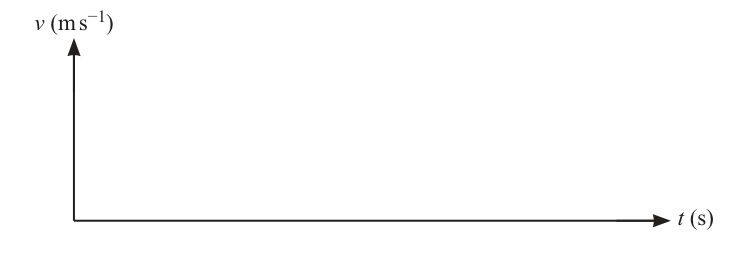
Approach
The journey consists of three distinct phases: acceleration from rest to a maximum speed, travel at constant maximum speed, and deceleration to rest. The velocity-time graph will reflect these phases as a trapezium.
Working
The graph starts at the origin . It rises linearly with a positive gradient to the point . It then remains horizontal at until time . Finally, it decreases linearly with a negative gradient to the point on the -axis.
Answer
Sketch of a trapezium starting at , rising to , horizontal, then falling to .
Trapezium-shaped velocity-time graph from (0,0) to (240,0) with maximum velocity 16 m/s.
Walkthrough
The problem describes a bus journey with three stages: constant acceleration, constant velocity, and constant deceleration. On a velocity-time graph, constant acceleration is represented by a straight line with a positive gradient, constant velocity by a horizontal line, and constant deceleration by a straight line with a negative gradient. Since the bus starts from rest and ends at rest, the graph must start and finish on the -axis. The maximum velocity reached is , so the horizontal section is at height . The total time is , so the graph ends at .
Key Takeaways
A velocity-time graph for an object accelerating, moving at constant speed, and then decelerating forms a trapezium (or triangle if there is no constant speed phase). The gradient of the graph represents acceleration, and the area under the graph represents displacement.
Common Mistakes
- Drawing a curve instead of straight lines for constant acceleration/deceleration.
- Forgetting to start at the origin or end at on the -axis.
- Not labelling the maximum velocity value () on the vertical axis.
Things to Be Careful About
The question asks for a sketch, so exact values for the time intervals are not required, but the overall shape (trapezium) and key values (, ) must be correct.
Find an expression, in terms of , for the length of time that the bus is travelling with constant speed.
Approach
Find the time taken for the acceleration phase and the deceleration phase using . Subtract these from the total time () to find the time spent at constant speed.
Working
Phase 1: Acceleration
Initial velocity , final velocity , acceleration .
Phase 3: Deceleration
Initial velocity , final velocity , acceleration .
Phase 2: Constant Speed
Let be the time at constant speed. The total time is .
Answer
240 - 16/a - 64/(3a)
Walkthrough
We need to find the duration of the constant speed phase. We know the total time is 240 s. We can find the time for the other two phases using the kinematic equation .
For the acceleration phase, the bus goes from rest () to with acceleration . So , giving .
For the deceleration phase, the bus goes from to rest () with acceleration (negative because it is decelerating). So . Solving for : .
The time at constant speed is the total time minus the times for the other two phases: .
Key Takeaways
The equation is useful for finding time when velocities and acceleration are known. When decelerating, the acceleration is negative in the equation.
Common Mistakes
- Forgetting that deceleration means negative acceleration in the formula.
- Algebraic errors when simplifying .
- Not expressing the final answer purely in terms of .
Things to Be Careful About
Ensure the expression for is correctly formed by subtracting both and from 240. The mark scheme allows unsimplified forms like .
Approach
The distance travelled is equal to the area under the velocity-time graph. The graph is a trapezium with parallel sides of length and , and height . Set this area equal to and solve for using the expression for from part (b).
Working
Area under graph (distance)
The area of the trapezium is:
Given that the distance is :
Substitute T from part (b)
From part (b), . Equating the two expressions for :
Solve for a
Find a common denominator for the left side:
Simplify by dividing numerator and denominator by 7:
Answer
16/45
Walkthrough
The total distance is the area under the velocity-time graph. The graph is a trapezium with parallel horizontal sides. The top side has length (the time at constant speed) and the bottom side has length (the total time). The height is (the maximum velocity).
Area = . Solving this gives , so .
Now use the expression for from part (b): . Rearranging gives . Combining the fractions on the left: . Solving for : , so .
Key Takeaways
The area under a velocity-time graph represents displacement. For a trapezium, use the formula where and are the lengths of the parallel sides.
Common Mistakes
- Using the wrong formula for the area of a trapezium (e.g., forgetting the ).
- Algebraic errors when combining fractions like .
- Simplifying incorrectly (both are divisible by 7).
Things to Be Careful About
Ensure you use the expression for derived in part (b). The mark scheme allows alternative methods such as summing the areas of the two triangles and the rectangle, which leads to the same equation.
A particle, , is projected vertically upwards from a point with a speed of . One second later a second particle, , with the same mass as , is projected vertically upwards from with a speed of . At time after the first particle is projected, the two particles collide and coalesce to form a particle .
Approach
Both particles start from and collide when their displacements from are equal. Take upwards as positive, so the acceleration is . Since is projected second after , at time after 's projection particle has been moving for seconds.
Working
For particle :
For particle , using time :
At collision, :
Expand and simplify:
Answer
T = 3.5 s
Walkthrough
We want the time when both particles are at the same height. Particle is projected at ; particle is projected one second later, so when the clock reads , particle has only been moving for seconds. Take upwards as positive, so the acceleration is . Using , write the displacement of each particle from . Because both start at , they collide exactly when these displacements are equal. Equating the two expressions makes the terms cancel, leaving a linear equation in . Solving gives .
Key Takeaways
- A launch delay means the times of flight are different: if one starts s later, its time is .
- Collision from the same point means equal displacements from that point.
- The suvat equation is the key tool.
Common Mistakes
- Using the same time for both particles.
- Forgetting that acceleration is negative for upward motion.
- Expanding incorrectly.
- Not showing both displacement equations before equating, which loses marks.
Things to Be Careful About
- The mark scheme awards the first method mark for at least one correct use of with or and .
- For the final answer, this is an answer-given question, so all working must be clean and lead exactly to .
- Use so that .
Approach
Use the displacement equation for at the collision time found in part (a). Alternatively, use with time .
Working
Using particle :
The height above is .
Answer
218.75 m
Walkthrough
We already know the collision happens at s after is projected. Substitute this value into the displacement equation for : . This gives m. Alternatively, use with time s; the result is the same.
Key Takeaways
- Once a time is known, the suvat displacement formula gives the position directly.
- Either particle can be used to find the collision height.
Common Mistakes
- Arithmetic slips such as being miscomputed.
- Using for instead of .
- Forgetting the factor in the acceleration term.
Things to Be Careful About
- The mark scheme allows either or .
- Include units: metres.
Approach
First find the velocities of and just before the collision using . Then apply conservation of linear momentum to the coalescing particles to find the speed of immediately after collision. Finally, use for moving from the collision height back to , and add the collision time .
Working
Just before collision:
Both velocities are upwards. Let each particle have mass . Conservation of momentum during coalescence:
So starts from height with upward speed . Taking upwards as positive, its displacement when it returns to is :
Rearrange:
Divide by :
Using the quadratic formula:
The positive root is . This is the time from collision until returns to . Total time from 's projection:
Answer
18.4 s
Walkthrough
First find each particle's velocity just before the collision. For , ; for , . Using gives and m/s upwards. Since the particles coalesce, momentum is conserved in the direct impact. With equal masses , total momentum before is , and after is , so m/s.
Now is at height m moving upwards at m/s. To return to , its displacement from the collision point is m. Use with , , . This gives a quadratic in . Solve it and take the positive root, which is the time from collision to return. Finally add the s before the collision to get the total time from 's projection.
Key Takeaways
- Momentum is conserved when two particles coalesce, but the combined mass must be used after the collision.
- The velocity just before collision comes from .
- After the collision, the motion is again governed by constant acceleration formulae.
Common Mistakes
- Using instead of .
- Forgetting to multiply by the combined mass after collision.
- Using instead of for the displacement back to .
- Forgetting to add the s collision time to the return time.
- Taking the negative root of the quadratic.
Things to Be Careful About
- The mark scheme's first method mark is for using with or only.
- The momentum mark requires three non-zero terms; if the total before is wrong, show where both terms came from.
- The final equation must use the height from part (b) and the speed found from momentum.
- Final answer should be rounded to s.
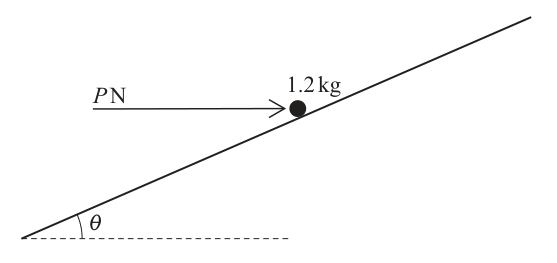
A particle of mass is placed on a rough plane which is inclined at an angle to the horizontal, where . The particle is kept in equilibrium by a horizontal force of magnitude acting in a vertical plane containing a line of greatest slope (see diagram). The coefficient of friction between the particle and the plane is .
Find the least possible value of .
Approach
To find the least possible value of , we assume the particle is in limiting equilibrium and is on the verge of sliding down the plane. This means the frictional force acts up the plane and is at its maximum value, . We resolve the forces perpendicular and parallel to the inclined plane to form two equations, then substitute to solve for . We use .
Working
Given , we can find :
The forces acting on the particle are:
- Weight acting vertically downwards.
- Horizontal force acting horizontally towards the right.
- Normal reaction acting perpendicular to the plane.
- Friction acting up the plane (since is at its minimum, the particle tends to slide down).
Resolve perpendicular to the plane:
Resolve parallel to the plane (taking up the plane as positive):
Since the particle is in limiting equilibrium, use :
Answer
1.63
Walkthrough
First, we determine from the given using the Pythagorean identity, yielding . We assume , which gives the weight .
To find the least value of , the particle must be on the verge of sliding down the plane. Therefore, the frictional force acts up the plane and is at its maximum limiting value, .
We resolve forces perpendicular to the plane. The normal reaction balances the components of both the weight and the horizontal force that push into the plane: . Substituting the values gives .
Next, we resolve forces parallel to the plane. The forces acting up the plane are the horizontal force component and the friction . The force acting down the plane is the weight component . Setting these equal gives , which simplifies to .
Finally, we substitute the expressions for and into the limiting friction equation . This gives . Expanding and collecting terms in yields , so .
Key Takeaways
- When asked for the least force to maintain equilibrium on an incline, friction acts up the slope to prevent sliding down.
- A horizontal force has components both parallel () and perpendicular () to an inclined plane.
- Resolving forces in two perpendicular directions (parallel and perpendicular to the plane) is the standard method for inclined plane equilibrium problems.
Common Mistakes
- Assuming friction acts down the plane (this would give the maximum value of ).
- Forgetting that the horizontal force contributes to the normal reaction via its component perpendicular to the plane.
- Using instead of (Cambridge A-Level typically uses unless specified, and the mark scheme confirms , which requires ).
Things to Be Careful About
- Ensure you correctly identify the direction of friction based on whether you are finding the minimum or maximum force.
- Keep track of which components of and act into the plane versus along the plane.
- The mark scheme allows or the exact fraction ; rounding to 3 significant figures is appropriate here.
A car has mass . When the car is travelling at a speed of , there is a resistive force of magnitude . The maximum power of the car's engine is .
The car travels along a straight level road.
Approach
The car's maximum power is used just to overcome resistance at the greatest constant speed. Because the speed is constant, the driving force equals the resistive force , so
Convert the engine power to watts and set it equal to .
Working
At maximum constant speed:
Answer
k = 40
Walkthrough
At its greatest constant speed, the car is not accelerating, so the driving force from the engine exactly balances the resistive force. The resistance is , and at constant speed . The power developed by the engine is , so . Substitute the maximum power W and to obtain . Since , divide to find . This completes the required proof.
Because this is a 'show that' question, simply quoting is not enough; the working above demonstrates the result.
Key Takeaways
- At constant speed on a level road, resultant force is zero and driving force equals resistance.
- Engine power is the product of driving force and speed: .
- When resistance is proportional to speed, , the maximum constant speed satisfies .
- Units must be consistent: kilowatts must be converted to watts.
Common Mistakes
- Forgetting to convert kW into W.
- Writing instead of .
- Substituting the value of without showing any method, which is not valid for an 'AG' (answer given) question.
Things to Be Careful About
- The resistive force has magnitude , not or ; the square appears only when computing the power .
- The maximum speed occurs when the engine is working at maximum power and the car has zero acceleration.
- Keep the units in watts throughout, so that comes out in appropriate units.
Approach
At speed , the greatest driving force is obtained by using the maximum engine power, . The resistance is . The net force is , and this equals .
Working
Newton's second law:
Answer
a = 31/150 m s^-2 (≈ 0.207 m s^-2)
Walkthrough
At the instant the speed is m s, the greatest possible driving force is obtained by using all of the engine's maximum power. Since , , so N. The resistance at this speed is N. The car is on a level road, so the only horizontal forces are the forward driving force and the backward resistance. The net force is N. Newton's second law gives , so and m s, about m s.
Key Takeaways
- At maximum power, the driving force at a given speed is .
- Newton's second law must be applied to the resultant force, not to the driving force alone.
- Resistive force is speed-dependent, so its magnitude changes at every speed.
Common Mistakes
- Using the engine power as the driving force without dividing by speed ( instead of ).
- Finding with only the driving force and omitting the resistance.
- Incorrectly computing the resistive force, e.g. instead of .
- Sign errors in the net force equation.
Things to Be Careful About
- In the marking scheme, the Newton's second law step should have three terms: driving force minus resistance equals ; it must be dimensionally correct, and sign errors are allowed only in the working, not in the final answer.
- The answer should be positive because the car is accelerating forward.
- Keep the speed in m s and force in newtons; then is in m s.
The car now travels at a constant speed up a hill inclined at an angle of to the horizontal.
Find the greatest possible speed of the car going up the hill.
Approach
At constant speed up the hill there is no acceleration, so the driving force must balance both the resistive force and the component of the weight down the slope, . Here . The maximum power condition gives , producing a quadratic equation in .
Working
Taking ,
Using maximum power:
Divide by :
Using the quadratic formula and taking the positive root:
Answer
v = 30.5 m s^-1 (30.51179...)
Walkthrough
On the hill, the weight has a component down the slope. If , then , so the component of weight down the slope is N (using m s). Because the car travels up the hill at a constant speed, its acceleration is zero, so the driving force must balance the sum of the resistance and this weight component: . At maximum power, , so . Expanding gives , or . Dividing by gives . The quadratic formula gives one positive and one negative root; speed must be positive, so m s to 3 significant figures.
Key Takeaways
- On an incline, resolve weight into components parallel and perpendicular to the slope; the parallel component is .
- Constant speed means zero acceleration, so the resultant force along the slope is zero.
- At maximum power, , and setting this up often leads to a quadratic equation.
- Only the positive root is physically meaningful for a speed.
Common Mistakes
- Using instead of for the component down the slope.
- Forgetting the weight component entirely, giving .
- Missing the factor when multiplying the driving force by speed; writing instead of .
- Discarding or ignoring the negative quadratic root without comment; the positive root must be selected.
- Using when the question and mark scheme use ; this changes the numerical answer.
Things to Be Careful About
- The marking scheme allows sign errors and even a sin/cos mix in the first force-balance mark, provided the expression is dimensionally correct; however, for the final answer the correct component must be used.
- Convert kW to W before substituting into the power equation.
- The quadratic root should be rounded appropriately: the exact value is , so m s is correct to 3 significant figures.
- Keep the units consistent so that the speed is in m s.
A particle moves in a straight line, passing through a point with velocity . At time after passes , the acceleration, , of is given by .
Find the distance travels between the times at which it is at instantaneous rest.
Approach
Integrate the acceleration to obtain an expression for velocity. Use the initial condition to find the constant. Set velocity to zero to find the two times at which the particle is instantaneously at rest. Integrate velocity to obtain displacement. The distance travelled between those two times is the magnitude of the displacement between them, since the velocity is negative throughout that interval.
Working
Integrate with respect to :
At , , so :
At instantaneous rest, :
Multiply by 10:
Divide by 3:
Factorise:
So the particle is at rest at:
For , , so the particle moves in one direction only between these times. The distance travelled is therefore the magnitude of the displacement from to .
Integrate to find displacement :
Since when , :
At :
At :
Distance travelled:
Answer
6.25 m
Walkthrough
We are told the acceleration is a function of time, not constant, so the constant-acceleration suvat equations cannot be used. Instead, use calculus.
First integrate acceleration to get velocity:
The particle passes O with velocity at , so substitute , to find .
Instantaneous rest means . Solve:
Multiplying by 10 and dividing by 3 gives , which factorises as . So the particle is at rest at and .
Between and , is negative, so the particle does not change direction in this interval. Therefore the distance travelled equals the magnitude of the displacement from to .
Integrate velocity to obtain displacement:
Since at , . Then evaluate and . The displacement from to is , so the distance is metres.
Key Takeaways
This question tests the link between acceleration, velocity and displacement through integration, and the difference between displacement and distance. It also requires solving a quadratic to find the times when velocity is zero. A key idea is that when velocity does not change sign over an interval, distance is the absolute value of displacement.
Common Mistakes
- Using suvat equations: the acceleration is not constant, so suvat cannot be applied.
- Forgetting the constant of integration and not using the initial condition at .
- Solving instead of for instantaneous rest.
- Quoting the displacement as the distance without taking the absolute value.
- Not showing the integration method. The mark scheme allows at most SC B1 for an unsupported correct answer of 6.25, so method marks are essential.
- Using the wrong order of limits or evaluating at and instead of and .
Things to Be Careful About
- Instantaneous rest means , not .
- The velocity is negative between and , so the displacement is negative; distance is the magnitude.
- When integrating , the constant term is zero because at , but if a constant were included it would cancel when subtracting from .
- Keep units consistent: the final distance is in metres.
- For method marks, integration attempts must show the power increased by 1 and the coefficient changed in at least one term; unsupported answers cannot earn full marks.
- The mark scheme requires a three-term cubic for when using the final method mark; ensure the expression contains , and terms.