Mathematics 9709/33 — October/November 2024
Cambridge A-Level · Pure Mathematics 3 · worked solutions for every part, with the mark scheme
Topics Trigonometry · Complex Numbers · Differentiation · Algebra · Integration · Numerical Solution of Equations · +3 more
The complex number satisfies and .
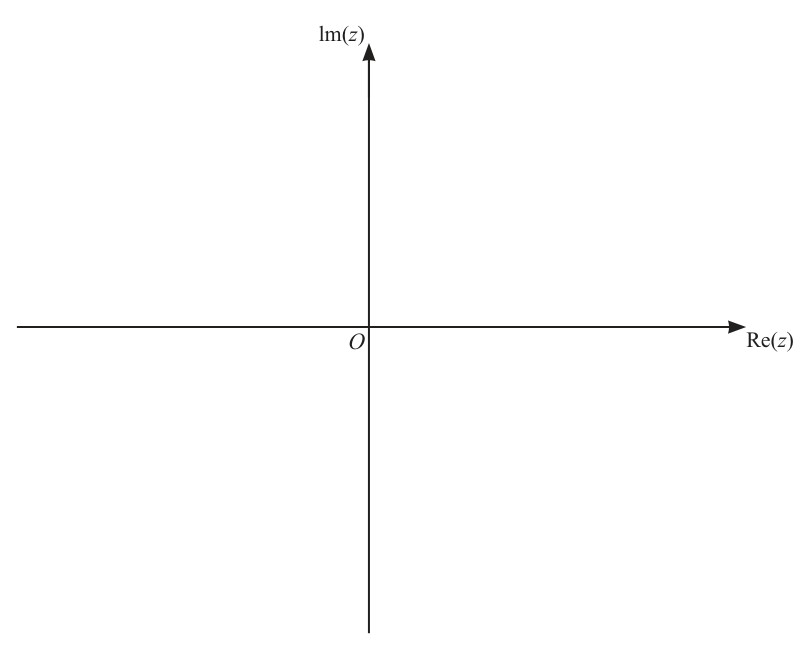
Approach
The condition represents a circle of radius 2 centred at the origin. The condition restricts this locus to a sector between the positive real axis and the line at angle in the first quadrant.
Working
- is an arc of a circle centred at the origin with radius 2.
- restricts the locus to the sector from the positive real axis to the line in the first quadrant.
- Sketch this arc on the Argand diagram, marking on the real axis and indicating the angle .
Answer
See diagram for part (a).
Arc of circle centred at origin with radius 2, between arg 0 and arg pi/4
Walkthrough
First, we interpret the modulus condition. The equation means the distance from the origin to the point is always 2. On an Argand diagram, this is a circle of radius 2 centred at the origin.
Next, we interpret the argument condition. The inequality means the angle that the line from the origin to makes with the positive real axis is between 0 and radians (0° to 45°). This restricts our circle to a specific sector in the first quadrant.
We combine these two conditions to draw an arc of radius 2 starting from the point on the real axis and ending at the point on the line .
Key Takeaways
- The modulus represents a circle of radius centred at the origin.
- The argument represents a sector between two rays from the origin.
- Combining these gives an arc or sector on the Argand diagram.
Common Mistakes
- Forgetting to restrict the circle to the correct sector based on the argument condition.
- Drawing the arc with the wrong radius.
- Not marking the key points or angles clearly on the diagram.
Things to Be Careful About
- Ensure the scales on the real and imaginary axes are approximately equal.
- The angle is 45°, so the upper boundary of the sector should be at a 45° angle to the real axis.
- Dashes can replace numbers on the axes, and arcs don't have to be perfectly circular as long as the intention is clear.
Approach
If , then by De Moivre's theorem, . We apply this to the locus of found in part (a) to find the locus of .
Working
- For , we have and .
- For , the modulus is . This is an arc of a circle centred at the origin with radius 4.
- The argument is . Since , we have .
- Sketch this larger arc on the same Argand diagram, marking on the real axis and on the imaginary axis.
Answer
See diagram for part (b).
Arc of circle centred at origin with radius 4, between arg 0 and arg pi/2
Walkthrough
We use the polar form of complex numbers to understand the geometric effect of squaring. If has modulus and argument , then has modulus and argument .
From part (a), the locus of is an arc of a circle with radius and angles between and .
When we square :
- The new modulus is . So the locus of lies on a circle of radius 4.
- The new argument is . Since , multiplying by 2 gives . This means the locus spans from the positive real axis to the positive imaginary axis (the first quadrant).
We draw an arc of radius 4 from the point to the point on the imaginary axis.
Key Takeaways
- Squaring a complex number squares its modulus and doubles its argument.
- This transforms a sector of angle into a sector of angle and radius .
- De Moivre's theorem provides a quick way to find the modulus and argument of powers of complex numbers.
Common Mistakes
- Forgetting to square the modulus (using 2 instead of 4).
- Forgetting to double the argument (using instead of ).
- Drawing the arc in the wrong quadrant.
Things to Be Careful About
- Ensure the scales on the axes are consistent with part (a) so the diagram is accurate.
- Mark the key points and to clearly show the radius of the new arc.
- The upper boundary of the sector for is the positive imaginary axis, corresponding to .
Let .
Show that if a sequence of values given by the iterative formula
converges, then it converges to a root of the equation .
Approach
Suppose the sequence converges to a limit . Then both and tend to , so we can replace them by in the iterative formula and rearrange to obtain .
Working
Let as . Then also, so
Squaring both sides:
Multiply by :
Expanding:
Rearranging:
Since , this is . Therefore the limit of the sequence is a root of .
Answer
If the sequence converges to , then , so the sequence converges to a root of .
If the sequence converges to L, then f(L) = 0.
Walkthrough
When an iterative sequence converges to a limit , the values get closer and closer to . Since is just the next term in the same sequence, it also tends to . Therefore, in the limit, the formula becomes . Here , so we set equal to that expression. Squaring removes the square root; multiplying by the denominator and rearranging gives the cubic , which is exactly . This proves that any convergent limit of the iteration must be a root of the original equation.
Key Takeaways
- A convergent iteration must converge to a fixed point .
- Rearranging the fixed-point equation can recover the original equation whose root is being approximated.
- This is why the iterative formula is a valid way to find roots of .
Common Mistakes
- Forgetting to square both sides when removing the square root.
- Stopping at without rearranging to the required cubic form.
- Assuming convergence without noting that the argument only applies if the sequence converges.
Things to Be Careful About
- The denominator must be nonzero; the squaring step is valid for real where the square root is defined.
- The question says "if ... converges", so no proof of convergence is required; only the limiting rearrangement is needed.
- Use the same variable throughout, or consistently use and .
The equation has a root close to 1.2.
Use the iterative formula from part (a) and an initial value of 1.2 to determine the root correct to 2 decimal places. Give the result of each iteration to 4 decimal places.
Approach
Use the given iterative formula with , record each value to 4 decimal places, and confirm the root by checking a sign change in the interval .
Working
With :
Continuing the iteration:
| 0 | 1.2000 |
| 1 | 1.2403 |
| 2 | 1.2601 |
| 3 | 1.2700 |
| 4 | 1.2752 |
| 5 | 1.2778 |
| 6 | 1.2792 |
The successive values are increasing and approaching a limit. To confirm the root to 2 decimal places, check the sign of on the interval :
There is a sign change, so the root lies between and . Hence, correct to 2 decimal places, the root is .
Answer
x = 1.28
Walkthrough
We start with . Substitute into to get . Then use to get , and so on. Each value is rounded to 4 decimal places as requested. The values increase: 1.2000, 1.2403, 1.2601, 1.2700, 1.2752, 1.2778, 1.2792. They appear to be settling near 1.28. To be certain the root rounds to 1.28, we check and ; the sign change shows the root is in , so every number in this interval rounds to 1.28 to 2 decimal places.
Key Takeaways
- Iterative formulas produce a sequence of improving approximations.
- Rounding intermediate results to the requested number of decimal places is part of the method.
- A sign change over an interval whose endpoints both round to the same 2-dp value confirms the root's rounded value.
Common Mistakes
- Using the wrong initial value or substituting into instead of the iterative formula.
- Not showing enough iterations to justify the final rounded answer.
- Rounding every intermediate value to 2 decimal places instead of 4.
- Forgetting to check a sign change; an unsupported final answer may not earn full marks.
Things to Be Careful About
- The formula requires careful use of brackets: is the whole denominator.
- Keep at least 4 decimal places during the iteration; premature rounding can shift the final digit.
- The root is just above 1.28, so values below it such as 1.2792 still round to 1.28; the sign change justifies the rounding.
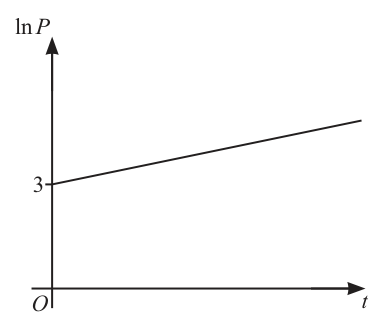
The number of bacteria in a population, , at time hours is modelled by the equation , where and are constants. The graph of against , shown in the diagram, has gradient and intersects the vertical axis at .
Approach
Take the natural logarithm of both sides of to linearise the equation, then read off the gradient and y-intercept from the given graph of against .
Working
Taking the natural logarithm of both sides:
Using the logarithm law :
Since :
This is a straight line of the form with and independent variable . The gradient is and the y-intercept is .
From the graph, the gradient is , so:
The line intersects the vertical axis at , so the y-intercept is :
Solving for :
Evaluating:
Rounding to 2 significant figures:
Answer
and
k = 1/20, a = 20
Walkthrough
The model is , which is exponential. To extract the constants and from the graph of against , we linearise by taking the natural logarithm of both sides.
Step 1: Linearise the equation.
Using the logarithm law , we write:
Since , this simplifies to:
Step 2: Match with the straight-line equation.
This has the form where , the gradient , and the y-intercept .
Step 3: Read off from the gradient.
The graph has gradient , so .
Step 4: Read off from the y-intercept.
The graph crosses the vertical axis at when , so . Therefore , which rounds to to 2 significant figures.
Key Takeaways
- Taking the natural logarithm of an exponential model yields a linear equation , allowing parameters to be read from a graph.
- The gradient of the vs graph gives , and the y-intercept gives .
- Always check the required number of significant figures when reporting numerical answers.
Common Mistakes
- Using to find instead of reading it directly from the graph. The mark scheme explicitly states must not come from differentiation.
- Forgetting to round to 2 significant figures. must be reported as , not or .
- Writing without correctly identifying which constant is the gradient and which is the intercept.
Things to Be Careful About
- The value must be stated directly from the graph gradient, not derived via .
- The answer for must be to exactly 2 significant figures. rounds to (2 sf), not (3 sf).
- The mark scheme notes that alone does not earn marks until it is associated with the values of and . Always state the final values of and explicitly.
Approach
At , the population is . When the population has doubled, . Substitute this into the model and solve for .
Working
At :
When has doubled, . Substituting into the model :
Dividing both sides by (since ):
Taking the natural logarithm of both sides:
Substituting :
Solving for :
Evaluating:
Rounding to the nearest hour:
Answer
14 hours
14 hours
Walkthrough
Step 1: Identify the doubling condition.
At , . Doubling means . This is the key equation to solve.
Step 2: Substitute into the model.
Setting in :
Step 3: Simplify.
Since , divide both sides by :
Note that cancels out — this is why the exact value of is not needed for this part.
Step 4: Solve for .
Take the natural logarithm:
Substitute :
Step 5: Round appropriately.
The question asks for the answer to the nearest hour, so hours.
Key Takeaways
- When asked for the time to double (or halve), set (or ) and solve.
- The initial value often cancels out in doubling/halving problems, so you don't need its exact value.
- Always use logarithms to solve equations where the unknown is in the exponent.
Common Mistakes
- Forgetting to divide by and trying to solve without simplifying.
- Using instead of (natural logarithm) when solving . While works if you use correctly, it's error-prone.
- Rounding too early: , which rounds to , not .
- Not stating the units (hours) in the final answer.
Things to Be Careful About
- The question asks for the answer to the nearest hour, not to 2 significant figures or 1 decimal place. rounds to , not .
- The mark scheme allows hours (13 hours 45 minutes) as an acceptable answer leading to hours, but is the correct value from .
- Always show the equation or equivalent to earn the method mark, even if cancels.
Find the complex number satisfying the equation
Give your answer in the form , where and are real.
Approach
Substitute into the equation, cross-multiply, expand using , then equate real and imaginary parts to get two simultaneous equations in and .
Working
Let , where . Then
Cross-multiply:
Expand the left-hand side:
Expand the right-hand side using :
So the equation becomes:
Equate real parts:
Equate imaginary parts:
Solve the simultaneous equations:
From , . Substitute into :
Then .
Answer
z = 3 - 2i
Walkthrough
The key idea is to turn the equation involving the unknown complex number into equations involving only real numbers. We write , where and are real, so the left-hand side becomes a quotient of two complex numbers. Because for the solution, we may multiply both sides by the denominator and by 5 to clear the fractions. This gives a complex equation whose two sides are products of linear expressions in and .
Next, expand both sides. The only special rule needed is ; this is what converts terms such as into the real number . After expansion, each side is written in the form real + (imaginary)i.
Two complex numbers are equal if and only if their real parts are equal and their imaginary parts are equal. Therefore we equate the real parts to obtain one linear equation in and , and equate the imaginary parts to obtain another. Solving this pair of simultaneous equations gives and , so .
Key Takeaways
- A complex equation can be solved by writing the unknown as and separating real and imaginary parts.
- The identity must be applied whenever multiplying complex numbers.
- Equality of complex numbers means equality of real parts and equality of imaginary parts.
- The final answer should be given in the requested Cartesian form .
Common Mistakes
- Forgetting to use , which leaves terms and gives a wrong equation.
- Expanding the product incorrectly, especially the signs of terms involving .
- Equating only real parts or only imaginary parts, instead of both.
- Making sign errors when rearranging the simultaneous equations.
- Giving an answer without showing the method; the mark scheme requires the working leading to .
Things to Be Careful About
- The denominator must not be zero; the solution is valid because .
- When cross-multiplying, multiply the whole numerator by 5, not just part of it.
- The simultaneous equations can be written in different equivalent forms; simplify them before solving to reduce sign errors.
- If using the alternative method of solving for first and then dividing by a complex number, you must show the multiplication by the conjugate; simply stating the final value is not enough for full marks.
Approach
Start with the left-hand side. Factor as a difference of squares, and rewrite using . Then apply the Pythagorean identity to obtain the right-hand side.
Working
Therefore,
Using ,
Answer
cos^4 theta - sin^4 theta - 4 sin^2 theta cos^2 theta = cos^2 2theta + cos 2theta - 1
Walkthrough
We need to prove an identity. Start with the left-hand side because it is more complicated. First factor : this is a difference of two squares, so it becomes . Since and , this simplifies to . Next, . The whole left-hand side becomes . Finally, use to replace it, giving , which is the right-hand side.
Key Takeaways
This question tests the double-angle formulae and the Pythagorean identity. Recognising as a difference of squares lets us simplify quickly, and rewriting as makes the connection to clear.
Common Mistakes
- Expanding and directly can lead to long, error-prone algebra; factoring is cleaner.
- Forgetting that , not .
- Sign errors when subtracting after replacing it with .
Things to Be Careful About
This is an 'AG' (answer given) question, so every step must be shown clearly. The identity is just the Pythagorean identity applied to the angle .
Approach
Use the identity from part (a) to rewrite the equation as a quadratic in . Solve the quadratic, reject any value outside , then find all angles in the given range.
Working
Bring all terms to one side:
Using the identity from part (a), this becomes:
Let . Then:
So or . Since , reject .
Therefore:
For , we have . Cosine is positive in the first and fourth quadrants, so:
or
Thus:
alpha = 25.9 degrees or alpha = 154.1 degrees
Walkthrough
The equation is exactly the left-hand side of the identity from part (a) set equal to zero. So replace with . This gives a quadratic in . Let and solve using the quadratic formula. One solution is and the other is ; the latter is impossible because cosine is always between and . Now solve . Since , the angle ranges from to . Cosine is positive in the first and fourth quadrants, so can be or . Dividing by gives and .
Key Takeaways
This part connects a trigonometric identity to solving an equation. Once the identity is used, the problem becomes a quadratic equation followed by a standard trigonometric equation. You must always consider the full range of , not just the principal value of the inverse cosine.
Common Mistakes
- Forgetting to bring all terms to one side before applying the identity.
- Keeping the root , which is outside the range of cosine.
- Finding only and missing .
- Mixing degrees and radians; the question uses degrees.
Things to Be Careful About
The mark scheme allows for , but you must give both solutions and no extra solutions in the range. If you work in radians, the solutions would be and , which is treated as a misread. Always check the range for before dividing by .
The lines and have vector equations
Lines and intersect at the point .
Approach
The two lines have the same position vector . Since they intersect at , this common point is the intersection.
Working
Both lines are written as
and
Taking and gives the common point:
Answer
P(2, 1, -3)
Walkthrough
The two lines are given in vector form . Both lines have exactly the same position vector . Since the lines intersect at , the common point is obtained when both parameters are zero, so . There is no need to solve simultaneous equations because the shared position vector is already the intersection point.
Key Takeaways
A line in the form passes through the point with position vector . If two lines share the same , that point lies on both lines.
Common Mistakes
Writing the answer as instead of coordinates. The question asks for coordinates, so the answer must be . The mark scheme does not accept the vector or column-vector form.
Things to Be Careful About
The mark scheme accepts as an alternative. Use parentheses and commas for coordinates.
Approach
The angle between two lines is the angle between their direction vectors. Use the scalar product formula and take the acute angle.
Working
Direction vector of :
Direction vector of :
Scalar product:
Magnitudes:
Therefore
Since the scalar product is positive, this is the acute angle.
Answer
8/(5√6)
Walkthrough
To find the angle between two lines, use their direction vectors. For , the direction vector is ; for , it is . Compute their scalar product:
Then compute the magnitudes:
The cosine formula gives
Because the scalar product is positive, the angle is acute, so no sign adjustment is needed.
Key Takeaways
The cosine of the angle between two lines is found from the scalar product of their direction vectors divided by the product of their magnitudes. This is one of the main applications of the scalar product.
Common Mistakes
Using position vectors instead of direction vectors. Forgetting to take the absolute value when the scalar product is negative. Giving only a decimal approximation, which is not accepted for an exact-value question.
Things to Be Careful About
The scalar product can be negative, meaning the angle between the direction vectors is obtuse; for the acute angle between the lines, use the positive value. Simplify to if desired. Equivalent exact forms such as or are accepted.
The point on line has coordinates . The point on line has coordinates .
Find the exact area of triangle .
Approach
Use the sides of triangle and the sine formula for area: . Find the side lengths, then use with the cosine from part (b).
Working
With , and :
From part (b),
so
Therefore the area is
Answer
√86
Walkthrough
We need the area of triangle . With , compute the displacement vectors from to the other vertices:
Their lengths are and . We also compute with length . The area of a triangle using two sides and the included angle is . From part (b), , so . Therefore
Key Takeaways
The area of a triangle can be found from two side vectors and the sine of the included angle. When only the cosine is known, use the identity . Exact surd arithmetic is essential.
Common Mistakes
Forgetting the factor of in the area formula. Using instead of . Giving a decimal answer instead of the exact value . Using instead of when forming .
Things to Be Careful About
The actual angle may be obtuse, but of an obtuse angle is still positive, so the area calculation is unaffected. Ensure the vectors are taken from the correct vertex. The final answer must be exact; the mark scheme accepts simplified exact equivalents.
The parametric equations of a curve are
for .
Approach
Differentiate and with respect to , then use the parametric relation
Working
Differentiate :
Differentiate :
Therefore
Write the numerator as a single fraction:
Since and ,
Cancel :
Answer
dy/dx = -2/(3 sin^2 2t)
Walkthrough
We are given and as functions of , so to find we cannot differentiate directly with respect to . Instead we differentiate both and with respect to the parameter , then use
First, gives . Then gives . Dividing these gives
To simplify, write as a single fraction:
Then use and , so . Substituting and cancelling the common factor gives the required result.
Key Takeaways
Parametric differentiation uses the chain rule in the form
Trigonometric identities such as the double-angle formulae are often needed to simplify derivatives. Cancellation is only valid when the factors in the numerator and denominator are identical.
Common Mistakes
- Forgetting to divide by .
- Writing as or .
- Failing to combine into a single fraction.
- Cancelling before writing the numerator and denominator with identical factors.
- Sign errors: , not .
Things to Be Careful About
The mark scheme requires full working; unsupported answers are not enough. At , both and are zero, so the quotient form is indeterminate at that single point; the simplified expression is obtained by cancellation and is valid by continuity. Alternatively, use to avoid this. Use the correct variable; slips between , and can lose the final mark if not corrected.
Find the equation of the normal to the curve at the point where . Give your answer in the form , where and are integers.
Approach
Use the derivative from part (a) at to find the gradient of the tangent. The normal has gradient equal to the negative reciprocal, then use point-slope form.
Working
At :
From part (a),
so at :
Gradient of normal:
Equation of normal through :
Multiply by 2:
Rearrange:
Answer
2y - 3x + 5 = 0
Walkthrough
At , compute the coordinates. Since ,
and since ,
The point is . From part (a), the tangent gradient is
The normal is perpendicular to the tangent, so its gradient is the negative reciprocal:
Using point-slope form with :
Multiply by 2 and rearrange to integer form:
Key Takeaways
To find a normal, take the negative reciprocal of the tangent gradient. Use the point-slope equation of a straight line. The final answer should be in the requested integer form .
Common Mistakes
- Using the tangent gradient instead of the normal gradient .
- Using the wrong point, for example substituting values incorrectly.
- Not multiplying through to clear the fraction.
- Rearranging with sign errors.
Things to Be Careful About
The mark scheme allows a wrong or but not both when using the normal gradient. The final equation must have integer coefficients; any non-zero integer multiple is accepted. Check the point lies on the line: .
Let , where is a positive constant.
Approach
Express the given rational function as a sum of partial fractions with denominators and . Clear denominators and solve for the constants and .
Working
Let
Multiplying by :
Substitute so that :
Hence .
Substitute so that :
Hence .
Therefore
Answer
f(x) = 2a/(a-2x) + a/(3a+x)
Walkthrough
We need to decompose into partial fractions. Because the denominator has two distinct linear factors, we write the expression as . Multiplying through by the denominator gives . To find , choose , which makes the term vanish; this gives , so . To find , choose , which makes the term vanish; this gives , so . This method is efficient because each substitution isolates one unknown.
Key Takeaways
This question tests the standard partial fraction decomposition for distinct linear factors. It also shows how substituting values that make one factor zero can quickly determine constants without solving simultaneous equations.
Common Mistakes
- Forgetting to include both partial fraction terms.
- Substituting the wrong value for when eliminating a term.
- Making sign errors when substituting .
- Not simplifying and in terms of .
Things to Be Careful About
The denominators are and , not or , so the signs in the substitutions must be handled carefully. Since is a positive constant, no absolute value issues arise, but the constants still contain .
Hence obtain the expansion of in ascending powers of , up to and including the term in .
Approach
Use the partial fraction result from part (a). Rewrite each term in the form and expand up to using the binomial series, then combine like terms.
Working
From part (a),
Rewrite the first term:
Expanding:
Rewrite the second term:
Expanding:
Adding the two expansions:
Constant term:
Coefficient of :
Coefficient of :
Therefore
Answer
7/3 + 35x/(9a) + 217x^2/(27a^2)
Walkthrough
From part (a), . To expand in ascending powers of , rewrite each term so that the binomial has first term . For the first term, . Using with , this becomes . For the second term, , which expands to . Adding the constant terms gives ; adding the coefficients gives ; adding the coefficients gives . Thus the expansion is .
Key Takeaways
This question tests the binomial expansion for negative powers and how to combine two expansions. It also reinforces the importance of rewriting expressions as before expanding.
Common Mistakes
- Forgetting the factor or when expanding.
- Using the wrong sign in the expansion of .
- Incorrectly adding the coefficients: , not .
- Including higher powers of in the final answer.
Things to Be Careful About
The expansion of has all positive signs, while alternates signs. When adding, align terms of the same power of . The final answer should contain no terms beyond .
Approach
A binomial expansion is valid for . Apply this condition to both factors in the partial fraction expansion and take the stricter restriction.
Working
For the factor :
For the factor :
Since , the condition is stricter than .
Answer
or equivalently .
|x| < a/2
Walkthrough
For a binomial expansion , the series is valid when . The expansion in part (b) contains two binomial factors: and . The first requires , i.e. . The second requires , i.e. . Since , , so the stricter condition is . Therefore the expansion is valid for .
Key Takeaways
This question tests the validity condition for binomial expansions with rational or negative powers. When several expansions are multiplied or added, the overall validity interval is the intersection of the individual intervals.
Common Mistakes
- Only applying the condition to one factor and forgetting the other.
- Choosing instead of the stricter .
- Omitting the absolute value or writing a one-sided inequality.
Things to Be Careful About
The condition must be stated clearly as a set of values. Because is positive, ; if were negative the comparison would differ. The final answer can be given as or .
Approach
Divide the leading term of by the leading term of , multiply back, subtract, and repeat until the remainder has degree less than 2.
Working
Since the remainder has degree less than the divisor , the division stops. Therefore
So the quotient is and the remainder is .
Answer
Quotient: ; remainder: .
Quotient x^2 - 4; remainder 32
Walkthrough
We are dividing by . The first term of the quotient is , because . Multiplying back gives , and subtracting this from leaves . The next term is , because . Multiplying back gives , and subtracting leaves . Since has degree , which is less than the degree of the divisor, we stop. Hence , so the quotient is and the remainder is .
Key Takeaways
Polynomial division lets us rewrite a rational expression as a polynomial plus a proper remainder. This is especially useful before integrating a rational function. The quotient and remainder can be checked by expanding .
Common Mistakes
Students often forget the missing , and terms when setting up long division. Sign errors are common when subtracting, especially with . The mark scheme also penalises labelling a correct quotient and remainder incorrectly: if the quotient and remainder are stated wrongly, at most 2 of the 3 marks can be awarded.
Things to Be Careful About
The divisor is , not . The remainder must have degree less than the divisor, so is the final remainder. If using the alternative equating-coefficients method, expand and compare coefficients carefully.
Approach
Use the result of part (a) to rewrite the integrand as . Integrate term by term, using the standard integral . Then evaluate the definite integral between and .
Working
At :
At :
Subtracting the lower value from the upper value:
Answer
4/3(π + 4)
Walkthrough
Part (a) gives , so dividing by gives . This is the key step: it turns a quartic-over-quadratic into a simple polynomial plus a term we can integrate. The polynomial part integrates to . For , use with , so the integral is . Evaluating at the upper limit , the and cancel, leaving . At the lower limit , the value is . Subtracting the lower value from the upper value gives .
Key Takeaways
A rational function can often be simplified by polynomial division before integration. The integral produces an inverse tangent, and the factor must not be forgotten. Exact values of and are needed to obtain the final exact answer.
Common Mistakes
The most common error is forgetting the factor when integrating : the antiderivative is , not . Another common error is subtracting the lower limit incorrectly: the whole lower value, including , must be subtracted. The mark scheme states this is an AG (answer given) question, so the final result must be obtained from full and correct working; an unsupported answer is not enough.
Things to Be Careful About
Use the exact values and . Note that . Keep the limits in the correct order: evaluate at first and subtract the value at . Finally, combine as and add to get .
A water tank is in the shape of a cuboid with base area . At time minutes the depth of water in the tank is . Water is pumped into the tank at a rate of per minute. Water is leaking out of the tank through a hole in the bottom at a rate of per minute.
Approach
Let be the volume of water in the tank. The net rate of change of is the inflow minus the leakage.
Working
Since the tank is a cuboid with base area ,
By the chain rule,
Equating the two expressions for ,
Divide by :
Answer
200 dh/dt = 250 - 3h
Walkthrough
We need to connect the rate at which the depth changes to the rates given in the problem. Start by letting be the volume of water. The tank gains per minute from the pump and loses per minute through the hole, so the net rate is .
Because the tank is a cuboid with base area , the volume is . Differentiating with respect to gives . The chain rule links the rates:
Substituting and gives
Finally divide every term by : , , , producing the required equation.
Key Takeaways
- A rate-of-change statement can be translated directly into a differential equation by identifying the net rate of change.
- For a cuboid, , so is constant.
- The chain rule is essential when relating to .
Common Mistakes
- Forgetting that the leak rate depends on , so it must be , not a constant.
- Using instead of the correct chain-rule division.
- Failing to divide by at the end.
Things to Be Careful About
- The units are consistent: volumes in , time in minutes, depth in cm.
- The net rate can be positive or negative depending on ; here at it is positive, so depth initially increases.
- The mark scheme requires the full chain-rule step to earn the method mark; do not jump straight to the final equation.
It is given that when , .
Find the time taken for the depth of water in the tank to reach . Give your answer correct to 2 significant figures.
Approach
Separate the variables so that appears with and appears with , then integrate both sides. Use the initial condition to find the constant, then substitute and solve for .
Working
Separating variables gives
Integrating,
At , :
So
When , , so
Rearrange:
Therefore
Answer
t = 150 minutes (2 s.f.)
Walkthrough
The differential equation from part (a) is
To solve it, separate the variables: put all -terms on one side with , and all -terms on the other side with .
Integrate the left side. Since the derivative of is , dividing by gives . The right side integrates to .
Use :
so . Then substitute the target depth . Since , we get
Rearrange using :
So minutes, which is minutes correct to 2 significant figures.
Key Takeaways
- Separable first-order differential equations are solved by collecting each variable with its own differential and integrating.
- The constant of integration is found from an initial condition.
- Logarithm laws allow the final expression to be simplified before evaluating.
Common Mistakes
- Forgetting the factor when integrating .
- Omitting the constant of integration before using the initial condition.
- Rounding to incorrectly;to 2 significant figures the first significant figure is 1, so the number is and becomes .
- Using the limits incorrectly if attempting a definite-integral method.
Things to Be Careful About
- The modulus signs in are mathematically important, though the mark scheme condones their omission.
- Here for the values used ( and ), so no sign issue arises.
- The answer must be given to 2 significant figures; do not give or without rounding to the required accuracy.
- The mark scheme accepts equivalent logarithmic forms, but the final numerical time must be .
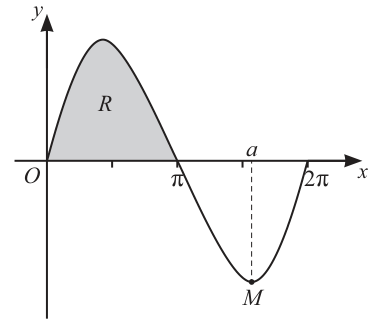
The diagram shows the curve , for , and its minimum point , where .
Approach
Differentiate by combining the product rule with the chain rule on the square-root factor. Set , eliminate using , and form a quadratic in . Solve the quadratic and select the root corresponding to the minimum (which lies between and ).
Working
Write and apply the product rule:
For the second term, use the chain rule:
Combine the two parts:
Set :
Multiply both sides by to clear the denominator:
Substitute :
Rearrange into a standard quadratic in :
Apply the quadratic formula:
The value lies outside the admissible range , so it is rejected. Hence:
The minimum lies in the third quadrant (just before , where is still positive but is negative), so:
Answer
a = 4.93
Walkthrough
The function is a product of two pieces: and the square-root factor . Because the second piece is itself a composition (with inside a square root), finding requires the product rule together with the chain rule.
Let and . The product rule gives . The first piece gives , contributing the term .
For , treat it as a composition with and . By the chain rule, . Multiplying by gives the second term .
After setting , multiply both sides by to clear the denominator, giving . Now use the Pythagorean identity so that the equation involves only . This yields the quadratic .
Applying the quadratic formula gives . Only is a valid cosine (the other root is less than ).
The minimum in the diagram lies between and in the third quadrant, where is negative. Using the cosine-positive value but in the second part of the unit circle, .
Key Takeaways
- Combining the product rule with the chain rule is essential for differentiating products that include composite functions.
- The Pythagorean identity lets you reduce a trig equation to a polynomial in one trig function.
- After solving, restrict the solutions by both the cosine range and the geometric quadrant of the answer.
- A local minimum on a closed interval corresponds to a critical point; verify by checking that the second derivative or the function values indicate a minimum.
Common Mistakes
- Forgetting the chain rule and writing without the factor.
- Sign error: writing instead of .
- Failing to clear the fraction when setting , leading to an unsimplified equation.
- Choosing , which is not in and gives no real solution.
- Picking the maximum value instead of the minimum .
Things to Be Careful About
- The mark scheme's intermediate step is ; the cancels, but the unsimplified form is the one expected for the A1 mark.
- The acceptance guidance allows followed by as BOD (benefit of the doubt) for the final A1, but alone scores A0.
- More accurate values such as are accepted; the question only asks for 2 decimal places.
- The derivative must be set to zero before simplifying, and squaring is unnecessary here because the equation is already cleared by multiplication.
Approach
Express the shaded area as the definite integral . Apply the given substitution , find , change the limits, integrate, and simplify.
Working
The area of is:
Using the substitution :
New limits in :
Substitute throughout, allowing the negative sign from to flip the limits:
Integrate using the power rule:
Apply the limits:
Answer
R = (4/3)(3√3 - 1) = 4√3 - 4/3
Walkthrough
The shaded region lies between the curve and the x-axis from to . In this interval the function is non-negative (zero at the endpoints and positive in between), so the area is simply the definite integral:
The substitution is given. Differentiating, , so . This swap turns the awkward into the cleaner .
Always change the limits when using a definite integral: and . The integral becomes , which equals after the negative sign flips the limits.
Now the integrand is purely in . Apply the power rule: .
Evaluate between the limits and :
This is the exact area; equivalent forms like or are also accepted.
Key Takeaways
- A definite integral in can be converted to one in by substituting and rewriting as .
- When using a definite integral, change the limits to -values; do not transform back to .
- A negative sign from can be absorbed either by flipping the limits or by keeping the negative sign in front.
- (equivalently ), and .
Common Mistakes
- Forgetting to change the limits, leading to with substituted but the wrong orientation.
- Wrong sign for : instead of .
- Not flipping the limits after the negative sign, leaving a negative area.
- Integrating as (i.e., forgetting the factor from the power rule).
- Evaluating incorrectly as instead of .
Things to Be Careful About
- The mark scheme accepts either (keep negative, original flipped limits) or (absorb negative, flipped limits); both score the A1.
- A sign error in that leads to a negative final answer is penalised: "If the answer is changed from negative to positive value at end, then A0."
- The exact form is required; numerical approximations are not accepted here.
- The constant of integration is not required since the integral is definite.