Mathematics 9709/32 — October/November 2024
Cambridge A-Level · Pure Mathematics 3 · worked solutions for every part, with the mark scheme
Topics Algebra · Trigonometry · Complex Numbers · Logarithmic and Exponential Functions · Differentiation · Numerical Solution of Equations · +3 more
Expand in ascending powers of , up to and including the term in , simplifying the coefficients.
Approach
Factor out so that the bracket becomes , then apply the binomial expansion for the rational power , keeping terms up to . Finally multiply by the factor and simplify the coefficients.
Working
Write the expression as:
Use the binomial expansion:
Substitute :
Simplify the term:
Simplify the term:
Therefore:
Answer
3 - x/2 - x^2/24
Walkthrough
Start by noticing that the base is not of the form , so factor out :
Since the whole expression is raised to the power , the factor comes out as . This is the key first step: it turns the problem into the standard binomial form with .
Then apply the binomial expansion for a rational index:
This formula is valid for , i.e. , but only the first three terms are needed. Substitute and multiply every term by the factor . The term becomes , and the term becomes .
Finally collect the constant term with the two simplified terms to write:
This is the expansion in ascending powers of , up to and including the term in .
Key Takeaways
- To expand a binomial whose first term is not , factor out the constant so it becomes .
- For rational , use the general binomial coefficients such as , and simplify them numerically.
- The expansion is valid only when ; here that means .
Common Mistakes
- Forgetting to multiply by the factor after factoring out . The expansion of alone is , not the required answer.
- Sign errors when substituting , especially in the term where the square makes the sign positive but the binomial coefficient is negative.
- Leaving coefficients as symbolic binomial coefficients instead of simplifying them; the question asks for simplified coefficients.
- Omitting the unsimplified working needed for the method mark; the mark scheme requires a correct unsimplified or term to be seen.
Things to Be Careful About
- The constant term is , not .
- The term: , and the binomial coefficient is , so the term is .
- The expansion is only valid for ; although the question does not ask for the range, it is good practice to note it.
- If you choose to expand first, remember to multiply the final expansion by before giving the answer.
By sketching a suitable pair of graphs, show that the equation has exactly one root in the interval .
Approach
Sketch and on the same axes for . Analyse the behaviour of each curve — asymptotes, intercepts, and monotonicity — to show they intersect exactly once.
Working
Graph of :
Vertical asymptotes occur where , i.e., , giving
In the interval , there are vertical asymptotes at and .
The -intercept occurs where , i.e., , so .
As , .
As , .
Since is continuous and strictly decreasing on , it falls from to , crossing zero at .
Graph of :
In the interval , , so .
At , .
As , .
Since is strictly decreasing on , is strictly increasing on this interval, rising from to .
Number of intersections:
As :
So near .
At :
So at .
Since is continuous and strictly decreasing, and is continuous and strictly increasing on , and they swap relative order, there is exactly one point of intersection in .
For :
So there is no intersection in this sub-interval.
Therefore, has exactly one root in .
Answer
The equation has exactly one root in , as shown by the single intersection of the two curves.
Exactly one root in 0 < x < π/2
Walkthrough
We are asked to show that has exactly one root in the interval by sketching suitable graphs.
Step 1: Sketch .
The function has vertical asymptotes where the denominator is zero: gives , so . In our interval , the asymptotes are at both endpoints. The -intercept is where , giving . As approaches from the right, goes to ; as approaches from the left, goes to . The function is continuous and strictly decreasing on .
Step 2: Sketch .
The function is positive on since there. At , . As , so . Since is strictly decreasing on this interval, is strictly increasing from to .
Step 3: Compare the two curves.
Near , while , so . At , while , so . By the Intermediate Value Theorem (since both functions are continuous on ), there is at least one intersection. Since is strictly decreasing and is strictly increasing, their difference is strictly decreasing, so there is exactly one intersection in .
For , while , so no intersection is possible.
Therefore, there is exactly one root in .
Key Takeaways
- When asked to show an equation has a given number of roots by sketching, identify two functions whose intersection points are the roots.
- Analyse asymptotes, intercepts, and monotonicity of each graph to determine the number of intersections.
- Use the fact that a strictly decreasing function and a strictly increasing function can intersect at most once to prove uniqueness.
Common Mistakes
- Forgetting the vertical asymptotes of at and , leading to an incorrect sketch.
- Not justifying why there is exactly one intersection — merely sketching is not enough; you must explain why the curves cross only once.
- Marking the intersection at — this is outside the open interval .
Things to Be Careful About
- The interval is open: . The asymptotes at the endpoints are not roots.
- At , but , so this is not a root.
- For in the interval, is negative while is positive, so no further intersections can occur.
- The mark scheme also accepts the alternative approach of sketching and , which gives as the equivalent equation.
Show that if a sequence of real values given by the iterative formula
converges, then it converges to the root in part (a).
Approach
If the sequence converges, let the limit be . Substitute and into the iterative formula, then rearrange to show that satisfies the equation .
Working
Suppose the sequence converges to a limit . Then as :
Substituting into the iterative formula:
Multiply both sides by 2:
Take the tangent of both sides:
Rearrange by dividing both sides by (which is non-zero since ):
Alternatively, write :
Rearranging:
This is exactly the equation from part (a). Therefore, if the sequence converges, it converges to the root of in .
Answer
If the sequence converges, it converges to the root in part (a).
The sequence converges to the root of cot 2x = sec x in 0 < x < π/2
Walkthrough
We are given the iterative formula and asked to show that if it converges, it converges to the root found in part (a).
Step 1: Assume convergence.
If the sequence converges, let the limit be . This means and .
Step 2: Substitute into the iterative formula.
Taking the limit on both sides of :
Step 3: Rearrange to recover the original equation.
Multiply by 2: .
Take the tangent of both sides: .
Now we need to show this is equivalent to . Write :
Rearrange by cross-multiplying or inverting:
This is exactly the equation from part (a), so must be the root of that equation in .
Key Takeaways
- If a sequence defined by converges to , then — this is the fixed-point equation.
- Rearranging the fixed-point equation can recover the original equation whose root is being approximated.
- The iterative formula is designed so that its fixed point is the solution to the target equation.
Common Mistakes
- Forgetting to state the assumption that the sequence converges before taking the limit.
- Not showing the rearrangement steps clearly — the mark scheme requires seeing or the equivalent .
- Dividing by zero or assuming without justification (though guarantees this).
Things to Be Careful About
- The question says "if a sequence ... converges" — you must state this assumption before taking the limit.
- The rearrangement from to requires and , which holds since and (as we showed at ).
- The mark scheme accepts stopping at if the alternative approach from part (a) was used.
The square roots of can be expressed in the Cartesian form , where and are real and exact.
By first forming a quartic equation in or , find the square roots of in exact Cartesian form.
Approach
Let a square root be . Square it and equate real and imaginary parts. This gives two equations. Eliminate (or ) to form a quartic in (or ). Solve as a quadratic in (or ), reject non-real values, then find the corresponding (or ) values and pair them correctly.
Working
Let . Then
Equating real and imaginary parts with :
Thus . Using :
Let :
so or . Since is real, , hence .
For :
For :
Answer
The square roots are
i.e.
±(2√2 - √2i)
Walkthrough
We are looking for numbers of the form whose square equals . The first step is to square . Because , the square is . We then compare real parts: must equal , and imaginary parts: must equal . This gives two equations in two unknowns.
Next, we eliminate one variable. From , , so . Substituting into gives . Multiplying by gives , a quartic in . Although it is quartic, it is quadratic in the variable . Factorising gives , so or . Since must be non-negative for real , we reject . Thus , so .
Finally, use to find the corresponding values. If , then . If , then . These pairings give the two square roots. The answer can be written .
Key Takeaways
This question combines complex number arithmetic with solving a polynomial equation. The key idea is that equating real and imaginary parts turns one complex equation into two real equations. Eliminating one variable produces a quartic, but because only even powers of appear, it can be solved as a quadratic in . It is also important to reject solutions that would make or non-real, and to pair the signs correctly using .
Common Mistakes
- Forgetting that , so , not .
- Using the wrong sign for the imaginary part: , not .
- Making a sign error when dividing by 2: . A wrong relation here often leads to an incorrect quartic.
- Rejecting the negative value of is necessary, but forgetting to reject it and trying to use would give non-real .
- Pairing and incorrectly. The pairs must satisfy , so goes with , not with .
Things to Be Careful About
- The mark scheme allows a minor slip in the elimination step, but not seriously incorrect algebra. In particular, a sign error in would be serious and would not earn the method mark.
- Both square roots are needed; give both or state the two separate values.
- If you solve using instead of , the quartic becomes . The same care is needed: , so , and then use to pair.
- Exact surd forms are required; do not give decimal approximations.
Solve the equation . Give your answer correct to 3 decimal places.
Approach
Rewrite using the index law , then isolate . Once is equal to a constant, take natural logarithms of both sides and solve for .
Working
Using , the equation becomes
Rearrange to collect the terms in :
So
Take natural logarithms:
Therefore
Evaluating gives
Answer
-0.544
Walkthrough
Start by making the two powers of 5 comparable. Since , the equation becomes . This is now linear in the single unknown quantity .
Collect the terms on one side. Subtracting from both sides gives , or equivalently . Dividing by 24 gives .
Now the unknown is in the exponent. Taking natural logarithms of both sides is the standard way to bring it down: , so . Dividing by gives . Evaluating this on a calculator gives , which rounds to to 3 decimal places.
Key Takeaways
- Use the index law to rewrite terms with the same base in terms of one unknown power.
- An equation of the form can be solved by taking logarithms of both sides.
- The logarithm brings the exponent down: .
- Keep the exact fraction until the final step, then round only at the end.
Common Mistakes
- Writing as or instead of .
- Forgetting to collect like terms in before taking logarithms.
- Taking logarithms before isolating the exponential term, which makes the algebra harder.
- Giving an unsupported answer: the mark scheme awards 0/3 if no working is shown, even if the final value is correct.
Things to Be Careful About
- The final answer must be given to 3 decimal places, so use , not or an unrounded value.
- Since is negative, the value of is negative; check that this makes sense.
- The fraction can be written as or ; both are equivalent and acceptable.
- The logarithm of a positive number is required; is always positive, so there is no domain issue here.
Approach
Write the numerator in polar form using De Moivre's theorem, identify the argument of the denominator as the conjugate, then divide by subtracting arguments.
Working
By De Moivre's theorem,
so the argument of the numerator is .
The denominator is the conjugate of , so
and its argument is .
For division in polar form, arguments subtract:
Answer
arg u = 5π/7
Walkthrough
We are dividing two complex numbers given in modulus-argument form. The numerator is a power of . De Moivre's theorem tells us that raising this to the 4th power multiplies the argument by 4, so the numerator has argument .
The denominator is , which is the conjugate. Its argument is the negative of , i.e. .
When dividing two complex numbers in polar form, we subtract the argument of the denominator from the argument of the numerator. Hence .
Key Takeaways
- De Moivre's theorem: .
- The conjugate has argument .
- Division in polar form: arguments subtract.
Common Mistakes
- Forgetting that the denominator has argument , not .
- Subtracting in the wrong order, giving instead of .
- Giving the answer in degrees; the question requires an exact value in radians.
Things to Be Careful About
- The principal argument is conventionally in , and is in this range.
- Keep the fractions in terms of ; do not convert to decimals.
- The mark scheme requires the argument of a complex number to be stated or implied to earn the method mark.
The complex numbers and are plotted on an Argand diagram.
Describe the single geometrical transformation that maps onto and state the exact value of .
Approach
Use the fact that is the complex conjugate of . On an Argand diagram, conjugation reflects a point in the real axis. Therefore the argument of is the negative of the argument of .
Working
If , then
so .
From part (a), . Therefore
Answer
Reflection in the real axis; .
Reflection in the real axis; arg u* = -5π/7
Walkthrough
A complex number has conjugate . On the Argand diagram, the point is reflected in the real axis to . This is exactly the same as reflecting the line from the origin to across the real axis, so the angle with the positive real axis changes from to . Using from part (a), we get .
Key Takeaways
- Conjugation corresponds to reflection in the real axis.
- The argument of the conjugate is the negative of the argument of the original number.
Common Mistakes
- Saying reflection in the imaginary axis instead of the real axis.
- Writing instead of .
- Giving only without substituting the exact value from part (a); the question asks for the exact value.
Things to Be Careful About
- The mark scheme requires the word 'reflection'; 'mirror' or 'flip' is not enough.
- The answer must be exact; do not give a decimal approximation.
- Both and are principal arguments. If using a non-principal form, it should be consistent, but the standard exact value is .
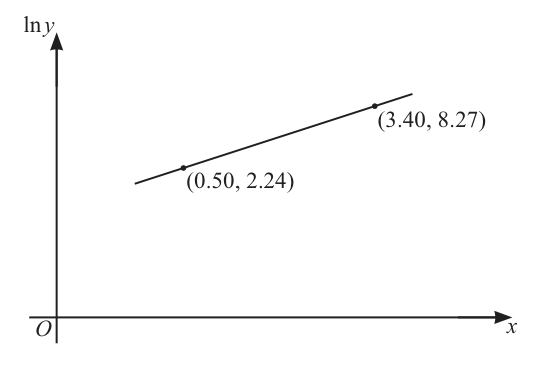
The variables and satisfy the equation , where and are constants. The graph of against is a straight line passing through the points and , as shown in the diagram.
Find the values of and . Give each value correct to 1 significant figure.
Approach
Take the natural logarithm of both sides of the equation to transform it into a linear form . This matches the equation of a straight line , where the gradient is and the y-intercept is . Use the two given points on the graph to find the gradient and y-intercept, then solve for and .
Working
Given , take of both sides:
Apply logarithm laws:
Rearranging for :
This is a straight line with gradient and y-intercept .
The line passes through and . The gradient is:
So:
Rounding to 1 significant figure, .
To find , substitute the gradient and one point, e.g., , into the linear equation:
So:
Rounding to 1 significant figure, .
Answer
a = 0.3, b = 8
Walkthrough
First, we need to convert the exponential equation into a linear form so we can use the straight-line graph. Taking the natural logarithm of both sides gives . Using logarithm laws, this becomes . Rearranging for gives , which is in the form with , , gradient , and y-intercept .
Next, we calculate the gradient using the two coordinates provided on the graph: and . The gradient is . Since , we find , which rounds to to 1 significant figure.
Finally, we use the y-intercept relationship . Substituting the gradient and one of the points into the linear equation gives , leading to . Exponentiating gives , which rounds to to 1 significant figure.
Key Takeaways
- Taking logarithms of both sides of an exponential equation is a standard technique to linearise it for graph-based analysis.
- Carefully identifying the gradient and y-intercept in terms of the original constants is crucial; here, the y-intercept is , not .
- Always round final answers to the specified number of significant figures only after all intermediate calculations are complete.
Common Mistakes
- Forgetting the term when linearising, incorrectly writing instead of .
- Misidentifying the y-intercept as instead of , which leads to an incorrect value for .
- Rounding intermediate values (like the gradient) too early, which can cause small errors in the final answer.
Things to Be Careful About
- The question asks for values correct to 1 significant figure, not decimal places. rounds to (1 s.f.), and rounds to (1 s.f.).
- Ensure that the coordinates are used correctly in the gradient formula , keeping in mind that the vertical axis is , not .
Approach
Let . Replace using the double-angle formula, clear the fraction, then factor out and divide by (valid because ).
Working
Let . The double-angle formula gives
Substitute into the equation:
Multiply through by :
Expand and simplify:
Factor:
Since , divide by :
Hence
Answer
The equation reduces to for .
tan^4 x - 2 tan^2 x - 3 = 0 for tan x ≠ 0
Walkthrough
Start with the equation . The only term not already in terms of is . Use the double-angle formula to rewrite everything in terms of . Then multiply the whole equation by to remove the fraction. Expand and collect like terms to obtain a polynomial. Factor out . Because the question specifies , dividing by is valid and leaves the required quartic. Each of these steps earns a mark: the correct double-angle substitution, a correct fraction-free equation, and the final reduction.
Key Takeaways
This question tests the double-angle formula for tangent and algebraic manipulation of rational expressions. It also shows why a condition like is needed before dividing by a factor.
Common Mistakes
- Forgetting to multiply the first and last terms by when clearing the fraction.
- Making sign errors when expanding ; the middle term becomes , not .
- Dividing by without stating that .
- In a 'show that' question, skipping lines or writing an incorrect intermediate equation.
Things to Be Careful About
The mark scheme allows the intermediate equation to be missing '', but every line that is written must be correct. It also condones not mentioning , but mentioning it is good practice. The final answer must be exactly .
Approach
Apply the result of part (a) with . This gives a quartic in . Let , solve the resulting quadratic, then find all values of in and halve them.
Working
Using part (a) with (for ):
Let . Then
So or . Since , only is possible:
Since , we have .
For :
For :
Halving gives
Note: the original equation also has , giving , but this is not required by the mark scheme.
Answer
θ = π/6, π/3, 2π/3, 5π/6
Walkthrough
Since part (a) showed the reduction for , replace by . This gives . To solve this, set ; the quartic becomes a quadratic . Factorise to get or . Since a square cannot be negative, reject . Thus , so . Now use the range: means . Find the four angles in this interval with tangent or , then halve each to get . The mark scheme requires exact values and does not require the extra solution that comes from in the original equation.
Key Takeaways
This part combines a substitution from a previous result, solving a quadratic in , and solving a trigonometric equation over a doubled interval. It is important to consider both positive and negative square roots and to halve the angles at the end.
Common Mistakes
- Forgetting to halve the values of ; this loses the method mark.
- Only taking the positive square root, missing .
- Giving answers outside .
- Giving decimal answers instead of exact multiples of .
- Not using the result from part (a) and instead trying to solve the original equation from scratch.
Things to Be Careful About
The mark scheme accepts equivalent fractions such as for . It ignores answers outside the interval. If a candidate makes a copying slip but still has a complete method to obtain a value of , the method mark can still be awarded. The solution from is not required.
The parametric equations of a curve are
for .
Approach
Differentiate and with respect to the parameter , then use the parametric formula
and simplify using and .
Working
Differentiate using the chain rule:
Differentiate :
Therefore,
Using and :
Answer
-1/2 cos^3 2t
Walkthrough
We have and given as functions of the parameter . To find , differentiate both and with respect to , then use
First, . Think of it as . The chain rule gives times the derivative of , which is , so .
Next, differentiates to .
Divide by . The expression contains and ; rewrite and . The denominator becomes , so the factors cancel and the result is .
Key Takeaways
This question tests parametric differentiation: when and are both functions of a parameter, . It also tests the chain rule and the ability to simplify trigonometric fractions.
Common Mistakes
- Forgetting the factor from differentiating when differentiating .
- Using instead of .
- Stopping before fully simplifying to the required form.
Things to Be Careful About
The domain ensures , so cancelling is valid. Keep the exact trigonometric form rather than converting to decimals.
Hence find the equation of the normal to the curve at the point where . Give your answer in the form .
Approach
Substitute into the parametric equations to find the point. Use the derivative from part (a) to find the gradient of the tangent, then take its negative reciprocal to get the gradient of the normal. Form the equation of the normal using point-gradient form and rearrange into .
Working
At :
So the point is .
From part (a),
At :
The gradient of the normal is the negative reciprocal:
Equation of the normal through :
Rearrange:
Answer
y = 4√2x - 7√2/2
Walkthrough
First find the coordinates of the point. Since , we have . Thus and .
Next, use the derivative from part (a): . At , , so the tangent gradient is
The normal is perpendicular to the tangent, so its gradient is the negative reciprocal:
Now use the point-gradient equation with and :
Expand and collect the constant terms:
Key Takeaways
This part combines parametric coordinates with the geometric meaning of the derivative: the tangent gradient is at the point, and the normal gradient is its negative reciprocal. It also reviews writing a line in the form .
Common Mistakes
- Using the tangent gradient instead of the normal gradient.
- Taking the reciprocal instead of the negative reciprocal.
- Making a sign error when combining and .
- Leaving the answer in a form other than .
Things to Be Careful About
The mark scheme accepts equivalent decimals such as , but the exact surd form is preferred. Be careful that simplifies to , not .
With respect to the origin , the points , and have position vectors given by
Approach
Use the given relation together with the link to express directly in terms of the given position vectors.
Working
First compute :
Therefore
Since , rearrange to get :
Answer
(3, -11, -10)
Walkthrough
We need to find the position vector of D given that ABCD is a trapezium in which the side DC is parallel to AB and exactly three times as long. The condition ties D and C to A and B.
Step 1: Compute as the difference of position vectors, . This gives the displacement from A to B.
Step 2: Form . The factor 3 stretches the vector, so is three times the length of and points in the same direction.
Step 3: The defining relation comes from the fact that the vector from D to C equals the position vector of the head C minus the position vector of the tail D. Rearranging gives , and we substitute the known values.
Key Takeaways
- is the displacement from A to B.
- The relation can always be rearranged to isolate any one position vector.
- The relation gives both the direction and the magnitude of the side in terms of .
Common Mistakes
- Writing as instead of (this would actually be ).
- Using instead of when rearranging, which gives the wrong sign for .
- Sign errors when subtracting two column vectors component by component.
Things to Be Careful About
- The order of letters in a vector matters: — they are negatives of each other.
- A scalar multiple preserves direction; means DC is parallel to AB and points the same way, with D on the opposite side of A from B (since the trapezium is ABCD rather than ABDC).
Approach
Write parametric vector equations for both diagonals AC and BD, equate their components to find the parameters, then substitute back to obtain the position vector of P.
Working
The direction of diagonal AC is
Using D from part (a), the direction of diagonal BD is
The parametric equations of the two diagonals are therefore
At the intersection P the two expressions are equal. Equating the - and -components:
From (1), . Substitute into (2):
So , which gives , hence .
Check using the -components: and . ✓
Substitute back into the equation of line AC:
Answer
(3/4, 1/4, -7/4)
Walkthrough
The two diagonals of trapezium ABCD are AC and BD, and they meet at the interior point P. To locate P, we use the standard technique of writing each diagonal as a parametric line and equating the two expressions.
Step 1: Compute the direction . This is the displacement from A to C.
Step 2: Compute the direction using the position vector of D from part (a).
Step 3: Write each diagonal in the form , using A as the basepoint of line AC and B as the basepoint of line BD. We use different parameter names ( and ) so we can keep track of which line a parameter belongs to.
Step 4: At the intersection, the two expressions are equal, so the -, -, and -components must all match. This yields three equations in two unknowns, of which we use any two to solve. We pick and because they are simplest.
Step 5: Eliminate one parameter, solve for the other, and substitute back to get the position vector of P. The third component should agree automatically — this is a useful consistency check that confirms the lines really do meet.
An alternative observation: in a trapezium with and , the diagonals divide each other in the ratio , so — the same answer obtained more directly.
Key Takeaways
- A line through two points and can be written as for some real parameter .
- To find where two lines meet in 3D, write both in parametric form, equate components, and solve. The third component acts as a check that the lines are not skew.
- In a trapezium with parallel sides in ratio , the diagonals cut each other in the same ratio (similar-triangles argument).
Common Mistakes
- Using the wrong direction vector (e.g. instead of ): this still works but the parameter value at P has the opposite sign.
- Failing to verify the third component after solving — if the lines are skew rather than intersecting, the third equation will be inconsistent.
- Sign slips in or in substituting back into line BD.
Things to Be Careful About
- The mark scheme uses the equivalent form for line AC, which has as the direction. This gives instead of our but the same P.
- Always substitute the found parameter back and confirm all three components agree before reporting the answer.
Approach
Form vectors and from the common vertex B, then apply the scalar product formula to obtain .
Working
Find the two direction vectors from B:
Compute the scalar product:
Compute the magnitudes:
Apply the formula:
Therefore
Equivalently, radians.
Answer
77.3° (or 1.35 rad)
Walkthrough
The angle ABC is the angle at vertex B between the two sides BA and BC. The scalar product formula gives this directly from the two direction vectors:
Step 1: Compute and . These are the vectors from B to A and from B to C respectively, each obtained by subtracting the position vector of B from that of the other vertex.
Step 2: Compute the scalar product by multiplying corresponding components and summing. The negative times negative is the dominant positive term, and the final result is .
Step 3: Compute each magnitude using . Squaring removes sign issues, and the three terms are then summed and square-rooted.
Step 4: Divide the scalar product by the product of the magnitudes, then take the inverse cosine. A small positive cosine gives a large angle; here corresponds to about .
Key Takeaways
- The scalar product gives angles between vectors via .
- In 3D, magnitudes use and scalar products use .
- The angle between two vectors is always in , so returns a unique value.
Common Mistakes
- Using and (instead of and ): these point into B rather than out of B and would give the supplementary angle. Both vectors must emanate from the same vertex.
- Forgetting to take the inverse cosine, leaving the answer as instead of converting to degrees.
- Sign errors in the scalar product (e.g. treating as instead of ).
Things to Be Careful About
- The mark scheme accepts either or rad — both come from the same numerical value.
- The exact value is ; round at the end, not part-way through the calculation.
- Using and vs. and gives the same final angle because the scalar product and the product of magnitudes are both unchanged when both vectors are negated.
A balloon in the shape of a sphere has volume and radius . Air is pumped into the balloon at a constant rate of starting when time and . At the same time, air begins to flow out of the balloon at a rate of . The balloon remains a sphere at all times.
Approach
Let be the volume of the spherical balloon. The net rate at which volume changes is inflow minus outflow. Relate to using the sphere volume formula and the chain rule.
Working
The net rate of change of volume is
For a sphere,
so
By the chain rule,
Equating the two expressions for :
Divide by :
Since and ,
Answer
dr/dt = (50-r)/(5r^2)
Walkthrough
We start from the physical statement: volume is being added at and removed at , so the net rate of change of volume is . Next, because the balloon is always a sphere, , so differentiating with respect to gives . The chain rule links the two rates: . Substituting and dividing by gives the required differential equation.
Key Takeaways
This part tests the ability to translate a rate-of-change statement into a differential equation, and to use the chain rule when the intermediate variable is the radius. The key idea is that can be expressed both from the given rates and from the geometry of the sphere.
Common Mistakes
A common mistake is to ignore the outflow and write only. Another is to confuse with . The mark scheme requires a complete correct statement for each of the three steps.
Things to Be Careful About
The factor cancels, so it is easy to lose it incorrectly. Also, the outflow term is , not , so the radius must remain in the term. Since initially, the expression is not valid at the exact starting instant, but the differential equation is derived for .
Approach
Divide by . Because the divisor has leading term , the quotient will have negative coefficients. Express the result as .
Working
Long division:
The first term of the quotient is
Multiplying:
Subtracting gives . The next term of the quotient is
Multiplying:
Subtracting leaves remainder . Hence
Answer
Quotient: ; remainder: .
quotient = -5r - 250, remainder = 12500
Walkthrough
We divide by . Since the divisor is , its leading term is . The first quotient term is found by dividing by , giving . Multiplying back and subtracting removes the term and leaves . Then divided by gives . Multiplying and subtracting leaves the constant remainder . Therefore .
Key Takeaways
This part practises polynomial division by a linear factor written with a negative leading coefficient. It is important to keep the signs correct when the divisor is rather than .
Common Mistakes
A common mistake is to divide by and obtain quotient ; this gives the same remainder but the quotient differs by a sign. The mark scheme allows this only if the quotient and remainder are clearly identified consistently.
Things to Be Careful About
The divisor is , not . The quotient is , while the remainder is positive . If using the remainder theorem, it can only give the remainder, not the quotient.
Approach
Invert the differential equation to write , separate the variables, use the division from part (b) to rewrite the integrand, integrate, and then use to find the constant.
Working
From part (a),
Therefore
Using the division in part (b),
So
Integrate:
Use when :
so
Hence
Answer
t = -5/2 r^2 - 250r - 12500 ln(50-r) + 12500 ln 50
Walkthrough
We need in terms of , so we invert the given differential equation to get . The integrand is not a simple standard form, but part (b) rewrites it as . Integrating term by term: gives , gives , and gives because the derivative of is . Finally, the condition when determines the constant .
Key Takeaways
This part combines separable differential equations with algebraic preparation of the integrand. The division in part (b) is not an isolated exercise; it is exactly what makes the integral possible. The integral of is , not .
Common Mistakes
A common mistake is to forget the minus sign when integrating . Another is to omit the constant of integration or to apply the initial condition incorrectly. The mark scheme allows missing or or integral signs, but not both.
Things to Be Careful About
The expression is valid for because the logarithm requires . When using the initial condition, substitute into to get , not . Also, the constant may be left as it is or evaluated numerically.
Approach
Substitute into the expression for found in part (c) and evaluate.
Working
Combine the logarithms:
Answer
More precisely, .
t = 70.5 (more precisely 70.4605)
Walkthrough
We take the expression for from part (c) and replace by . The arithmetic gives . The logarithmic part is . Evaluating this gives approximately .
Key Takeaways
This part checks that the student can use a modelled solution in a practical context. It also reinforces the logarithm law .
Common Mistakes
A common mistake is to evaluate as , which is incorrect. Another is to forget the negative sign in front of .
Things to Be Careful About
The value is well within the domain , so the logarithm is defined. The mark scheme accepts or a more accurate value such as .
Let .
Find and hence find the exact coordinates of the stationary point of the curve with equation .
Approach
Differentiate using the quotient rule, set to locate the stationary point, solve the resulting exponential equation, and then substitute back to find the -coordinate.
Working
Let and . Then
Using the quotient rule,
Simplify the numerator:
Hence
At a stationary point, . Since and the denominator is non-zero at the stationary point,
Therefore
Substitute into :
Answer
The stationary point is
x = ln(4/3), y = -16
Walkthrough
We are told that is a quotient of two exponential expressions, so the quotient rule is the natural tool. Write the numerator as and the denominator as . Differentiate each separately: and . Then substitute into the quotient rule formula. After expanding the numerator, the terms cancel and the remaining terms factor as .
For a stationary point, set . A fraction is zero when its numerator is zero, provided the denominator is not also zero. Since is never zero, we need , giving and hence . Finally substitute this value back into to get the -coordinate. Using makes the substitution tidy and gives .
Key Takeaways
This question tests the quotient rule for a quotient of exponential functions, the fact that stationary points occur where the derivative is zero, and the use of natural logarithms to solve . It also reinforces that finding a stationary point requires both coordinates, not just the -value.
Common Mistakes
- Forgetting to square the denominator in the quotient rule.
- Expanding the numerator incorrectly, especially the signs when subtracting .
- Setting the whole fraction equal to zero and incorrectly trying to solve with the denominator.
- Forgetting that for all real , so it cannot contribute a solution.
- Finding only and not substituting back to find .
Things to Be Careful About
The question asks for , so the derivative must be given in a complete form, not just the numerator. The coordinates must be exact, so leave the answer as rather than a decimal. Also check that the denominator is non-zero at the stationary point; here it equals , so the point is valid.
Use the substitution and partial fractions to find the exact value of .
Give your answer in the form , where is a rational number in its simplest form.
Approach
Use the substitution to convert the integral into one in , decompose the integrand into partial fractions, integrate term by term, and evaluate at the new limits.
Working
Let . Then
Since , the integral becomes
Factorise the denominator:
Write
Multiplying through by :
Set :
Set :
Thus
Integrate:
Evaluate from to :
Simplify using and :
Answer
ln(81/4)
Walkthrough
Because the integrand contains and , the substitution is natural. Since , we have , so . This turns the integral into . Remember to change the limits: becomes , and becomes .
Next factor the denominator as and write the integrand as . Clearing denominators gives . Substituting and quickly gives and . This is the partial fraction decomposition.
Integrating term by term, and . Evaluating from to and using log laws gives .
Key Takeaways
This question combines three core techniques: substitution to simplify an exponential integrand, partial fractions to split a rational function, and integration of reciprocal linear terms to logarithms. It also reviews the laws of logarithms needed to combine terms into a single logarithm.
Common Mistakes
- Forgetting to change the limits when substituting .
- Writing instead of .
- Failing to convert into , leaving an incorrect integrand.
- Making sign errors when finding and in the partial fractions.
- Combining logarithms incorrectly, e.g. writing as incorrectly.
Things to Be Careful About
The final answer must be in the form with rational in simplest form, so simplify fully. Since the interval is to , both and are positive, so no absolute value signs are needed. The mark scheme requires the substitution step, the partial fraction form, and the use of limits to be clearly shown.