Mathematics 9709/31 — October/November 2024
Cambridge A-Level · Pure Mathematics 3 · worked solutions for every part, with the mark scheme
Topics Algebra · Integration · Differentiation · Trigonometry · Logarithmic and Exponential Functions · Numerical Solution of Equations · +3 more
The polynomial , where and are constants, is denoted by . It is given that is a factor of . When is divided by the remainder is equal to 3 times the remainder when is divided by .
Find the values of and .
Approach
Use the factor theorem: since is a factor, . Use the remainder theorem: the remainder when dividing by is , so the given condition gives . This yields two linear equations in and ; solve them simultaneously.
Working
Since is a factor, :
So , i.e. .
By the remainder theorem, the remainder on division by is , and on division by is . Given :
So .
Now solve the system:
From the second equation, . Substitute into the first:
Then .
Answer
a = -32, b = 11
Walkthrough
We are told that is a factor of . By the factor theorem, if is a factor, then substituting the value of that makes (i.e. ) into must give 0. This gives our first equation in and .
Then we use the remainder theorem: when a polynomial is divided by , the remainder is . So the remainder when dividing by is , and when dividing by is . The problem tells us the first remainder is 3 times the second, so . This gives our second equation.
Finally we have two linear equations in and , which we solve by substitution (or elimination).
Key Takeaways
- The factor theorem: if is a factor of , then .
- The remainder theorem: the remainder on division by is .
- Forming equations from given conditions and solving simultaneous linear equations.
Common Mistakes
- Forgetting to use rather than when is the factor. The root is .
- Sign errors when substituting negative values into the polynomial.
- Confusing which remainder is larger: the problem says the remainder on division by is 3 times the remainder on division by , so , not . The mark scheme condones if 3 is on the wrong side, but it is better to get it right.
- Arithmetic errors when simplifying and .
- Not showing the substitution step — the mark scheme requires M1 for substituting and equating to zero.
Things to Be Careful About
- The factor gives root , not or .
- When computing : , , .
- When computing : , , .
- The mark scheme allows equivalent forms of the equations, e.g. or ; and or .
- The final answer must give both and .
Find the exact value of . Give your answer in the form , where and are rational and is an integer.
Approach
Use integration by parts with and , since differentiating the logarithm simplifies the integrand. Then evaluate the resulting definite integral between the limits and simplify using .
Working
Let
Choose
Then
Integration by parts gives
Evaluate from 1 to 3:
Since ,
Answer
53/3 ln 3 - 26/9
Walkthrough
This is a definite integral of a product, so integration by parts is the natural method. The product is . We choose because its derivative is , which lowers the power of when multiplied by . We choose , giving .
Applying the formula , the new integral is . This is now a simple power integral, so the antiderivative becomes .
Next, substitute the upper limit and the lower limit , and subtract the lower value from the upper value. At , the value is ; at , it is . Subtracting gives .
Finally, use to combine the logarithmic terms: . The exact value is .
Key Takeaways
- Integration by parts is used for products where one factor simplifies when differentiated.
- Choosing as the logarithmic factor and as the polynomial factor is usually effective.
- Definite integrals require evaluating the antiderivative at both limits and subtracting correctly.
- Logarithm laws such as are often needed to simplify the final answer into the required form.
Common Mistakes
- Forgetting the minus sign in the integration by parts formula.
- Writing the derivative of as instead of .
- Forgetting to subtract the value at the lower limit when evaluating a definite integral.
- Leaving the answer as instead of simplifying to .
- Not showing the integration-by-parts step, which is required for the method mark.
Things to Be Careful About
- The derivative of is by the chain rule, not .
- When substituting limits, compute , including the sign of the term.
- The final answer must be exact; decimals are not acceptable.
- The required form is with and rational and an integer, so , , and .
The equation of a curve is .
Find the gradient of the curve at the point .
Approach
Differentiate both sides of the equation implicitly with respect to . The left side requires the chain rule on , and the right side requires the product rule on . Then substitute the point and solve for .
Working
Differentiate implicitly:
Substitute and :
So
Solve:
Answer
dy/dx = 1/2
Walkthrough
We are asked for the gradient of a curve given by an equation linking and . Since is not written explicitly as a function of , we differentiate both sides with respect to implicitly.
Start with the left side, . By the chain rule, the derivative of is . Here , so . Therefore the derivative is .
Now differentiate the right side, . This is a product of and . Using the product rule, , with and , gives .
Equate the two derivatives:
Now substitute the point . Since , and , the equation becomes:
Rearranging gives , so .
An alternative is to rewrite the equation as before differentiating. The derivative of the left side is still , and the derivative of the right side is . At , , giving the same equation and the same answer.
Key Takeaways
This question tests implicit differentiation. The key skills are:
- Differentiating a composite function such as using the chain rule.
- Differentiating a product such as using the product rule, remembering that is a function of .
- Substituting given coordinates into the differentiated equation before solving for .
Common Mistakes
- Forgetting to multiply by when differentiating a term containing . For example, writing the derivative of as just misses the term.
- Forgetting the factor when differentiating , or omitting the inside the numerator.
- Substituting before differentiating. This is invalid because the derivative must be found first.
- Algebraic sign or rearrangement errors when solving .
Things to Be Careful About
- The point makes , so the denominator on the left is ; this simplifies the substitution but must still be written.
- Since at the given point, the alternative method leads to the same simplified equation.
- The gradient is a number at a point; do not leave as an expression involving and after substitution.
- Marks are awarded for stating the correct derivative forms before substitution, so show both derivatives explicitly.
Approach
Factor the difference of squares and use the Pythagorean identity .
Working
Answer
sec^4 θ - tan^4 θ ≡ 1 + 2 tan^2 θ
Walkthrough
We need to prove an identity. The left-hand side is a difference of squares: . Factorising gives .
The key Pythagorean identity for secant and tangent is , so the first factor is simply 1. Also . Therefore the second factor becomes . This is exactly the right-hand side.
Key Takeaways
The identity is the secant-tangent form of Pythagoras. Recognising a difference of squares lets us factor the fourth powers and reduce the expression quickly.
Common Mistakes
- Forgetting that , not .
- Trying to expand directly without using the factorisation, which makes the proof longer and more error-prone.
- Not showing the use of the identity, which is required for the method marks.
Things to Be Careful About
The identity is an identity, so it must hold for every value of where both sides are defined. The proof should use exact algebraic manipulation; no numerical substitution is sufficient.
Approach
Use the identity from part (a) with , replace by , solve for , then list all solutions in the given interval.
Working
Let . From part (a),
The equation becomes
Expanding and simplifying:
Thus , where , so .
Since , we need . The tangent has period , so:
- : or .
- : or .
Dividing by 2 gives all solutions.
Answer
alpha ≈ 20.0°, 70.0°, 110.0°, 160.0°
Walkthrough
Use the result from part (a) with . The left-hand side of the given equation is exactly , so it equals .
The right-hand side is . Replace with . Let ; then the equation becomes . Expanding gives , so . Thus , , and .
Now solve with . Because , the angle lies in . Tangent is positive in the first and third quadrants and negative in the second and fourth. With , the four possible values of are approximately , , , and . Dividing by 2 gives .
Key Takeaways
A "hence" instruction usually means the previous identity should be substituted directly. Reducing a trigonometric equation to an equation in often makes it algebraic. When solving over a full circle, remember tangent has period and there are two solutions in any interval.
Common Mistakes
- Forgetting to use the identity from part (a), or using it incorrectly.
- Replacing by (wrong sign).
- Taking only the positive square root and losing the negative solutions.
- Solving only for and forgetting to divide by 2 to get .
- Stopping at the acute solution and missing the other three solutions in the range.
- Including or , which are excluded by the open interval.
Things to Be Careful About
The domain is for , not for ; this is why there are four solutions. The value is exact; the angles are approximate. Use degree mode on the calculator. The mark scheme requires all four solutions and no others in the range.
Approach
Split the equation into two separate functions and sketch both on the same axes. The roots of the original equation correspond to the -coordinates of the intersection points of the two graphs.
Working
Consider the two curves:
Graph of :
- This is an exponential decay curve shifted vertically upwards by 2.
- -intercept: at , , so the curve passes through .
- As , , so . There is a horizontal asymptote at .
- The curve is strictly decreasing and concave up.
Graph of :
- This is a logarithmic curve shifted left by 1.
- -intercept: at , , so the curve passes through the origin .
- The domain is .
- As , with decreasing gradient (concave down).
- The curve is strictly increasing.
Since is strictly decreasing from 3 towards 2, and is strictly increasing from 0 towards , the two curves must intersect exactly once. The intersection occurs in the first quadrant where and .
Answer
The two curves intersect at exactly one point, so the equation has only one root.
The curves y = 2 + e^{-0.2x} and y = ln(1+x) intersect at exactly one point.
Walkthrough
We are asked to show that the equation has only one root. The most natural approach is to split this into two separate functions and sketch them on the same set of axes.
Step 1: Define the two curves. Let and . Any -value where these two curves meet is a root of the original equation.
Step 2: Sketch . This is a transformed exponential function. The base function is an exponential decay (since the coefficient of is negative). Adding 2 shifts the entire graph up by 2 units. At , we get . As grows large, approaches 0, so approaches 2 from above. The curve is always decreasing and always concave up.
Step 3: Sketch . This is a logarithmic function. At , . The function is defined for . As increases, increases without bound, but the rate of increase slows down (concave down). The curve is always increasing.
Step 4: Argue uniqueness of intersection. Since is strictly decreasing and is strictly increasing, they can intersect at most once. Since and approaches 2 while grows without bound, there must be a point where overtakes . Therefore, they intersect exactly once.
Key Takeaways
- Splitting an equation into two curves and and sketching them is a powerful way to visualise roots.
- The monotonicity of the two curves (one increasing, one decreasing) guarantees at most one intersection.
- A sign change or crossing of values at two points guarantees at least one intersection.
Common Mistakes
- Sketching without the vertical shift of +2, giving a curve that approaches 0 instead of 2.
- Forgetting the -intercept of is at , not at .
- Claiming the curves do not intersect without checking values at specific points.
- Not justifying why there is only one intersection — merely sketching is insufficient.
Things to Be Careful About
- The horizontal asymptote need not be drawn explicitly, but the sketch should show the curve approaching a value near 2.
- The scale on the axes does not need to be marked, but the key points and should be approximately correct.
- The justification for a single root must reference the monotonic behaviour of both curves.
Approach
Define . If and have opposite signs, then by the intermediate value theorem, there is a root between and .
Working
Calculate :
So .
Calculate :
So .
Since and , there is a sign change in the interval . Since is continuous for , by the intermediate value theorem, there is at least one root in .
Answer
The root lies between and .
f(7) = 0.1672 > 0 and f(9) = -0.1373 < 0, so the root lies between 7 and 9.
Walkthrough
We need to show that the root of lies between 7 and 9. The standard technique is to define a single function and evaluate it at the two boundary values.
Step 1: Evaluate at x = 7.
and , so .
Since , the left-hand side is greater than the right-hand side at .
Step 2: Evaluate at x = 9.
and , so .
Since , the left-hand side is now less than the right-hand side at .
Step 3: Conclude.
Since is continuous on and changes sign from positive to negative, there must be at least one value of in where , i.e., a root of the original equation.
Key Takeaways
- Defining and checking for a sign change is the standard method for locating roots in an interval.
- The intermediate value theorem guarantees a root exists when a continuous function changes sign.
- Calculations should be done to at least 3 decimal places to ensure the sign is unambiguous.
Common Mistakes
- Calculating incorrectly (e.g., using instead of ).
- Forgetting to include the +2 in the expression.
- Not clearly stating that and have opposite signs.
- Not mentioning continuity of , though this is often implied.
Things to Be Careful About
- Ensure all values are calculated to sufficient precision (at least 3 decimal places) so the signs are unambiguous.
- The mark scheme also accepts comparing the two sides directly: at , , and at , .
- Make sure to state the conclusion clearly: the root lies between 7 and 9.
Use the iterative formula
to determine the root correct to 2 decimal places. Give the result of each iteration to 4 decimal places.
[ is an alternative notation for .]
Approach
Use the given iterative formula starting with an initial value in the interval . Continue iterating until successive values agree to 2 decimal places. Show all iterations to 4 decimal places.
Working
Choose as the initial value (any value in is acceptable).
Iteration 1:
Iteration 2:
Iteration 3:
Iteration 4:
Iteration 5:
Iteration 6:
The values are converging. We have and , which both round to to 2 decimal places. To confirm, we check the sign change in :
Since and , the root lies in , confirming it is to 2 decimal places.
Answer
The root is correct to 2 decimal places.
8.03
Walkthrough
We are given the iterative formula and asked to find the root to 2 decimal places.
Step 1: Choose an initial value. From part (b), we know the root lies between 7 and 9. We choose as a convenient starting point.
Step 2: Apply the iterative formula repeatedly.
Substitute :
Substitute :
Substitute :
Continue this process. The values oscillate around the true root, getting closer each time:
, , .
Step 3: Determine convergence. The values and both round to to 2 decimal places. To be rigorous, we verify that the root lies in the interval by checking the sign of at the endpoints. Since and , the root is indeed to 2 decimal places.
Key Takeaways
- Iterative formulas converge to a root when near the root. Here, the formula is rearranged from the original equation.
- Always show sufficient iterations to demonstrate convergence, not just the final answer.
- To confirm a value to decimal places, either show successive iterations agree to decimal places, or show a sign change in the interval .
Common Mistakes
- Making arithmetic errors in the exponential calculations.
- Not showing enough iterations to justify the final answer.
- Rounding intermediate values too early, which can cause the iteration to diverge or give incorrect results.
- Forgetting to check convergence properly — just stating the last value is not enough.
Things to Be Careful About
- Keep all intermediate values to at least 4 decimal places as specified.
- The mark scheme accepts various starting values (7, 8, or 9) and shows different sequences, all converging to 8.03.
- The final answer must be justified either by showing convergence of iterations or by a sign change in the appropriate interval.
- is the same as ; do not confuse with — they are the same thing, but be careful with the notation.
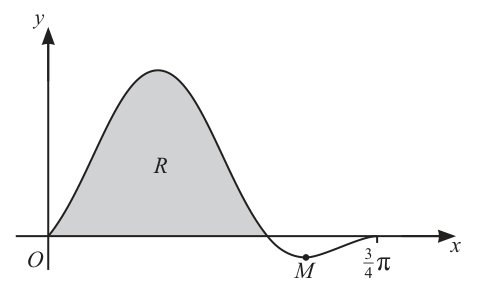
The diagram shows the curve , for , and its minimum point . The shaded region bounded by the curve that lies above the -axis and the -axis itself is denoted by .
Approach
To find the minimum point , differentiate with respect to using the product rule, set , and solve for within the given interval . Then substitute back into the original equation to find .
Working
Given .
Differentiate using the product rule:
Set :
This gives two cases:
We are given that , which means .
- For in this range, . At this point, . This is an x-intercept, not the minimum point described as being strictly inside the interval.
- For in the range (third quadrant), the reference angle is , so .
Substitute into the original equation:
Thus, the coordinates of are .
Answer
M = (7π/12, -1/4)
Walkthrough
First, we differentiate the function using the product rule. Let and . Then and . Applying , we get , which simplifies to .
Next, we set the derivative to zero to find stationary points. This gives or . We restrict our attention to the interval , meaning . In this third-quadrant range, at (giving ), but this yields , which is an intercept. The equation has the solution , so . Substituting this back into with gives .
Key Takeaways
- The product rule is essential for differentiating products of trigonometric functions.
- When finding stationary points in a restricted interval, always check which solutions fall within the specified range and evaluate the function to distinguish between maxima, minima, and intercepts.
Common Mistakes
- Forgetting the chain rule when differentiating (must multiply by 2).
- Missing the solution and only considering .
- Using degrees instead of radians when the question asks for exact answers in terms of .
Things to Be Careful About
- The interval for is , so is in . Be careful to find the correct angle in this range for .
- The question asks for exact coordinates, so do not give decimal approximations.
Approach
The region is bounded by the curve and the x-axis where . From the diagram and the function , at and (since at ). Between and , , so . The area is given by . We expand the integrand and use the double angle identity to integrate.
Working
The area of region is:
Expand the integrand:
Use the identity :
Integrate term by term:
Evaluate at the upper limit :
Evaluate at the lower limit :
Subtract the lower limit value from the upper limit value:
Answer
π/4 + 1
Walkthrough
Region is the area under the first hump of the curve, above the x-axis. The curve intersects the x-axis when (at ) or (at ). Between and , is positive, so is positive. Thus, the limits of integration are and .
We integrate . To integrate , we use the double angle identity , which rearranges to . This transforms the integral into .
Integrating term by term gives . Evaluating this from to : at , we get ; at , we get . The difference is .
Key Takeaways
- Always determine the correct limits of integration by finding where the curve intersects the bounding line (here, the x-axis).
- Trigonometric identities like are crucial for integrating squared trigonometric functions.
- Be careful with signs when evaluating definite integrals, especially with negative values at the lower limit.
Common Mistakes
- Using incorrect limits (e.g., integrating up to instead of , which would include the negative area below the x-axis).
- Forgetting to halve the coefficient when integrating (must divide by 4).
- Sign errors when evaluating .
Things to Be Careful About
- The question asks for the area of the region bounded by the curve that lies above the x-axis. This restricts the limits to .
- Ensure all answers are exact; do not use decimal approximations for .
Let .
Approach
Since the denominator contains the irreducible quadratic , use the partial fraction form
Clear denominators, expand, and equate coefficients of , and the constant term.
Working
Multiplying by :
Expanding the right-hand side:
Equating coefficients:
Solving these equations gives:
Answer
f(x) = 1/(1+2x) + (2x+3)/(2+x^2)
Walkthrough
We want to write the fraction as a sum of simpler fractions. The denominator has a linear factor and a quadratic factor . Because cannot be factored into real linear factors, we must use a numerator of the form over it; if we used a constant, we could not match all the terms in the numerator.
Set
Multiply both sides by the denominator to remove fractions. Then expand the right-hand side and group by powers of . Comparing the coefficients of , and the constant term gives three equations. Solving them gives , , , so the partial fraction decomposition is complete.
Key Takeaways
- A quadratic denominator that cannot be factored over the reals requires a linear numerator in partial fractions.
- Clearing denominators and equating coefficients is a reliable method for finding the constants.
- Always check that the number of equations matches the number of unknown constants.
Common Mistakes
- Using instead of ; this cannot represent the term in the numerator.
- Errors in expanding , especially the and terms.
- Solving the simultaneous equations incorrectly because of sign errors.
Things to Be Careful About
- The linear factor is , not ; the constant term in the denominator is 1.
- When equating coefficients, include the constant term from , which is .
- There is no need to factor ; it is already irreducible over the reals.
Approach
Use the partial fraction result from part (a). Expand each term using the binomial theorem for negative indices, then collect only the coefficient of .
Working
First term:
so the coefficient of from this term is .
Second term:
Therefore
The only contribution to is
Total coefficient of :
Answer
-17/2
Walkthrough
After part (a), write
For the first term, use the binomial expansion for a negative index:
with . The term is , so its coefficient is .
For the second term, factor out :
Expanding only as far as needed:
Multiplying by , the term can only come from times the term, because times the expansion gives only even powers. This contribution is
Adding the two coefficients gives .
Key Takeaways
- Binomial expansions with negative indices are infinite series; we only need the terms up to the required power.
- When multiplying series, identify which product of terms can produce the required power.
- Partial fractions turn a complicated expansion into a sum of simpler binomial expansions.
Common Mistakes
- Forgetting the factor when expanding .
- Missing the minus sign in the term of .
- Using only the first term and forgetting the contribution from the second partial fraction.
- Trying to expand without first factoring out .
Things to Be Careful About
- The expansion of is valid for , and for ; the coefficient of is still found by the same series.
- The coefficient is requested, not the full term; the final answer is .
- If you use the binomial coefficient formula, remember the signs alternate: .
Given that and that is a real number, express in the form , where and are functions of .
Approach
To express in the form , multiply the numerator and denominator by the complex conjugate of the denominator.
Working
Multiply numerator and denominator by the conjugate :
Expand the denominator using the difference of two squares:
So:
Separate into real and imaginary parts:
Therefore:
Answer
a = 1/(1+y^2), b = -y/(1+y^2)
Walkthrough
We are given and need to express in Cartesian form . The standard technique is to multiply numerator and denominator by the complex conjugate of the denominator. The conjugate of is . Multiplying gives . The denominator simplifies via the difference of two squares: since . Dividing both terms in the numerator by the real denominator gives the real part and the imaginary part .
Key Takeaways
- To find for , multiply by the conjugate over itself.
- The denominator becomes , which is always real and positive (for ).
- Always separate the result into real and imaginary components explicitly.
Common Mistakes
- Forgetting to multiply both numerator and denominator by the conjugate.
- Writing instead of , which gives the wrong denominator.
- Not clearly identifying which part is and which is .
Things to Be Careful About
- The question asks for and as functions of , so leave them in terms of .
- The imaginary part is , which is negative when . Do not drop the minus sign.
Approach
Substitute the expressions for and from part (a) into , expand, and simplify to show the result equals .
Working
From part (a):
Substitute into :
Expand the first bracket using :
Simplify the middle term:
Combine the first and last terms over the common denominator :
Simplify :
The first two terms cancel:
Answer
(a - 1/2)^2 + b^2 = 1/4
Walkthrough
We substitute and into . First, expand as , giving . Then . Adding the two squared terms: . This exactly cancels the term, leaving only .
Key Takeaways
- When proving an identity involving complex number components, substitute and expand carefully.
- Combining fractions with the same denominator is a key simplification step.
- The result is the equation of a circle, which connects to part (c).
Common Mistakes
- Expanding incorrectly (e.g., forgetting the term or getting the sign wrong).
- Not combining into before cancelling.
- Algebraic errors when simplifying to .
Things to Be Careful About
- The question says "show that", so you must show full working — unsupported answers earn no marks.
- Follow their answer from part (a); if part (a) was wrong, part (b) can still be awarded method marks for correct substitution.
- The final answer must be , not an expression in .
On a single Argand diagram, sketch the loci given by the equations and , where is a complex number.
Approach
Interpret each equation geometrically on the Argand diagram, then sketch both loci.
Working
Locus 1:
Let . Then . This is a vertical straight line passing through the point on the real axis, parallel to the imaginary axis.
Locus 2:
Let . Then:
Squaring both sides:
This is the equation of a circle with centre , i.e., , and radius .
The circle passes through the origin and the point , and intersects the imaginary axis at and .
Answer
The locus is a vertical line through . The locus is a circle with centre and radius .
Vertical line x = 1 and circle centre (1/2, 0) radius 1/2
Walkthrough
We need to sketch two loci on an Argand diagram.
For : If , then . Setting gives a vertical line through the point on the real axis. This line is parallel to the imaginary (y) axis.
For : The expression represents the distance from to the point in the Argand diagram. So is the set of all points at distance from . This is a circle with centre and radius .
Key points on the circle:
- Centre:
- Passes through origin: ✓
- Passes through : ✓
- Intersects imaginary axis at : — actually these are NOT on the circle. The circle intersects the imaginary axis where : , so , meaning it only touches the imaginary axis at the origin.
Key Takeaways
- is always a vertical line .
- is always a circle with centre and radius .
- The Argand diagram uses the real axis as the horizontal axis and the imaginary axis as the vertical axis.
Common Mistakes
- Drawing the circle with centre at the origin instead of at .
- Drawing the vertical line at (the imaginary axis) instead of .
- Forgetting to label axes as and .
Things to Be Careful About
- The circle passes through the origin and , and is entirely in the right half-plane ().
- The vertical line is tangent to the circle at the point .
- The mark scheme awards marks for: correct vertical line through , correct circle centre at , and correct radius with centre not at the origin.
The complex number is such that . Use your answer to part (b) to give a geometrical description of the locus of .
Approach
Use the result from part (b) and the condition to describe the locus of geometrically.
Working
From part (a), when (i.e., with real), we have:
From part (b), we showed that:
This is the equation of a circle in the - plane (which is the Argand diagram for ) with:
- Centre: , i.e.,
- Radius:
As varies over all real numbers, the point traces out this circle. Note that when , , which is the point on the circle. As , , so the origin is approached but never reached (since is finite).
Answer
The locus of is a circle with centre and radius .
Circle with centre 1/2 + 0i and radius 1/2
Walkthrough
We are told that , so for some real number . From part (a), where and . From part (b), these satisfy .
The equation is the standard form of a circle equation with centre and radius .
In the Argand diagram for (where the horizontal axis is and the vertical axis is ), this describes a circle centred at with radius .
Note: The origin is on this circle (when : ✓), but never actually equals for any finite . The mark scheme concedes inclusion of the origin.
Key Takeaways
- Part (b) establishes that the transformation maps the vertical line to a circle.
- This is an example of a Möbius transformation mapping lines to circles (or lines).
- The equation directly gives the centre and radius.
Common Mistakes
- Describing the locus as a line instead of a circle.
- Getting the centre or radius wrong from the equation .
- Forgetting to mention that this is the locus of , not of .
Things to Be Careful About
- The question asks for a geometrical description, so state centre and radius clearly.
- The origin lies on the circle but is not actually attained by for any finite ; however, the mark scheme concedes inclusion of the origin.
- Reference the result from part (b) explicitly to show the connection.
The position vector of point relative to the origin is .
The line passes through and is parallel to the vector .
Approach
A line through a point with position vector and parallel to direction vector has equation .
Working
Here and . Therefore
Answer
r = 8i - 5j + 6k + λ(2i + j + 4k)
Walkthrough
A vector equation of a line needs two pieces of information: a point on the line and a direction parallel to the line. Here the point is with position vector , and the direction is the given vector . The standard form is , where is a scalar parameter. Substituting the given vectors gives the equation directly.
Key Takeaways
The vector equation of a line is . It is not unique: any point on the line and any non-zero scalar multiple of the direction vector give an equivalent equation.
Common Mistakes
- Using the direction vector as the position vector, or omitting the parameter .
- Writing the equation as instead of .
Things to Be Careful About
The parameter is often denoted or ; any letter is acceptable. The direction vector must be parallel to the line, not perpendicular.
The position vector of point relative to the origin is , where is a constant. The line also passes through .
Find the value of .
Approach
Since lies on , its position vector must equal the vector equation of for some value of . Equate components and solve for and .
Working
Let be . For :
From the first equation, . Substitute into the second:
Then . Check the third equation: and .
Answer
t = -2
Walkthrough
We know that lies on the line . This means there is one value of the parameter for which the position vector of is exactly the same as the position vector given by the equation of . Write the line equation in components: , , . These must equal , and respectively. Use the first equation to express in terms of , substitute into the second to find , then find . Finally check that the third component is also satisfied.
Key Takeaways
A point lies on a line if its position vector satisfies the line equation for some parameter value. Equating components gives simultaneous equations that can be solved for the unknown parameter and any other unknown constant.
Common Mistakes
- Using different parameters for different components. The same must work for all three components.
- Confusing the constant in the coordinates of with the parameter of the line.
- Sign errors when substituting into .
- Forgetting to check the third component after solving two equations.
Things to Be Careful About
If the third component did not match, the point would not lie on the line, so the check is important. Here it does match, confirming .
The line has vector equation . The acute angle between the directions of and is , where .
Find the possible values of .
Approach
The direction of is and the direction of is . Use the scalar product formula
Since is the acute angle between the lines, use and solve for .
Working
So
Squaring both sides:
Divide by 3:
So or .
Answer
a = -2 or a = -86
Walkthrough
The direction of a line given by is the vector . For the direction vector is ; for it is . The cosine of the angle between two direction vectors is their scalar product divided by the product of their magnitudes. Compute the scalar product: . Compute the magnitudes: and . The angle between the lines is acute, so its cosine is positive, but the scalar product of the chosen direction vectors may be positive or negative depending on the orientation. Therefore we set the expression equal to . Squaring removes the sign and gives a quadratic equation in . Solving it gives the two possible values.
Key Takeaways
The scalar product formula connects vectors to angles. For the acute angle between lines, use the absolute value of the cosine, which is why the sign appears. Solving the resulting equation often leads to a quadratic.
Common Mistakes
- Forgetting the sign, which would lose one solution.
- Sign errors in the scalar product, especially the from .
- Writing the magnitude of as incorrectly; it is .
- Squaring incorrectly: remember to square the whole numerator and denominator.
Things to Be Careful About
Both and are valid. For the scalar product is positive; for it is negative, but the acute angle between the two lines is the same because a direction vector can be reversed. Always check that the values satisfy the original equation after squaring.
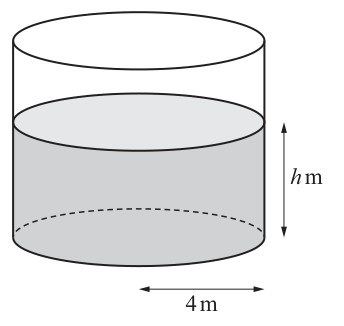
A large cylindrical tank is used to store water. The base of the tank is a circle of radius 4 metres. At time minutes, the depth of the water in the tank is metres. There is a tap at the bottom of the tank. When the tap is open, water flows out of the tank at a rate proportional to the square root of the volume of water in the tank.
Approach
Relate the volume of water to the depth using the formula for the volume of a cylinder. Use the given proportionality for the rate of change of volume and the chain rule to find .
Working
The volume of water in the cylindrical tank with radius and depth is:
Differentiating with respect to :
The rate at which water flows out is proportional to . Since water is leaving the tank, is negative. Let be a positive constant of proportionality:
Substitute :
Using the chain rule, :
Solve for :
Let . Since and are positive constants, is a positive constant.
Answer
Shown as required.
dh/dt = -lambda sqrt(h)
Walkthrough
First, we express the volume of water in terms of the depth . For a cylinder of radius 4, . Differentiating this gives .
Next, we translate the word statement 'water flows out at a rate proportional to the square root of the volume' into a mathematical equation. Since the volume is decreasing, for some . Substituting gives .
We then use the chain rule to link the rate of change of volume to the rate of change of depth. Equating the two expressions for allows us to solve for . The constant coefficient is renamed to match the required form.
Key Takeaways
- Volume of a cylinder is .
- Related rates problems often require the chain rule to connect variables.
- Proportionality in a decreasing quantity implies a negative constant of proportionality.
Common Mistakes
- Forgetting the negative sign in , which is crucial because the water level is dropping.
- Incorrectly applying the chain rule or forgetting to multiply by .
- Not simplifying correctly to .
Things to Be Careful About
- Ensure is shown to be positive since and are positive.
- The question asks to 'show', so the final line must match the required expression exactly.
At time the tap is opened. It is given that when and that when .
Solve the differential equation to obtain an expression for in terms of , and hence find the time taken to empty the tank.
Approach
Separate the variables in the differential equation and integrate. Use the given initial conditions ( and ) to find the constants and . Finally, set to find the time to empty the tank.
Working
Separate variables:
Integrate both sides:
Apply the first boundary condition: when , :
Substitute into the equation:
Apply the second boundary condition: when , :
Substitute back into the equation:
Rearrange to obtain in terms of :
To find the time taken to empty the tank, set :
Answer
Time to empty the tank is 80 minutes.
t = 80 - 40sqrt(h); 80 minutes
Walkthrough
We start with the differential equation . Separating variables gives . Integrating both sides yields .
We use the initial condition when to find : .
We then use the second condition when to find : .
Substituting these constants back gives . Rearranging for gives .
Finally, the tank is empty when . Substituting gives minutes.
Key Takeaways
- Separation of variables is a standard technique for first-order ODEs of the form .
- Integration of gives ; here .
- Boundary conditions are used to determine constants of integration.
- Physical interpretation: 'empty tank' means depth .
Common Mistakes
- Forgetting the constant of integration .
- Sign errors when rearranging the equation for .
- Calculating incorrectly (it is 1.5).
- Forgetting to set at the end to find the emptying time.
Things to Be Careful About
- Ensure the final expression for is explicitly solved for .
- Check that is positive as derived in part (a).
- Units are in minutes, so the final answer is 80 minutes.