Mathematics 9709/42 — May/June 2024
Cambridge A-Level · Mechanics · worked solutions for every part, with the mark scheme
Topics Energy, Work and Power · Forces and Equilibrium · Kinematics of Motion in a Straight Line · Momentum · Newton's Laws of Motion
A cyclist and bicycle have a total mass of . The cyclist rides along a horizontal road against a total resistance force of .
Find the total work done by the cyclist to increase his speed from to while travelling a distance of metres.
Approach
Use the work-energy principle: the work done by the cyclist equals the increase in kinetic energy plus the work done against the resistance force.
Working
Initial kinetic energy:
Final kinetic energy:
Increase in kinetic energy:
Work done against resistance:
Work-energy equation:
Therefore:
Answer
The total work done by the cyclist is .
9712 J
Walkthrough
This is a work-energy problem. The cyclist does work to increase the bicycle's kinetic energy, but some of that work is lost overcoming the resistance force. We therefore need three pieces: the initial kinetic energy, the final kinetic energy, and the work done against resistance.
First calculate the initial kinetic energy using with and :
Then calculate the final kinetic energy with :
The increase in kinetic energy is the difference:
Next, work done against resistance is force times distance:
The work-energy principle states that the net work done on the object equals its change in kinetic energy. Here the cyclist's work is positive, while resistance does negative work. So:
Solving gives:
An alternative method uses suvat to find the acceleration and then Newton's second law to find the driving force, but the work-energy method is more direct.
Key Takeaways
- Kinetic energy is .
- Work done by a constant force is when force and displacement are in the same direction.
- The work-energy principle connects net work to change in kinetic energy.
- When a resistance force acts, the driving work must overcome both the resistance and the increase in kinetic energy.
Common Mistakes
- Forgetting to include the work done against resistance.
- Using the change in speed () instead of the change in when finding the kinetic energy increase.
- Sign errors: resistance work should be subtracted from the cyclist's work in the net work equation.
- Using the total distance incorrectly, e.g. multiplying resistance by instead of distance.
- Giving an unsupported final answer; the mark scheme requires the work-energy equation to be shown to earn the method mark.
Things to Be Careful About
- The mass is for the whole cyclist and bicycle; do not split it.
- The speeds are in and distance in metres, so the work is in joules.
- In the mark scheme, the final answer may be written as ; is condoned as a rounding, but the exact value is preferred.
- The mark scheme says "Do not ISW", so if a candidate gives a correct value then writes incorrect subsequent working, the subsequent working should not be ignored.
- Show the work-energy equation with all four terms to earn the method mark; an unsupported answer may not receive full credit.
A particle moves in a straight line. At time after leaving a point on the line, has velocity , where .
Approach
Acceleration is the rate of change of velocity, so differentiate with respect to . Then require the acceleration to be positive and solve the resulting inequality, remembering that .
Working
Differentiate :
For positive acceleration:
Since , the set of values is:
Answer
0 <= t < 11/3
Walkthrough
The velocity function is . Since acceleration is the derivative of velocity with respect to time, differentiate each term:
So
We need this acceleration to be positive, so we solve
Rearranging gives
Because represents time after the particle leaves , cannot be negative. Therefore the valid set is .
Key Takeaways
- Acceleration is the rate of change of velocity: .
- Differentiating a polynomial is done term by term.
- The time domain is important when giving a set of values for kinematics problems.
Common Mistakes
- Using instead of differentiating ; this scores no method mark.
- Solving and giving instead of the strict inequality .
- Including negative values of , which are not meaningful after leaving point .
Things to Be Careful About
- The inequality must be strict because the question asks for positive acceleration, not zero acceleration.
- If a lower limit is included, it must be : either or is acceptable.
- The mark scheme allows equivalent decimal or fractional answers such as or .
Approach
Displacement is the integral of velocity. Integrate , impose the initial condition at that when , then set the displacement equal to zero and solve for . The root is the initial instant at , so exclude it.
Working
Since starts at , when , so :
Returning to means :
Factorise:
Thus , or . Since is the starting time at , the two return times are:
Answer
t = 2 and t = 9
Walkthrough
To find when the particle returns to , we need its displacement from as a function of time. Displacement is the integral of velocity, so integrate term by term:
At , the particle is at , so . This gives , and therefore
Returning to means the displacement is zero again:
Factor out :
The quadratic factorises further:
So the solutions are , , and . The value is simply the starting instant at , not a return to . Therefore the two required values are and .
Key Takeaways
- Displacement is the integral of velocity with respect to time.
- The constant of integration must be found using the initial condition at the starting point.
- A particle returns to the origin when its displacement is zero, not when its velocity is zero.
- Cubic equations can often be solved by factorisation after taking out a common factor.
Common Mistakes
- Using instead of integrating ; this is invalid because the velocity is not constant.
- Forgetting the constant of integration. Here , but it must still be justified by at .
- Trying to solve the cubic by expanding incorrectly, or missing the factor .
- Including as one of the return times. It is the initial time at , not a return.
Things to Be Careful About
- The expression must be set equal to zero, not equated to the velocity.
- The factorisation is , giving roots , , and .
- Since the question asks for the two values at which returns to , only and should be given.
- The units are seconds; the answer can be stated as and seconds.
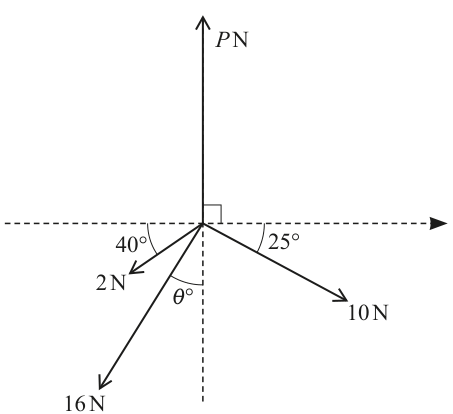
Four coplanar forces of magnitude , , and act at a point in the directions shown in the diagram. It is given that the forces are in equilibrium.
Find the values of and .
Approach
Since the four forces are coplanar and in equilibrium, the vector sum of all forces must be zero. This means the sum of the horizontal components is zero and the sum of the vertical components is zero. We resolve the forces horizontally and vertically to form two equations in the two unknowns and .
Working
Horizontal resolution:
Taking forces to the right as positive, the rightward component is . The leftward components are (from the 2 N force) and (from the 16 N force, noting that is measured from the vertical).
Calculating the numerical values:
Solving for :
Rounding to 3 significant figures:
Vertical resolution:
Taking forces upwards as positive, the upward force is . The downward components are (from the 10 N force), (from the 16 N force), and (from the 2 N force).
Substituting the unrounded value :
Calculating the numerical values:
Rounding to 3 significant figures:
Answer
theta = 28.1 degrees, P = 19.6 N
Walkthrough
The problem states that four coplanar forces act at a point and are in equilibrium. The fundamental principle here is that for a system of forces to be in equilibrium, the resultant force in any direction must be zero. We choose two perpendicular directions (horizontal and vertical) to resolve the forces.
Step 1: Horizontal Resolution
We look at all forces and their horizontal components. Taking the right direction as positive:
- The 10 N force is at below the positive x-axis, so its horizontal component is to the right.
- The 2 N force is at below the negative x-axis, so its horizontal component is to the left.
- The 16 N force is at to the negative y-axis. Since the angle is measured from the vertical, the horizontal component is to the left.
Setting the sum of rightward forces equal to the sum of leftward forces:
We rearrange this to isolate :
Evaluating this gives , so .
Step 2: Vertical Resolution
Now we consider the vertical components. Taking the upward direction as positive:
- The force acts vertically upwards.
- The 10 N force has a vertical component of downwards.
- The 16 N force has a vertical component of downwards (since is from the vertical).
- The 2 N force has a vertical component of downwards.
Setting the upward force equal to the sum of downward forces:
Substituting the value of found in Step 1 (using the unrounded value for accuracy) gives N.
Key Takeaways
- Equilibrium condition: For coplanar forces in equilibrium, and . This provides two independent equations for two unknowns.
- Resolving forces: Always identify the reference axis for each angle. If an angle is given to the horizontal, use cosine for the horizontal component and sine for the vertical. If given to the vertical, use sine for the horizontal and cosine for the vertical.
- Accuracy in intermediate steps: When solving for one unknown to substitute into another equation, always use the unrounded value to avoid compounding rounding errors.
Common Mistakes
- Mixing up sine and cosine: A very common error is using for the horizontal component of the 16 N force. Since is measured from the vertical (negative y-axis), the horizontal component must be .
- Sign errors: Forgetting that forces pointing left or down are negative when setting up the equilibrium equations. It is often safer to write and to avoid sign confusion.
- Rounding too early: Calculating and rounding to before substituting into the vertical equation can lead to a slightly incorrect value for (e.g., might still be correct, but in other cases it could push the answer to the next rounding boundary).
Things to Be Careful About
- Angle references: Pay close attention to how angles are defined in the diagram. The 2 N force is at to the horizontal (negative x-axis), while the 16 N force is at to the vertical (negative y-axis). This difference dictates whether sine or cosine is used for each component.
- Units: Ensure the final answer for includes the unit of force (Newtons, N), while is an angle (degrees).
- Mark scheme guidance: The mark scheme allows sign errors in the initial resolution equation (M1) as long as the correct number of relevant terms are present, but the final numerical answers must be correct to 3 significant figures.
A car has mass . When the speed of the car is the magnitude of the resistance to motion is where is a constant.
The car moves at a constant speed of up a hill inclined at an angle of to the horizontal where . At this speed the magnitude of the resistance to motion is .
Approach
Use the formula for resistance: at speed , resistance . Substitute the given speed and resistance and solve for .
Working
At , the resistance is :
Answer
k = 5/6
Walkthrough
We are told that the resistive force has magnitude . At the instant the speed is , this equals , so we can substitute these values directly.
It may help to think of this as:
Then divide both sides by to obtain .
Key Takeaways
This part tests the direct use of a given force model. To find an unknown constant in a formula, substitute the corresponding known quantities and solve.
Common Mistakes
- Substituting and instead of the other way round.
- Forgetting to square the speed.
- Simplifying incorrectly.
Things to Be Careful About
The resistance is given in newtons when is in . The constant will have units of , but in mechanics numerical problems we usually only need its value. No diagram is required.
Approach
Since the car moves at constant speed, acceleration is , so the resultant force along the slope is zero. Resolve forces parallel to the slope: driving force must balance the resistance plus the component of the car’s weight down the slope. Then use .
Working
Along the slope:
With , and :
Therefore the power is
Answer
The power of the car’s engine is (or ).
51840 W
Walkthrough
Constant speed means the acceleration is zero. Newton’s second law therefore tells us that the net force along the direction of motion is zero.
On the hill, three forces act in the direction parallel to the slope: the driving force forwards, the resistance backwards, and the component of the car’s weight down the slope. To resolve the weight, multiply by , because the component along a slope inclined at angle is .
Set the forward driving force equal to the sum of the two backward forces:
Finally, the power of the engine is the rate at which the driving force does work, given by when the car is moving at constant speed in the direction of the force.
Key Takeaways
- On an incline, the component of weight along the slope is .
- At constant speed the resultant force is zero.
- Power supplied by an engine equals driving force times speed for motion in the line of the force.
Common Mistakes
- Using instead of for the component along the slope.
- Forgetting the resistance term when setting up the balance of forces.
- Using with the wrong force, or forgetting that power uses the driving force, not the net force.
- If acceleration is zero, treating the car as if it still has a nonzero resultant force.
Things to Be Careful About
The mark scheme expects a clear statement of Newton’s second law with three terms in the balance, so show all three forces. Also, if the final answer is given in kW, include the unit; otherwise a bare number may not be accepted.
The car now moves at a constant speed on a straight level road.
Given that its engine is working at , find this speed.
Approach
On a level road the car moves at constant speed, so acceleration is zero and the driving force equals the resistance. Express the driving force in terms of using , equate it to , and solve the resulting cubic equation.
Working
Let the speed be . The resistance is
At constant speed on level ground,
Using with :
Hence the speed is .
Answer
40.2 m s^-1
Walkthrough
On a level road the car’s weight is perpendicular to the motion, so it does not have a component along the road. Since the car moves at constant speed, there is no acceleration. Newton’s second law along the horizontal direction gives:
so the driving force equals the resistance.
The engine power is related to force and speed by . Substituting :
Solve this cubic by multiplying by and taking the cube root.
Key Takeaways
- On level ground at constant speed, the driving force is exactly balanced by the resistance.
- links engine power, driving force and speed.
- When power is constant but resistance depends on , the speed satisfies a cubic equation.
Common Mistakes
- Using instead of in the power equation.
- Using as the driving force directly, without multiplying by for power.
- Forgetting to convert to .
- Taking a square root instead of a cube root.
Things to Be Careful About
The mark scheme allows follow-through on the value of from part (a), so if you used a different , still set up and solve. The final speed must be positive; the cubic has one real positive root here. Include units in the final answer.
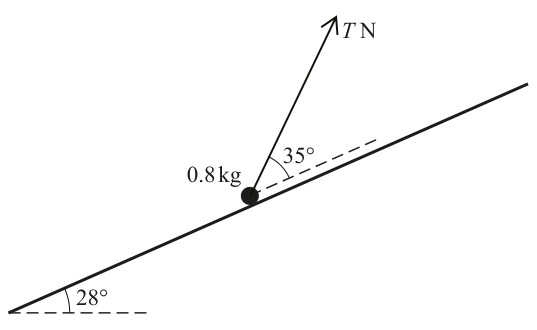
A particle of mass lies on a rough plane which is inclined at an angle of to the horizontal. The particle is kept in equilibrium by a force of magnitude . This force acts at an angle of above a line of greatest slope of the plane (see diagram). The coefficient of friction between the particle and the plane is .
Find the least and greatest possible values of .
Approach
Resolve the forces acting on the particle perpendicular and parallel to the inclined plane. Since the particle is in equilibrium with friction potentially acting in either direction along the plane, consider the two cases of limiting equilibrium: impending motion up the plane (minimum ) and impending motion down the plane (maximum ). Use the limiting friction condition to solve for in each case.
Working
Resolving perpendicular to the plane:
The forces perpendicular to the plane are the normal reaction (upwards), the component of perpendicular to the plane (, upwards), and the component of weight perpendicular to the plane (, downwards). Equating forces perpendicular to the plane:
Resolving parallel to the plane:
The forces parallel to the plane are the component of parallel to the plane (, up the plane), the component of weight parallel to the plane (, down the plane), and the frictional force .
Case 1: Impending motion down the plane (greatest )
Friction acts up the plane to oppose the motion. Equating forces parallel to the plane:
Case 2: Impending motion up the plane (least )
Friction acts down the plane to oppose the motion. Equating forces parallel to the plane:
Using limiting friction :
Substitute into :
For Case 1 (greatest ):
For Case 2 (least ):
Answer
The least possible value of is N and the greatest possible value is N.
Least T = 3.33 N, Greatest T = 5.53 N
Walkthrough
First, we resolve the forces perpendicular to the inclined plane to find an expression for the normal reaction in terms of . The forces are the normal reaction acting upwards perpendicular to the plane, the perpendicular component of the applied force also acting upwards, and the perpendicular component of the weight acting downwards. Setting the sum of upward forces equal to the downward force gives .
Next, we resolve the forces parallel to the plane. The parallel component of the applied force is acting up the plane, and the parallel component of the weight is acting down the plane. Friction acts parallel to the plane to oppose impending motion.
Since we want the least and greatest values of , we consider the two limiting cases:
- Greatest : The particle is on the verge of sliding up the plane. Friction acts down the plane. The equation is .
- Least : The particle is on the verge of sliding down the plane. Friction acts up the plane. The equation is .
At limiting equilibrium, the frictional force is . We substitute the expression for from the perpendicular resolution into this friction equation, giving . Substituting this into both parallel resolution equations allows us to solve for in each case, yielding N for the greatest value and N for the least value.
Key Takeaways
- Resolving forces perpendicular and parallel to an inclined plane is a fundamental technique in equilibrium problems.
- When finding the range of a force for equilibrium on a rough surface, always consider both directions of impending motion (up and down the plane) to account for friction acting in opposite directions.
- The limiting friction condition must be applied at the boundary of equilibrium.
Common Mistakes
- Forgetting to consider both cases of impending motion (only finding one value of instead of the least and greatest).
- Resolving incorrectly by mixing up sine and cosine components for the angle of the applied force relative to the plane.
- Using the wrong angle for the weight components (must use , the angle of the plane to the horizontal).
- Not substituting correctly or making algebraic errors when solving the simultaneous equations.
Things to Be Careful About
- Ensure is used consistently throughout the calculation.
- Keep intermediate values to at least 4-5 decimal places to avoid rounding errors in the final answer.
- The final answers should be given to 3 significant figures as per standard practice (3.33 and 5.53).
Three particles , and of masses , and respectively lie at rest in that order on a straight smooth horizontal track . Initially is at , is at and is at . Particle is projected towards with a speed of and at the same instant is projected towards with a speed of . In the subsequent motion, collides and coalesces with to form particle . Particle then collides and coalesces with to form particle and moves towards .
Approach
Take the direction from towards as positive. For each collision the particles coalesce, so they have a common velocity afterwards. Since the track is smooth and horizontal, horizontal momentum is conserved in each direct impact.
Working
First collision: (mass , speed ) hits stationary (mass ) and they form .
Second collision: (mass , speed ) moves towards , while (mass ) moves towards with speed , so in the positive direction its velocity is .
Answer
Speed of E is (15 - v)/4 m/s
Walkthrough
Here two separate impacts occur. In an impact where the particles coalesce, the final object has mass equal to the sum of the two masses and moves with one common velocity. No external horizontal force acts during the impact because the track is smooth and horizontal, so the total horizontal momentum is conserved.
For the first impact, only is moving before the impact; is initially at rest. Therefore
which gives .
For the second impact, choose positive direction from to . The combined particle moves in this direction, so its momentum is positive. Particle , however, is projected from towards , which is the negative direction, so its velocity is and its momentum is . Setting total momentum before equal to total momentum after gives
Substituting and solving gives , as required.
Key Takeaways
- In a coalescing collision the two masses stick together, so the final mass is the sum of the masses.
- Momentum is conserved in a direct impact on a smooth horizontal track.
- A velocity in the opposite direction to the chosen positive direction must be given a negative sign.
Common Mistakes
- Forgetting that is moving towards , not away from it, and writing its velocity as .
- Using the mass of twice, or forgetting to add the masses of and when forming .
- Treating the two collisions as if they could be combined into one collision.
Things to Be Careful About
- This is a show that result: the final answer must be written in terms of and all working must be shown.
- The speed must be positive; the formula is consistent with moving towards only when .
The total loss of kinetic energy of the system due to the two collisions is .
Use the result from (a) to show that .
Approach
The total kinetic energy after both collisions is the kinetic energy of the single final particle , because all mass has coalesced. The loss in kinetic energy is
Use the speed of obtained in part (a), then solve the resulting quadratic in .
Working
Initial kinetic energy of the system:
Final kinetic energy, when the single particle has mass and speed :
Loss:
Since is a speed, , so .
Answer
v = 3
Walkthrough
Before any collision, the moving particles are and , so the initial kinetic energy has two terms: for and for . After both collisions every particle has coalesced into , so the final kinetic energy is just the kinetic energy of one particle of mass moving at the speed from part (a).
Subtract final KE from initial KE and set the loss equal to . Clearing the fraction gives a quadratic equation. Factorising gives or . Since is a speed and is projected towards , only is physically possible.
Key Takeaways
- Kinetic energy is not conserved in a perfectly inelastic (coalescing) collision; use conservation of momentum to find speeds, then calculate energy loss.
- The total kinetic energy after all collisions is that of the single final combined object.
- A negative speed is not physically valid.
Common Mistakes
- Forgetting the second initial kinetic energy term for particle .
- Using in the final kinetic energy, or failing to use the result from part (a).
- Setting the loss equal to or not clearing the fraction correctly.
- Giving as a valid solution without discarding it.
Things to Be Careful About
- This is also a show that result. The mark scheme requires the algebraic solving of the quadratic to be shown; just writing the quadratic and the answer is not enough.
- When clearing the fraction, multiply every term by .
It is given that the distance is and the distance is .
Approach
First find how long takes to travel at . During this time also moves, so find how far is from when the first collision occurs. After the first collision, and move towards each other; use their combined approach speed to find the time until the second collision.
Working
Time for to reach :
In these , moves distance from . Therefore the distance from to (at ) is
After the first collision, has speed towards , and has speed towards . If the time between the collisions is seconds, the sum of the distances they travel before meeting is the gap of :
Answer
The time between the two collisions is seconds.
10 s
Walkthrough
Assume all particles move with constant speeds, because after projection or coalescence there is no horizontal force on a smooth track. takes seconds to travel . At this moment has also been moving for seconds at , so it has covered from . Since , the gap between and the point is .
After and coalesce, starts from at towards , while continues at towards . Together they close the gap at , so the time is seconds.
Key Takeaways
- Distance = speed time can be used for constant-speed motion.
- To find when two moving objects meet, add their speeds when they travel towards each other.
- Position at the moment of the first collision is found by subtracting the distance has covered from .
Common Mistakes
- Using as the initial gap between and without subtracting 's motion during the first seconds.
- Treating the relative speed as instead of , since the two bodies move towards each other.
- Using for 's speed instead of from part (a).
Things to Be Careful About
- The mark scheme allows follow-through from the found in the first step.
- The gap is the distance between the particles at the instant of the first collision, not the original distance.
Find the time between the instant that is projected from and the instant that reaches .
Approach
After both collisions, moves towards with the speed found in part (a). The point at which the second collision occurs is exactly the point that has reached after moving from for the whole time up to that collision. So find that distance, divide by 's speed, and add all three stage times.
Working
From part (b), , so from part (a)
The second collision occurs after is projected. During that time has travelled from a distance
So takes to reach . Total time:
Answer
The time is seconds.
32 s
Walkthrough
The only new part is the journey of from the second collision point to . The second collision happens at the position that has reached. Since starts at and moves for seconds before the second collision, that point is from . has speed , so takes seconds to reach . Add the seconds for to reach and the seconds between collisions, giving seconds.
Key Takeaways
- The final stage time is found by dividing the remaining distance to by the speed of .
- The remaining distance can be found from the total distance has travelled from up to the second collision.
- Total journey time is the sum of the times of the separate stages.
Common Mistakes
- Forgetting to add all three stage times together.
- Using the whole distance as the distance must travel after the second collision.
- Forgetting that from part (b), so using an incorrect speed for .
Things to Be Careful About
- The second collision occurs seconds after is projected, not seconds after.
- All speeds are constant, so is valid for the final stage.
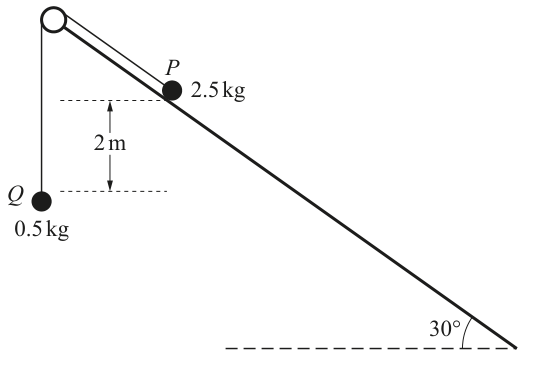
Two particles and of masses and respectively are connected by a light inextensible string that passes over a small smooth pulley fixed at the top of a plane inclined at an angle of to the horizontal. Particle is on the plane and hangs below the pulley such that the level of is below the level of (see diagram).
Particle is released from rest with the string taut and slides down the plane. The plane is rough with coefficient of friction between the plane and .
Approach
Apply Newton's second law to each particle separately. For P, resolve the weight along and perpendicular to the plane; friction acts up the plane because P slides down. For Q, the only forces are its weight and the tension. The string is inextensible, so both particles share the same magnitude of acceleration . Add the two equations to eliminate the tension and solve for .
Working
For particle on the inclined plane:
Perpendicular to the plane (no acceleration), the normal reaction balances the component of the weight:
Friction opposes P's motion down the plane, so it acts up the plane:
Along the plane (taking down-the-plane as positive for P, since P accelerates in that direction):
For particle (taking upward as positive, since Q accelerates upward when P slides down):
Adding equations (i) and (ii) eliminates :
Substitute :
Factor out on the left:
With :
Answer
(Using , the answer is m s, which matches the mark scheme.)
a ≈ 1.04 m s⁻²
Walkthrough
We have two particles connected by an inextensible string passing over a pulley at the top of a rough inclined plane. Because the string is inextensible, both particles share the same magnitude of acceleration . When P slides down the plane, Q rises vertically.
Step 1 — Normal reaction on P. Resolving the weight of P perpendicular to the plane and using the fact that P has no acceleration perpendicular to the surface gives .
Step 2 — Friction on P. The plane is rough with , so the friction force is . Because P is moving down the plane, friction acts up the plane to oppose this motion.
Step 3 — Newton's second law along the plane for P. Taking the down-the-plane direction as positive, the three forces contributing along the plane are: the weight component (positive), the tension (negative, up the plane), and the friction (negative, up the plane). This yields equation (i): .
Step 4 — Newton's second law for Q. For the hanging mass Q, taking upward as positive: .
Step 5 — Eliminate the tension. Adding (i) and (ii) cancels and gives the system equation .
Step 6 — Substitute and solve. Replacing with and using , the right-hand side becomes , giving m s.
Key Takeaways
- Connected particles on either side of a pulley share the same magnitude of acceleration.
- On a rough plane, friction always opposes the direction of motion, so it acts up the plane when P slides down.
- The cleanest approach is to write Newton's second law for each particle and then add the equations to eliminate the unknown tension.
Common Mistakes
- Forgetting to take the friction direction as opposite to motion (i.e., placing it on the wrong side of the equation).
- Using (the friction on a 0.5 kg particle) instead of (the friction on the 2.5 kg particle actually on the plane). The mark scheme explicitly warns about this: " is wrong; it should use the mass of P."
- Mixing up the sine and cosine: the component along the plane is , not .
- Treating the two particles as if they have different accelerations.
Things to Be Careful About
- The friction model only applies once the contact is rough; with and the system accelerating down the plane, this is the relevant case.
- The mark scheme accepts (using ); with the equivalent is , which is a slightly different numerical value but uses identical working. Both are "correct work"; the choice of is convention.
- The mass of P (2.5 kg) — not the mass of Q (0.5 kg) — must be used in the friction calculation.
Use an energy method to find the speed of the particles at the instant when they are at the same vertical height.
Approach
Let be the distance P slides down the plane; the string being inextensible means Q rises the same distance . Use the geometric condition that P and Q are at the same vertical height to find . Then apply the work–energy principle to the whole system: total KE gained equals the net loss of gravitational PE minus the work done against friction.
Working
Step 1 — Geometry to find .
When P moves a distance down the plane, its vertical drop is . Q rises a vertical distance . The initial vertical separation is m (Q is m below P), so the new vertical separation is . Setting this to zero:
So P's vertical drop is m, and Q's vertical rise is m.
Step 2 — Work–energy equation.
Both particles have the same speed at the instant in question. Take the system as a whole:
where from part (a).
The left-hand side simplifies:
With :
Answer
(Using , the answer is m s, which matches the mark scheme.)
v ≈ 1.66 m s⁻¹
Walkthrough
The question asks for the speed "at the instant when they are at the same vertical height", so the first step is to figure out how far each particle has moved at that instant. The energy equation cannot be set up until we know that distance.
Step 1 — Geometric condition. Let be the distance P travels down the slope. By the inextensibility of the string, Q rises the same distance vertically. P's vertical drop is . Setting the new vertical separation to zero:
P drops m; Q rises m. The mark scheme also lists an alternative: a time-based method using , which gives the same and hence the same distance — this is the "Special Case" route and only earns 2 marks.
Step 2 — Kinetic-energy change. Both particles share the same speed (same string, same inextensibility), so the total KE gained is .
Step 3 — Change in gravitational PE. P loses PE equal to ; Q gains PE equal to . The net PE change is (with in the appropriate units). The mark scheme accepts either calculating each term separately or using the combined factor (since ).
Step 4 — Work done against friction. From part (a), . Over the distance m that P slides, the work done against friction is .
Step 5 — Assemble the work–energy equation. KE gained = net PE lost − work done against friction:
With , , so m s.
Key Takeaways
- The work–energy principle for a system reads: total KE gained = total PE lost − energy dissipated (e.g., against friction).
- When two particles are connected by an inextensible string, both share the same speed (and the same magnitude of acceleration) at every instant, so the two KE terms share a single .
- The geometric condition "P and Q at the same height" converts a vertical-distance problem into a single equation in the unknown distance — this step is required before any energy balance can be set up.
- Friction always dissipates energy: the work done against friction is , where is the distance the contact surface moves (here, the distance P slides down the plane).
Common Mistakes
- Forgetting to subtract the PE gained by Q (a frequent error, since the system has two particles moving in opposite directions vertically).
- Using the wrong distance in the friction work — e.g., using (P's vertical drop) instead of (P's distance along the plane). Friction is a contact force along the plane, so the relevant distance is along the plane, not vertical.
- Mixing up the friction formula: , not . Only P is on the rough plane.
- Failing to find first and just plugging in m (the initial separation) or m.
- Using a "time-based constant acceleration" approach: the mark scheme caps this at 2 marks because it skips the energy reasoning the question explicitly asks for ("use an energy method").
Things to Be Careful About
- The string is over a pulley, so the distance moved by P along the plane equals the distance moved by Q vertically.
- The mark scheme accepts the alternative of working with (the vertical distance of Q below P's starting point); the relation is , giving m and m. Either parameterisation works.
- The mark scheme gives m s using ; with the equivalent is m s. Both come from the same equation .
- The "use an energy method" instruction is mandatory for full credit on this part: students who find purely from cap at 2 marks.