Mathematics 9709/33 — May/June 2024
Cambridge A-Level · Pure Mathematics 3 · worked solutions for every part, with the mark scheme
Topics Logarithmic and Exponential Functions · Complex Numbers · Algebra · Integration · Differentiation · Trigonometry · +2 more
Solve the equation . Give your answer correct to 3 decimal places.
Approach
Take natural logarithms of both sides to bring the variable exponents down, then use the laws of logarithms to obtain a linear equation in and solve it.
Working
Take logs of both sides:
Using the power law on the left and the product law on the right:
Expand the left-hand side:
Collect the -terms on one side:
Solve for :
Answer
x = 0.524
Walkthrough
We start with the equation . The unknown appears in the exponents, so taking logarithms of both sides is the natural first step: it converts powers into products and brings the exponents down.
Taking natural logs gives
On the left, the power law gives . On the right, the product law gives , and then the power law gives .
The equation is now linear in :
Expanding the left-hand side and collecting all -terms on one side gives
Finally, dividing by the coefficient of gives , which rounds to to 3 decimal places.
Key Takeaways
This question tests the ability to solve an equation with the unknown in the exponent. The key idea is to take logarithms of both sides and then apply the laws of logarithms: the power law to bring exponents down, and the product law to split a product inside a logarithm. Once the equation is linear in , standard algebraic rearrangement completes the solution.
Common Mistakes
- Forgetting to take logs of the whole right-hand side, e.g. writing incorrectly as instead of .
- Failing to apply the power law correctly when the exponent contains , such as writing or missing the minus sign.
- Not showing working: the mark scheme states that no working scores 0 marks, and an unsupported final answer cannot receive full credit.
- Rounding too early, which can change the final decimal answer.
Things to Be Careful About
- The answer must be given correct to 3 decimal places, so keep sufficient precision during the calculation and round only at the end.
- Any base of logarithm is acceptable, but natural logs are usually the most convenient. If decimals are used, small errors in the second and third decimal places may be tolerated in intermediate working, but the final answer must still be .
- Be careful with signs when collecting -terms: the term moves across the equation as .
Find the exact coordinates of the stationary point of the curve for .
Approach
Use the product rule to differentiate . Since is never zero, set the derivative equal to zero and solve the resulting trigonometric equation for in the given interval. Then substitute back into to find the exact -coordinate.
Working
At a stationary point, , so
Since for all , this gives
For , we have . In this interval, when . Thus
Now substitute into :
Answer
x = 3π/8, y = (√2/2)e^(3π/4)
Walkthrough
Start by differentiating . The product rule says that . Here and . The derivative of is by the chain rule, and the derivative of is .
At a stationary point the gradient is zero, so set . Because is never zero, divide both sides by . This gives , or .
Now solve on the interval . Multiplying by 2 gives . On this interval tangent is negative only in the second quadrant, so , hence .
Finally substitute this into the original equation. Since , we get . The exact value , so .
Key Takeaways
The product rule and chain rule are both needed when differentiating a product of composite functions. A stationary point is found by solving ; an exponential factor is never zero and can be divided out. Exact stationary-point coordinates require substituting back into the original function and simplifying using exact trig values.
Common Mistakes
Forgetting the factor 2 in the derivative of or ; this loses the A1 for the derivative. Solving incorrectly:the angle must be , not or , because the interval for is . Using degrees for the final exact answer: is not accepted;the A1 requires the exact radian value. Substituting the wrong or ignoring the interval can produce extra values;answers outside should be ignored. Not simplifying to loses the final exact form.
Things to Be Careful About
The domain restriction is essential: ranges from to , so there is exactly one solution to . If the interval were different, there could be more solutions. The derivative factor is positive for all real , so it cannot cause the derivative to be zero. Mark scheme guidance: CWO (correct working only) and ISW (ignore subsequent working) apply;unsupported answers are not enough. The exact coordinate must be in radians and in simplified form.
The square roots of can be expressed in the Cartesian form , where and are real and exact.
By first forming a quartic equation in or , find the square roots of in exact Cartesian form.
Approach
Let a square root be . Square it and equate the real and imaginary parts to and . This gives two equations. Eliminate to obtain a quartic in , then reduce it to a quadratic by substituting . Finally use to determine the correct signs.
Working
Let . Then
Since , equating real and imaginary parts gives
From , . Substituting into :
Multiply by :
so
Let . Then
Using the quadratic formula,
Thus or . Since ,
Now use . If , then
If , then .
Answer
x = 7√2/2, y = -√2/2 and x = -7√2/2, y = √2/2
Walkthrough
We want numbers such that . Write . Squaring gives . The real part must be and the imaginary part must be , so we get and . The second equation tells us and have opposite signs, because their product is negative.
To remove , solve and substitute. This gives . Although this is a quartic, it is quadratic in , so set . Solving gives or . Since is a square, only is possible, so .
Finally, use to find which goes with each . For positive , is negative; for negative , is positive. This produces exactly two square roots.
Key Takeaways
- To find square roots of a complex number, write the unknown as and equate real and imaginary parts after squaring.
- The equation not only links and but also fixes the sign pairing.
- A quartic that contains only even powers can be solved as a quadratic in .
- Only real values of and are allowed, so discard any squared value that is negative.
Common Mistakes
- Forgetting that ; this would give the wrong real part.
- Equating only the real parts or only the imaginary parts.
- Multiplying by without noting that ; here guarantees this.
- Taking all four combinations of and ; the condition allows only two.
- Writing in a way that hides the correct pairing, or failing to simplify .
Things to Be Careful About
- The signs of and must be opposite because .
- When solving the quadratic in , discard the negative root.
- The final answer should be in exact Cartesian form with simplified surds.
- If you use the quartic in instead, , the same sign-pairing condition must be applied.
- Check that the modulus of each square root is , since .
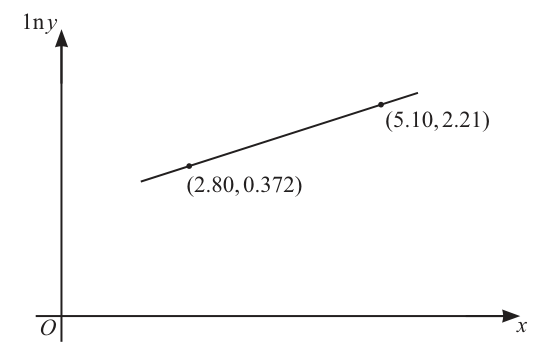
The variables and satisfy the equation , where and are constants. The graph of against is a straight line passing through the points and , as shown in the diagram.
Find the values of and . Give each value correct to 2 significant figures.
Approach
Take the natural logarithm of both sides of to linearise the relationship, giving . This is a straight line with gradient and y-intercept . Use the two given points to find the gradient , then substitute back to find .
Working
Take natural logarithms of both sides:
Rearrange into straight-line form:
This is a straight line equation with , , gradient , and y-intercept .
The gradient is found from the two points and :
Rounding to 2 significant figures:
Substitute and the point into :
Therefore:
Rounding to 2 significant figures:
Answer
c = 0.80, k = 6.5
Walkthrough
First, we linearise the equation by taking natural logarithms of both sides. This gives , which rearranges to . This is now in the form of a straight line where the vertical axis is , the horizontal axis is , the gradient is , and the y-intercept is .
Since the graph of against is a straight line passing through and , we can calculate the gradient directly using the standard gradient formula:
With known, we substitute one of the points (say ) and the gradient into the straight-line equation to find the y-intercept:
Finally, we exponentiate to find :
Key Takeaways
- Taking logarithms of both sides of an exponential equation can transform it into a linear form suitable for straight-line graph analysis.
- The gradient and y-intercept of the linearised graph directly correspond to the constants in the original equation.
- Always round final answers to the specified number of significant figures.
Common Mistakes
- Forgetting to take the logarithm of both sides, or only taking the logarithm of one side.
- Incorrectly rearranging ; the y-intercept is , not .
- Using the wrong points or swapping the numerator and denominator when calculating the gradient.
- Rounding intermediate values too early, which can cause the final answer for to be slightly off.
- Giving or as fractions instead of decimal values to the required significant figures.
Things to Be Careful About
- The mark scheme accepts or , and ; these must be given as decimals to 2 significant figures, not as fractions.
- When using the gradient to find , using a rounded value of is acceptable (AWRT), but using the exact gradient gives a more precise , still yielding .
- The y-intercept of the line is , so where is the y-intercept. A sign error here is a common mistake.
- Always verify the answer by substituting the second point : , confirming consistency.
Express in partial fractions.
Approach
Since the numerator and denominator have the same degree, the partial fraction form must include a constant term:
Find by division or by comparing coefficients, then find and by substituting the roots of the denominator.
Working
Multiply both sides by :
Comparing the coefficients gives , so . With :
Subtracting from both sides:
Substitute : , so .
Substitute : , so .
Answer
3 + 2/(x - 1) - 3/(2x + 1)
Walkthrough
First notice that the numerator and denominator have the same degree. In partial fractions, when the numerator degree is at least the denominator degree, there must be a polynomial part. Here that polynomial part is a constant, so we write
Multiplying by the denominator clears the fractions. To find , compare the coefficients of : the left side has , and on the right only the term contributes . Hence .
Next, subtract from the numerator. This leaves , so we only need to decompose
Substitute to make the term vanish; this gives . Substitute to make the term vanish; this gives . Finally, combine the constant and the two fractions to write the answer.
Key Takeaways
- When the numerator and denominator have equal degree, the partial fraction decomposition must include a constant term.
- Substituting the roots of the denominator is an efficient way to find the constants one at a time.
- The final answer can be checked by combining the fractions back over the common denominator.
Common Mistakes
- Omitting the constant term and trying to write only .
- Making a sign error when substituting , especially with .
- Not showing the initial form; the mark scheme awards a method mark for stating or implying the correct form.
- Forgetting to multiply the whole right-hand side by the denominator when clearing fractions.
Things to Be Careful About
- At , the factor equals , so the resulting equation gives a negative value for .
- If using polynomial division instead, the remainder must be ; any other remainder indicates an arithmetic error.
- The two linear factors are distinct, so no repeated-factor terms such as are needed.
On an Argand diagram shade the region whose points represent complex numbers which satisfy both the inequalities and .
Approach
Interpret each inequality geometrically on the Argand diagram. The modulus inequality defines a circular region, and the argument inequality defines a half-plane bounded by a half-line. Shade the intersection of these two regions.
Working
The first inequality is . This represents all points whose distance from the point (coordinates ) is less than or equal to 2. This is a closed disk with centre and radius 2.
The second inequality is . The boundary is a half-line starting from the point (coordinates ) making an angle of with the positive real axis. The condition means the region lies to the left (or above) this half-line.
The required shaded region is the intersection of the interior of the circle and the half-plane above the half-line.
Answer
The shaded region is bounded by the circle with centre and radius 2, and the half-line from at angle , as shown in the diagram above.
Shaded region inside the circle |z - (4 + 3i)| <= 2 and above the half-line from (2, 1) at angle pi/3.
Walkthrough
First, analyze the modulus inequality . By definition, is the distance between the point and the fixed point on the Argand diagram. Here, , which corresponds to the coordinates . The inequality states that this distance is at most 2, which describes a closed disk (a circle and its interior) with centre and radius 2.
Next, analyze the argument inequality . The expression represents the vector from the point (coordinates ) to . The argument is the angle this vector makes with the positive real axis. The boundary is a half-line originating at and extending at an angle of (or ) to the positive real axis. The condition indicates that we want all points that make an angle greater than or equal to with the positive real axis relative to , which is the region to the left (or above) this half-line.
Finally, shade the region that satisfies both conditions simultaneously. This is the part of the circular disk that lies above the half-line.
Key Takeaways
- The locus is a circle with centre and radius . The inequality includes the interior.
- The locus is a half-line starting at at angle . The inequality gives the region to the left of this half-line.
- Intersecting these loci gives the required shaded region.
Common Mistakes
- Drawing a full line instead of a half-line for the argument boundary, or extending it in the wrong direction.
- Shading the region below the half-line instead of above it.
- Forgetting to include the boundary of the circle (the inequality is , not ).
Things to Be Careful About
- Ensure the half-line starts exactly at and not at the origin.
- The angle is measured from the positive real axis, not from the vertical axis.
- The mark scheme notes that a full circle is not strictly required, but the centre and relevant arc must be shown clearly.
Approach
The argument is the angle the vector from the origin to makes with the positive real axis. To maximize for points in the shaded region, we find the line from the origin that is tangent to the circle and has the steepest gradient, then verify this tangent point lies within the shaded region.
Working
The centre of the circle is and its radius is . The distance from the origin to is:
Let be the angle of with the positive real axis:
Let be the angle between and the tangent from the origin to the circle. From the right-angled triangle formed by the origin, the centre, and the point of tangency:
The greatest value of is :
Calculating this value:
We must verify that this tangent point lies in the shaded region. The half-line boundary is at angle . Since , the tangent point is above the half-line and thus lies within the shaded region.
Alternatively, using the discriminant method, let . Substituting into and setting the discriminant to 0 gives rad.
Answer
1.06 rad (or 60.5 degrees)
Walkthrough
To find the greatest value of , we need to find the point in the shaded region that makes the largest angle with the positive real axis. Geometrically, this occurs at the point on the boundary of the region where a line from the origin is tangent to the circle, provided this tangent point is within the shaded area.
First, calculate the distance from the origin to the centre of the circle : . The angle of with the positive real axis is .
The angle between and the tangent line from the origin to the circle is , where . Thus, .
The maximum argument is rad or .
Finally, check that this point is in the shaded region. The half-line boundary is at . Since , the tangent point is above the half-line and inside the shaded region. Thus, the maximum argument is indeed rad.
Key Takeaways
- The maximum argument of points on a circle from the origin is found using the tangent from the origin to the circle.
- The angle can be found using right-angled triangle trigonometry: where is the distance from the origin to the centre.
- Always verify that the optimal point lies within any additional constraints (like the half-line boundary).
Common Mistakes
- Assuming the maximum argument is simply the angle to the centre plus the angle to the top of the circle.
- Forgetting to check whether the tangent point satisfies the argument inequality .
- Using the wrong trigonometric ratio (e.g., instead of ).
Things to Be Careful About
- The answer must be in radians or degrees as appropriate; the mark scheme accepts 1.06, 1.055, or .
- If the tangent point did not lie in the shaded region (e.g., if it were below the half-line), the maximum argument would occur at the intersection of the half-line and the circle, not at the tangent point.
Let .
Approach
Use the factor theorem: is a factor of if and only if .
Working
Substitute :
Since , is a factor of .
Answer
is a factor of .
x + 7 is a factor of f(x)
Walkthrough
The factor theorem says that for a polynomial , if then is a factor. Here we want as a factor, which corresponds to because . So substitute into and evaluate. If the result is , the factor theorem confirms that is a factor. We compute each term: , , , and . Their sum is . Since there are no arithmetic errors, is a factor. Alternatively, long division would produce the quotient and a zero remainder.
Key Takeaways
The factor theorem connects roots to factors. To show that a linear factor exists, evaluate and show that it is zero. This avoids doing a full polynomial division.
Common Mistakes
Arithmetic errors with negatives are common: , so ; , so ; and . Sign errors here are easy to make. The mark scheme says no errors are allowed in this substitution. If division is used instead, the quotient and remainder must be correct.
Things to Be Careful About
Remember that corresponds to , not . Show explicitly. If using division, the remainder must be .
Approach
Use polynomial division (or synthetic division) to divide by .
Working
Using synthetic division with :
The quotient is and the remainder is .
Answer
8x^2 - 2x - 3
Walkthrough
We need the quotient when is divided by . Synthetic division with is efficient. Bring down the leading coefficient . Multiply by to get , then add to to get . Multiply by to get , then add to to get . Multiply by to get , then add to to get . The bottom row gives coefficients , , and a remainder of , so the quotient is . This agrees with the factorisation .
Key Takeaways
Synthetic division is a compact method for dividing by a linear factor . The quotient has degree one less than the original polynomial. A zero remainder confirms that the divisor is a factor.
Common Mistakes
Sign errors in the synthetic multiplication step are common, as is forgetting to bring down the first coefficient. Misplacing coefficients can also occur. The mark scheme allows partial credit for reaching or for finding , , or in the form .
Things to Be Careful About
The quotient must be stated in part (b) even if the division was shown in part (a). If using coefficient comparison, make sure every coefficient of the cubic is matched correctly.
Approach
Use the factorisation from part (b): . Let . Since is always between and , the factor gives no valid solution. Solve the quadratic factor for , then find all angles in the interval.
Working
Factor the quadratic:
So
For :
For :
Answer
(accept or ; no other solutions in the interval).
θ = 41.4°, 120°, 240°, 318.6° (accept 318.6° or 319°)
Walkthrough
We have the equation . Let . Then the equation becomes . From parts (a) and (b), . Factor the quadratic further: . So the equation is . The possible values are , , and . But must lie between and , so is impossible and is discarded. Now solve and for . For , the principal value is . Cosine is positive in the first and fourth quadrants, so the second solution is . For , cosine is negative in the second and third quadrants. The reference angle is , so the solutions are and . Thus there are four solutions in the interval.
Key Takeaways
A trigonometric equation can often be reduced to a polynomial equation by substitution such as . Factorisation using the factor theorem then makes solving straightforward. Always check the range of the trigonometric function to discard impossible roots. For , use the symmetry of the cosine graph to find all solutions in the required interval.
Common Mistakes
A common mistake is including as a solution, but this is impossible because . Another mistake is giving only the principal value for and forgetting the fourth-quadrant solution . For , students sometimes give only and forget . Giving answers in radians when the interval is in degrees loses marks; the mark scheme allows a maximum of for radian answers. Including solutions outside to is also penalised.
Things to Be Careful About
Use degree mode on the calculator because the interval is given in degrees. The angles and are exact. The angles for are approximate, and is often accepted as . Make sure no extra solutions are included from the discarded factor .
Approach
Write the expression as by expanding the right-hand side and comparing coefficients.
Working
Expand:
Comparing with :
Then
so
and
Since , .
Answer
R = 2√3, α = π/6
Walkthrough
We want to write as . Expanding the right-hand side gives . Comparing coefficients with the target expression gives and . Squaring and adding eliminates and gives , so . Dividing the second equation by the first gives . Because , the angle is .
Key Takeaways
- The expansion of has coefficients and .
- can be found by .
- The quadrant of is determined by the signs of and ; here both are positive.
Common Mistakes
- Treating and as and ; this is not valid and the mark scheme awards M0 A0 if this is seen.
- Using would give a negative angle; since the answer is CWO, this would lose the final A1.
- Forgetting the condition , which selects the positive angle.
Things to Be Careful About
- The original expression has a minus sign before ; after comparison this becomes , not negative.
- corresponds to , not ; check exact trig values carefully.
Approach
Use part (a) to rewrite the denominator, convert the integrand to a form, integrate, and evaluate at the limits.
Working
From part (a),
Therefore
So the integrand is
Thus
Integrating,
At , , so .
At , , so .
Therefore
Answer
√3/12
Walkthrough
Use the result from part (a): . Squaring gives . Therefore the integrand becomes . Integrate ; since the derivative of is 2, the integral is . Multiplying by gives . Substitute limits: at , the angle is , with ; at , the angle is , with . Subtract lower from upper and simplify: .
Key Takeaways
- Squaring a form gives , which can be converted to for integration.
- .
- Exact values and are needed.
Common Mistakes
- Forgetting the factor when integrating .
- Forgetting the factor from ; the mark scheme requires the coefficient to be correct.
- Not simplifying ; the mark scheme requires a single term exact equivalent.
- Substituting limits in the wrong order; always upper limit minus lower limit.
Things to Be Careful About
- The mark scheme allows follow-through on from part (a), but the coefficient must still be correct.
- The final answer may be written as , or ; all are accepted.
- Keep the angle in radians throughout, since the limits are in radians.
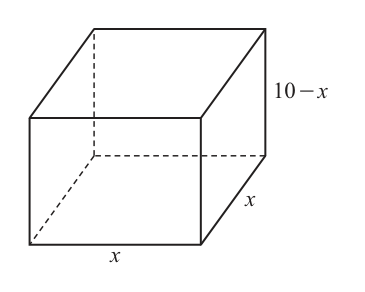
A container in the shape of a cuboid has a square base of side and a height of . It is given that varies with time, , where . The container decreases in volume at a rate which is inversely proportional to .
When , and the rate of decrease of is .
Approach
Express the volume in terms of , write the rate-of-change statement using a constant of proportionality, then use the chain rule to convert into . Finally substitute the three given data values to find the constant and reach the stated differential equation.
Working
The cuboid has a square base of side and height , so its volume is
Differentiating with respect to :
Since the volume decreases at a rate inversely proportional to , with the constant of proportionality,
Apply the chain rule :
Now use , and . First compute at :
Substitute:
Hence , giving . Substituting back:
Answer
dx/dt = -1/(2t(20x - 3x^2))
Walkthrough
The cuboid has volume , so . The problem says the volume is decreasing at a rate inversely proportional to , so we write for some positive constant (the minus sign is what makes it a decrease). Because depends on which depends on , the chain rule links the two derivatives: , hence . This general form still has an unknown , so we use the three given data values. At we have , and substituting and gives , so . Putting this back produces the required differential equation.
Key Takeaways
- Translate "decreases at a rate inversely proportional to " into (the sign is what makes it a decrease).
- Use the chain rule to convert between rates with respect to different variables, here .
- Substitute known values of , and to determine the constant of proportionality.
Common Mistakes
- Forgetting the minus sign in when the volume is decreasing.
- Using instead of correctly differentiating , giving .
- Inverting the chain rule and writing .
- Writing (positive) when the problem states the rate of decrease of is , so .
Things to Be Careful About
- The mark scheme requires the value to appear (not ) for the final A1.
- When you compute at , remember it is , not .
- Keep symbolic until the substitution step; only then determine .
Approach
Separate the variables so that all -terms are on the left and all -terms are on the right, integrate both sides, and use the given initial condition when to fix the constant of integration. Then isolate by collecting the logarithms and exponentiating.
Working
Starting from
separate the variables:
Integrate both sides:
The left side gives
and the right side gives
So
Apply the initial condition , :
Evaluate the left side: .
And . Therefore
So the implicit solution is
Rearrange to isolate :
Combine the logarithms:
Exponentiate both sides and divide by :
Answer
t = (1/10) e^(2x^3 - 20x^2 + 19/4)
Walkthrough
The differential equation is separable: every lives on the right-hand side inside the bracket, so we move it to the left and move to the right. This produces . Integrating the left side with respect to uses the power rule: and . Integrating gives , and since we may drop the absolute value, leaving . Adding a constant on the right gives the implicit general solution . The initial condition at then determines : the left side is , and the right side is , so . To solve explicitly for , multiply the implicit relation by to clear the fraction on the term, then collect all logarithms on the left to form , and finally exponentiate to obtain .
Key Takeaways
- A separable ODE of the form is solved by writing and integrating both sides.
- After integration, an implicit relation between and is produced; algebraic manipulation (combining logs, exponentiating) is needed to make the subject.
- The constant of integration is found by substituting the initial data into the general (with ) relation.
Common Mistakes
- Forgetting to put brackets around the side: writing is correct, but would mean misreading the differential equation.
- Integrating the right side as instead of (dropping the factor ).
- Forgetting the negative sign when separating, producing the wrong sign throughout.
- Failing to combine into (or ) and getting stuck with logs on both sides.
- Writing (or similar): the mark scheme forbids an term sitting in the final answer.
Things to Be Careful About
- Domain: is given, so is defined without absolute value bars.
- Sign of : many equivalent final forms are accepted, but the working must be self-consistent.
- The mark scheme allows several equivalent forms of the constant: and are both permitted as decimal approximations.
The equations of two straight lines are
where is a constant.
Given that the acute angle between the directions of these lines is , find the possible values of .
Approach
The angle between two lines is found from their direction vectors using
Since the acute angle is , set this equal to and solve for .
Working
The direction vectors are
Their scalar product is
The magnitudes are
Therefore
Squaring both sides:
Expand and simplify:
Multiply by 2:
Factorising:
So or .
Answer
a = 5 or a = 35
Walkthrough
The two lines are given in vector form, so their directions are the vectors multiplying the parameters: and . The angle between the lines is the angle between these direction vectors, so we use the scalar product formula.
First compute the dot product: . Then compute the magnitudes: and .
The cosine of the angle is . Since the acute angle is , this cosine should be . Because the acute angle between two lines can correspond to either direction vector being reversed, the mark scheme allows .
Square both sides to remove the square root. This gives . Expanding and simplifying gives , which factors as . Hence or . Both values give a positive dot product and satisfy the acute angle condition.
Key Takeaways
The scalar product formula connects vector directions to angles. Magnitudes of vectors are found by taking the square root of the sum of squares of components. When an angle condition leads to a square root, squaring both sides often produces a quadratic equation. The sign accounts for the acute angle between lines.
Common Mistakes
- Forgetting to use both direction vectors consistently; the same two vectors must be used throughout.
- Forgetting the when setting the cosine equal to , or using only the positive value without justification.
- Squaring only one side, or not squaring the whole product of moduli, leading to an incorrect quadratic.
- Sign errors in the dot product, especially .
Things to Be Careful About
- The mark scheme requires a correct equation such as before squaring.
- When squaring, you must square to get three terms and remove the square root from the other side.
- Both and are valid; do not discard one because it seems large.
Given instead that the lines intersect, find the value of and the position vector of the point of intersection.
Approach
For two lines to intersect, their position vectors must be equal for some parameters and . Write each line in component form, equate corresponding components, solve for and , then use the remaining component to find .
Working
Line 1:
Line 2:
Equating components:
Add the two equations:
Substitute into :
Use the third component:
The point of intersection is obtained using in line 1:
So the position vector is
Answer
a = 2; position vector = -2i - 3j + 2k
Walkthrough
For the lines to intersect, there must be values of and such that the position vectors are equal. Write each line in component form: line 1 is and line 2 is .
Equate the -components: , so . Equate the -components: , so , or . These two equations involve only and , so solve them simultaneously. Adding gives , so . Substituting back gives .
Now use the -component: . With and , this becomes . Finally substitute into line 1 to get , so the position vector is .
Key Takeaways
Two lines intersect when their vector equations can be made equal for some parameters. Equating components produces a system of equations. Solving for the parameters first is often easiest because the third component then determines any unknown constant. The intersection point is found by substituting the parameter back into either line.
Common Mistakes
- Only equating two components and solving for and without using the third component to find .
- Using different parameter values for the two lines, e.g. using in both equations.
- Sign errors when equating components, especially with the negative signs in line 2.
- Substituting or into the wrong line or using the wrong sign, giving an incorrect point.
Things to Be Careful About
- The mark scheme expects the general point of at least one line in component form before equating.
- When solving, and must both be obtained.
- The final position vector must be written as a single vector, not as separate components with in a tuple such as .
- If two different points are given, the answer is marked wrong even if one is correct.
Use the substitution to find the exact value of
Give your answer in the form , where and are rational numbers.
Approach
We are told to use the substitution . This is a natural choice because it converts into . We will differentiate the substitution to replace , change the limits of integration, simplify the integrand using the Pythagorean identity, and then integrate.
Working
Let . Then
Also,
Change the limits. When , , so . When , , so . Hence
Use :
Evaluate:
Answer
so and .
3/2 + (3/4)π
Walkthrough
We are given the substitution . The key reason this substitution is effective is the identity , which exactly matches the denominator . First differentiate the substitution to find in terms of . Then replace all 's and in the integral. Because this is a definite integral, change the limits: substitute the original limits into . Then simplify the integrand: , and the brings a factor , so the secant powers cancel, leaving . Then use the double-angle identity to integrate . Finally evaluate at the limits and simplify to the form .
Key Takeaways
- Recognising when a trigonometric substitution is appropriate: when the integrand contains or , the identity is the key.
- The importance of changing the limits of integration when using substitution in a definite integral.
- Using trigonometric identities to reduce powers of cosine before integrating.
- Simplifying the final answer into the requested linear form in .
Common Mistakes
- Forgetting to change the limits of integration when substituting.
- Incorrectly differentiating ; remember .
- Failing to simplify correctly; note .
- Forgetting the factor that appears from .
- Incorrectly integrating without using the double-angle identity.
Things to Be Careful About
- The substitution gives ; do not omit the .
- When simplifying, , not .
- The limits: and .
- The final answer must be in the form ; here and .
- Since no mark scheme was provided, ensure every algebraic step is shown clearly to gain method marks.