Mathematics 9709/31 — May/June 2024
Cambridge A-Level · Pure Mathematics 3 · worked solutions for every part, with the mark scheme
Topics Logarithmic and Exponential Functions · Integration · Complex Numbers · Differentiation · Trigonometry · Algebra · +3 more
Expand in ascending powers of , up to and including the term in , simplifying the coefficients.
Approach
Use the binomial expansion for rational :
valid for . Take and , expand up to the term in , then multiply by and collect like terms up to .
Working
Simplify the first two non-constant terms:
So
Now multiply by :
Expanding and keeping terms up to :
Ignoring the term,
Answer
3 - 2x - (5/2)x^2
Walkthrough
We need the expansion of up to . The bracket has a fractional index, so its binomial expansion is an infinite series. The formula is
with . Here and , so the series is valid for .
Substitute and . The linear term is
The quadratic term is
So the bracket becomes .
Next multiply by . For the constant term, . For the term, . For the term, . The term is of order , so it is not needed. This gives the final expansion.
The mark scheme gives B1 for the first two terms of the binomial expansion, B1 for the term, M1 for multiplying by , and A1 for the final simplified answer.
Key Takeaways
This question tests the binomial expansion for a rational index, where the expansion is infinite and valid only when . It also tests careful multiplication of a binomial series by a linear factor and collection of terms up to a specified order. You should be comfortable converting into and simplifying fractional coefficients.
Common Mistakes
- Leaving the coefficients in symbolic form, such as , is not enough; the mark scheme requires the actual numerical coefficients, e.g. .
- Forgetting the term of the binomial expansion, or using the wrong sign because is positive.
- When multiplying by , forgetting the contribution to the coefficient.
- Including higher-order terms unnecessarily or making sign errors when collecting and terms.
Things to Be Careful About
- Use , not ; the sign of matters.
- The quadratic term uses with .
- When collecting the coefficient, both and contribute.
- The expansion is valid for , although the question only asks for the series up to .
Solve the equation . Give your answer correct to 2 decimal places.
Approach
Use the product law of logarithms to combine the two terms into a single logarithm, then exponentiate both sides to eliminate the logarithm and obtain a quadratic equation. Solve the quadratic and select the root that satisfies the domain .
Working
The equation is
Bring the term to the left-hand side:
Using :
Exponentiate both sides (using ):
So
Using the quadratic formula with , , :
Since :
This gives or . Since the original equation requires (for to be defined), the negative root is rejected.
Answer
x = 35.71
Walkthrough
We start with . The first goal is to collect the logarithms on one side so we can combine them. Adding to both sides gives . The product law lets us merge them into . This is useful because a single logarithm is easy to remove: since , exponentiating both sides gives . Expanding gives the quadratic . We solve it with the quadratic formula. The discriminant is , so . Numerically, the plus sign gives and the minus sign gives . The domain of the original equation requires , so only is valid.
Key Takeaways
- Logarithms can be combined using product/quotient laws before solving.
- Exponentiating both sides removes a logarithm because and are inverse functions.
- Equations involving logarithms often lead to quadratic equations.
- Always check the domain of the original logarithmic expressions; extraneous roots must be rejected.
Common Mistakes
- Forgetting to add to both sides before combining, leading to an incorrect single logarithm.
- Misapplying the product law, e.g. writing instead of .
- Failing to exponentiate both sides correctly, or forgetting that .
- Giving both quadratic roots without rejecting the negative one; the mark scheme accepts only .
Things to Be Careful About
- The domain: requires , and requires , so the combined restriction is .
- Use enough decimal places when approximating so the final rounding to 2 decimal places is correct.
- When using the quadratic formula, keep the expression in exact form () as long as possible before rounding.
- The mark scheme requires a clear method: the product/quotient law and the elimination of the logarithm must be shown.
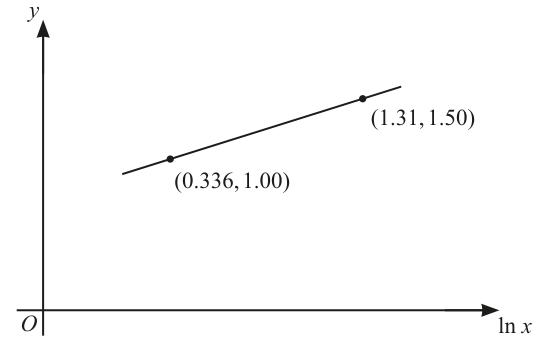
The variables and satisfy the equation , where and are constants. The graph of against is a straight line passing through the points and , as shown in the diagram.
Find the values of and . Give each value correct to the nearest integer.
Approach
Take the natural logarithm of both sides of to obtain a linear relationship between and . The gradient and intercept of this line can then be determined from the two given points, allowing us to find and .
Working
Take natural logarithms of both sides of :
This is a straight-line equation of the form , where the gradient is and the -intercept is .
The line passes through and . The gradient is:
Since :
Rounding to the nearest integer, .
To find , substitute into :
Rounding to the nearest integer, .
Verification using the second point :
Answer
a = 7, b = 5
Walkthrough
The equation is not linear in its current form, but taking logarithms converts it into a linear relationship. We start by applying the natural logarithm to both sides:
Using logarithm laws, and , giving:
Rearranging into the standard straight-line form :
This tells us the graph of against is a straight line with gradient and -intercept .
We are given two points on this line: and . The gradient is calculated as:
Setting gives , so , which rounds to .
To find , we substitute one of the points into the linearised equation. Using :
This rounds to . We can verify using the second point :
Both points give the same value of , confirming our answer.
Key Takeaways
- When an equation involves a variable in an exponent (like ), taking logarithms is the standard technique to linearise it.
- The linearised form has on the vertical axis and on the horizontal axis, with gradient and intercept .
- Two points on a straight line are sufficient to determine both the gradient and the intercept, which in turn give the constants in the original equation.
- Always verify your answer by checking both given points to catch any arithmetic errors.
Common Mistakes
- Forgetting to apply the logarithm law correctly, e.g., writing instead.
- Misidentifying which variable is on which axis: the gradient is , not itself. The equation is , so the coefficient of is .
- Rounding intermediate values too early, which can lead to incorrect final answers. Keep several decimal places until the final step.
- Forgetting to round to the nearest integer as required by the question.
Things to Be Careful About
- The question asks for values correct to the nearest integer, so do not leave answers as exact logarithmic expressions.
- Ensure you use consistent decimal places throughout the working to avoid rounding errors. The mark scheme accepts and to the nearest integer.
- When substituting points into the linearised equation, be careful with the order: means , not .
- The mark scheme requires showing the linearised form (B1) and a correct method for finding or (M1). Do not skip these steps.
The complex number is given by .
Approach
Find the modulus using , then determine the principal argument from the quadrant of the point , and write in polar form.
Working
For , the real part is and the imaginary part is .
The point lies in the third quadrant, so the principal argument is the negative angle below the negative real axis. Since and ,
Answer
r = 2, θ = -2π/3
Walkthrough
For part (a), identify the real part and the imaginary part . The modulus is the distance from the origin to the point , so . To find the argument, locate the point in the Argand diagram: it is in the third quadrant. The reference angle is from the negative real axis, so the principal argument is , not , because the principal argument must satisfy . Then write .
Key Takeaways
This part tests the conversion from Cartesian form to polar form. You need to compute the modulus using Pythagoras and choose the principal argument based on the quadrant of the complex number. The polar form is equivalent to .
Common Mistakes
A common mistake is to give instead of . Both angles correspond to the same point, but only lies in the required interval . Another common mistake is forgetting the negative sign on the imaginary part when computing the argument.
Things to Be Careful About
Use radians, not degrees. The modulus must be positive. The argument must be exact and in the principal range. When the point is in the third quadrant, the principal argument is negative if measured clockwise from the positive real axis.
Approach
Write both and in polar exponential form. To divide complex numbers in polar form, divide the moduli and subtract the arguments. Then check that the resulting argument lies in .
Working
From part (a), . Also,
Therefore,
Since , this is already in the required principal range.
Answer
r = 5/2, θ = 5π/6
Walkthrough
Use the polar form of from part (a): . Write in exponential form: . To divide two complex numbers in polar form, divide their moduli and subtract their arguments. Thus and . Since lies between and , it is already the principal argument. Therefore .
Key Takeaways
This part uses the rule for division in polar form: if and , then . It also reinforces the need to keep arguments in the principal range.
Common Mistakes
A common mistake is to add the arguments instead of subtracting them when dividing. Another is to forget to divide the moduli. Some students also give an equivalent angle outside the principal range, such as , without converting it back into .
Things to Be Careful About
The final argument must satisfy . Here is already acceptable. If part (a) was incorrect, the mark scheme allows follow-through using your values of and . Keep all values exact and use radians.
The equation of a curve is for .
Find and hence find the -coordinates of the stationary points of the curve.
Approach
Differentiate using the quotient rule. Then set the numerator of the derivative equal to zero, use to obtain a quadratic in , solve it, and find the -coordinates in .
Working
Let and . Then
By the quotient rule,
so
Thus
For stationary points, , so the numerator must be zero (the denominator is finite when the curve is defined):
Since and the curve is undefined where , we need
Use :
Solve this quadratic in :
Since , the only possible value is
Let radians. In , the solutions are
Answer
The -coordinates of the stationary points are
x = 3.57 and x = ̈5.86 radians
Walkthrough
We begin by differentiating . The function is a quotient, so the quotient rule is the natural tool: . Here , whose derivative uses the chain rule, giving , and , whose derivative is . Substituting these into the quotient rule gives the derivative.
For a stationary point we need . Because the derivative is a fraction, this means the numerator must be zero (provided the denominator is defined). We factor the numerator. The factor is never zero. The factor would correspond to points where the original curve is undefined, because in the denominator. Therefore the only stationary points come from .
We now have an equation involving both and . To solve it, use ,which turns it into a quadratic in : . Solving this quadratic gives . Since , it cannot be a sine value; only is possible.
Finally, we find all angles in with that sine value. The principal value of is negative, about radians. The two angles in the required interval are in the third and fourth quadrants: and . These give approximately and radians.
Key Takeaways
The quotient rule is used when differentiating a ratio of two functions; remember to square the denominator.
The chain rule is needed for and for .
Stationary points occur where , but for a quotient we only set the numerator to zero, not the denominator.
Trigonometric equations involving both and can often been reduced to a quadratic in one trigonometric function using .
When solving in a given interval, there may be two solutions; use the quadrant diagram or the general solution formulae.
Common Mistakes
Forgetting the chain rule when differentiating or .
Writing the quotient-rule numerator with the wrong sign: the second term must be , so since is negative, it becomes a plus term.
Setting as a stationary point: those -values are not in the domain of the original curve because makes the denominator zero.
Taking only the principal value of ; this gives a negative angle, not the required -coordinates in .
Forgetting that is outside the range of ,and so must be rejected.
The mark scheme requires solutions to at least 3 significant figures; give and , not just the principal value.
Things to Be Careful About
The curve is undefined where , i.e. at and ; these are not stationary points.
The derivative can also be written as , but the quotient-rule form is equally acceptable.
All -coordinates are in radians unless the question states otherwise.
When using the quadratic formula, check both roots against the range .
The final answers should be given to at least 3 significant figures.
By sketching a suitable pair of graphs, show that the equation has exactly one root, denoted by , in the interval .
Approach
To show that has exactly one root in , we sketch the two curves and on the same axes and observe their intersection.
Working
Curve 1:
This is the standard exponential shifted down by 3 units.
- At : , so the curve passes through .
- As increases, increases exponentially.
- At : .
Curve 2:
For , we have , so is positive and increasing from to .
- As : , so .
- At : .
- The curve decreases monotonically from to on this interval, with a minimum value of at .
Intersection:
At , while , so .
At , while , so .
Since is decreasing and is increasing on , they cross exactly once. This single intersection point is the root .
Answer
The two curves intersect at exactly one point in , confirming exactly one root .
The curves y = e^x - 3 and y = cosec(x/2) intersect exactly once in 0 < x < π, giving exactly one root α.
Walkthrough
We are asked to show that the equation has exactly one root in the interval . The most direct approach is to treat each side as a separate function and sketch both graphs on the same axes.
Step 1: Sketch . This is the standard exponential function shifted downward by 3. At , . The curve rises steeply as increases. It crosses the x-axis where , i.e., at .
Step 2: Sketch . Recall that . For , the argument lies in , where sine is positive and increasing. Therefore cosecant is positive and decreasing. As , so . At , . The curve is a smooth decreasing curve from down to .
Step 3: Identify the intersection. At the left end (), the cosecant curve is very large while the exponential curve is near . At the right end (), the cosecant curve is at while the exponential curve is at about . Since one curve is decreasing and the other is increasing, they must cross exactly once. That crossing point is the root .
Key Takeaways
- Sketching two curves and finding their intersection is a powerful method for showing the number of roots of an equation.
- Understanding the behaviour of on is essential: it decreases from to .
- The monotonicity of both curves (one increasing, one decreasing) guarantees exactly one intersection.
Common Mistakes
- Forgetting that as and drawing the cosecant curve starting from a finite value.
- Not justifying why there is exactly one intersection — merely sketching is insufficient; the argument about one curve being increasing and the other decreasing is needed.
- Using degrees instead of radians when evaluating cosecant values in later parts.
Things to Be Careful About
- The interval is (open interval), so is excluded and the cosecant curve has a vertical asymptote there.
- The minimum of on this interval is at , which is above the x-axis.
- The mark scheme awards a mark for justifying the statement about the single root, not just for the sketch.
Approach
Let . We evaluate and and show they have opposite signs, which by the Intermediate Value Theorem implies a root lies between 1 and 2.
Working
At :
Since , we have .
At :
Since , we have .
Since and , and is continuous on , by the Intermediate Value Theorem there is a root in .
Answer
and , so lies between 1 and 2.
α lies between 1 and 2
Walkthrough
We need to verify that the root (from part (a)) lies between and . The standard method is to define a function and show that and have opposite signs.
Step 1: Evaluate at .
- . Using a calculator in radian mode: , so .
- .
- So .
Step 2: Evaluate at .
- . Using a calculator: , so .
- .
- So .
Step 3: Conclude. Since and , and is continuous on , there must be a root in .
Key Takeaways
- To locate a root between two values, evaluate the function at both endpoints and check for a sign change.
- Always ensure your calculator is in radian mode when dealing with trigonometric functions in calculus contexts.
- At least 2 significant figures are acceptable for the values.
Common Mistakes
- Using degrees instead of radians: . This would give completely wrong values and lose the method mark.
- Forgetting to state the sign change argument — merely computing values is not enough; you must explicitly state that the signs are opposite and conclude a root lies between them.
- Rounding too early: use at least 4 decimal places in intermediate calculations.
Things to Be Careful About
- The mark scheme explicitly states: "Use of degrees is M0" — this is a common pitfall.
- Values need at least 2 significant figures. The mark scheme accepts: and , or equivalently and .
- Truncation is condoned, but the argument must be complete.
Show that if a sequence of values in the interval given by the iterative formula
converges, then it converges to .
Approach
If the sequence converges, let the limit be . Then as , both and . Substitute into the iterative formula and show it satisfies the original equation.
Working
Assume the sequence converges to a limit . Then:
Exponentiate both sides:
Rearrange:
This is exactly the original equation , so .
Answer
If the sequence converges, it converges to .
If the sequence converges to L, then L satisfies cosec(L/2) = e^L - 3, so L = α.
Walkthrough
This part asks us to show that if the iterative sequence converges, its limit must be the root of the original equation.
Step 1: Assume convergence. Suppose the sequence converges to some limit . This means and .
Step 2: Substitute into the iterative formula. The iterative formula is . Taking the limit of both sides as :
Step 3: Rearrange to recover the original equation. Exponentiate both sides:
Subtract 3:
This is precisely the equation from part (a), whose unique root in is . Therefore .
Key Takeaways
- When an iterative formula converges, the limit satisfies the fixed-point equation obtained by setting .
- Rearranging the fixed-point equation back to the original form confirms the limit is the desired root.
- This is a standard technique for justifying iterative methods.
Common Mistakes
- Not explicitly stating the assumption that the sequence converges before substituting .
- Forgetting to exponentiate to recover the original equation form.
- Not concluding that (the unique root).
Things to Be Careful About
- The mark scheme awards a B1 for stating and rearranging to the given equation. The argument is straightforward but must be complete.
- This part does not ask to prove convergence — only that IF it converges, then it converges to .
Use this iterative formula with an initial value of 1.4 to determine correct to 2 decimal places. Give the result of each iteration to 4 decimal places.
Approach
Use the iterative formula with , computing each value to 4 decimal places, until the value stabilises to 2 decimal places.
Working
Iteration 1:
Iteration 2:
Iteration 3:
Iteration 4:
Iteration 5:
Iteration 6:
Iteration 7:
The values are converging: , , .
To confirm to 2 decimal places, we check that the root lies in :
Since and , the root lies in , confirming to 2 decimal places.
Answer
correct to 2 decimal places.
α = 1.50
Walkthrough
We apply the iterative formula starting with , computing each result to 4 decimal places.
Iteration 2: . Since , . So .
Iteration 3: . Since , . So .
Iteration 4: . Since , . So .
Iteration 5: . Since , . So .
Iteration 6: . Since , . So .
The sequence is oscillating and converging: 1.5156, 1.4940, 1.4978, 1.4971, 1.4973, ... All values round to 1.50 to 2 decimal places.
To formally confirm, we check that the function changes sign in , which proves the root is 1.50 to 2 d.p.
Key Takeaways
- When using iterative formulas, compute to at least 4 decimal places to ensure accuracy for 2 d.p. answers.
- The sequence may oscillate around the root before converging — this is normal for this type of iteration.
- To confirm the answer to 2 d.p., show that the value is in the correct rounding interval .
Common Mistakes
- Using degrees instead of radians in the cosecant function — this gives completely wrong iteration values.
- Not computing enough iterations to show convergence.
- Not verifying the final answer by checking the sign change in the rounding interval.
- Rounding intermediate values too early, which can accumulate errors.
Things to Be Careful About
- The mark scheme accepts values like 1.5156, 1.4940, 1.4978, 1.4971 as sufficient iterations.
- The final answer must be 1.50 (not 1.5, which is only 1 d.p.).
- You must show sufficient iterations to 4 d.p. to justify the answer, or show a sign change in .
- The iterative formula uses , not in degrees.
State the minimum number of calculated iterations needed with this initial value to determine correct to 2 decimal places.
Approach
Count the number of iterations needed from part (d) until the value is confirmed correct to 2 decimal places.
Working
From part (d), the iterations are:
After and , both round to to 2 decimal places. We then verified that the root lies in using and .
The sign change in was established using (which is ) and (which is ), but more precisely we evaluated at the boundary points. The iterations through all give values in , confirming to 2 d.p.
The minimum number of calculated iterations needed is 4 (producing ), after which we can confirm convergence to 2 d.p.
Actually, counting from the initial value :
- After 1 iteration: (not yet stable to 2 d.p.)
- After 2 iterations: (rounds to 1.49)
- After 3 iterations: (rounds to 1.50)
- After 4 iterations: (rounds to 1.50)
With 4 calculated iterations ( through ), we have two consecutive values that both round to 1.50, and we can verify the root is in .
Answer
4
4
Walkthrough
In part (d), we performed iterations and obtained:
- (given)
- (1st iteration)
- (2nd iteration)
- (3rd iteration)
- (4th iteration)
After the 4th iteration (), we have two consecutive values ( and ) that both round to to 2 decimal places. We then confirmed by checking and that the root indeed lies in the interval , so to 2 d.p.
The minimum number of calculated iterations (not counting the initial value) is 4.
Key Takeaways
- To determine the minimum number of iterations, count how many calculations are needed until the answer is confirmed to the required accuracy.
- Consecutive iterations giving the same value to the required decimal places, combined with a sign change check, confirm the answer.
Common Mistakes
- Counting the initial value as an iteration — it is given, not calculated.
- Not performing enough iterations to confirm stability to 2 d.p.
Things to Be Careful About
- The mark scheme answer is 4, meaning 4 calculated iterations () are needed.
- Some students might say 5 if they include , but 4 is sufficient when combined with the sign change verification.
On a single Argand diagram sketch the loci given by the equations and where and are complex numbers.
Approach
Rewrite each modulus equation in a standard form to identify the geometric locus:
- represents a circle with centre and radius .
- represents the perpendicular bisector of the line segment joining and .
Working
Locus 1:
Rewrite as:
This is a circle with centre and radius .
Locus 2:
Rewrite as:
This means is equidistant from the points and . The locus is the perpendicular bisector of the line segment joining these two points.
Find the midpoint of the segment joining and :
Find the slope of the segment joining and :
The perpendicular bisector has slope (negative reciprocal of ) and passes through :
Sketch both loci on an Argand diagram:
Answer
The loci are: a circle centred at with radius , and the line (the perpendicular bisector of the segment from to ).
Circle centre (3, -2) radius 2; perpendicular bisector y = x + 1
Walkthrough
Step 1: Identify Locus 1. The equation can be rewritten as . In the Argand diagram, is the set of all points at distance from , which is a circle. Here , corresponding to the point , and . So this is a circle centred at with radius .
Step 2: Identify Locus 2. The equation can be rewritten as . This says the distance from to equals the distance from to . The set of points equidistant from two fixed points is the perpendicular bisector of the segment joining them.
Step 3: Find the perpendicular bisector. The midpoint of the segment from to is . The slope of the segment is , so the perpendicular bisector has slope . Using point-slope form through : , giving .
Step 4: Sketch. Plot the circle and the line on the Argand diagram with Re and Im axes.
Key Takeaways
- is always a circle with centre and radius on the Argand diagram.
- is always the perpendicular bisector of the segment joining and .
- To find the perpendicular bisector, compute the midpoint and the negative reciprocal of the segment's slope.
Common Mistakes
- Forgetting to rewrite as and misidentifying the centre as instead of .
- Not showing the midpoint or the point on the diagram, which are needed for the B1 marks.
- Drawing the perpendicular bisector with the wrong slope (e.g., using slope instead of ).
- Forgetting that the locus is a full line, not just a ray or segment.
Things to Be Careful About
- The centre is in the fourth quadrant (positive Re, negative Im). Do not confuse the sign of the imaginary part.
- The mark scheme awards B1FT for the perpendicular bisector based on the correct positions of and the circle centre, so ensure both points are clearly marked.
- The line passes through and has gradient ; verify this matches the diagram.
Hence find the least value of for points on these loci. Give your answer in an exact form.
Approach
The minimum value of is the shortest distance between a point on the circle and a point on the line. This equals the perpendicular distance from the centre of the circle to the line, minus the radius of the circle.
Working
The centre of the circle is and the line is , or equivalently .
The perpendicular from to the line has slope (negative reciprocal of ). The line through with slope is:
Find the intersection with :
So the foot of the perpendicular from to the line is , which is the midpoint of the segment joining and .
The distance from to is:
The minimum value of is this distance minus the radius :
Answer
3√2 - 2
Walkthrough
Step 1: Understand the geometry. We want the minimum distance between any point on the circle and any point on the line. The shortest distance from a circle to a line is along the perpendicular from the centre of the circle to the line, minus the radius.
Step 2: Find the perpendicular foot. The line is with gradient . The perpendicular from has gradient . The line through with gradient is . Setting gives . So the perpendicular meets the line at .
Step 3: Calculate the distance. The distance from to is .
Step 4: Subtract the radius. The minimum distance from the circle to the line is .
Key Takeaways
- The minimum distance between a circle and a line is the perpendicular distance from the centre to the line, minus the radius.
- When the line is a perpendicular bisector, the perpendicular from one endpoint to the bisector meets it at the midpoint of the segment.
- Always express the final answer in exact form (surds, not decimals).
Common Mistakes
- Adding the radius instead of subtracting it, giving .
- Using the wrong distance formula or making arithmetic errors in .
- Not showing the method of finding the perpendicular distance, which is required for the M1 mark.
- Giving a decimal approximation instead of the exact form .
Things to Be Careful About
- The mark scheme accepts or ; both are correct.
- Ensure the answer is in exact form — no decimal approximations.
- The method must clearly show the distance from the centre to the line being calculated before subtracting the radius.
Use the substitution to find the exact value of
Give your answer in the form where and are rational numbers to be determined.
Approach
Use the substitution . Differentiate to find , rewrite using the double-angle identity, transform the integral into powers of , integrate, then evaluate using the new limits.
Working
Let
Then
Also
Therefore
Equivalently,
Integrate:
Evaluate at :
Evaluate at :
Subtract:
Answer
So and .
8/3 - (4/3)√2, so a = 8/3 and b = -4/3
Walkthrough
We need to evaluate a definite integral where the integrand contains and . The substitution is suggested because the denominator becomes , and the derivative of is , which appears in the numerator after using .
First differentiate the substitution:
This tells us how to replace the part of the integrand. Next, rewrite as . Since , we get . Substituting into the integral:
So the integral becomes
For a definite integral, we must also change the limits. When , , so . When , , so . Thus the new limits are and .
Now integrate term by term:
Evaluate at and :
This simplifies to , so and .
Key Takeaways
- In a substitution, always replace using the derivative of the substitution, including any minus sign.
- Use trigonometric identities such as to expose the derivative of the substituted expression.
- For definite integrals, change the limits from -values to corresponding -values before evaluating.
- Integrals involving are handled as powers: and .
Common Mistakes
- Forgetting the minus sign from . This changes the sign of the whole integral.
- Not changing the limits when using a substitution in a definite integral.
- Using the wrong value of : , so the lower limit is , not .
- Incorrectly expanding ; be careful that the factor becomes after taking out the minus sign.
- Not simplifying the final surd expression to the required form .
Things to Be Careful About
- At , , so .
- The antiderivative can also be written as ; either form gives the same final answer when evaluated with the correct limits.
- The final answer must be exact, with rational and : , .
- Be careful with the order of subtraction: evaluate the antiderivative at the upper limit minus the lower limit.
The equations of two straight lines and are
where is a constant.
The lines and are perpendicular.
Approach
The direction vectors of two perpendicular lines have a scalar product of zero. We extract the direction vectors from the vector forms of and , set their scalar product equal to zero, and solve for .
Working
The direction vector of is and the direction vector of is .
Since , the scalar product of the direction vectors is zero:
Answer
a = 4
Walkthrough
The direction vector of a line given in vector form is the vector that multiplies the parameter. So for the direction vector is , and for it is .
Two lines are perpendicular if and only if the scalar (dot) product of their direction vectors is zero. The scalar product is computed by multiplying corresponding components and summing them: .
Setting this equal to zero gives the linear equation , which we solve to obtain .
Key Takeaways
- The direction vector of a line is the multiplier of the parameter .
- Two lines are perpendicular if and only if the scalar product of their direction vectors is zero: .
- The scalar product of and is .
Common Mistakes
- Using the position vectors of the lines instead of their direction vectors.
- Forgetting to set the scalar product equal to zero, or mistakenly equating it to some other value.
- Sign errors when expanding the products (for example, writing instead of ).
Things to Be Careful About
- The perpendicularity condition is the scalar product equals zero, not the magnitudes being equal or the vectors being equal.
- The unknown only appears in the direction of , so it appears in just one term of the scalar product.
Approach
With , write both lines in component form. Equate the components to obtain a system of three equations in the two unknowns and , then solve using any two equations (the third acts as a check). Substitute back into either line to find the position vector of the intersection.
Working
With , a general point on is:
A general point on is:
For the lines to intersect, we require:
From equation (2):
Substituting into equation (1):
Hence .
Substituting into the equation of :
Check with the third component: with , the point is , which matches the result from .
Answer
-i - j - k
Walkthrough
With in hand from part (a), we can write down the components of a general point on each line. A point on has -coordinate , -coordinate , and -coordinate . A point on has -coordinate , -coordinate , and -coordinate .
For the lines to share a point, all three components must match for some pair . This gives three equations in two unknowns. Using the second equation we get . Substituting this into the first equation yields , hence .
Substituting into the equation of gives the position vector . As a sanity check, in the equation of gives the same point.
Key Takeaways
- A line in vector form can be written in component form as .
- The intersection of two lines is found by equating their components and solving the resulting system.
- An overdetermined system (more equations than unknowns) is consistent precisely when the two lines actually intersect.
Common Mistakes
- Sign errors when expanding the line equations (e.g., writing as ).
- Confusing and — they are different parameters for the two lines.
- Forgetting to use the third component as a check on the answer.
Things to Be Careful About
- The two lines are given with different parameters ( and ); they are generally not the same value.
- The third component equation is consistent with the first two only because the lines are given to intersect; it serves as a check that the answer is correct.
Approach
A point lies on a line in vector form if and only if its position vector can be written as for some value of . We substitute the position vector of into the equation of , find from one component, and check that it gives the correct values for the other two components.
Working
A general point on is:
Setting the -component equal to that of :
Check the -component with :
This matches the -component of (). ✓
Check the -component with :
This matches the -component of (). ✓
All three components agree, so lies on at .
Answer
lies on (at ).
A lies on l_1 (at λ = -3)
Walkthrough
A point lies on a line in vector form if and only if its position vector can be written as for some value of . So we need to find a value of such that the equation of produces 's position vector.
Equating the -components gives , hence . We then check that this same also produces the correct and components. With :
- -component: ✓ (matches 's )
- -component: ✓ (matches 's )
Since all three components agree, lies on at .
Key Takeaways
- A point lies on a line in vector form iff its position vector is of the form for some .
- To verify a point is on a line, find the parameter from one component equation and confirm it satisfies the others.
Common Mistakes
- Only checking one component of the line equation instead of all three.
- Sign errors when solving (writing instead of ).
- Confusing the parameter on the line with the constant in the direction vector.
Things to Be Careful About
- A single component check is not enough — the parameter must produce the correct value for ALL three components.
- The mark scheme accepts either checking all three components explicitly, or finding from each component and noting they all give the same value.
The point is the image of after a reflection in the line .
Find the position vector of .
Approach
The reflection of a point in a line is given by , where is the foot of the perpendicular from to the line. The key observation is that lies on (from part c) and , so the segment lies along and is perpendicular to . Since and intersect, the intersection point is the unique point on reached by travelling along from — this is .
Working
From part (b), the intersection of and is .
Confirm using the scalar product:
So is indeed the foot of perpendicular from to .
Apply the reflection formula :
Answer
3i - 3j + 7k
Walkthrough
The reflection of a point in a line is the point such that is the perpendicular bisector of . The formula is , where is the foot of the perpendicular from to (i.e., the point on closest to ).
We need to find . From part (c), lies on . From part (a), . So the segment , which is along , is perpendicular to for any point on . In particular, the intersection point of and is on , and the line from to this intersection lies along , hence is perpendicular to . So this intersection point is the foot of perpendicular .
From part (b), .
Applying the reflection formula:
Key Takeaways
- The reflection of a point in a line is given by , where is the foot of the perpendicular from to the line.
- The foot of perpendicular is the unique point on the line closest to (i.e., where is perpendicular to the line).
- When lies on a line that is perpendicular to a line , and and intersect, the intersection point is the foot of perpendicular from to .
Common Mistakes
- Using or instead of .
- Failing to recognize that the intersection of perpendicular lines is the foot of perpendicular from one to the other.
- Sign errors when expanding the reflection formula.
Things to Be Careful About
- The formula comes from being the midpoint of (i.e., , rearranged to ).
- Always verify the foot of perpendicular — in this case, the scalar product check confirms .
- This quick technique only works because happens to lie on a line perpendicular to . In general, the foot of perpendicular must be found by solving an optimisation problem or a system of equations.
Approach
Differentiate both sides of with respect to , replace using the Pythagorean identity , then invert to obtain and finally substitute .
Working
Differentiating both sides of with respect to :
Using the Pythagorean identity :
Inverting:
Since , we have , so:
Answer
dy/dx = 2/(1 + 4x^2)
Walkthrough
The relation defines implicitly as a function of , so must be found by implicit differentiation. A clean way is to differentiate both sides of the equation with respect to . On the left, by the chain rule. On the right, . This gives .
We now have , but we want . The next step is to eliminate the trig function using the Pythagorean identity , so . Inverting both sides gives .
Finally, we use the original relation to replace with , and arrive at the result , as required.
Key Takeaways
- When is defined implicitly by an equation in and , implicit differentiation gives .
- Differentiating with respect to and then inverting is a useful alternative to differentiating with respect to and using the chain rule, especially when the original equation is simple in .
- The Pythagorean identity is the key tool for converting between and .
- This result is the standard derivative of , which is needed in part (b).
Common Mistakes
- Forgetting to invert at the end and leaving the answer as .
- Forgetting the Pythagorean identity and leaving in the final answer.
- Writing instead of — the squaring applies to the whole of .
Things to Be Careful About
- : inversion is reciprocation, not negation.
- The Pythagorean identity uses , not — the square is essential.
- When inverting , the factor of moves into the numerator, not the denominator.
Approach
Use integration by parts with (so that , the result from part (a)) and (so that ). The remaining integral has a numerator of the same degree as the denominator, so we split it as and integrate each piece. Finally, evaluate the antiderivative at and in the correct order.
Working
With , , and , :
Rewrite the new integrand by expressing the numerator in terms of the denominator:
Integrate:
Combining the two pieces:
Evaluate at the upper limit , where and :
Evaluate at the lower limit , where and :
Subtract (upper minus lower):
Answer
5π/48 − √3/8 + 1/8
Walkthrough
The integrand is a product of a polynomial and an inverse-trig function, so integration by parts is the natural tool. The formula is , and the standard choice is to put the inverse-trig function in (its derivative is simpler) and the polynomial in (it can be integrated). So we set and . The derivative is precisely the result derived in part (a) — this is the "hence" connection between the two parts of the question. The antiderivative of is .
Applying the formula, the integral becomes . The new integral cannot be integrated directly because the numerator and the denominator have the same degree. The standard trick is to write the numerator in terms of the denominator: . The integrand is now a constant minus , both of which can be integrated: the constant gives , and integrates to , so the second term gives .
Combining the two pieces gives the antiderivative . Now evaluate at the limits. The chosen limits are exactly the values that give nice inverse-trig results: at , so ; at , so . After substituting and combining the fractions with a common denominator of , the final answer is .
Key Takeaways
- Integration by parts is the standard technique for products of polynomials and inverse-trig functions.
- The choice works because its derivative is a rational function that combines well with the rest of the integrand.
- When the degree of the numerator equals the degree of the denominator, use the algebraic identity to split into a polynomial plus a proper rational function before integrating.
- The standard result must be used, not .
- Limits are chosen so that evaluates to a familiar fraction of (here and ).
Common Mistakes
- Trying to integrate directly without first performing the algebraic simplification.
- Integrating as instead of , giving a wrong coefficient on the final arctan term.
- Subtracting the upper limit from the lower limit instead of the other way around (sign error).
- Forgetting the minus sign in the integration-by-parts formula and writing .
- Computing as instead of — the squaring applies to both the and the .
Things to Be Careful About
- The chain rule on the derivative of gives the factor of in the numerator, which must be carried through consistently.
- The two arctan terms in the final antiderivative (one from , one from ) both have positive coefficients, while the term is negative.
- When computing , the squaring applies to the in the denominator too: .
- The sign of in the final answer is negative.
- Numerical sanity check: , , , total , which should be positive (and is).
In a field there are 300 plants of a certain species, all of which can be infected by a particular disease. At time after the first plant is infected there are infected plants. The rate of change of is proportional to the product of the number of plants infected and the number of plants that are not yet infected. The variables and are treated as continuous, and it is given that and when .
Approach
Translate the statement about rates and proportions into a differential equation involving a constant of proportionality, then use the given rate at the initial instant to determine that constant and rearrange.
Working
Let be the constant of proportionality. Since the number not yet infected is , the rate equation is
When , we are given that and . Substituting:
Hence
So
Multiplying both sides by gives
as required.
Answer
1495 dx/dt = x(300 - x)
Walkthrough
The statement says that the rate at which infected plants increase, , is proportional to the product of the infected count and the not-yet-infected count . The word "proportional" means there is an unknown constant , so write . The initial conditions tell us the rate when exactly one plant has just become infected: and . Substituting these values determines , and then multiplying by gives the required form.
Key Takeaways
This question tests translating a written rate-of-change statement into a differential equation and using an initial rate to find a proportionality constant. It also emphasises that the number not yet infected is total population minus infected.
Common Mistakes
- Starting with the wrong factor instead of for the uninfected plants.
- Rounding instead of using the exact value .
- The mark scheme says that simply verifying the final differential equation is not enough; you must derive it from .
Things to Be Careful About
Use the condition exactly at : and . The decimal is exact here, so convert it to the fraction before simplifying. At the end, multiply by so the equation matches the requested form.
Using partial fractions, solve the differential equation and obtain an expression for in terms of a single logarithm involving .
Approach
Separate variables so that all terms are with and all terms are with , write as partial fractions, integrate both sides, use the initial condition , to fix the constant, and simplify into a single logarithm for .
Working
From part (a), . Separating variables:
Write
Then
Substituting gives , so ; subatituting gives , so . Therefore
and the separated equation becomes
Multiplying by :
where . Using , :
Since ,
Therefore
Solving for :
Combine the logarithms using and :
Finally simplify :
Answer
t = (299/60) ln(299x/(300 - x))
Walkthrough
This is a separable differential equation, so separate the variables: put and -dependent terms on one side and on the other. The resulting integrand cannot be integrated directly, so decompose it into partial fractions.
Since the denominator has two distinct linear factors, write . Multiplying through by lets you find and by substituting and : both turn out to be .
Integrate term by term. Because , the second partial fraction produces a negative logarithm. Do not forget the constant of integration.
Use the initial condition , to evaluate the constant. Since and , the constant is . Then rearrange to isolate .
Finally, use the laws of logarithms: the difference of logarithms becomes a quotient and the sum with becomes a product. This gives the single logarithm expression requested. The coefficient simplifies to .
Key Takeaways
This question combines several important ideas: solving a first-order separable differential equation, using partial fractions to integrate a rational function, determining an arbitrary constant from an initial condition, and using the laws of logarithms to simplify an answer into a single logarithm. It also shows that constants can be multiplied through by a common factor when the integration is done in an equivalent form.
Common Mistakes
- Forgetting the minus sign when integrating . Since , this term must be negative.
- Making an error in the partial fractions. Here . If you multiply through by first, the equivalent values are , which is also acceptable.
- Omitting the constant of integration and then being unable to use , correctly.
- Writing as . Remember means .
- Not reducing to or not combining into a single logarithm when the question asks for one.
Things to Be Careful About
The solution is valid while , because both and are positive inside the logarithms. The mark scheme accepts equivalent forms, but the final answer should be a single logarithm. Keep all steps exact; avoid decimals when converting or the integration constant. Check the sign of the constant carefully when rearranging: the constant term should be .