Mathematics 9709/32 — February/March 2024
Cambridge A-Level · Pure Mathematics 3 · worked solutions for every part, with the mark scheme
Topics Algebra · Logarithmic and Exponential Functions · Complex Numbers · Differentiation · Integration · Numerical Solution of Equations · +3 more
Find the quotient and remainder when is divided by .
Approach
Perform polynomial long division of by to find the quotient and remainder.
Working
Divide the leading term of the dividend by the leading term of the divisor:
Multiply the divisor by and subtract from the dividend:
Divide the leading term of the new expression by the leading term of the divisor:
Multiply the divisor by and subtract:
Divide the leading term by the leading term of the divisor:
Multiply the divisor by and subtract:
The degree of the remainder is less than the degree of the divisor , so the division is complete.
Answer
Quotient: x^2 - 3x + 4, Remainder: 3x + 7
Walkthrough
We are asked to divide the polynomial by . Since the divisor is a quadratic, we use polynomial long division.
First, we divide the highest degree term of the dividend, , by the highest degree term of the divisor, , to get the first term of the quotient: . We then multiply the entire divisor by to get , and subtract this from the dividend. This gives .
Next, we take the new leading term and divide it by to get . Multiplying the divisor by gives . Subtracting this from the current expression leaves .
Finally, we divide by to get . Multiplying the divisor by gives . Subtracting this from the current expression leaves .
Since the degree of the remainder () is less than the degree of the divisor (), we stop. The quotient is and the remainder is .
Key Takeaways
- Polynomial long division works similarly to numerical long division, matching terms by descending degree.
- The remainder must always have a degree strictly less than the divisor.
- Missing terms in the dividend (like an term if it were absent) should be represented with a coefficient of to keep columns aligned.
Common Mistakes
- Forgetting to subtract the entire product, leading to sign errors (e.g., subtracting as instead of ).
- Misaligning terms of different degrees during subtraction.
- Stopping the division too early or continuing until the remainder is when it shouldn't be.
Things to Be Careful About
- Ensure all terms of the dividend are included, even if their coefficient is zero (e.g., if dividing by , the term in the dividend must be accounted for).
- The final answer should clearly state both the quotient and the remainder, as the question asks for both.
Approach
Rewrite as and expand using the binomial series for with and , up to the term in . Then multiply by and collect the coefficient of .
Working
First expand :
Using with :
Therefore
Now multiply by :
The terms in are
Hence the coefficient of is .
Answer
-27/64
Walkthrough
Start by rewriting the expression so that the binomial expansion can be applied. Since , we factor out to get the standard form with . This is necessary because the binomial series for is only directly usable when the first term is .
Next expand up to the term using
Substituting gives the linear term and the quadratic term . Multiplying by the factor from gives .
Then multiply this expansion by . The only ways to obtain an term are times the -term of the expansion and times the -term of the expansion. Collecting these gives , so the coefficient is .
Key Takeaways
- To expand , rewrite it as .
- The binomial expansion for rational requires the bracket to be of the form .
- When multiplying expansions, identify all contributions to the required power.
- The coefficient is the number multiplying in the final expansion.
Common Mistakes
- Forgetting to multiply by after rewriting the bracket.
- Using but substituting incorrectly, especially sign errors in the term.
- Only using one of the two contributions to when multiplying by .
- Giving the term of instead of the coefficient in the full product.
Things to Be Careful About
- The binomial coefficient for is , not alone.
- The expansion is only valid for , so any terms beyond should not be used for the coefficient.
- The mark scheme accepts unsimplified forms such as ; showing the unsimplified terms can earn method marks.
Approach
The binomial expansion of is valid for . Here , so the expansion is valid when .
Working
Answer
-4 < x < 4
Walkthrough
The binomial expansion of is valid only when . In part (a), after writing , the relevant is . Therefore the expansion is valid when , which simplifies to , or equivalently .
Key Takeaways
- The validity condition for binomial expansions with rational is always .
- Identify correctly after rewriting the expression.
- and are equivalent ways to state the same set.
Common Mistakes
- Stating only, forgetting the lower bound .
- Using the domain of () instead of the binomial validity condition.
- Writing by confusing with .
Things to Be Careful About
- The condition is strict: , not .
- Although is real for , the binomial expansion is not valid for ; the validity set is specifically .
It is given that .
Approach
Square in Cartesian form, then convert the result to polar (exponential) form by finding its modulus and argument, ensuring the argument lies in .
Working
Modulus:
Argument: since the real part and the imaginary part , the point lies in the fourth quadrant.
This already satisfies .
Answer
z^2 = 4e^{-iπ/3}
Walkthrough
We start by squaring directly in Cartesian form. Using the binomial expansion, gives three terms: , twice the product , and . Combining these yields .
To write this in the form , we need the modulus and the argument . The modulus is found from the Pythagorean formula: the square root of the sum of the squares of the real and imaginary parts. With real part and imaginary part , we have .
For the argument, the reference angle has , giving a reference angle of . Because the real part is positive and the imaginary part is negative, the angle lies in the fourth quadrant, so . This value is already inside the required range , so no adjustment is needed.
Key Takeaways
- Squaring a complex number in Cartesian form is straightforward binomial expansion.
- The modulus is always non-negative and computed from the real and imaginary parts.
- The argument must be assigned to the correct quadrant based on the signs of both parts.
- The principal range excludes but includes (equivalent to ).
Common Mistakes
- Forgetting that when squaring, leading to — a wrong answer.
- Taking and reporting without checking the quadrant (here it happens to be correct, but in general this can fail).
- Reporting the argument as instead of because of sign carelessness.
Things to Be Careful About
- Always state the quadrant explicitly when determining an argument from a ratio.
- Do not give a decimal approximation for the argument — keep it in terms of .
The complex number is such that is real and .
Find the two possible values of , giving your answers in the form , where and .
Approach
Write and use the polar-form rules: and . The condition that is real forces the sum of arguments to be or , while the modulus equation fixes .
Working
From part (a), , so and .
Let .
Condition 1 — modulus:
Condition 2 — argument (product is real):
- If , then (valid, in range).
- If , then (not in range; equivalent to ).
- If , then (valid, in range).
So the two admissible arguments are and .
Answer
ω = (1/3)e^{iπ/3} or ω = (1/3)e^{-i2π/3}
Walkthrough
We are told is real and . Writing in polar form, , lets us translate both conditions into simple polar equations.
For the modulus, the rule is . We know from part (a), so , giving . This alone fixes the magnitude of .
For the argument, the rule is . The product being real means its argument is , , or (all three describe the positive or negative real axis). So we need
This gives three candidate values of : , , and . Because lies outside the range , only two values are valid: and .
Combining with yields the two possible values of .
Key Takeaways
- A complex number is real iff its argument is , , or (equivalently, for integer ).
- Modulus is multiplicative: and .
- Argument is additive: (modulo ).
- After solving, always check the final arguments lie in the requested principal range.
Common Mistakes
- Forgetting to include both and as conditions for a real product, leading to only one value of .
- Stating the result with without reducing to its principal-range equivalent .
- Confusing the modulus equation: writing instead of .
- Using degrees instead of radians, or mixing the two.
Things to Be Careful About
- The argument equation has three candidate solutions, but only those inside the principal range are accepted.
- The question explicitly asks for the answer in the form with , so do not give answers in Cartesian form.
The positive numbers and are such that
Express in terms of and .
Approach
Apply the laws of logarithms to rewrite the two given equations as linear equations in and . Solve these simultaneous equations, then use the power law for logarithms to form .
Working
From :
From :
From (1), . Substitute into (2):
Then
Now
Answer
(13a + 8b)/3
Walkthrough
Start with the first equation. The logarithm of a quotient is the difference of the logarithms, so . This gives one linear equation in the two unknown logarithms. Similarly, the logarithm of a product is the sum of the logarithms, and , so the second equation becomes . These are simultaneous linear equations in and . Solve by substituting from the first equation into the second; this gives and then . Finally, use the power law: . Substitute the two values and simplify to get .
Key Takeaways
This question tests the laws of logarithms: the quotient law, the product law, and the power law. It also shows that logarithms convert multiplicative relationships into linear equations, making simultaneous equation techniques available.
Common Mistakes
- Forgetting that , not .
- Forgetting that .
- Making sign errors when solving the simultaneous equations, especially using instead of .
- If using the alternative method of writing as a linear combination of and , do not leave exponentials in the working; the mark scheme requires all exponentials to be removed.
Things to Be Careful About
- The variables and are positive, so all logarithms are defined; there are no domain issues.
- Keep all work in terms of and until the final substitution; do not introduce decimals or approximate values.
- Simplify the final fraction carefully: .
- Show the rewritten equations, the substitution, and the final simplification to earn the method marks (M1) and answer mark (A1).
On a sketch of an Argand diagram, shade the region whose points represent complex numbers satisfying the inequalities and .
Approach
Interpret each modulus inequality as a region on the Argand diagram, then find their intersection and shade it.
Working
First inequality:
This represents all points whose distance from the point is at most 3. Geometrically, this is the closed disk (interior and boundary) of a circle with centre and radius 3.
Second inequality:
Let . Squaring both sides:
This is the half-plane to the right of (and including) the vertical line .
Intersection:
The required region is where both conditions hold: inside or on the circle of radius 3 centred at , and with .
The circle crosses the line :
So the circle intersects the line at and .
The shaded region is the segment of the circle to the right of .
Answer
The region is the part of the disk with , shaded between the vertical line and the right arc of the circle centred at with radius 3.
The shaded region is the segment of the circle (centre , radius 3) to the right of the line .
Walkthrough
Step 1: Interpret the first inequality.
The expression asks for all complex numbers whose distance from the point is at most 3. On an Argand diagram, this is the filled circle (disk) with centre and radius 3. The boundary circle has equation .
Step 2: Interpret the second inequality.
The expression compares the distance of from the origin with the distance of from . Points equidistant from and lie on the perpendicular bisector of the segment joining them, which is the vertical line . Points closer to than to the origin satisfy , which is the half-plane .
Algebraically, squaring both sides of with gives , which simplifies to .
Step 3: Find the intersection.
The region satisfying both inequalities is the part of the disk that lies to the right of (or on) the line . The circle intersects this line at , giving the points and .
Step 4: Shade the region.
The shaded region is the circular segment bounded by the chord on (from to ) and the right arc of the circle.
Key Takeaways
- represents a closed disk of radius centred at on the Argand diagram.
- represents the half-plane on the side of the perpendicular bisector of that is closer to .
- When multiple modulus inequalities are given, interpret each geometrically and find the intersection of the regions.
Common Mistakes
- Forgetting that gives (the region to the right), not .
- Drawing the circle with the wrong centre or radius.
- Shading the wrong side of the line or the wrong part of the circle.
- Not showing the line clearly on the diagram.
Things to Be Careful About
- The inequality includes the boundary (closed disk), so the circle itself is part of the region.
- The line is included (, not ).
- The centre of the circle is at , not at the origin. Mark it clearly on the diagram.
- The radius is 3, so the circle extends from to and from to .
Approach
The argument is the angle that the line from the origin to makes with the positive real axis. To maximise this angle for points in the shaded region, we need the point in the region that is 'highest' relative to its horizontal distance from the origin.
The shaded region is bounded by the line on the left and the circular arc on the right. The greatest argument occurs at the upper intersection point of the line and the circle, since moving along the circular arc to the right decreases the argument (the arc curves away from the origin's line of sight).
Working
The upper intersection point is at and .
At this point, .
The argument is:
Calculating:
Converting to degrees:
Answer
0.768 radians (or 44.0°)
Walkthrough
Step 1: Identify where the maximum argument occurs.
The argument for a point in the first quadrant. To maximise this, we want to be as large as possible within the shaded region.
The shaded region is bounded on the left by and on the right by the circular arc. Along the line , the argument increases as increases, reaching its maximum at the upper intersection point .
Along the circular arc (where ), as we move from the upper intersection point to the right, increases and decreases, so decreases and the argument decreases. Therefore, the maximum argument is at .
Step 2: Compute the argument.
At :
Numerically: , so .
Key Takeaways
- The maximum argument in a region bounded by a line and a curve often occurs at a boundary intersection point.
- When comparing points in a region, check both boundary segments to find the extremum.
- Always verify that the candidate point is actually in the feasible region.
Common Mistakes
- Assuming the maximum argument occurs at a tangent from the origin to the circle. The tangent point lies outside the region , so it is not valid.
- Forgetting to check both boundaries (the line and the arc) when searching for the maximum argument.
- Computing the wrong intersection point (using the lower one instead of the upper one).
Things to Be Careful About
- The tangent from the origin to the full circle gives an argument of about , but the tangent point has , so it is outside the shaded region. This is a common trap.
- The answer must be in the correct units (radians or degrees) as specified or clearly stated.
- can be written as or computed as from the geometry (radius 3, horizontal distance from centre to line is 1).
The equation of a curve is .
Approach
Differentiate both sides of the curve equation implicitly with respect to , treating as a function of . Use the product rule for the term, then collect the terms containing on one side and solve.
Working
Differentiate each term:
So the differentiated equation is
Collect the terms:
Hence
Answer
dy/dx = (2x - 3y - 1)/(4y + 3x)
Walkthrough
We need to differentiate the equation because is defined implicitly as a function of . Differentiate each term with respect to .
For , use the chain rule: the derivative is . For , use the product rule: . The derivative of is , and the derivative of is .
Putting these together gives
Now collect the terms containing on one side:
Finally divide by to obtain the required expression.
Key Takeaways
Implicit differentiation treats as a function of , so every -term needs a factor. The product rule is needed for . Once differentiated, collect derivative terms and solve algebraically.
Common Mistakes
- Forgetting the factor when differentiating .
- Differentiating as just , omitting the term.
- Moving terms with the wrong sign.
- Not writing a complete equation such as ; since the answer is given, the intermediate equation must be shown.
Things to Be Careful About
The mark scheme requires seeing or equivalent. The derivative of the term is , and the right-hand side differentiates to . Keep attached to every term involving .
Approach
A tangent parallel to the -axis is horizontal, so its gradient is zero. Set , which means the numerator is zero. Use this relation to eliminate one variable from the curve equation, obtaining a quadratic in the other variable. Show this quadratic has no real roots by its discriminant.
Working
For a horizontal tangent,
Thus
Substitute into :
Simplify:
Since , this becomes
Multiply by :
Its discriminant is
Therefore the quadratic has no real roots, so there is no real point on the curve where . Hence the curve has no tangent parallel to the -axis.
Answer
No tangent parallel to the -axis exists.
No tangent parallel to the x-axis exists.
Walkthrough
A tangent parallel to the -axis is horizontal, so its gradient is zero. From part (a), requires the numerator to be zero:
This gives , so . Substitute this into the curve equation to eliminate :
Simplify. The term becomes . Thus
Multiply by and expand:
so
The discriminant is
A negative discriminant means there are no real values of satisfying the equation. Therefore no point on the curve has , so no tangent is parallel to the -axis.
Key Takeaways
A horizontal tangent is found by setting the derivative equal to zero. For an implicit derivative, this means setting the numerator to zero. Substituting the resulting relation into the original curve gives an equation in one variable; the discriminant can prove that no real solution exists.
Common Mistakes
- Setting the denominator equal to zero instead of the numerator.
- Substituting incorrectly or losing the term when simplifying.
- Making expansion errors with .
- Concluding no tangent without showing the discriminant is negative or that the quadratic has no real roots.
Things to Be Careful About
The mark scheme expects the numerator to be equated to zero, a correct equation in one variable, and a clear conclusion of no real roots. If you solve the quadratic and obtain complex roots, you must still state that there are no real roots. Keep the algebra tidy; multiplying by early avoids fractions.
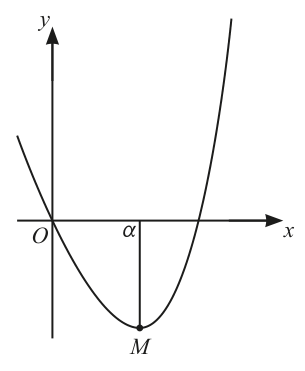
The diagram shows the curve and its minimum point , where .
Approach
Differentiate using the product rule, set at the minimum point , and rearrange the resulting equation to obtain the required form.
Working
Apply the product rule to :
At the minimum point , and :
Factor out :
Take the natural logarithm of both sides:
Divide by 2:
Answer
α = ½ln(5 / (1 + 2α))
Walkthrough
We are given the curve with a minimum point at . To find the condition satisfied by , we differentiate with respect to and set the derivative to zero.
First, we apply the product rule to the term . Let and . Then and . The derivative is . Differentiating gives . So .
At a minimum point, the gradient is zero. Substituting and :
We factor from the first two terms:
Isolating the exponential term:
To solve for , we take the natural logarithm of both sides. Since , we get:
Dividing by 2 yields the required equation:
Key Takeaways
- The product rule is essential when differentiating a product of two functions of .
- At stationary points (minima or maxima), the first derivative equals zero.
- Exponential equations can be solved by taking logarithms, using the property .
Common Mistakes
- Forgetting the product rule and incorrectly differentiating as or .
- Failing to factor correctly when rearranging.
- Not substituting for before equating to zero, or not rearranging into the exact form requested.
Things to Be Careful About
- Ensure the derivative is fully simplified before setting to zero.
- When taking logarithms, remember that , not just .
- The final equation must be expressed entirely in terms of , not .
Approach
Evaluate the derivative at and . If the values have opposite signs, by the Intermediate Value Theorem, there is a root of between these values, meaning lies between 0.4 and 0.5.
Working
At :
At :
Since changes sign from negative () at to positive () at , and is continuous, there must be a value of between and where .
This value is , so lies between and .
Answer
0.4 < α < 0.5
Walkthrough
We need to show that the -coordinate of the minimum point, , lies between and . Since is a root of , we can evaluate the derivative at the boundary values and .
Using the derivative from part (a):
Substituting :
Substituting :
The derivative is negative at and positive at . Because the derivative is a continuous function, it must cross zero somewhere between and . This zero corresponds to the minimum point , so must lie in the interval .
Key Takeaways
- A sign change in a continuous function guarantees a root between the two points (Intermediate Value Theorem).
- Evaluating the derivative at two points is a standard method to locate stationary points.
Common Mistakes
- Calculating only one value instead of both.
- Forgetting to state that the derivative changes sign and thus a root exists between the values.
- Rounding errors that lead to incorrect sign conclusions.
Things to Be Careful About
- Ensure calculations are accurate to at least 3 decimal places to clearly show the sign change.
- Explicitly state that the derivative is continuous, which justifies the sign change argument.
Use an iterative formula based on the equation in part (a) to determine correct to 2 decimal places. Give the result of each iteration to 4 decimal places.
Approach
Use the iterative formula derived in part (a): . Start with an initial value (e.g., ) and iterate, recording each result to 4 decimal places, until the value stabilizes to 2 decimal places.
Working
Iterative formula:
Let :
The values are oscillating around . To confirm correct to 2 decimal places, we check for a sign change in between and :
At :
At :
Since there is a sign change between and , correct to 2 decimal places.
Answer
0.47
Walkthrough
We use the iterative formula to find . Starting with , we substitute this value into the right-hand side to get , then substitute to get , and so on.
Calculations:
The sequence is oscillating and converging towards a value around . To confirm that correct to 2 decimal places, we verify that the root lies in the interval . We define and check the signs at the boundaries:
The sign change confirms the root is in this interval, so to 2 decimal places.
Key Takeaways
- Iterative methods can find roots of equations to a desired accuracy.
- Showing a sign change in an interval of width centered on the answer is the standard way to justify a 2 decimal place answer.
- Iterations must be carried out to sufficient precision (4 d.p. here) to avoid rounding errors.
Common Mistakes
- Using the wrong iterative formula or making arithmetic errors in early iterations.
- Stopping the iteration too early without verifying convergence.
- Not showing sufficient iterations or the sign change argument to justify the final answer.
Things to Be Careful About
- Always carry at least 4 decimal places during iterations to ensure the final answer is accurate.
- Explicitly show the sign change at and to justify the 2 decimal place answer; simply stating the iteration values is not enough.
Express in the form , where and . State the exact value of and give correct to 3 decimal places.
Approach
Expand using the compound angle formula, collect the terms into , and then write the result as .
Working
Expand the cosine term:
Multiply by :
Add :
Now write . Expanding the right-hand side:
Matching coefficients gives and . Therefore
and
To 3 decimal places, .
Answer
with and .
R = sqrt(5), alpha = 1.107
Walkthrough
Start by expanding using the compound angle formula. Because , the shifted cosine becomes . Multiplying by gives . Adding gives .
Next, compare this with . The coefficient of is and the coefficient of is , so and . Squaring and adding gives , so . Dividing the two equations gives , so radians. Since both and are positive, lies in the first quadrant, matching the required range .
Key Takeaways
- The compound angle formula for is .
- To write as , use and , choosing the quadrant from the signs of and .
- Exact values should be given exactly where requested; approximations are only for the final decimal answer.
Common Mistakes
- Forgetting the minus sign in .
- Using instead of .
- Choosing the wrong quadrant for ; here both coefficients are positive, so is acute.
- Giving as a decimal instead of the exact value .
Things to Be Careful About
- must be in radians because the question asks for 3 decimal places and the interval is in radians; giving is treated as a misread.
- The mark scheme requires the correct expansion before the and values are accepted.
- Check that ; here it is satisfied.
Approach
Use the result from part (a) with . The left-hand side is exactly twice the expression in part (a), so the equation becomes a sine equation. Solve for , then list all solutions in the interval .
Working
From part (a),
Putting and multiplying by 2 gives
So the equation is
Let . The principal value is
Since , we have , so
which is approximately .
The general solutions of are
Therefore
Converting back, :
or
For the first family, gives and gives ; gives , outside the interval. For the second family, gives and gives ; gives , outside the interval. These are the only integer values of that keep in the interval.
Answer
The solutions in the interval are
theta = -9.97, -0.74, 2.60, 11.8
Walkthrough
The left-hand side of the equation is exactly twice the expression from part (a) with . Therefore it can be replaced by . Dividing by gives .
Let . The principal solution is . Because sine is periodic with period , the general solutions are and .
Now convert back: . This gives from the first family and from the second. The interval is approximately . Testing integer values of : first family gives and ; second family gives and . These are the four required solutions.
Key Takeaways
- The R-form result can be used directly to solve equations of the form .
- The general solution of has two families: and .
- When an interval is given, substitute integer values of and discard solutions outside the interval.
Common Mistakes
- Forgetting the second family when solving .
- Forgetting to add and therefore missing solutions.
- Forgetting to convert the interval for into an interval for or .
- Using degrees instead of radians; the mark scheme treats degree answers as a misread.
- Giving only one or two solutions instead of all four in the interval.
Things to Be Careful About
- The interval is strict, , but none of the four solutions lies exactly on an endpoint.
- Answers outside the interval should be ignored, not counted.
- If a rounded value of is used, the final answers may differ slightly in the last decimal place; this is acceptable.
- The mark scheme says that if is used (degrees), the first accuracy mark is withheld, but later accuracy marks may still be allowed.
Relative to the origin , the position vectors of the points , and are given by
Approach
We use vectors. To show that is a rectangle, we show that one pair of adjacent sides is perpendicular and that both pairs of opposite sides are parallel and equal in length.
Working
Let
Then the sides of quadrilateral are:
So , showing that side is parallel and equal to side .
Also,
so is parallel and equal in length to .
Now check a pair of adjacent sides:
Thus is perpendicular to . Since opposite sides are parallel and equal, is a parallelogram; with a right angle at , it is a rectangle.
Answer
is a rectangle because its adjacent sides are perpendicular and its opposite sides are parallel and equal in length.
OABC is a rectangle because adjacent sides are perpendicular and opposite sides are parallel and equal in length.
Walkthrough
We start from the position vectors of , and relative to the origin . To show that is a rectangle, we first show that it is a parallelogram, then check that one of its angles is a right angle.
Compute the side vectors from the vertex order . In vector form, , and subtraction gives , which is exactly . Hence is parallel to and has the same length. Similarly, , so is parallel to and has the same length.
Next, use the scalar product to test whether adjacent sides meet at a right angle. Since , the side has the same vector as . The scalar product , so the two adjacent sides and are perpendicular. A parallelogram with a right angle is a rectangle.
Key Takeaways
A rectangle is a parallelogram with a right angle. To prove a quadrilateral is a rectangle using vectors, show both pairs of opposite sides are parallel and equal, and use a zero scalar product to show one pair of adjacent sides is perpendicular. Vector subtraction is used to find side vectors from position vectors.
Common Mistakes
- Using the given position vectors , , as if they were the four sides of the rectangle, instead of computing the actual side vectors of .
- Omitting one of the two pairs of opposite sides when proving parallelism.
- Only showing that lengths are equal without showing that the sides are parallel.
- Sign errors when subtracting position vectors, e.g. writing .
Things to Be Careful About
- The correct subtraction is .
- A scalar product of zero means the vectors are perpendicular; to earn the mark, show the numerator , so the denominator is irrelevant here.
- Showing is enough to establish both parallel and equal in length for that pair; confirming handles the other pair.
- If you only show equal lengths for the opposite sides, you have not yet proved they are parallel, which is needed for the rectangle conclusion.
Approach
We need the two diagonals of the parallelogram . Since is the origin and the vertices are , the diagonals are and . We use the scalar product formula
Working
First find the diagonal :
The other diagonal is
Their scalar product is
Their magnitudes are
and
Therefore,
Since this dot product is positive, is the acute angle:
This is radians.
Answer
The acute angle between the diagonals is .
65.0°
Walkthrough
In the quadrilateral , with vertices in the order , the two diagonals are and . We need the acute angle between them.
First find the vector for diagonal by subtracting position vectors: . The other diagonal is .
Apply the scalar product formula
The scalar product of the diagonals is . The magnitudes are both , so
Because this value is positive, the angle found by is already the acute angle between the diagonals: (or radians).
Key Takeaways
This question tests the scalar product definition of the angle between two vectors, finding diagonal vectors by vector subtraction, and computing vector magnitudes. It also highlights that if the scalar product is positive, the angle from the cosine formula is acute, while a negative scalar product would need the supplement .
Common Mistakes
- Using non-diagonal vectors such as and as the diagonals, or using four sides instead of diagonals.
- Forgetting to divide by the product of the moduli; the cosine formula requires both magnitudes in the denominator.
- Arithmetic sign mistakes in the scalar product, especially with the negative components.
- If a negative scalar product occurs, reporting the obtuse angle instead of converting it to the acute angle.
Things to Be Careful About
- The diagonals of are and , not and .
- Here the scalar product is , so the resulting angle is acute. If it were negative, the acute angle would be minus the computed angle.
- Simplify to ; the answer is accepted as or radians.
- In the mark scheme, the vector for may be written with either sign; using the opposite sign would change the sign of the scalar product, so choose the direction that gives the required acute angle.
Let , where is a positive constant.
Approach
Write the rational function in the standard partial fraction form for three distinct linear factors. Multiply through by the common denominator, then substitute values of that make each factor zero to find the coefficients.
Working
Let
Multiplying by the denominator:
Set :
Set :
Set :
Answer
1/(2a+x) + 9/(2a-x) - 16/(5a-2x)
Walkthrough
We have a rational function whose denominator is a product of three distinct linear factors. The first step is to write the correct partial fraction form:
This form is guaranteed because each factor is linear and none is repeated. The mark scheme gives a mark for stating this form before any coefficients are found.
Next, multiply both sides by the denominator. This clears the fractions and gives an identity valid for all :
Now choose values of that make one factor zero. This isolates one coefficient at a time. Setting makes the factor zero, so only the term survives; this gives . Setting makes zero, giving . Setting makes zero, giving . The substitution method is quick and avoids expanding and comparing coefficients.
Key Takeaways
A rational function with three distinct linear factors decomposes into three simple fractions. Substituting the roots of the linear factors is an efficient way to find coefficients. The coefficients may depend on parameters such as , but here they are constants.
Common Mistakes
- Using an incorrect form, such as combining the first two factors into one quadratic denominator. The mark scheme allows at most 2 marks if only is found with the wrong form.
- Not showing a valid method for finding a coefficient; the method mark requires more than just writing the final answer.
- Sign errors when substituting , because one of the remaining factors is negative.
- Forgetting to multiply the whole numerator by the missing factors when clearing denominators.
Things to Be Careful About
- The factors are distinct, so no repeated-factor term such as is needed.
- When substituting a value that makes a factor zero, that factor must be omitted from the corresponding product; otherwise the term becomes zero and the coefficient cannot be found.
- Keep symbolic throughout; do not assign a numerical value to unless the question asks for it.
Hence find the exact value of , giving your answer in the form where and are integers and and are prime numbers.
Approach
Integrate each partial fraction term separately using the rule for . Then evaluate the definite integral by substituting and , and simplify the logarithms using the laws of logarithms.
Working
From part (a),
Therefore
Let be this antiderivative. At :
At :
Thus
Using and :
Answer
So , , and .
18 ln 3 - 8 ln 7
Walkthrough
Start from the partial fraction decomposition in part (a). Integrate each term separately. For , the derivative of the denominator is , so the integral is . For , the derivative of the denominator is , so the integral is . For , the derivative of the denominator is , so the integral is .
Define as the antiderivative. The definite integral is . Since and lies between and , all of , and are positive, so the modulus signs can be removed. Substitute the limits:
Then subtract carefully:
Finally use and . The terms cancel, leaving . This matches with , , , .
Key Takeaways
A partial fraction decomposition converts a complicated rational integrand into simple reciprocal-linear terms that integrate to logarithms. Definite integrals are evaluated by substituting the upper limit then subtracting the lower limit. Laws of logarithms are often needed to simplify the result into the requested form.
Common Mistakes
- Forgetting the factor from the chain rule when integrating ; the correct term is , not or .
- Subtracting incorrectly. Every term of must be subtracted, which changes several signs.
- Assigning a numerical value to . The mark scheme awards at most 3 marks in part (b) if a value is assigned to .
- Writing logarithms of negative numbers; the mark scheme gives A0 if the solution involves logarithms of negative numbers. Here all arguments are positive on the interval.
- Stopping before the terms cancel; the final answer must be independent of and in the form with prime bases.
Things to Be Careful About
- The order of limits is important: evaluate , not .
- When combining terms, note that ; the contributions must cancel exactly.
- The coefficient of is at the upper limit and at the lower limit, giving in total.
- The answer should be expressed with prime bases: and .
The variables and satisfy the differential equation
It is given that when .
Solve the differential equation and find the exact value of when .
Approach
Separate the variables so that all terms are on one side and all terms on the other. Integrate the left side using integration by parts and the right side using the identity . Use the given initial condition to fix the constant, then substitute and solve for .
Working
Separate variables:
Integrate the left side by parts with , , so and :
For the right side, use :
Combine the constants into one constant :
Use , . Since and :
So the particular solution is:
Now set :
Multiply by 2:
Answer
tan theta = 17/9 - 14/(9e^3)
Walkthrough
This is a separable first-order differential equation. The first step is to rearrange it so that every appears with and every appears with . Dividing both sides by and by gives
The left-hand side is a product of a linear factor and an exponential, so integration by parts is the natural tool. Let and . Then and . The formula gives
For the right-hand side, the denominator is simplified using the double-angle identity . This turns the integrand into , whose integral is .
After adding the constant of integration, the general solution is
The initial condition when is used to find . Since and , substituting gives
so .
Finally, substitute into the particular solution:
Combining the exponential terms gives , so
Multiplying by 2 yields the exact value
Key Takeaways
This question combines several core skills: separating variables in a differential equation, integrating a product using integration by parts, using a trigonometric identity to make an integral tractable, and using an initial condition to determine an arbitrary constant. It also tests careful algebraic manipulation with fractions and exponentials. After solving, a student should be comfortable recognising when a first-order differential equation is separable and executing each integration technique accurately.
Common Mistakes
A common mistake is separating variables incorrectly, for example writing instead of . In integration by parts, sign errors frequently occur in the second term: the integral of is , not . Another common error is forgetting the constant of integration or placing it inconsistently. On the right-hand side, students sometimes fail to use and attempt a more complicated integration. The mark scheme also requires an exact final answer; a decimal approximation is not accepted, and using instead of loses the final mark.
Things to Be Careful About
Be consistent about which side carries the constant of integration. Here it is convenient to write on the left-hand side, giving ; if it is put on the right-hand side, the sign of changes. When substituting , remember that is a common factor: . Finally, multiply by 2 correctly to obtain , and leave the answer in exact form with as the variable.