Mathematics 9709/42 — October/November 2021
Cambridge A-Level · Mechanics · worked solutions for every part, with the mark scheme
Topics Kinematics of Motion in a Straight Line · Newton's Laws of Motion · Energy, Work and Power · Forces and Equilibrium · Momentum
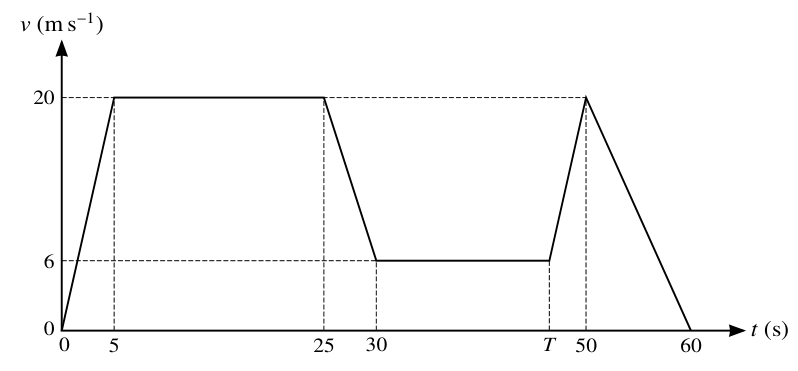
The diagram shows a velocity-time graph which models the motion of a car. The graph consists of six straight line segments. The car accelerates from rest to a speed of over a period of , and then travels at this speed for a further . The car then decelerates to a speed of over a period of . This speed is maintained for a further . The car then accelerates again to a speed of over a period of , before decelerating to rest over a period of .
Given that during the two stages of the motion when the car is accelerating, the accelerations are equal, find the value of .
Approach
The acceleration during any stage is the gradient of the velocity-time graph. Calculate the acceleration for the first accelerating stage ( to ) and the second accelerating stage ( to ), then equate them to solve for .
Working
The acceleration during the first stage is:
The acceleration during the second stage is:
Equating the accelerations:
Solving for :
Answer
T = 46.5
Walkthrough
The problem states that the two accelerating stages have equal acceleration. Acceleration on a velocity-time graph is given by the gradient of the line segment.
First, we find the acceleration during the initial stage from to . The velocity increases from to , so the gradient is .
Next, we find the acceleration during the second stage from to . The velocity increases from to over a time of seconds, giving a gradient of .
Setting these two gradients equal gives . Cross-multiplying yields , which rearranges to , so .
Key Takeaways
- The gradient of a velocity-time graph represents acceleration.
- Equating gradients from different segments allows you to solve for unknown time values.
Common Mistakes
- Using the wrong time interval for the second acceleration (e.g., using instead of ).
- Forgetting that the velocity at is , not .
Things to Be Careful About
- Ensure the time interval is calculated correctly as the difference between the end and start times ().
- Check that the algebraic manipulation of the fraction is correct when cross-multiplying.
Find the total distance travelled by the car during the motion.
Approach
The total distance travelled is equal to the area under the velocity-time graph. Calculate the area of each of the six geometric shapes formed by the segments and sum them, substituting .
Working
The area under the graph is the sum of the areas of the following shapes:
- Triangle from to :
- Rectangle from to :
- Trapezium from to :
- Rectangle from to :
- Trapezium from to :
- Triangle from to :
Total distance:
Answer
759.5 m
Walkthrough
Distance is the area under a velocity-time graph. The graph is composed of six distinct segments, which create six geometric regions between the graph and the time axis. We calculate the area of each region individually and add them together.
From to , the shape is a triangle with base and height , giving area .
From to , the shape is a rectangle with width and height , giving area .
From to , the shape is a trapezium with parallel sides and , and width , giving area .
From to , the shape is a rectangle with width and height , giving area .
From to , the shape is a trapezium with parallel sides and , and width , giving area .
From to , the shape is a triangle with base and height , giving area .
Summing these areas gives the total distance: metres.
Key Takeaways
- The area under a velocity-time graph represents the total distance travelled.
- Complex shapes under the graph can be decomposed into simple geometric figures (triangles, rectangles, trapeziums) for easier calculation.
Common Mistakes
- Forgetting to substitute the value of found in part (a) before calculating the areas of the last two regions.
- Using the wrong formula for the area of a trapezium (must use , not ).
Things to Be Careful About
- Ensure all time intervals are calculated as differences (e.g., and ).
- Check arithmetic when summing the final areas to avoid simple addition errors.
The rest of this paper
6 more questions- Q2Newton's Laws of Motion6M
- Q3Energy, Work and Power5M
- Q4Kinematics of Motion in a Straight Line7M
- Q5Energy, Work and Power · Forces and Equilibrium7M
- Q6Forces and Equilibrium8M
- Q7Newton's Laws of Motion · Kinematics of Motion in a Straight Line · Momentum13M