Mathematics 9709/41 — May/June 2019
Cambridge A-Level · Mechanics · worked solutions for every part, with the mark scheme
Topics Forces and Equilibrium · Kinematics of Motion in a Straight Line · Energy, Work and Power · Newton's Laws of Motion
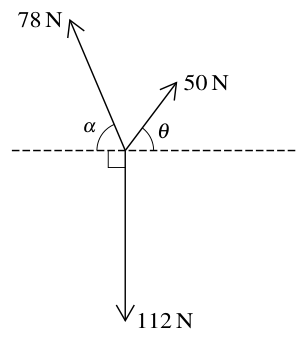
Given that and , show that the coplanar forces shown in the diagram are in equilibrium.
Approach
To show that the coplanar forces are in equilibrium, we must demonstrate that the resultant force is zero. We do this by resolving all forces into horizontal and vertical components and verifying that the sum of the components in each direction is exactly zero. First, we use the given tangent values to find the exact sine and cosine ratios for angles and .
Working
Step 1: Find exact trigonometric ratios for and .
Given , we can form a right-angled triangle with opposite side and adjacent side . The hypotenuse is:
Therefore:
Given , we form a right-angled triangle with opposite side and adjacent side . The hypotenuse is:
Therefore:
Step 2: Resolve forces horizontally.
Taking the right direction as positive, the force has a positive horizontal component, the force has a negative horizontal component, and the force has none. Let be the resultant horizontal force:
Substitute the exact values:
Step 3: Resolve forces vertically.
Taking the upward direction as positive, the and forces have positive vertical components, while the force acts downwards. Let be the resultant vertical force:
Substitute the exact values:
Step 4: Conclude equilibrium.
Since the resultant horizontal component and the resultant vertical component , the vector sum of all forces is zero. Therefore, the coplanar forces are in equilibrium.
Answer
The horizontal and vertical components both sum to zero (, ), confirming the forces are in equilibrium.
X = 0 and Y = 0, so the forces are in equilibrium.
Walkthrough
The problem asks us to prove that a system of three coplanar forces is in equilibrium. A system is in equilibrium if and only if the vector sum of all forces acting on it is zero. The most direct way to verify this is to resolve each force into its horizontal and vertical components and check that they sum to zero in both directions.
Step 1: Trigonometric ratios. The problem gives and . To resolve the forces, we need and for these angles. Using Pythagoras' theorem on the implied right-angled triangles, we find the hypotenuses are and respectively. This gives us the exact fractions: , , , and . Using exact fractions rather than decimal approximations is crucial to avoid rounding errors and to show the components cancel perfectly.
Step 2: Horizontal resolution. We set up a horizontal axis. Taking right as positive, the force pushes right (), the force pulls left (), and the force is vertical so it contributes nothing. Substituting the values gives .
Step 3: Vertical resolution. Taking upwards as positive, both the and forces have upward components ( and ), while the force pulls down (). Substituting the values gives .
Step 4: Conclusion. Because both the net horizontal and net vertical forces are exactly zero, the resultant force is the zero vector, which is the definition of equilibrium for a particle under coplanar forces.
Key Takeaways
- To prove equilibrium, resolve all forces into two perpendicular directions (usually horizontal and vertical) and show that the resultant in each direction is zero.
- When given , always construct the right-angled triangle to find exact and values to ensure precise cancellation in equilibrium problems.
- Sign conventions (e.g., right is positive, up is positive) must be applied consistently when resolving forces.
Common Mistakes
- Using decimal approximations for the angles (e.g., ) and then multiplying, which can lead to small rounding errors that make the components look like instead of . Always use exact fractions.
- Forgetting the negative sign for a force component that acts in the negative direction of the chosen axis (e.g., taking the leftward component as positive in the horizontal resolution).
- Confusing and when resolving: the horizontal component uses (adjacent to the angle with the horizontal axis) and the vertical component uses (opposite to the angle with the horizontal axis).
Things to Be Careful About
- Ensure the angle given in the diagram is correctly matched to the trigonometric ratio. Here, is measured from the negative horizontal axis, so its horizontal component is and vertical is . Similarly, is measured from the positive horizontal axis.
- The mark scheme also accepts Lami's theorem as an alternative method. If using Lami's theorem, one must correctly identify the angles between the forces: , , and , and then show that .
- Explicitly state the conclusion and (or equivalent) to earn the final mark for showing equilibrium; simply calculating the components is not enough.
The rest of this paper
5 more questions- Q2Kinematics of Motion in a Straight Line7M
- Q3Forces and Equilibrium · Energy, Work and Power7M
- Q4Forces and Equilibrium · Newton's Laws of Motion · Energy, Work and Power · Kinematics of Motion in a Straight Line9M
- Q5Kinematics of Motion in a Straight Line10M
- Q6Forces and Equilibrium · Newton's Laws of Motion · Kinematics of Motion in a Straight Line · Energy, Work and Power14M