Mathematics 9709/43 — October/November 2018
Cambridge A-Level · Mechanics · worked solutions for every part, with the mark scheme
Topics Kinematics of Motion in a Straight Line · Forces and Equilibrium · Energy, Work and Power · Newton's Laws of Motion
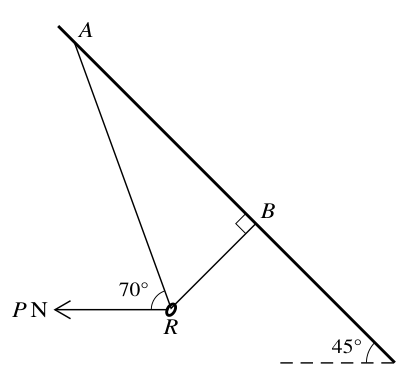
A small smooth ring of mass is threaded onto a light inextensible string . The two ends of the string are attached to points and on a sloping roof inclined at to the horizontal. A horizontal force of magnitude , acting in the plane , is applied to the ring. The section of the string is perpendicular to the roof and the section of the string is inclined at to the horizontal (see diagram). The system is in equilibrium. Find the tension in the string and the value of .
Approach
The ring is in equilibrium under the action of three forces: its weight acting vertically downwards, the horizontal force acting to the left, and the tension in the string. Since the ring is smooth, the tension is uniform throughout the string . We resolve the tension into its vertical and horizontal components using the given angles, then apply the equilibrium conditions (sum of vertical forces = 0, sum of horizontal forces = 0) to find and . We take .
Working
The forces acting on the ring are:
- Weight acting vertically downwards.
- Horizontal force acting to the left.
- Tension along , inclined at to the horizontal (pulling up and to the left).
- Tension along . Since the roof is inclined at to the horizontal and is perpendicular to the roof, is inclined at to the horizontal (pulling up and to the right).
Resolving vertically (upwards positive):
The upward components of the tension balance the downward weight.
Substitute the values and :
Rounding to 3 significant figures:
Resolving horizontally (rightwards positive):
The rightward component of the tension along balances the leftward force and the leftward component of the tension along .
Rearranging to solve for :
Substitute and the values and :
Rounding to 3 significant figures:
Answer
The tension in the string is and the value of is .
T = 1.21 N, P = 0.443 N
Walkthrough
First, we identify all the forces acting on the ring . The ring has a mass of , so its weight is acting vertically downwards. Using , the weight is . A horizontal force acts to the left. The string passes through the smooth ring, meaning the tension is the same in both sections and .
Next, we determine the directions of the tension forces. Section is given as inclined at to the horizontal. From the diagram, is above and to the left of , so the tension along pulls the ring up and to the left at to the horizontal. Section is perpendicular to the roof. The roof is inclined at to the horizontal. A line perpendicular to a slope is at to the horizontal. From the diagram, is above and to the right of , so the tension along pulls the ring up and to the right at to the horizontal.
To find the tension , we resolve forces vertically. The upward vertical components of the two tension forces must balance the downward weight. This gives the equation . Substituting and solving for yields .
To find , we resolve forces horizontally. The rightward horizontal component of the tension along must balance the leftward force and the leftward horizontal component of the tension along . This gives the equation . Rearranging for and substituting the value of yields .
Key Takeaways
- In equilibrium problems involving a smooth ring on a string, the tension is uniform throughout the string.
- Forces can be resolved into perpendicular components (usually horizontal and vertical) to apply the equilibrium condition .
- Geometrical relationships (like a line being perpendicular to a slope) must be used to correctly determine the angles of the forces.
Common Mistakes
- Forgetting that the tension is the same in both sections of the string because the ring is smooth.
- Incorrectly determining the angle of with the horizontal; it is , not or to the vertical (though to the vertical is the same as to the horizontal, care must be taken with the components).
- Sign errors when resolving horizontally; ensuring that leftward and rightward forces are correctly assigned.
- Using or instead of , which is standard for this syllabus unless specified otherwise (the mark scheme values confirm is used here).
Things to Be Careful About
- Always check the direction of the forces to ensure correct signs in the resolution equations.
- The angle is given to the horizontal, so the vertical component uses and the horizontal component uses .
- Ensure the final answers are given to an appropriate number of significant figures (3 s.f. is standard).
- Verify that the geometry makes sense: the sum of the upward vertical components must equal the weight, and the sum of the leftward horizontal components must equal the sum of the rightward horizontal components.
The rest of this paper
6 more questions- Q2Forces and Equilibrium5M
- Q3Energy, Work and Power5M
- Q4Kinematics of Motion in a Straight Line7M
- Q5Newton's Laws of Motion · Kinematics of Motion in a Straight Line9M
- Q6Energy, Work and Power · Newton's Laws of Motion · Forces and Equilibrium · Kinematics of Motion in a Straight Line10M
- Q7Kinematics of Motion in a Straight Line10M