Mathematics 9709/43 — October/November 2015
Cambridge A-Level · Mechanics · worked solutions for every part, with the mark scheme
Topics Kinematics of Motion in a Straight Line · Forces and Equilibrium · Newton's Laws of Motion · Energy, Work and Power
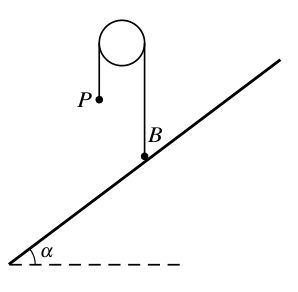
A small ball of mass is attached to one end of a light inextensible string. A particle of mass is attached to the other end of the string. The string passes over a fixed smooth pulley. The system is in equilibrium with the string taut and its straight parts vertical. is at rest on a rough plane inclined to the horizontal at an angle of , where (see diagram). State the tension in the string and find the normal component of the contact force exerted on by the plane.
Approach
The system is in equilibrium. We first analyse particle , which hangs vertically, to determine the tension in the string. Then we analyse ball on the inclined plane, resolving forces perpendicular to the plane to find the normal reaction. A critical detail from the problem statement is that the straight parts of the string are vertical; therefore, the string attached to is vertical, not parallel to the inclined plane.
Working
Finding the tension:
Particle has mass and is in equilibrium. The forces acting on are its weight downwards and the tension upwards.
Using :
Finding the normal component of the contact force on :
Ball has mass . The forces acting on are:
- Weight acting vertically downwards.
- Tension acting vertically upwards (since the string is vertical).
- Normal reaction acting perpendicular to the plane, away from it.
- Friction acting parallel to the plane (direction not needed for this part).
The inclined plane makes an angle with the horizontal, where . The angle between the vertical direction and the normal to the plane is also .
Resolving forces on perpendicular to the plane:
- The component of the weight acting into the plane is .
- The component of the tension acting away from the plane is .
- The normal reaction acts away from the plane.
Applying the equilibrium condition perpendicular to the plane:
Rearranging to solve for :
Substitute , , and :
Answer
The tension in the string is and the normal component of the contact force exerted on by the plane is .
Tension = 30 N, Normal component = 8 N
Walkthrough
First, we look at particle . Since it hangs vertically and the system is in equilibrium, the upward tension in the string must exactly balance the downward weight of . This gives .
Next, we focus on ball on the inclined plane. The problem explicitly states that the string parts are vertical. This is the key geometric detail: the tension force on is directed vertically upwards, not parallel to the slope. The weight of is also directed vertically downwards. To find the normal reaction , we resolve all forces perpendicular to the inclined plane.
The angle between the vertical and the normal to the plane is . Therefore, both the weight () and the tension () have a component perpendicular to the plane equal to their magnitude multiplied by . The weight component pushes into the plane (), while the tension component pulls away from the plane (). The normal reaction also pulls away from the plane. Setting the sum of forces away from the plane equal to the sum of forces into the plane gives , which simplifies to . Substituting the known values yields .
Key Takeaways
- In equilibrium problems, always start with the simplest particle (here, the vertically hanging ) to find unknown forces like tension.
- When resolving forces on an inclined plane, carefully identify the direction of each force. A vertical force on an incline must be resolved using the angle between the vertical and the normal to the plane.
- The component of a vertical force (weight or vertical tension) perpendicular to an incline of angle is always .
Common Mistakes
- Assuming the string attached to is parallel to the inclined plane. If so, the tension would not have a perpendicular component, and the equation would incorrectly be .
- Forgetting to resolve the vertical tension perpendicular to the plane. Since the string is vertical, it contributes to the forces perpendicular to the plane.
- Using instead of . The mark scheme implies by giving the tension as exactly .
Things to Be Careful About
- Always read the problem statement for geometric details like "its straight parts vertical". This changes the force resolution significantly compared to a string parallel to the slope.
- Ensure that the angle used for resolving vertical forces on an inclined plane is (the angle between the vertical and the normal to the plane), not .
- The question asks for the "normal component of the contact force", which is the normal reaction . Do not confuse this with the total contact force, which would include friction.
The rest of this paper
6 more questions- Q2Forces and Equilibrium5M
- Q3Forces and Equilibrium7M
- Q4Newton's Laws of Motion · Kinematics of Motion in a Straight Line7M
- Q5Newton's Laws of Motion · Energy, Work and Power · Kinematics of Motion in a Straight Line8M
- Q6Kinematics of Motion in a Straight Line9M
- Q7Energy, Work and Power · Newton's Laws of Motion · Kinematics of Motion in a Straight Line11M