Economics 9708/21 — October/November 2025
Cambridge AS Level · AS Level Data Response and Essays · worked solutions for every part, with the mark scheme
Topics Economic Systems · Scarcity, Choice and Opportunity Cost · Methods of Government Intervention in Markets · Balance of Payments · Elasticities of Demand · Classification of Goods and Services · +3 more
Mexico’s backward-looking energy policy is bad for the country and the planet
In 2023, Mexico’s energy policies looked increasingly out of step with those in the rest of the world. The Mexican President reversed recent reforms of Mexico’s energy market. These reforms increased the role of private sector firms. He changed the balance of the mixed economy by prioritising state-owned companies and stressed that Mexico should produce its own energy rather than importing it.
The government invested in a new oil refinery and decided to keep coal-fired power stations running. It also gave state-owned electricity and oil companies priority over private sector rivals, so it was harder for private firms to obtain permits to generate electricity or to explore for oil.
Mexico has traditionally exported crude oil and imported natural gas. However, the new plan is that the oil will be used to generate the country’s electricity. There has been a global shift towards energy self-sufficiency but it is unclear whether Mexico has the capacity to produce enough electricity for its 130 million people. There may also be an impact on the country’s balance of trade in goods which was in deficit for nine months of 2022, as shown in Figure 1.1.
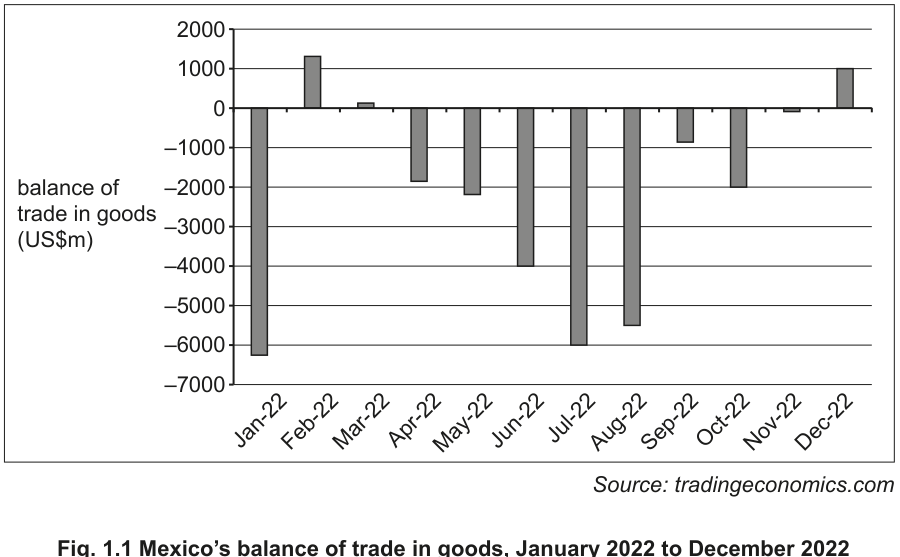
Fig. 1.1 Mexico’s balance of trade in goods, January 2022 to December 2022
Energy is likely to become more expensive. Operating costs of the state-owned electricity producers are significantly higher than their private sector rivals. Its old and inefficient plants are expensive to maintain. These costs will be passed on to the consumer, either directly or by the government having to spend more on subsidies to keep down the price.
The environment will also suffer. Mexico will see less investment in renewable energy because of its change in energy policy. In the past, domestic and foreign firms in the private sector did much of the investing. The policy change means that Mexico is unlikely to meet its pledge to produce 35% of its electricity from renewable sources by 2024.
The impact of the energy policy may be felt in the economy more broadly. The earlier energy reforms had helped to bring manufacturers to Mexico by making power cheaper and more reliable. Now the uncertainty is deterring investors.
The opportunity cost of Mexico’s new energy policy is huge. Economists reckon that Mexico could have produced almost half its electricity from renewable sources long before its target of 2050. Multinational companies were looking at Mexico as an alternative location to other countries, but because of Mexico’s change in energy policy, those companies are likely to go elsewhere.
Source: Adapted from: ‘Mexico’s energy policy’, The Economist, The World Ahead 2023, published 2022
Answer
A mixed economy is one in which resources are allocated through both the private sector and the public sector. The extract shows that Mexico has a private sector, as evidenced by references to "private sector rivals" and "private firms". It also has a public sector, as shown by the prioritisation of "state-owned companies" and "state-owned electricity and oil companies". Therefore, Mexico is a mixed economy.
Mexico is a mixed economy because it has both a private sector and a public sector.
Background Concept
A mixed economy combines elements of both market (private sector) and planned (public sector) economies. Resources are allocated through a combination of price mechanisms and government intervention. This contrasts with a pure market economy, where all resources are privately owned and allocated through markets, and a pure planned economy, where the state owns all resources and makes all allocation decisions.
Understanding the Question
The question asks you to use the information provided to explain whether Mexico is a mixed economy. This requires you to know the definition of a mixed economy and then find evidence in the extract that Mexico has both private and public sector involvement in its economy, specifically in the energy sector.
Approach
First, state the definition of a mixed economy. Second, scan the extract for evidence of private sector activity (e.g., private firms, private sector rivals) and public sector activity (e.g., state-owned companies, government investment). Third, conclude that Mexico fits the definition because both sectors are present.
Step-by-Step Reasoning
- Definition: A mixed economy exists when both the private sector and the public sector play significant roles in allocating resources.
- Private sector evidence: The extract mentions "private sector rivals", "harder for private firms to obtain permits", and "domestic firms in private sector". This confirms the existence of a private sector.
- Public sector evidence: The extract mentions "state-owned companies", "state-owned electricity and oil companies", and government investment in a new oil refinery. This confirms the existence of a public sector.
- Conclusion: Since both sectors are present and active in Mexico's energy market, Mexico is correctly classified as a mixed economy.
Key Takeaways
The defining feature of a mixed economy is the coexistence of private and public ownership/decision-making. When answering data-response questions, always support your explanation with specific references to the text.
Common Mistakes
- Defining a market or planned economy instead of a mixed economy.
- Mentioning only one sector (e.g., only the public sector) and ignoring the other.
- Stating that Mexico is a mixed economy without providing evidence from the extract.
Things to Be Careful About
Ensure you explicitly link the evidence from the extract to the definition. The question asks you to use the information provided, so generic statements about Mexico's economy are insufficient without textual support.
Answer
Opportunity cost is the value of the next best alternative forgone when a decision is taken. The opportunity cost of Mexico's new energy policy is huge because the alternatives forgone are significant: multinational companies may decide to locate elsewhere rather than in Mexico, and Mexico may fail to produce almost half its electricity from renewable sources by 2050.
Opportunity cost is the value of the next best alternative forgone; in this case, lost foreign investment and lost renewable energy generation.
Background Concept
Opportunity cost is a fundamental concept in economics arising from scarcity. Because resources are limited, choosing to use them in one way means giving up the next best alternative use. Opportunity cost is not about all alternatives, but specifically the value of the single best alternative that is sacrificed. It applies to individuals, firms, and governments.
Understanding the Question
The question asks you to explain the meaning of the statement that "The opportunity cost of Mexico's new energy policy is huge." This requires two steps: first, define opportunity cost accurately; second, apply it to the specific choices Mexico has made in its energy policy and explain why the cost is "huge" (i.e., significant).
Approach
Define opportunity cost clearly. Then identify the decision Mexico took (prioritising state-owned companies, using oil for domestic electricity, reducing private sector involvement in renewables). Identify the next best alternatives that have been forgone as a result. Explain why these alternatives are valuable, justifying the word "huge".
Step-by-Step Reasoning
- Definition: Opportunity cost is the value of the next best alternative foregone when a choice is made.
- The decision: Mexico reversed energy reforms, prioritised state-owned companies, and decided to use oil for domestic electricity rather than exporting it and encouraging private renewable investment.
- The alternatives forgone:
- Multinational companies that might have located in Mexico (bringing foreign direct investment, jobs, and technology) may decide to go elsewhere where energy policy is more open to private firms.
- Mexico may fail to develop renewable energy capacity. The extract states economists reckon Mexico could have produced almost half its electricity from renewables before 2050, but the policy change makes this unlikely.
- Why it is huge: Both alternatives represent significant economic value - lost investment and lost future renewable energy capacity. Therefore, the opportunity cost is substantial.
Key Takeaways
Opportunity cost helps to reveal the true cost of decisions. When evaluating government policy, always ask what has been given up, not just what has been gained.
Common Mistakes
- Defining opportunity cost as "all alternatives forgone" rather than just the next best one.
- Giving a generic definition without applying it to Mexico's specific policy.
- Failing to explain why the cost is "huge" - you must identify valuable alternatives that have been lost.
Things to Be Careful About
Make sure your application is specific to the extract. The two alternatives mentioned in the mark scheme are multinational investment and renewable energy capacity. Either is acceptable, but you must explain why it represents a significant loss.
Consider the extent to which direct provision of electricity in Mexico through state-owned companies may be advantageous to consumers.
Answer
Potential advantages of direct provision through state-owned companies include: they may operate in the national interest rather than for profit, potentially benefiting consumers; and the government may have greater financial resources to support them, possibly leading to lower prices and more efficient supply.
Potential disadvantages include: operating costs are significantly higher than private sector rivals, which could lead to higher prices for consumers; old and inefficient plants are expensive to maintain, leading to less efficient supply; and there will be less investment in renewable energy.
Evaluation: Direct provision is unlikely to be advantageous to consumers overall. The higher operating costs and inefficiencies of state-owned producers are likely to lead to higher prices and less reliable supply, outweighing any potential benefits from operating in the national interest.
Direct provision is unlikely to be advantageous to consumers overall because higher state-owned operating costs and inefficiencies will likely lead to higher prices and less reliable supply.
Background Concept
Direct provision occurs when the government provides goods or services directly through state-owned enterprises rather than relying on private firms or subsidies. Reasons for direct provision include market failure, the need for universal access, and strategic national interests. The impact on consumers depends on the efficiency of the state-owned enterprise, its cost structure, and whether it prioritises consumer welfare.
Understanding the Question
The question asks you to consider the extent to which direct provision of electricity through state-owned companies may be advantageous to consumers. This is an evaluative question requiring you to analyse both advantages and disadvantages, then reach a judgement about the net impact on consumers specifically.
Approach
Identify advantages from the extract (national interest, government resources) and disadvantages (higher costs, inefficiency, less renewables). Focus throughout on how each point affects consumers (prices, quality, reliability). Then weigh the two sides to reach a justified conclusion.
Step-by-Step Reasoning
- Advantage 1 - National interest: State-owned companies may prioritise national interest over profit, which could mean more reliable supply or lower prices for consumers.
- Advantage 2 - Financial resources: The government may have deeper financial resources than private firms, allowing it to subsidise operations or invest in infrastructure, potentially leading to lower prices.
- Disadvantage 1 - Higher operating costs: The extract explicitly states that operating costs of state-owned electricity producers are "significantly higher" than private rivals. Higher costs are typically passed to consumers through higher prices.
- Disadvantage 2 - Inefficiency: Old and inefficient plants are expensive to maintain, leading to less efficient supply and potentially higher prices or poorer service quality.
- Disadvantage 3 - Renewables: Less investment in renewable energy may lead to higher long-term costs and environmental damage, indirectly affecting consumers through higher future prices or taxes.
- Evaluation: The disadvantages appear stronger because the extract provides concrete evidence of higher costs and inefficiency, which directly harm consumers through higher prices. The advantages are speculative ("may", "potentially") and lack concrete evidence in the extract. Therefore, direct provision is probably not advantageous to consumers.
Key Takeaways
When evaluating government intervention, always focus on the specific group mentioned in the question (here, consumers). Higher production costs for state-owned enterprises usually translate into higher prices or higher taxes for consumers.
Common Mistakes
- Focusing on benefits to producers, the government, or the environment rather than consumers.
- Providing a one-sided answer (only advantages or only disadvantages).
- Making a vague conclusion without justifying which side is stronger.
Things to Be Careful About
The question asks about advantage "to consumers". Points about national sovereignty or environmental benefits only count if they ultimately benefit consumers. The extract strongly suggests higher costs, which is a direct disadvantage to consumers.
With the help of a diagram, assess whether the potential advantages of providing a subsidy to keep down the price of electricity in Mexico will outweigh the potential disadvantages.
Answer
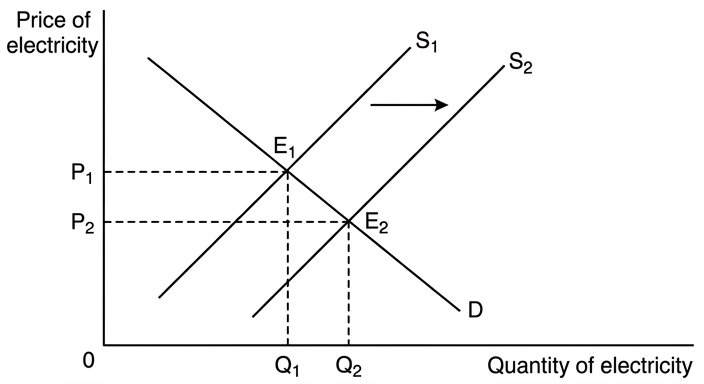
The diagram shows the market for electricity with a downward-sloping demand curve (D) and an upward-sloping initial supply curve (S1). A subsidy to producers shifts the supply curve to the right to S2. This lowers the equilibrium price from P1 to P2 and raises the equilibrium quantity from Q1 to Q2.
Advantages of the subsidy include a lower price for consumers and a higher quantity of electricity consumed.
Disadvantages include the cost to the government of financing the subsidy, which represents an opportunity cost, and the potential for inefficiencies if electricity producers become dependent on subsidies rather than improving productivity.
Evaluation: The potential advantages will only outweigh the disadvantages if the subsidy is targeted effectively and Mexico can afford the fiscal cost. Given that state-owned electricity producers already have high operating costs and the government faces budget constraints, the disadvantages may outweigh the advantages unless the subsidy is temporary or specifically aimed at encouraging renewable energy investment.
The advantages will only outweigh the disadvantages if the subsidy is affordable and targeted; given Mexico's fiscal constraints and existing inefficiencies, the disadvantages likely outweigh the advantages unless carefully designed.
Background Concept
A subsidy is a payment by the government to producers to reduce their costs of production. It shifts the supply curve to the right (downwards), leading to a lower equilibrium price and a higher equilibrium quantity. Subsidies are often used to encourage consumption of merit goods, to support infant industries, or to keep prices of essential goods affordable. However, they cost the government money (opportunity cost) and can create dependency or inefficiency if not well-designed.
Understanding the Question
The question asks you to assess whether the potential advantages of providing a subsidy to keep down electricity prices in Mexico will outweigh the potential disadvantages. This requires: (1) a diagram showing the subsidy; (2) analysis of advantages; (3) analysis of disadvantages; and (4) an evaluative judgement weighing the two sides.
Approach
Draw a standard supply and demand diagram with the subsidy shifting supply right. Explain the price and quantity effects. List advantages (lower price, higher quantity) and disadvantages (government cost, inefficiency, opportunity cost). Then evaluate, considering Mexico's specific context (existing high costs of state-owned firms, government budget constraints).
Step-by-Step Reasoning
- Diagram: Draw price (vertical) and quantity (horizontal). Demand curve (D) downward sloping. Initial supply (S1) upward sloping. Subsidy shifts supply to S2. Mark P1, Q1 (initial equilibrium) and P2, Q2 (new equilibrium), with P2 < P1 and Q2 > Q1.
- Advantages: The subsidy lowers the price consumers pay (from P1 to P2), making electricity more affordable. It also increases the quantity available (from Q1 to Q2), potentially improving access.
- Disadvantages: The government must finance the subsidy, which requires taxation or borrowing - this is an opportunity cost as those funds could be used elsewhere (e.g., healthcare, education). If state-owned firms are already inefficient, the subsidy may simply prop up inefficiency rather than lead to genuine efficiency gains. There is also a risk of moral hazard if firms expect ongoing subsidies.
- Evaluation: Whether advantages outweigh disadvantages depends on context. If electricity is a merit good and the subsidy corrects under-consumption, it may be justified. However, given that Mexico's state-owned producers already have high operating costs, a subsidy may primarily benefit inefficient firms rather than consumers. If the government is running a budget deficit (as suggested by the need to keep prices down), the fiscal cost may be unsustainable. Therefore, the disadvantages likely outweigh the advantages unless the subsidy is carefully targeted and time-limited.
Key Takeaways
A subsidy diagram must clearly show the rightward shift in supply and the resulting lower price and higher quantity. Evaluation must consider the specific market context and government constraints.
Common Mistakes
- Drawing a demand shift instead of a supply shift.
- Forgetting to label curves or axes.
- Describing the diagram without explaining what it shows.
- Providing a one-sided evaluation.
- Not reaching a clear conclusion.
Things to Be Careful About
Ensure the diagram is fully explained in the prose. State which curve shifts, why, and what happens to P and Q. In the evaluation, address the "outweigh" element explicitly by weighing the two sides.
Assess the potential benefits and limitations of Mexico keeping its oil to generate the country’s electricity.
Answer
Benefits of Mexico keeping its oil to generate electricity include greater energy self-sufficiency, reducing reliance on imported natural gas and enhancing national security over energy supply.
Limitations include: Mexico may lack the capacity to produce enough electricity for its population of 130 million; and keeping oil for domestic use rather than exporting it could worsen the balance of trade in goods. Fig. 1.1 shows that Mexico's balance of trade in goods was in deficit for nine months of 2022 (e.g., -US$6200m in January, -US$6000m in July). Reducing exports of crude oil would likely increase this deficit.
Evaluation: The potential benefits are likely to be outweighed by the limitations. Without sufficient capacity to meet domestic demand, Mexico may face energy shortages. Moreover, worsening the existing trade deficit would put downward pressure on the currency and reduce living standards. Therefore, keeping the oil is not advisable unless significant investment increases productive capacity.
The limitations likely outweigh the benefits because Mexico lacks the capacity for self-sufficiency and the policy would worsen the existing trade deficit.
Background Concept
Energy self-sufficiency means a country produces all the energy it consumes rather than importing it. Benefits include reduced vulnerability to international price shocks and enhanced energy security. However, countries should generally specialise in goods where they have a comparative advantage and trade for others. The balance of trade in goods is the difference between the value of goods exported and goods imported. A deficit means imports exceed exports, which can lead to currency depreciation and reduced living standards if persistent.
Understanding the Question
The question asks you to assess the potential benefits and limitations of Mexico keeping its oil to generate electricity rather than exporting it. The extract provides data on the balance of trade in goods (Fig. 1.1) and mentions Mexico's population of 130 million and existing energy policy. You must use this evidence.
Approach
Identify benefits (self-sufficiency, reduced imports, security). Identify limitations (capacity constraints, impact on trade balance using Fig. 1.1 data). Weigh them against each other, considering whether the existing trade deficit makes reducing exports particularly damaging.
Step-by-Step Reasoning
- Benefits: Keeping oil for domestic electricity generation increases energy self-sufficiency. This reduces reliance on imported natural gas, saving foreign exchange and reducing vulnerability to global energy price fluctuations. It may also create domestic jobs in oil and electricity sectors.
- Limitation 1 - Capacity: The extract questions whether Mexico has the capacity to produce enough electricity for 130 million people. If domestic oil is used for electricity but capacity is insufficient, Mexico may face blackouts or need to import electricity anyway.
- Limitation 2 - Balance of trade: Mexico traditionally exports crude oil and imports natural gas. By keeping oil for domestic use, export revenue falls. Fig. 1.1 shows the balance of trade in goods was in deficit for nine months of 2022 (e.g., January -US$6200m, July -US$6000m). Reducing exports while maintaining or increasing imports would worsen this deficit. A persistent trade deficit can lead to currency depreciation, higher import prices, inflation, and lower living standards.
- Evaluation: The limitations likely outweigh the benefits. Mexico lacks comparative advantage in oil refining/electricity generation if it can produce crude oil more efficiently. The existing trade deficit suggests the economy is already spending more on imports than it earns from exports; reducing export revenue would exacerbate this imbalance. Without massive investment in capacity, self-sufficiency is not feasible and would damage the external balance.
Key Takeaways
Always use data from the extract to support your points. When assessing trade policies, consider the existing balance of payments position and the concept of comparative advantage.
Common Mistakes
- Ignoring the Fig. 1.1 data entirely.
- Asserting a trend without quoting figures (e.g., saying "the trade balance was unstable" without citing the deficit months).
- Providing a one-sided answer focusing only on benefits or only on limitations.
- Not explaining the mechanism by which keeping oil affects the trade balance.
Things to Be Careful About
The balance of trade in goods is exports minus imports of goods. If crude oil exports fall because oil is kept at home, the trade balance deteriorates (moves toward deficit or larger deficit). The extract shows this is already a problem (9 months of deficit).
With the help of a formula, explain what is meant by price elasticity of demand for a product and consider the importance of time in determining whether demand for the product is likely to be relatively price elastic or relatively price inelastic.
Answer
AO1 Knowledge and understanding
Price elasticity of demand (PED) measures the responsiveness of quantity demanded to a change in price. The formula is:
PED = % change in quantity demanded / % change in price
If PED > 1, demand is price elastic (quantity demanded changes proportionally more than price). If 0 < PED < 1, demand is price inelastic (quantity demanded changes proportionally less than price).
AO2 Analysis
Time is a key determinant of PED. In the short run, demand tends to be more price inelastic because consumers have limited time to adjust their consumption patterns. For example, a rise in the price of petrol may not immediately reduce quantity demanded much because consumers are locked into existing travel habits and vehicle choices. In the long run, demand becomes more price elastic as consumers have more time to find substitutes, such as switching to public transport or buying more fuel-efficient cars. Thus, the longer the time period considered, the more elastic demand is likely to become.
AO3 Evaluation
Time is an important factor in determining PED, but its significance varies across products. For goods with few substitutes even in the long run (e.g., insulin), demand may remain inelastic regardless of time. Conversely, for goods with many substitutes (e.g., a specific brand of cereal), demand may be elastic even in the short run. Therefore, while time is generally important, it is not the sole determinant; the availability of substitutes and the nature of the good also play crucial roles. On balance, time is a significant factor because it allows consumers to adjust, but its importance is moderated by other factors.
Time is an important factor in determining PED, but its significance depends on the availability of substitutes and the nature of the product.
Background Concept
Price elasticity of demand (PED) is a measure of how much the quantity demanded of a product responds to a change in its price. It is calculated using the formula:
PED = (% change in quantity demanded) / (% change in price)
The value of PED is usually negative because price and quantity demanded move in opposite directions, but economists often refer to the absolute value. If |PED| > 1, demand is elastic; if |PED| < 1, demand is inelastic. Several factors influence PED, including the availability of substitutes, the proportion of income spent on the good, whether the good is a necessity or luxury, and the time period considered.
Understanding the Question
This question has two parts: first, you must explain what PED is, using the formula (AO1). Second, you must consider the importance of time in determining whether demand is elastic or inelastic (AO2 and AO3). The command word "explain" requires you to define and describe, while "consider" invites a short evaluation. The mark scheme allocates 3 marks for knowledge, 3 for analysis, and 2 for evaluation. You need to show that you understand the formula and the concept of elasticity, analyse how time affects elasticity, and then offer a balanced judgement on the importance of time.
Approach
Start by stating the formula for PED and explaining what it means. Then define elastic and inelastic demand. Next, analyse the role of time: in the short run, demand is more inelastic because consumers cannot easily change their behaviour; in the long run, demand becomes more elastic as consumers find substitutes. Finally, evaluate the importance of time by acknowledging that other factors also matter, and conclude that time is significant but not the only determinant.
Step-by-Step Reasoning
-
Knowledge (AO1): Write the formula: PED = % change in quantity demanded / % change in price. Explain that if the absolute value is greater than 1, demand is elastic; if less than 1, inelastic. This earns up to 3 marks.
-
Analysis (AO2): Discuss time. In the short run, consumers have limited time to adjust, so demand is less responsive. For example, a price rise for petrol may not immediately reduce consumption because people still need to drive. In the long run, consumers can switch to alternatives, making demand more elastic. This analysis should be developed: mention that habits and contracts can lock consumers in the short run, but over time they can change behaviour. This earns up to 3 marks.
-
Evaluation (AO3): Offer a judgement. Time is important, but its effect depends on the product. For necessities with no substitutes (e.g., life-saving drugs), demand may remain inelastic even in the long run. For luxury goods with many substitutes, demand may be elastic even in the short run. Therefore, while time is a key factor, it is not the only one. Conclude that time is generally important, but its significance varies. This earns up to 2 marks.
Key Takeaways
- PED formula and interpretation are essential knowledge.
- Time is a major determinant of PED: demand becomes more elastic over time.
- Evaluation requires acknowledging other factors and reaching a balanced conclusion.
- In point-based questions, address each assessment objective separately.
Common Mistakes
- Forgetting to state the formula or misstating it (e.g., using percentage change in price over quantity).
- Not distinguishing between short run and long run clearly.
- Providing a one-sided evaluation (e.g., only saying time is important without considering other factors).
- Failing to reach a conclusion, which loses the evaluation marks.
Things to Be Careful About
- Use the correct formula and explain it.
- Give specific examples to illustrate the role of time.
- Ensure the evaluation is balanced and ends with a clear judgement.
- Do not introduce irrelevant factors like income elasticity; focus on PED and time.
Assess whether knowledge of a product’s income elasticity of demand is more important to a firm producing it than knowledge of its cross elasticity of demand.
Introduction
Income elasticity of demand (YED) measures the responsiveness of quantity demanded to a change in consumer income, while cross elasticity of demand (XED) measures the responsiveness of quantity demanded of one good to a change in the price of another good. Both provide valuable information to a firm, but their relative importance depends on the nature of the product and market conditions. This essay assesses whether YED is more important than XED for a firm.
Income Elasticity of Demand (YED)
YED is calculated as % change in quantity demanded / % change in income. For normal goods, YED is positive; for inferior goods, YED is negative. The size of YED indicates whether a good is a luxury (YED > 1) or a necessity (0 < YED < 1). Knowledge of YED helps a firm forecast sales changes in response to economic cycles. For example, a firm producing luxury cars (high YED) will expect a significant drop in sales during a recession and may plan accordingly by reducing production or targeting different market segments. Conversely, a firm producing inferior goods (e.g., own-brand groceries) may see increased demand during downturns. YED also informs marketing strategies and inventory management.
Cross Elasticity of Demand (XED)
XED is calculated as % change in quantity demanded of good A / % change in price of good B. For substitutes, XED is positive; for complements, XED is negative. The magnitude indicates the strength of the relationship. Knowledge of XED helps a firm understand its competitive position. If a firm’s product has a high positive XED with a rival’s product, a price cut by the rival could significantly reduce the firm’s sales. This information is crucial for pricing decisions and for assessing the risk of competition. For example, a smartphone manufacturer monitors XED with other brands to anticipate the impact of competitors’ price changes. XED also helps in identifying potential threats from new entrants or substitute products.
Evaluation
Whether YED or XED is more important depends on the context. For a firm producing a luxury good with high YED, understanding income sensitivity is vital for strategic planning, especially in volatile economic conditions. For a firm operating in a highly competitive market with many close substitutes, XED may be more critical for pricing and marketing decisions. Additionally, the time horizon matters: in the short run, XED may be more relevant for immediate pricing battles, while YED is more important for long-term planning. The size of the firm also plays a role; a large firm with diversified products may need both, while a small firm in a niche market may rely more on XED. Ultimately, both elasticities provide complementary information, and neglecting either could lead to poor decisions.
Conclusion
Neither YED nor XED is universally more important; their relative significance depends on the specific product, market structure, and economic environment. For a luxury goods firm, YED is crucial; for a firm in a competitive market with close substitutes, XED is more important. Therefore, firms should analyse both elasticities to make informed decisions. The question cannot be answered definitively without considering the context.
The relative importance of YED and XED to a firm depends on the nature of the product and market conditions. For a luxury good, YED is more important; for a product in a competitive market with close substitutes, XED is more important. Therefore, neither is universally more important; firms should consider both.
Background Concept
Income elasticity of demand (YED) and cross elasticity of demand (XED) are two types of demand elasticity that help firms understand how their product's demand responds to changes in external factors. YED measures the effect of changes in consumer income, while XED measures the effect of changes in the price of another good. Both are calculated using percentage changes and provide insights into the nature of the product (normal vs inferior, substitute vs complement) and the strength of these relationships. Firms use this information for pricing, production planning, marketing, and risk management.
Understanding the Question
The question asks you to assess whether knowledge of YED is more important to a firm than knowledge of XED. The command word "assess" requires a balanced discussion and a justified conclusion. This is a levels-marked question (12 marks: 8 for AO1+AO2, 4 for AO3). The top band requires detailed knowledge, developed analysis, and a well-supported evaluative conclusion. You must consider both sides and reach a judgement that addresses the specific question.
Approach
Start by defining YED and XED and explaining their significance. Then analyse the importance of each for a firm, using examples. Next, evaluate the relative importance by considering factors such as the type of product, market structure, and time horizon. Finally, conclude that the answer depends on context, but provide a reasoned judgement.
Step-by-Step Reasoning
-
Introduction: Define YED and XED briefly. State that the essay will assess their relative importance.
-
Analysis of YED: Explain the formula and interpretation. Discuss how YED helps firms forecast sales in different economic conditions. Give examples: luxury cars (high YED) vs necessities (low YED). Explain that firms can adjust production, marketing, and inventory based on YED.
-
Analysis of XED: Explain the formula and interpretation. Discuss how XED helps firms understand competition and complementarity. Give examples: substitutes (Coca-Cola and Pepsi) and complements (printers and ink). Explain that firms can set prices strategically and assess risk from rivals.
-
Evaluation: Compare the two. Consider scenarios: for a luxury goods firm, YED is critical; for a firm in a competitive market, XED is critical. Also consider time horizon: short-run pricing decisions may rely more on XED, while long-run planning may rely more on YED. Acknowledge that both are important and that the question cannot be answered absolutely.
-
Conclusion: Provide a justified conclusion that answers the question. State that neither is universally more important; it depends on context. This satisfies the AO3 requirement for a justified judgement.
Key Takeaways
- YED and XED are both important tools for firms.
- YED helps with income-related planning; XED helps with competitive strategy.
- The relative importance varies by product and market.
- A good answer is balanced and ends with a clear conclusion.
Common Mistakes
- Providing a one-sided answer (e.g., only arguing that YED is more important). This loses all evaluation marks.
- Failing to define YED and XED properly.
- Not using examples to support analysis.
- Ending with a vague conclusion like "it depends" without explaining on what it depends.
- Ignoring the command word "assess" and simply describing the elasticities.
Things to Be Careful About
- Ensure both elasticities are given equal weight in analysis.
- Use specific examples to illustrate points.
- The conclusion must be justified, not just a summary.
- Organise the essay logically with clear paragraphs.
- Do not introduce irrelevant concepts like PED unless necessary.
With the help of examples, explain the nature and characteristics of free goods and private goods (economic goods) and consider the significance of the distinction between these two types of good.
Answer
Free goods: A free good is one that is not scarce; there is enough to satisfy everyone at zero price, so it has no opportunity cost. Example: sunlight, air.
Private goods (economic goods): A private good is scarce and consumed for private benefit. It is excludable (people can be prevented from consuming if they do not pay) and rival (consumption by one person reduces availability for others). Example: clothing, food.
Significance of the distinction: The distinction is fundamental because free goods do not require allocation through markets; they are not subject to the economic problem. Private goods, being scarce, require a price mechanism to allocate them efficiently. The distinction also affects government policy: free goods are not provided by the market, while private goods are typically provided by the market. However, some goods may be free in some contexts (e.g., air is free but clean air may become scarce). Overall, the distinction is significant because it determines whether a good requires market allocation or not, and it underpins the classification of goods in economics.
The distinction is fundamental: free goods are not scarce and have no opportunity cost, while private goods are scarce, rival, and excludable, requiring market allocation.
Background Concept
In economics, goods are classified based on scarcity and the economic problem. A free good is one that is abundant relative to demand, so it has zero opportunity cost and is not scarce. Examples include sunlight, air, and seawater. A private good (economic good) is scarce, meaning its use involves an opportunity cost. Private goods are characterised by excludability (people can be prevented from consuming if they do not pay) and rivalry (consumption by one person reduces the amount available for others). This classification is essential for understanding how resources are allocated in different economic systems.
Understanding the Question
The question asks you to explain the nature and characteristics of free goods and private goods, using examples, and then consider the significance of the distinction. The command word 'explain' requires you to define and describe the features of each type. The phrase 'consider the significance' introduces an evaluative element: you must judge why the distinction matters in economics. This part is worth 8 marks, split into AO1 (knowledge and understanding, 3 marks), AO2 (analysis, 3 marks), and AO3 (evaluation, 2 marks).
Approach
Start by defining free goods and private goods, giving clear examples for each. Then analyse the characteristics: for free goods, emphasise the absence of scarcity and opportunity cost; for private goods, explain excludability and rivalry. Finally, evaluate the significance of the distinction by discussing its implications for resource allocation, market provision, and government policy. Conclude with a clear judgement.
Step-by-Step Reasoning
- Define free goods: A free good is available in unlimited supply at zero price. Because it is not scarce, consuming it does not involve an opportunity cost. Example: sunlight. (AO1)
- Define private goods: A private good is scarce and consumed for private benefit. It is excludable (sellers can prevent non-payers from using it) and rival (one person's consumption reduces availability for others). Example: a sandwich. (AO1)
- Analyse free goods: Since free goods are not scarce, there is no need for a market. The quantity demanded equals quantity supplied at zero price. No factors of production are used, so opportunity cost is zero. (AO2)
- Analyse private goods: Private goods are allocated through markets. Excludability allows firms to charge a price, and rivalry means that consumption by one person reduces the amount for others, creating competition. This leads to the need for a pricing mechanism to ration the good. (AO2)
- Evaluate significance: The distinction is crucial because it determines whether a good is subject to the economic problem. Free goods do not require allocation decisions, while private goods do. This affects government policy: free goods are not provided by the market, but private goods are typically left to the market unless there are market failures. However, some goods can change status (e.g., clean air may become scarce and thus an economic good). The distinction also helps in understanding the classification of goods into public, merit, and demerit goods. (AO3)
- Conclusion: The distinction is significant because it underpins the fundamental economic problem of scarcity and the need for choice. (AO3)
Key Takeaways
- Free goods are not scarce and have zero opportunity cost; private goods are scarce and have opportunity cost.
- Private goods are excludable and rival; free goods are not.
- The distinction is important for understanding resource allocation and the role of markets.
- Examples help illustrate the concepts: sunlight (free), clothing (private).
Common Mistakes
- Confusing free goods with public goods: public goods are non-excludable and non-rival but still scarce (e.g., national defence). Free goods are not scarce at all.
- Thinking that free goods are always available: some goods that are normally free can become scarce (e.g., clean air in polluted cities).
- Forgetting to mention excludability and rivalry for private goods.
- Providing examples that are not clearly free or private (e.g., water can be both depending on context).
Things to Be Careful About
- Use precise definitions: free good = no scarcity, no opportunity cost; private good = scarce, excludable, rival.
- Ensure examples are unambiguous: sunlight is a classic free good; a car is a private good.
- In the evaluation, do not just list points; make a judgement about why the distinction matters.
- The question asks for 'the significance of the distinction', so focus on the implications for economics, not just a summary.
Introduction
A public good is defined by non-excludability and non-rivalry, leading to the free-rider problem. A merit good is a private good that is under-consumed due to imperfect information about its benefits. This essay assesses whether education should be classified as a public good or a merit good.
Analysis of education as a public good
For a good to be a pure public good, it must be non-excludable (impossible to prevent anyone from consuming it) and non-rival (consumption by one person does not reduce availability for others). Education does not fully meet these criteria. Schools can exclude students who do not pay fees, so education is excludable. Classrooms have limited capacity, so education is rival to some extent (more students reduce the quality for others). Therefore, education is not a pure public good. However, some argue that basic education has positive externalities (e.g., a more educated workforce benefits society), which might suggest public good characteristics, but positive externalities alone do not make a good a public good.
Analysis of education as a merit good
A merit good is a private good that is under-consumed because individuals have imperfect information about its long-term benefits. Education fits this description: it is excludable (private schools exist) and rival (class size matters), but many people may not fully appreciate the future returns to education, leading to under-investment. Government intervention, such as subsidies or compulsory schooling, corrects this market failure. Education also generates positive externalities, which is a common feature of merit goods.
Evaluation
While education has some public good aspects (positive externalities, government provision), it does not satisfy the key criteria of non-excludability and non-rivalry. The free-rider problem does not apply because exclusion is possible. The under-consumption of education is better explained by imperfect information than by public good characteristics. Therefore, education is more accurately classified as a merit good. Some may argue that if education were provided entirely by the state and free at the point of use, it might appear non-excludable, but exclusion is still possible in principle. The classification matters because it determines the appropriate policy response: for a public good, the government must provide it; for a merit good, the government may intervene to correct under-consumption but private provision is also possible.
Conclusion
Education should be classified as a merit good, not a public good. It is excludable and rival, and its under-consumption stems from imperfect information about its benefits. Government intervention is justified to ensure optimal consumption, but this does not make it a public good.
Education should be classified as a merit good, not a public good, because it is excludable and rival, and its under-consumption is due to imperfect information about its benefits, justifying government intervention without it being a pure public good.
Background Concept
Public goods are goods that are non-excludable (impossible to prevent anyone from consuming) and non-rival (consumption by one person does not reduce availability for others). Examples include national defence and street lighting. Because of these characteristics, public goods suffer from the free-rider problem: individuals can benefit without paying, so private markets fail to provide them efficiently. Merit goods are private goods (excludable and rival) that are under-consumed because individuals have imperfect information about their benefits. Education and healthcare are classic examples. Merit goods often generate positive externalities, but that does not make them public goods.
Understanding the Question
The question asks you to assess whether education should be classified as a public good or a merit good. 'Assess' requires you to consider both sides of the argument and reach a justified conclusion. This is a levels-marked question worth 12 marks: AO1 and AO2 (knowledge, understanding, analysis) out of 8, and AO3 (evaluation) out of 4. The top band requires detailed knowledge, fully developed explanations, and a justified conclusion.
Approach
First, define public good and merit good, clearly stating their characteristics. Then apply these characteristics to education: examine whether education is non-excludable and non-rival (public good criteria) and whether it is excludable, rival, and under-consumed due to imperfect information (merit good criteria). Evaluate the arguments for each classification, considering counterarguments. Finally, conclude with a clear judgement, explaining why education is better classified as a merit good.
Step-by-Step Reasoning
- Define public good: A pure public good is non-excludable and non-rival. Non-excludability means that once provided, no one can be prevented from consuming it. Non-rivalry means that one person's consumption does not reduce the amount available for others. This leads to the free-rider problem, making private provision unprofitable. (AO1)
- Define merit good: A merit good is a private good (excludable and rival) that is under-consumed because individuals lack full information about its benefits. Government intervention (e.g., subsidies, provision) is often used to correct this. (AO1)
- Apply public good criteria to education: Education is excludable: schools can charge fees and exclude non-payers. It is also rival to some extent: adding more students to a classroom reduces the quality of education for others (crowding). Therefore, education does not meet the strict definition of a public good. However, some argue that basic education has positive externalities (e.g., lower crime, higher productivity) that benefit society as a whole, which might suggest public good characteristics. But positive externalities are not sufficient to classify a good as a public good. (AO2)
- Apply merit good criteria to education: Education is excludable (private schools exist) and rival (class size matters). Many individuals may not fully understand the long-term benefits of education, leading to under-consumption. This is a classic market failure due to imperfect information. Government intervention, such as compulsory schooling and subsidies, aims to increase consumption to the socially optimal level. Education also generates positive externalities, which is a common feature of merit goods. (AO2)
- Evaluate: The key distinction is that public goods are non-excludable and non-rival, while merit goods are excludable and rival but under-consumed. Education clearly fits the latter. The fact that governments often provide education does not make it a public good; it is provided because of its merit good nature. Some might argue that if education were free and compulsory, it becomes non-excludable in practice, but exclusion is still possible in principle. The free-rider problem does not apply because exclusion is feasible. Therefore, the merit good classification is more accurate. (AO3)
- Conclusion: Education should be classified as a merit good. This classification has important policy implications: the government should intervene to correct under-consumption (e.g., through subsidies or provision), but private provision is also possible. (AO3)
Key Takeaways
- Public goods are non-excludable and non-rival; merit goods are excludable and rival but under-consumed due to imperfect information.
- Education is excludable and rival, so it is not a pure public good.
- The under-consumption of education is due to imperfect information, making it a merit good.
- Positive externalities do not make a good a public good.
- Classification affects the appropriate government policy response.
Common Mistakes
- Confusing public goods with goods provided by the government: many goods provided by the government (e.g., education, healthcare) are not public goods.
- Thinking that because education has positive externalities, it is a public good: positive externalities are a feature of merit goods, not a defining characteristic of public goods.
- Ignoring the criteria of excludability and rivalry: some students argue that education is a public good because it benefits society, but they fail to apply the technical definitions.
- Providing a one-sided answer: the question requires assessment, so both sides must be considered. A one-sided response cannot gain evaluation marks.
Things to Be Careful About
- Use precise definitions: non-excludability and non-rivalry are the defining features of public goods.
- Apply the characteristics directly to education: give specific examples (e.g., private schools show excludability; class size limits show rivalry).
- In the evaluation, do not just list pros and cons; weigh the arguments and reach a clear conclusion.
- The conclusion must be justified: explain why the merit good classification is more appropriate based on the evidence.
- Avoid vague statements like 'it depends'; provide a definitive judgement.
Explain the possible causes of frictional unemployment and technological unemployment and consider whether some element of frictional unemployment is inevitable in an economy.
Answer
Unemployment refers to individuals who are willing and able to work but are without a job. Frictional unemployment is temporary unemployment that occurs when workers are between jobs, e.g. moving to a new city or searching for a better position. It arises because of imperfect information about job vacancies and the time needed to match workers with suitable jobs. Technological unemployment is a form of structural unemployment caused by the introduction of new technology that replaces labour, leaving workers whose skills are no longer demanded.
Some element of frictional unemployment is inevitable in any dynamic economy because workers will always change jobs, new entrants join the labour force, and information about vacancies is never perfect. However, its level can be reduced through better job-matching services, training, and information provision. Therefore, while a small amount is unavoidable, it is not inevitable that it remains high.
Some element of frictional unemployment is inevitable because workers will always change jobs and information is imperfect, but its level can be reduced by improving labour market information.
Background Concept
Unemployment is a key macroeconomic indicator. Frictional unemployment is a natural part of a healthy labour market where workers move between jobs. Technological unemployment is a type of structural unemployment caused by changes in production methods. Understanding the causes helps evaluate whether unemployment is inevitable or can be reduced.
Understanding the Question
The question asks to explain the causes of frictional and technological unemployment, and then to consider whether some frictional unemployment is inevitable. The command word 'explain' requires a clear description of the causes, and 'consider' requires a short evaluation. The marks are split: 3 for knowledge, 3 for analysis, 2 for evaluation.
Approach
First, define unemployment. Then explain frictional unemployment: it is short-term, arises from job search, imperfect information, and labour mobility. Then explain technological unemployment: it is long-term, arises from skill obsolescence due to new technology. For the evaluation, argue that some frictional unemployment is inevitable because of the dynamic nature of labour markets, but its level can be influenced by policy.
Step-by-Step Reasoning
- Define unemployment: people without work but actively seeking. (AO1)
- Frictional unemployment: caused by time lags in job matching. Examples: graduates searching, people moving. (AO1)
- Technological unemployment: caused by automation replacing jobs; workers lack new skills. (AO1)
- Analysis: Is frictional unemployment inevitable? Yes, because there will always be some turnover. But the extent depends on information and mobility. (AO2)
- Evaluation: A small amount is inevitable, but it is not a serious problem; it can be reduced. (AO3)
Key Takeaways
- Frictional unemployment is temporary and often voluntary.
- Technological unemployment is structural and requires retraining.
- Some frictional unemployment is unavoidable but manageable.
Common Mistakes
- Confusing frictional with cyclical unemployment.
- Not providing a clear definition of unemployment.
- Forgetting to include the evaluative judgement.
Things to Be Careful About
- Use precise terminology: 'frictional', 'technological', 'structural'.
- Ensure the evaluation directly answers the 'consider' part.
- Keep the answer concise; do not over-elaborate.
Assess whether the consequences of technological unemployment are likely to be more serious than those of cyclical unemployment.
Introduction
Technological unemployment arises when workers are displaced by new technology, while cyclical unemployment results from a deficiency in aggregate demand. Both have serious consequences, but their severity differs in scope, duration, and impact on individuals and the economy.
Technological unemployment may be more serious
Technological unemployment is structural: workers lose jobs because their skills are no longer needed. This can lead to long-term unemployment if retraining is not available, causing loss of human capital, lower lifetime earnings, and social problems such as poverty and inequality. It affects specific industries, but the displaced workers may find it hard to re-enter the labour market. Moreover, technological change can be permanent, so the unemployment may persist.
Cyclical unemployment may be more serious
Cyclical unemployment affects the entire economy during a recession. It can be severe, with millions losing jobs simultaneously. Prolonged cyclical unemployment can lead to hysteresis, where workers lose skills and become structurally unemployed. It also reduces aggregate demand further, creating a downward spiral. The social costs are widespread, including increased poverty, crime, and mental health issues. However, cyclical unemployment is temporary if the economy recovers.
Evaluation
While technological unemployment can be devastating for affected individuals, cyclical unemployment is more serious overall because it affects a larger number of people across all sectors and can cause long-term damage to the economy if not addressed. The consequences of cyclical unemployment are more likely to be severe in the short run and can lead to permanent scarring. Technological unemployment, though painful, is part of creative destruction and can eventually create new jobs.
Conclusion
Cyclical unemployment is likely to have more serious consequences than technological unemployment because of its economy-wide impact and potential for hysteresis, even though technological unemployment poses significant challenges for displaced workers.
Cyclical unemployment is likely to have more serious consequences overall because it affects the whole economy, can lead to long-term scarring if prolonged, and is harder for individuals to escape without macroeconomic recovery, whereas technological unemployment, though painful for affected workers, is part of structural change that can eventually create new opportunities.
Background Concept
Unemployment has various types, each with different causes and consequences. Technological unemployment is structural, caused by changes in production methods. Cyclical unemployment is demand-deficient, caused by recessions. The consequences include loss of income, skills deterioration, social costs, and macroeconomic effects.
Understanding the Question
The question asks to assess which type of unemployment has more serious consequences. 'Assess' requires a balanced analysis and a justified conclusion. The marks are 8 for analysis and 4 for evaluation. The top band requires detailed knowledge, developed analysis, and a justified conclusion.
Approach
First, define both types and their consequences. Then present arguments for why technological unemployment might be more serious (long-term, skill obsolescence). Then present arguments for why cyclical unemployment might be more serious (economy-wide, hysteresis). Finally, weigh the arguments and reach a conclusion based on scope and duration.
Step-by-Step Reasoning
- Define technological unemployment: caused by technology replacing labour; workers need new skills. Consequences: long-term unemployment, loss of human capital, inequality.
- Define cyclical unemployment: caused by lack of AD; affects all sectors. Consequences: widespread job losses, reduced income, potential hysteresis.
- Argument for technological being more serious: permanent displacement, need for retraining, individual hardship.
- Argument for cyclical being more serious: larger scale, macroeconomic feedback, can become structural if prolonged.
- Evaluation: Cyclical unemployment is more serious because it affects the whole economy and can cause long-term damage. Technological unemployment is serious but part of progress.
- Conclusion: Cyclical unemployment is likely more serious.
Key Takeaways
- Different types of unemployment have different consequences.
- Cyclical unemployment can lead to hysteresis.
- Technological unemployment requires structural adjustment.
- Evaluation should consider scope, duration, and policy implications.
Common Mistakes
- One-sided argument: must discuss both sides.
- No conclusion or vague conclusion.
- Confusing consequences with causes.
- Not using economic terminology.
Things to Be Careful About
- Ensure the conclusion is justified, not just a summary.
- Use specific examples to support arguments.
- Address the 'more serious' comparison directly.
- Avoid overgeneralisation; acknowledge that severity depends on context.
Explain two tools of protection used by a country when trading internationally and consider whether one is likely to have more of an impact on the country’s economy than the other.
Answer
AO1 Knowledge and understanding
Protectionism refers to government policies that restrict international trade to protect domestic industries from foreign competition.
Tool 1: Tariff – A tax on imported goods, raising their price in the domestic market.
Tool 2: Import Quota – A physical limit on the quantity of a good that can be imported over a period.
AO2 Analysis
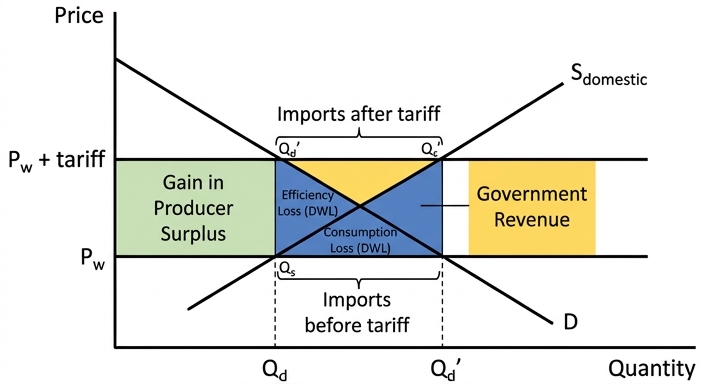
Impact of a tariff: A tariff raises the domestic price of the imported good. This reduces the quantity demanded of imports and allows domestic producers to increase output and charge a higher price. The government gains tariff revenue. Consumers lose consumer surplus as they pay more and consume less. The domestic industry is protected, but at a cost to consumers.
Impact of an import quota: An import quota directly restricts the quantity of imports. This reduces supply, raising the domestic price. Domestic producers gain higher sales and profits. Consumers face higher prices and reduced choice. Unlike a tariff, the government does not receive revenue; instead, the higher price paid by consumers accrues as extra profit to importers who hold the quota licences.
AO3 Evaluation
A tariff is likely to have a more predictable and transparent impact on the economy than a quota. A tariff raises revenue for the government, which can be used to offset the welfare loss to consumers or to fund other priorities. A quota, by contrast, creates quota profits for importers and lacks the automatic price-adjustment mechanism of a tariff. However, if the objective is to guarantee a specific reduction in import volume, a quota is more certain. On balance, a tariff is likely to have a more beneficial overall impact because it generates government revenue and distorts the market less than a quota, which creates artificial scarcity and rents for importers.
A tariff is likely to have a more beneficial overall impact than a quota because it generates government revenue and distorts the market less, though a quota provides more certain volume control.
Background Concept
Protectionism is the economic policy of restricting imports to shield domestic industries from foreign competition. The core economic rationale is to protect infant industries, safeguard jobs, and improve the balance of trade. However, protectionism generally reduces overall economic welfare by distorting prices, reducing consumer choice, and leading to inefficient allocation of resources. The main tools include tariffs (taxes on imports), quotas (quantity limits), export subsidies, embargoes (bans), and administrative barriers ('red tape').
Understanding the Question
This is an 8-mark, point-based question with three assessment objectives: AO1 (3 marks) for defining protectionism and explaining two tools; AO2 (3 marks) for analysing how each tool impacts the economy; AO3 (2 marks) for evaluating which tool is likely to have a greater impact. The command word 'Explain' requires a clear definition and description of each tool. The phrase 'and consider whether one is likely to have more of an impact' introduces the evaluative element. The answer must be balanced, comparing the two tools on a relevant criterion (e.g., government revenue, certainty of effect, market distortion).
Approach
- Define protectionism (AO1).
- Explain two tools – choose a tariff and an import quota as they are the most common and have clear economic effects (AO1).
- Analyse the impact of a tariff – use a demand and supply diagram to show the price rise, reduction in imports, gain in producer surplus, loss of consumer surplus, and government revenue (AO2).
- Analyse the impact of an import quota – explain how it restricts quantity, raises price, benefits domestic producers, harms consumers, and creates quota profits (AO2).
- Evaluate – compare the two on criteria such as government revenue, certainty, market distortion, and transparency. Reach a justified conclusion (AO3).
Step-by-Step Reasoning
Step 1: Define protectionism (AO1)
Protectionism is any government policy that restricts international trade to protect domestic industries from foreign competition. This is the foundational definition.
Step 2: Explain two tools (AO1)
- Tariff: A tax imposed on imported goods. It raises the domestic price of the imported good above the world price.
- Import Quota: A physical limit on the quantity of a specific good that can be imported over a given period.
Step 3: Analyse the impact of a tariff (AO2)
Consider a domestic market for a good where the world price is lower than the domestic equilibrium price. Without a tariff, the domestic price equals the world price, and domestic consumers buy Qd, with domestic producers supplying Qs and imports filling the gap (Qd - Qs).
When a tariff is imposed, the domestic price rises to the world price plus the tariff. This causes:
- Consumers: Pay a higher price, so consumer surplus falls. Quantity demanded falls from Qd to Qd'.
- Domestic producers: Can now sell at the higher price, so producer surplus rises. Domestic supply increases from Qs to Qs'.
- Government: Gains tariff revenue equal to the tariff per unit multiplied by the new quantity of imports (Qd' - Qs').
- Imports: Fall from (Qd - Qs) to (Qd' - Qs').
- Welfare: There is a deadweight welfare loss due to inefficient domestic production and lost consumer surplus.
Step 4: Analyse the impact of an import quota (AO2)
An import quota directly limits imports to a fixed quantity, say Qq. This reduces total market supply. The domestic price rises to clear the market at the new, lower total supply. The effects are similar to a tariff:
- Consumers: Face a higher price and reduced choice. Consumer surplus falls.
- Domestic producers: Gain higher sales and profits. Producer surplus rises.
- Government: Does NOT receive revenue. Instead, the difference between the higher domestic price and the world price on the quota quantity accrues as 'quota profits' to the importers who hold the licences.
- Imports: Are fixed at the quota limit.
- Welfare: Similar deadweight loss, but no government revenue; the revenue is transferred to importers.
Step 5: Evaluate which tool has a greater impact (AO3)
- Government revenue: A tariff generates revenue for the government, which can be used to reduce other taxes or fund public services. A quota does not; the revenue becomes private profit for importers. This makes a tariff more beneficial from a public finance perspective.
- Certainty of effect: A quota provides absolute certainty about the maximum volume of imports. A tariff's effect on import volume depends on the price elasticity of demand for imports. If the goal is to guarantee a specific reduction in imports, a quota is more effective.
- Market distortion: A tariff works through the price mechanism, allowing the market to adjust. A quota creates an artificial scarcity and can lead to rent-seeking behaviour (e.g., lobbying for quota licences). A tariff is generally considered less distortionary.
- Transparency: A tariff is a transparent tax. Quota allocation can be opaque and prone to corruption.
Conclusion: On balance, a tariff is likely to have a more beneficial overall impact on the economy because it generates government revenue, is more transparent, and distorts the market less than a quota. However, if the primary objective is to guarantee a specific reduction in import volume, a quota is more certain.
Key Takeaways
- Protectionism reduces overall economic welfare but can benefit specific groups (domestic producers, government).
- Tariffs and quotas have similar effects on prices and quantities but differ in who captures the revenue/profits.
- Evaluation requires comparing tools on specific criteria (revenue, certainty, distortion).
- A diagram is essential for analysing the impact of a tariff or quota.
Common Mistakes
- Only explaining one tool: The question explicitly asks for two. A maximum of 2 marks for AO2 if only one tool is analysed.
- Confusing a quota with a tariff: They are different tools with different revenue implications.
- Omitting the diagram: A diagram is necessary to fully explain the impact of a tariff/quota. Without it, analysis is limited.
- One-sided evaluation: The 'consider' clause requires a comparative judgement. Simply stating one is better without reasoning is insufficient.
- Not reaching a conclusion: The AO3 marks require a conclusion. A vague statement like 'it depends' without a final judgement is not enough.
Things to Be Careful About
- Label the diagram correctly: Axes (Price, Quantity), curves (D, S domestic, S world, S world + tariff), and areas (consumer surplus, producer surplus, government revenue, deadweight loss).
- Use the correct terminology: 'Tariff revenue' vs 'quota profits'.
- Distinguish between the impact on consumers, producers, and the government.
- The evaluation must be a comparison. State which tool has a greater impact and why, based on a clear criterion.
Assess whether all consumers, all producers and the government in a country will benefit equally from protectionism.
Introduction
Protectionism refers to government policies that restrict international trade, such as tariffs and quotas. The impact of these policies is not uniform across all economic agents. This essay assesses whether all consumers, all producers, and the government benefit equally from protectionism.
The case that groups do not benefit equally
Consumers: Consumers are generally made worse off by protectionism. A tariff or quota raises the domestic price of imported goods and import-competing domestic goods. This reduces consumer surplus as consumers pay higher prices and consume less. For example, a tariff on imported cars raises the price of all cars, reducing the purchasing power of consumers. The loss of consumer surplus is a clear welfare loss for this group.
Producers: Domestic producers in the protected industry benefit from protectionism. The higher price allows them to increase output and earn higher profits. Producer surplus rises as they capture a larger share of the market at the expense of consumers. However, not all producers benefit equally. Producers in export-oriented industries may be harmed if protectionism leads to retaliatory tariffs from trading partners. Furthermore, protectionism can reduce the incentive for domestic firms to innovate and become efficient, potentially harming their long-term competitiveness.
Government: The government can benefit from a tariff through the collection of tariff revenue. This revenue can be used to fund public services or reduce other taxes. However, the government may also face costs. Protectionism can lead to trade wars, harming the overall economy and reducing tax revenue from other sectors. The net benefit to the government is therefore ambiguous.
The case that some groups may benefit equally
It is possible that some groups within the same category benefit equally. For example, all domestic producers in a protected industry benefit from higher prices and profits. Similarly, all consumers of the protected good are harmed by higher prices. However, this is not true across all groups. The government's benefit (tariff revenue) comes at the direct expense of consumers (higher prices). Therefore, consumers and the government cannot both benefit equally; one group's gain is another's loss.
Evaluation
The extent to which groups benefit depends on several factors:
- Price elasticity of demand: If demand for the protected good is inelastic, the price rise is larger, and consumers bear a greater burden. If demand is elastic, the quantity reduction is larger, and producers may not benefit as much.
- Type of protection: A tariff generates government revenue, while a quota does not. Under a quota, the benefit accrues to importers (quota holders), not the government. This changes the distribution of gains and losses.
- Retaliation: If trading partners retaliate, export-oriented producers are harmed, and the government may lose more from reduced trade than it gains from tariff revenue.
- Long-run effects: In the long run, protectionism can lead to inefficient domestic industries, harming all groups (consumers, producers, and the government) through lower economic growth.
Conclusion
It is clear that all consumers, all producers, and the government do not benefit equally from protectionism. Consumers are almost always net losers. Domestic producers in the protected industry are net gainers, but export-oriented producers may be net losers. The government's benefit is conditional on the type of protection and the risk of retaliation. The distribution of gains and losses is inherently unequal and depends on the specific policy and market conditions. Therefore, the statement is false; the benefits of protectionism are not shared equally.
No, all consumers, all producers, and the government do not benefit equally from protectionism. Consumers are net losers, domestic producers in protected industries are net gainers, and the government's benefit is conditional and often comes at the expense of consumers.
Background Concept
Protectionism creates a redistribution of welfare between different groups in the economy. The standard analysis uses consumer and producer surplus to measure the gains and losses. A tariff or quota raises the domestic price, which:
- Reduces consumer surplus (consumers lose).
- Increases producer surplus for domestic firms in the protected industry (producers gain).
- Generates government revenue (in the case of a tariff) or creates quota profits (in the case of a quota).
The net welfare effect is negative (deadweight loss), but the distributional effects are highly uneven. The question asks whether all consumers, all producers, and the government benefit equally. This requires analysing not just the direction of the effect but also its magnitude and whether it is uniform within each group.
Understanding the Question
This is a 12-mark, levels-marked essay. The command word 'Assess' requires a balanced analysis of the impact on three groups (consumers, producers, government) and a justified conclusion on whether they benefit equally. The top band (AO1/AO2) requires detailed knowledge, developed analysis, and a well-organised response. The top band for AO3 requires a justified conclusion with developed evaluative comments. The question explicitly asks about 'all consumers' and 'all producers', which invites consideration of heterogeneity within these groups (e.g., consumers of different goods, producers in different industries).
Approach
- Introduction: Define protectionism and state the essay's focus on distributional effects.
- First side (unequal benefits): Analyse how each group is affected differently.
- Consumers: Almost always lose (higher prices, less choice).
- Producers: Gain if in the protected industry; lose if in export-oriented industries (due to retaliation).
- Government: Gains tariff revenue but may lose from trade wars and reduced economic efficiency.
- Second side (potential for equal benefits): Acknowledge that within a group, some may benefit equally (e.g., all domestic producers in the protected industry). However, this is not true across groups.
- Evaluation: Discuss factors that affect the distribution (elasticity, type of protection, retaliation, long-run effects).
- Conclusion: State a clear, justified judgement that benefits are not shared equally.
Step-by-Step Reasoning
Step 1: Define protectionism and set up the analysis.
Protectionism includes tariffs, quotas, subsidies, and non-tariff barriers. The core economic effect is to raise the domestic price of the protected good. This creates winners and losers.
Step 2: Analyse the impact on consumers.
- Direct effect: Higher prices reduce consumer surplus. The loss is the area between the original and new price, up to the quantity consumed.
- Indirect effect: Reduced choice and potentially lower quality if domestic firms face less competition.
- Heterogeneity: All consumers of the protected good are harmed, but the burden is greater for those with inelastic demand (e.g., necessities) or those who spend a larger share of their income on the good. Consumers of non-protected goods may be unaffected or may benefit if the government uses tariff revenue to cut other taxes.
Step 3: Analyse the impact on producers.
- Direct effect: Domestic producers in the protected industry gain higher prices and profits. Producer surplus increases.
- Heterogeneity: Not all producers benefit. Producers in export-oriented industries may be harmed if trading partners retaliate with their own tariffs. Producers in industries that use imported inputs face higher costs, reducing their profits. Furthermore, protectionism can reduce the incentive for firms to innovate, harming their long-term competitiveness.
Step 4: Analyse the impact on the government.
- Direct effect: A tariff generates revenue. This is a benefit for the government, as it can be used to fund public spending or reduce other taxes.
- Indirect effect: Protectionism can lead to trade wars, reducing overall trade and economic activity. This can lower tax revenue from other sectors (e.g., income tax, corporate tax). The government may also face pressure to provide subsidies to protected industries.
- Heterogeneity: The government's benefit is conditional on the type of protection. A quota does not generate revenue; instead, it creates quota profits for importers.
Step 5: Evaluate the distributional effects.
- Elasticity: If demand is inelastic, the price rise is larger, and consumers bear a greater burden. If supply is inelastic, producers may not be able to increase output much, limiting their gain.
- Type of protection: A tariff benefits the government; a quota benefits importers. This changes the distribution of gains.
- Retaliation: The risk of retaliation is a key factor. If it occurs, export-oriented producers and the government lose, potentially outweighing the gains to protected industries.
- Long-run effects: In the long run, protectionism can lead to inefficient, uncompetitive domestic industries. This harms all groups (consumers, producers, and the government) through lower economic growth and higher costs.
Step 6: Reach a justified conclusion.
The evidence clearly shows that the benefits of protectionism are not shared equally. Consumers are net losers. Domestic producers in the protected industry are net gainers, but this is not true for all producers. The government's benefit is conditional and often comes at the expense of consumers. Therefore, the statement is false. The distribution of gains and losses is inherently unequal and depends on the specific policy, market conditions, and the response of trading partners.
Key Takeaways
- Protectionism creates winners and losers; it is not a Pareto improvement.
- The distributional effects depend on the type of protection, elasticities, and the risk of retaliation.
- 'All consumers' and 'all producers' are not homogeneous groups; their interests can conflict.
- A strong evaluation requires considering multiple factors (elasticity, time period, retaliation) and reaching a clear, justified conclusion.
Common Mistakes
- One-sided analysis: Only discussing the benefits to producers or the costs to consumers. The question requires a balanced assessment of all three groups.
- Ignoring heterogeneity: Treating 'all consumers' and 'all producers' as monolithic groups. The question explicitly asks about 'all', which invites discussion of differences within groups.
- No conclusion: The top band for AO3 requires a justified conclusion. A summary without a judgement is insufficient.
- Vague conclusion: A conclusion like 'it depends' without stating what it depends on and which way the balance lies is not a justified judgement.
- Lack of economic terminology: Not using terms like consumer surplus, producer surplus, deadweight loss, elasticity, and retaliation.
Things to Be Careful About
- Structure the essay clearly: Use separate paragraphs for consumers, producers, and the government.
- Use examples: A real-world example (e.g., US tariffs on steel, EU tariffs on agricultural goods) strengthens the analysis.
- Distinguish between short-run and long-run effects: Short-run gains for producers may be offset by long-run inefficiency.
- The conclusion must directly answer the question: 'Do all groups benefit equally?' The answer should be a clear 'no', with reasoning.
- Do not be one-sided: The 'assess' command requires a balanced discussion. Acknowledge the arguments for and against equal benefits before reaching a conclusion.