Economics 9708/23 — May/June 2025
Cambridge AS Level · AS Level Data Response and Essays · worked solutions for every part, with the mark scheme
Topics Price Elasticity of Supply · Demand and Supply · Production Possibility Curves · Methods of Government Intervention in Markets · Income and Wealth Inequality · Market Equilibrium and the Price Mechanism · +6 more
How onions became a luxury good in the Philippines
Global inflation is putting a strain on food prices, particularly in low-income countries in Asia.
Content removed due to copyright restrictions.
It was also reported that the government had set up a partnership with two local universities to experiment growing onions and other vegetables using alternative techniques in a controlled environment to increase crop yields.
Sources: Chad de Guzman, ‘In the Philippines, onions are now more expensive than meat’, Time Magazine, 9 January 2023
Cost of living: How onions became a luxury in the Philippines, BBC, 27 January 2023
Use a demand and supply diagram to demonstrate how ‘a series of typhoons’ affected the market price of food crops in Southeast Asia in January 2023.
Answer
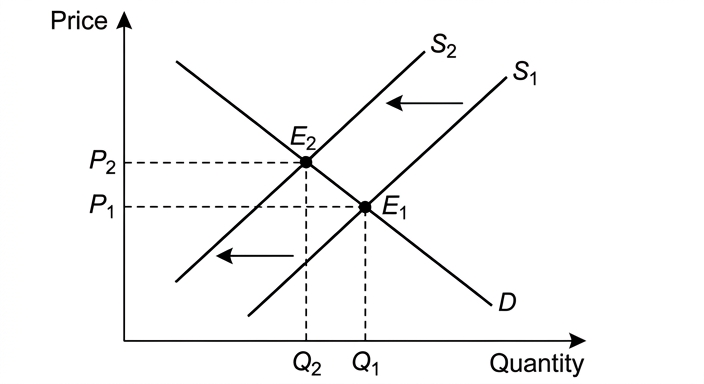
The diagram shows a leftward shift of the supply curve from S1 to S2 due to the typhoons. The new equilibrium is at a higher price P2 and lower quantity Q2.
The diagram shows a leftward shift of the supply curve, leading to a higher equilibrium price and lower equilibrium quantity.
Background Concept
The demand and supply model shows how prices are determined in a market. A shift in supply occurs when a factor other than price changes the quantity producers are willing to supply at each price. Typhoons destroy crops, reducing supply at every price, shifting the supply curve left. This leads to a new equilibrium with a higher price and lower quantity.
Understanding the Question
The question asks to use a diagram to show how typhoons affected the market price of food crops. The extract mentions typhoons in Southeast Asia. The candidate must draw a demand and supply diagram, shift supply left, and identify the new equilibrium price and quantity.
Approach
Draw a standard demand and supply diagram. Label axes and curves. Show the initial equilibrium. Then shift the supply curve leftward to represent the reduction in supply due to typhoons. Label the new equilibrium and indicate the higher price and lower quantity.
Step-by-Step Reasoning
- Draw vertical axis (Price) and horizontal axis (Quantity).
- Draw a downward-sloping demand curve (D) and an upward-sloping supply curve (S1). Their intersection is the initial equilibrium (E1) with price P1 and quantity Q1.
- The typhoons reduce supply, so at every price, less is supplied. Draw a new supply curve S2 to the left of S1.
- The new equilibrium (E2) is at the intersection of D and S2, with price P2 (higher) and quantity Q2 (lower).
- The diagram clearly shows the effect: price rises, quantity falls.
Key Takeaways
- A leftward supply shift raises price and lowers quantity.
- Always label axes, curves, and equilibrium points.
- Distinguish between a shift of the curve and a movement along it.
Common Mistakes
- Drawing a shift in demand instead of supply.
- Not labelling the new equilibrium or the shift direction.
- Confusing a movement along the supply curve with a shift.
Things to Be Careful About
- Ensure the supply curve shifts left, not right.
- Label the new price as higher and quantity as lower.
- The diagram must be fully labelled to earn both marks.
Is the short-run price elasticity of supply of red onions elastic or inelastic? Justify your answer.
Answer
Inelastic. In the short run, agricultural supply is fixed due to growing cycles; typhoons have destroyed crops, and farmers cannot quickly increase supply. Therefore, PES is inelastic.
Inelastic
Background Concept
Price elasticity of supply (PES) measures the responsiveness of quantity supplied to a change in price. In the short run, supply is often inelastic because producers cannot easily change output. For agricultural products, growing cycles and perishability make supply highly inelastic in the short run.
Understanding the Question
The question asks whether the short-run PES of red onions is elastic or inelastic, and to justify. The extract mentions typhoons and supply disruptions, indicating that supply cannot quickly adjust.
Approach
State that PES is inelastic. Justify by referring to the short time period, the nature of agricultural production (cannot instantly grow more onions), and the impact of typhoons destroying existing crops.
Step-by-Step Reasoning
- PES = % change in quantity supplied / % change in price.
- In the short run, farmers cannot increase onion production quickly because onions take months to grow.
- The typhoons have destroyed crops, further reducing supply.
- Therefore, even if price rises, quantity supplied cannot increase much; PES is inelastic (close to zero).
- Accept perfectly inelastic if argued that supply is fixed in the very short run.
Key Takeaways
- Short-run agricultural supply is typically inelastic.
- Justification must link to factors affecting PES: time, storage, production process.
Common Mistakes
- Saying elastic without justification.
- Confusing PES with PED.
- Not linking to the context of typhoons.
Things to Be Careful About
- The answer must be justified; a bare statement of inelastic gets only 1 mark.
- If the candidate argues elastic due to illegal imports, that is acceptable only if developed.
With the help of a production possibility curve (PPC) diagram, consider the impact on the opportunity cost to a farmer in the Philippines of starting to grow red onions.
Answer
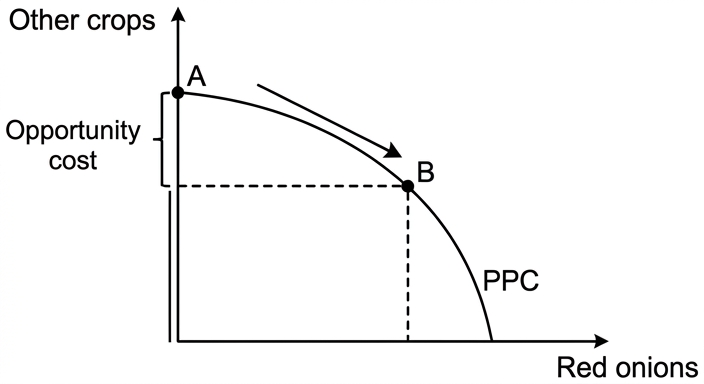
The PPC shows the maximum combinations of red onions and other crops. Initially, the farmer produces at point A (zero onions, maximum other crops). To start growing onions, the farmer moves to point B, producing some onions but fewer other crops. The opportunity cost is the amount of other crops forgone. If the PPC is concave, the opportunity cost increases as more onions are produced.
The opportunity cost is the reduction in other crops; it may increase if the PPC is concave due to diminishing returns.
Background Concept
A production possibility curve (PPC) shows the maximum combinations of two goods an economy can produce with given resources. The opportunity cost of producing more of one good is the amount of the other good forgone. The shape of the PPC reflects increasing or constant opportunity cost.
Understanding the Question
The question asks to use a PPC diagram to consider the impact on opportunity cost for a farmer starting to grow red onions. The farmer must reallocate resources from other crops to onions. The opportunity cost is the reduction in other crops.
Approach
Draw a PPC with 'Other crops' on the vertical axis and 'Red onions' on the horizontal axis. Show an initial point with zero onions and maximum other crops. Then show a movement to a point with some onions and fewer other crops. Explain that the opportunity cost is the amount of other crops forgone. Evaluate that if the PPC is concave, opportunity cost increases as more onions are produced.
Step-by-Step Reasoning
- Draw axes: vertical = Other crops, horizontal = Red onions.
- Draw a concave PPC (bowed outward) to represent increasing opportunity cost.
- Mark point A on the vertical axis: zero onions, maximum other crops.
- Mark point B on the curve to the right: some onions, fewer other crops.
- The vertical distance between A and B is the opportunity cost of producing the onions.
- If the farmer moves further along the curve, the opportunity cost increases because resources are less suited to onion production (diminishing returns).
- Therefore, the opportunity cost of starting to grow onions is the forgone other crops, and it may rise as more onions are grown.
Key Takeaways
- PPC illustrates opportunity cost as a movement along the curve.
- Concave PPC implies increasing opportunity cost.
- The initial point must be at zero onions to show the cost of starting.
Common Mistakes
- Drawing a PPC that does not touch the axes.
- Not starting at zero onions (marking scheme caps at 1 mark for analysis if not at zero).
- Confusing a shift of the PPC with a movement along it.
Things to Be Careful About
- Label axes clearly with 'Red onions' on the horizontal.
- Show the movement with an arrow.
- The evaluation mark is for noting that opportunity cost may increase.
Assess whether a ‘suggested retail price’ is the best way of stabilising onion prices in the Philippines.
Answer
A suggested retail price is a maximum price (price ceiling). Benefits: It prevents excessive prices during supply shortages, protects consumers, and reduces hoarding. Disadvantages: It can cause shortages, black markets, and reduce producer incentives. Alternative policies: Subsidies to farmers can lower production costs and increase supply; a buffer stock scheme can buy during surplus and sell during shortage. Evaluation: While a maximum price provides immediate relief, it may worsen long-term supply. A buffer stock scheme is more effective for stabilisation as it addresses both surplus and shortage, but requires storage and funding. Therefore, a suggested retail price is not the best; a combination of buffer stock and subsidies is more sustainable.
A suggested retail price is not the best way; a buffer stock scheme combined with subsidies is more effective for stabilising onion prices.
Background Concept
A maximum price (price ceiling) is a legal limit on how high a price can be charged. It is set below the equilibrium to make goods affordable. However, it can cause shortages and black markets. Alternative policies include subsidies to producers or buffer stock schemes to stabilise prices.
Understanding the Question
The question asks to assess whether a 'suggested retail price' (a maximum price) is the best way to stabilise onion prices. The extract mentions price spikes due to supply issues. The candidate must consider benefits and drawbacks of a maximum price, compare with an alternative, and reach a conclusion.
Approach
First, explain the benefits of a maximum price: protects consumers, reduces hoarding, provides certainty. Then explain drawbacks: shortages, black markets, reduced producer incentives. Then present an alternative policy, e.g., a buffer stock scheme or subsidies. Evaluate which is better, considering effectiveness, cost, and sustainability. Conclude with a justified judgement.
Step-by-Step Reasoning
- Maximum price: set below equilibrium. Benefits: affordable onions for consumers, reduces panic buying, government shows action. Drawbacks: excess demand leads to shortages, queues, black markets; farmers may reduce production if price is too low; enforcement costs.
- Alternative: buffer stock scheme. Government buys onions when price is low (surplus) and sells when price is high (shortage). This stabilises price around a target. Benefits: directly addresses price volatility, no shortages if managed well. Drawbacks: storage costs, risk of spoilage, requires funding.
- Alternative: subsidies to farmers. Lower production costs, increase supply, reduce price. Benefits: encourages production, no shortages. Drawbacks: fiscal cost, may not address immediate shortage.
- Evaluation: A maximum price provides quick relief but creates distortions. A buffer stock scheme is more effective for stabilisation as it smooths price fluctuations without causing shortages. However, it requires infrastructure. Given the Philippines' context, a combination of buffer stock and subsidies may be best. Therefore, a suggested retail price is not the best; alternatives are more sustainable.
Key Takeaways
- Maximum prices have both benefits and drawbacks.
- Evaluation requires comparison with alternatives.
- A justified conclusion is essential for full marks.
Common Mistakes
- Only discussing one side of the maximum price (max 2 marks).
- Not mentioning an alternative policy.
- Failing to reach a conclusion.
Things to Be Careful About
- The question asks 'best way', so comparison is necessary.
- Reserve 1 mark for a reasoned conclusion.
- Use extract context: supply disruptions, need for stabilisation.
Assess the extent to which the increase in onion prices is likely to have affected all households equally in the Philippines.
Answer
On one hand, onions are a staple in Filipino cooking, so all households face higher prices. Demand is price inelastic, so quantity demanded does not fall much, affecting all. On the other hand, lower-income households spend a larger proportion of their income on food, so the price rise hits them harder. Wealthier households can afford substitutes. Therefore, the increase does not affect all households equally; it disproportionately burdens lower-income households.
The increase in onion prices does not affect all households equally; lower-income households are disproportionately affected due to the higher proportion of income spent on food.
Background Concept
The impact of a price increase on households depends on the proportion of income spent on the good and the availability of substitutes. Lower-income households spend a larger share of income on necessities, so they are more affected. Demand for necessities is price inelastic, so quantity does not fall much.
Understanding the Question
The question asks to assess the extent to which the onion price increase affected all households equally. The extract mentions onions are a staple. The candidate must consider arguments for equal impact (all consume onions, inelastic demand) and unequal impact (different income levels, substitution possibilities). Then conclude.
Approach
Present the case for equal impact: onions are widely consumed, demand inelastic, so all face higher costs. Then present the case for unequal impact: lower-income households spend higher proportion of income, may have less ability to substitute. Evaluate that the impact is unequal, with lower-income households bearing a heavier burden. Conclude that the increase does not affect all equally.
Step-by-Step Reasoning
- Equal impact: Onions are used in most Filipino dishes, so all households buy them. Demand is price inelastic (few substitutes), so quantity demanded does not fall much; all households pay the higher price. Therefore, the price rise affects everyone.
- Unequal impact: Lower-income households spend a larger percentage of their income on food, so the same price increase represents a larger burden. Wealthier households can afford substitutes (e.g., other vegetables) or have more flexibility in their budget. Rural households may grow their own onions, so they are less affected. Therefore, the impact is not equal.
- Evaluation: While all households face higher onion prices, the burden is disproportionately on lower-income households because of the higher share of income spent on food. The extent of inequality is significant. Therefore, the increase does not affect all households equally.
Key Takeaways
- Price changes affect households differently based on income and consumption patterns.
- Use concepts of income elasticity and proportion of spending.
- A balanced answer with a clear conclusion is required.
Common Mistakes
- Only arguing one side (max 4 marks, no evaluation marks).
- Not using the extract context (onions as staple).
- Failing to reach a conclusion.
Things to Be Careful About
- The question asks 'extent to which', so the conclusion should state the degree of inequality.
- Reserve 1 mark for a reasoned conclusion.
- Use economic terminology: proportion of income, inelastic demand, substitutes.
Semi-conductors are widely used in the production of many types of electronic goods such as smartphones. It has been estimated that the price elasticity of supply for semi-conductors is 0.2 in the short run and 0.8 in the long run.
Explain what these estimates mean for producers of smartphones that use semi-conductors and consider the significance of the long-run estimate.
Answer
Price elasticity of supply (PES) measures the responsiveness of quantity supplied to a change in price. The formula is PES = (% change in quantity supplied) / (% change in price). A PES of 0.2 means supply is highly inelastic: a 10% increase in price leads to only a 2% increase in quantity supplied in the short run. A PES of 0.8 means supply is more elastic but still inelastic: a 10% price rise leads to an 8% increase in quantity supplied in the long run.
For smartphone producers, the short-run inelasticity means that if demand for semi-conductors rises, prices will increase sharply while quantity supplied increases only slightly. This raises production costs for smartphones, potentially reducing profit margins or leading to higher smartphone prices. In the long run, the higher PES of 0.8 indicates that suppliers can increase output more substantially, moderating price increases. This is because over time, producers can adjust production capacity, invest in new technology, and increase the availability of inputs.
The significance of the long-run estimate is that it reduces the risk of persistent shortages. With a PES of 0.8, the market can respond more effectively to sustained demand increases, encouraging investment in semi-conductor production. However, even 0.8 is still inelastic, so price rises will still occur, and the full adjustment may take time. This may incentivise smartphone producers to secure long-term contracts or invest in alternative sources.
The long-run PES of 0.8, while still inelastic, allows for a greater supply response, reducing the likelihood of severe shortages and encouraging investment, but price increases for semi-conductors are still expected.
Background Concept
Price elasticity of supply (PES) is a measure of how much the quantity supplied of a good changes in response to a change in its price. It is calculated as the percentage change in quantity supplied divided by the percentage change in price. PES values range from 0 (perfectly inelastic) to infinity (perfectly elastic). A value between 0 and 1 indicates inelastic supply, meaning quantity supplied changes by a smaller percentage than price. Factors affecting PES include the time period (longer periods allow more adjustment), availability of stocks, spare capacity, and the ease of increasing production.
Understanding the Question
The question provides two PES estimates for semi-conductors: 0.2 in the short run and 0.8 in the long run. It asks you to explain what these estimates mean for producers of smartphones (who use semi-conductors as an input) and to consider the significance of the long-run estimate. The command word 'explain' requires you to define and interpret the coefficients, and 'consider' introduces an evaluative element (AO3). You need to show knowledge of PES, analyse why the values differ, and evaluate the implications for smartphone producers.
Approach
Start by defining PES and giving the formula. Then interpret each coefficient: 0.2 means very inelastic supply in the short run; 0.8 means more elastic but still inelastic in the long run. Explain why the values differ: time allows producers to adjust capacity, increase stocks, and improve production processes. Then analyse the impact on smartphone producers: short-run price spikes raise costs; long-run adjustment moderates prices but still not fully elastic. Finally, evaluate the significance of the long-run estimate: it reduces shortage risk and encourages investment, but the adjustment is slow and costs remain.
Step-by-Step Reasoning
- Definition and formula: PES = %ΔQs / %ΔP. This is a standard definition worth 1 mark.
- Interpretation of 0.2: If price rises by 10%, quantity supplied rises by only 2%. This shows supply is highly unresponsive in the short run. For smartphone producers, this means any increase in demand for semi-conductors will cause a large price increase, raising their input costs.
- Interpretation of 0.8: If price rises by 10%, quantity supplied rises by 8%. Supply is more responsive but still inelastic. In the long run, producers can expand capacity, so the price increase is smaller than in the short run.
- Why the difference: Time period is the key factor. In the short run, factors of production are fixed; producers can only increase output by using existing capacity more intensively or running down stocks. In the long run, all factors are variable; new factories can be built, new technology adopted, and more workers trained. This explains the higher PES.
- Impact on smartphone producers: Short-run inelasticity means sharp price rises for semi-conductors, squeezing profit margins or forcing higher smartphone prices. Long-run elasticity moderates this, but the adjustment takes time. Smartphone producers may face temporary cost increases.
- Significance of long-run estimate: A PES of 0.8 means the market can eventually respond to sustained demand, reducing the risk of persistent shortages. It encourages investment in semi-conductor production, which can stabilise supply. However, because supply is still inelastic, prices will remain above the original level, and the full adjustment may take years. Smartphone producers might seek long-term contracts or invest in backward integration.
Key Takeaways
- PES measures supply responsiveness; values below 1 indicate inelastic supply.
- Time is a crucial determinant of PES: longer periods allow greater adjustment.
- Inelastic supply means price changes have a larger impact on price than quantity.
- For producers using an input with inelastic supply, cost increases are likely when demand rises.
- The long-run PES is more relevant for assessing the ability of the market to adjust to sustained demand changes.
Common Mistakes
- Confusing PES with PED (price elasticity of demand). PES is about supply, not demand.
- Stating that a PES of 0.8 is elastic; it is still inelastic (less than 1).
- Not explaining why the short-run and long-run values differ; simply stating the numbers without analysis.
- Omitting the evaluative 'consider' part; the question explicitly asks for significance, so a conclusion is needed.
- Using the formula incorrectly or not stating it.
Things to Be Careful About
- Always include the formula for PES when defining it.
- Clearly distinguish between short run and long run in terms of factor variability.
- When interpreting coefficients, use a concrete example (e.g., 10% price change) to illustrate.
- For the evaluation, focus on the implications for smartphone producers, not just general statements.
- Keep the answer concise; 8 marks means about 3-4 well-developed paragraphs.
Assess the likely effects on resource allocation of a continuing increase in demand for semi-conductors.
Introduction
Resource allocation refers to how an economy distributes its scarce factors of production among competing uses. A continuing increase in demand for semi-conductors will affect resource allocation through the price mechanism and may also involve opportunity cost and market imperfections.
Analysis of effects
The price mechanism performs three functions. First, the signaling function: rising demand leads to higher prices, which signal to producers that semi-conductors are more valuable. Second, the incentive function: higher prices provide profit incentives for existing producers to expand output and for new firms to enter the market. Third, the rationing function: higher prices allocate the limited supply to those consumers who value it most, reducing excess demand. Over time, these functions should direct more resources—labour, capital, raw materials—into semi-conductor production. This may involve investment in new factories, research into more efficient production, and training of workers. The result is a reallocation of resources towards semi-conductors and away from other industries, reflecting changing consumer preferences.
Limitations and constraints
However, the effectiveness of the price mechanism depends on the elasticity of supply. In the short run, supply is highly inelastic (PES = 0.2), so price rises sharply but quantity supplied increases little. This may lead to windfall profits for existing producers but does not immediately reallocate resources. In the long run, supply is more elastic (PES = 0.8), but still inelastic, so the response is limited. Moreover, resource allocation may be constrained by the availability of key inputs like silicon, the cost of extraction, and time lags in building new capacity. Government intervention, such as environmental regulations or export controls, may also distort the market outcome. Additionally, the opportunity cost of diverting resources to semi-conductors is the forgone output of other goods and services, which may have negative effects on other sectors.
Evaluation
The net effect on resource allocation depends on the speed and magnitude of the supply response. If the increase in demand is sustained, the price mechanism will eventually direct more resources into semi-conductor production, but the process may be slow and costly. In a market economy, this reallocation is generally efficient because it responds to consumer demand. However, if there are significant externalities or market failures, such as environmental damage from silicon mining, government intervention may be needed to improve allocation. The type of economy also matters: in a planned economy, the government might directly allocate resources, which could be faster but may ignore price signals.
Conclusion
Overall, a continuing increase in demand for semi-conductors will lead to a reallocation of resources towards their production, driven by higher prices and profit incentives. However, the extent of reallocation is limited by supply inelasticity, time lags, and potential government constraints. The price mechanism works but not perfectly, and the final allocation may involve trade-offs with other sectors. Therefore, while the market will respond, the adjustment is likely to be gradual and may require complementary policies to ensure efficient resource use.
A continuing increase in demand for semi-conductors will reallocate resources towards their production via the price mechanism, but the process is constrained by inelastic supply and time lags, leading to a gradual adjustment with opportunity costs for other sectors.
Background Concept
Resource allocation is the distribution of scarce resources among alternative uses. In a market economy, the price mechanism allocates resources through three functions: signaling (prices indicate where resources are most valued), incentive (higher prices encourage producers to increase supply), and rationing (prices limit demand to available supply). The production possibility curve (PPC) illustrates opportunity cost: producing more of one good requires sacrificing some of another. Supply elasticity determines how quickly producers can respond to price changes. Market failures, such as externalities or public goods, can lead to inefficient allocation.
Understanding the Question
The question asks you to 'assess' the likely effects on resource allocation of a continuing increase in demand for semi-conductors. 'Assess' requires you to consider both positive and negative aspects and reach a justified conclusion. The context is a specific market (semi-conductors) with given supply elasticities (0.2 short run, 0.8 long run). You need to analyse how the price mechanism will reallocate resources, but also consider constraints like inelastic supply, time lags, input availability, and government intervention. The top band requires a balanced, developed analysis and a conclusion that addresses the specific question.
Approach
Start by defining resource allocation and the price mechanism. Then analyse the positive effects: how rising prices signal profitability, incentivise expansion, and ration supply. Then discuss limitations: inelastic supply limits short-run response, time lags delay adjustment, input constraints, opportunity cost, and potential government intervention. Evaluate by weighing the strengths and weaknesses, considering the time frame and market conditions. Conclude with a justified judgement on the overall effect on resource allocation.
Step-by-Step Reasoning
- Define resource allocation: The distribution of scarce factors (land, labour, capital, enterprise) among competing uses. The price mechanism is the primary allocator in market economies.
- Signaling function: A continuing increase in demand shifts the demand curve right, raising the equilibrium price. This higher price signals to producers that semi-conductors are more profitable, encouraging them to allocate more resources to their production.
- Incentive function: Higher prices increase profit margins, providing an incentive for existing firms to expand output (e.g., by investing in new machinery) and for new firms to enter the market. This draws resources from other industries.
- Rationing function: At the higher price, only those consumers willing to pay the new price can purchase semi-conductors. This allocates the limited supply to their highest-valued uses (e.g., high-end electronics rather than low-margin goods).
- Long-run adjustment: Over time, supply becomes more elastic (PES = 0.8), so the quantity supplied increases more substantially. Resources flow into semi-conductor production: more labour, capital, and raw materials (silicon) are used. This may involve building new factories, training workers, and developing new technology.
- Opportunity cost: Using more resources for semi-conductors means fewer resources for other goods. This is shown by a movement along the PPC: producing more semi-conductors reduces the output of other goods. The opportunity cost is the value of the next best alternative forgone.
- Limitations: In the short run, supply is highly inelastic (PES = 0.2), so price rises sharply but quantity supplied changes little. This means resources are not immediately reallocated; existing producers earn windfall profits. In the long run, even with PES = 0.8, supply is still inelastic, so the reallocation is limited. Other constraints include the availability of silicon (a finite resource), the cost of extraction, and time lags in building capacity. Government policies (e.g., environmental regulations, export controls) may also affect resource allocation.
- Evaluation: The price mechanism is generally efficient in responding to consumer demand, but its effectiveness depends on supply elasticity. In this case, the inelastic supply means the reallocation is slow and may be insufficient to meet demand fully. Market failures, such as negative externalities from silicon mining, may require government intervention to improve allocation. The type of economy matters: in a planned economy, the government might directly allocate resources, potentially faster but with less regard for consumer preferences.
- Conclusion: The continuing increase in demand will lead to a reallocation of resources towards semi-conductors, but the process is gradual and constrained. The price mechanism works, but the outcome is not perfectly efficient due to supply inelasticity and potential market failures. Therefore, the reallocation is likely to be partial and may require complementary policies.
Key Takeaways
- The price mechanism allocates resources through signaling, incentive, and rationing functions.
- Supply elasticity determines how quickly and to what extent resources are reallocated.
- Opportunity cost is inherent in any reallocation of resources.
- Market failures and government intervention can affect the efficiency of resource allocation.
- A balanced assessment requires considering both the strengths and limitations of the price mechanism.
Common Mistakes
- Writing a one-sided answer that only discusses the positive effects of the price mechanism, ignoring constraints. This loses all evaluation marks.
- Failing to provide a conclusion or providing a vague conclusion that does not address the specific question.
- Not using the given PES values to support the analysis.
- Confusing resource allocation with just price changes; the focus should be on how factors of production are redirected.
- Ignoring opportunity cost; a PPC analysis can strengthen the answer.
- Making assertions without development (e.g., 'prices will rise' without explaining why and what happens next).
Things to Be Careful About
- Use economic terminology precisely: signaling, incentive, rationing, opportunity cost, elasticity.
- Develop each point with a chain of reasoning: cause -> effect -> implication.
- Ensure the answer is balanced: present both the benefits and limitations of the price mechanism.
- The conclusion must be justified: state which side is stronger and why, based on the analysis.
- Relate the analysis to the specific market (semi-conductors) and the given PES values.
- Avoid discussing unrelated topics like inflation or unemployment unless directly relevant.
Explain what is meant by a merit good and why governments provide merit goods such as healthcare free of charge and consider why such provision may not always be successful.
Answer
Merit good definition: A merit good is a good that is considered socially desirable but is under-consumed in a free market because individuals have imperfect information about its true private benefits. For example, healthcare is a merit good because people may not fully appreciate the long-term benefits of preventive care.
Why governments provide free of charge: Governments provide merit goods like healthcare free of charge to correct the under-consumption. By removing the price barrier, the government encourages greater consumption, which improves overall welfare. Additionally, some healthcare services, such as vaccinations, have public good characteristics (non-excludable and non-rival), meaning the private sector would under-provide them. Government provision ensures these services are available to all, protecting public health and reducing inequality in access.
Why provision may not always be successful: Despite free provision, consumption may not increase as intended. Individuals may still lack awareness of the benefits, so they do not seek care. Also, there are non-monetary costs such as time, travel, and waiting times that discourage use. Furthermore, free provision can lead to overconsumption and wastage of resources, as people may demand unnecessary treatments. Thus, the policy may not achieve its desired outcomes.
Merit goods are under-consumed due to information failure; free provision can increase consumption but may fail due to non-monetary costs and overuse.
Background Concept
A merit good is a good that is deemed socially desirable but is under-consumed in a free market because individuals do not fully perceive the private benefits. This under-consumption arises from imperfect information: people may not be aware of the long-term benefits of healthcare, education, or vaccinations. As a result, the market fails to allocate resources efficiently, and the government intervenes to correct this market failure. The concept is part of the classification of goods and services, distinguishing merit goods from private goods, public goods, and demerit goods.
Understanding the Question
This question asks you to first define a merit good (AO1), then explain why governments provide merit goods like healthcare free of charge (AO2), and finally consider why such provision may not always be successful (AO3). The command word "explain" requires a clear definition and a chain of reasoning for government provision. The word "consider" indicates that you need to evaluate the limitations of the policy. The question is worth 8 marks, split into 3 for knowledge, 3 for analysis, and 2 for evaluation.
Approach
Start by defining a merit good, emphasising the role of information failure. Then, explain the rationale for government provision: to correct under-consumption, improve social welfare, and address public good aspects. Finally, evaluate why the policy might fail: non-monetary barriers, persistent information failure, and potential overconsumption. Use examples to support your points.
Step-by-Step Reasoning
-
Definition: A merit good is under-consumed due to information failure. For example, individuals may not realise the full benefits of regular health check-ups, so they consume less than the socially optimal level. This leads to a market failure.
-
Government provision: By providing healthcare free of charge, the government removes the price barrier, encouraging consumption. This increases social welfare because the marginal social benefit exceeds the marginal private benefit at the market equilibrium. Additionally, some healthcare services (e.g., vaccinations) have public good characteristics: non-excludability and non-rivalry. Private firms would under-provide these because they cannot charge consumers. Government provision ensures these services are available to all, protecting public health and reducing inequality.
-
Why provision may not be successful: Even with free provision, consumption may not rise to the optimal level. First, individuals may still lack awareness of the benefits, so they do not seek care. Second, there are non-monetary costs: time spent travelling, waiting times, and inconvenience. These costs can deter use, especially for low-income individuals who may have less flexible time. Third, free provision can lead to overconsumption and wastage, as people may demand unnecessary treatments, straining resources and increasing waiting times. Thus, the policy may not achieve its intended outcomes.
Key Takeaways
- Merit goods are under-consumed due to information failure.
- Government provision aims to correct this by removing price barriers and ensuring access.
- However, non-monetary costs and persistent information failure can limit the effectiveness of free provision.
- Evaluation requires considering both the intended benefits and the unintended consequences.
Common Mistakes
- Confusing merit goods with public goods. Merit goods are rival and excludable but under-consumed; public goods are non-rival and non-excludable.
- Only discussing the benefits of free provision without evaluating the limitations.
- Failing to use examples to support the explanation.
- Writing a one-sided answer that does not address the "consider" part.
Things to Be Careful About
- Clearly define the term "merit good" with reference to information failure.
- Ensure the analysis is developed: explain the chain from information failure to under-consumption to government intervention.
- For evaluation, provide specific reasons why provision may fail, not just a general statement.
- Use economic terminology such as "market failure", "social welfare", "non-monetary costs".
Assess whether a charge made for healthcare at the point of use is likely to be more beneficial to consumers and providers than if healthcare is available to all free of charge.
Introduction
Healthcare is a merit good, under-consumed due to information failure. Governments often provide it free of charge to correct this market failure. However, some argue that charging a fee at the point of use may be more beneficial. This essay assesses whether charging is likely to be more beneficial to consumers and providers than free provision.
Arguments for charging
Charging a fee can discourage unnecessary or excessive use of healthcare services, reducing resource wastage and long waiting times. This benefits providers by allowing them to allocate resources more efficiently and benefits consumers who genuinely need care by reducing waiting times. Additionally, the revenue generated can be reinvested into improving healthcare quality and infrastructure, benefiting both consumers and providers in the long term. Charging also reduces the financial strain on government budgets, freeing up funds for other public services or targeted subsidies for those in genuine need.
Arguments against charging
Charging fees increase inequality in access, as low-income individuals may be deterred from seeking care even when necessary. This can lead to worsened health outcomes and higher long-term healthcare costs, as conditions become more severe. Providers may also face increased costs from treating advanced illnesses. Furthermore, charging may lead to under-provision of preventive care, as people delay treatment until they are severely ill. This undermines the merit good rationale, as the goal is to encourage consumption to improve overall health.
Evaluation
The benefits of charging depend on the design of the system. If exemptions are made for the poor and for essential preventive care, the negative effects on equity can be mitigated. The magnitude of the benefits also depends on the price elasticity of demand for healthcare. If demand is inelastic, charging may not significantly reduce unnecessary use but will still impose costs on consumers. Moreover, the administrative costs of collecting fees may offset the revenue gains. For providers, the impact depends on how the revenue is used; if it improves quality, providers may benefit, but if it leads to under-treatment, providers may face ethical and financial challenges.
Conclusion
On balance, charging for healthcare at the point of use is likely to be more beneficial only if implemented with careful targeting, such as exemptions for low-income groups and essential services. A blanket charge risks significant inequality and under-treatment, which may outweigh the efficiency gains. Therefore, a free-at-point-of-use system with adequate funding and measures to reduce non-monetary barriers may be more beneficial overall, especially for a merit good like healthcare.
Charging for healthcare may be more beneficial in reducing waste and generating revenue, but it risks significant inequality and under-treatment; a targeted system with exemptions for the poor and essential care is likely superior to either extreme.
Background Concept
Healthcare is a classic example of a merit good. Merit goods are under-consumed in a free market because individuals have imperfect information about the private benefits. Governments often intervene to correct this by providing healthcare free of charge, aiming to increase consumption to the socially optimal level. However, this policy has drawbacks, such as overconsumption and financial strain. An alternative is to charge a fee at the point of use, which can reduce waste and generate revenue but may deter necessary care and increase inequality. This question requires you to assess the trade-offs.
Understanding the Question
The question asks you to assess whether charging for healthcare at the point of use is likely to be more beneficial to consumers and providers than free provision. The command word "assess" requires a balanced analysis of both sides and a justified conclusion. The question is worth 12 marks, with 8 marks for AO1 and AO2 (knowledge and analysis) and 4 marks for AO3 (evaluation). The top band requires a detailed, well-organised response with a justified conclusion.
Approach
Structure your essay with an introduction defining key terms, then present arguments for charging (benefits to consumers and providers), followed by arguments against charging (drawbacks). Then evaluate the arguments, considering factors such as elasticity, administrative costs, and equity. Finally, reach a justified conclusion that answers the question directly.
Step-by-Step Reasoning
-
Introduction: Define healthcare as a merit good and state the policy options: free provision vs charging. Outline the essay structure.
-
Arguments for charging:
- Discourages unnecessary use: When healthcare is free, there is a risk of overconsumption (moral hazard). Charging a fee makes consumers consider the cost, reducing waste. This benefits providers by freeing up resources for those who need care more urgently, and consumers benefit from shorter waiting times.
- Generates revenue: The fees can be used to improve healthcare facilities, pay staff, and invest in technology. This improves the quality of care for consumers and increases provider satisfaction.
- Reduces government budget strain: Less public spending on healthcare allows funds to be allocated to other priorities, such as education or infrastructure, which can benefit society as a whole.
-
Arguments against charging:
- Increases inequality: Low-income individuals are more price-sensitive and may delay or avoid necessary care. This can lead to worse health outcomes, increasing long-term costs for the healthcare system. Providers may face ethical dilemmas and higher costs from treating advanced diseases.
- Under-provision of preventive care: People may only seek care when they are severely ill, undermining the merit good rationale. Preventive care, which is cost-effective, may be neglected.
- Administrative costs: Collecting fees requires bureaucracy, which can offset the revenue gains. This is a deadweight loss.
-
Evaluation:
- The effectiveness of charging depends on the price elasticity of demand for healthcare. If demand is inelastic (e.g., for essential treatments), charging may not reduce unnecessary use much but will still deter some necessary care. If demand is elastic for non-essential services, charging can reduce waste.
- The design of the charging system matters: exemptions for the poor, caps on total charges, and free provision of preventive services can mitigate negative effects.
- For providers, the impact depends on how revenue is used. If it improves quality, providers benefit; if it leads to under-treatment, they may suffer.
- Compare to free provision: free provision ensures equity but may lead to overconsumption and inefficiency. The optimal policy may be a mixed system.
-
Conclusion: Weigh the evidence. A blanket charge is likely to harm equity and health outcomes. A targeted system with exemptions may capture the benefits of charging while minimising drawbacks. However, given the merit good nature, free provision with measures to reduce non-monetary barriers (e.g., better information, reduced waiting times) may be more beneficial overall.
Key Takeaways
- Charging for healthcare involves trade-offs between efficiency and equity.
- Evaluation requires considering price elasticity, administrative costs, and policy design.
- A justified conclusion must address the specific question and weigh both sides.
- Use economic concepts such as moral hazard, price elasticity, and market failure.
Common Mistakes
- Writing a one-sided answer: must discuss both benefits and drawbacks.
- Failing to reach a conclusion or providing a vague conclusion.
- Not addressing both consumers and providers explicitly.
- Using generic arguments without applying them to healthcare.
- Ignoring the merit good context and the rationale for government intervention.
Things to Be Careful About
- Ensure the analysis is developed: explain the chain of reasoning for each point.
- Use economic terminology accurately.
- The conclusion should be justified, not just a summary.
- Consider the specific question: "more beneficial to consumers and providers" – address both groups.
- Avoid making unsupported assertions; provide reasoning and examples.
Explain two causes of economic growth and consider the extent to which their impact can be measured.
Answer
Economic growth is the increase in the real value of goods and services produced in an economy over time, typically measured as the percentage increase in real GDP.
Two causes of economic growth are:
-
Increase in aggregate demand (AD): A rise in consumption, investment, government spending, or net exports shifts the AD curve to the right. This leads to an increase in real output in the short run, especially if the economy is operating below full capacity. For example, a reduction in income tax increases disposable income, boosting consumption and AD, thereby increasing real GDP.
-
Increase in long-run aggregate supply (LRAS): Improvements in productivity, increased investment in capital, or technological progress shift the LRAS curve to the right. This increases the economy's productive capacity, allowing for sustained growth without inflationary pressure. For instance, investment in education and training enhances human capital, raising labour productivity and potential output.
Consideration of measurement: The impact of these causes on economic growth can be measured using real GDP growth rates. However, measurement is complicated by the existence of the hidden (informal) economy, which is not captured in official statistics. If a significant portion of economic activity is unreported, the measured growth may understate the true increase in output. Additionally, improvements in quality of goods and services are not fully reflected in GDP figures. Therefore, while real GDP provides a useful indicator, it does not perfectly capture the full impact of growth causes. Conclusion: The impact can be measured to a reasonable extent, but the presence of the hidden economy and quality adjustments limit the accuracy of such measurement.
The impact of causes of economic growth can be measured to a reasonable extent using real GDP, but the hidden economy and quality changes limit accuracy.
Background Concept
Economic growth is a central macroeconomic objective, defined as an increase in the real output of an economy over time. It is typically measured by the percentage change in real Gross Domestic Product (GDP). Causes of growth can be categorised as demand-side (increases in aggregate demand, AD) or supply-side (increases in long-run aggregate supply, LRAS). Measurement relies on national income accounting, but there are well-known limitations, including the informal (hidden) economy, non-market activities, and difficulties in adjusting for quality changes.
Understanding the Question
The question asks you to explain two causes of economic growth and then consider the extent to which their impact can be measured. The command word "explain" requires a clear chain of reasoning for each cause, showing how it leads to an increase in real output. The phrase "consider the extent to which" introduces an evaluative element: you must discuss the limitations of measurement and reach a justified conclusion. The marks are split: up to 3 for knowledge (AO1), up to 3 for analysis (AO2), and up to 2 for evaluation (AO3), with 1 mark reserved for a justified conclusion.
Approach
First, define economic growth. Then choose two distinct causes: one demand-side (e.g., a tax cut boosting consumption) and one supply-side (e.g., investment in capital increasing productivity). For each, explain the mechanism step by step. Then discuss measurement: real GDP is the standard measure, but it has limitations. The hidden economy is a key issue because unreported activity is not captured. Also mention quality adjustments. Conclude that measurement is possible but imperfect, and state the extent to which it is reliable.
Step-by-Step Reasoning
-
Definition: Start by defining economic growth as an increase in real GDP. This establishes the knowledge base.
-
Cause 1 – Increase in AD: Explain that a reduction in income tax increases disposable income, leading to higher consumption. This shifts the AD curve to the right. If the economy has spare capacity, real output rises. This is a demand-side cause. Provide a clear chain: tax cut → higher disposable income → higher consumption → higher AD → higher real GDP.
-
Cause 2 – Increase in LRAS: Explain that investment in education improves labour productivity, shifting the LRAS curve to the right. This increases potential output without causing inflation. Chain: investment in education → higher human capital → higher productivity → higher LRAS → higher potential output → economic growth.
-
Measurement: Real GDP growth is the standard measure. However, the hidden economy (e.g., cash-in-hand work, illegal activities) is not recorded, so official GDP may understate true growth. Also, GDP does not fully capture improvements in quality (e.g., better healthcare). Therefore, the measured impact may be inaccurate.
-
Conclusion: The impact can be measured to a reasonable extent, but the hidden economy and quality adjustments limit accuracy. This is a justified conclusion because it acknowledges both the usefulness and the limitations of the measure.
Key Takeaways
- Economic growth can be caused by demand-side or supply-side factors.
- Each cause must be explained with a clear chain of reasoning.
- Measurement of growth uses real GDP but has limitations, especially the hidden economy.
- A justified conclusion is required for full marks.
Common Mistakes
- Confusing nominal GDP with real GDP (inflation must be adjusted).
- Providing only a list of causes without explaining the mechanism.
- Omitting the evaluation of measurement or the conclusion.
- Giving a one-sided evaluation (e.g., only stating that measurement is accurate).
Things to Be Careful About
- Use correct economic terminology: real GDP, AD, LRAS, hidden economy.
- Ensure the conclusion directly addresses the "extent to which" and is justified.
- Mention the hidden economy as a specific limitation; it is a common point in mark schemes.
- Do not exceed the scope: the question asks about measurement of the impact of causes, not about other aspects of growth.
Assess the extent to which economic growth is always beneficial for the people and government in an economy.
Answer
Introduction
Economic growth refers to an increase in the real output of an economy over time. While it is often pursued as a key macroeconomic objective, its benefits are not automatic or universal. This essay assesses whether economic growth is always beneficial for the people and the government.
Benefits of economic growth
For people, growth typically raises real GDP per capita, enabling higher consumption and improved living standards. It also creates job opportunities, reducing unemployment and increasing household incomes. For the government, higher incomes generate greater tax revenues without raising tax rates, allowing increased spending on public services such as healthcare and education. Sustained growth can also foster a positive climate for investment and innovation.
Costs of economic growth
However, growth may disproportionately benefit the wealthy, widening income and wealth inequality. The benefits may not reach all groups, especially those in declining industries or with low skills. Growth often leads to environmental degradation, such as pollution and resource depletion, which imposes costs on society. Rapid growth can also cause demand-pull inflation, eroding purchasing power and creating economic instability. For the government, managing inflationary pressures may require contractionary policies that slow growth.
Evaluation
The net benefit of growth depends on its nature and distribution. Inclusive growth that reduces inequality and is environmentally sustainable is more beneficial than growth that exacerbates disparities or harms the environment. The time horizon matters: short-term growth may come at the expense of long-term sustainability. Moreover, the government faces trade-offs: higher tax revenues may be offset by increased spending on environmental remediation or social welfare. Therefore, growth is not always beneficial; its impact depends on how it is achieved and how the gains are distributed.
Conclusion
Economic growth is not always beneficial for all people and the government. While it can raise living standards and provide fiscal dividends, these benefits are conditional on the growth being inclusive, sustainable, and non-inflationary. In many cases, the costs of inequality and environmental damage can outweigh the gains. Thus, the extent to which growth is beneficial varies, and policymakers must consider the quality of growth, not just its rate.
Economic growth is not always beneficial; its benefits depend on inclusivity, sustainability, and the absence of significant negative externalities. Policymakers should focus on the quality of growth.
Background Concept
Economic growth is an increase in the real output of an economy. It is typically measured by the percentage change in real GDP. While growth is a common policy objective, it has both positive and negative consequences. Benefits include higher living standards, lower unemployment, and increased tax revenues. Costs include inequality, environmental damage, and inflation. The net effect depends on the type of growth, its distribution, and its sustainability.
Understanding the Question
The question asks you to assess the extent to which economic growth is always beneficial for the people and the government. The command word "assess" requires a balanced discussion of both benefits and costs, leading to a justified conclusion. The word "always" implies that you should consider conditions under which growth may not be beneficial. The marks are levels-based: AO1+AO2 out of 8, AO3 out of 4. The top band requires detailed knowledge, developed analysis, and a justified conclusion that addresses the specific requirements of the question.
Approach
Structure the essay as follows:
- Introduction: Define economic growth and state the purpose of the essay.
- Benefits: Discuss how growth benefits people (higher consumption, employment) and government (higher tax revenues, ability to fund public services). Develop each point with reasoning.
- Costs: Discuss inequality, environmental damage, inflation, and the burden on government to manage negative externalities. Develop each point.
- Evaluation: Weigh the benefits against the costs. Consider factors such as distribution, sustainability, and time horizon. Use economic concepts like externalities, opportunity cost, and trade-offs.
- Conclusion: Provide a justified judgement that directly answers the question. State that growth is not always beneficial and explain the conditions under which it is more or less beneficial.
Step-by-Step Reasoning
-
Introduction: Define economic growth and note that it is a key objective but not an end in itself. State that the essay will assess whether it is always beneficial.
-
Benefits for people: Growth increases real GDP per capita, allowing people to consume more goods and services, improving material living standards. It also reduces unemployment as firms hire more workers to meet higher demand. This leads to higher incomes and reduced poverty.
-
Benefits for government: Higher incomes and profits increase tax revenues from income tax, corporation tax, and VAT. This allows the government to spend more on public services without raising tax rates. Growth also improves the fiscal position, reducing the need for borrowing.
-
Costs – inequality: Growth may benefit the wealthy more than the poor, especially if it is driven by capital accumulation or technological change that rewards high-skilled workers. This can widen the gap between rich and poor, leading to social tensions.
-
Costs – environment: Increased production and consumption often lead to pollution, resource depletion, and climate change. These negative externalities impose costs on society that are not reflected in GDP. The government may need to spend on cleanup or regulation.
-
Costs – inflation: Rapid growth can cause demand-pull inflation if the economy is near full capacity. Inflation erodes purchasing power, especially for those on fixed incomes, and can lead to economic instability. The government may have to implement contractionary policies, which can slow growth.
-
Evaluation: The net benefit depends on the type of growth. Inclusive growth that reduces inequality and is environmentally sustainable is more beneficial. Short-term growth that depletes resources or causes inflation may be harmful in the long run. The government faces trade-offs: higher tax revenues may be offset by increased spending on addressing negative externalities. Therefore, growth is not always beneficial.
-
Conclusion: Economic growth is not always beneficial. Its benefits are conditional on inclusivity, sustainability, and the absence of significant negative externalities. Policymakers should focus on the quality of growth, not just the rate.
Key Takeaways
- Economic growth has both benefits and costs.
- A balanced analysis is required for high marks.
- The conclusion must be justified and address the "always" claim.
- Use economic concepts such as externalities, inequality, and inflation.
Common Mistakes
- Writing a one-sided answer (only benefits or only costs) – this loses all evaluation marks.
- Providing a vague conclusion or no conclusion at all.
- Listing points without development (e.g., "growth causes pollution" without explaining how or why).
- Ignoring the "always" aspect – failing to consider conditions under which growth may not be beneficial.
- Not addressing both people and government.
Things to Be Careful About
- Ensure the essay is well-organised and logical.
- Use economic terminology correctly (e.g., real GDP, demand-pull inflation, negative externalities).
- Provide a justified conclusion that states the extent to which growth is beneficial.
- Avoid making unsupported assertions; develop each point with reasoning.
- Remember that the top band requires detailed knowledge and developed analysis.
The terms of trade index for an economy changed from 105 to 110 in a given year.
Explain two likely reasons for this change and consider the extent to which the change is likely to benefit the current account of the balance of payments of this economy.
Answer
AO1 Knowledge and understanding
The terms of trade measure the relative price of a country's exports compared to its imports. It is calculated as:
Terms of Trade Index = (Index of Export Prices / Index of Import Prices) x 100
An increase from 105 to 110 represents an improvement in the terms of trade, meaning export prices have risen relative to import prices.
AO2 Analysis
Reason 1: A rise in export prices. If global demand for the country's exports increases, the price of exports will rise. This increases the numerator of the terms of trade formula, causing the index to rise.
Reason 2: A fall in import prices. If the price of imported raw materials or finished goods falls (e.g., due to a global recession or a fall in the price of oil), the denominator of the formula falls, causing the index to rise even if export prices remain constant.
Impact on the current account:
An improvement in the terms of trade means the country can now buy the same quantity of imports with fewer exports. This is a benefit. However, the effect on the current account balance depends on the price elasticity of demand for exports and imports.
- If export prices rise, the volume of exports demanded may fall. If demand is price elastic, the fall in volume will outweigh the rise in price, reducing export revenue and worsening the current account.
- If import prices fall, the volume of imports demanded may rise. If demand is price elastic, the increase in volume will outweigh the fall in price, increasing import expenditure and worsening the current account.
AO3 Evaluation
The extent of the benefit depends on the price elasticities of demand. For a country with inelastic demand for its exports (e.g., a primary commodity exporter) and inelastic demand for imports (e.g., essential capital goods), an improvement in the terms of trade is likely to improve the current account. However, for a country with elastic demand, the improvement could worsen the current account. Therefore, the benefit is not guaranteed and depends on the specific elasticities involved.
An improvement in the terms of trade can benefit the current account if demand for exports and imports is price inelastic, but it may worsen the current account if demand is price elastic; the net effect depends on the specific elasticities.
Background Concept
The terms of trade (ToT) is a key concept in international economics that measures the relative price of a country's exports compared to its imports. It is calculated as:
ToT Index = (Index of Export Prices / Index of Import Prices) x 100
An improvement in the terms of trade (a rise in the index) means that a country can buy more imports for the same quantity of exports. This is generally considered beneficial for a country's welfare. However, the impact on the current account of the balance of payments is more complex and depends on the price elasticity of demand for exports and imports.
The current account records the net flow of money from trade in goods, services, primary income, and secondary income. A key component is the balance of trade (exports minus imports). A change in the terms of trade directly affects the prices of exports and imports, which in turn affects the value of exports and imports.
Understanding the Question
This question has two distinct parts. First, you must explain two likely reasons for an improvement in the terms of trade (from 105 to 110). Second, you must 'consider the extent to which' this change is likely to benefit the current account. The command word 'consider' signals that evaluation is required. The mark scheme allocates up to 3 marks for knowledge (AO1), up to 3 marks for analysis (AO2), and up to 2 marks for evaluation (AO3). The evaluation must include a conclusion.
The question is point-based, so you need to provide discrete, creditable points. For the analysis, the mark scheme explicitly states a maximum of 2 marks if only benefits are considered, so you must discuss both the potential benefits and the potential drawbacks.
Approach
- Define the terms of trade (AO1): Start with a clear definition and the formula. This establishes your knowledge.
- Explain two reasons (AO2): Identify two distinct causes of an improvement. The most straightforward are a rise in export prices and a fall in import prices. For each, explain the mechanism clearly.
- Analyse the impact on the current account (AO2): This is the core of the analysis. You must build a chain of reasoning for both the benefit and the potential drawback.
- Benefit: Higher export prices or lower import prices directly improve the trade balance if volumes remain constant.
- Drawback: The change in prices will affect the quantity demanded. This is where elasticity comes in. Higher export prices reduce export volume; lower import prices increase import volume. The net effect on the value of trade depends on PED.
- Evaluate and conclude (AO3): Weigh the two scenarios against each other. The conclusion should state that the benefit is not automatic and depends on the price elasticities of demand. A justified conclusion will state which scenario is more likely for a typical economy or specify the conditions under which the benefit occurs.
Step-by-Step Reasoning
Step 1: Define the Terms of Trade (AO1)
Start by defining the concept. The terms of trade is the ratio of export prices to import prices. The formula is:
Terms of Trade Index = (Index of Export Prices / Index of Import Prices) x 100
An increase from 105 to 110 means export prices have risen by a greater percentage than import prices, or import prices have fallen by a greater percentage than export prices, or a combination of both. This is an 'improvement' because the country can now obtain more imports for each unit of exports.
Step 2: Explain Two Likely Reasons (AO2)
Reason 1: A rise in export prices. This could be caused by:
- An increase in global demand for the country's exports (e.g., a new source of demand for its manufactured goods).
- A fall in the global supply of the exported good (e.g., a poor harvest for an agricultural exporter).
- The country gaining market power and raising prices (e.g., a cartel like OPEC).
Reason 2: A fall in import prices. This could be caused by:
- A global recession reducing demand for the goods the country imports, lowering their price.
- A fall in the price of a key imported commodity, such as oil.
- An appreciation of the country's currency, which makes foreign goods cheaper in domestic currency terms (though this is a cause, not a reason for the ToT change itself, it's a valid point).
Step 3: Analyse the Impact on the Current Account (AO2)
This is the most important part. You must show a developed chain of reasoning.
The Benefit (Direct Effect):
- If export prices rise, the country receives more revenue for each unit exported. If the volume of exports stays the same, export revenue increases, improving the current account.
- If import prices fall, the country spends less on each unit imported. If the volume of imports stays the same, import expenditure falls, improving the current account.
The Potential Drawback (Indirect Effect via Elasticity):
- Higher Export Prices: The law of demand states that as price rises, quantity demanded falls. The extent of the fall depends on the Price Elasticity of Demand (PED) for the country's exports.
- If PED > 1 (elastic), the percentage fall in quantity demanded is greater than the percentage rise in price. Total export revenue (Price x Quantity) will fall, worsening the current account.
- If PED < 1 (inelastic), the percentage fall in quantity demanded is less than the percentage rise in price. Total export revenue will rise, improving the current account.
- Lower Import Prices: As the price of imports falls, the quantity of imports demanded will rise.
- If PED for imports > 1 (elastic), the percentage rise in quantity demanded is greater than the percentage fall in price. Total import expenditure will rise, worsening the current account.
- If PED for imports < 1 (inelastic), the percentage rise in quantity demanded is less than the percentage fall in price. Total import expenditure will fall, improving the current account.
Step 4: Evaluate and Conclude (AO3)
To 'consider the extent to which' the change is likely to benefit the current account, you must weigh the two effects. The conclusion should be justified.
- Argument that it will benefit: For a country that exports primary commodities (e.g., oil, food) with inelastic demand, a rise in export prices will significantly increase revenue. Similarly, if a country imports essential capital goods with inelastic demand, a fall in import prices will significantly reduce expenditure. In this scenario, the improvement in the terms of trade is very likely to benefit the current account.
- Argument that it may not benefit: For a country that exports manufactured goods with many substitutes (elastic demand), a rise in export prices could lead to a large fall in export volume, reducing revenue. Similarly, if a country imports luxury goods with elastic demand, a fall in import prices could lead to a large increase in import volume, increasing expenditure. In this scenario, the improvement in the terms of trade could worsen the current account.
Conclusion: The extent to which an improvement in the terms of trade benefits the current account depends critically on the price elasticities of demand for exports and imports. For a typical developing country exporting inelastic primary commodities and importing inelastic capital goods, the benefit is likely. For a developed country exporting elastic manufactured goods, the benefit is less certain. Therefore, the change is not automatically beneficial.
Key Takeaways
- The terms of trade is a ratio of export prices to import prices.
- An 'improvement' means export prices have risen relative to import prices.
- The impact on the current account is not straightforward; it depends on the price elasticity of demand for exports and imports.
- A rise in export prices or a fall in import prices can worsen the current account if demand is elastic.
- Evaluation requires a two-sided argument and a justified conclusion.
Common Mistakes
- One-sided answer: Only discussing the benefits of an improvement in the terms of trade. The mark scheme explicitly caps analysis at 2 marks if only benefits are considered.
- Confusing terms of trade with the balance of trade: The terms of trade is about relative prices; the balance of trade is about the value of exports minus imports. A change in the terms of trade can affect the balance of trade, but they are not the same thing.
- Ignoring elasticity: Failing to mention price elasticity of demand is a major omission. The entire evaluation hinges on this concept.
- No conclusion: The mark scheme reserves 1 mark for a valid conclusion. An answer that simply lists pros and cons without a final judgement will lose this mark.
- Vague conclusion: A conclusion like 'it depends' is not sufficient. You must state what it depends on and under what conditions the benefit is more or less likely.
Things to Be Careful About
- Use the correct formula: Ensure you state the formula for the terms of trade correctly.
- Distinguish between price and volume: Clearly explain that the effect on total revenue/expenditure depends on the relative changes in price and volume.
- Be specific about elasticities: Use the terms 'price elastic' (PED > 1) and 'price inelastic' (PED < 1) correctly.
- Structure your answer: Follow the AO1, AO2, AO3 structure to ensure you hit all the assessment objectives. The mark scheme is explicit about this split.
Assess whether government policy can influence an economy’s comparative advantage in a good or service.
Introduction
Comparative advantage is the ability of a country to produce a good or service at a lower opportunity cost than its trading partners. This question assesses whether government policy can influence this underlying cost structure.
The case that government policy CAN influence comparative advantage
Government policy, particularly supply-side policy, can alter the factors that determine a country's opportunity costs. By investing in education and training, a government can improve the skills and productivity of its labour force. A more productive workforce can produce a given output with fewer resources, lowering the opportunity cost of production in that sector. For example, a government that heavily subsidises engineering education could create a comparative advantage in high-tech manufacturing.
Similarly, government investment in research and development (R&D) can lead to technological innovation. A new, more efficient production process can dramatically reduce the cost of producing a good, shifting the country's production possibility frontier and altering its comparative advantage. Government investment in infrastructure, such as ports, roads, and digital networks, reduces the costs of production and distribution for all industries, making the entire economy more competitive and potentially creating a comparative advantage in goods that rely on efficient logistics.
The case that government policy has LIMITED influence on comparative advantage
There are significant limitations to a government's ability to influence comparative advantage. Firstly, the effects of such policies are subject to long and uncertain time lags. Investment in education and R&D may take decades to yield results, and by the time they do, global market conditions may have changed. Secondly, comparative advantage is determined by relative costs, not absolute costs. Even if a government successfully reduces costs in one sector, other countries may implement similar or more effective policies, or may benefit from natural endowments that cannot be replicated. For instance, a country cannot create a comparative advantage in tropical agriculture if it has a cold climate.
Thirdly, government intervention can lead to unintended consequences and inefficiencies. Picking 'winning' sectors is notoriously difficult, and government support can create a culture of dependency, reducing the incentive for firms to innovate independently. Furthermore, such policies can be very expensive, diverting resources from other areas of the economy and potentially creating a comparative disadvantage elsewhere.
Evaluation
The extent to which government policy can influence comparative advantage depends on several factors. The type of policy matters: policies that improve the general business environment (e.g., infrastructure) are more likely to be successful than those that try to pick specific sectors. The time horizon is crucial: in the short run, comparative advantage is largely determined by existing factor endowments, but in the long run, it can be shaped by policy. The global context is also important; a first-mover advantage in a new technology can be decisive.
Conclusion
While government policy cannot create a comparative advantage from nothing, it can certainly influence it over the long term by investing in the fundamental drivers of productivity: human capital, technology, and infrastructure. However, the success of such policies is not guaranteed and is subject to significant risks, including time lags, global competition, and government failure. Therefore, government policy can influence comparative advantage, but the extent of this influence is limited and uncertain, and it is more about creating the conditions for it to emerge than dictating it.
Government policy can influence comparative advantage over the long term through supply-side policies that improve productivity, but the extent of this influence is limited by time lags, global competition, and the risk of government failure, making it an uncertain and indirect process.
Background Concept
Comparative advantage is a core principle of international trade. It states that a country should specialise in producing and exporting goods and services in which it has a lower opportunity cost of production compared to its trading partners. Opportunity cost is the value of the next best alternative forgone. A country's comparative advantage is traditionally thought to be determined by its factor endowments (land, labour, capital, and enterprise), climate, and technology.
Government policy, particularly supply-side policy, aims to increase the productive capacity of the economy. This can be achieved through various tools, including investment in education and training, research and development (R&D), and infrastructure. These policies can alter the productivity of factors of production, thereby changing the opportunity cost of producing different goods and services.
Understanding the Question
This is a levels-marked essay question (12 marks) with a command word 'Assess'. This requires a balanced, two-sided argument and a justified conclusion. The question asks whether government policy 'can influence' comparative advantage. This is not a question of whether it 'does' or 'should', but whether it is possible. The mark scheme provides indicative content and level descriptors. The top band (Level 3 for AO1/AO2) requires detailed knowledge, fully developed explanations, and a well-organised response. The top band for AO3 (Level 2) requires a justified conclusion with developed evaluative comments.
The key is to build a clear chain of reasoning for both sides. The 'for' side must explain how policy can change the underlying determinants of comparative advantage. The 'against' side must explain the limitations and problems with this approach.
Approach
- Introduction: Define comparative advantage and state the central question.
- Side 1 (Policy CAN influence): Develop a clear argument. Use specific examples of supply-side policies (education, R&D, infrastructure) and explain the mechanism by which they lower opportunity cost. Use a real or hypothetical example to illustrate the point.
- Side 2 (Policy has LIMITED influence): Develop the counter-argument. Focus on the key limitations: time lags, the relative nature of comparative advantage, the difficulty of 'picking winners', and the risk of government failure.
- Evaluation: Weigh the two sides against each other. The evaluation should not just be a list of points but should compare their relative importance. For example, the long time lag is a significant limitation, but it does not mean the policy is impossible, just that it requires a long-term perspective.
- Conclusion: Provide a justified judgement that directly answers the question. The conclusion should state the extent to which government policy can influence comparative advantage, based on the arguments presented.
Step-by-Step Reasoning
Step 1: Define Key Terms (Introduction)
Start by defining comparative advantage. 'A country has a comparative advantage in the production of a good if it can produce it at a lower opportunity cost than another country.' This sets the foundation for the entire essay.
Step 2: Build the Case FOR Government Influence
- Education and Training: Explain how a better-educated workforce is more productive. A more productive worker can produce more output per hour. This reduces the labour cost per unit of output. If this policy is targeted at a specific sector (e.g., a government-funded programme to train software engineers), it lowers the opportunity cost of producing software. The country now gives up less of other goods to produce each unit of software, creating or strengthening a comparative advantage.
- Research and Development (R&D): Explain how innovation can create a technological lead. A new, patented production process can dramatically lower costs. This is a direct change in the production function. For example, a government grant that leads to a breakthrough in battery technology could give a country a comparative advantage in electric vehicles.
- Infrastructure: Explain how better infrastructure (ports, roads, digital networks) reduces the costs of transporting goods and communicating. This lowers the overall cost of production for all firms in the economy. This can make the country a more attractive location for manufacturing, potentially creating a comparative advantage in goods that are heavy or time-sensitive to deliver.
Step 3: Build the Case AGAINST Government Influence
- Time Lags: The benefits of education and R&D take a very long time to materialise. It can take a generation to improve the skills of the workforce. By the time the policy has an effect, the global economy may have changed, and the advantage may have been lost.
- Relative Nature of Comparative Advantage: Comparative advantage is about relative costs. Even if a government successfully reduces costs in one sector, other countries may do the same, or may have a natural advantage that cannot be overcome. For example, no amount of government policy can give Canada a comparative advantage in growing bananas.
- Government Failure and 'Picking Winners': Governments are often poor at identifying which sectors will be successful in the future. Subsidising a failing industry can be a huge waste of resources. This is known as 'picking winners'. Furthermore, government support can create a culture of dependency, where firms rely on subsidies rather than becoming genuinely competitive.
- Opportunity Cost of Government Spending: The money spent on one policy is money not spent on another. Investing heavily in R&D for a specific sector might mean under-investing in education or healthcare, which could harm the economy's overall potential.
Step 4: Evaluate and Conclude
The evaluation should weigh the strength of the arguments.
- Point for evaluation: The 'time lag' argument is strong, but it does not mean policy is ineffective; it means it requires a long-term, consistent commitment.
- Point for evaluation: The 'relative nature' argument is also strong. Policy is most effective when it builds on existing strengths or creates a new niche, rather than trying to compete head-on with a country that has a massive natural advantage.
- Point for evaluation: The risk of government failure is real, but it can be mitigated by policies that are broad-based (e.g., improving the general education system) rather than targeted at specific sectors.
Conclusion: The conclusion should be a direct answer to the question. 'Government policy can influence comparative advantage, but it is a difficult, long-term, and uncertain process. It is more likely to be successful when it focuses on creating the general conditions for productivity growth (e.g., education and infrastructure) rather than trying to pick specific winning industries. Therefore, while influence is possible, its extent is limited and not guaranteed.'
Key Takeaways
- Comparative advantage is determined by opportunity cost, which can be changed by government policy.
- Supply-side policies (education, R&D, infrastructure) are the primary tools for influencing comparative advantage.
- The effectiveness of these policies is limited by time lags, the relative nature of advantage, and the risk of government failure.
- A successful answer requires a balanced, two-sided argument and a justified conclusion.
- The command word 'Assess' demands evaluation.
Common Mistakes
- One-sided answer: Only arguing that government policy can or cannot influence comparative advantage. This would score zero for evaluation (AO3).
- Confusing absolute and comparative advantage: The question is specifically about comparative advantage (opportunity cost), not absolute advantage (producing more with fewer resources).
- Lack of development: Simply stating 'education helps' without explaining the mechanism (how it lowers opportunity cost) is insufficient for a top-band answer.
- No conclusion: A levels-marked essay must have a conclusion. A top-band answer requires a justified conclusion.
- Ignoring the 'Assess' command: Writing a purely descriptive answer about supply-side policies without evaluating their effectiveness.
Things to Be Careful About
- Use specific examples: The mark scheme mentions examples. Use a real-world example (e.g., South Korea's investment in education creating a comparative advantage in electronics) to strengthen your argument.
- Focus on the mechanism: Always explain how a policy leads to a change in comparative advantage. The chain of reasoning is crucial.
- Distinguish between short run and long run: This is a key evaluative point. In the short run, comparative advantage is fixed; in the long run, it can be influenced.
- Use economic terminology: Use terms like 'opportunity cost', 'productivity', 'factor endowments', 'supply-side policy', and 'government failure' correctly.
- Structure your essay: A well-organised essay with clear paragraphs for each side and a separate evaluation section is more likely to achieve a top band.