Economics 9708/21 — October/November 2024
Cambridge AS Level · AS Level Data Response and Essays · worked solutions for every part, with the mark scheme
Topics Methods of Government Intervention in Markets · Price Stability · Monetary Policy · Demand and Supply · Price Elasticity of Supply · Production Possibility Curves · +6 more
Inflation in Argentina
Argentina’s annual inflation rate increased from just over 40% in February 2021 to just over 50% in January 2022. Argentina’s annual inflation rate, as measured by changes in the consumer price index (CPI) over 12 months is shown in Fig. 1.1.
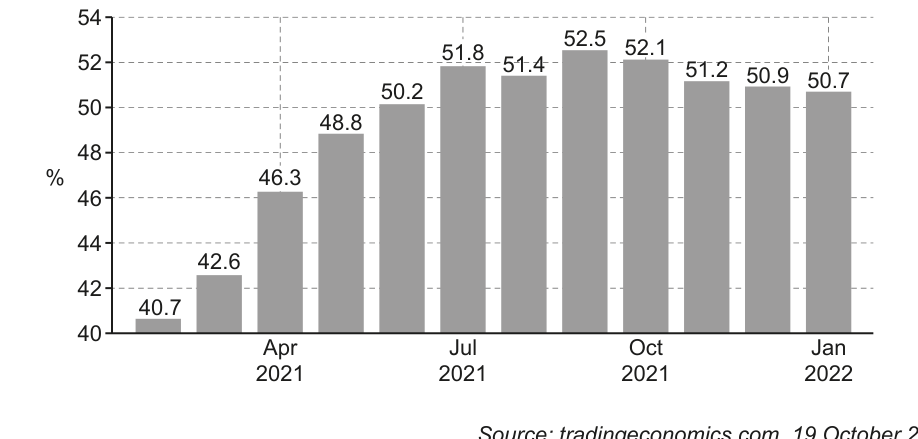
Fig. 1.1 Annual rate of inflation in Argentina, February 2021 to January 2022
Source: tradingeconomics.com, 19 October 2022
Argentina has the fifth highest inflation rate in the world after Venezuela, Sudan, Suriname and Zimbabwe. It is forecast to continue to rise during 2022 to reach an annual rate of between 55% and 58% by the end of the year. One of the main reasons for this high rate of inflation is excessive growth of the money supply. The need to lower the rate of inflation in Argentina is considered essential by many economists.
The government of Argentina has tried to control the increase in the rate of inflation by imposing maximum prices on 1432 products. This has the advantage of limiting price increases, but such a policy can also have a number of disadvantages. One such disadvantage is the creation of excess demand in markets.
Another policy has been to increase interest rates. In January 2022, Argentina’s central bank raised its main interest rate from 38% to 40%, but many economists argued that this increase was insufficient to control inflation. This is because the real interest rate will be negative. A more appropriate monetary policy would be to lift the interest rate above the inflation rate so that the real interest rate will be positive.
Source: Adapted from: Buenos Aires Times, 15 February 2022
Using the data in Fig. 1.1, describe the trend shown in the annual inflation rate in Argentina over the period February 2021 to January 2022.
Answer
The overall trend in Argentina’s annual inflation rate between February 2021 and January 2022 was upward, rising from 40.7% in February 2021 to a peak of 52.5% in September 2021, before falling slightly to 50.7% in January 2022. Within this overall upward trend, there was a short downward trend from the September 2021 peak to January 2022, with the rate falling from 52.5% to 50.7% over this four-month period.
Overall upward trend from 40.7% (Feb 2021) to 50.7% (Jan 2022), peaking at 52.5% in Sep 2021 before a slight fall.
Background Concept
An inflation trend describes the direction of change in the rate of price rises over a period of time. Time-series data, such as the monthly inflation rates shown in Fig. 1.1, are used to identify whether inflation is rising, falling, or stable, and to spot any short-term deviations from the main trend. Describing a trend requires stating the overall direction first, then supporting this with specific data points, and finally noting any exceptions or sub-trends.
Understanding the Question
This 2-mark question asks you to describe the trend in Argentina’s annual inflation rate between February 2021 and January 2022, using only the data provided in Fig. 1.1. No analysis or evaluation is required, only a clear description of the pattern shown in the chart. The mark scheme awards one mark for the overall upward trend, and one mark for the slight downward trend after the September 2021 peak.
Approach
First, identify the starting value (February 2021: 40.7%) and the ending value (January 2022: 50.7%) to establish the overall direction of the trend. Next, identify the highest value (peak) in the period to note any sub-trends: here the peak is 52.5% in September 2021, after which the rate falls slightly to 50.7% in January 2022. Support every claim about the trend with the specific percentage figures from the chart.
Step-by-Step Reasoning
- The first bar in the chart is February 2021, with an inflation rate of 40.7%. The final bar is January 2022, with a rate of 50.7%. Since 50.7% is higher than 40.7%, the overall trend over the period is upward/increasing.
- The highest bar in the chart is September 2021, at 52.5%. After this peak, the rate falls to 52.1% (October 2021), 51.2% (November 2021), 50.9% (December 2021) and 50.7% (January 2022). This is a short downward sub-trend within the overall upward trend.
- Combining these, the full description is: overall upward trend from 40.7% to 50.7%, peaking at 52.5% in September 2021 before a slight fall to 50.7% in January 2022.
Key Takeaways
When describing time-series trends, always lead with the overall direction, support it with the start and end values, then note any deviations or sub-trends with specific data points. Never state a trend without evidence from the data, and never list figures without explaining what trend they show.
Common Mistakes
- Stating a trend (e.g. "inflation rose") without quoting any data points to support it, which earns no marks.
- Only quoting the start and end values and missing the sub-trend after the September peak, which loses the second mark.
- Describing month-to-month fluctuations instead of the overall trend, which is not what the question asks for.
Things to Be Careful About
- Use the exact time period given in the question (February 2021 to January 2022) and do not include data from outside this range.
- Use the correct unit (percentage) when quoting figures.
- Make sure to note both the overall trend and the sub-trend to secure both marks.
Explain what is meant by ‘the real interest rate will be negative’ in Argentina in January 2022.
Answer
The real interest rate is the nominal interest rate adjusted for inflation, calculated as nominal interest rate minus the inflation rate. In January 2022, Argentina’s nominal interest rate was 40% and the annual inflation rate was 50.7%, so the real interest rate was 40% - 50.7% = -10.7%. A negative real interest rate means the purchasing power of money saved in a bank account falls over time, as the interest earned is lower than the rate at which prices are rising.
Real interest rate = nominal rate - inflation rate = 40% - 50.7% = -10.7%, meaning the purchasing power of savings falls as inflation exceeds the interest earned.
Background Concept
The nominal interest rate is the stated rate of interest paid on savings or charged on loans, without adjustment for inflation. The real interest rate adjusts the nominal rate for the effect of inflation, showing the true purchasing power return to savers or true cost of borrowing. The formula is: Real interest rate = Nominal interest rate - Inflation rate. A negative real interest rate means the purchasing power of money falls over time: interest earned on savings is lower than the rate at which prices are rising, so savers lose purchasing power, while borrowers gain as they repay loans with money worth less than when they borrowed.
Understanding the Question
This 2-mark question asks you to explain what is meant by a negative real interest rate in Argentina in January 2022, using the data provided in the extract. The extract states the nominal interest rate was 40% in January 2022, and Fig. 1.1 shows the inflation rate was 50.7% in January 2022. One mark is for explaining that a negative real rate occurs when the nominal rate is lower than inflation, and one mark is for calculating the correct value using the given figures.
Approach
First, define the real interest rate and state the formula. Then substitute the given nominal interest rate (40%) and the January 2022 inflation rate (50.7%) into the formula to calculate the real rate. Finally, explain the meaning of the negative result.
Step-by-Step Reasoning
- The real interest rate is calculated as the nominal interest rate minus the inflation rate. It reflects the true change in the purchasing power of money over time.
- In January 2022, Argentina’s nominal interest rate was 40%, and the annual inflation rate (from Fig. 1.1) was 50.7%.
- Substituting these values: Real interest rate = 40% - 50.7% = -10.7%.
- A negative real interest rate means that the purchasing power of money saved in a bank account falls by 10.7% over the year, as the interest earned is not enough to offset the rise in prices. Borrowers benefit, as the real value of the debt they repay is lower than the value of the loan when they took it out.
Key Takeaways
Always adjust nominal interest rates for inflation to find the real interest rate, as this is the figure that matters for savers, borrowers and economic decision-making. A negative real rate erodes the value of savings and encourages borrowing.
Common Mistakes
- Using the wrong inflation figure (e.g. the February 2021 rate of 40.7% instead of the January 2022 rate of 50.7%), which gives an incorrect real rate.
- Adding instead of subtracting inflation from the nominal rate, which gives a wrong positive value.
- Forgetting to explain the meaning of the negative value, which would lose the second mark.
Things to Be Careful About
- Use the exact figures provided in the extract for the calculation.
- Include the negative sign in the final result, as this is the defining feature of a negative real interest rate.
- Explain the implication of the negative rate, not just the calculation, to secure both marks.
Consider the extent to which having ‘the fifth highest inflation rate in the world’ is likely to be a problem for Argentina’s economy.
Answer
High inflation is likely to be a significant problem for Argentina’s economy. First, it reduces the purchasing power of households’ incomes, so real living standards fall, particularly for those on fixed incomes such as pensioners. Second, it reduces the price competitiveness of Argentina’s exports, as the price of its goods rises relative to goods from other countries, which could lower export volumes, reduce employment in export sectors and worsen the current account balance. High inflation also creates uncertainty for firms, discouraging long-term investment and reducing future economic growth, and imposes menu costs and shoe leather costs on the economy.
There are some limited benefits of high inflation. Firms that are able to raise their output prices by more than the rise in their input costs will see higher profits, and borrowers benefit as the real value of the debt they repay is lower than when they borrowed.
Overall, having the fifth highest inflation rate in the world is a serious economic problem for Argentina. While there are some small benefits, the costs of falling real living standards, lower export competitiveness and reduced investment are likely to outweigh these, especially as inflation is forecast to rise further during 2022.
It is a serious problem, as the costs of high inflation (reduced purchasing power, lower export competitiveness, investment uncertainty) outweigh the limited benefits (higher firm profits, lower real debt for borrowers).
Background Concept
Inflation is the sustained rise in the general price level of goods and services in an economy. High inflation (well above the typical target of 2% per year) has a range of potential negative consequences, but it can also have some limited benefits for certain groups. The extent to which high inflation is a problem depends on the size of the inflation rate, its causes, and how it compares to inflation rates in other countries.
Understanding the Question
This 4-mark evaluative question asks you to consider the extent to which having the fifth highest inflation rate in the world is a problem for Argentina’s economy. The mark scheme awards up to 2 marks for problems caused by high inflation, up to 1 mark for potential benefits, and 1 mark for a justified judgement on the extent of the problem. You must cover both sides (problems and benefits) to secure the evaluation mark.
Approach
First, list the key negative consequences of high inflation, using economic theory and the context of Argentina (very high inflation, forecast to rise further). Then list the potential benefits of high inflation for specific groups. Finally, weigh the costs against the benefits to form a judgement on whether the high inflation rate is a serious problem.
Step-by-Step Reasoning
- Problems of high inflation (up to 2 marks):
- Reduced purchasing power: As prices rise faster than incomes, households can afford fewer goods and services, so real living standards fall. This is particularly harmful for groups on fixed incomes, such as pensioners, who cannot negotiate higher pay to keep up with inflation.
- Reduced export competitiveness: If Argentina’s inflation rate is higher than that of its trading partners, its exports become more expensive in foreign markets, reducing export volumes, lowering profits for export firms, and increasing unemployment in export sectors. It may also worsen the current account balance as imports become relatively cheaper.
- Menu costs and shoe leather costs: Firms face costs of frequently changing prices (menu costs), while households face costs of searching for better deals or holding less cash (shoe leather costs), which reduce economic efficiency.
- Uncertainty and lower investment: High and volatile inflation creates uncertainty for firms about future costs and prices, discouraging long-term investment and reducing future economic growth.
- Benefits of high inflation (up to 1 mark):
- Higher profits for some firms: If firms can raise their output prices by more than the rise in their input costs (e.g. wages, raw materials), their profit margins will increase.
- Lower real debt for borrowers: The real value of debt falls as inflation rises, so borrowers (including households with mortgages and the government) repay loans with money that is worth less than when they borrowed it.
- Judgement (1 mark):
Having the fifth highest inflation rate in the world is a serious problem for Argentina. While there are some limited benefits for specific groups, the widespread costs of falling real living standards, lower export competitiveness, reduced investment and efficiency costs are likely to outweigh these benefits. The fact that inflation is forecast to rise further to 55-58% by the end of 2022 makes the problem even more severe, as higher inflation will increase all of the above costs.
Key Takeaways
High inflation has both costs and benefits, but the costs are usually widespread across the economy, while the benefits are limited to specific groups. When evaluating whether high inflation is a problem, compare the size of the costs and benefits, and consider the context (e.g. whether inflation is rising, how it compares to other countries).
Common Mistakes
- Only listing problems or only listing benefits, which means you cannot secure the evaluation mark. A one-sided answer scores zero for evaluation.
- Listing many shallow points instead of developing a few key points, which loses marks for lack of detail.
- Ending with a summary of both sides instead of a justified judgement, which scores no marks for the evaluation element.
- Forgetting to use the context of Argentina (e.g. the forecast rise in inflation) in the judgement, which makes the conclusion vague.
Things to Be Careful About
- Ensure you cover both problems and benefits to secure the evaluation mark.
- Make your judgement specific to the question: do not just say "inflation is bad", but explain why the high global ranking makes it a serious problem for Argentina specifically.
- Use the extract’s data (e.g. the forecast rise to 55-58%) to strengthen your judgement.
Assess whether the potential benefits of introducing maximum prices on 1432 products in Argentina are likely to outweigh the potential disadvantages.
Answer
A maximum price is a legal price ceiling set below the free-market equilibrium price, intended to make essential goods more affordable for households.
Benefits of maximum prices:
- Lower prices for essential goods: The policy keeps the price of basic necessities (such as food, included in the 1432 products) lower than the market equilibrium, making them more affordable for low-income households who spend a large share of their income on these items.
- Reduced inflation: By limiting price rises across a large number of products, the policy can help lower the overall rate of inflation in Argentina, which is a key government objective given the current inflation rate of over 50%.
Disadvantages of maximum prices:
- Excess demand and shortages: At the maximum price, quantity demanded exceeds quantity supplied, creating a shortage of the goods. This means many households will be unable to purchase the goods even at the lower price.
- Queues and rationing: Shortages lead to long queues as consumers compete for the limited supply, and the government may introduce rationing to allocate the scarce goods fairly.
- Informal markets: Sellers may choose to sell goods illegally on the black market at prices above the maximum price, to capture higher profits. This undermines the policy and leads to lost tax revenue for the government.
- Reduced quality or supply: Producers may cut the quality of goods to reduce costs, or exit the market entirely if the maximum price makes production unprofitable, worsening the shortage.
Evaluation:
The benefits of maximum prices are limited to short-term gains for low-income households who can successfully purchase the goods at the lower price, and a small reduction in overall inflation. However, the disadvantages are likely to be far more severe in Argentina’s context of very high inflation. Producers are facing rising input costs, so a maximum price set too low will make production unprofitable, leading to larger shortages. The informal market will flourish, meaning many households cannot access the goods at all. The queuing and rationing also impose significant time costs on households. Overall, the potential disadvantages of maximum prices are likely to outweigh the benefits, as the shortages and informal markets will harm the very low-income households the policy is designed to help.
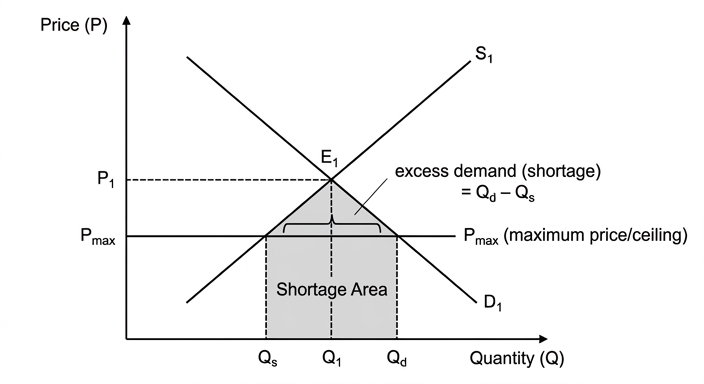
The potential disadvantages of maximum prices are likely to outweigh the benefits, as the resulting shortages, rationing and informal markets will harm low-income households most, despite lower prices for those who can access the goods.
Background Concept
A maximum price (price ceiling) is a government-imposed legal limit on the price that can be charged for a good or service, usually set below the free-market equilibrium price to make essential goods more affordable for low-income households. In a free market, the equilibrium price is where quantity demanded equals quantity supplied. If a maximum price is set below this equilibrium, quantity demanded exceeds quantity supplied, creating excess demand (a shortage). This can lead to unintended consequences such as queues, rationing, and the emergence of an informal market where goods are sold at higher prices.
Understanding the Question
This 6-mark evaluative question asks you to assess whether the potential benefits of introducing maximum prices on 1432 products in Argentina are likely to outweigh the potential disadvantages. The mark scheme awards up to 4 marks for analysis (up to 3 for benefits, up to 3 for disadvantages) and up to 2 marks for evaluation (weighing the two sides and reaching a justified conclusion). A diagram is not explicitly required but can be used to support the explanation of excess demand.
Approach
First, explain what a maximum price is and its intended benefit: to keep prices of essential goods low and reduce inflation. Then explain the disadvantages: excess demand, shortages, and unintended consequences such as informal markets. Use a demand and supply diagram to illustrate the effect of a maximum price if helpful. Finally, weigh the benefits against the disadvantages in the context of Argentina’s high inflation to reach a judgement.
Step-by-Step Reasoning
- Benefits of maximum prices (up to 3 marks):
- Lower prices for essential goods: The maximum price keeps the price of basic necessities (such as food, which is likely included in the 1432 products) lower than the free-market equilibrium price, making them more affordable for low-income households who spend a large share of their income on these goods.
- Reduced inflation: By limiting price rises across a large number of products, the policy can help reduce the overall rate of inflation in the economy, which is a key government objective in Argentina where inflation is over 50%.
- Disadvantages of maximum prices (up to 3 marks):
- Excess demand and shortages: At the maximum price (set below equilibrium), quantity demanded exceeds quantity supplied, leading to a shortage of the goods. This is illustrated in the diagram: at price Pmax, Qd > Qs, so excess demand of Qd - Qs exists.
- Queues and rationing: When goods are in short supply, consumers may have to queue for hours to buy them, or the government may introduce rationing systems that limit how much each household can buy.
- Informal markets: Sellers may choose to sell goods illegally on the informal (black) market at prices above the maximum price, to capture higher profits. This undermines the policy and means the government loses tax revenue from these sales.
- Reduced quality or supply: Producers may reduce the quality of the goods to cut costs, or exit the market entirely if the maximum price makes production unprofitable, worsening the shortage.
- Evaluation (up to 2 marks):
The benefits of maximum prices are limited to short-term gains for low-income households who can access the goods, and a small reduction in inflation. However, the disadvantages are likely to be far more severe in Argentina’s context. The high inflation rate means producers are facing rising input costs, so a maximum price set too low will make production unprofitable, leading to even larger shortages. The informal market will flourish, meaning many households cannot access the goods at all, even at the lower price. The queuing and rationing also impose significant time costs on households. Overall, the potential disadvantages of maximum prices are likely to outweigh the benefits, as the shortages and informal markets will harm the very households the policy is intended to help.
Key Takeaways
Maximum prices are a government intervention intended to make essential goods affordable, but they create excess demand when set below equilibrium. The success of the policy depends on how far the maximum price is set below the equilibrium price, and the availability of the goods in the market.
Common Mistakes
- Only explaining one side (either benefits or disadvantages), which means you cannot secure any evaluation marks. A one-sided answer scores zero for evaluation.
- Forgetting to explain the link between the maximum price and excess demand, which is the core of the disadvantage analysis.
- Ending with a summary of both sides instead of a justified judgement, which loses the evaluation mark.
- Drawing a diagram but not explaining what it shows, which does not earn credit.
Things to Be Careful About
- Ensure you cover both benefits and disadvantages in your analysis to secure the full 4 analysis marks.
- Use the context of Argentina (high inflation, 1432 products covered) to make your analysis specific, rather than generic.
- Make your judgement clear: do not just say "it depends", but explain why the disadvantages outweigh the benefits in this case.
- If you use a diagram, label all curves and axes, show the direction of the maximum price relative to equilibrium, and explain the excess demand it creates in the surrounding prose.
Assess the potential benefits and limitations of using monetary policy to control inflation in a country such as Argentina.
Answer
Contractionary monetary policy (higher interest rates) can reduce inflation by lowering aggregate demand (AD). Higher interest rates increase the cost of borrowing for households and firms, reducing consumption and investment, and increase the incentive to save, further reducing consumption. They may also lead to an appreciation of the exchange rate, reducing net exports. The leftward shift in AD reduces the price level, lowering inflation. If interest rates are set above the inflation rate, the real interest rate becomes positive, which also helps reduce inflation expectations and break the wage-price spiral.
However, there are significant limitations to using monetary policy to control inflation in Argentina:
- Time lags: There is a 12-18 month lag between a change in interest rates and its full effect on inflation, so it may not reduce inflation quickly enough given that Argentina’s inflation is already over 50% and forecast to rise further.
- Risk of negative real interest rates: If interest rates are raised but not by enough to exceed the inflation rate, the real interest rate remains negative, so borrowing is still cheap and inflation continues to rise. To get a positive real rate in January 2022, interest rates would need to be above 50.7%, which is very high.
- Interest inelastic demand: If consumption and investment are insensitive to interest rate changes (e.g. if households have high existing debt, or firms expect strong future demand), higher rates may not reduce AD by enough to lower inflation significantly.
- Cost-push inflation: If Argentina’s high inflation is partly caused by cost-push factors (e.g. rising import prices, supply chain disruptions), higher interest rates will not address the root cause, and may even worsen inflation by reducing investment in supply capacity.
- Conflict with other objectives: Higher interest rates reduce AD, lowering real output and increasing unemployment, and reducing economic growth, which is harmful if Argentina is already experiencing low growth.
Evaluation:
Monetary policy has a role to play in controlling inflation in Argentina, but its limitations are significant. The high existing inflation rate means very high interest rates are needed to get a positive real rate, which would cause a severe fall in output and rise in unemployment. If inflation is partly cost-push, monetary policy alone will not solve the problem. While it can reduce demand-pull inflation and anchor inflation expectations, it needs to be combined with other policies (such as supply-side policies to reduce cost-push pressures, and fiscal policy to reduce money supply growth) to be effective. Overall, monetary policy is a useful tool but is not sufficient on its own to control Argentina’s high inflation, and its use will involve significant short-run economic costs.
Monetary policy can reduce demand-pull inflation and anchor inflation expectations, but its limitations (time lags, risk of negative real rates, conflict with growth and employment objectives, inability to address cost-push inflation) mean it is not sufficient on its own for Argentina and will involve significant short-run economic costs.
Background Concept
Monetary policy is the use of interest rates and money supply controls by the central bank to influence macroeconomic objectives such as inflation, growth and unemployment. Contractionary monetary policy (higher interest rates) is used to reduce high inflation by lowering aggregate demand (AD). Higher interest rates increase the cost of borrowing for households and firms, reducing consumption and investment, and increase the incentive to save, further reducing consumption. They may also lead to an appreciation of the exchange rate, reducing net exports. The fall in AD reduces the price level, lowering inflation. However, monetary policy has limitations, including time lags, the risk of negative real interest rates if set too low, and potential conflicts with other objectives such as growth and employment.
Understanding the Question
This 6-mark evaluative question asks you to assess the potential benefits and limitations of using monetary policy to control inflation in a country such as Argentina. The mark scheme awards up to 4 marks for analysis (up to 3 for benefits, up to 3 for limitations) and up to 2 marks for evaluation (weighing the two sides and reaching a justified conclusion). You must use the context of Argentina (very high inflation, negative real interest rates in January 2022) in your answer.
Approach
First, explain how contractionary monetary policy (higher interest rates) works to reduce inflation via the AD/AS model, stating its benefits. Then explain the limitations of monetary policy for Argentina’s specific context, including the time lag, the risk of negative real rates, the interest elasticity of demand, and conflicts with other policy objectives. Finally, weigh the benefits against the limitations to assess how suitable monetary policy is for Argentina.
Step-by-Step Reasoning
- Benefits of monetary policy for controlling inflation (up to 3 marks):
- Reduces demand-pull inflation: Higher interest rates reduce consumption, investment and net exports, shifting the AD curve leftward. This reduces the price level, lowering inflation, as shown in the AD/AS model: a leftward shift of AD from AD1 to AD2 reduces the price level from P1 to P2 and real output from Y1 to Y2 in the short run.
- Positive real interest rates: If interest rates are set above the inflation rate, the real interest rate becomes positive, encouraging saving and reducing borrowing, which further reduces AD and inflation. This also helps reduce inflation expectations, breaking the wage-price spiral that can keep inflation high.
- Credibility: If the central bank is seen as committed to reducing inflation, higher interest rates can reduce inflation expectations, which reduces wage demands and price rises by firms, lowering inflation even without a large fall in AD.
- Limitations of monetary policy for Argentina (up to 3 marks):
- Time lags: There is a significant time lag (often 12-18 months) between a change in interest rates and its full effect on inflation. This means monetary policy may not reduce inflation quickly enough for Argentina, where inflation is already over 50% and forecast to rise further.
- Risk of negative real interest rates: If the central bank raises interest rates but not by enough to exceed the inflation rate, the real interest rate remains negative, so borrowing is still cheap and inflation continues to rise. To get a positive real rate in January 2022, interest rates would need to be above 50.7%, which is very high.
- Interest inelastic demand: If consumption and investment are relatively insensitive to interest rate changes (e.g. if households already have high levels of debt, or firms expect high future demand), higher interest rates may not reduce AD by enough to lower inflation significantly.
- Cost-push inflation: If Argentina’s high inflation is partly caused by cost-push factors (e.g. rising import prices due to currency depreciation, supply chain disruptions, or higher energy costs), higher interest rates will not address the root cause of inflation, and may even worsen it by reducing investment in supply capacity, shifting the SRAS curve leftward and raising prices further.
- Conflict with other objectives: Higher interest rates reduce AD, which lowers real output and increases unemployment, and reduces economic growth. This is a particular problem if Argentina is already experiencing low or negative growth.
- Evaluation (up to 2 marks):
Monetary policy has a role to play in controlling inflation in Argentina, but its limitations are significant. The high existing inflation rate means very high interest rates are needed to get a positive real rate, which would cause a severe fall in output and rise in unemployment. If inflation is partly cost-push, monetary policy alone will not solve the problem. While monetary policy can reduce demand-pull inflation and anchor inflation expectations, it needs to be combined with other policies (such as supply-side policies to reduce cost-push pressures, and fiscal policy to reduce budget deficits and money supply growth) to be effective. Overall, monetary policy is a useful tool but is not sufficient on its own to control Argentina’s high inflation, and its use will involve significant short-run economic costs.
Key Takeaways
Contractionary monetary policy reduces inflation by lowering aggregate demand, but its effectiveness depends on the cause of inflation, the interest elasticity of demand, and the time lag between policy implementation and effect. For countries with very high inflation, monetary policy may need to be combined with other policies to be effective.
Common Mistakes
- Only explaining the benefits or only the limitations of monetary policy, which means you cannot secure any evaluation marks. A one-sided answer scores zero for evaluation.
- Forgetting to use the context of Argentina (e.g. the negative real interest rate in January 2022, the forecast rise in inflation) in your analysis, making your answer generic.
- Confusing a shift in AD with a movement along the AD curve when explaining the effect of interest rates.
- Ending with a summary of both sides instead of a justified judgement, which loses the evaluation mark.
Things to Be Careful About
- Ensure you cover both benefits and limitations in your analysis to secure the full 4 analysis marks.
- Link your analysis explicitly to Argentina’s context: refer to the high inflation rate, the negative real interest rate, and the forecast rise in inflation.
- Make your judgement clear: do not just say "monetary policy is useful", but explain its limitations and what other policies are needed.
- If you use an AD/AS diagram, label all curves and axes, show the leftward shift of AD, and explain the resulting fall in the price level and real output in the surrounding prose.
Explain the determinants of supply for an agricultural product, such as rice, and consider which of these determinants is likely to be of the greatest significance at the present time.
Answer
The supply of an agricultural product like rice is determined by several factors.
Physical factors such as climate, soil quality, and the availability of water are fundamental. Favourable weather and fertile land increase the quantity that can be supplied at any given price, shifting the supply curve rightwards. Unfavourable conditions, such as drought or flooding, reduce supply.
Institutional factors include land tenure systems and government policies. Secure land rights give farmers the incentive to invest in long-term improvements, increasing supply. Government price supports or input subsidies can also encourage greater production.
Infrastructural factors like irrigation systems, storage facilities, and transport networks affect the ability to produce and bring goods to market. Better irrigation reduces dependence on rainfall, stabilising and increasing supply. Improved storage reduces post-harvest losses.
The price of the product itself and the prices of alternative crops influence the quantity supplied. A higher price for rice provides an incentive to allocate more land and resources to rice production. If the price of a substitute crop, such as wheat, rises, farmers may switch production away from rice, reducing its supply.
The time period is also a key determinant. In the short run, supply is relatively inelastic because production decisions are already made and crops take time to grow. In the long run, supply becomes more elastic as farmers can adjust their planting decisions and invest in new technology.
Evaluation: At the present time, physical factors, particularly climate change and extreme weather events, are likely to be of the greatest significance. These factors are largely outside human control and can cause sudden and severe disruptions to supply, as seen with droughts in major rice-producing regions. While other factors like price and infrastructure matter, the immediate and unpredictable impact of climate on harvests makes physical factors the most significant determinant of supply in the short to medium term.
Physical factors, especially climate change and extreme weather, are likely the most significant determinant of supply for an agricultural product like rice at the present time, due to their immediate and unpredictable impact on harvests.
Background Concept
Supply refers to the quantity of a good or service that producers are willing and able to offer for sale at a given price over a specific time period. The law of supply states that, ceteris paribus, as the price of a good rises, the quantity supplied rises. The supply curve is a graphical representation of this relationship. A change in any factor other than the good's own price causes a shift of the entire supply curve (an increase or decrease in supply). A change in the good's own price causes a movement along the existing supply curve (a change in quantity supplied).
The determinants of supply are the factors that can cause the supply curve to shift. For agricultural products, these are often distinct from manufactured goods because of the heavy reliance on natural conditions and biological processes.
Price Elasticity of Supply (PES) measures the responsiveness of quantity supplied to a change in price. PES = (% change in quantity supplied) / (% change in price). Factors affecting PES include the time period, the availability of spare capacity, the ease of storing stocks, the length of the production process, and the mobility of factors of production.
Understanding the Question
This is a two-part question. The first part (a) asks you to "Explain the determinants of supply for an agricultural product, such as rice, and consider which of these determinants is likely to be of the greatest significance at the present time." The command word is "Explain" and then "consider". This means you need to:
- AO1 (Knowledge): Identify and define the key determinants of supply for an agricultural product.
- AO2 (Analysis): Explain how each determinant affects supply, building a clear chain of reasoning.
- AO3 (Evaluation): Make a judgement on which determinant is most significant at the present time. This requires a short, justified conclusion. The phrase "at the present time" is crucial; it asks you to consider current economic or environmental conditions.
The question is point-based, with a specific mark split: 3 marks for AO1, 3 marks for AO2, and 2 marks for AO3. Your answer must be structured to earn these discrete points.
Approach
- Identify the Determinants: Start by listing the main determinants of supply for an agricultural product. The mark scheme suggests physical, institutional, infrastructural, and price factors. The time period is also a crucial determinant.
- Explain Each Determinant (AO1 & AO2): For each determinant, provide a clear definition and then explain the causal mechanism. For example, "Better irrigation (infrastructure) reduces the risk of crop failure, which increases the quantity farmers are willing to supply at any given price, shifting the supply curve to the right." Use the specific example of rice to ground your explanation.
- Evaluate (AO3): The final part of your answer must be a judgement. You need to weigh the different determinants against each other. A strong evaluation will use a criterion, such as the immediacy or unpredictability of the impact. The mark scheme suggests that physical factors (like climate) are likely the most significant at the present time, given the context of climate change. State your conclusion clearly and justify it with a brief reason.
Step-by-Step Reasoning
- Start with a clear definition: "The supply of an agricultural product like rice is determined by several factors that influence the willingness and ability of farmers to bring the product to market."
- Explain Physical Factors: "Physical factors, such as climate, soil fertility, and water availability, are fundamental. For rice, a crop that requires large amounts of water, a drought will drastically reduce the harvestable yield. This means that at any given price, less rice is available for sale, causing the supply curve to shift to the left. Conversely, a favourable monsoon season can lead to a bumper harvest, shifting the supply curve to the right."
- Explain Institutional Factors: "Institutional factors include government policies and land tenure. For example, a government subsidy on fertiliser reduces the cost of production for rice farmers. This makes rice production more profitable at any given market price, encouraging farmers to supply more, shifting the supply curve to the right. Similarly, secure land rights give farmers the confidence to invest in long-term improvements like drainage systems, which can increase supply over time."
- Explain Infrastructural Factors: "Infrastructural factors like irrigation, storage, and transport are critical. In many developing countries, a lack of cold storage facilities means that a significant portion of the rice harvest is lost to pests and spoilage after it is harvested. Improved storage would reduce these post-harvest losses, effectively increasing the quantity supplied to the market. Better roads reduce transport costs and time, also increasing the effective supply."
- Explain Price and Time Period: "The price of rice itself is a key determinant. A higher price provides a profit incentive for farmers to allocate more land and resources to rice production. However, this response takes time. In the short run, supply is very inelastic because the crop is already planted. In the long run, farmers can respond to higher prices by planting more rice, using more fertiliser, or investing in irrigation, making supply more elastic. The prices of alternative crops, like wheat or maize, also matter. If the price of wheat rises, farmers may switch land from rice to wheat, reducing the supply of rice."
- Formulate the Evaluation (AO3): "Evaluation: While all these factors are important, physical factors, particularly those related to climate change, are likely the most significant determinant of supply at the present time. The reason is their immediacy and unpredictability. A single extreme weather event, such as a flood or drought, can wipe out an entire season's harvest in a major producing region, causing an immediate and dramatic fall in global supply. This impact is far more sudden and severe than the gradual effects of changes in government policy or infrastructure investment. Therefore, in the current context of increasing climate volatility, physical factors pose the greatest risk to the stability of the global rice supply."
Key Takeaways
- The determinants of supply are the factors that cause the supply curve to shift.
- For agricultural products, physical, institutional, and infrastructural factors are particularly important.
- The time period is a crucial determinant, affecting the price elasticity of supply.
- When a question asks you to "consider" or "evaluate", you must make a judgement and justify it. Use a clear criterion (e.g., immediacy, magnitude, predictability) to support your conclusion.
- In point-based questions, ensure you cover the requirements of each assessment objective (AO1, AO2, AO3) explicitly.
Common Mistakes
- Confusing supply with quantity supplied: A common error is to say "if the price of rice rises, supply increases." This is a movement along the curve, not a shift. The determinants of supply are the factors that shift the curve.
- Being one-sided in the evaluation: The question asks you to "consider which... is likely to be of the greatest significance." You must make a choice and justify it. Simply listing all the determinants without a concluding judgement will lose the AO3 marks.
- Providing a generic answer: The question specifies "an agricultural product, such as rice." A good answer will use the specific characteristics of rice (e.g., water-intensive, long growing period) to illustrate the points.
- Ignoring the time period: The time period is a fundamental determinant of supply, especially for agriculture. Failing to mention it is a significant omission.
Things to Be Careful About
- Structure your answer clearly: Use separate paragraphs for each determinant to ensure your points are distinct and easy for the examiner to credit.
- Use economic terminology correctly: Use terms like "supply curve shifts to the left/right", "incentive", "cost of production", and "price elasticity of supply".
- Make your evaluation explicit: Use a signposting phrase like "In my judgement..." or "The most significant factor is..." to clearly indicate your conclusion.
- Link your evaluation to the present time: The question specifically asks for significance "at the present time." Your justification must be contemporary, referencing current issues like climate change or global supply chain disruptions.
Assess whether the supply of agricultural products is likely to be more price elastic or less price elastic than the supply of manufactured products.
Introduction
Price elasticity of supply (PES) measures the responsiveness of quantity supplied to a change in price. The PES of agricultural products and manufactured products is likely to differ significantly due to the distinct nature of their production processes. This essay will analyse the factors that determine PES for both types of products and assess which is likely to be more elastic.
Factors Making Agricultural Supply Less Elastic
The supply of agricultural products is generally considered to be less price elastic than that of manufactured products for several reasons. Firstly, the length of the production process is a critical factor. Agricultural goods, such as crops and livestock, have a long and fixed biological production cycle. A wheat farmer cannot instantly increase supply in response to a price rise; the crop must be planted and grown over several months. This makes supply very inelastic in the short run. In contrast, many manufactured goods can be produced much more quickly, especially if there is spare capacity.
Secondly, factor mobility is low in agriculture. Land is a specific and immobile factor of production. A farmer cannot easily switch from growing wheat to rearing cattle without significant time and investment. Labour in agriculture is often specialised and may not be easily transferable to other sectors. In manufacturing, resources like labour and capital are often more mobile, allowing firms to switch production between different goods more readily in response to price changes.
Thirdly, the availability of stocks is often limited for agricultural products. Many agricultural goods are perishable (e.g., fresh fruit, dairy) and cannot be stored for long periods. This means producers cannot draw on accumulated inventories to quickly increase supply when prices rise. Manufactured goods, particularly durable ones, can be stored more easily, allowing firms to release stocks onto the market to respond to price increases, making their supply more elastic.
Factors Making Agricultural Supply More Elastic
However, there are arguments that agricultural supply can be more elastic in certain contexts. The number of producers in agriculture is typically very large, with many small farms. In a perfectly competitive market, this could lead to a highly elastic supply, as any individual price increase would incentivise many farmers to increase output. However, this is often offset by the other factors mentioned.
Furthermore, in the long run, the supply of agricultural products can become quite elastic. Farmers can respond to sustained high prices by investing in new technology (e.g., irrigation, high-yield seeds), bringing new land into cultivation, or switching from other crops. Over a longer time horizon, the constraints of the production cycle become less binding.
Evaluation
The assessment depends critically on the time period under consideration. In the short run, the supply of agricultural products is almost certainly less elastic than that of manufactured products. The biological lags and low factor mobility create a near-vertical supply curve for agriculture. In the long run, the difference narrows significantly. While manufactured goods can still be produced more quickly, agriculture can also become responsive through investment and technological change.
Another key factor is the degree of spare capacity. A manufacturing firm with idle factories and unemployed workers can increase output very quickly and elastically. An agricultural producer, however, is constrained by the available land and the natural growing season, even in the long run. There is a physical limit to how much can be produced from a fixed area of land.
Conclusion
In conclusion, while the long-run elasticities may converge, the supply of agricultural products is likely to be less price elastic than the supply of manufactured products, particularly in the short run. The fundamental constraints of biological production cycles, low factor mobility, and the perishability of output make it inherently more difficult and time-consuming for agricultural producers to respond to price signals compared to their manufacturing counterparts. This conclusion is most robust when considering the short to medium term, which is the most relevant time frame for most market analyses.
The supply of agricultural products is likely to be less price elastic than the supply of manufactured products, particularly in the short run, due to longer production cycles, lower factor mobility, and greater perishability. This difference narrows in the long run but does not disappear entirely.
Background Concept
Price Elasticity of Supply (PES) is a measure of the responsiveness of the quantity supplied of a good or service to a change in its price. It is calculated as: PES = (% change in quantity supplied) / (% change in price).
- Elastic Supply (PES > 1): Quantity supplied is highly responsive to price changes. The supply curve is relatively flat.
- Inelastic Supply (PES < 1): Quantity supplied is not very responsive to price changes. The supply curve is relatively steep.
- Perfectly Inelastic Supply (PES = 0): Quantity supplied does not change at all when price changes. The supply curve is vertical.
- Perfectly Elastic Supply (PES = ∞): Quantity supplied can change by an infinite amount at a given price. The supply curve is horizontal.
The key factors that determine PES are:
- Time Period: Supply is more elastic in the long run than in the short run.
- Spare Capacity: Firms with spare capacity can increase output more easily.
- Ease of Storing Stocks: If stocks can be stored, firms can release them to increase supply quickly.
- Length of the Production Process: A longer production process makes supply less elastic.
- Factor Mobility: If factors of production can be easily moved from one use to another, supply is more elastic.
- Number of Producers: A larger number of producers can lead to a more elastic market supply.
Understanding the Question
This is a levels-marked essay question (12 marks). The command word is "Assess whether...". This requires you to:
- Analyse (AO1 & AO2): Provide a detailed and developed explanation of the factors affecting PES for both agricultural and manufactured products. You must build a clear chain of reasoning for each factor.
- Evaluate (AO3): Weigh the arguments for and against the proposition that agricultural supply is more or less elastic. You must reach a justified conclusion that directly answers the question. A one-sided answer will score zero for evaluation.
The mark scheme provides level descriptors. To reach Level 3 for AO1/AO2 (6-8 marks), you need a detailed, well-organised, and fully developed analysis. To reach Level 2 for AO3 (3-4 marks), you need a justified conclusion with developed evaluative comments.
Approach
- Introduction: Define PES and state the purpose of the essay. Briefly outline the two sides of the argument.
- First Side (Agricultural Supply is Less Elastic): Dedicate a section to explaining why agricultural supply is likely to be less elastic. Use the factors of production time, factor mobility, and perishability/storage. Develop each point fully with clear reasoning and examples.
- Second Side (Agricultural Supply Could Be More Elastic): Dedicate a section to the counter-argument. Discuss the large number of producers and the potential for long-run elasticity. This shows balance and is essential for evaluation marks.
- Evaluation: This is the most important part. Do not just summarise the two sides. Instead, weigh them against each other. Use a criterion like the time period (short run vs. long run) or the degree of spare capacity. Explain why, on balance, one side is stronger. For example, "While the long run allows for some adjustment, the fundamental biological constraints of agriculture mean its supply is inherently less elastic in the short to medium term, which is the most relevant time frame for market analysis."
- Conclusion: State your final, justified judgement clearly. It should directly answer the question: "Is the supply of agricultural products likely to be more or less price elastic than manufactured products?"
Step-by-Step Reasoning
- Introduction: "Price elasticity of supply (PES) measures the responsiveness of quantity supplied to a change in price. The PES of agricultural and manufactured products differs due to their distinct production characteristics. This essay will analyse these differences to assess which type of product has a more elastic supply."
- Developing the 'Less Elastic' Argument for Agriculture:
- Production Time: "Agricultural products have a long and fixed biological production cycle. A rice farmer cannot respond to a sudden price increase by harvesting more rice the next day; the crop takes months to grow. This makes short-run supply highly inelastic. In contrast, a factory producing furniture can often increase output within days or weeks by running extra shifts, assuming spare capacity exists."
- Factor Mobility: "Land is a specific and immobile factor. A farmer cannot easily switch from growing wheat to rearing cattle. Labour in agriculture is often specialised and tied to the land. In manufacturing, capital and labour are more mobile; a car factory can be retooled to produce trucks, and workers can be retrained more easily."
- Storage and Perishability: "Many agricultural goods are perishable. Fresh milk, fruit, and vegetables cannot be stored for long. This means producers cannot build up stocks to release onto the market when prices rise. Manufactured goods like electronics or clothing can be stored in warehouses, allowing firms to increase supply quickly by running down inventories."
- Developing the 'More Elastic' Counter-Argument:
- Number of Producers: "Agriculture is often characterised by a large number of small producers. In a competitive market, this could lead to a highly elastic supply, as any price increase would incentivise many farmers to increase output. However, this is often offset by the constraints of land and time."
- Long-Run Elasticity: "In the long run, the supply of agricultural products can become more elastic. Farmers can respond to sustained high prices by investing in irrigation, using more fertiliser, or bringing new land into cultivation. Over a period of several years, the supply of a crop like palm oil can increase significantly."
- Evaluation and Conclusion:
- "The assessment depends critically on the time period. In the short run, the supply of agricultural products is almost certainly less elastic. The biological lags and low factor mobility create a near-vertical supply curve. In the long run, the difference narrows, as both sectors can adjust. However, even in the long run, agriculture faces a fundamental constraint: the fixed supply of land. A manufacturer can build a new factory, but a farmer cannot create new farmland. Therefore, on balance, the supply of agricultural products is likely to be less price elastic than the supply of manufactured products, especially in the short to medium term."
Key Takeaways
- PES is a crucial concept for understanding how markets respond to price changes.
- The factors affecting PES are not just a list to be memorised; they must be applied and analysed in context.
- For a "discuss" or "assess" question, you must present a balanced argument. A one-sided answer will lose all evaluation marks.
- The evaluation must go beyond simple listing. Use a criterion (like time period) to weigh the arguments and reach a justified conclusion.
- The conclusion must directly answer the question and be supported by the analysis that precedes it.
Common Mistakes
- One-sided answer: Only arguing that agricultural supply is less elastic, without considering the counter-arguments. This would cap the mark at Level 2 for AO1/AO2 and score 0 for AO3.
- Descriptive rather than analytical: Simply stating that "agriculture has a long production time" without explaining why this makes supply inelastic (i.e., linking it to the inability to respond quickly to price changes).
- Lack of a conclusion: Ending the essay with a summary of both sides but no final judgement. The top band requires a "justified conclusion or judgement."
- Vague conclusion: Saying "it depends" without explaining what it depends on and which way the balance tips. A good conclusion is specific: "On balance, agricultural supply is less elastic, particularly in the short run, because..."
- Ignoring the time period: The time period is the single most important factor affecting PES. Failing to distinguish between short-run and long-run elasticity is a major omission.
Things to Be Careful About
- Structure your essay logically: Use clear paragraphs and signposting (e.g., "On the one hand...", "On the other hand...", "In conclusion...").
- Use specific examples: Referencing specific agricultural products (e.g., wheat, rice, fresh milk) and manufactured products (e.g., cars, furniture, electronics) strengthens your analysis.
- Define your terms: Define PES at the start of the essay to show your knowledge.
- Focus on the question: The question asks for a comparison. Every point you make should be framed in terms of how it affects the relative elasticity of the two types of products.
- Develop your evaluation: Do not just say "agricultural supply is less elastic." Explain why this is the case, under what conditions it might be different, and what the most important factor is that leads to your conclusion.
With the help of a diagram, explain the significance of a position within a market economy’s production possibility curve (PPC) and consider whether such a position is likely to be permanent.
Answer
AO1 Knowledge and understanding
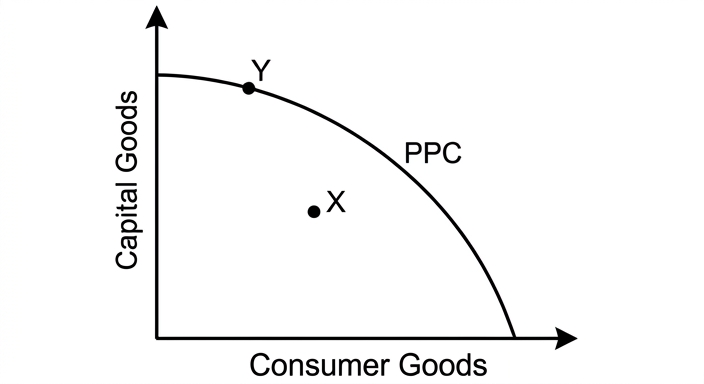
The diagram shows a production possibility curve (PPC). The axes are labelled Capital Goods and Consumer Goods. The curve is drawn concave to the origin, touching both axes. A point inside the curve, such as point X, is shown.
AO2 Analysis
A position within the PPC, like point X, signifies that the economy is not using all its available resources efficiently. It could be producing at this point because some resources are idle (e.g. unemployment of labour or capital) or because resources are being used wastefully (e.g. inefficiency in production). The output of both capital and consumer goods at X is lower than what is possible if all resources were fully and efficiently employed on the frontier (e.g. point Y on the PPC). Therefore, point X represents an underutilisation of the economy's productive capacity.
Whether this position is permanent depends on the cause. If the economy is in a temporary recession with cyclical unemployment, it may move back to the frontier as aggregate demand recovers. However, if the inefficiency is structural — due to persistent unemployment, low investment, or poor institutions — the economy could remain inside the frontier for a long period, possibly indefinitely. Even if the economy does return to full capacity, the PPC itself may have shifted outward in the meantime, so the economy is still producing below its new potential.
AO3 Evaluation
In general, a position inside the PPC is not permanent in the very long run because the economy will tend towards full employment through market adjustment or government policy. However, it can persist for extended periods, particularly in the case of structural unemployment or during a deep recession. It is not a fixed state and is likely to change over time.
A position within the PPC is not permanent; it will change over time as the economy adjusts towards the frontier, but it may persist for extended periods if the cause is structural.
Background Concept
The Production Possibility Curve (PPC) is a model that shows the maximum possible combinations of two goods or services that an economy can produce when all resources (land, labour, capital, enterprise) are fully and efficiently employed, given the current state of technology. Points on the PPC are efficient; points inside the PPC are inefficient — they imply that resources are either unemployed, underemployed, or used in an inefficient way (allocative or technical inefficiency). Points outside the PPC are unattainable without economic growth (a shift of the curve rightward).
If the economy is inside the PPC, the opportunity cost of increasing production of one good is the amount of the other good that is forgone. But the key point is that because resources are not being fully used, it is possible to increase output of both goods by moving towards the frontier.
Understanding the Question
The question has two distinct tasks:
- Explain the significance of a position within a PPC (using a diagram). This means drawing a correctly labelled PPC, marking a point inside it, and explaining what it means: inefficient use of resources, unemployed resources, lower output than possible, etc.
- Consider whether such a position is likely to be permanent. The command word 'consider' here asks for a judgement — it is the AO3 evaluation element. The answer must not just describe two sides but must reach a justified short conclusion.
The mark scheme allocates: AO1 (max 3) for the diagram, AO2 (max 3) for the analysis, and AO3 (max 2) for the evaluation.
Approach
First, draw the diagram. The axes must be labelled appropriately (e.g. Capital Goods and Consumer Goods). The curve must touch both axes and be concave to the origin (reflecting increasing opportunity cost). Mark a point inside the curve (point X) and a point on the frontier for contrast (point Y).
Then explain: a point inside the PPC means the economy is not using all its resources to their full potential — either some resources are idle or they are being used inefficiently. The implication is that output is below potential; both goods could be increased without sacrificing the other.
Finally, evaluate permanence: consider structural unemployment, cyclical unemployment, and the possibility that an economy may never fully return to its frontier if the PPC shifts outward while it is still inside. A reasonable conclusion is that it is usually temporary in the long run, but can persist.
Step-by-Step Reasoning
Step 1: Draw the PPC diagram
- Horizontal axis: Consumer Goods.
- Vertical axis: Capital Goods.
- Draw a concave curve from the top of the vertical axis to the right-hand end of the horizontal axis, touching both axes.
- Label a point on the curve as Y (efficient, e.g. high capital goods, low consumer goods).
- Label a point inside the curve as X (underutilisation: less of both goods than point Y).
Step 2: Explain the significance
- Point X means the economy is not achieving productive efficiency. Some labour may be unemployed; capital may be underused; land may lie fallow; there may be waste or misallocation.
- At point X, the economy could produce more of both goods by moving to the frontier — opportunity cost is zero for increasing one good when the other does not fall.
- This is usually associated with a recession, high unemployment, or inefficient production.
Step 3: Evaluate permanence
- If the cause is cyclical (demand-side recession), the economy can return to the frontier as aggregate demand recovers, e.g. through expansionary fiscal or monetary policy. So temporary.
- If the cause is structural (long-term unemployment, low capital investment, poor infrastructure, lack of training), the economy may remain inside for a long time. The PPC might shift outwards in the meantime, making the economy even further below potential relative to its new frontier.
- Also, even if the economy returns to full employment, it could be on a different point on the frontier, not necessarily the same mix. The key is that the initial position inside the PPC is not fixed — it is a temporary or semi-permanent state that changes with economic conditions.
- Conclusion: It is not permanent in the very long run, but it can be persistent. The answer should not say 'it depends' without a conclusion, but a justified 'it depends' with a clear condition is acceptable (e.g. depends on whether the cause is cyclical or structural). A strong conclusion might be: 'A position inside the PPC is not permanent; economies tend to move towards the frontier through market forces or policy, but the speed depends on the nature of the inefficiency.'
Key Takeaways
- A PPC diagram must be correctly labelled (axes, curve, point inside).
- Inside the PPC means inefficient or unemployed resources.
- Evaluation requires considering both sides (temporary vs persistent) and reaching a short justified judgement.
- Distinguish between cyclical and structural causes.
Common Mistakes
- Drawing the PPC as a straight line when the context does not imply constant opportunity cost (always use a concave curve for a normal economy).
- Not labelling the axes or the points inside/outside.
- Not explaining why the position is significant — just saying 'it is inefficient' without referring to resource use or output levels.
- Forgetting to 'consider' the permanence — many candidates describe the significance but do not give a judgement.
- Giving a vague conclusion, e.g. 'it depends' without stating on what or reaching a conclusion.
Things to Be Careful About
- The diagram must be drawn accurately in the exam. For written answers, describe it precisely.
- The 'significance' must be linked to the diagram: the fact that the point is inside shows that output is lower than the maximum.
- The evaluation must be a short, discrete section, not just a sentence buried in the analysis.
- Use correct economic terms: underutilisation, idle resources, productive inefficiency, recession, structural vs cyclical unemployment.
Assess whether consumers always benefit when the government of a mixed economy reduces the role of the market mechanism in allocating resources.
Introduction
In a mixed economy, resources are allocated partly by the market mechanism (price signals responding to consumer demand and producer supply) and partly by the government through direct provision, regulation, taxes and subsidies. Reducing the role of the market mechanism means the government takes a larger role in deciding what, how, and for whom to produce. This essay assesses whether consumers always benefit from such a change.
The case that consumers may benefit from less market mechanism
Markets fail to allocate resources efficiently in several important ways, and reducing the market's role can correct these failures, benefiting consumers.
First, public goods such as national defence, street lighting, and police services are non-rival and non-excludable. The market cannot provide them profitably because of the free-rider problem — consumers can enjoy the benefit without paying. If the government reduces the market's role and directly provides these goods, consumers benefit from security and order that would otherwise be unavailable. Similarly, merit goods such as education and healthcare are under-consumed in a pure market because consumers have imperfect information about the long-term benefits. Government provision or subsidy increases consumption, raising social welfare. For example, state-funded education improves literacy, which benefits consumers individually and society at large.
Second, markets can produce external costs (negative externalities) such as pollution from factories or congestion from cars. If left to the market, too many such goods are produced because the cost to society exceeds the private cost. Government intervention in the form of stricter regulations, pollution taxes, or quotas reduces overconsumption, improving consumers' quality of life, for instance through cleaner air and less traffic.
Third, a completely free market produces high levels of income and wealth inequality. The market mechanism allocates resources according to willingness and ability to pay, which is determined by existing income distribution. Government intervention — such as redistribution via progressive taxes or provision of a safety net — can ensure a minimum standard of living for all consumers, even if they cannot afford market prices. Many consumers, particularly those on low incomes, benefit from this.
Therefore, in the presence of public goods, information failures, externalities, and inequality, reducing the market's role can improve consumer welfare.
The case that consumers may lose from less market mechanism
However, reducing the market's role carries significant risks, and consumers may be worse off.
First, government intervention can result in government failure. Without the profit motive and competitive pressure, state-run enterprises may have weak incentives to minimise costs, leading to inefficiency and higher prices or lower quality for consumers. Bureaucracy and vested interests may delay decision-making or direct resources to politically favoured sectors rather than consumer needs.
Second, the market mechanism is a powerful information system. Prices convey information about scarcity and consumer preferences. When the government allocates resources, it must decide what to produce without the benefit of price signals. This can lead to surpluses (waste) or shortages (rationing). In planned economies of the past, such misallocation caused long queues and poor-quality goods, harming consumers.
Third, reducing the market's role may reduce consumer choice. In a market, a wide variety of products caters to diverse preferences. Government provision often standardises goods and services (e.g. a single type of public transport, a one-size-fits-all education curriculum). Consumers with particular needs may find their preferences unsatisfied.
Fourth, government intervention is financed through taxation. Even if government provision is efficient, consumers bear the cost through higher taxes, which reduces their disposable income and may offset the benefits of improved public services. If the intervention is wasteful (government failure), the net effect on consumers is negative.
Evaluation
The key question is not whether any reduction of the market's role is beneficial, but whether the specific intervention corrects a market failure more effectively than the market would allocate on its own. Where markets fail severely — public goods, large externalities, extreme inequality — government provision often raises consumer welfare, despite some inefficiency. However, for normal private goods where competition works well, reducing the market's role is likely to harm consumers through loss of choice, lower efficiency, and higher taxes.
Furthermore, the type of intervention matters. Regulation that corrects information asymmetry (e.g. food safety labelling) can benefit consumers at low cost, whereas nationalising a competitive industry is likely to reduce consumer welfare.
Conclusion
Consumers do not always benefit when the government reduces the role of the market mechanism. They benefit when intervention corrects genuine and significant market failures (public goods, merit goods, externalities, inequality), but they are harmed when government failure exceeds the original market failure or when the intervention overrides an efficient competitive market. A balanced conclusion is that consumers only benefit from selective, well-designed intervention focused on identified market failures; a blanket reduction in the market mechanism is unlikely to be always beneficial.
Consumers do not always benefit when the government reduces the role of the market mechanism. They benefit when intervention corrects market failures (public goods, merit goods, externalities, inequality) but are harmed when government failure (inefficiency, lack of choice, high taxes) dominates. The outcome depends on the specific context and design of the intervention.
Background Concept
A mixed economy combines elements of the free market (where prices allocate resources based on consumer demand and profit motives) with government intervention (through taxation, regulation, direct provision, and other policy tools). The central economic debate in this question is: how much should the government intervene? The market mechanism is the process by which the forces of supply and demand determine prices, which in turn guide resource allocation. The government can reduce this market role by stepping in through the methods of government intervention (e.g. direct provision of goods, setting maximum/minimum prices, nationalisation, regulation). The result is that the market allocates fewer resources than it would in a pure laissez-faire system.
Key theoretical concepts needed:
- Market failure: when the free market leads to an inefficient allocation of resources (e.g. underprovision of public goods, overconsumption of demerit goods, externalities, information asymmetry).
- Government failure: when government intervention actually makes the allocation worse than the market left alone (e.g. inefficiency, unintended consequences, bureaucratic costs, lack of information).
- Consumer sovereignty: in a market, consumers are sovereign — they decide what is produced through their spending. In a more planned system, the government decides for them.
- Allocative efficiency: producing the goods and services that consumers want, at the right quantities and prices.
Understanding the Question
This is a 12-mark essay (AO1+AO2 = 8, AO3 = 4), levels-marked. The command word is 'Assess whether', which requires:
- A developed analysis of BOTH why consumers might benefit AND why they might lose.
- A final conclusion that gives a justified answer to the question: is it always beneficial?
The question contains an absolute ('always'), so the answer must argue against the absolute to achieve top evaluation marks. The top band requires a detailed, developed, balanced, and well-organised response, with a justified conclusion. A one-sided answer cannot achieve any evaluation marks.
Approach
- Define key terms (market mechanism, mixed economy) in the introduction.
- Build a strong 'for' case: show how markets fail in specific ways (public goods, merit goods, externalities, inequality) and how reducing the market role (through government provision, regulation, etc.) can improve consumer welfare.
- Build a strong 'against' case: show the risks of government failure (inefficiency, lack of choice, bureaucratic misallocation, tax burden) that can harm consumers.
- Evaluate: on what basis do we decide? The key criterion is whether the specific intervention corrects a larger market failure than the government failure it introduces. Also consider the nature of the good/service and the type of intervention.
- Conclude with a clear, justified answer that addresses the 'always' claim.
Step-by-Step Reasoning
Step 1: Define and introduce
- The market mechanism allocates through prices, consumer sovereignty, and profit motive.
- A mixed economy has both market and state allocation.
- 'Reducing the role of the market mechanism' means the state takes over more of the allocation.
Step 2: Develop the 'benefit' case
- (i) Public goods: e.g. national defence, street lighting. Non-rival and non-excludable; market fails. If government provides them directly, consumers benefit from security and access they could not buy. Example: free public policing vs private security guards.
- (ii) Merit goods: e.g. education, healthcare. Under-consumed due to imperfect information and positive externalities. Government subsidy or provision increases consumption and long-term welfare. Consumers gain: educated workforce, healthier population.
- (iii) Negative externalities: e.g. pollution from factories, congestion. Market produces too much. Government regulation (emission limits, carbon tax) reduces overconsumption, improving consumer quality of life (cleaner environment).
- (iv) Inequality: market allocates according to ability to pay, which can be highly unequal. Government redistribution (progressive taxation, welfare benefits) ensures minimum living standards for low-income consumers.
- Example: minimum wage laws protect low-paid workers.
Step 3: Develop the 'harm' case
- (i) Government failure: state enterprises often lack profit incentive -> higher costs, inefficiency, poor quality. Example: state-run utilities in some countries are notorious for power cuts and high prices.
- (ii) Loss of price signals: government planners lack information; can produce wrong goods in wrong quantities -> shortages or surpluses. Example: central planning in the Soviet Union produced long queues for basic goods and huge surpluses of unwanted goods.
- (iii) Reduced consumer choice: standardised products limit variety. Example: state-provided healthcare may offer only basic treatment, whereas a market system offers many options.
- (iv) Tax burden: government provision requires tax revenue, reducing disposable income for other goods. If the intervention is inefficient, the net benefit to consumers is negative.
- (v) Bureaucracy and political motives: decisions may serve political interests rather than consumer welfare. Example: subsidies to politically powerful industries maintain inefficient production.
Step 4: Evaluation
- The key is to compare the magnitude of the market failure with the magnitude of the government failure.
- For pure public goods (e.g. defence), market failure is total; even an inefficient government provision is better than none -> consumers benefit.
- For goods with minor externalities (e.g. some foods), market works well; government intervention may do more harm than good -> consumers lose.
- The type of intervention matters: information campaigns (e.g. healthy eating advice) are low-cost and preserve choice, while nationalisation is high-risk.
- Conclusion: consumers do NOT always benefit. They benefit only when intervention corrects a specific and significant market failure more efficiently than the market would. The question's 'always' is false.
Step 5: Write a justified conclusion
- State clearly that consumers do not always benefit.
- Give the condition under which they do or do not: benefit when the intervention is targeted and the market failure is severe; lose when government failure dominates or the market is efficient.
- Mention that the outcome is context-specific.
Key Takeaways
- For 'assess' questions, the conclusion MUST be justified, not just a summary.
- A one-sided response gets zero for evaluation (AO3).
- Use specific economic concepts: market failure, government failure, public goods, merit goods, externalities, inequality, allocative efficiency.
- Examples strengthen the answer and show application.
- The absolute ('always') must be addressed — usually it is false.
Common Mistakes
- Writing one-sided: only arguing that government intervention is good (or bad). This forfeits all evaluation marks and caps analysis at Level 2 (max 5 marks for AO1/AO2).
- Failing to reach a conclusion: a description of both sides without a judgement is not evaluated.
- Giving a vague conclusion: 'It depends' without stating on what, or not reaching a decision.
- Ignoring the absolute 'always' and giving a general discussion of intervention vs market.
- Using generic evaluation (e.g. 'in the short run vs long run') without linking to consumer benefit.
- Not distinguishing between types of goods (public, merit, private) — the answer becomes overly general.
- Confusing 'market mechanism' with 'capitalism' or 'competition' in a way that loses precision.
Things to Be Careful About
- The term 'mixed economy' already has government intervention; reducing the market mechanism means shifting the balance towards more state control. Clarify this.
- Distinguish between the government reducing the market mechanism (i.e. doing more itself) and the government simply reducing its own role (which is the opposite). The question says 'reduces the role of the market mechanism', so intervention increases.
- Evaluation should be integrated, not a separate paragraph at the end that merely repeats the two sides. It should weigh them against a clear criterion.
- Use the level descriptors: for Level 3 (AO1/AO2), ensure analysis is fully developed, not just points listed. For Level 2 (AO3), ensure the conclusion is justified and specific.
Explain two possible causes of economic growth and consider whether the consequences of economic growth for an economy will always be positive.
Answer
AO1 Knowledge and understanding
Economic growth is an increase in the productive capacity of an economy, measured by the rate of increase in real GDP.
Two possible causes of economic growth are:
-
An increase in the quantity of labour. A larger labour force, due to population growth or higher participation rates, increases the economy's ability to produce goods and services.
-
Investment in capital stock. Spending on new machinery, factories, and infrastructure increases the stock of physical capital, raising labour productivity and the economy's potential output.
AO2 Analysis
The consequences of economic growth are not always positive.
Positive consequences:
- Higher real GDP per capita can raise the material standard of living, allowing households to consume more goods and services.
- Growth may reduce unemployment as firms expand output and hire more workers.
Negative consequences:
- Growth may deplete non-renewable natural resources and cause environmental damage, such as pollution and carbon emissions, which reduce welfare.
- It can reduce the quality of life if it comes at the expense of more leisure time, for example through longer working hours.
AO3 Evaluation
Whether the consequences are always positive depends on the type and sustainability of growth. Growth driven by resource depletion or that ignores external costs may reduce net welfare even as GDP rises. Therefore, the consequences are not always positive; they depend on how growth is achieved and what is sacrificed to achieve it.
The consequences of economic growth are not always positive; they depend on the type and sustainability of growth, as growth that depletes resources or damages the environment may reduce net welfare.
Background Concept
Economic growth refers to an increase in the productive capacity of an economy, typically measured as the percentage increase in real Gross Domestic Product (GDP) over a period. It can be illustrated by an outward shift of the Production Possibility Curve (PPC) or a rightward shift of the Long-Run Aggregate Supply (LRAS) curve. The causes of growth are broadly divided into increases in the quantity of factors of production (land, labour, capital, enterprise) and improvements in their quality or productivity (technological progress, better education, more efficient institutions). The consequences of growth are a central debate in economics: while growth raises material living standards and can reduce unemployment, it also imposes costs such as environmental degradation, resource depletion, and potential reductions in leisure time. The question asks whether these consequences are always positive, which is an absolute claim that requires a counter-example to challenge.
Understanding the Question
This is a Paper 2 essay part (a), worth 8 marks, and it is point-based. The command word is "Explain... and consider whether...". The first part ("Explain two possible causes of economic growth") tests AO1 (Knowledge and understanding) and AO2 (Analysis). The second part ("consider whether the consequences... will always be positive") tests AO3 (Evaluation). The mark scheme allocates up to 3 marks for AO1, up to 3 marks for AO2, and up to 2 marks for AO3. The key is to provide two distinct, well-explained causes, then analyse both positive and negative consequences, and finally deliver a short, justified judgement that directly addresses the word "always". A one-sided answer that only lists positive consequences would score zero for evaluation.
Approach
- AO1 (Knowledge): Define economic growth. Then state two clear, distinct causes. Avoid vague causes like "more resources" — be specific (e.g., "an increase in the size of the labour force" and "investment in physical capital").
- AO2 (Analysis): For each cause, briefly explain the mechanism by which it leads to growth (e.g., more workers -> more output; more capital -> higher productivity -> more output). Then analyse the consequences of growth, explicitly covering both positive and negative sides. Use chains of reasoning: growth -> higher incomes -> higher consumption -> higher standard of living; growth -> more production -> more pollution -> lower environmental quality -> lower welfare.
- AO3 (Evaluation): The word "always" is the target. Argue that the net effect depends on the type of growth (sustainable vs. unsustainable), the trade-offs involved (e.g., growth vs. environment, growth vs. leisure), and how welfare is measured (GDP vs. broader measures like the Human Development Index or Genuine Progress Indicator). Conclude that consequences are not always positive.
Step-by-Step Reasoning
Step 1: Define economic growth.
Start with a precise definition: "Economic growth is an increase in the productive capacity of an economy, measured by the rate of increase in real GDP." This earns the first knowledge mark.
Step 2: State and explain two causes.
Choose two causes from the mark scheme's list. Good choices are:
- Increase in the quantity of labour: A growing population or higher labour force participation rate (e.g., more women entering the workforce) increases the total number of workers. More workers can produce more output, shifting the PPC outward. This is a source of extensive growth.
- Investment in capital stock: Firms spend on new machinery, factories, and infrastructure. This increases the capital-to-labour ratio, making each worker more productive. This is a source of intensive growth and is often associated with technological progress.
For each cause, provide a one-sentence explanation of the mechanism. This earns the analysis marks.
Step 3: Analyse positive consequences.
- Higher standard of living: Growth raises real GDP per capita, allowing households to consume more goods and services, improving material welfare.
- Lower unemployment: As firms expand output to meet rising demand, they hire more workers, reducing cyclical unemployment.
Step 4: Analyse negative consequences.
- Environmental damage: Increased production often leads to more pollution, resource depletion, and carbon emissions. These are negative externalities that reduce social welfare even as GDP rises.
- Reduced quality of life: Growth may require longer working hours, less leisure time, and increased stress, which can lower subjective well-being.
Step 5: Deliver the evaluative judgement.
The question asks whether consequences are "always" positive. The word "always" is an absolute. To challenge it, argue that the net effect depends on:
- The type of growth: Growth driven by sustainable investment in technology and human capital is more likely to have net positive effects than growth driven by resource extraction or pollution-intensive industries.
- The trade-offs: If growth comes at the expense of environmental quality or leisure, the net welfare effect could be negative.
- Measurement issues: GDP does not account for externalities or non-market activities (e.g., household production, leisure). Broader measures of welfare may show that growth does not always improve well-being.
Conclusion: "Therefore, the consequences of economic growth are not always positive; they depend on the nature of the growth and the trade-offs involved."
Key Takeaways
- Economic growth is an increase in productive capacity, not just a short-term rise in output.
- Causes can be classified as increases in factor quantities (extensive growth) or improvements in factor quality/productivity (intensive growth).
- The consequences of growth are multi-dimensional: material living standards, employment, environment, and quality of life.
- An absolute claim ("always", "never", "all") in an economics question is almost always false and requires a counter-example or a conditional judgement.
- In point-based questions, each assessment objective must be explicitly addressed; do not mix them up.
Common Mistakes
- One-sided answer: Only listing positive consequences and ignoring negative ones. This forfeits all evaluation marks.
- Vague causes: Saying "more resources" without specifying which factor of production or how it increases.
- No definition: Failing to define economic growth at the start loses a simple AO1 mark.
- No judgement: Ending with a summary of both sides without a clear, justified conclusion. The mark scheme reserves 1 mark for a conclusion.
- Confusing causes with consequences: Explaining the effects of growth as if they were causes.
Things to Be Careful About
- The word "always" is the key to the evaluation. Directly address it.
- Keep the answer concise. This is 8 marks, not an essay. Two causes, two positive and two negative consequences, and a short judgement is sufficient.
- Use economic terminology: "productive capacity", "real GDP", "capital stock", "labour productivity", "negative externalities", "welfare".
- Do not introduce a diagram; the question does not require one, and the mark scheme does not mention one.
Assess whether a government should always aim for an expansionary fiscal policy rather than a contractionary fiscal policy.
Introduction
Fiscal policy involves the use of government spending and taxation to influence aggregate demand (AD). An expansionary fiscal policy (increased spending and/or lower taxes) shifts AD rightwards, while a contractionary fiscal policy (reduced spending and/or higher taxes) shifts AD leftwards. The question asks whether a government should always aim for expansionary rather than contractionary policy. This essay argues that the appropriate stance depends on the macroeconomic conditions, and that neither policy is universally superior.
The case for expansionary fiscal policy
Expansionary fiscal policy is appropriate when the economy is operating below full capacity, with a negative output gap, high unemployment, and low or falling inflation. In such a recessionary or deflationary situation, increasing government spending or cutting taxes raises AD. This leads to higher real output and employment, moving the economy towards its potential. For example, during the 2008–09 global financial crisis, many governments implemented expansionary fiscal packages to stimulate demand and prevent a deeper recession. The policy is effective when the SRAS curve is relatively flat, as the increase in AD raises output significantly with little inflationary pressure.
The case against always using expansionary policy
However, expansionary fiscal policy is inappropriate when the economy is at or above full capacity. If AD is already high, further stimulus will overheat the economy, causing demand-pull inflation. In such conditions, a contractionary fiscal policy is needed to reduce inflationary pressure. For instance, a government facing high inflation and a positive output gap should raise taxes or cut spending to cool down AD. Additionally, expansionary policy can lead to a larger budget deficit and a growing national debt, which may crowd out private investment and impose a burden on future generations. Persistent deficits can also reduce international confidence and lead to higher borrowing costs.
Evaluation
The choice between expansionary and contractionary fiscal policy depends on the position of the economy in the business cycle. The key criterion is the state of the output gap and the rate of inflation. A government should use expansionary policy during a recession and contractionary policy during an inflationary boom. However, the effectiveness of either policy is limited by time lags (recognition, decision, and implementation lags) and by the possibility of crowding out. Furthermore, supply-side policies may be more appropriate for addressing structural problems. The question's absolute claim ("always") is therefore false; the correct stance is contingent on economic circumstances.
Conclusion
A government should not always aim for expansionary fiscal policy. The appropriate stance depends on the macroeconomic context: expansionary policy is suitable for recessions with high unemployment, while contractionary policy is necessary to control inflation when the economy is overheating. A one-size-fits-all approach is economically unsound. The best policy is a counter-cyclical one, where the government acts to stabilise the economy by expanding during downturns and contracting during booms.
A government should not always aim for expansionary fiscal policy; the appropriate stance depends on the macroeconomic context, with expansionary policy suitable for recessions and contractionary policy necessary to control inflation during booms.
Background Concept
Fiscal policy refers to changes in government spending and taxation to influence the level of aggregate demand (AD) in the economy. AD = C + I + G + (X – M). Expansionary fiscal policy involves increasing G or decreasing taxes (which raises C and I), shifting AD to the right. Contractionary fiscal policy involves decreasing G or increasing taxes, shifting AD to the left. The impact on real output and the price level depends on the slope of the Short-Run Aggregate Supply (SRAS) curve. When the economy is in a recession (negative output gap), SRAS is relatively flat, so an AD increase raises output significantly with little inflation. When the economy is at full capacity (positive output gap), SRAS is steep, so an AD increase mainly raises the price level (inflation) with little increase in output. The question asks whether a government should always aim for expansionary policy, which is an absolute claim that requires a counter-cyclical perspective to challenge.
Understanding the Question
This is a Paper 2 essay part (b), worth 12 marks, and it is levels-marked. The command word is "Assess whether...". The mark scheme uses Table A (AO1/AO2, out of 8 marks) and Table B (AO3, out of 4 marks). The top band for AO1/AO2 requires detailed knowledge, fully developed explanations, and accurate use of analytical tools (AD/AS diagrams). The top band for AO3 requires a justified conclusion and developed evaluative comments. The question contains an absolute ("always"), so the core of the evaluation is to argue that the appropriate policy depends on the economic situation. A one-sided answer that only argues for expansionary policy would score zero for evaluation.
Approach
- Introduction: Define fiscal policy and the two stances. State the thesis: the appropriate policy depends on the economic context, not an absolute rule.
- First side (expansionary): Explain when it is appropriate (recession, negative output gap, high unemployment, low inflation). Use AD/AS analysis to show the effect on output and prices. Provide a real-world example (e.g., post-2008 stimulus).
- Second side (contractionary): Explain when it is appropriate (overheating, positive output gap, high inflation). Use AD/AS analysis to show the effect on output and prices. Also discuss the downsides of expansionary policy (budget deficits, national debt, crowding out).
- Evaluation: Weigh the two sides. The key criterion is the state of the business cycle. Discuss limitations: time lags, crowding out, the role of supply-side policies. Conclude that the absolute claim is false; a counter-cyclical approach is best.
- Conclusion: Restate the judgement clearly and justify it.
Step-by-Step Reasoning
Step 1: Define fiscal policy and the two stances.
- Expansionary: increase G, decrease taxes -> AD shifts right.
- Contractionary: decrease G, increase taxes -> AD shifts left.
Step 2: Build the case for expansionary policy.
- When it is appropriate: The economy is in a recession with a negative output gap (actual GDP < potential GDP). Unemployment is high, inflation is low or negative (deflation).
- How it works: Increased G or lower taxes raises AD. Because the economy is below full capacity, the SRAS curve is relatively elastic (flat). The increase in AD leads to a large increase in real output (Y) and a small increase in the price level (P). This reduces unemployment and stimulates growth.
- Example: The 2008–09 global financial crisis led many governments (e.g., the US, UK, China) to implement large fiscal stimulus packages to prevent a depression.
Step 3: Build the case against always using expansionary policy.
- When it is inappropriate: The economy is at or above full capacity with a positive output gap. Inflation is high (demand-pull).
- Why contractionary is needed: Raising taxes or cutting G reduces AD. Because the economy is at full capacity, the SRAS curve is relatively inelastic (steep). The decrease in AD leads to a large fall in the price level (reducing inflation) and a small fall in real output. This cools down the economy without causing a severe recession.
- Downsides of expansionary policy:
- Budget deficit and national debt: Persistent expansionary policy increases the government's borrowing, which can lead to a growing national debt. This may crowd out private investment (higher interest rates reduce C and I) and impose a burden on future taxpayers.
- Inflation: If used when the economy is already at full capacity, it causes demand-pull inflation.
- Time lags: By the time the policy takes effect, the economy may have already recovered, making the stimulus pro-cyclical and inflationary.
Step 4: Evaluate and reach a judgement.
- The absolute claim ("always") is false. The correct stance is counter-cyclical: expand during recessions, contract during booms.
- However, the effectiveness of fiscal policy is limited by:
- Time lags: Recognition lag (identifying the problem), decision lag (passing legislation), implementation lag (spending actually occurs). These can make fiscal policy slow to respond.
- Crowding out: Expansionary policy financed by borrowing may raise interest rates, reducing private investment and offsetting some of the stimulus.
- Supply-side constraints: If the economy's potential output is low due to structural issues, fiscal stimulus may only cause inflation without raising long-run growth. Supply-side policies (e.g., training, deregulation) may be more appropriate.
- Justified conclusion: A government should not always aim for expansionary policy. The choice depends on the macroeconomic context. A counter-cyclical approach, where policy is expansionary during recessions and contractionary during booms, is the most appropriate strategy for stabilising the economy.
Key Takeaways
- Fiscal policy is a demand-side tool; its effectiveness depends on the state of the economy (the slope of SRAS).
- Expansionary policy is for recessions; contractionary policy is for inflationary booms.
- An absolute claim in economics is almost always false and requires a conditional or contingent judgement.
- Evaluation should consider time lags, crowding out, and the role of supply-side policies.
- A justified conclusion must state which side is stronger and why, not just summarise both sides.
Common Mistakes
- One-sided answer: Only arguing for expansionary policy, ignoring the need for contractionary policy during booms. This scores zero for evaluation.
- No AD/AS analysis: Failing to use the AD/AS model to explain the effects of fiscal policy. The top band requires accurate use of analytical tools.
- No conclusion: Ending without a clear, justified judgement. The top band for AO3 requires a conclusion that addresses the specific question.
- Vague conclusion: Saying "it depends" without specifying what it depends on and which way the judgement falls.
- Confusing fiscal and monetary policy: Discussing interest rates instead of government spending and taxation.
- Ignoring the absolute: Not directly addressing the word "always" in the question.
Things to Be Careful About
- The question asks "Assess whether a government should always aim for an expansionary fiscal policy rather than a contractionary fiscal policy." The word "always" is the key to the evaluation. Directly challenge it.
- Use the AD/AS diagram in your explanation. Describe the shift in AD, the slope of SRAS, and the impact on output and prices. A diagram is not explicitly required by the question, but the mark scheme's top band mentions "accurate and relevant use of analytical tools such as diagrams and formulae". Including a well-explained AD/AS diagram would strengthen the answer and help secure a top-band mark.
- Keep the answer focused on fiscal policy. Do not drift into monetary policy or supply-side policy except as part of the evaluation (e.g., "supply-side policies may be more appropriate for structural problems").
- Ensure the conclusion is justified: state the criterion (state of the business cycle) and explain why it leads to the judgement.
Explain the potential advantages of free trade and consider whether such advantages are always greater than the potential disadvantages of free trade.
Answer
AO1 Knowledge and understanding
Free trade is the exchange of goods and services between countries without artificial barriers such as tariffs, quotas, or subsidies. Its potential advantages include:
- An increase in world output through specialisation according to comparative advantage.
- A wider range of products for consumers, increasing choice and competition.
- Lower prices for consumers due to greater efficiency and economies of scale.
AO2 Analysis
However, free trade also has potential disadvantages:
- Specialisation can lead to the decline of domestic industries, causing structural unemployment as workers lack the skills for expanding sectors.
- Over-reliance on a narrow range of exports makes an economy vulnerable to price volatility or demand shocks.
- Importing essential goods (e.g. food, energy) creates a security risk if supply is disrupted.
These disadvantages contrast with the advantages: while free trade raises total output, the gains may be unevenly distributed, and the costs of adjustment (unemployment, risk) can be significant.
AO3 Evaluation
The advantages of free trade are not always greater than the disadvantages. The net benefit depends on factors such as the flexibility of the economy, the availability of safety nets (e.g. retraining programmes), and the degree of diversification. For a developed economy with a flexible labour market and strong institutions, the advantages typically outweigh the disadvantages. For a developing economy dependent on a single commodity, the risks may be severe. Therefore, while free trade offers substantial gains, the claim that its advantages are always greater is not supported.
The advantages of free trade are not always greater than the disadvantages; the net benefit depends on the economy's flexibility, diversification, and institutional support.
Background Concept
Free trade is the policy of allowing goods and services to move across international borders without government-imposed restrictions such as tariffs, quotas, or subsidies. The core economic argument for free trade rests on the theory of comparative advantage, developed by David Ricardo. This theory shows that even if one country is less efficient at producing everything than another, both countries can still gain from trade if each specialises in producing the good in which it has a lower opportunity cost. Specialisation according to comparative advantage allows world output to increase for a given amount of resources, because each country focuses on what it does relatively best.
The benefits of free trade extend beyond static output gains. They include dynamic gains such as economies of scale (firms can produce for a larger market), increased competition which drives down prices and improves quality, greater consumer choice, and the transfer of technology and ideas across borders.
However, free trade also has potential costs. Specialisation can make an economy vulnerable to external shocks if it becomes too dependent on a narrow range of exports. The process of adjustment can be painful: workers in declining industries may lack the skills for expanding sectors, leading to structural unemployment. There are also strategic concerns about relying on other countries for essential goods such as food, energy, or medical supplies.
Understanding the Question
This is part (a) of a two-part essay question on Paper 2. It carries 8 marks and is point-based, split across three assessment objectives: AO1 (Knowledge and understanding, max 3 marks), AO2 (Analysis, max 3 marks), and AO3 (Evaluation, max 2 marks).
The question has two clauses:
- "Explain the potential advantages of free trade" — this requires you to demonstrate knowledge and understanding of the benefits (AO1) and to develop an analysis of how these benefits arise (AO2).
- "...and consider whether such advantages are always greater than the potential disadvantages of free trade" — this is the evaluative element (AO3). The word "consider" signals that a short judgement is required, not a full essay. The word "always" is an absolute that you must challenge.
You must address both clauses explicitly. A response that only explains advantages and ignores the "consider" clause cannot earn the AO3 marks.
Approach
-
AO1 (up to 3 marks): Define free trade and state at least two clear advantages. The mark scheme mentions: increased world output, wider range of products, improved standard of living. You can also add lower prices and economies of scale.
-
AO2 (up to 3 marks): Explain at least two disadvantages of free trade and show how they contrast with the advantages. The mark scheme mentions: specialisation leading to unemployment, overreliance on commodities being risky, security risk from importing vital resources. Develop each point with a brief chain of reasoning.
-
AO3 (up to 2 marks): Offer a valid judgement on whether the advantages are "always" greater. The answer must be "no" — the absolute claim is too strong. Explain why the net benefit depends on context (e.g. flexibility of the economy, diversification, safety nets). Reserve 1 mark for the judgement itself and 1 mark for reaching a conclusion.
Step-by-Step Reasoning
Step 1: Define free trade and state its advantages (AO1)
Start by defining free trade as the absence of artificial barriers to international trade. Then list the advantages:
- Increased world output: Specialisation according to comparative advantage means resources are used more efficiently, so total production rises.
- Greater consumer choice: Consumers can buy products from all over the world, not just domestically produced goods.
- Lower prices: Competition from foreign firms forces domestic firms to be more efficient, and consumers benefit from lower prices.
- Economies of scale: Firms can produce for a global market, allowing them to achieve lower average costs.
Step 2: Explain the disadvantages (AO2)
Now explain the counter-arguments:
- Structural unemployment: Specialisation means some industries expand while others contract. Workers in declining industries may not have the skills for growing sectors, leading to long-term unemployment. This is a cost that is not captured by the simple comparative advantage model.
- Over-reliance on a narrow range of exports: If a country specialises in a few commodities (e.g. oil, coffee, copper), it is vulnerable to price fluctuations and demand shocks. A fall in the world price can devastate the economy.
- Security risk: Importing essential goods such as food, energy, or medical supplies creates a strategic vulnerability. If trade is disrupted (by war, sanctions, or natural disasters), the country may face shortages.
Contrast these with the advantages: the gains from trade are static and dynamic, but they are not guaranteed to be distributed evenly or to compensate for the adjustment costs.
Step 3: Evaluate and conclude (AO3)
The question asks whether the advantages are "always" greater. The word "always" makes the statement an absolute, which is almost certainly false in economics. The net benefit of free trade depends on:
- The flexibility of the economy: An economy with a flexible labour market, good retraining programmes, and a strong welfare state can manage the adjustment costs more easily.
- The degree of diversification: A diversified economy is less vulnerable to shocks than one dependent on a single commodity.
- The stage of development: Developing economies may face greater risks from free trade if their infant industries cannot compete with established foreign firms.
Therefore, the conclusion is that the advantages are not always greater. In many cases they are, but there are circumstances where the disadvantages can outweigh the benefits. This is a justified judgement that directly addresses the question.
Key Takeaways
- Free trade increases world output through specialisation according to comparative advantage.
- However, it also creates adjustment costs such as structural unemployment and vulnerability to shocks.
- The net benefit depends on context: the flexibility of the economy, its diversification, and its institutional support.
- An absolute claim ("always") should be challenged in an evaluative answer.
- For a point-based question, make sure each assessment objective is visibly addressed.
Common Mistakes
- One-sided answer: Only explaining advantages and ignoring the "consider" clause. This loses all AO3 marks.
- Assertion without development: Stating that free trade is good or bad without explaining why. This loses AO2 marks.
- No conclusion: Failing to reach a judgement on the "always" claim. The mark scheme reserves 1 mark for a conclusion.
- Vague conclusion: Saying "it depends" without explaining what it depends on. The conclusion must be justified.
- Confusing comparative advantage with absolute advantage: The theory of comparative advantage is about opportunity cost, not absolute efficiency.
Things to Be Careful About
- The question asks about "free trade" in general, not about a specific country or policy. Keep the analysis general but grounded in economic theory.
- The AO3 element is only 2 marks, so the evaluation should be concise — a few sentences, not a full paragraph.
- Use economic terminology correctly: comparative advantage, opportunity cost, structural unemployment, specialisation.
- Make sure the conclusion directly answers the question: "Are the advantages always greater?" The answer should be "no" with a clear reason.
Assess whether an economy will always benefit from having a surplus on the current account of its balance of payments.
Introduction
The current account of the balance of payments records the value of exports of goods and services, imports, and net income flows. A surplus means that the value of exports plus net income inflows exceeds the value of imports plus net income outflows. While a surplus is often seen as a sign of economic strength, this essay assesses whether an economy will always benefit from having one.
Potential benefits of a current account surplus
A surplus provides the economy with a net inflow of foreign exchange. This can be used to invest abroad, earning future income and diversifying the country's asset base. For example, China's large surpluses have allowed it to accumulate substantial foreign exchange reserves and invest in overseas assets.
A surplus is often associated with a strong export sector. High exports create jobs in export-oriented industries and can stimulate economic growth through the multiplier effect. If the surplus is driven by high competitiveness, it may reflect a healthy, productive economy.
A surplus also means that spending on imports is relatively low compared to export earnings. This may indicate that consumers are buying more domestic goods, which supports domestic employment and output.
Potential disadvantages of a current account surplus
However, a surplus can also be a sign of underlying economic weakness. A large surplus may reflect weak domestic demand — if consumers and firms are spending less on imports, it could be because the economy is in recession or experiencing low consumer confidence. In this case, the surplus is not a sign of strength but of a lack of domestic spending, which can lead to lower output and higher unemployment.
A persistent surplus can also create tensions with trading partners. Countries with deficits may retaliate with protectionist measures, harming global trade. For example, the US has frequently pressured China to reduce its surplus, leading to trade disputes.
Furthermore, a surplus means that the country is saving more than it is investing domestically. This could indicate that there are insufficient profitable investment opportunities at home, which may constrain long-run economic growth.
Evaluation
Whether an economy benefits from a surplus depends critically on the cause of the surplus. If the surplus is driven by strong export competitiveness and high productivity, it is likely to be beneficial, bringing jobs, growth, and foreign exchange. If the surplus is caused by weak domestic demand and a recession, it is harmful because it reflects low spending and economic stagnation.
The size of the surplus also matters. A moderate surplus is generally healthy, but a very large and persistent surplus may indicate structural imbalances and invite retaliation.
The impact also depends on the country's stage of development. A developing country may benefit from a surplus to build foreign exchange reserves, while a developed economy with a mature export sector may find a surplus less critical.
Conclusion
An economy will not always benefit from having a current account surplus. The net benefit depends on the cause of the surplus, its size, and the broader economic context. A surplus driven by strong competitiveness is beneficial, but one caused by weak domestic demand is harmful. Therefore, the statement that an economy will always benefit from a surplus is not supported.
An economy will not always benefit from a current account surplus; the net benefit depends on the cause of the surplus (strong exports vs weak domestic demand), its size, and the broader economic context.
Background Concept
The current account of the balance of payments records all transactions between residents of a country and the rest of the world that involve the exchange of goods, services, primary income (e.g. investment earnings), and secondary income (e.g. remittances). A surplus on the current account means that the value of exports plus net income inflows exceeds the value of imports plus net income outflows. In other words, the country is earning more from abroad than it is spending.
A current account surplus is often viewed positively because it implies that the country is a net lender to the rest of the world. It accumulates foreign exchange reserves, which can be used to pay for future imports or to invest abroad. However, the economic interpretation of a surplus is more nuanced. A surplus can arise from very different underlying conditions: strong export competitiveness (good) or weak domestic demand (bad). The same numerical outcome can have opposite welfare implications.
Understanding the Question
This is part (b) of a two-part essay question on Paper 2. It carries 12 marks and is levels-marked, with AO1 and AO2 out of 8 marks (Table A) and AO3 out of 4 marks (Table B).
The question asks: "Assess whether an economy will always benefit from having a surplus on the current account of its balance of payments."
The command word is "Assess", which requires a balanced analysis of both sides and a justified conclusion. The word "always" is an absolute that must be challenged. The question is specifically about the current account surplus, not the balance of payments as a whole.
The top band (Level 3 for AO1/AO2) requires: detailed knowledge and understanding, fully developed explanations, accurate and relevant use of economic concepts, and a well-organised, logical response. The top band for AO3 (Level 2) requires: a justified conclusion that addresses the specific requirements of the question, with developed, reasoned, and well-supported evaluative comments.
Approach
-
Introduction: Define the current account and a surplus. State that the essay will assess whether an economy always benefits.
-
First side — potential benefits: Develop the arguments for why a surplus can be beneficial. Use a chain of reasoning: strong exports -> jobs -> growth -> foreign exchange reserves. Give an example (e.g. China, Germany).
-
Second side — potential disadvantages: Develop the counter-arguments. The key point is that a surplus can reflect weak domestic demand. Also consider trade tensions and the opportunity cost of saving rather than investing.
-
Evaluation: Weigh the two sides. The critical factor is the cause of the surplus. Also consider the size of the surplus and the country's stage of development.
-
Conclusion: Answer the question directly: no, an economy will not always benefit. The net benefit depends on the cause and context.
Step-by-Step Reasoning
Step 1: Define key terms
Start by defining the current account and a surplus. This demonstrates knowledge (AO1).
Step 2: Develop the case for benefits (AO2)
- Foreign exchange reserves: A surplus means the country earns more foreign currency than it spends. This builds reserves, which can be used to stabilise the exchange rate, pay for future imports, or invest abroad. For example, China's large surpluses have allowed it to accumulate over $3 trillion in reserves.
- Employment and growth: A surplus is often associated with a strong export sector. High exports create jobs in manufacturing and services. The multiplier effect means that increased export earnings lead to higher income and spending throughout the economy, stimulating growth.
- Domestic industry support: If the surplus is because imports are low, it may mean consumers are buying domestic goods, supporting local firms and employment.
Step 3: Develop the case against benefits (AO2)
- Weak domestic demand: A surplus can arise because the economy is in recession — consumers and firms have low incomes and spend less on imports. In this case, the surplus is a symptom of economic weakness, not strength. Japan's persistent surpluses in the 1990s and 2000s were partly due to weak domestic demand and deflation.
- Trade tensions: A large and persistent surplus can lead to protectionist retaliation from deficit countries. The US-China trade war was partly driven by the US's large deficit with China. Retaliatory tariffs harm both economies.
- Opportunity cost: A surplus means the country is saving more than it is investing domestically. This could indicate a lack of profitable investment opportunities at home, which may constrain long-run growth. The resources could have been used for domestic consumption or investment.
- Lower output and employment in deficit countries: A surplus in one country necessarily means a deficit elsewhere. The surplus country's gain may come at the expense of other countries' output and employment, which can create global imbalances.
Step 4: Evaluate (AO3)
To reach a justified conclusion, weigh the two sides against explicit criteria:
- Cause of the surplus: This is the most important factor. If the surplus is driven by high productivity and strong export competitiveness (e.g. Germany), it is beneficial. If it is driven by weak domestic demand (e.g. Japan in the 1990s), it is harmful.
- Size and persistence: A moderate, temporary surplus is generally healthy. A very large and persistent surplus may indicate structural problems and invite retaliation.
- Stage of development: A developing country may benefit more from a surplus to build reserves and finance development. A developed economy may have less need for a surplus.
- Global context: In a world of floating exchange rates, a surplus should theoretically be self-correcting (the currency appreciates, reducing competitiveness). If the surplus persists, it may indicate market imperfections or government intervention.
Step 5: Conclude
The conclusion must directly answer the question: "Will an economy always benefit?" The answer is no. The net benefit depends on the cause of the surplus. A surplus driven by strong exports is beneficial; one caused by weak domestic demand is harmful. Therefore, the absolute claim is not supported.
Key Takeaways
- A current account surplus is not always beneficial; its impact depends on the underlying cause.
- A surplus can reflect either economic strength (strong exports) or weakness (weak domestic demand).
- Evaluation should consider the cause, size, persistence, and context of the surplus.
- The word "always" in a question signals that the answer should challenge the absolute claim.
- For a levels-marked essay, depth of development matters more than breadth of points.
Common Mistakes
- One-sided answer: Only discussing the benefits of a surplus and ignoring the disadvantages. This loses all AO3 marks (the mark scheme explicitly states: "A one-sided response cannot gain any marks for evaluation").
- Confusing the current account with the capital/financial account: The question is specifically about the current account surplus.
- Assertion without development: Stating that a surplus is good or bad without explaining the chain of reasoning. This keeps the answer at Level 1 or 2.
- No conclusion or a vague conclusion: The top band requires a justified conclusion that addresses the specific question. "It depends" is not enough — you must say what it depends on and why.
- Ignoring the word "always": Failing to challenge the absolute claim means the answer does not fully address the question.
Things to Be Careful About
- Use economic terminology correctly: current account, surplus, deficit, foreign exchange reserves, domestic demand, structural imbalance.
- Develop each point with a clear chain of reasoning. For example: "A surplus caused by weak domestic demand means that consumers are spending less, which reduces aggregate demand, leading to lower output and higher unemployment."
- The evaluation should be developed and well-supported. Do not just list factors — explain why they matter and how they affect the conclusion.
- The conclusion should be a single, clear statement that answers the question, followed by a brief justification.
- The response should be well-organised and logical. Use paragraphs to separate different points and sides of the argument.