Economics 9708/23 — May/June 2023
Cambridge AS Level · AS Level Data Response and Essays · worked solutions for every part, with the mark scheme
Topics Elasticities of Demand · Classification of Goods and Services · Methods of Government Intervention in Markets · Demand and Supply · Consumer and Producer Surplus · Reasons for Government Intervention in Markets · +5 more
Are doughnuts demerit goods?
Consumers love to eat doughnuts. In 2019, 10 billion of these deep-fried sugar-coated products were consumed in the United States (US). Fig. 1.1 shows that the US market increased steadily from 2011 to 2019. Doughnuts are widely available throughout the US. There are specialist shops selling their branded products almost everywhere; local coffee shops invariably sell ‘hole in one’ doughnuts as a popular breakfast snack to tempt consumers on their way to work. The growing number of shops selling doughnuts has been an important reason behind overall market growth.
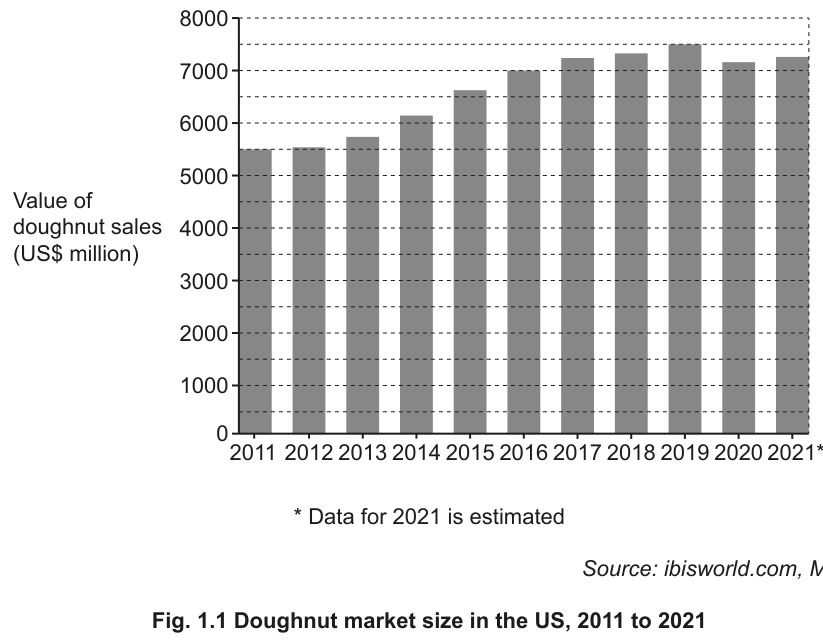
*Data for 2021 is estimated
Source: ibisworld.com, March 2021
Fig. 1.1 Doughnut market size in the US, 2011 to 2021
The COVID-19 pandemic has had a varying impact on the US doughnut market. Despite having less income, many consumers have continued to buy small luxuries such as doughnuts which remain affordable and can provide some short-term relief from the stresses of the pandemic. Overall, sales of doughnuts fell in 2020 and are forecast to remain below their 2019 peak into 2021. Reasons for this fall in demand are that consumers are making fewer shopping trips and in cities, more people are working from home and therefore not buying their daily coffee and doughnut snack.
In the United Kingdom (UK), more so than in the US, there are growing concerns about the increase in sugar consumption amongst children. This increase comes from soft drinks, chocolate biscuits and sweets (candy) as well as from jam-filled doughnuts, all of which are widely available in supermarkets and local convenience stores. In 2021, it was estimated that a third of teenagers and two thirds of adults in the UK were overweight. This has increased the pressure on the UK government to end online advertising of a range of products including doughnuts. It has been estimated that viewing one minute of advertising for products like doughnuts leads to a child consuming an additional 14.2 calories. Moreover, a ban on advertising sugary foods would result in children consuming the equivalent of 62 million fewer doughnuts a year in the UK.
Using the data in Fig. 1.1, calculate the percentage change in the value of sales of doughnuts in the US from 2011 to 2019.
Explain one reason why the US market for doughnuts contracted in 2020.
Comment on whether the demand for doughnuts in the US is income elastic or income inelastic.
Explain why a doughnut might be regarded as a demerit good.
With the help of a diagram, assess how the market for sugary foods in the UK might be affected by a ban on online advertising.
Assess the likely effects on UK consumers and the UK government of a ban on online adverts for sugary foods.
The rest of this paper
4 more questions- Q2Elasticities of Demand · Consumer and Producer Surplus20M
- Q3Classification of Goods and Services · Reasons for Government Intervention in Markets · Methods of Government Intervention in Markets20M
- Q4The Circular Flow of Income20M
- Q5Monetary Policy · Price Stability · Fiscal Policy · Supply-Side Policy20M