Economics 9708/22 — May/June 2023
Cambridge AS Level · AS Level Data Response and Essays · worked solutions for every part, with the mark scheme
Topics Fiscal Policy · Price Stability · Supply-Side Policy · Production Possibility Curves · Consumer and Producer Surplus · Methods of Government Intervention in Markets · +10 more
Is Nigeria being held back by its dependence on oil and gas?
Nigeria has about half of West Africa’s population with approximately 202 million people and one of the largest populations of young people in the world. With an abundance of natural resources, it is Africa’s biggest oil exporter, and has the largest natural gas reserves on the continent.
Nigeria is highly vulnerable to the global economic disruption caused by the COVID-19 pandemic, particularly due to the steep decline in oil prices. Nationally, 40% of Nigerians live in poverty, while another 25% are vulnerable and could fall into poverty due to the pandemic.
Oil accounts for 80% of Nigeria’s export revenues, a dominant position that it has occupied since the 1970s. Many people believe that Nigeria needs to move further away from its dependence on oil and natural gas. Initial attempts at diversification have produced limited gains as the policies have been aimed mainly at the domestic market to create jobs and to improve living standards. There needs to be a focus on export-orientated manufacturing that should boost economic growth as it has done in countries such as Malaysia and Indonesia.
Based on the experience of these countries, more open trade and competition policies would help to diversify the economy, especially as the African Continental Free Trade Area (ACFTA) takes effect. Nigeria needs to create at least five million new jobs each year to employ its growing population of young people.
Table 1.1 Nigeria: key economic indicators
| 2016 | 2017 | 2018 | 2019 | 2020 | |
|---|---|---|---|---|---|
| Economic growth rate (% change in real Gross Domestic Product (GDP) per year) | 1.6 | 0.8 | 1.9 | 2.2 | -1.8 |
| Inflation rate (% change in Consumer Price Index (CPI) per year) | 15.7 | 16.5 | 12.1 | 11.4 | 12.8 |
| Current account balance (% of GDP) | 0.7 | 2.8 | 1.30 | -3.8 | -3.7 |
| Government budget balance (% of GDP) | -3.9 | -5.4 | -4.5 | -4.3 | -5.2 |
| Unemployment rate (% of labour force) | 7.0 | 8.4 | 8.5 | 8.5 | 9.0 |
Source : Global economy.com
Nigeria’s economy entered a recession in 2020 due to fall in crude oil prices caused by falling global demand and measures to fight the spread of COVID-19. Inflation rose in 2020 due mainly to higher food prices, the removal of fuel subsidies and an increase in the price of electricity. The budget deficit also worsened in 2020 because the COVID-19 pandemic caused higher government spending and lower tax revenues, adding to the national debt.
Nigeria’s national debt is sustainable at 25% of GDP, but interest payments are high, accounting for about 50% of government spending. Nigeria’s government could improve its finances by reforming domestic tax collection. Non-oil tax revenue is equivalent to just 4% of GDP. An increase in the rate of value-added tax (VAT) from 5% to 7.5% in 2020 resulted in less revenue than forecast because of the recession. A wider tax base could help the budget, but this will require significant reform to reduce both tax evasion and a large informal economy.
Sources: Adapted from: World Bank in Nigeria Nov 2020 and: IMF News, African Department, February 2020 and: African Development Bank Group: Nigeria Economic outlook, 2021
Compare the government budget balance of Nigeria in 2016 with the government budget balance in 2020.
Answer
In 2016, the government budget balance was -3.9% of GDP, a deficit. In 2020, it was -5.2% of GDP, also a deficit. The deficit increased between 2016 and 2020.
The budget deficit increased from 3.9% of GDP to 5.2% of GDP.
Background Concept
The government budget balance is the difference between government revenue and government spending. A negative balance indicates a budget deficit (spending exceeds revenue). The size of the deficit as a percentage of GDP allows comparison over time.
Understanding the Question
The question asks to compare the government budget balance in 2016 and 2020 using the data in Table 1.1. The command word 'compare' requires stating the value for each year and identifying the change.
Approach
Read the row 'Government budget balance (% of GDP)' for 2016 and 2020. Note that both are negative (deficits). Then state that the deficit increased (became more negative).
Step-by-Step Reasoning
From Table 1.1: 2016: -3.9% of GDP; 2020: -5.2% of GDP. Both are deficits. The deficit increased by 1.3 percentage points. The mark scheme requires explicit reference to deficit in both years.
Key Takeaways
- Budget deficits are common; comparing them requires looking at the sign and magnitude.
- Always use the data provided.
Common Mistakes
- Saying the balance 'became worse' without stating it was a deficit both years.
- Quoting figures without interpreting them as deficits.
Things to Be Careful About
- Ensure you mention that both are deficits.
- Use the correct units (% of GDP).
Using a production possibility curve (PPC) diagram, demonstrate the impact of the rising level of unemployment on the Nigerian economy.
Answer
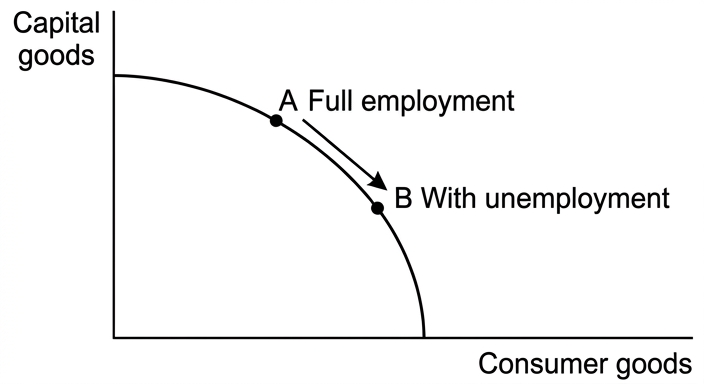
The diagram shows a production possibility curve for Nigeria. With rising unemployment, the economy moves from a point on the curve (full employment) to a point inside the curve, indicating that fewer goods and services are being produced than the economy's potential.
Rising unemployment moves the economy from a point on the PPC to a point inside the PPC, reducing output below potential.
Background Concept
A production possibility curve (PPC) shows the maximum combinations of two goods that an economy can produce given its resources and technology. Points on the curve represent efficient production; points inside represent underutilisation of resources (e.g., unemployment).
Understanding the Question
The question asks to demonstrate the impact of rising unemployment using a PPC diagram. Unemployment means labour resources are idle, so the economy cannot produce on its frontier.
Approach
Draw a standard PPC with two goods (e.g., capital goods and consumer goods). Label axes. Show a point on the curve (full employment) and a point inside (with unemployment). Indicate the movement caused by rising unemployment.
Step-by-Step Reasoning
- Draw axes: 'Capital goods' on vertical, 'Consumer goods' on horizontal.
- Draw a concave curve from one axis to the other, labelled 'PPC'.
- Mark point A on the curve, labelled 'Full employment'.
- Mark point B inside the curve, labelled 'With unemployment'.
- Draw an arrow from A to B to show the movement.
- Explain: Rising unemployment means fewer workers are employed, so the economy produces less of both goods, moving inside the PPC.
Key Takeaways
- Unemployment is represented by a point inside the PPC, not a shift of the curve.
- The PPC itself does not shift unless resources or technology change.
Common Mistakes
- Shifting the PPC inward instead of moving inside it.
- Not labelling axes or curve.
- Drawing a straight-line PPC (constant opportunity cost) when concave is standard.
Things to Be Careful About
- Ensure the curve touches both axes.
- The arrow should clearly show movement from on-curve to inside.
Consider the extent to which the removal of fuel subsidies in Nigeria would lead to an increase in inflation.
Answer
Removing fuel subsidies increases the cost of supplying fuel, shifting the supply curve leftwards and raising the price of fuel. Fuel has a high weighting in the CPI, so this directly raises the price level. Fuel is also an important cost of production, so higher fuel prices increase costs for many other goods, leading to cost-push inflation. If workers demand higher wages to maintain real incomes, this can cause a wage-price spiral, sustaining inflation.
However, the extent of inflation depends on factors such as the price elasticity of demand for fuel (if elastic, the price rise may be smaller), the size of the original subsidy, and whether other costs fall simultaneously. The inflationary impact may be partially offset if the government reduces other taxes or if the economy is in recession, dampening demand-pull pressures. Overall, the removal of fuel subsidies is likely to cause a one-off increase in the price level, but sustained inflation depends on the response of wages and other costs.
The removal of fuel subsidies is likely to cause a one-off increase in the price level, but sustained inflation depends on wage responses and other factors; the extent is limited by demand elasticity and recessionary conditions.
Background Concept
Inflation is a sustained increase in the general price level. Cost-push inflation occurs when costs of production rise, shifting SRAS left. Subsidies reduce production costs; removing them increases costs. The CPI measures inflation using a basket of goods; fuel has a significant weight.
Understanding the Question
The question asks to 'consider the extent to which' removal of fuel subsidies leads to inflation. This requires explaining the inflationary mechanism and then evaluating factors that limit or amplify the effect.
Approach
First, explain the direct effect: subsidy removal raises fuel price. Then, explain how this feeds into inflation via CPI and cost-push. Then, evaluate with offsetting factors: elasticity, size of subsidy, recession, wage response.
Step-by-Step Reasoning
- Subsidy removal increases production cost for fuel suppliers, shifting supply left, raising price.
- Fuel has high weight in CPI, so CPI rises directly.
- Fuel is an input for many goods; higher fuel costs increase production costs across the economy, shifting SRAS left, causing cost-push inflation.
- If workers demand higher wages to compensate, firms pass on costs, creating wage-price spiral.
- Evaluation: If demand for fuel is elastic, quantity falls significantly, limiting price rise. The size of the subsidy matters: a large subsidy removal has bigger impact. In a recession, demand is weak, so firms may absorb costs rather than raise prices. Also, if other costs fall (e.g., lower taxes), inflation may be offset.
Key Takeaways
- Subsidy removal is a supply-side shock that can cause cost-push inflation.
- The extent depends on elasticities, size of shock, and macroeconomic conditions.
- A one-off price level increase is not the same as sustained inflation.
Common Mistakes
- Only explaining the direct price effect without linking to inflation.
- Ignoring evaluation (the 'extent' part).
- Confusing a one-off price rise with ongoing inflation.
Things to Be Careful About
- Use the extract: Nigeria's inflation rose in 2020 due to higher food prices, removal of fuel subsidies, and electricity price increase.
- Mention the recession as a dampening factor.
Assess whether using supply-side policy is the best way to diversify the Nigerian economy away from its dependence on oil and natural gas exports.
Answer
Supply-side policies such as investment in education and training, infrastructure, and support for research and development can help diversify Nigeria's economy by improving productivity and competitiveness in non-oil sectors. For example, better infrastructure reduces production costs for manufacturing, making exports more competitive. Training programmes can equip workers with skills for industries like manufacturing and services, reducing dependence on oil.
However, supply-side policies take time to have an effect and require significant government funding, which is constrained by Nigeria's high debt and interest payments. There is also a risk of government failure if policies are poorly designed or implemented. Moreover, diversification may require complementary policies such as trade liberalisation (e.g., ACFTA) to open export markets, or protection of infant industries to allow them to grow.
Compared to alternative policies, supply-side policy addresses the root causes of low productivity and competitiveness, making it a sustainable long-term strategy. However, given Nigeria's urgent need to create jobs and reduce poverty, supply-side policies alone may be insufficient. A combination of supply-side measures with trade policy and macroeconomic stability is likely to be more effective. Therefore, while supply-side policy is an important component, it is not necessarily the best single way; a comprehensive approach is required.
Supply-side policy is a crucial component for diversification, but it is not the best single way; a combination with trade liberalisation and other policies is more effective given Nigeria's constraints.
Background Concept
Supply-side policies aim to increase the productive capacity of the economy by shifting LRAS right. They include improving labour productivity (education, training), capital (infrastructure, R&D), and efficiency (deregulation). Diversification means expanding the range of goods and services produced, reducing reliance on a single sector.
Understanding the Question
The question asks to 'assess whether' supply-side policy is the best way to diversify. This requires analysing the strengths and weaknesses of supply-side policies in the Nigerian context, and comparing with alternatives (e.g., trade policy, protectionism). A justified conclusion is required.
Approach
First, explain how specific supply-side policies can help diversify (e.g., training for manufacturing, infrastructure for export industries). Then, discuss weaknesses: time lags, cost, government failure, need for complementary policies. Then, evaluate by comparing with alternatives and considering Nigeria's specific constraints (high debt, large informal economy, urgent job creation). Conclude with a balanced judgement.
Step-by-Step Reasoning
- Strengths: Training improves human capital for non-oil sectors; infrastructure reduces costs; R&D fosters innovation. These can increase competitiveness of manufacturing and services.
- Weaknesses: Long time lags; requires substantial investment; Nigeria's high debt limits fiscal space; risk of corruption or poor implementation; may not address immediate job creation needs.
- Alternatives: Trade liberalisation (ACFTA) opens markets; protectionism (tariffs) protects infant industries; macroeconomic stability (low inflation) encourages investment. Each has pros and cons.
- Evaluation: Supply-side policy is essential for long-term structural change, but given Nigeria's urgent needs, a mix of policies is better. The best approach combines supply-side reforms with trade openness and fiscal discipline.
Key Takeaways
- Supply-side policy is not a quick fix; it requires time and resources.
- Diversification often requires multiple policies working together.
- Evaluation must consider the specific context of the country.
Common Mistakes
- Only listing policies without explaining how they help diversification.
- One-sided analysis (only strengths or only weaknesses).
- No conclusion or a vague conclusion.
Things to Be Careful About
- Use the extract: Nigeria needs 5 million jobs per year; ACFTA is mentioned.
- Link policies to the goal of reducing oil dependence.
Assess whether adjusting the collection of direct tax or indirect tax is likely to be more effective in increasing the tax revenue collected by the Nigerian government.
Answer
Adjusting direct tax, such as making income tax more progressive, could increase revenue from those with higher incomes. However, Nigeria has a large informal economy and significant tax evasion, so the tax base is narrow. Higher rates may discourage work and investment, and compliance costs are high. The non-oil tax revenue is only 4% of GDP, indicating limited capacity.
Adjusting indirect tax, such as increasing VAT further from 7.5%, could raise revenue from a broader base, including consumption. However, VAT is regressive and may reduce consumption, especially during a recession. The 2020 increase yielded less revenue than forecast due to the recession, suggesting that further increases may be counterproductive if demand is elastic.
Evaluation: Given Nigeria's large informal economy and low compliance, indirect taxes like VAT may be easier to collect because they are levied on transactions and harder to evade. However, the recession limits the scope for further increases. Direct tax reform, including broadening the tax base and improving enforcement, could be more effective in the long run but requires significant administrative reform. In the short term, improving collection of existing taxes (both direct and indirect) may be more effective than raising rates. Overall, adjusting indirect tax is likely to be more effective in the short term due to broader coverage, but direct tax reform is essential for sustainable revenue growth.
In the short term, adjusting indirect tax (VAT) is likely more effective due to broader coverage and lower evasion, but direct tax reform is needed for long-term sustainability.
Background Concept
Direct taxes are levied on income and wealth (e.g., income tax, corporation tax). Indirect taxes are levied on spending (e.g., VAT, excise duties). Progressive taxes take a higher percentage from higher incomes; regressive taxes take a higher percentage from lower incomes. Tax revenue depends on the tax base, tax rate, and compliance.
Understanding the Question
The question asks to assess which type of tax adjustment is more effective in increasing tax revenue for Nigeria. This requires analysing the strengths and weaknesses of adjusting direct and indirect taxes, considering Nigeria's context (large informal economy, recession, low non-oil tax revenue). A conclusion is required.
Approach
First, analyse direct tax: progressive income tax could raise revenue but faces evasion and narrow base. Then, analyse indirect tax: VAT increase can raise revenue but is regressive and may reduce consumption. Then, evaluate by comparing the two in the Nigerian context: which is more feasible given the informal economy and recession? Conclude with a justified judgement.
Step-by-Step Reasoning
- Direct tax: Progressive income tax can target high earners, but Nigeria's informal economy means many are not registered. Tax evasion is high. Higher rates may discourage formal employment. Compliance costs are high. Non-oil tax revenue is only 4% of GDP, showing limited capacity.
- Indirect tax: VAT is collected at point of sale, harder to evade. Broad base includes consumption by all. However, VAT is regressive, hurting the poor. In a recession, higher VAT reduces consumption, potentially lowering revenue (Laffer curve effect). The 2020 VAT increase from 5% to 7.5% yielded less than forecast due to recession.
- Evaluation: In the short term, indirect tax is more effective because it is easier to collect and reaches the informal sector through transactions. However, the recession limits further increases. Direct tax reform (broadening base, improving enforcement) is essential for long-term revenue growth but requires administrative capacity. Therefore, a combination is best, but for immediate revenue, indirect tax adjustment is more effective.
Key Takeaways
- The effectiveness of tax policy depends on the economic context (informal economy, recession).
- Indirect taxes are often easier to collect in developing countries.
- Tax increases can be counterproductive if they reduce the tax base.
Common Mistakes
- Only discussing one type of tax.
- Ignoring the context (Nigeria's informal economy, recession).
- No conclusion or a conclusion that does not weigh the two.
Things to Be Careful About
- Use extract data: non-oil tax revenue 4% of GDP, VAT increase to 7.5% yielded less revenue.
- Mention the recession as a factor limiting VAT increases.
The rest of this paper
4 more questions- Q2Consumer and Producer Surplus · Methods of Government Intervention in Markets · Income and Wealth Inequality20M
- Q3Market Equilibrium and the Price Mechanism · Price Elasticity of Supply · Factors of Production · Economic Growth20M
- Q4International Trade and Comparative Advantage · Protectionism · Balance of Payments20M
- Q5Price Stability · Exchange Rates · Monetary Policy · Fiscal Policy · Supply-Side Policy20M