Economics 9708/22 — October/November 2022
Cambridge AS Level · AS Level Data Response and Essays · worked solutions for every part, with the mark scheme
Topics Exchange Rates · Demand and Supply · Market Equilibrium and the Price Mechanism · Methods of Government Intervention in Markets · Consumer and Producer Surplus · Reasons for Government Intervention in Markets · +6 more
Variations in the price of maize
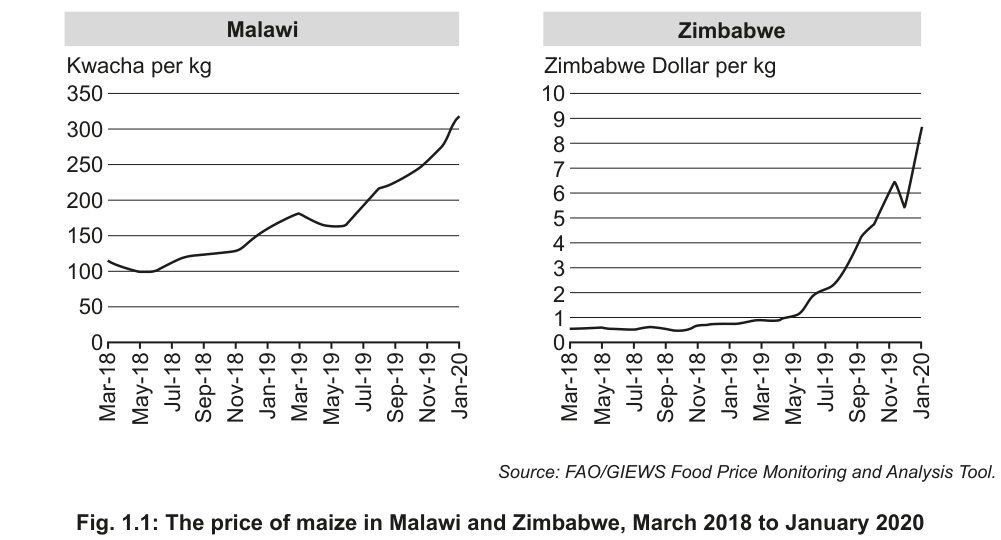
Fig. 1.1: The price of maize in Malawi and Zimbabwe, March 2018 to January 2020
Source: FAO/GIEWS Food Price Monitoring and Analysis Tool.
Table 1.1: Maize production in Malawi and Zimbabwe
| 2015–2019 average (000 tonnes) | 2019 (000 tonnes) | 2020 forecast (000 tonnes) | Change 2019–2020 % | |
|---|---|---|---|---|
| Malawi | 2959 | 3392 | 3600 | 6.1 |
| Zimbabwe | 1313 | 1701 | 777 | -54.3 |
Source: Adapted from Food and Agriculture Organisation of the UN. Country Briefs: Malawi and Zimbabwe 01/06/20
Extract 1: World export prices of maize fall sharply
Export prices of maize declined further in April 2020, with the United States (US) maize price nearly 10% down from April 2019. It is now at the lowest value in more than ten years. Large global supplies and good harvest prospects in South America continue to reduce prices. In addition, lower demand for maize from the biofuel and animal feed industries is depressing the price further.
Source: Food and Agriculture Organization of the United Nations 12/05/2020
Extract 2: Zimbabwe takes steps to curb the rise in maize prices
Despite a falling world price for maize, the price of this staple food in Zimbabwe has continued to increase and is now at an exceptionally high level. The increased price mostly results from continued weakness in Zimbabwe’s currency that has damaged the country’s ability to import maize. In addition, the sharply reduced harvest of maize in Zimbabwe resulted in low domestic supplies. In an effort to tackle the soaring prices, the government has implemented several policies. To increase market supplies, the government removed a ban on imports of certain types of maize. It also increased producer subsidies on maize by 40%. Poorer households should benefit from access to this subsidised maize.
Source: Food and Agriculture Organization of the United Nations 17/02/2020
Extract 3: Malawi raises guaranteed minimum price for maize
Malawi’s Ministry of Agriculture has released updated guaranteed prices for cereals produced on Malawi’s farms in 2020. These are the minimum prices that farmers will receive for their crops. The guaranteed price for the food staple, maize, was raised by just over 10%. The government has begun purchasing maize at this increased price. This change in the minimum price is expected to increase the production of maize in 2020 and in the future to an average level of 3.7 million tonnes per year.
Source: Food and Agriculture Organization of the United Nations 10/04/2020
Identify one possible cause of the decline in world export prices of maize.
Explain one change in a factor of demand that would lead to maize prices rising in Malawi despite the increase in domestic production.
With reference to Extract 2 explain two reasons why maize prices are rising in Zimbabwe despite the fall in the world export price of maize.
Explain, with the help of a diagram, how a rise in the minimum price of maize in Malawi will encourage production.
Consider, with the help of a diagram, whether a subsidy on maize production will benefit both the producers of maize and poorer households in Zimbabwe equally.
Discuss whether maximum prices on staple foods such as maize are likely to be effective in providing food for poorer households in Zimbabwe.
The rest of this paper
3 more questions- Q2(Legacy) - Money · Monetary Policy · Price Stability20M
- Q3Production Possibility Curves · Supply-Side Policy20M
- Q4Exchange Rates · International Trade and Comparative Advantage20M