Economics 9708/23 — May/June 2022
Cambridge AS Level · AS Level Data Response and Essays · worked solutions for every part, with the mark scheme
Topics International Trade and Comparative Advantage · Demand and Supply · Price Elasticity of Supply · Production Possibility Curves · Market Equilibrium and the Price Mechanism · (Legacy) - Externalities and Cost-Benefit Analysis · +5 more
The changing market for avocados
The global consumption of avocados has increased in the last few years, particularly in the United States (US) but also in China and parts of Europe. This growth is largely due to the increasing popularity of 'guacamole' (smashed avocado) and the health benefits claimed for its regular consumption. The US is the largest importer of avocados with supplies coming mainly from Central and South American producers as shown in Fig. 1.1.
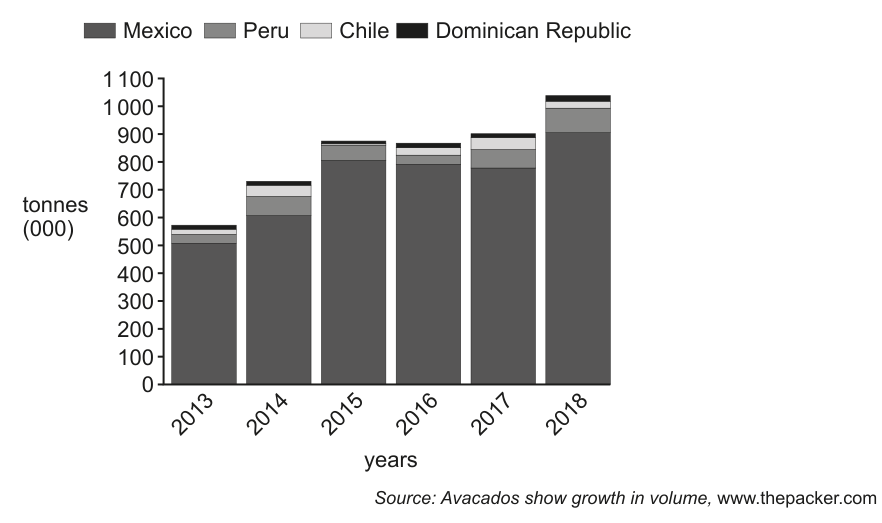
Fig. 1.1: US Avocado imports by country, 2010 to 2018
The supply of avocados is unpredictable. It is estimated that to produce one kilogram of avocado requires 2000 litres of water. Consequently, production is highly susceptible to drought conditions such as those that affected Central American growers in 2018. When this happens, the price of avocados increases as shown in Fig. 1.2.
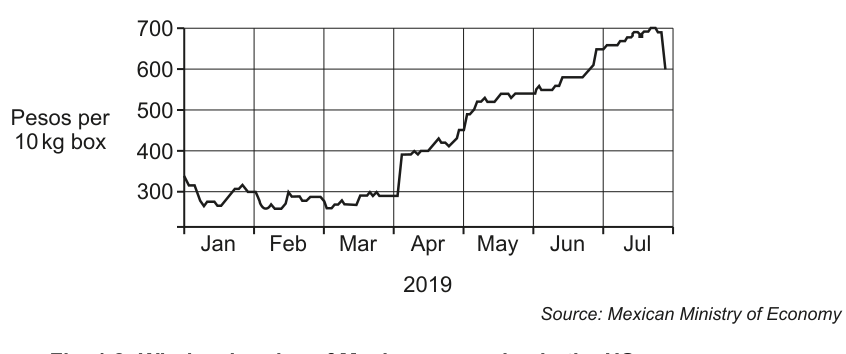
Fig. 1.2: Wholesale price of Mexican avocados in the US, January to July 2019 (pesos per 10kg box)
A shortage in supply provides an opportunity for new producers to enter the global market. Kenya, for example, has expanded its productive capacity and signed an agreement to supply the Chinese market. Even some New Zealand farmers switched from dairy to avocado production.
The global market for avocados is expected to continue to grow over the next few years. Rising prices will continue to increase production. It should be recognised, however, that there are increasing objections to higher production. In Mexico, for example, farmers have cleared forests to cultivate more avocados. This has put a strain on water supplies and raised concerns about the effects of the farmers' actions on climate change. These concerns have led one market research report to conclude that 'the price mechanism is not working to allocate resources successfully.'
Source: Global avocado market, Mordor Intelligence, Avocado market trends 2020, Inspira Farms
Describe the change in the level and source countries of the US's imports of avocados from 2013 to 2018.
Calculate the percentage change in the wholesale price of Mexican avocados between April 2019 and the end of July 2019.
Explain one possible demand reason and one possible supply reason for this change in price.
Using the information provided, consider whether the supply of avocados is price elastic or price inelastic in the short run and in the long run.
Explain, with the help of a production possibility curve diagram, the opportunity cost to a New Zealand farmer of converting from dairy to avocado production.
Discuss whether the price mechanism in the avocado market is working to allocate resources successfully.
The rest of this paper
3 more questions- Q2Classification of Goods and Services20M
- Q3Price Stability · Monetary Policy · Fiscal Policy20M
- Q4Balance of Payments20M