Economics 9708/23 — May/June 2021
Cambridge AS Level · AS Level Data Response and Essays · worked solutions for every part, with the mark scheme
Topics Elasticities of Demand · Methods of Government Intervention in Markets · Demand and Supply · Scarcity, Choice and Opportunity Cost · Classification of Goods and Services · Market Equilibrium and the Price Mechanism · +4 more
Luxembourg’s answer to resource misallocation in the transport market
Congestion is unfortunately a very familiar feature of most road transport networks. It occurs when there is too much traffic relative to road capacity or more simply, when demand exceeds supply. Congestion means longer journey times and wasted fuel, which adversely affects car drivers and bus passengers. Roads are scarce resources, but usually there is no price for using them. This represents a misallocation of resources.
Fig. 1.1 shows the changes in passenger journeys by public transport in Great Britain (GB) since 1997/98. The government has tried various policies to encourage more use of bus transport in the capital city, London, as well as in the rest of GB. These policies include privatisation along with increased bus subsidies and higher taxes on car users. All have failed to improve the allocation of resources and the cost of all travel continues to rise at a faster rate than the cost of living (See Fig. 1.2). The price of using cars has risen by less than other forms of transport since 2010 and some experts have suggested that a minimum price for fuel should be introduced.
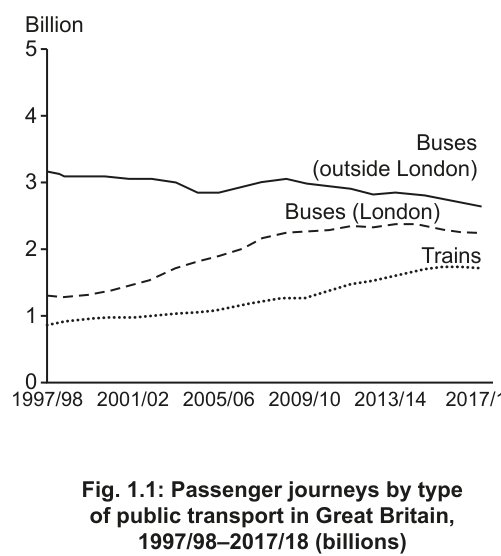
Fig. 1.1: Passenger journeys by type of public transport in Great Britain, 1997/98–2017/18 (billions)
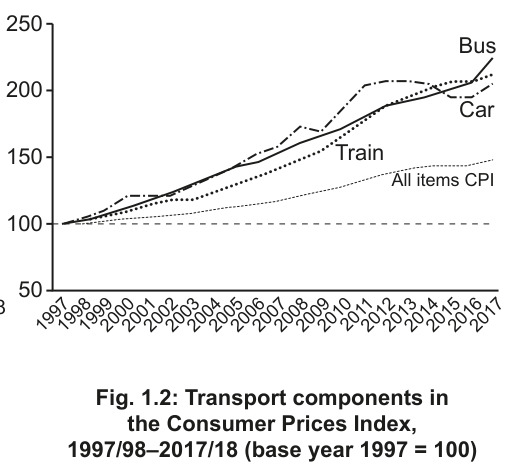
Fig. 1.2: Transport components in the Consumer Prices Index, 1997/98–2017/18 (base year 1997 = 100)
It is therefore interesting to see what Luxembourg, a relatively small European country, plans to do about its transport problems. From March 2020, the Luxembourg government has decided that all prices for public transport use (including buses and trains) will be removed, making travel by public transport free to consumers. The cost to its government is forecast to be almost US$1 billion per year.
Luxembourg’s radical policy is one that should be given serious consideration in Great Britain and in other countries that face similar resource misallocation in their transport markets.
Source: Transport Statistics for Great Britain, 2018
Use the information in Fig. 1.1 to describe the changes in the number of journeys by bus in Great Britain from 1997/98 to 2017/18.
Using the information in Fig. 1.2, explain one of the changes you have identified.
Explain how opportunity cost can be applied to the Great British government’s decision to subsidise public transport.
Explain whether public transport in Luxembourg has become a free good as a result of all prices being removed.
Discuss whether a minimum price for fuel would be effective in reducing the congestion caused by the demand for roads exceeding supply.
Discuss whether making public transport free to consumers is the best way to allocate resources in public transport markets.
The rest of this paper
3 more questions- Q2Elasticities of Demand · Methods of Government Intervention in Markets · Price Elasticity of Supply20M
- Q3Aggregate Demand and Aggregate Supply20M
- Q4(Legacy) - Economic Integration · International Trade and Comparative Advantage20M