Economics 9708/21 — May/June 2021
Cambridge AS Level · AS Level Data Response and Essays · worked solutions for every part, with the mark scheme
Topics Balance of Payments · Demand and Supply · International Trade and Comparative Advantage · Aggregate Demand and Aggregate Supply · Classification of Goods and Services · Methods of Government Intervention in Markets · +6 more
Vietnam’s exports of fruit and vegetables to exceed US$4 billion
The value of Vietnam’s fruit and vegetable exports reached US$1.3 billion in the first four months of 2018, a year-on-year increase of 30%, according to the Vietnam Ministry of Agriculture. With a high export growth rate in the past four years, the sector is expected to exceed the export target of US$4 billion set for 2018.
A government spokesperson stated that because world trade in fruit and vegetables is worth US$230 billion a year, with an annual growth rate of 3% to 5%, there is more scope for Vietnam to increase its fruit and vegetable exports. The spokesperson said that Vietnam must use more land to grow crops to export and build additional modern food processing facilities to take advantage of these opportunities.
The increase in the export of fruit and vegetables will add to Vietnam’s current account balance. Fig. 1.1 below shows the balance of the current account of the balance of payments for Vietnam from Q1 2016 to Q2 2018.
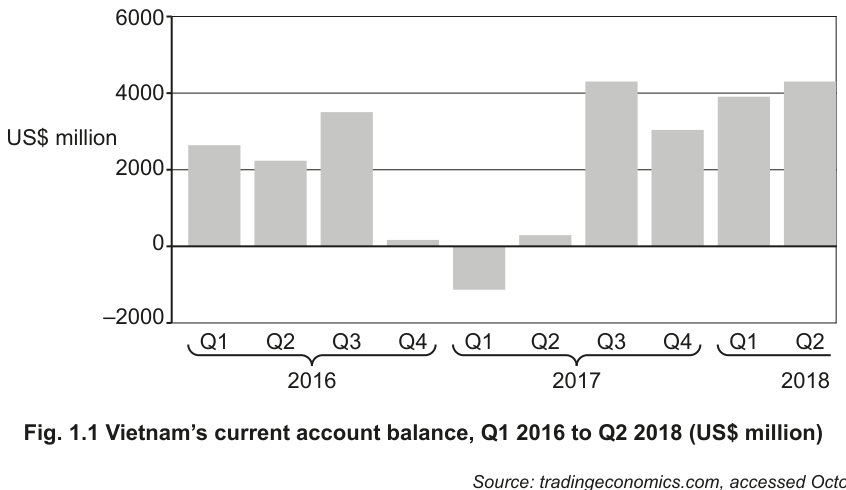
Fig. 1.1 Vietnam’s current account balance, Q1 2016 to Q2 2018 (US$ million)
Source: tradingeconomics.com, accessed October 2019
Despite its impressive results in exporting fruit and vegetables, Vietnam faces possible risks because it relies very heavily on China, its biggest fruit and vegetable importer. China accounted for 77% of Vietnam’s exports of fruit and vegetables in the first four months of 2018 while the United States, its second biggest importer, accounted for just 2.8% and Japan, its third biggest importer, accounted for 2.7%. Some analysts believe that Vietnam’s agricultural sector in general, and fruit and vegetable producers in particular, should explore other potential countries for their exports.
According to the Vietnam Fruit and Vegetable Association, fruit and vegetable exporters face additional costs in complying with administrative burdens on trade, such as strict hygiene and food safety regulations. Vietnam’s producers need to ensure that product quality is as high as possible and production costs as low as possible if they are to succeed.
Source: adapted from Vietnam News, 7 May 2018
Describe the overall trend in Vietnam’s current account balance between Q1 2017 and Q2 2018.
Calculate the value of Vietnam’s exports of fruit and vegetables to China in the first four months of 2018.
Explain one possible demand factor and one possible supply factor that could have caused the increase in Vietnam’s export sales of fruit and vegetables.
Explain how complying with administrative burdens on trade will affect Vietnam’s supply of fruit and vegetables for export.
Discuss whether the risks of Vietnam relying very heavily on the Chinese market for the export of its fruit and vegetables are greater than the potential benefits.
Using aggregate demand and aggregate supply analysis, discuss the possible impact on Vietnam’s economy of a sustained increase in its net exports.
The rest of this paper
3 more questions- Q2Classification of Goods and Services · Methods of Government Intervention in Markets · Market Equilibrium and the Price Mechanism20M
- Q3Consumer and Producer Surplus · Elasticities of Demand20M
- Q4Exchange Rates · Monetary Policy · Price Stability20M