Economics 9708/22 — October/November 2020
Cambridge AS Level · AS Level Data Response and Essays · worked solutions for every part, with the mark scheme
Topics International Trade and Comparative Advantage · Demand and Supply · Elasticities of Demand · Price Elasticity of Supply · Balance of Payments · Consumer and Producer Surplus · +5 more
Ice cream producers struggle with record vanilla prices
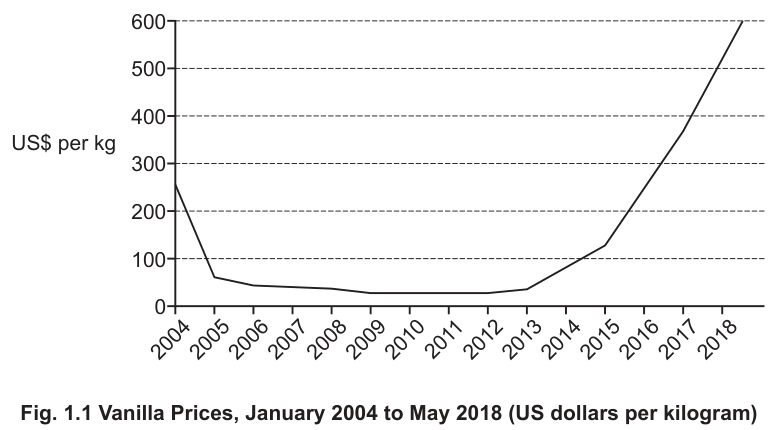
Fig. 1.1 Vanilla Prices, January 2004 to May 2018 (US dollars per kilogram)
The price of natural vanilla hit a record high of US$600 per kilogram in May 2018, making it even more expensive than silver. As a result, many ice cream producers are considering whether they should raise their prices or perhaps stop selling the vanilla flavour of ice cream. The price of natural vanilla has been rising sharply since March 2017 when a cyclone hit Madagascar, which accounts for 75% of global production. Natural vanilla represents 20% of Madagascan exports, worth around US$600 million at current prices.
Natural vanilla comes from the vanilla orchid, which produces vanilla beans. Madagascar has the perfect climate and soil for growing vanilla, but poor harvests have reduced the country’s vanilla production by more than 20%, leading to a worldwide supply shortage. It takes three years for the plant to start producing. So if there is a sharp rise in price, people plant more, but then it takes three years for the new supplies to reach the market.
Vanillin is a synthetic substitute to natural vanilla that can be used in the production of ice cream. It is made from more reliable sources of plentiful raw materials, such as wood pulp and petroleum and it has been falling in price. For many years, some of the world’s largest producers of ice cream replaced natural vanilla with vanillin. A consequence of this falling demand for natural vanilla was that Madagascar’s farmers earned very low returns and many ceased growing natural vanilla. Surprisingly, despite there being fewer growers, the price of natural vanilla stayed low between 2005 and 2012.
However, from 2012, concerns about possible health risks arising from the use of vanillin caused some producers to use more natural vanilla in their ice cream production process. For example, in 2015, one of the world’s largest ice cream producers announced plans to end their use of vanillin and use only natural ingredients by 2020. In recent years, however, the sharply rising price of natural vanilla has persuaded some ice cream makers to consider turning back to vanillin. As a result, some of the leading producers of ice cream have more than a year’s stock of vanillin.
Source: Hong Kong Economic Journal, 9 May 2018
With reference to the extract and Fig. 1.1, use supply and demand diagrams to explain the change in the price of natural vanilla
from 2004 to 2009
from 2015 to 2018.
Ice cream producers can use natural vanilla or vanillin to produce ice cream.
State the concept that an economist would use to measure the responsiveness of the demand for natural vanilla to a change in the price of vanillin.
Explain the value that you would expect for this measurement.
Explain why the price elasticity of supply of ice cream made with vanillin is likely to be relatively more elastic than the price elasticity of supply of ice cream made with natural vanilla.
Discuss whether the recent rise in the price of vanilla is on balance likely to have a positive or negative impact upon Madagascar’s economy.
The rest of this paper
3 more questions- Q2Consumer and Producer Surplus · Methods of Government Intervention in Markets · Fiscal Policy20M
- Q3Factors of Production · Aggregate Demand and Aggregate Supply · Monetary Policy20M
- Q4International Trade and Comparative Advantage20M