Economics 9708/21 — October/November 2020
Cambridge AS Level · AS Level Data Response and Essays · worked solutions for every part, with the mark scheme
Topics Elasticities of Demand · Factors of Production · (Legacy) - Economic Integration · Exchange Rates · Fiscal Policy · Price Stability · +7 more
Latvia becomes a banking capital between the European Union’s (EU’s) east and west
Latvia regards itself as a financial bridge between Europe’s east and west. Since the Soviet Union’s collapse in 1991, Latvia (population 2.2 million) joined the EU (population 510 million) in 2004. It has since built itself into a banking centre for people from all parts of Europe and many other parts of the world, although its reputation as a financial centre has been growing since 1988 when two entrepreneurs founded a private bank, Parex Bank, in the capital, Riga.
In the early years of the 21st century, favourable credit conditions in Latvia contributed to an economic boom, but in the global financial crisis of 2007–2008 Parex Bank, by then Latvia’s second biggest bank, needed government assistance and was nationalised.
The financial crisis caused Latvia’s annual inflation rate to rise rapidly to 17.7% in May 2008, which was significantly higher than its average annual inflation rate of 3.7% for the period 1998–2018.
In 2008, the Latvian government decided to substantially reduce the size of the budget deficit, in an attempt to reduce the relatively high rate of inflation, through a series of fiscal measures such as increasing taxation and reducing public spending.
Latvia emerged from the global financial crisis to become the EU’s fastest-growing economy. The intention was that Latvia would eventually join the EU’s common currency (the euro). Fig. 1.1 below shows the exchange rate of Latvian Lats (the country’s former currency) per euro from 2007 to 2013.
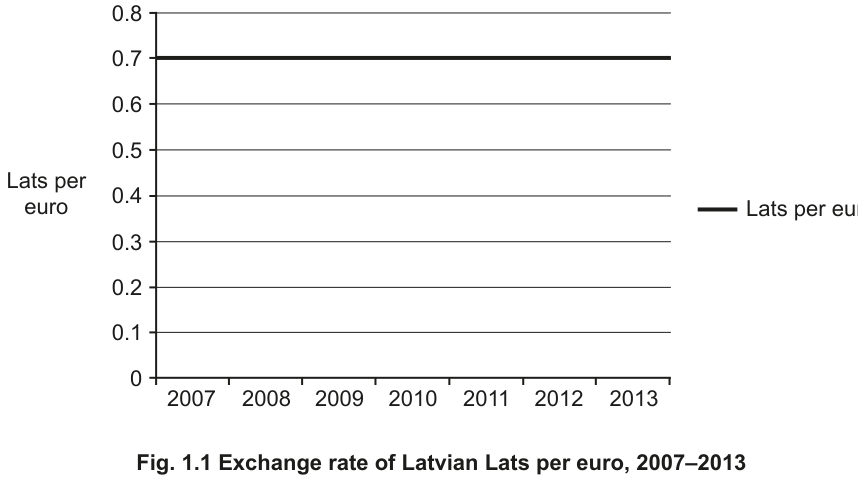
Fig. 1.1 Exchange rate of Latvian Lats per euro, 2007–2013
In January 2014, Latvia did join the euro and this was welcomed by business leaders and economists in Latvia, stating that it would improve Latvia’s credit rating and attract foreign investors. The governor of Latvia’s central bank said: “The euro brings stability and certainty, definitely attracting investment.”
However, not everybody in Latvia supported the introduction of the euro. Many people thought that Latvia would lose a certain amount of economic independence and that it would lead to an increase in prices and taxes.
Sources: Adapted from The Financial Times 20 February 2018
Latvijas Banka, accessed October 2018
Describe the functions of an entrepreneur in the production process.
Answer
- Organising and coordinating the other factors of production (land, labour and capital) to carry out the production process.
- Taking risks associated with production, such as the risk of business failure or losses from unsuccessful product launches.
The two functions are: (1) organising/coordinating the factors of production, and (2) taking risks in the production process.
Background Concept
The entrepreneur is one of the four factors of production, alongside land, labour and capital. Unlike the other factors, the entrepreneur is not just a passive input but an active organiser who drives the production process. Their role is distinct because they bear the ultimate responsibility for the success or failure of the business, rather than receiving a fixed reward for their input.
Understanding the Question
This 2-mark question asks you to describe the two core functions of an entrepreneur in the production process. It is a straightforward recall question, with no application to the Latvia extract required. The mark scheme awards one mark for each of the two required functions, so you must state both clearly to gain full marks.
Approach
Recall the standard definition of the entrepreneur's role from the factors of production topic. The two functions that examiners consistently look for are: (1) the organisational/coordination role of bringing together and managing the other factors of production, and (2) the risk-bearing role of accepting the uncertainty of business outcomes. State each clearly in a separate point.
Step-by-Step Reasoning
First, the entrepreneur is responsible for deciding what to produce, how to produce it, and how to organise the other factors (hiring workers, acquiring capital, sourcing land/raw materials) to turn inputs into output. This is the organisational function, which earns the first mark. Second, the entrepreneur bears the risk of the business: if the firm makes losses, the entrepreneur is the one who suffers (e.g. through reduced profits, bankruptcy), unlike workers who receive a fixed wage or landowners who receive fixed rent. This risk-taking function earns the second mark. No application to the Latvia case is needed here, as the question is a general definition.
Key Takeaways
The entrepreneur is the only factor of production that bears residual risk and is responsible for the coordination of all other production inputs. These two functions are the defining features of the entrepreneur in economic theory.
Common Mistakes
Only stating one of the two functions will limit you to 1 mark. Some candidates incorrectly describe the entrepreneur as just a "business owner" without linking to the specific economic functions of organising factors and bearing risk, which may not earn full credit.
Things to Be Careful About
Make sure each function is clearly stated as a separate point, as the mark scheme awards one mark per distinct function. Avoid vague descriptions like "runs the business" without linking to the specific economic roles of coordination and risk-bearing.
When Latvia joined the EU it became part of a customs union.
How does a customs union differ from a free trade area?
Answer
A customs union is an agreement between two or more countries to remove trade barriers and eliminate customs duties on trade between member countries, and to adopt a common external tariff on imports from non-member countries. A free trade area is an agreement between two or more countries to remove trade barriers and eliminate customs duties on trade between member countries, but member countries retain the right to set their own individual tariffs on imports from non-member countries. The key difference is that a customs union has a common external tariff, while a free trade area does not.
A customs union has a common external tariff on imports from non-member countries, while a free trade area allows member countries to set their own individual external tariffs.
Background Concept
Trade blocs are agreements between countries to reduce or eliminate trade barriers between themselves, to increase trade and economic integration. The two most basic types of trade bloc are free trade areas and customs unions, which differ in their approach to trade with non-member countries.
Understanding the Question
This 2-mark question asks you to explain the difference between a customs union and a free trade area, in the context of Latvia joining the EU (which is a customs union). You need to clearly define both terms and highlight the key difference between them to gain both marks. The mark scheme awards one mark for a clear explanation of each, with the common external tariff being the critical distinguishing feature.
Approach
First, define a customs union, noting both the removal of internal trade barriers and the common external tariff. Then define a free trade area, noting the removal of internal trade barriers but the absence of a common external tariff. Explicitly state the difference between the two to make the contrast clear.
Step-by-Step Reasoning
A customs union requires member countries to eliminate tariffs and other trade barriers on goods traded between themselves, and to agree on a single, common tariff rate that applies to all imports coming from countries outside the customs union. For example, the EU is a customs union, so all EU member states charge the same import tariffs on goods from non-EU countries like the US or China. A free trade area also requires member countries to eliminate tariffs and trade barriers on trade between themselves, but each member country retains the right to set its own separate tariff rates on imports from non-member countries. For example, the North American Free Trade Agreement (NAFTA, now USMCA) is a free trade area, so the US, Canada and Mexico can set different tariffs on imports from non-member countries. The key difference is therefore the presence of a common external tariff in a customs union, and its absence in a free trade area.
Key Takeaways
The defining feature that separates a customs union from a free trade area is the common external tariff. All deeper forms of economic integration (customs union, common market, economic union) build on the free trade area by adding further layers of coordination, including the common external tariff.
Common Mistakes
Only defining one of the two terms will limit you to 1 mark. Failing to explicitly state the difference (e.g. just defining both separately without contrasting them) may also mean you do not make the distinction clear enough to earn both marks, as the mark scheme requires the difference to be made explicit.
Things to Be Careful About
Use linking words like "whereas" or "however" to make the contrast between the two clear, as the mark scheme explicitly notes this is required to gain both marks. Avoid confusing the two terms, or adding irrelevant details about monetary unions or other deeper integration forms that are not asked for.
As a result of the global financial crisis in 2007–2008 there was a large capital outflow from Latvia.
Use a supply and demand diagram to explain how the exchange rate against the euro was maintained as shown in Fig. 1.1.
Answer
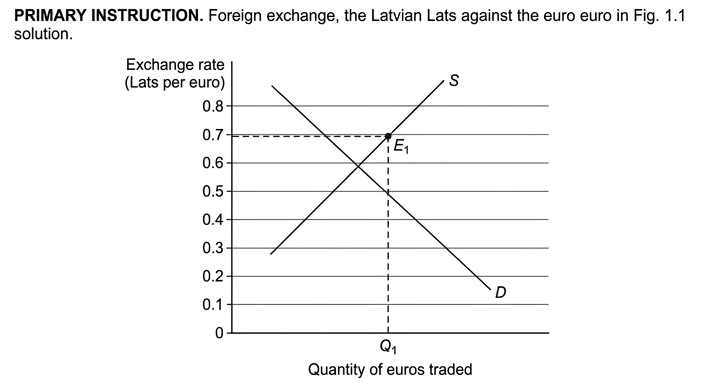
Diagram explanation
The diagram shows the market for the Latvian Lats against the euro. The vertical axis is the exchange rate (Lats per euro), and the horizontal axis is the quantity of euros traded. The demand for euros (D) and supply of euros (S) intersect at equilibrium E1, with an exchange rate of 0.7 Lats per euro, as shown in Fig. 1.1.
Explanation
The global financial crisis caused a large capital outflow from Latvia, as investors and residents moved money out of the country to safer assets. This meant people sold Lats to buy euros, increasing the supply of Lats in the foreign exchange market. This would normally cause the Lats to depreciate (the exchange rate would rise above 0.7 Lats per euro, as more Lats are needed to buy one euro). To maintain the fixed exchange rate at 0.7 Lats per euro, the Latvian central bank intervened in the foreign exchange market by selling euros from its foreign exchange reserves and buying Lats. This increased demand for Lats, offsetting the excess supply from the capital outflow, and kept the exchange rate at the fixed 0.7 level throughout 2007–2013.
The Latvian central bank maintained the fixed exchange rate by selling euros from its foreign exchange reserves and buying Lats to offset the excess supply of Lats caused by the capital outflow, keeping the rate at 0.7 Lats per euro.
Background Concept
An exchange rate is the price of one currency expressed in terms of another. In a fixed exchange rate system, the government or central bank sets the value of the domestic currency against another currency (or a basket of currencies) and intervenes in the foreign exchange market to maintain that rate. Capital outflows (when residents or investors move money out of a country) increase the supply of the domestic currency in the foreign exchange market, putting downward pressure on its value (depreciation). To maintain a fixed rate, the central bank must buy the excess supply of domestic currency using its foreign exchange reserves.
Understanding the Question
This 4-mark question asks you to use a supply and demand diagram to explain how Latvia maintained its fixed exchange rate of 0.7 Lats per euro against the euro during 2007–2013, despite a large capital outflow during the global financial crisis. You need to draw a correct foreign exchange market diagram showing the fixed equilibrium rate, and explain the central bank's intervention policy to maintain that rate. The mark scheme awards 2 marks for the diagram and 2 marks for the explanation of intervention.
Approach
First, draw a standard foreign exchange market diagram for the Lats per euro, with the equilibrium exchange rate marked at 0.7, as shown in Fig. 1.1. Then, explain that the capital outflow increased the supply of Lats, which would have caused depreciation, and that the central bank intervened by selling euros (using foreign reserves) to buy the excess Lats, keeping the rate fixed.
Step-by-Step Reasoning
- The foreign exchange market for the Lats works like any other market: the price (exchange rate, Lats per euro) is determined by the demand for and supply of Lats (or equivalently, demand for and supply of euros).
- A capital outflow from Latvia means that Latvian residents and investors are converting Lats into euros to move money abroad. This increases the supply of Lats in the foreign exchange market, as more people are willing to sell Lats at any given exchange rate. This would shift the supply curve of Lats to the right, leading to a lower value of the Lats (higher Lats per euro, i.e. depreciation) if the rate was floating.
- However, Fig. 1.1 shows the exchange rate remained fixed at 0.7 Lats per euro throughout 2007–2013, meaning Latvia operated a fixed (or pegged) exchange rate regime against the euro.
- To maintain this fixed rate, the Latvian central bank intervened in the foreign exchange market by selling euros from its foreign exchange reserves and buying the excess Lats. This increased the demand for Lats, offsetting the rightward shift in supply, and kept the equilibrium exchange rate at 0.7 Lats per euro.
- The diagram should show the demand for euros (D) and supply of euros (S) intersecting at the equilibrium exchange rate of 0.7 Lats per euro, with the equilibrium quantity marked. You do not need to show the shift in supply, as the question asks you to explain how the rate was maintained, not the effect of the capital outflow.
Key Takeaways
In a fixed exchange rate system, the central bank must be willing to buy or sell its domestic currency using foreign reserves to maintain the pegged rate, even when market pressures (like capital outflows) would otherwise move the rate. The sustainability of a fixed rate depends on the size of the central bank's foreign reserves relative to the pressure on the currency.
Common Mistakes
Drawing a demand and supply diagram for a normal goods market instead of a foreign exchange market, or failing to label the equilibrium exchange rate as 0.7 Lats per euro, will lose diagram marks. Forgetting to mention the use of foreign exchange reserves or the specific intervention action (selling euros, buying Lats) will lose explanation marks. Some candidates incorrectly explain that the government raised interest rates to attract capital inflows, which is not the intervention method described in the mark scheme for this question.
Things to Be Careful About
Label all axes and curves clearly in the diagram: the vertical axis must be the exchange rate (Lats per euro), and the equilibrium point must be marked at 0.7. Make sure your explanation explicitly links the capital outflow to the exchange rate pressure, and the central bank's action to maintaining the fixed rate. Do not confuse Lats per euro (the price of euros in Lats) with euros per Lats, as this would reverse the direction of the exchange rate change.
Explain what is meant by a ‘budget deficit’.
Answer
A government budget is a statement of the government's expected (or actual) expenditure and revenue over a financial year. A budget deficit occurs when the government's total expenditure exceeds its total revenue in a given period.
A budget deficit is the amount by which a government's total expenditure exceeds its total revenue in a given period.
Background Concept
The government budget is a key tool of fiscal policy, setting out how the government will raise revenue (mainly through taxation) and how it will spend that revenue (on public services, infrastructure, welfare, etc.) over a specific period, usually a year. The balance between revenue and expenditure determines whether the government runs a budget deficit, surplus, or balanced budget.
Understanding the Question
This 2-mark question asks you to explain the meaning of a budget deficit. It is a straightforward definition question, with no application to the Latvia extract required beyond referencing the context of government spending and taxation. The mark scheme awards one mark for explaining what a government budget is, and one mark for defining a budget deficit as expenditure exceeding revenue.
Approach
First, briefly define the government budget as a record of government expenditure and revenue. Then define a budget deficit as the shortfall that occurs when expenditure is higher than revenue. Keep the answer concise, as it is only worth 2 marks.
Step-by-Step Reasoning
The government budget sets out all of the government's planned sources of income (revenue) and planned spending (expenditure) for a financial year. Revenue comes mainly from taxes (direct taxes like income tax, indirect taxes like VAT), as well as other sources like fees and state-owned enterprise profits. Expenditure includes spending on public services (health, education), welfare benefits, infrastructure, debt interest, and other government activities. If, in a given year, the government's total expenditure is higher than its total revenue, the difference is called a budget deficit. For example, if a government raises $100 billion in revenue but spends $120 billion, it runs a $20 billion budget deficit. In the Latvia extract, the government introduced fiscal measures (higher taxes, lower spending) to reduce the budget deficit, meaning it wanted to bring expenditure and revenue closer together to eliminate the shortfall.
Key Takeaways
A budget deficit is a flow concept (measured over a period of time, usually a year), as opposed to the national debt, which is a stock concept (the total accumulated debt from past deficits). A budget deficit requires the government to borrow money to cover the shortfall, which increases the national debt over time.
Common Mistakes
Confusing a budget deficit with the national debt (the total accumulated borrowing) is a common error. Some candidates define a budget deficit as the total amount the government owes, which is incorrect: the deficit is the annual shortfall, while the debt is the total of all past deficits minus any surpluses.
Things to Be Careful About
Make sure you clearly state that a deficit occurs when expenditure is higher than revenue, not the other way around (that would be a budget surplus). Keep the answer concise, as it is only worth 2 marks, so there is no need to discuss causes or consequences of deficits unless asked.
Analyse, using a diagram, how fiscal measures to reduce the budget deficit could be used by the Latvian government to lower the relatively high rate of inflation.
Answer
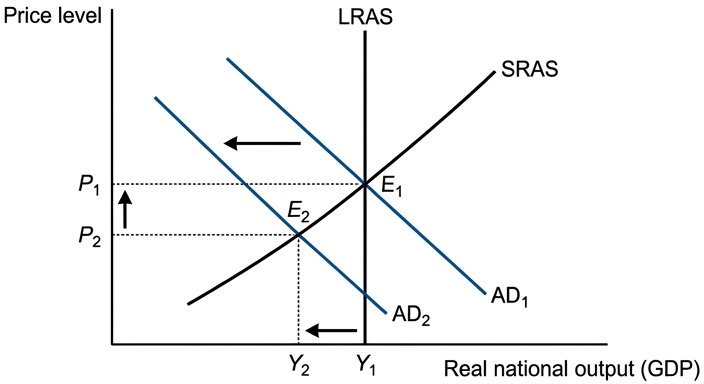
Diagram explanation
The diagram is an AD/AS model. The vertical axis is the price level, the horizontal axis is real national output (GDP). The short-run aggregate supply curve (SRAS) is upward sloping, and the long-run aggregate supply curve (LRAS) is vertical at the potential output level. The initial aggregate demand curve is AD1, intersecting SRAS at equilibrium E1, with price level P1 and output Y1.
Analysis
To reduce the budget deficit, the Latvian government can use contractionary fiscal policy: either reduce government expenditure (G) or increase taxation (direct taxes like income tax, or indirect taxes like VAT). Both measures reduce the total amount of spending in the economy: lower G directly reduces aggregate demand, while higher taxes reduce households' disposable income, lowering consumption (C), which also reduces aggregate demand. This causes the AD curve to shift left from AD1 to AD2. The new equilibrium E2 is at a lower price level P2 and lower output Y2. Since the high inflation in Latvia in 2008 was demand-pull inflation (driven by the earlier economic boom and high aggregate demand), this reduction in aggregate demand will reduce inflationary pressure and lower the rate of inflation. In the long run, if the economy was at full employment, the lower price level will bring output back to potential, but in the short run, output falls slightly as inflation is reduced.
Contractionary fiscal policy (higher taxes, lower government spending) reduces aggregate demand, shifting the AD curve left and lowering the price level, reducing demand-pull inflation.
Background Concept
Contractionary fiscal policy is a macroeconomic policy where the government reduces its spending or increases taxation to reduce aggregate demand in the economy. It is used to reduce inflationary pressures when the economy is overheating (growing too fast, with demand outstripping supply). The AD/AS model shows that a leftward shift in the aggregate demand (AD) curve reduces the price level and real output in the short run. Inflation is a sustained increase in the general price level, and demand-pull inflation occurs when aggregate demand grows faster than aggregate supply, pushing up prices.
Understanding the Question
This 4-mark question asks you to analyse, using a diagram, how fiscal measures to reduce the budget deficit could lower Latvia's high inflation rate. The extract states that Latvia had high inflation (17.7% in May 2008) driven by an earlier economic boom, so this is demand-pull inflation. You need to explain how contractionary fiscal policy (used to reduce the deficit) reduces aggregate demand and lowers the price level, and include a correct AD/AS diagram. The mark scheme awards 2 marks for the analysis of the policy impact, and 2 marks for the diagram.
Approach
First, explain that reducing the budget deficit requires contractionary fiscal policy: either cutting government spending or raising taxes. Then explain how these measures reduce aggregate demand, using the AD/AS model to show the leftward shift in AD and the fall in the price level. Link this to the reduction in demand-pull inflation, which is the type of inflation Latvia was experiencing.
Step-by-Step Reasoning
- A budget deficit occurs when government spending exceeds tax revenue. To reduce the deficit, the government must either cut its spending, raise taxes, or a combination of both. Both of these are contractionary fiscal policy measures, as they reduce the total level of spending in the economy.
- Government spending (G) is a component of aggregate demand (AD = C + I + G + (X - M)). A cut in G directly reduces AD. Higher taxes reduce households' disposable income, which lowers consumption (C), another component of AD, also reducing total AD.
- The AD/AS diagram shows the initial equilibrium at the intersection of AD1, SRAS and LRAS, with price level P1 and output Y1 (at or near potential output, since the economy was in a boom before the crisis).
- The reduction in AD shifts the AD curve left to AD2. The new short-run equilibrium is at the intersection of AD2 and SRAS, with a lower price level P2 and lower output Y2.
- Since Latvia's high inflation was demand-pull inflation (caused by excessive aggregate demand during the boom), this reduction in AD reduces the upward pressure on prices, lowering the rate of inflation. In the long run, if the economy returns to potential output (Y1), the price level will fall further to P3, but in the short run, the main effect is a lower price level and reduced inflation.
Key Takeaways
Contractionary fiscal policy reduces aggregate demand, which lowers the price level and reduces demand-pull inflation. The trade-off is lower real output and higher unemployment in the short run, but this is acceptable when the primary policy goal is to reduce high inflation, as was the case in Latvia in 2008.
Common Mistakes
Drawing an AD/AS diagram that shows a shift in SRAS instead of AD will lose diagram marks. Failing to link the fiscal measures to aggregate demand, or to explain how lower AD reduces the price level, will lose analysis marks. Some candidates discuss cost-push inflation, which is not relevant here, as the extract states the inflation was driven by the economic boom (demand-pull).
Things to Be Careful About
Label all curves and axes clearly in the AD/AS diagram: vertical axis is price level, horizontal axis is real output, label AD1, AD2, SRAS, LRAS, and the two equilibrium points E1 and E2, with price levels P1 and P2. Make sure your explanation explicitly links the fiscal measures (higher taxes, lower spending) to lower AD, and lower AD to lower inflation. Do not discuss supply-side effects of tax cuts, as the question is about measures to reduce the budget deficit (which require higher taxes or lower spending, not tax cuts).
Discuss whether it is better for Latvia to specialise in banking services rather than having a more diversified economy.
Answer
Advantages of Latvia specialising in banking services
Specialisation allows Latvia to focus on the sector where it has a comparative advantage, meaning it can produce banking services at a lower opportunity cost than other goods. This would increase total economic output and allow Latvia to trade for other goods and services it needs, raising living standards. Latvia already has an established reputation as a banking centre, so further specialisation would build on existing expertise, infrastructure and skilled labour in the sector, increasing efficiency and competitiveness. Banking services also have low transport costs, especially with online banking, so Latvia can serve clients across the EU and globally without the logistical costs of physical goods trade.
Advantages of a more diversified economy
Over-specialisation carries significant risks: if demand for banking services falls (e.g. due to a global financial crisis, new regulation, or competition from other financial centres), Latvia's entire economy would be severely affected, with high unemployment and falling output. A diversified economy spreads risk across multiple sectors (e.g. manufacturing, agriculture, tourism), so a shock to one sector does not cripple the whole economy. Diversification also reduces reliance on a single foreign sector, making the economy more resilient to external shocks like changes in global financial market conditions.
Conclusion
It is not necessarily better for Latvia to specialise entirely in banking services. While specialisation would bring efficiency gains and higher output in the short run, the risks of over-specialisation in a single volatile sector mean a diversified economy is more stable and resilient in the long run, especially given the history of financial crises affecting the banking sector. A balanced approach, with a strong banking sector alongside other key industries, is likely to be optimal.
A diversified economy is better for Latvia in the long run, as the risks of over-specialisation in the volatile banking sector outweigh the short-run efficiency gains from full specialisation.
Background Concept
Specialisation occurs when an economy focuses its resources on producing a narrow range of goods and services in which it has a comparative advantage (a lower opportunity cost than other economies). This allows for greater efficiency, higher output, and gains from trade, as the economy can exchange its specialised goods for other products it needs. However, over-specialisation carries risks: if demand for the specialised good falls, or if the sector is hit by a shock, the entire economy suffers, as it has no alternative industries to fall back on. Economic diversification means spreading production across a wide range of sectors, reducing reliance on any single industry and spreading risk.
Understanding the Question
This 6-mark evaluative question asks you to discuss whether it is better for Latvia to specialise entirely in banking services, or to have a more diversified economy. You need to present arguments for both sides, and reach a justified conclusion to gain full marks. The mark scheme awards up to 3 marks for advantages of specialisation, up to 3 marks for advantages of diversification, and 1 reserved mark for a justified conclusion, so you must cover both sides and end with a clear verdict.
Approach
First, outline the advantages of specialisation in banking services, using the theory of comparative advantage and the specific context of Latvia's existing banking sector. Then outline the advantages of a diversified economy, focusing on the risks of over-specialisation and the benefits of risk-spreading. Finally, weigh the two sides against each other, considering the volatility of the banking sector and Latvia's history of financial crises, to reach a justified conclusion.
Step-by-Step Reasoning
Case for specialising in banking services
- Comparative advantage: If Latvia has a lower opportunity cost of producing banking services than other goods (e.g. because it has a skilled workforce, established financial infrastructure, and a strategic location between east and west Europe), specialising in banking will allow it to produce more total output than if it spread resources across all sectors. It can then trade its banking services for other goods and services it needs, raising overall living standards beyond what it could achieve self-sufficiently.
- Existing expertise and reputation: Latvia has already built a reputation as a financial centre since 1988, with existing banks, skilled financial workers, and regulatory frameworks in place. Further specialisation would allow it to build on these existing strengths, increasing efficiency and competitiveness in the global financial market.
- Low transport costs: Banking services are intangible and can be delivered online, so they have negligible transport costs compared to physical goods. This means Latvia can serve clients across the EU and globally without the logistical costs of exporting physical products, making the sector even more profitable.
Case for a diversified economy
- Risk of over-specialisation: The banking sector is highly vulnerable to external shocks, as seen in the 2007–2008 global financial crisis, when Latvia's second-largest bank needed government bailouts. If Latvia specialises entirely in banking, a future financial crisis, new EU regulation, or competition from other financial centres would cause a collapse in demand for Latvia's banking services, leading to mass unemployment, falling output, and economic instability.
- Risk-spreading: A diversified economy with sectors including manufacturing, agriculture, tourism, and technology is more resilient to shocks. If the banking sector faces a downturn, other sectors can continue to support economic activity, reducing the risk of deep recessions.
- Reduced external vulnerability: Specialisation in banking makes Latvia heavily reliant on global financial market conditions, which are outside its control. A diversified economy reduces this reliance, making domestic economic performance more stable.
Evaluation and conclusion
The key trade-off is between short-run efficiency gains from specialisation and long-run economic stability from diversification. While specialisation would raise output and living standards in the short run, the high volatility of the banking sector and Latvia's recent experience of financial crisis make over-specialisation very risky. A fully specialised economy would be extremely vulnerable to external shocks, which could wipe out the gains from specialisation. Therefore, a more diversified economy, with a strong but not dominant banking sector, is better for Latvia's long-term economic stability and resilience.
Key Takeaways
Specialisation brings efficiency gains from comparative advantage, but over-specialisation creates vulnerability to sector-specific shocks. The optimal level of specialisation depends on the volatility of the sector and the economy's ability to absorb shocks. For small, open economies like Latvia, diversification is often a more sustainable strategy than full specialisation in a single volatile sector.
Common Mistakes
Writing a one-sided answer that only discusses the advantages of specialisation, or only the advantages of diversification, will lose all evaluation marks, as the mark scheme requires discussion of both sides to gain full marks. Ending with a vague summary of both sides instead of a justified conclusion will lose the reserved 1 mark for the conclusion. Failing to link the arguments to the specific context of Latvia's banking sector and its experience of the financial crisis will make the answer too generic and lose marks.
Things to Be Careful About
Make sure your conclusion is justified, not just a statement of which option is better: explain why the side you choose is stronger, referencing the volatility of the banking sector and the risks of over-specialisation. Use specific context from the extract (e.g. the 2008 nationalisation of Parex Bank, the high inflation during the crisis) to support your points, rather than just giving generic advantages of specialisation/diversification. Ensure you cover at least three distinct points for each side to reach the maximum 3 marks per side.
The rest of this paper
3 more questions- Q2Classification of Goods and Services · Economic Systems · Market Equilibrium and the Price Mechanism20M
- Q3Elasticities of Demand20M
- Q4Methods of Government Intervention in Markets · Elasticities of Demand · Supply-Side Policy · Balance of Payments20M