Economics 9708/22 — May/June 2020
Cambridge AS Level · AS Level Data Response and Essays · worked solutions for every part, with the mark scheme
Topics Methods of Government Intervention in Markets · Exchange Rates · Fiscal Policy · Balance of Payments · Price Stability · Monetary Policy · +6 more
Argentina raises interest rates to 40 per cent
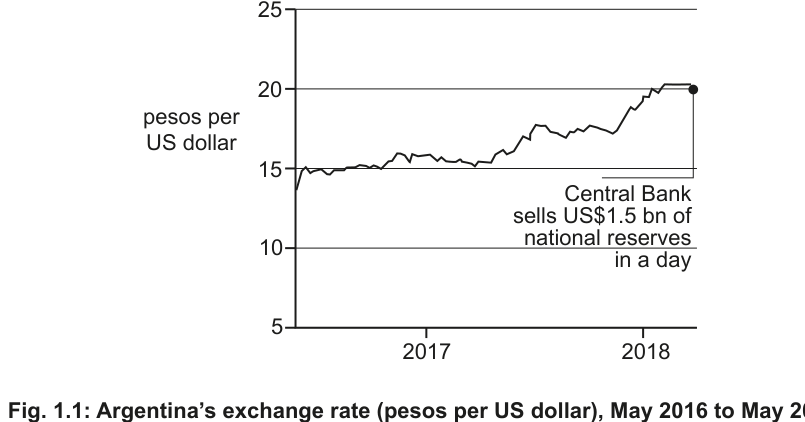
Fig. 1.1: Argentina’s exchange rate (pesos per US dollar), May 2016 to May 2018
Source: BBC/Bloomberg
On 4 May 2018, Argentina’s central bank raised interest rates to 40%. The day before this increase they were raised from 30.25% to 33.25%. A week earlier, they were raised from 27.25%. The rises were aimed at supporting Argentina’s currency, the peso, which lost a quarter of its value over the previous year. Despite these rises, the peso, which before the economic turmoil in Argentina in 2001–2002 was fixed at parity with the US dollar, was trading at about 22 pesos to the US dollar. Risks to the peso had been developing for some time. These included large budget and current account deficits, a heavy government debt burden, persistent high inflation and an overvalued currency.
Inflation, a long-standing problem in Argentina, was 25% in 2017, the highest annual rate in South America except for Venezuela. The central bank has set an annual inflation target of 15% and has stated it will continue to take measures to achieve it.
Argentina’s new president is pursuing a pro-market economic reform programme, seeking to reverse the protectionism and high government spending of previous governments. The president has pledged to reduce government spending drastically. The political opposition wants to stop him from removing subsidies on a range of basic household products, including gas and electricity. Removing the subsidies may bring more inflation in the short term but could help bring it down from its current high level to an annual rate of about 5% by 2020.
International and domestic investors still believe the president has a good plan for Argentina’s economic recovery, but they are not convinced he has enough political support to achieve it.
Source: BBC News, 4 May 2018
State what the upward trend shown in Fig. 1.1 means has happened to the value of the peso between 2016 and 2018.
The central bank of Argentina sold US dollars from its foreign exchange reserves to a value of US$1.5 billion on one day in May 2018.
With the help of a supply and demand diagram, explain what effect you would expect this intervention to have on the value of the Argentine peso.
In the extract it is stated that risks to the peso have been developing for some time and that large budget and current account deficits are some of these risks.
Distinguish between a budget deficit and a current account deficit.
The extract also states that persistent high inflation represents a risk to the peso.
Explain one way in which persistent high inflation represents a risk to the peso.
Use aggregate demand and aggregate supply analysis to explain how the recent interest rate rises might help Argentina to reduce its annual rate of inflation and achieve its target.
Discuss whether the potential advantages outweigh the disadvantages to the Argentine economy if the president is successful in reversing protectionism.
The rest of this paper
3 more questions- Q2Production Possibility Curves · Economic Systems20M
- Q3Price Elasticity of Supply · Methods of Government Intervention in Markets20M
- Q4Classification of Goods and Services · Methods of Government Intervention in Markets20M