Economics 9708/23 — October/November 2018
Cambridge AS Level · AS Level Data Response and Essays · worked solutions for every part, with the mark scheme
Topics Methods of Government Intervention in Markets · Economic Methodology · Demand and Supply · Factors of Production · Protectionism · International Trade and Comparative Advantage · +4 more
The air transport market in India
Over the past 20 years or so, global air transport markets have become more competitive. This is especially the case in the United States (US), the European Union (EU) and, most recently, in Asia. Governments have sought to provide opportunities for new firms, invariably ‘low-cost carriers’ (budget airlines), to open new routes and compete with established airline operators, often in domestic markets.
The situation in India is typical but only to a certain extent. The country has two established airline operators with extensive international as well as domestic service networks. They now face increasing competition from a number of low-cost carriers who operate services within India. Consumers have benefitted from these changes. As well as opening new routes, the increased competition has seen all airline operators offering cheaper prices. At the same time, the established airline operators have had to reduce costs to remain competitive. Also, demand has increased for leisure travel as well as business travel.
The Indian air transport market still has some restrictions imposed by the Indian government. An important restriction is the ‘5/20 rule’. This stipulates that Indian-owned airline operators must have a minimum number of aircraft (20) and have been in business for a minimum of 5 years, before they can operate international services.
Opponents to the 5/20 rule argue that it seriously discriminates against Indian airline operators by not allowing them to compete in a free market. They further claim that applying the rule is having a negative impact on the Indian economy. Foreign-owned airline operators, which have a 70% share of international passenger traffic to and from India, do not have to meet the 5/20 rule.
Source: Times of India, 27 February 2016 and The Mint, 25 February 2016
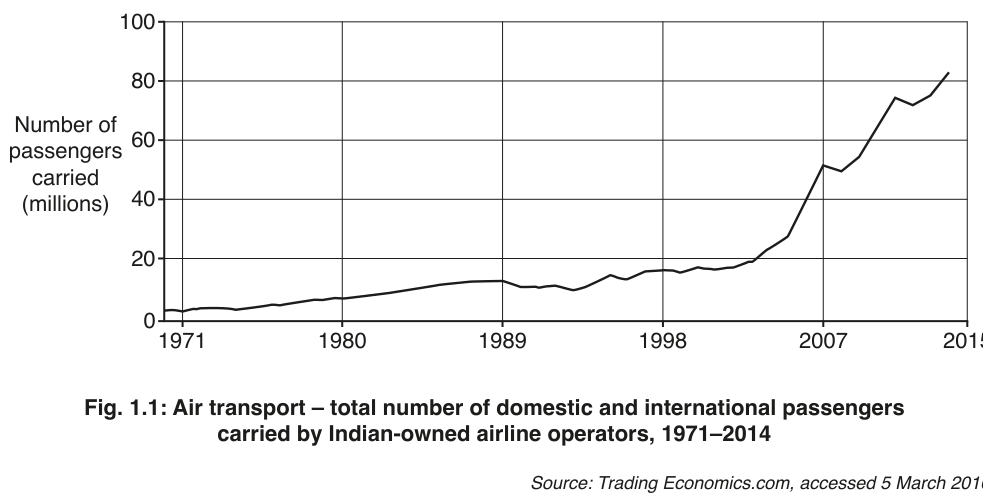
Fig. 1.1: Air transport – total number of domestic and international passengers carried by Indian-owned airline operators, 1971–2014
Source: Trading Economics.com, accessed 5 March 2016
Using Fig. 1.1, describe the trend in the number of air passengers carried since 1971.
Explain one possible change in a demand factor and one possible change in a supply factor which could have caused the overall trend in the Indian air travel market.
Name and give an example of each of two factors of production that are required by airline operators.
In February 2016, the Indian government increased the tax on aviation fuel from 8% to 14%.
Use a diagram to analyse the effects of this increase on the market for aviation fuel. Explain what would determine the incidence of this tax between the aviation fuel producers and the airline operators who buy the fuel.
Discuss whether ending the 5/20 rule would be likely to be of overall benefit to the Indian economy.
The rest of this paper
3 more questions- Q2Classification of Goods and Services · Methods of Government Intervention in Markets20M
- Q3Exchange Rates20M
- Q4Aggregate Demand and Aggregate Supply · Economic Growth20M