Economics 9708/23 — May/June 2017
Cambridge AS Level · AS Level Data Response and Essays · worked solutions for every part, with the mark scheme
Topics Price Stability · Exchange Rates · Aggregate Demand and Aggregate Supply · International Trade and Comparative Advantage · Elasticities of Demand · Economic Systems · +2 more
Zambia bears the brunt of China’s economic slowdown
Fig. 1: Zambian kwacha and copper price
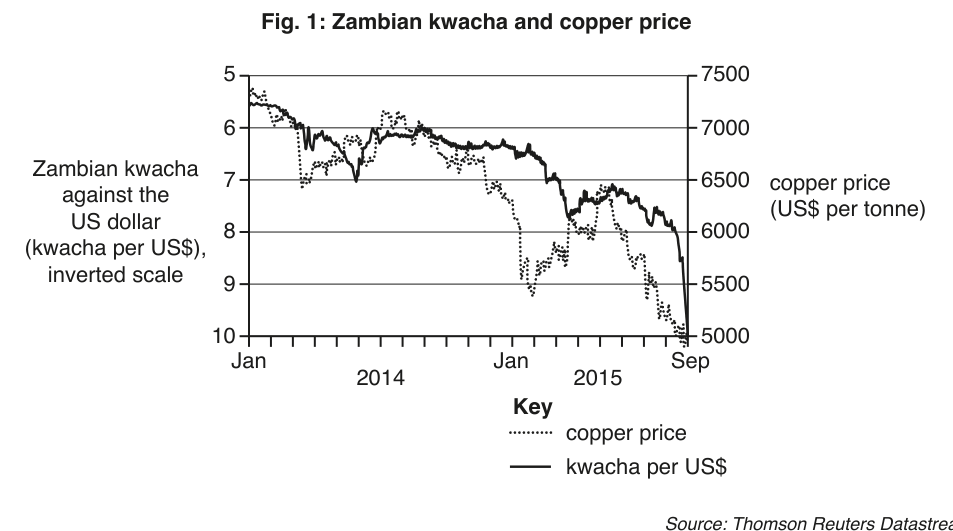
Source: Thomson Reuters Datastream
Zambia was one of Africa’s main beneficiaries when China’s economy was expanding. With copper its key export, China’s huge demand for minerals helped the southern African nation enjoy a decade of economic boom. But as China’s economy slows down, Zambia finds itself with real problems. A large mining group has announced it is to suspend production for 18 months. In addition, a Chinese-owned company has said it will suspend operations and cut jobs in Zambia because of the copper price. The situation highlights the vulnerability of Africa’s resource-dependent nations to the fortunes of China.
Zambia is Africa’s second biggest copper producer and depends on the metal for about 70% of its foreign exchange earnings and 25–30% of government revenue. Copper prices have fallen 18% this year, sliding to a six year low of below US$5000 per tonne last month. As a result, Zambia has been ranked top of an index of African nations most exposed to China’s slowdown. In 2012, Zambian exports to China amounted to 4.3% of Zambia’s national income.
During the boom years, mining led to billions of dollars of investment. Much of this was foreign direct investment from China. The sector was a key driver of Zambia’s economy, which grew by an annual average of 6.4% over the last decade – one of the world’s fastest growth rates.
The Zambian government is now struggling to balance its budget. It is expected that the 2015 fiscal deficit will be much greater than previously estimated, and the government has pledged to reduce its spending. A further problem is that the weakness of Zambia’s currency, the kwacha, risks feeding through into inflation.
The government has spoken of the need for economic diversification to reduce the country’s dependence on copper. This is a tough task which China’s slowdown has highlighted for many resource-rich African nations.
Source: Financial Times, 9 September 2015
What is the overall trend in the value of the Zambian kwacha from January 2014 to September 2015 shown in Fig. 1?
Answer
The overall trend in the value of the Zambian kwacha against the US dollar is a depreciation (decline in value) from January 2014 to September 2015.
The overall trend in the value of the Zambian kwacha is a decline (depreciation) against the US dollar from January 2014 to September 2015.
Background Concept
An exchange rate is the price of one currency expressed in terms of another. When a currency depreciates, its value falls, meaning more units of the currency are needed to buy one unit of a foreign currency. When reading exchange rate charts, it is critical to check the axis label and scale: some charts use an inverted scale, where a downward movement on the axis actually represents depreciation (a fall in value) rather than appreciation.
Understanding the Question
This 1-mark question asks you to identify the overall trend in the value of the Zambian kwacha (ZMW) against the US dollar (USD) between January 2014 and September 2015, using the data in Fig. 1. The chart uses an inverted scale for the kwacha: the vertical axis for the kwacha is labelled "Zambian kwacha against the US dollar (kwacha per US$), inverted scale", with lower positions on the axis representing a higher number of kwacha per US dollar (i.e. a weaker kwacha).
Approach
To answer this, look at the starting position of the solid line (representing the kwacha per US$) in January 2014 and its ending position in September 2015, noting the direction of the overall trend across the full period, ignoring short-term fluctuations.
Step-by-Step Reasoning
- In January 2014, the kwacha per US$ was approximately 5.5, meaning 1 US dollar cost 5.5 kwacha.
- By September 2015, the kwacha per US$ had risen to 10, meaning 1 US dollar cost 10 kwacha.
- Because the axis is inverted, the solid line moves downward on the chart as the number of kwacha per US dollar rises. This means the kwacha has depreciated (lost value) against the US dollar over the period.
- The overall trend is therefore a decline in the value of the kwacha.
Key Takeaways
- Always check the axis label and scale when reading charts: an inverted scale reverses the usual interpretation of line movements.
- A rise in the number of domestic currency units per US dollar always represents depreciation of the domestic currency.
Common Mistakes
- Misreading the inverted scale and concluding the kwacha appreciated because the line moved downward.
- Quoting individual month-to-month fluctuations instead of stating the overall trend across the full period.
Things to Be Careful About
- The question asks for the overall trend, so ignore short-term ups and downs in the line and focus on the start-to-end direction.
- Use the correct terminology: "depreciation" for a market-determined fall in value of a currency in a floating exchange rate system.
Explain why the economic slowdown in China has resulted in this change in the value of the kwacha.
Answer
China’s economic slowdown has reduced its demand for imported copper, Zambia’s main export. This has lowered the global price of copper, as shown in Fig. 1. Lower copper export earnings mean foreign buyers need fewer Zambian kwacha to pay for Zambian goods, reducing demand for the kwacha. At the same time, Zambian copper exporters have more kwacha to sell (as they earn less US dollar revenue), increasing the supply of kwacha on the foreign exchange market. The fall in demand and rise in supply of the kwacha relative to the US dollar causes the kwacha to depreciate (its value to fall).
China's slowdown reduces demand for Zambian copper, lowering copper prices and Zambia's export earnings, which reduces demand for the kwacha and increases its supply, leading to kwacha depreciation.
Background Concept
The value of a currency in a floating exchange rate system is determined by the demand and supply of that currency on the foreign exchange market. Demand for a currency comes primarily from foreign buyers needing the currency to purchase the country's exports, while supply of the currency comes from domestic buyers needing foreign currency to purchase imports. A fall in demand for a country's exports will reduce demand for its currency, leading to depreciation.
Understanding the Question
This 3-mark question asks you to explain the causal link between China’s economic slowdown and the fall in the value of the Zambian kwacha observed in part (a)(i). The extract states that copper is Zambia’s key export, making up 70% of its foreign exchange earnings, and China is a major importer of copper.
Approach
Build a clear causal chain with three links: 1) China’s slowdown reduces demand for copper, lowering copper prices; 2) lower copper prices reduce Zambia’s export earnings, reducing demand for the kwacha; 3) the fall in kwacha demand (and rise in kwacha supply) leads to a fall in the kwacha’s value. Each link needs to be explicitly stated to earn full marks.
Step-by-Step Reasoning
- First, China’s economic slowdown reduces its domestic demand for goods, including imported minerals such as copper. Zambia is Africa’s second-biggest copper producer, and China is a major buyer of its copper, so this reduction in Chinese demand lowers the global price of copper (as confirmed by the dotted line in Fig. 1, which shows copper prices falling from ~US$7300 per tonne in January 2014 to below US$5000 per tonne in September 2015).
- Zambia depends on copper for around 70% of its foreign exchange earnings. Lower copper prices mean Zambia earns less US dollar revenue from its copper exports.
- Demand for the Zambian kwacha on the foreign exchange market comes from foreign buyers who need kwacha to purchase Zambian exports (such as copper). With lower export volumes and prices, total demand for the kwacha falls.
- At the same time, Zambian copper exporters now have less US dollar revenue to convert back to kwacha. This increases the supply of kwacha on the foreign exchange market, as more exporters are selling kwacha to get US dollars.
- The combination of falling demand for the kwacha and rising supply of the kwacha relative to the US dollar means the equilibrium value of the kwacha falls: more kwacha are needed to buy 1 US dollar, which is the depreciation observed in Fig. 1.
Key Takeaways
- The demand for a currency is derived from demand for the country’s exports: a fall in export demand reduces currency demand and causes depreciation.
- Exchange rate movements can be explained using standard demand and supply analysis, with the currency as the good being traded.
Common Mistakes
- Missing the first link: failing to explain that China’s slowdown reduces copper demand and prices, so the explanation does not connect the external shock to the Zambian economy.
- Confusing the direction of the effect: claiming lower export earnings increase demand for the kwacha, rather than reduce it.
- Forgetting that supply of the currency also rises when export earnings fall, as exporters have more domestic currency to sell.
Things to Be Careful About
- Explicitly link each step of the causal chain: do not assume the examiner will fill in gaps between "China slows down" and "kwacha falls".
- Use evidence from the extract (e.g. copper makes up 70% of Zambia’s foreign exchange earnings) to strengthen your explanation.
Explain how the change in the value of the kwacha might feed into inflation in Zambia.
Answer
A depreciation of the kwacha means more kwacha are required to buy the same amount of foreign currency to pay for imports. This raises the price of all imported goods, including raw materials, components, and consumer goods. For Zambian producers, higher prices for imported inputs increase their costs of production. To maintain profit margins, producers raise the prices of their domestic output. For households, higher prices of imported consumer goods directly increase the cost of living. This widespread rise in prices driven by higher production and import costs is cost-push inflation. While a weaker kwacha could theoretically boost export demand and raise aggregate demand to cause demand-pull inflation, this is unlikely in Zambia’s case, as falling copper prices are reducing export earnings and aggregate demand.
The depreciation of the kwacha causes cost-push inflation by raising the price of imported inputs and consumer goods, increasing production and living costs across the economy.
Background Concept
Inflation is a sustained rise in the general price level of goods and services in an economy. Cost-push inflation occurs when rising costs of production (such as higher wages, raw material prices, or import prices) push up the prices of final goods and services. Exchange rate depreciation can cause cost-push inflation by raising the domestic currency price of imported inputs and consumer goods.
Understanding the Question
This 4-mark question asks you to explain the transmission mechanism through which the depreciation of the Zambian kwacha (identified in part (a)(i)) leads to inflation in Zambia. The extract notes that the weakness of the kwacha "risks feeding through into inflation".
Approach
Build a clear causal chain from kwacha depreciation to higher import prices, to higher production and consumer costs, and finally to cost-push inflation. You can also note the theoretical possibility of demand-pull inflation, but explain why it is less relevant in Zambia’s context.
Step-by-Step Reasoning
- The kwacha has depreciated against the US dollar, meaning it takes more kwacha to buy 1 US dollar. Since most international trade is priced in US dollars, all imports into Zambia now cost more kwacha than before.
- Imported goods include raw materials (such as machinery parts for mines), energy, and consumer goods (such as food and clothing). The price of all these imported items rises in kwacha terms.
- For domestic producers, higher prices for imported raw materials and components increase their costs of production. To protect their profit margins, producers raise the prices of the goods they sell domestically.
- For households, higher prices of imported consumer goods directly increase the cost of living. As these goods make up part of the consumer price index (the measure of inflation), this directly contributes to a rise in the general price level.
- This rise in prices, driven by higher costs of production and imports, is classified as cost-push inflation, as it is caused by a supply-side shock (higher input costs) rather than a rise in aggregate demand.
- Theoretically, a weaker kwacha could make Zambian exports cheaper for foreign buyers, raising export demand and aggregate demand, which could cause demand-pull inflation. However, in Zambia’s current context, the fall in copper prices is reducing export earnings and aggregate demand, so this channel is unlikely to dominate. The primary inflation risk is cost-push.
Key Takeaways
- Exchange rate depreciation raises the domestic price of imports, which can cause cost-push inflation via higher production and consumer costs.
- The type of inflation (cost-push vs demand-pull) depends on the underlying cause of the price rise: supply-side cost increases vs demand-side excess demand.
Common Mistakes
- Confusing the effect of depreciation: claiming it makes imports cheaper, rather than more expensive.
- Failing to link the exchange rate change to actual price rises for producers and consumers, instead just stating "imports cost more" without explaining the impact on domestic prices.
- Not identifying the type of inflation, or incorrectly classifying it as demand-pull without justification.
Things to Be Careful About
- Use the extract’s context: note that Zambia relies on imported inputs for its mining and other sectors, so import price rises affect domestic production costs significantly.
- The mark scheme allows credit for demand-pull inflation only if it is consistent with the context, so you should explain why cost-push is the more likely channel in this case.
Explain how the fall in China’s demand for copper would be likely to affect each of the components of aggregate demand in Zambia.
Answer
Aggregate demand (AD) is the total planned spending on an economy’s output at a given price level, calculated as AD = C + I + G + (X - M), where C is consumption, I is investment, G is government spending, and (X - M) is net exports (exports minus imports).
The fall in China’s demand for copper affects each component as follows:
- Consumption (C): Lower copper prices and production cuts reduce household incomes in the mining sector and related industries. Lower disposable incomes lead to a fall in consumer spending.
- Investment (I): Falling copper prices reduce expected profits for businesses, so firms cut back on investment in new capital and expansion.
- Government spending (G): Lower copper export earnings reduce government tax revenues, forcing the government to cut spending to reduce the budget deficit, as pledged in the extract. Alternatively, higher unemployment from mining job cuts could increase welfare spending, but the dominant effect is a fall in G.
- Net exports (X - M): In the short run, lower copper export volumes and prices reduce export earnings, so net exports fall. In the long run, kwacha depreciation may make other Zambian exports more competitive and imports more expensive, which could improve net exports, but the immediate effect is a fall.
Consumption, investment and net exports fall in the short run; government spending also falls due to lower tax revenues, though it could rise slightly from higher welfare payments. In the long run, net exports may rise due to kwacha depreciation.
Background Concept
Aggregate demand (AD) is the total demand for all final goods and services produced in an economy over a given period. It is composed of four components: consumer spending (C) by households, investment spending (I) by businesses on capital goods, government spending (G) on public services and infrastructure, and net exports (X - M), which is the value of exports minus the value of imports. Shocks to any of these components will shift the AD curve, affecting real output, employment, and the price level.
Understanding the Question
This 6-mark question asks you to explain how a fall in Chinese demand for Zambia’s copper exports will affect each of the four components of aggregate demand in Zambia. The extract provides context that copper is Zambia’s main export, a key driver of its economy, and that the government is facing a larger fiscal deficit as a result of the slowdown.
Approach
First, clearly state the formula for aggregate demand and name its four components to earn the first 2 marks. Then, for each component, explain the specific transmission mechanism from the fall in copper demand to that component, using evidence from the extract where relevant. You can note short-run vs long run effects where appropriate.
Step-by-Step Reasoning
- Identify AD components: Aggregate demand is calculated as AD = C + I + G + (X - M), where C = consumption, I = investment, G = government spending, and (X - M) = net exports. Naming these components explicitly earns up to 2 marks.
- Effect on Consumption (C): The extract states that a large mining group is suspending production and a Chinese-owned firm is cutting jobs in Zambia. Mining is a key sector of the economy, so these job losses and reduced working hours will lower household disposable incomes for miners and workers in related sectors (such as transport and equipment supply). With lower disposable incomes, households will reduce their spending on consumer goods and services, so C falls.
- Effect on Investment (I): Lower copper prices reduce expected future profits for mining firms and other businesses that rely on the mining sector. With lower expected returns on investment, firms will postpone or cancel planned investment projects (such as new mining equipment or factory expansion), so I falls.
- Effect on Government Spending (G): The extract notes that copper accounts for 25-30% of government revenue. Lower copper export earnings reduce tax revenues from the mining sector, leading to a larger fiscal deficit than expected. The government has pledged to reduce spending to cut the deficit, so G will fall (or grow more slowly) in the short run. Alternatively, higher unemployment from mining job cuts may increase government spending on unemployment benefits and other welfare support, but the extract’s emphasis on spending cuts means the net effect is likely a fall in G.
- Effect on Net Exports (X - M): Exports make up a large share of Zambia’s AD, with copper accounting for 70% of foreign exchange earnings. The fall in copper demand and prices directly reduces the value of Zambia’s exports (X), so net exports (X - M) fall in the short run. In the long run, the depreciation of the kwacha (identified in part (a)) will make other Zambian exports cheaper for foreign buyers and imports more expensive for Zambian buyers, which could raise net exports. However, the immediate impact of the copper demand shock is a fall in net exports.
Key Takeaways
- Aggregate demand components are interlinked: a shock to one sector (mining) affects household incomes, business profits, government revenues, and export earnings, which in turn affect all AD components.
- External shocks to export demand can have widespread effects on a small open economy that relies heavily on a single export.
Common Mistakes
- Only naming the AD components without explaining how each is affected, which limits marks to the first 2.
- Forgetting that government spending can have two opposing effects (higher welfare spending vs spending cuts), and not explaining which effect dominates in the given context.
- Confusing net exports with just exports, or forgetting that import values also affect net exports.
Things to Be Careful About
- Use the extract’s specific data (e.g. copper makes up 70% of foreign exchange earnings, 25-30% of government revenue) to justify your explanations.
- Distinguish between short-run and long run effects where relevant, as the mark scheme accepts both for net exports.
Consider whether economic theory would support the view that diversification of the Zambian economy is the most effective way of tackling the problems it faces as a result of the slowdown of China’s economy.
Introduction
Economic theory, particularly the theory of comparative advantage, suggests that countries should specialise in producing goods and services for which they have the lowest opportunity cost, and trade for other goods. Specialisation allows countries to consume beyond their production possibility frontier, increasing overall output and welfare. Zambia has a comparative advantage in copper production, which drove a decade of high economic growth. However, over-reliance on a single export creates vulnerability to external shocks.
Benefits of diversification
Diversification involves developing other sectors of the economy (such as agriculture, manufacturing or tourism) to reduce reliance on copper. This reduces Zambia’s exposure to fluctuations in global copper prices and demand from major importers like China, leading to more stable government revenues, household incomes and economic growth. It also reduces the risk of currency depreciation and budget deficits during commodity price slumps. Developing new sectors can also create jobs for workers displaced from the mining industry, reducing unemployment.
Costs of diversification
Diversification requires shifting resources (labour, capital, land) away from copper production, where Zambia has a comparative advantage. This creates an opportunity cost, as these resources would have produced more output if used in the mining sector. Developing new industries also requires significant investment in infrastructure, training and technology, which is costly and takes time. New sectors may also lack the skills and scale to compete with established global producers, leading to inefficiency and lower output in the short to medium term.
Benefits of maintaining specialisation in copper
Sticking with specialisation allows Zambia to exploit its existing comparative advantage, leading to higher output, export earnings and economic growth. The mining sector benefits from economies of scale as production increases, and Zambia remains attractive to foreign direct investment in mining, as seen during the China boom years. Specialisation also allows Zambia to trade copper for other goods it needs, increasing consumer choice and welfare.
Costs of maintaining specialisation
Over-reliance on copper makes Zambia highly vulnerable to external price and demand shocks, as seen in the current slowdown. This leads to volatile economic growth, large fiscal deficits when copper prices fall, currency depreciation (which increases import prices and inflation), and high unemployment in the mining sector during price slumps.
Evaluation and Conclusion
While static comparative advantage theory supports specialisation in copper, the severe vulnerability created by over-reliance on a single volatile commodity means that diversification is the most effective long-term solution to Zambia’s current problems. The short-run opportunity costs of diversification are outweighed by the long-run benefits of a more resilient economy, even if diversification is a slow and costly process. Economic theory supports this because dynamic comparative advantage can be built over time through investment in new sectors, and the risks of over-specialisation in a single commodity outweigh the static gains from specialisation in Zambia’s context.
Diversification is the most effective long-term solution to Zambia's problems, as the risks of over-specialisation in copper outweigh the short-run opportunity costs of developing new sectors, even though specialisation has delivered past growth.
Background Concept
The theory of comparative advantage, developed by David Ricardo, states that a country has a comparative advantage in producing a good if it can produce it at a lower opportunity cost than other countries. If countries specialise in producing goods for which they have a comparative advantage, and trade for other goods, total global output increases, and all trading countries can consume beyond their domestic production possibility frontier (PPF). This is the core economic argument for free trade and specialisation.
However, the theory of comparative advantage has limitations. It assumes stable global prices for goods, no transport costs, perfect information, and that resources can move freely between sectors. For countries that rely heavily on a single primary commodity export, volatile global prices for that commodity can create significant economic instability, which the static theory of comparative advantage does not account for. Diversification is a supply-side policy that involves developing a wider range of economic sectors to reduce reliance on a single export, with the aim of increasing economic resilience.
Understanding the Question
This 6-mark evaluative question asks you to consider whether economic theory supports the view that diversification of Zambia’s economy is the most effective way to tackle the problems it faces from China’s economic slowdown. The extract highlights that Zambia’s over-reliance on copper exports has left it highly vulnerable to falls in copper demand and prices, leading to falling export earnings, a larger fiscal deficit, currency depreciation, and job losses in mining.
Approach
To answer this, you need to:
- First, state the relevant economic theory (comparative advantage and the benefits of specialisation) that would argue against diversification.
- Then, discuss the benefits and costs of diversification as a policy to address Zambia’s problems.
- Next, discuss the benefits and costs of maintaining specialisation in copper, as supported by economic theory.
- Finally, weigh the two approaches against each other to reach a justified conclusion on whether diversification is the most effective solution.
Step-by-Step Reasoning
- Relevant economic theory supporting specialisation: The theory of comparative advantage argues that countries should specialise in producing goods where they have the lowest opportunity cost. Zambia has large copper reserves, an established mining sector, and has benefited from Chinese FDI in mining, giving it a comparative advantage in copper production. Specialisation in copper has allowed Zambia to achieve high economic growth (6.4% annual average over the last decade) by allocating resources to their most efficient use, and trading copper for other goods. This suggests that maintaining specialisation in copper would maximise output and welfare in the long run.
- Benefits of diversification: Diversification would reduce Zambia’s reliance on copper, making the economy less vulnerable to external shocks such as falls in global copper prices or demand from major importers like China. This would lead to more stable government revenues (reducing the risk of large fiscal deficits during price slumps), more stable household incomes, and lower risk of currency depreciation. It would also create jobs in new sectors for workers displaced from the mining industry, reducing unemployment. Over time, a more diversified economy can build new comparative advantages in other sectors, increasing long-run resilience.
- Costs of diversification: Shifting resources away from copper production, where Zambia has a current comparative advantage, involves an opportunity cost: labour, capital and land used in new sectors would have produced more output if used in the mining sector. Developing new industries also requires significant investment in infrastructure, training and technology, which is costly and takes time, especially for a country with limited fiscal space due to the current deficit. New sectors may also lack the skills and scale to compete with established global producers, leading to inefficiency and lower output in the short to medium term.
- Benefits of maintaining specialisation: Sticking with copper specialisation allows Zambia to exploit its existing comparative advantage, leading to higher output, export earnings and economic growth. The mining sector benefits from economies of scale as production increases, and Zambia remains attractive to foreign direct investment in mining, as seen during the China boom years. Specialisation also allows Zambia to trade copper for other goods it needs, increasing consumer choice and welfare.
- Costs of maintaining specialisation: Over-reliance on copper makes Zambia highly vulnerable to external price and demand shocks, as seen in the current slowdown. This leads to volatile economic growth, large fiscal deficits when copper prices fall, currency depreciation (which increases import prices and inflation), and high unemployment in the mining sector during price slumps. The extract notes that Zambia is the African nation most exposed to China’s slowdown, highlighting the severity of this vulnerability.
- Evaluation and conclusion: While static comparative advantage theory supports specialisation in copper, the severe vulnerability created by over-reliance on a single volatile commodity means that diversification is the most effective long-term solution to Zambia’s current problems. The short-run opportunity costs of diversification are outweighed by the long-run benefits of a more resilient economy, even if diversification is a slow and costly process. Economic theory supports this because dynamic comparative advantage can be built over time through investment in new sectors, and the risks of over-specialisation in a single commodity outweigh the static gains from specialisation in Zambia’s context.
Key Takeaways
- Static comparative advantage supports specialisation, but this assumes stable global prices and no large external shocks.
- Over-specialisation in a single volatile commodity creates significant economic vulnerability, which can outweigh the benefits of specialisation.
- Diversification is a supply-side policy aimed at building dynamic comparative advantage and economic resilience, even if it involves short-run opportunity costs.
- Evaluative answers require weighing both sides of an argument and reaching a justified, specific conclusion.
Common Mistakes
- Only discussing one side of the argument (e.g. only the benefits of diversification, or only the benefits of specialisation), which forfeits all evaluation marks.
- Failing to link the discussion to economic theory, instead just listing generic pros and cons of diversification.
- Reaching a vague or unsupported conclusion, such as "it depends" without explaining what it depends on, or which option is better in Zambia’s case.
- Forgetting to mention opportunity costs when discussing diversification, which is a core concept in the theory of specialisation.
Things to Be Careful About
- Explicitly link each point to economic theory (e.g. comparative advantage, opportunity cost, production possibility frontiers) to demonstrate knowledge and understanding.
- Use the extract’s specific context (Zambia’s reliance on copper, the problems caused by the price fall) to tailor your answer to the question, rather than writing a generic essay on diversification.
- Ensure your conclusion is justified: it must state which option is more effective and why, based on the arguments you have presented.
The rest of this paper
3 more questions- Q2Elasticities of Demand20M
- Q3Economic Systems20M
- Q4(Legacy) - Money · Price Stability · Monetary Policy20M