Economics 9708/22 — May/June 2016
Cambridge AS Level · AS Level Data Response and Essays · worked solutions for every part, with the mark scheme
Topics Elasticities of Demand · Balance of Payments · Production Possibility Curves · Exchange Rates · Fiscal Policy · Classification of Goods and Services · +3 more
Turkey’s economic policies
Extract 1: Turkey’s medium-term programme
In a press statement in 2014, Turkey’s minister in charge of the economy, Ali Babacan, introduced Turkey’s medium-term programme (MTP) for the period 2015–2017. He stated that the first priority of the MTP is solving the problem of inflation, second is the current account deficit and third is structural reforms.
Tight fiscal policy will be pursued in order to reach Turkey’s goals of lower inflation and a reduced current account deficit. Structural reforms are important to increase Turkey’s potential growth, the minister said.
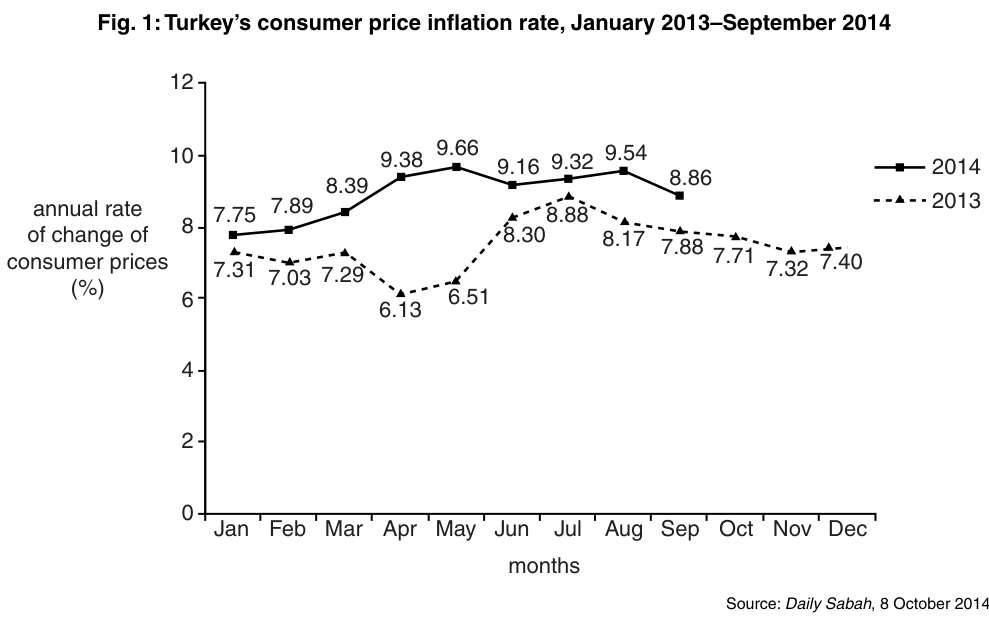
He announced that the inflation rate is expected to fall from 9.4% in 2014 to 6.3% in 2015 and 5.0% by 2017. The minister also stated that the unemployment rate is expected to drop from 9.6% in 2014 to 9.1% by 2017.
As the United States (US) economy recovers, the US central bank is expected to increase interest rates, causing the US dollar to continue to rise. The outcome of these policies might be harmful for Turkey’s economy.
The minister claimed that Turkey’s macroeconomic policies were already increasing saving in the economy and reducing consumer credit. By 2017 domestic savings are expected to rise to 15% of national income.
Fig. 1: Turkey’s consumer price inflation rate, January 2013–September 2014
Source: Daily Sabah, 8 October 2014
Table 1: Turkey’s balance of payments current account, 2012–2013 (US$ million)
| 2012 | 2013 | |
|---|---|---|
| Exports of goods | 163 221 | 163 371 |
| Imports of goods | -228 552 | -243 394 |
| Services | 22 562 | 23 131 |
| Income | -7 161 | -9 355 |
| Current transfers | 1 433 | 1 181 |
Source: www.turkstat.gov.tr
What happened to the balance on Turkey’s current account between 2012 and 2013?
Use a production possibility curve diagram to show the intended outcome of the structural reforms in Turkey.
With the help of a demand and supply diagram, show how the expected change in US interest rates was likely to cause the US dollar ‘to continue to rise’.
Consider whether the outcome of the interest rate changes in the US was likely to be ‘harmful for Turkey’s economy’.
Explain two factors that determine how the increase in consumer prices between 2013 and 2014 shown in Fig. 1 might affect the total value of Turkey’s exports.
Discuss how ‘tight fiscal policy’ could be expected to help Turkey achieve the first priority of the MTP, and consider how effective this is likely to be.
The rest of this paper
3 more questions- Q2Classification of Goods and Services · Reasons for Government Intervention in Markets20M
- Q3Elasticities of Demand20M
- Q4Monetary Policy · Supply-Side Policy20M