Economics 9708/22 — February/March 2016
Cambridge AS Level · AS Level Data Response and Essays · worked solutions for every part, with the mark scheme
Topics Economic Methodology · Demand and Supply · Market Equilibrium and the Price Mechanism · Elasticities of Demand · Reasons for Government Intervention in Markets · Exchange Rates · +7 more
The impact of changes in the world energy market
Extract 1: The growth of solar power
As technology continues to improve rapidly, solar power is now so cheap that it competes with oil. Around 29% of electricity generating capacity added in the United States (US) in 2013 came from solar power. The average price of solar power in the US has dropped from US$6 per unit in 2010 to US$2.59 per unit in 2014. It is expected that this fall will continue to US$2.30 per unit by 2015 and US$1.60 per unit by 2020. We have now entered an era of falling energy prices that must damage the producers of oil, gas and other fossil fuels.
Source: Daily Telegraph, 9 April 2014
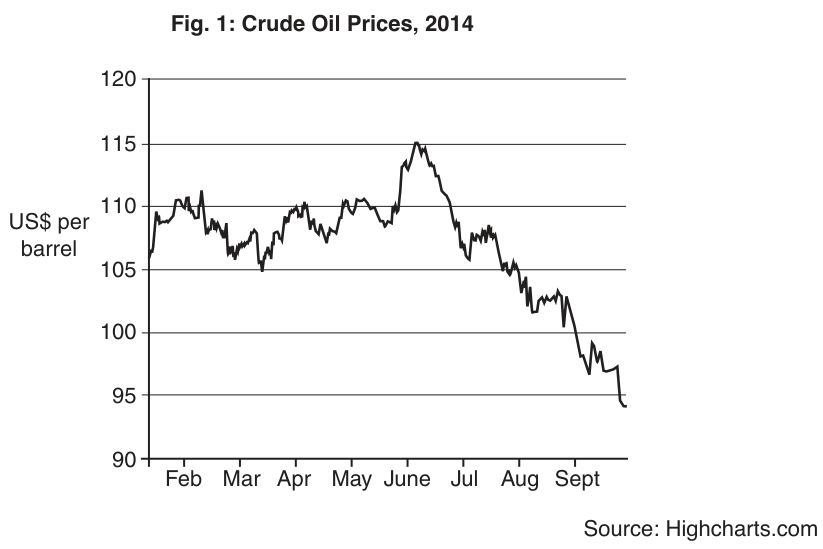
Fig. 1: Crude Oil Prices, 2014
Source: Highcharts.com
Extract 2: Venezuela vulnerable to falling oil prices
Content removed due to copyright restrictions.
Compare the trend in the price of crude oil between April 2014 and June 2014 with that between June 2014 and September 2014.
Use a demand and supply diagram to show the change in the average price of a unit of solar power referred to in the article.
What formula would you use to measure the relationship between the change in the price of solar power and the change in the demand for oil?
What would you expect this measure to show in this case? Explain your answer.
In Venezuela the state-owned industry sells gasoline (petrol) at a price below the market price. Explain the likely economic effects if the price mechanism were allowed to operate without government interference in Venezuela.
Venezuela was facing a recession, high inflation and the government had problems in balancing its budget. Controls on foreign exchange and imports have been used to keep the exchange rate of Venezuela’s currency, the bolivar, stable. Discuss whether a devaluation of the bolivar might be considered a ‘dangerous step’ or the solution to Venezuela’s economic problems.
The rest of this paper
3 more questions- Q2Classification of Goods and Services · Methods of Government Intervention in Markets20M
- Q3Price Elasticity of Supply · Supply-Side Policy20M
- Q4Aggregate Demand and Aggregate Supply · Price Stability20M