Economics 9708/22 — October/November 2015
Cambridge AS Level · AS Level Data Response and Essays · worked solutions for every part, with the mark scheme
Topics Elasticities of Demand · Exchange Rates · Balance of Payments · Methods of Government Intervention in Markets · Aggregate Demand and Aggregate Supply · Demand and Supply · +3 more
The Indonesian Economy
Extract 1: Indonesian rupiah weakens to lowest level in almost four years.
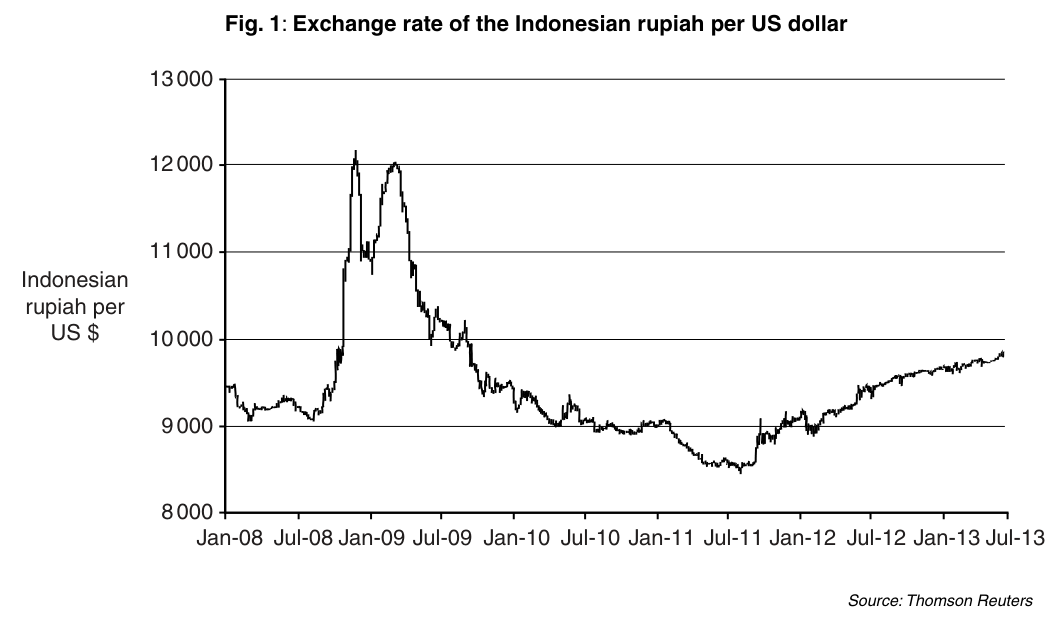
In 2012, the Indonesian rupiah's value against the United States (US) dollar fell to its lowest level since September 2009. This caused the cost of oil imports to rise, which resulted in a deficit on Indonesia's current account for the first time since 1997. However, recent developments might support the rupiah. In June, the 2013 Budget reduced fuel subsidies, which caused a price rise for fuel of 44%. Although this will put upward pressure on inflation, it is hoped that the reduction in fuel subsidies will have a positive impact on the Government Budget. Also, in June, Indonesia's Central Bank raised interest rates, which should take some pressure off the rupiah.
Source: Adapted from FocusEconomics 2013
Fig. 1: Exchange rate of the Indonesian rupiah per US dollar
Source: Thomson Reuters
Extract 2: Indonesia bans nickel exports.
Indonesia has started 2014 with a ban on exports of nickel, which is used to make stainless steel. Nickel prices increased as markets prepared themselves for a fall in global supply. It is hoped that the ban would mean that multinational companies would be forced to invest in factories in Indonesia so that the nickel is processed in Indonesia rather than just being mined and exported. This would create jobs in Indonesia and broaden Indonesia's manufacturing base.
Source: Sydney Morning Herald 2014
Extract 3: Higher interest rates in the US cause concern in Indonesia.
Interest rates in the US look likely to increase and this will have an impact upon several emerging economies, including Indonesia.
Indonesia's central bank has resisted increasing interest rates but is monitoring events in the US. Inflation in Indonesia was stable at 8.4% in December 2013, but economic growth slowed to its lowest rate in four years. In addition, Indonesia's trade position is poor and there is a large outflow of foreign capital.
Source: The Observer 2014
Describe the change in the value of the Indonesian rupiah between July 2009 and July 2013 shown in Fig.1.
Explain how the fall in the rupiah could cause the first current account deficit since 1997 as stated in Extract 1.
With the help of a diagram, explain how a cut in fuel subsidies would have contributed to the rise in the price of fuel by 44%.
How could a rise in interest rates in the US affect Indonesia's balance of payments?
With the help of a diagram, explain how this rise in US interest rates would be expected to cause a fall in the value of the Indonesian rupiah.
Discuss how any two changes described in the data might be expected to affect aggregate demand and aggregate supply in Indonesia and assess how prices and output might be affected.
The rest of this paper
3 more questions- Q2Elasticities of Demand · Demand and Supply20M
- Q3(Legacy) - Money · Price Stability20M
- Q4International Trade and Comparative Advantage20M