Economics 9708/43 — October/November 2023
Cambridge A-Level · A Level Data Response and Essays · worked solutions for every part, with the mark scheme
Topics Performance of Firms in Different Market Structures · Equity, Poverty and Redistribution · Economic Growth and Sustainability · Employment and Unemployment · Externalities, Social Costs and Benefits · Government Policies to Correct Market Failure · +5 more
The decline of South Africa’s economy
South Africa is the most industrialised country in the continent of Africa but it is also an economy with much economic inequality.
Recently governments in South Africa have aimed to reduce economic inequalities by redistributing incomes and increasing both job and investment opportunities for all sections of society. Unfortunately, the reforms have been undermined through poor organisation and management. State railways, port facilities, airways and electricity production have been affected.
Government statistics for the first quarter of 2020 show that South Africa’s economy contracted by 3.2%, the biggest quarterly decline of actual economic growth in a decade (see Fig. 1.1). Gross domestic product (GDP) per capita was US$6130 in December 2019, 5.8% lower than in December 2018.
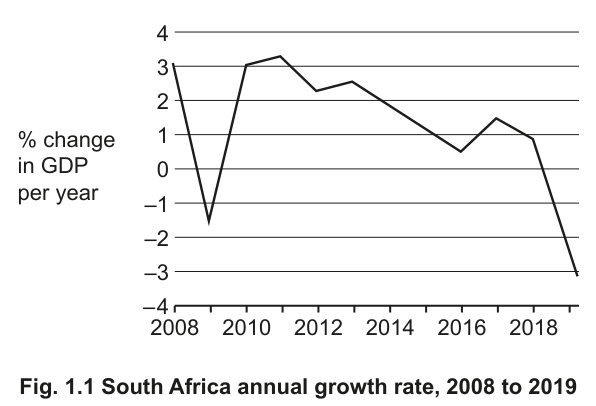
Fig. 1.1 South Africa annual growth rate, 2008 to 2019
This economic decline is reflected in the electricity supply industry, which is a state-owned monopoly. It is struggling to survive mainly due to mismanagement. For several months it rationed electricity consumption and introduced regular power cuts for households and industries. The rationing policy led to decreases in production and increases in unemployment. The company’s debts added significantly to South Africa’s current national debt to GDP ratio of 56% and are seen as the biggest threat to the economy.
Further evidence of economic difficulties can be found in the mining industry, a significant part of South Africa’s economy. A controversial reform was introduced to give more equality of ownership. Already facing rising costs and growing bureaucracy, many mining firms, including multinational companies, stopped investing altogether which reduced potential economic growth. The mining industry declined. Thousands of jobs were lost despite South Africa having significant deposits of platinum, gold and iron ore.
For South Africa’s economy to grow it needs to address major infrastructure issues. Also, in disadvantaged communities the education system is weak contributing to a skills shortage and a rise in the unemployment rate to 27% (see Fig. 1.2). Increased production is further hindered by restrictive trade union practices.
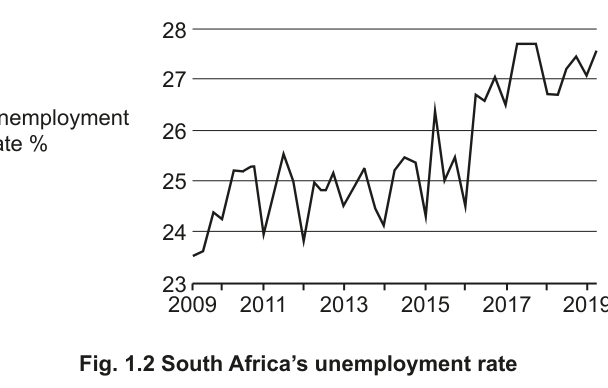
Fig. 1.2 South Africa’s unemployment rate
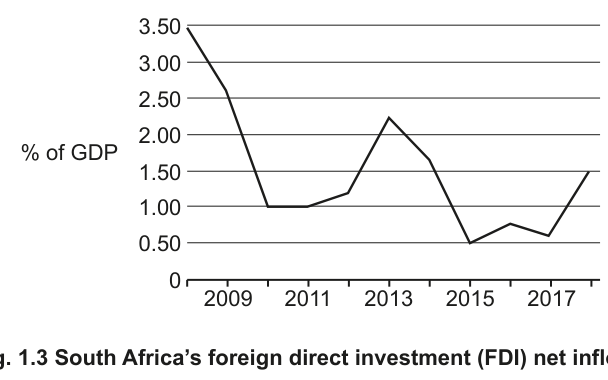
Fig. 1.3 South Africa’s foreign direct investment (FDI) net inflows
An analyst said: ‘A critical reason for low economic growth has been a lack of private sector investment and FDI (see Fig. 1.3). The lack of investment wasn’t just due to the political policies but also to uncertainty and mismanagement which led to continued inequalities.’
Sources: The Daily Telegraph, 6 July 2019 and ceicdata.com
Describe what is meant by economic equality and distinguish it from equity.
Answer
Economic equality is the equal distribution of income, wealth and opportunities across all sectors of society. (1)
Equity is fairness or justice in the distribution of resources and opportunities. (1)
The distinction is that equality focuses on equal treatment or equal shares for everyone, whereas equity focuses on fairness, which may require unequal treatment or redistribution to achieve justice (for example, progressive taxation or targeted benefits for disadvantaged groups). (1)
Economic equality is the equal distribution of income, wealth and opportunities; equity is fairness or justice in distribution, which may involve unequal treatment to achieve fairness.
Background Concept
Economic equality and equity are central concepts in the study of income distribution and welfare economics. Economic equality refers to a state where income, wealth and opportunities are distributed equally among members of society. This is often measured using metrics such as the Gini coefficient or income shares. Equity, by contrast, is a normative concept concerned with fairness or justice. It recognises that equal treatment may not produce fair outcomes because individuals have different needs, abilities or circumstances. For example, providing the same amount of education funding to all schools may perpetuate inequality if some communities start from a lower base; equity would favour allocating more resources to disadvantaged areas to achieve a fairer outcome.
Understanding the Question
The question asks you to describe economic equality and distinguish it from equity. This is a 3-mark definition/distinction question. You must provide accurate definitions of both terms and clearly explain how they differ. The command word 'distinguish' requires you to highlight the conceptual difference, not just list definitions.
Approach
Start by defining economic equality clearly, mentioning income, wealth and opportunities. Then define equity as fairness or justice. Finally, explain the distinction: equality focuses on equal outcomes or treatment, while equity focuses on fairness, which may require unequal treatment to compensate for disadvantage. Use a brief example if helpful (e.g., progressive taxation).
Step-by-Step Reasoning
- Economic equality: Define this as the equal distribution of income, wealth and opportunities across society. Mention that it concerns the actual distribution being equal.
- Equity: Define this as fairness or justice in distribution. It is a normative judgement about what is fair.
- Distinction: Explain that equality focuses on sameness (everyone gets the same), whereas equity focuses on fairness (everyone gets what they need or deserve, which may be different). For instance, equality would give everyone the same income, while equity would give more to those with greater need. In policy terms, equality might mean uniform benefits, while equity means targeted or means-tested benefits.
Key Takeaways
- Equality is a positive concept about equal distribution; equity is a normative concept about fairness.
- Policies promoting equality aim for equal outcomes; policies promoting equity aim for fair outcomes, which may involve redistribution.
- The distinction is crucial for evaluating government policies such as taxation and benefits.
Common Mistakes
- Confusing the two terms or using them interchangeably.
- Defining equality but failing to define equity, or vice versa.
- Stating that they are the same thing.
- Providing a lengthy discussion when only a concise distinction is needed for 3 marks.
Things to Be Careful About
- Ensure both definitions are accurate and distinct.
- The distinction must be explicit: equality is about equal shares/treatment, equity is about fairness/justice, which may involve unequal treatment.
- Keep the answer concise—this is only a 3-mark part.
Define what is meant by actual economic growth and analyse the relationship between economic growth and unemployment as illustrated by Fig. 1.1 and Fig. 1.2.
Answer
Actual economic growth is the increase in a country's real national output (GDP) over a period of time, measured by the percentage change in real GDP. (2)
Analysis of the relationship:
- Fig. 1.1 shows that South Africa's annual growth rate fluctuated between 2008 and 2019, with a general downward trend from 2011 (approx. 3.3%) to 2019 (approx. -3.2%). (1)
- Fig. 1.2 shows the unemployment rate generally rose from around 23.5% in 2009 to approximately 27.5% in 2019, despite fluctuations. (1)
- There is an inverse relationship between economic growth and unemployment: periods of negative or low growth (e.g., 2009, 2016, 2019) correspond with higher or rising unemployment, while periods of positive growth (e.g., 2010-2011) correspond with lower or stable unemployment. (1)
- Specifically, the sharp decline in growth to -1.5% in 2009 coincided with unemployment around 24-25%, and the final drop to -3.2% in 2019 coincided with unemployment near 27.5%. (1)
Overall, declining rates of economic growth are associated with increasing levels of unemployment. (1)
Actual economic growth is the percentage change in real GDP over time. The figures illustrate an inverse relationship: as the annual growth rate declined (particularly from 2011 to 2019), the unemployment rate generally rose, with negative growth corresponding to the highest unemployment rates.
Background Concept
Actual economic growth refers to the increase in the real volume of goods and services produced in an economy over a specific period, typically measured by the annual percentage change in real Gross Domestic Product (GDP). It is distinct from potential growth, which refers to the growth in the economy's productive capacity. The relationship between economic growth and unemployment is captured by Okun's Law, which suggests an inverse correlation: when an economy grows faster than its trend rate, unemployment tends to fall, and when growth slows or becomes negative, unemployment tends to rise. This occurs because growing output requires more labour inputs, while contracting output leads to layoffs.
Understanding the Question
The question has two components: define actual economic growth (AO1), and analyse the relationship between growth and unemployment using Fig. 1.1 and Fig. 1.2 (AO2). The figures show South Africa's annual GDP growth rate (2008-2019) and unemployment rate (2009-2019). You must describe the trends in both figures and explain the relationship between them.
Approach
First, provide a clear definition of actual economic growth, including that it is measured by the percentage change in real GDP over a period. Then, describe the overall trend in Fig. 1.1 (volatile but generally downward from 2011, ending negative in 2019) and Fig. 1.2 (generally upward from 2009 to 2019). Explain the inverse relationship: when growth falls or is negative, unemployment rises. Support this with specific data points from the figures (e.g., 2009 recession and unemployment, 2019 negative growth and high unemployment).
Step-by-Step Reasoning
- Definition: Actual economic growth is the increase in real national output (real GDP) over a period, measured as the annual percentage change. It reflects the economy's actual performance rather than its capacity.
- Fig. 1.1 analysis: The growth rate started at approximately 3.2% in 2008, fell to -1.5% in 2009, recovered to a peak of about 3.3% in 2011, then generally declined with fluctuations to approximately -3.2% by 2019. This shows a volatile but overall downward trend in growth over the period.
- Fig. 1.2 analysis: The unemployment rate started around 23.5% in 2009, fluctuated between 24% and 25.5% until 2015, then rose more sharply to peak at approximately 27.8% in 2017, ending near 27.5% in 2019. This shows a generally upward trend.
- Relationship: There is an inverse relationship. The negative growth in 2009 corresponded with rising unemployment. The positive growth period 2010-2011 corresponded with relatively stable or slightly lower unemployment. The subsequent decline in growth from 2011 onwards, particularly the falls in 2016 and 2019, corresponded with rising unemployment. The final figure of -3.2% growth in 2019 coincided with unemployment around 27.5%, near its peak.
- Conclusion on relationship: Declining economic growth is associated with increasing unemployment because falling output reduces the demand for labour.
Key Takeaways
- Actual economic growth is measured by the annual percentage change in real GDP.
- There is typically an inverse relationship between economic growth and unemployment (Okun's Law).
- When analysing graphs, always state the overall trend first, then support with specific data points.
- Correlation does not prove causation, but in this context the theoretical link is well-established.
Common Mistakes
- Defining economic growth as an increase in GDP without mentioning 'real' or 'percentage change'.
- Describing the trend in one figure but failing to link it to the other.
- Asserting a relationship without citing specific figures from the graphs.
- Claiming a perfect correlation when the relationship is inverse but not perfectly smooth (e.g., unemployment continued to rise slightly even when growth was positive in 2010-2011).
Things to Be Careful About
- Always use the approximate values from the figures (e.g., 'approximately -3.2%', 'around 27.5%').
- Note that the unemployment figure starts in 2009 while growth starts in 2008.
- The relationship is inverse: as growth falls, unemployment rises.
- Mention that the general growth trend is falling while the unemployment trend is rising.
Assess the evidence provided about the significance of the performance of the state-owned electricity monopoly as a contributor to the decline in South Africa’s economy.
Answer
The state-owned electricity monopoly is significant because electricity supply is fundamental to economic functioning, and its inability to meet demand through power cuts and rationing directly reduced output in other sectors such as mining and manufacturing, leading to increased unemployment. (1)
The text explicitly states that the electricity company is 'the biggest threat to the economy'. (1)
Its debts added significantly to South Africa's national debt to GDP ratio of 56%, worsening the fiscal position. (1)
General uncertainty from poor management of state industries has also reduced investment, contributing to actual growth being well below potential growth. (1)
However, the text identifies other contributing factors: poor organisation in other state sectors (railways, ports, airways), the decline in mining due to ownership reforms and rising costs, a weak education system causing skills shortages, and restrictive trade union practices. (1)
No similar quantitative figures are provided for these other industries, making it difficult to determine the exact relative significance of the electricity monopoly compared to these other factors. (1)
Overall, the electricity monopoly is a major contributor to the economic decline, but its exact significance relative to other factors cannot be definitively quantified from the evidence provided.
The electricity monopoly is a significant contributor to South Africa's economic decline due to its fundamental role, the direct impact of power cuts on production and employment, and its contribution to national debt and uncertainty; however, its exact significance relative to other factors such as mining decline, skills shortages and trade union practices cannot be definitively established from the evidence.
Background Concept
A state-owned monopoly is a firm that dominates a market (in this case, electricity supply) and is owned and controlled by the government. Unlike private monopolies, state-owned enterprises may have objectives beyond profit maximisation, such as universal service provision or political objectives. However, they can suffer from X-inefficiency (inefficiency due to lack of competitive pressure), bureaucratic mismanagement, and political interference. When a state-owned monopoly provides a critical infrastructure input like electricity, its poor performance can have severe spillover effects on the entire economy, reducing productivity in other sectors and undermining investor confidence.
Understanding the Question
The question asks you to assess the evidence about the significance of the state-owned electricity monopoly as a contributor to economic decline. 'Assess' requires you to analyse the evidence presented in the extract and make a judgement about its importance, considering both its impact and the limitations of the evidence. You must weigh the evidence for its significance against other factors mentioned in the text.
Approach
Identify the evidence in the text that highlights the electricity monopoly's negative impact: fundamental role in the economy, power cuts/rationing, effect on mining/manufacturing output and unemployment, debts adding to national debt, and the analyst's view that it is the biggest threat. Then identify other factors mentioned (other state industries, mining reforms, skills shortage, trade unions). Finally, judge the significance, noting that while the text calls it the biggest threat, the lack of comparative quantitative data for other sectors limits definitive assessment.
Step-by-Step Reasoning
- Fundamental role: Electricity is essential for all economic activity. The monopoly's failure to meet demand and introduction of rationing/power cuts directly constrained production.
- Impact on other sectors: The text states this led to decreased production and increased unemployment, specifically affecting mining and manufacturing.
- Explicit significance: The text states the electricity company is 'the biggest threat to the economy', which is strong evidence of its perceived significance.
- Fiscal impact: The company's debts added significantly to the national debt to GDP ratio (56%), worsening macroeconomic stability.
- Confidence/investment: Poor management of state industries including electricity created general uncertainty, reducing private investment and FDI, and causing actual growth to fall below potential.
- Other factors: The text also mentions poor organisation in railways, ports and airways; mining decline due to ownership reforms and rising costs; weak education/skills shortages; and restrictive trade union practices.
- Limitation of evidence: No similar quantitative figures (e.g., contribution to GDP decline, debt figures for other industries) are provided for these other sectors. This makes it impossible to definitively compare the electricity monopoly's impact with other factors.
- Judgement: The electricity monopoly is clearly a major contributor, supported by the text's description of it as the biggest threat and the direct causal links to output, employment and debt. However, the exact significance relative to other factors cannot be definitively quantified due to the lack of comparative data.
Key Takeaways
- State-owned monopolies in essential infrastructure can have macroeconomic impacts far beyond their direct sector.
- 'Assess' questions require weighing evidence and acknowledging limitations.
- The absence of comparative data is a valid reason for caution in making definitive judgements about relative significance.
- Always use the extract's own evidence and explicit statements (e.g., 'biggest threat').
Common Mistakes
- Ignoring the 'assess' command and merely describing the electricity monopoly's problems without judging significance.
- Claiming it is definitely the most significant factor without acknowledging the lack of comparative data.
- Ignoring other factors mentioned in the text.
- Failing to mention the specific impacts (production, unemployment, debt).
Things to Be Careful About
- The question asks about 'significance', so your answer must weigh importance, not just list effects.
- Use the phrase 'biggest threat' from the text as evidence of significance.
- Acknowledge the limitation: no similar figures for other industries.
- Ensure the judgement is balanced and justified.
Evaluate whether attracting investment and managing uncertainty are the most effective ways to improve the prospects for South Africa’s economy.
Answer
Arguments that attracting investment and managing uncertainty are effective:
- The analyst identifies lack of private sector investment and FDI as a critical reason for low growth. (1)
- Mining firms stopped investing due to political policies, uncertainty and mismanagement, reducing potential economic growth. (1)
- Fig. 1.3 shows FDI net inflows have fallen significantly (from 3.4% of GDP in 2009 to around 0.5-1.5% in recent years), indicating low international confidence. (1)
- Attracting investment would increase the capital stock, create jobs, boost aggregate demand and improve productivity. (1)
- Managing uncertainty would improve business confidence, encouraging both domestic and foreign investment. (1)
Arguments that other factors are also important or that effectiveness is limited:
- High unemployment (27%) means low consumer expenditure and low aggregate demand, which also hinders growth regardless of investment levels. (1)
- A skills shortage caused by a weak education system limits the economy's capacity to utilise new investment effectively. (1)
- Restrictive trade union practices hinder increased production. (1)
- Major infrastructure issues (electricity, transport) must be addressed for investment to be productive. (1)
- Poor management of state-owned enterprises undermines overall confidence. (1)
- Future prospects appear limited in the short run. (1)
Conclusion: While attracting investment and managing uncertainty are necessary for long-term growth, they are not sufficient on their own, particularly in the short run. Addressing unemployment, skills shortages, infrastructure failures and labour market rigidities is also essential. Therefore, they are important but not necessarily the most effective ways if implemented in isolation; a combination of policies is required. (1)
Attracting investment and managing uncertainty are important for improving South Africa's long-term growth prospects, but they are not the most effective ways in isolation; short-run constraints including high unemployment, skills shortages, infrastructure failures and trade union practices must also be addressed, so a comprehensive policy mix is required.
Background Concept
Economic growth can be promoted through supply-side policies (increasing productive capacity) and demand-side policies (increasing aggregate demand). Attracting investment—both foreign direct investment (FDI) and domestic private investment—increases the capital stock, creates jobs, transfers technology and skills, and boosts aggregate demand. Managing economic uncertainty (through political stability, consistent policy, and good governance) improves business confidence, which is a key determinant of investment decisions. However, other factors also affect growth: human capital (education and skills), infrastructure, labour market flexibility, and the existing level of aggregate demand. The 'most effective' way depends on the specific constraints facing the economy.
Understanding the Question
The question asks you to evaluate whether attracting investment and managing uncertainty are the most effective ways to improve South Africa's economic prospects. This requires a balanced evaluation (AO3) considering both the case for these policies and the case against (or other constraints), leading to a justified judgement. The extract provides evidence on both sides: the analyst highlights lack of investment and uncertainty as critical problems, but the text also mentions skills shortages, infrastructure issues, trade union practices, and high unemployment.
Approach
Present arguments supporting the view that attracting investment and managing uncertainty are effective, using evidence from the extract (analyst's view, mining investment stop, FDI figures). Then present counter-arguments or limitations: other binding constraints (unemployment, skills, infrastructure, trade unions) that may limit effectiveness, and the short-run versus long-run distinction. Finally, weigh these and reach a judgement on whether they are the 'most effective' ways, acknowledging that a mix of policies is likely needed.
Step-by-Step Reasoning
- Case for attracting investment: The extract states that lack of private sector investment and FDI is a 'critical reason' for low growth. Mining firms stopped investing due to uncertainty and mismanagement. Fig. 1.3 shows FDI inflows are low and volatile (down from 3.4% of GDP in 2009 to around 0.5-1.5% recently). Investment would increase AD, create jobs, and improve productive capacity.
- Case for managing uncertainty: The analyst links low growth to uncertainty and mismanagement. Reducing uncertainty would improve confidence, encouraging both domestic and foreign investment.
- Limitations/other factors: High unemployment (27%) means low consumer spending, limiting AD. Skills shortages from weak education mean the workforce cannot fully utilise new capital. Infrastructure issues (electricity, transport) reduce productivity. Trade union practices restrict output. These factors may persist even if investment increases.
- Short-run vs long-run: In the short run, high unemployment and low AD may require demand-side stimulus. In the long run, investment and human capital development are crucial. The extract suggests future prospects are 'limited in the short run'.
- Judgement: Attracting investment and managing uncertainty are necessary conditions for growth, particularly given South Africa's low FDI and the analyst's view. However, they are not sufficient on their own. The economy faces multiple structural constraints. Therefore, while they are highly important, claiming they are the 'most effective' ways depends on whether other constraints are addressed simultaneously. A comprehensive approach is needed.
Key Takeaways
- Investment and confidence are key determinants of economic growth, but their effectiveness depends on other conditions (skills, infrastructure, labour markets).
- 'Most effective' requires comparing with alternative policies or constraints.
- Always use the extract's evidence to support both sides of an evaluation.
- A justified judgement must answer the precise question ('most effective') and explain the conditions.
Common Mistakes
- Presenting only one side (e.g., only arguing that investment is effective), which forfeits evaluation marks.
- Ignoring the extract's evidence about other constraints (skills, infrastructure, trade unions).
- Ending with a summary instead of a justified judgement.
- Failing to address the 'most effective' wording—simply listing policies without comparing their effectiveness.
Things to Be Careful About
- The question is 7 marks and point-based, so present discrete, clearly labelled points for and against, plus a conclusion.
- Use specific evidence from the extract (analyst quote, Fig. 1.3, unemployment figure, skills shortage, trade unions).
- The conclusion must be justified: explain WHY they are or are not the most effective, not just state a verdict.
- Address both 'attracting investment' and 'managing uncertainty' as the question asks about both.
The rest of this paper
4 more questions- Q2Externalities, Social Costs and Benefits · Government Policies to Correct Market Failure20M
- Q3Market Structures · Performance of Firms in Different Market Structures20M
- Q4The Multiplier and National Income Determination · Effectiveness of Macroeconomic Policies20M
- Q5Relationships Between Countries at Different Levels of Development · Economic Development and Living Standards20M