Economics 9708/42 — October/November 2023
Cambridge A-Level · A Level Data Response and Essays · worked solutions for every part, with the mark scheme
Topics Efficiency and Market Failure · Equity, Poverty and Redistribution · Externalities, Social Costs and Benefits · Government Policies to Correct Market Failure · Indifference Curves and Budget Lines · Performance of Firms in Different Market Structures · +2 more
Traffic Control
In 2020 Lagos, Nigeria’s largest city, banned the use of motorcycle taxis and tricycles from its most congested areas.
Content removed due to copyright restrictions.
Plans are in place to extend the system to 400km.
Sources: dailytrust.com, 7 February 2020 and The Daily Telegraph, 3 March 2020
Explain what is meant by equity and how the ban on motorcycle taxis and tricycles affects equity for commuters in Lagos.
Answer
Equity means fairness or justice; people in similar circumstances should be treated the same. The ban on motorcycle taxis and tricycles reduces equity because poorer commuters, who depend on these low-cost modes of transport, are forced to walk long distances in the heat, while wealthier commuters who can afford cars or private transport are not affected. This unequal impact violates the principle of equity.
Equity is fairness; the ban disproportionately harms poorer commuters, reducing equity.
Background Concept
Equity in economics refers to fairness in the distribution of resources or outcomes. It is distinct from equality, which means everyone receiving the same amount. Equity considers whether the distribution is just, given people's different circumstances. In this context, a policy that imposes the same restriction on everyone (banning motorcycles) may be applied equally but may be inequitable because it bears more heavily on those with fewer alternatives.
Understanding the Question
The question asks two things: (1) define equity, and (2) explain how the ban affects equity for commuters in Lagos. The article (though removed) says the ban targeted the most congested areas and that poorer workers rely on these vehicles. The candidate must link the definition to the specific impact on poorer commuters.
Approach
First, give a precise definition of equity as fairness (/justice/equal treatment in similar situations). Second, identify the group most affected – poorer workers who lack alternative transport. Third, explain why this is inequitable: they face a disproportionate burden (walking long distances in heat) compared to richer commuters. No evaluation is needed at 3 marks.
Step-by-Step Reasoning
- Start with the definition: "Equity means fairness or justice in the way people are treated. In economics, it often means that people in the same situation should receive similar treatment."
- Apply to the Lagos ban: The ban applies to all, but poorer commuters have less access to cars or buses; they relied on motorcycle taxis for affordable, quick travel.
- Consequence: They now must walk long distances under the hot sun, a significant hardship. Wealthier commuters can switch to cars or ride-hailing services, so they are less inconvenienced.
- Therefore, the policy treats people in different situations (different wealth levels) as if they were the same, leading to unfair outcomes. This reduces equity.
Key Takeaways
- Equity is about fairness, not necessarily equality of outcome.
- A policy can be applied equally (same restriction) but be inequitable if it disproportionately hurts vulnerable groups.
- In data-response questions, always use evidence from the extract to support your point about who is affected.
Common Mistakes
- Confusing equity with equality: saying "the ban reduces equality because everyone is treated equally" would be incorrect. Equity focuses on fairness, not sameness.
- Providing a generic definition without applying it to the given scenario. The mark scheme explicitly rewards the application to poorer workers and walking in heat.
- Forgetting to mention the specific group (poorer workers) – the mark scheme allocates a mark for that.
Things to Be Careful About
- Keep the definition concise: "fairness" is sufficient; do not overcomplicate with "equity of opportunity" etc.
- Ensure the link between the ban and the impact on equity is clearly stated.
- Use the phrase "poorer workers" or "low-income commuters" – the mark scheme uses "poorer workers".
- Do not stray into discussion of efficiency or other objectives – the question is only about equity.
Explain, with the help of a diagram, what is meant by a negative externality and identify two examples of negative externalities from the article.
Answer
A negative externality is a harmful spillover effect on a third party that is not reflected in the market price.
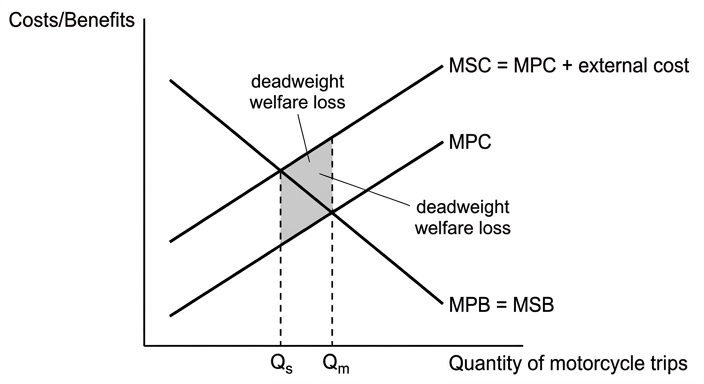
The diagram shows the marginal private benefit (MPB) and marginal social benefit (MSB) (both equal if no external benefits), and marginal private cost (MPC) and marginal social cost (MSC). The MSC curve lies above MPC due to external costs (e.g. pollution). The market equilibrium is where MPC = MPB, leading to output Qm, while the socially optimal output is where MSC = MSB at Qs. Because Qm > Qs, there is overconsumption of the good.
Two examples of negative externalities from the article are:
- Deaths caused by motorcycle accidents (death is a negative spillover on society and victims).
- Environmental damage (emissions from vehicles impose health and pollution costs on others).
Negative externality: a cost imposed on a third party not reflected in market price. Examples: deaths from accidents, environmental damage.
Background Concept
A negative externality occurs when the production or consumption of a good imposes a cost on a third party who is not directly involved in the transaction. This leads to a divergence between private costs (borne by the producer/consumer) and social costs (private + external costs). In a free market, producers/consumers ignore external costs, resulting in overproduction/overconsumption relative to the socially optimal level. The standard diagram uses marginal private cost (MPC) and marginal social cost (MSC) curves, with MPC < MSC, showing the external cost at each output. The market equilibrium is at the intersection of MPC and demand (MPB), while social optimum is at MSC = MSB. The shaded area between MPC and MSC from Qs to Qm represents the deadweight welfare loss.
Understanding the Question
The question requires three components: (1) definition of negative externality, (2) a diagram to illustrate it (with explanation), and (3) two examples from the article. The article mentions deaths (accidents) and environmental damage (congestion/pollution) as negative spillovers from motorcycle taxis and tricycles. The diagram must be correctly labelled (axes: quantity/cost-benefit) and explained in terms of overconsumption.
Approach
First, define negative externality precisely, using terms like "spillover cost", "third party", "not reflected in market price". Second, draw the diagram: label axes Price/Costs and Quantity; draw downward-sloping MPB = MSB (if no external benefits); draw upward-sloping MPC and MSC (MSC above MPC). Identify market equilibrium (Qm) and social optimum (Qs). Explain that Qm > Qs, so overconsumption occurs. Third, pick two examples from the article: deaths from crashes, environmental degradation (or congestion). Ensure each is clearly identified as a negative externality.
Step-by-Step Reasoning
- Definition: "A negative externality is an external cost that affects a third party who did not choose to incur that cost. For example, when a motorcycle taxi produces exhaust fumes, nearby residents breathe polluted air without compensation."
- Diagram:
- Axes: vertical axis = costs/benefits ($), horizontal axis = quantity (number of motorcycle trips).
- Curve labels:
- MPC: upward-sloping, representing the private cost to the driver (fuel, maintenance).
- MSC: also upward-sloping, lying above MPC, reflecting additional social costs (healthcare costs from accidents, pollution clean-up).
- MPB/MSB: downward-sloping, assumed equal as no external benefits (motorcycle trips give same benefit to rider and society).
- Equilibrium: market equilibrium at Qm where MPC = MPB. Social optimum at Qs where MSC = MSB.
- Explanation: At Qm, MSC > MSB, meaning the extra social cost of the last trip exceeds the social benefit; thus too many trips are taken. The area between MSC and MSB from Qs to Qm is the deadweight loss.
- Examples:
- Deaths: "Motorcycle accidents kill not only riders but also pedestrians, imposing costs on families and the healthcare system."
- Environmental damage: "Vehicle emissions contribute to air pollution and global warming, affecting the health of all city residents."
Key Takeaways
- Negative externality definition must include "third party" and "not reflected in market price".
- The diagram is essential; axes and curves must be correctly labelled. A common rubric gives 1 mark for each correct axis label and 1 mark for correctly indicating overconsumption.
- When asked for examples from the article, use the exact issues mentioned: deaths, environment, congestion – each can be a separate externality.
Common Mistakes
- Drawing the diagram incorrectly: wrong slopes (demand downward, supply upward), or confusing private and social curves.
- Labelling axes as "price" and "output" but not specifying they are costs/benefits.
- Failing to explain the diagram in words: just drawing it loses marks.
- Giving examples not from the article (e.g., generic smoking).
- Claiming that the market produces too little – negative externalities cause overproduction.
Things to Be Careful About
- Use correct terminology: "marginal private cost" vs "marginal social cost".
- Ensure the diagram includes all labels mentioned in the mark scheme: axes, MPC, MSC, MPB/MSB, Qm, Qs.
- The mark scheme allows any consistent labelling; as long as the candidates show the divergence, they earn the marks.
- Two examples: each must be clearly a negative externality affecting third parties, not just a personal cost.
From the evidence, consider whether the Singapore quota system or the ERP was more effective in solving the problem of traffic congestion.
Answer
The Singapore quota system (Certificate of Entitlement) raised the cost of owning a car, but it actually encouraged more use of cars because owners felt they had already paid a large sum and wanted to 'get their money's worth', thereby increasing congestion. This made the quota system less effective.
In contrast, the Electronic Road Pricing (ERP) system charges a fee that varies by time of day and level of congestion, directly pricing road use. This gives motorists an incentive to change their time of travel, route, or mode of transport, reducing congestion when it is worst. The fee is flexible to changing road conditions.
Based on the evidence, the ERP was more effective because it directly addresses the externality (congestion) through a price signal, whereas the quota only limited ownership but not usage, and even encouraged more driving.
The ERP was more effective because it directly prices congestion and gives motorists incentives to adjust behaviour, while the quota increased usage per car.
Background Concept
Traffic congestion is a negative externality: each driver imposes delay costs on others. Two policy approaches: (1) quantity restrictions (quotas on car ownership) to limit the total number of cars, and (2) price-based mechanisms (congestion charges) that make drivers pay the marginal social cost at the point of use. The effectiveness depends on whether the policy targets the source of the problem – usage, not ownership. The article described Singapore's experience: the quota system made car ownership expensive but once people owned cars, they used them just as much (or more) because they wanted to justify the cost (sunk cost fallacy). The ERP, as a variable toll, directly reduced driving during peak times.
Understanding the Question
The question asks: "From the evidence, consider whether the Singapore quota system or the ERP was more effective in solving the problem of traffic congestion." The command word "consider" implies a comparative evaluation. The mark scheme allocates 6 marks: points for explaining each policy's effects, and 1 reserved for a conclusion. The article (though partial) mentions that the quota system encouraged more car usage and that ERP is flexible.
Approach
First, explain the quota system: it limits car ownership via certificates, raising cost. However, it led to increased usage per car (owners drove more to get value). This worsened congestion. Second, explain ERP: it charges per use based on real-time congestion, encouraging motorists to avoid peak times/routes or switch to public transport. It is flexible. Then conclude: ERP more effective because it directly addresses usage and is adaptable.
Step-by-Step Reasoning
- Quota system:
- Increases the fixed cost of owning a car (the certificate price).
- But once paid, the marginal cost of driving is still low (fuel, parking).
- Psychological effect: owners feel they have paid a lot and want to use the car frequently to 'justify' the expense (sunk cost fallacy).
- Result: car usage per car increases, leading to even more congestion.
- Evidence from article: 'encouraged participants to use cars more' (mark scheme says this).
- ERP:
- Variable charge based on time of day and congestion level.
- Increases the marginal cost of driving at congested times.
- Motorists respond by: travelling earlier/later, using alternative routes, carpooling, or using public transport.
- Flexible: rates can adjust as congestion patterns change.
- Evidence: ERP was implemented after quota system and was seen as more effective (the article likely indicates this).
- Conclusion: "Based on the evidence, the ERP was more effective because it directly reduces congestion by targeting the timing and frequency of car use, while the quota system inadvertently increased congestion per car."
Key Takeaways
- Policies to correct externalities should target the source (usage, not ownership).
- Price-based instruments (taxes, charges) are often more efficient than quantity controls because they provide continuous incentives to reduce harmful behaviour.
- Behavioural responses (sunk cost fallacy) can undermine policy effectiveness.
- Evaluation in data response requires weighing both sides and reaching a judgement supported by evidence.
Common Mistakes
- Not using the article's evidence: just describing the policies theoretically loses marks.
- Forgetting the conclusion: the mark scheme explicitly reserves 1 mark for a conclusion that ERP is more effective (or could argue opposite if well justified, but the evidence points to ERP).
- One-sided analysis: must discuss both policies.
- Confusing the quota system with a tax on petrol or a road pricing scheme.
Things to Be Careful About
- The mark scheme says 'Evidence suggest ERP more effective (1)'. Ensure the final sentence states that.
- When using the mark scheme points, note that 'Max 5' before the conclusion mark means the evaluative point is additional to the first 5 marks; so the answer should have at least 5 analytical points before the conclusion.
- Use the exact evidence: 'quota system encouraged participants to use cars more' – quote or paraphrase.
- Keep the conclusion clear and explicit.
Assess whether government’s involvement in the provision of transport systems is because transport is a public good.
Answer
A public good has two characteristics: non-excludability (once provided, nobody can be prevented from consuming) and non-rivalry (one person's consumption does not reduce availability for others).
Transport systems (trains, buses, roads) are usually excludable: a ticket or toll is required for use. They are also rival in consumption beyond a point: a train or road has limited capacity, so additional passengers reduce space and comfort for others.
Therefore, transport is not a pure public good. Government involvement in provision is likely due to other reasons, such as natural monopoly (efficiency of a single provider), merit good arguments (benefits to society beyond private consumption), or equity (ensuring access for all). The public good argument is not the primary justification.
No, transport is not a public good because it is excludable and rival; government provision is for other reasons.
Background Concept
Public goods are a category of market failure where the free market underprovides because of non-excludability and non-rivalry. Non-excludability means once the good is provided, no one can be excluded from consuming, leading to free-riding. Non-rivalry means one person's consumption does not reduce the amount available for others, so the marginal cost of an extra user is zero. Pure public goods, like national defence, are non-excludable and non-rival. Most goods are private (excludable and rival) or have elements of both (quasi-public goods). Transport services (roads, trains) are typically excludable (tickets, tolls) and rival at high capacity (congestion), so they are not pure public goods.
Understanding the Question
The question asks to assess whether government involvement in transport provision is because transport is a public good. The command word 'assess' requires a judgement, but the mark scheme is point-based (5 marks). It expects: definition of public good (2 marks for non-excludable and non-rival), then application: transport requires payment (excludable) and has capacity constraints (rival), therefore not a public good (1 mark for rejecting that as the reason). The remaining 2 marks are implicit: the answer should also mention other reasons for government involvement (e.g., merit good, natural monopoly, equity) to fully assess the proposition (but the mark scheme doesn't explicitly state that; however, to 'assess' we should show that the claim is false and give alternative explanations). Actually the mark scheme only shows: definition (2 marks), payment/capacity (1 mark each?): travel needs a ticket (1), trains have given capacity (1) - that's 2 marks; then therefore not a public good (1). So total 5: 2 (definition) + 2 (excludable, rival) + 1 (conclusion). So we don't need to discuss other reasons. However, to be thorough, we might mention it, but the mark scheme is minimal. To be safe, we follow the mark scheme exactly. The candidate answer should include: non-excludable, non-rival, then state that transport fails both: tickets make it excludable, capacity makes it rival, thus not a public good.
Approach
First, define public good with both characteristics. Second, apply to transport: show excludability (tickets required) and rivalry (limited capacity). Third, conclude that transport is not a public good, so government involvement is justified for other reasons (briefly mention natural monopoly, merit good, etc., but not required).
Step-by-Step Reasoning
- Define: "A pure public good is non-excludable (impossible to prevent anyone from consuming) and non-rival (consumption by one does not reduce the quantity available for others)."
- Test excludability: "Transport services like trains and buses require a ticket or payment; non-payers can be excluded. Roads might seem non-excludable, but tolls or charges can be implemented. Thus, transport is excludable."
- Test rivalry: "A bus or train has a fixed capacity. When a passenger boards, they take up a seat, reducing space for others. At peak times, additional passengers cause congestion, making others worse off. So transport is rival (at least up to capacity)."
- Conclusion: "Therefore, transport does not satisfy both conditions; it is not a pure public good. Government involvement is more likely due to natural monopoly (lower costs of single provision) or merit good characteristics (positive externalities from public transport). The public good argument alone does not justify government provision."
Key Takeaways
- Public goods are defined by non-excludability and non-rivalry; missing either condition means it's not a pure public good.
- Many goods that governments provide (education, transport) have excludability and rivalry, so they are not public goods.
- Assess questions require a judgement: here the judgement is that the reason is not valid, but other reasons exist.
Common Mistakes
- Listing only non-excludability or non-rivalry, not both. The mark scheme gives 1 each.
- Confusing public goods with merit goods. Merit goods have positive externalities and are often underprovided, but they are still private goods.
- Stating that transport is a public good because it is provided by the government – that's circular reasoning and ignores the characteristics.
- Not providing a clear conclusion. The mark scheme has a separate mark for the rejection.
Things to Be Careful About
- Ensure the definition of public good includes both characteristics, even if briefly.
- Use clear examples: 'ticket' shows excludability, 'capacity' shows rivalry.
- The conclusion must explicitly state that transport is not a public good, so the proposition is false.
- Do not overcomplicate; 5 marks means about 5 points, not a long essay.
The rest of this paper
4 more questions- Q2Indifference Curves and Budget Lines20M
- Q3Efficiency and Market Failure · Performance of Firms in Different Market Structures20M
- Q4Relationships Between Countries at Different Levels of Development20M
- Q5Economic Development and Living Standards20M