Economics 9708/42 — February/March 2023
Cambridge A-Level · A Level Data Response and Essays · worked solutions for every part, with the mark scheme
Topics Economic Growth and Sustainability · Effectiveness of Macroeconomic Policies · The Multiplier and National Income Determination · Externalities, Social Costs and Benefits · Government Policies to Correct Market Failure · Performance of Firms in Different Market Structures · +5 more
Increasing public sector debt is a good policy
Politicians do not usually think it a success to borrow a large amount of money but, in June 2020, when the economy was approaching a recession, the United Kingdom (UK) borrowed five times as much as it did in June 2019. This made the government debt only just a little less than the total size of the economy. The ratio of public sector debt to gross domestic product (GDP) was 99.6%. It was the highest figure for 60 years. Public sector net borrowing is shown in Fig. 1.
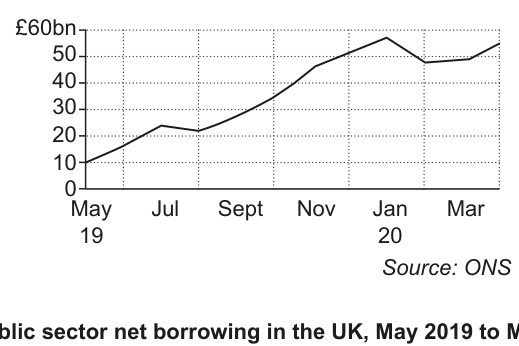
Fig. 1: Public sector net borrowing in the UK, May 2019 to March 2020
Borrowing is what the government ought to be doing in a recession in order to finance the spending used to boost aggregate demand. The question in 2020 was how long could the borrowing of such large amounts continue? There can be problems with a large public sector debt. An expansion of government borrowing might increase interest rates if investors require more compensation because they think the risk of holding government bonds has increased. This interest rate rise would affect the rest of the economy.
There is also a theoretical objection that government borrowing could ‘crowd out’ the private sector, especially when the economy is close to its productive capacity and unemployment of resources is low. This would not happen when there are unemployed resources in a recession.
The UK Finance Minister suggested that a high ratio of public sector debt to GDP was justified; it is the stability of the ratio that is important. This reasoning can be justified. Reducing government spending in order to reduce borrowing would risk stopping any recovery and make the situation worse. Economic recovery is necessary to restore economic activity, which in turn will restore the government’s finances.
However, economists cannot know with any precision what the limits of public sector borrowing should be. For many years, Japan has maintained a ratio of public sector debt to GDP of over 200% with no difficulty. But what is suitable for Japan may not be suitable in a different type of economy.
Source: The Times, 24 July 2020
State what is meant by ‘a recession’.
Analyse why governments borrow and why it is said that a government should increase spending in a recession.
Consider what is meant by the phrase ‘government borrowing could ‘crowd out’ the private sector.’
Assess whether the evidence in the article makes a conclusive case that the high level of government borrowing is an effective policy.
The rest of this paper
4 more questions- Q2Externalities, Social Costs and Benefits · Government Policies to Correct Market Failure20M
- Q3Performance of Firms in Different Market Structures · Efficiency and Market Failure20M
- Q4Balance of Payments and Policies to Correct Disequilibrium · Macroeconomic Objectives and Policy Conflicts20M
- Q5Globalisation and Economic Integration · Economic Development and Living Standards20M